

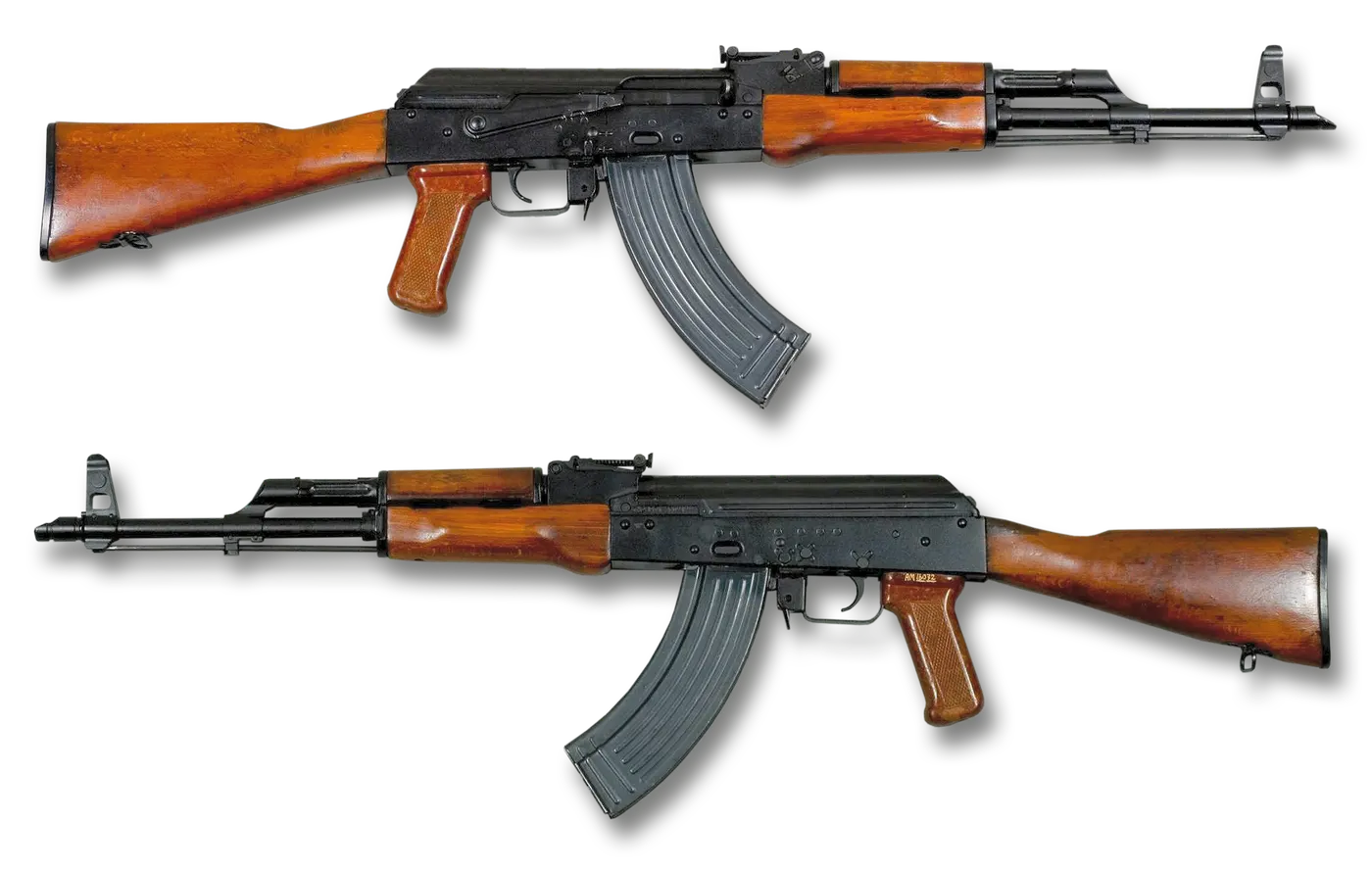

Between 1959 and 1977, Soviet factories built more than 10.27 million AKM rifles, making it the single most-produced variant across the entire Kalashnikov family and, by most counts, the most-produced firearm of any kind in history.1 The name is short for Avtomat Kalashnikova Modernizirovanniy (modernized Kalashnikov automatic rifle), and the modernized part is literal. The AKM is not a new rifle so much as a re-engineered production version of the AK-47, built to be cheaper, lighter, and faster to manufacture at Cold War scale.
- extreme mechanical reliability in dirt, sand, mud
- simple to strip, maintain, and mass-produce
- huge worldwide parts and ammunition supply
- effective at typical infantry engagement ranges
- cheap to buy and cheap to keep running
- heavy recoiling 7.62x39mm round with a loose, uncomfortable stock design
- iron sights only, no easy factory optics mounting
- poor stock ergonomics and a stiff, gritty safety selector
- wide open-bolt tolerances hurt precision beyond 300 meters
That re-engineering happened at Izhevsk, home of the Izhmash works (later folded into Kalashnikov Concern), where a design team led by Mikhail Kalashnikov submitted a stamped-steel version of the rifle to a 1957 Red Army trials board against competing Tula and Kovrov arsenal designs.2 Adopted in 1959, the AKM became the standard infantry rifle of the Soviet Army, the whole Warsaw Pact, and dozens of allied and client states, a footprint that reaches more than 80 countries with recorded AKM operators, from Ukraine and Russia through Egypt, Vietnam, and most of sub-Saharan Africa. It replaced the AK-47 as the definitive AK, and it was itself replaced, in Soviet service, by the smaller-caliber AK-74 starting in the mid-1970s. As one of the core assault rifles of the twentieth century, the AKM is still manufactured under license and encountered in active conflicts today.
{{photo-req side=right q="AKM rifle stamped receiver museum display" caption="An AKM with its distinctive slanted muzzle brake and stamped-steel receiver, the two features that most visibly separate it from the milled AK-47." alt="AKM assault rifle on museum display"}}
The AKM's core identity comes from three engineering choices made to solve the AK-47's production bottleneck. It kept the AK-47's gas-operated long-stroke piston, its rotating bolt, and its 7.62x39mm intermediate cartridge, but replaced the AK-47's expensive milled receiver with a stamped and riveted sheet-steel one, cutting weight by roughly a third and slashing machining time.3 It remains a select-fire weapon feeding from a detachable magazine, almost always the familiar curved 30-round steel box, though 40-round and 75-round drum magazines were issued for sustained fire.
Production quality varied enormously by country of manufacture, and this variation is central to understanding why AKM values, reliability reputations, and prices differ so much between a Soviet-made rifle and a war-economy clone. Licensed and unlicensed AKM-pattern production ran in Russia, Romania, Egypt, Poland, China, the former East Germany, North Korea, and elsewhere, feeding both state armies and, eventually, the black and gray arms markets that still move surplus AKMs today.
The Stamped-Steel Receiver That Solved the AK-47's Production Problem
The AK-47's original milled receiver was machined from a solid steel forging, a slow, tool-wearing process that limited how fast Soviet arsenals could arm the Warsaw Pact. The AKM's stamped receiver is pressed from a 1 mm sheet of steel, then riveted around trunnions that carry the barrel and locking lugs.2 The change alone dropped empty weight from the milled AK-47's roughly 4.3 kg to 3.1 kg unloaded and 3.9 kg loaded with a full magazine, a difference infantry felt on every march.3 Stamping also meant Soviet planners could equip an entire mechanized army and its client states in a fraction of the time a milled-receiver program would have required, which is the real reason the AKM became the rifle the world most associates with the name Kalashnikov, more so than the original AK-47.
- First Production Year1959
- Service Entry Year1959
- DesignerMikhail Kalashnikov
- Weight (Empty)3.1 kg
- Weight (Loaded)3.9 kg
- Currently In ServiceYes
A second visible change sits at the muzzle. The AKM adds a slant-cut muzzle brake and compensator, angled to vent gas sideways and down, pushing the barrel back onto target during automatic fire and taming the muzzle climb that plagued the AK-47 on full auto.3 Because the AKM kept the AK-47's 415mm barrel length, rifling twist, and 7.62x39mm chambering, its external ballistics did not change, muzzle velocity sits at roughly 715 m/s for a standard ball round, with an effective point-target range around 300 meters and area-fire effectiveness out to about 500 meters.1
- Cartridge7.62×39mm
- Calibre7.62 mm
- Case Length38.7 mm
- Calibre Classintermediate
- Bullet Weight7.9 g
- RimfireNo
- Caseless AmmunitionNo
{{photo-req side=left q="PBS-1 suppressor AKMS Soviet rifle" caption="The PBS-1 suppressor, developed for the AKMS in the early 1960s, paired with subsonic ammunition for Spetsnaz and border-guard use." alt="PBS-1 suppressor attached to a Kalashnikov rifle"}}
- Action TypeGas-Operated
- Fire Modessemi-automatic, fully automatic
- Select FireYes
- Feed SystemDetachable Magazine
- Magazine Capacity30
- Drum / Belt Capacity75
- Cyclic Rate of Fire600
- Practical Rate of Fire100
- Trigger Typesingle-stage
- Safety Typeselector lever
The Hammer Retarder, a Fix for the AKM's Own Lighter Receiver
Making the receiver lighter and thinner introduced a new problem the AK-47 never had. Under the flex of a stamped receiver, the bolt carrier could bounce slightly on its return stroke, leaving the bolt marginally out of battery at the instant the auto-sear released the hammer, a fault that could damage the rifle or injure the shooter. Soviet engineers answered it with a small pivoting pawl, the hammer retarder, fitted inside the trigger group, which catches the hammer's crossbar for a few milliseconds on every cycle and delays its fall just long enough for the bolt to fully lock.5 It is a small, easily overlooked part, but it is the clearest engineering fingerprint distinguishing a genuine AKM fire-control group from an AK-47's.
- Muzzle Velocity715 m/s
- Muzzle Energy2,108
- Effective Range (point)300 m
- Effective Range (area)500 m
- Maximum Range3,500 m
- Sighting Range378 m
- Penetration10 mm
- Accuracy10
The rifle is gas-piston operated, drawing propellant gas through a port above the barrel to drive a long-stroke piston rigidly attached to the bolt carrier, the same operating principle used across the whole AK family and a major reason for its tolerance of sand, mud, and neglect. Furniture on Soviet-production AKMs moved progressively from laminated birch to a mix of wood, stamped steel, and, from the mid-1970s, AG-4S impact-resistant plastic for the pistol grip and handguards, part of a broader industrial shift toward polymer components. A folding stock variant, the AKMS, used an underfolding steel stock for paratroopers, vehicle crews, and Spetsnaz, at a modest weight penalty.
- Barrel Length415 mm
- Rifling Twist240 mm (1 in 9.45)
- Rifling Grooves4
- Sight Typeiron sights with tangent rear, post front
- Optic RailNo
- Iron SightsYes
- Threaded BarrelNo
The rifle retains iron sights, a tangent notch rear sight graduated out to 1,000 meters and a hooded post front sight, adjustable for windage at the front and elevation at the rear. It has no factory optic rail, a limitation that later Kalashnikov derivatives corrected. It kept the AK-47's bayonet lug and can mount rifle grenades and the under-barrel grenade launchers issued alongside it in Soviet and satellite-state service. A threaded muzzle variant accepts the PBS-1 suppressor, a two-chamber, rubber-wipe design fielded from the early 1960s specifically for the AKMS, paired with subsonic 7.62x39mm ammunition and issued mainly to Spetsnaz and KGB border troops.6
- Receiver Materialsteel stamping
- Furniture Materialwood, metal, polymer
- Folding / Collapsing StockYes
- Bullpup LayoutNo
- Ambidextrous ControlsNo
- Modularityaccessory rails for optics, night vision, bipod
| Spec | AK-47 (milled) | AKM (stamped) |
|---|---|---|
| Receiver | Milled steel forging | Stamped sheet steel, riveted |
| Empty weight | ~4.3 kg | 3.1 kg |
| Muzzle device | None / simple nut | Slant-cut brake/compensator |
| Fire control | Standard hammer | Hammer retarder added |
- Total Production10,278,300
- Production Start1959
- Production End1977
- Variants10
- Width70 mm
- Height220 mm
From the 1957 Trials Board to the Standard Rifle of the Warsaw Pact
The AK-47 had been in Soviet service for roughly a decade when the Red Army opened a formal competition in 1957 to modernize it, inviting submissions from the Tula and Kovrov arsenals alongside Izhevsk's own design bureau. The Izhevsk entry, developed under Mikhail Kalashnikov with engineers including Aleksandr Zaitsev, kept the outgoing rifle's ballistics and general silhouette but rebuilt the receiver, muzzle device, and fire-control group for mass production.2 It won, and the Soviet government formally adopted it in 1959 as the 7.62mm Kalashnikov Modernized Automatic Rifle, with full-rate production starting at Izhevsk and quickly spreading to the Tula Arms Plant.
{{photo-req side=right q="Mikhail Kalashnikov portrait designer Soviet" caption="Designer Mikhail Kalashnikov, whose Izhevsk design bureau won the 1957 Red Army trials that produced the AKM." alt="Portrait of Mikhail Kalashnikov"}}
Licensing and technology transfer followed the same routes as Soviet political alignment. Egypt began receiving Soviet assistance and AK production equipment shortly after 1959, and by the mid-1960s the Maadi Company for Engineering Industries, known informally as Factory 54 in Cairo, was building AKM-pattern rifles domestically, marketed under names including Misr and, for the export/semi-automatic market, ARM, continuing production even after Soviet advisers were expelled from Egypt in 1972.7 Romania's Uzina Mecanică Cugir began building its own AKM derivative, the Pistol Mitralieră model 1963 (PM md. 63), in 1963, distinguished by a laminated wood foregrip added to help control muzzle climb, followed in 1965 by the folding-stock md. 65.8 China's Norinco-built Type 56 started as a milled-receiver AK-47 copy in the mid-1950s but converted to a stamped, AKM-equivalent receiver in the mid-1960s, distributed by the millions across Southeast Asia, Africa, and the Middle East.9 Poland, North Korea, and East Germany ran comparable domestic programs, and Yugoslavia's Zastava M70 developed its own thick-receiver AKM derivative with a different internal geometry for reliability under harder use.
{{photo-req side=left q="Warsaw Pact soldiers rifle training Cold War" caption="Warsaw Pact infantry training with the AKM, which became the standard-issue rifle across the alliance after 1959." alt="Warsaw Pact soldiers training with Kalashnikov rifles"}}
By the late 1970s the Soviet Union itself was replacing front-line AKMs with the smaller-caliber AK-74, pushing surplus AKMs into reserve stocks, allied militaries, and export channels, a pipeline that fed insurgencies and national armies across the developing world for the rest of the Cold War and after. The AKM's low unit cost made it a fixture of gray and black arms markets, and reporting on illicit arms flows in conflict-affected regions of Africa has repeatedly found AK-pattern rifles, including AKMs, selling for a few hundred dollars or less depending on local supply, a price point that has made the weapon disproportionately common in irregular and non-state forces relative to formally issued Western rifles.10
The Vietnam War and the AK-versus-M16 Rivalry That Defined an Era
North Vietnamese and Viet Cong forces fielded Kalashnikov-pattern rifles supplied by the Soviet Union and China throughout the war, though the Chinese Type 56 was far more common in the field than genuine Russian-made AKMs, which American troops nonetheless frequently misidentified as the same rifle.9 The Vietnam War is where the AKM's reputation for reliability in mud, water, and jungle rot first collided directly with the American M16, whose early reliability failures in the same conditions became a genuine scandal and cemented the AK family's image as the rugged, soldier-proof alternative for the rest of the Cold War.
{{photo-req side=right q="North Vietnamese Army soldier Kalashnikov rifle" caption="A North Vietnamese soldier with a Kalashnikov-pattern rifle, the weapon most associated with communist forces during the Vietnam War." alt="North Vietnamese soldier carrying an AK-pattern rifle"}}
The Soviet-Afghan War shows the AKM at the point where the Soviet Union itself was transitioning away from it. Afghan veterans' accounts describe most Soviet line infantry still carrying the AKM or the folding-stock AKMS through the mid-1980s, while airborne and elite units increasingly drew the newer AK-74. By 1986, reporting suggests only Spetsnaz reconnaissance troops and combat officers still routinely carried the AKM, alongside large quantities of captured mujahideen AKMs that were inspected and reissued by Soviet forces or handed to the allied Afghan army.13 The weapon reappears across almost every post-Soviet conflict that followed, the First and Second Nagorno-Karabakh wars, the Transnistria War, the war in Abkhazia, the First and Second Chechen Wars, and the Russo-Georgian War, reflecting the sheer volume of Soviet-era stockpiles still in circulation across the former USSR.
{{photo-req side=left q="Nagorno-Karabakh region map" caption="Nagorno-Karabakh, contested by Armenia and Azerbaijan across three wars in which both sides' infantry carried Soviet-pattern rifles including the AKM." alt="Map of the Nagorno-Karabakh region"}}
In the First Nagorno-Karabakh War, both Armenian and Azerbaijani forces drew on the same Soviet-army stockpiles the conflict inherited, and by the time of the 2020 Second Nagorno-Karabakh War, the Artsakh Defence Army's infantry had largely shifted to the AK-74 as its standard rifle, with older AKMs held in reserve and second-line units.14 The AKM has also seen extensive use in the Iraq War and the Iraqi Civil War of 2014-2017, the Iran-Iraq War, the Syrian Civil War, the Yemeni Civil War, the Libyan Civil War, the Somali Civil War, the Mali War, and the Lebanese Civil War, essentially every major post-1960s conflict fought with Eastern Bloc-supplied small arms. It remains present in Russian and Ukrainian reserve and territorial-defense stocks during the ongoing full-scale Russo-Ukrainian war, largely as a second-line rifle behind the AK-74 and AK-12 in front-line Russian units and AKM/AK-74 mixes in Ukrainian territorial defense formations.

The AKMS Folding Stock and the National Production Lines That Diverged From It
The AKMS is the AKM's most significant Soviet variant, replacing the fixed wood stock with an underfolding steel stock hinged beneath the receiver, intended for paratroopers, armored vehicle crews, and Spetsnaz who needed a shorter weapon for confined spaces or a parachute jump. It added roughly 0.4 kg over the standard rifle and, when fitted with the PBS-1 suppressor, became the preferred weapon of Soviet special reconnaissance units.6 Night-fighting variants, the AKMN and AKMSN, added a side rail for the NSP-2 or NSPU infrared/low-light scope, issued in limited numbers to specialist troops rather than line infantry.
{{photo-req side=right q="Romanian PM md 63 AKM rifle laminated wood foregrip" caption="Romania's Pistol Mitralieră model 1963, an AKM derivative built at Cugir with a distinctive laminated wood foregrip added to help control muzzle climb." alt="Romanian PM md. 63 assault rifle"}}
Beyond the Soviet family, the licensed and derivative lines diverged in real, sometimes significant, engineering details rather than remaining pure copies. Romania's Pistol Mitralieră model 1963/1965 added its forward pistol grip specifically to fix a muzzle-control complaint from Romanian troops, and stayed in production in various forms until 1994, well past the point most Warsaw Pact states had moved to AK-74-generation rifles.8 Egypt's Maadi/Misr line used genuine Soviet-spec components and tooling, closely enough matched to Soviet AKMs that Maadi rifles imported to the United States as the semi-automatic ARM became, for decades, the closest thing most American shooters could legally own to a real Soviet AKM.7 China's Type 56 split into the Type 56-1, with a Soviet-pattern underfolding stock, and the later Type 56-2, introduced around 1980 with a side-folding stock and dark bakelite furniture that included a built-in cleaning-kit compartment, changes that reflect decades of independent Chinese production rather than a static copy of the Soviet original.9 Yugoslavia's Zastava M70 took the opposite approach to weight and used a thicker receiver than the Soviet AKM, closer in mass to the milled AK-47, trading some of the AKM's weight savings for extra durability under harder field conditions, and North Korea produced its own Type 68 derivative for domestic use and export to allied movements.


From Soviet-Era Standard Issue to a 21st-Century Aid and Surplus Pipeline
Operator lists for the AKM read like a map of Soviet Cold War alignment followed by decades of surplus redistribution. Original Warsaw Pact and Soviet-client adopters, Russia, Poland, Romania, Hungary, Bulgaria, Cuba, and Egypt among them, brought the rifle in during the 1959-1966 window as direct Soviet military aid or licensed production start-up. Post-Soviet successor states, Ukraine, Belarus, Georgia, Armenia, Azerbaijan, Kazakhstan, Uzbekistan, Turkmenistan, Kyrgyzstan, Tajikistan, and Moldova, simply inherited Soviet-army stockpiles in place at independence in 1991, rather than acquiring the rifle through any separate procurement decision.
{{photo-req side=left q="Philippine Army soldier Kalashnikov rifle inspection" caption="Philippine Army personnel with Russian-donated AKM rifles delivered in October 2017 as part of a bilateral military aid package." alt="Philippine Army soldiers with donated Kalashnikov rifles"}}
A newer, more unusual entry on the operator list is the Philippines, which received 5,000 AKM rifles from Russia as a no-cost military aid package delivered in October 2017, alongside a million rounds of 7.62mm ammunition, trucks, and helmets, intended to support the Philippine Army's campaign against ISIS-aligned militants in Mindanao.15 Contemporary wire reporting at the time described the shipment as AK-74M rifles, but specialist defense-history coverage of the actual delivered rifles has since clarified they were 7.62x39mm AKMs, not the 5.45mm AK-74M, a genuine point of confusion in the initial reporting worth noting for anyone cross-referencing period news coverage.16 South Sudan built one of the largest post-2010 AKM inventories on the continent, reported at over 40,000 rifles, reflecting both inherited Sudanese stocks and continued regional arms flows since independence in 2011. The United States appears among operators as well, though this reflects captured-weapons familiarization, foreign-weapons proficiency training for special operations and advisory personnel, and evaluation stocks rather than any front-line American infantry issue of the AKM.
Two Cold War Rifles That Never Fought the Same War the Same Way
The AKM and the American M16 were designed to solve almost opposite problems, and comparing their specs directly misses why each country built what it built. The AKM traded accuracy and precision for guaranteed function, wide manufacturing tolerances, and a heavy, forgiving gas system that kept running when fouled with sand or mud. The M16 traded some of that mechanical margin for a lighter, flatter-shooting 5.56mm round and tighter tolerances that gave real accuracy gains on a clean rifle, at the cost of the reliability failures that plagued early M16s in Vietnam's jungle conditions before the improved M16A1 and better-maintained ammunition fixed most of them.9 Neither rifle is simply superior, each represents a different bet about what happens to a rifle in the hands of a poorly trained conscript army fighting in bad conditions, versus a smaller professional force expected to maintain its weapons properly.
The more direct family comparison is between the AKM and its own Soviet successor, the AK-74. The AK-74 kept almost the AKM's exact receiver, stock, and fire-control layout, but switched to the smaller 5.45x39mm cartridge for flatter trajectory, lighter ammunition loads per soldier, and sharply reduced recoil, at the cost of the 7.62x39mm round's superior performance against cover and at longer ranges. Soviet planners judged the tradeoff worth making for a conscript army needing controllable full-auto fire, and by the late 1970s the AK-74 had displaced the AKM as the Soviet Army's standard rifle, even though the AKM remained in parallel production and export for the rest of the Cold War because so many client states had already standardized on 7.62x39mm ammunition and logistics.
| Spec | AKM | AK-74 |
|---|---|---|
| Cartridge | 7.62x39mm | 5.45x39mm |
| Empty weight | 3.1 kg | ~3.3 kg |
| Muzzle velocity | ~715 m/s | ~900 m/s |
| Soviet adoption | 1959 | 1974 |


Is the AKM still in service? Yes. It remains in active or reserve inventory across dozens of countries, from former Soviet republics to African and Southeast Asian militaries, and continues to see combat use in ongoing conflicts, though most former Soviet and Warsaw Pact states have moved their front-line units to AK-74-generation or newer rifles.
What is the difference between the AK-47 and the AKM? The AKM replaced the AK-47's milled-steel receiver with a lighter stamped-and-riveted one, added a slant-cut muzzle brake to control recoil, and added an internal hammer retarder to prevent out-of-battery firing caused by the more flexible receiver. The two rifles share the same 7.62x39mm cartridge, barrel length, and general layout.3
What caliber does the AKM use? The AKM is chambered for the 7.62x39mm intermediate cartridge, the same round used in the AK-47, the SKS carbine, and the RPK light machine gun.
Who manufactures the AKM? Soviet-era production ran through Izhevsk's Izhmash works and the Tula Arms Plant. Licensed and derivative production has run in Romania, Egypt, Poland, China, North Korea, the former East Germany, and Yugoslavia, in addition to unlicensed clones built in numerous conflict zones.
How much does an AKM cost? Prices vary enormously by market and legal status. Illicit AK-pattern rifles including AKMs have sold for as little as a few hundred dollars in some African conflict markets, while legally imported and collector-grade examples in Western civilian markets command far higher prices reflecting import restrictions and rarity rather than manufacturing cost.10
What is the AKM's effective range? Point-target effective range is around 300 meters, with area (suppressive) fire effective out to roughly 500 meters, figures shared with the AK-47 since the AKM kept the same barrel length, rifling, and cartridge ballistics.
- "AKM", Wikipedia — en.wikipedia.org ↩
- "Evolution Of The AKM", American Rifleman — americanrifleman.org ↩
- "AKM vs. AK-47: What's the Difference?", The Armory Life — thearmorylife.com ↩
- "Basics of the AKM: The Misunderstood Kalashnikov", Guns.com — guns.com ↩
- "Hammer Release Delay Device", The AK Forum — theakforum.net ↩
- "PBS-1 silencer", Wikipedia — en.wikipedia.org ↩
- "Egyptian AKs (Misr, Maadi) - The First Kalashnikovs in The US. Part 1: History", TheFirearmBlog — thefirearmblog.com ↩
- "Pistol Mitralieră model 1963/1965", Wikipedia — en.wikipedia.org ↩
- "Type 56 assault rifle", Wikipedia — en.wikipedia.org ↩
- "Trafficking in the Sahel: Muzzling the illicit arms trade", UN News — news.un.org ↩
- "AKM", I Like to Hear Myself Talk History — hearmyselftalkhistory.com ↩
- "AK-47", Wikipedia — en.wikipedia.org ↩
- "Use of AKM assault rifle during the Soviet-Afghan war", Safar Publishing — safar-publishing.com ↩
- "Artsakh Defence Army", Wikipedia — en.wikipedia.org ↩
- "Russia donates 5k units of Kalashnikov rifles, 20 trucks to PHL", GMA News Online — gmanetwork.com ↩
- "The Story of the Philippine Army's AKM Rifles", Pitz Defense Analysis — pitzdefanalysis.net ↩