

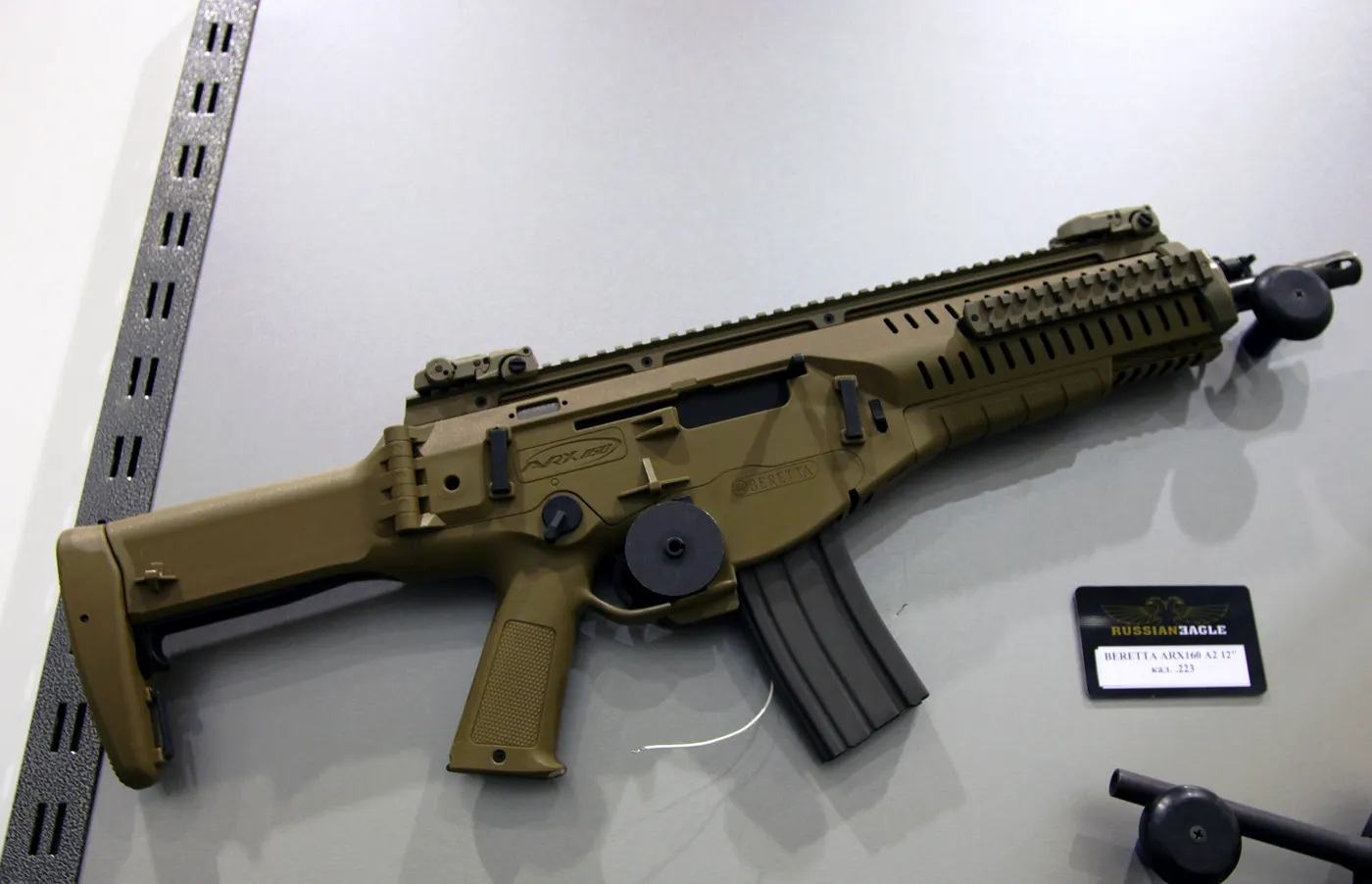
The Beretta ARX160 is a gas-operated, select-fire assault rifle built in Italy to replace the aging Beretta AR70/90 as the standard infantry weapon of the Soldato Futuro (Future Soldier) modernization program.1 Rather than an incremental update, Beretta engineer Ulrich Zedrosser designed a clean-sheet platform around modular calibre swaps, fully ambidextrous controls, and a folding stock made possible by dropping the AR15-style buffer tube entirely.1,2 Chambered primarily in 5.56x45mm NATO, the rifle can be reconfigured to fire 7.62x39mm from the same receiver by swapping barrel, bolt and magazine well, a party trick few NATO-issue rifles of its generation could match.1 It weighs roughly 3 kilograms empty and cycles at about 700 rounds per minute.3
- fully ambidextrous, switchable ejection side
- tool-free barrel and caliber swap
- shares parts and training lineage with the 7.62mm ARX200
- folds compact with no buffer tube to work around
- polymer-heavy build draws mixed reviews on feel versus metal-receiver rivals
- lost the 2017 French tender to the HK416F on ergonomics grounds
- Romania's licence-production deal has stalled for years without confirmed output
Italy fielded the rifle in Afghanistan while procurement was still ramping up, buying roughly 30,000 ARX160 A2 rifles for its Army, Navy, Air Force and special forces between 2008 and 2014.1,4 Beyond Italy, the ARX160 built a genuinely wide export footprint stretching from Turkmenistan, which adopted it as a direct AK-74 replacement, to police forces in Mexico and special units in Algeria, Egypt, Kazakhstan and Azerbaijan.1,5 A 7.62x51mm NATO derivative, the Beretta ARX200, scales the same operating system into a designated-marksman and battle-rifle platform and sits within the same battle rifles category on the site, sharing enough parts commonality with the ARX160 that Italian units trained on one transition quickly to the other.1
{{photo-req side=right q="Italian Army soldier ARX160 rifle Afghanistan" caption="An Italian soldier armed with the Beretta ARX160 during a deployment abroad." alt="Italian soldier holding a Beretta ARX160 assault rifle"}}
The rifle's gas-piston system keeps combustion gas out of the receiver, a design choice Beretta marketed as improving reliability in the sand and dust of Afghan operating conditions rather than the wetter, colder environments the AR70/90 was originally built around.4 Reviews of the rifle in both military and commercial hands have been mixed. Field reports from Italian deployments describe it as tolerant of harsh environments, while some civilian shooters of the semi-automatic .22 Long Rifle trainer variant have reported feeding issues traced to feed-ramp geometry rather than the core operating system.6,7 Whether the Beretta ARX160 is still in service is not in question. It remains the primary rifle of the Italian Armed Forces and continues to win new export contracts more than fifteen years after its 2008 launch.1
The Long-Stroke Piston That Sets the ARX160 Apart
Where most rifles derived from the AR15 pattern, including the ARX160's rival Heckler & Koch HK416, use a short-stroke piston moving a few millimetres, the Beretta ARX160's piston travels roughly 50.8mm on every cycle.1 Beretta's engineers argued the longer stroke produces lower peak gas pressure and a steadier push on the rotating bolt carrier, at the cost of slightly more moving mass. The 7-lug rotating bolt locks into a 406mm barrel on the standard-length configuration, giving a muzzle velocity around 920 m/s and an effective point-target range near 600 meters using the folding five-position rear sight.3,1
- First Production Year2008
- Service Entry Year2008
- DesignerUlrich Zedrosser
- Weight (Empty)3 kg
- Currently In ServiceYes
- Notable UsersItalian Armed Forces, Albania, Algeria, Azerbaijan, Brazil, Egypt, Indonesia
Every major control on the Beretta ARX160, safety, magazine release, bolt catch and charging handle, is either mirrored or reversible without a gunsmith, and the ejection port itself can be switched from right to left in minutes.1 That last feature quietly disappeared on the heavier 7.62mm ARX200, which ejects right-hand only, making the ARX160 the more thoroughly ambidextrous of the two Beretta siblings despite sharing most of the same architecture.1 The rifle feeds from a 30-round detachable magazine in 5.56mm form or an AKM-pattern magazine when converted to 7.62x39mm, and a 100-round drum has also been sold for the platform, though aftermarket drums for the .22 LR trainer variant have drawn complaints about unreliable feeding when the magazine is used as a monopod rest.6
- Cartridge5.56×45mm NATO; 7.62×39mm; 7.62×51mm NATO <small>(ARX200)</small>; .22 Long Rifle <small>(ARX160 22 LR)</small>
- Calibre5.56 mm
- Case Length45 mm
{{photo-req side=right q="Beretta ARX160 barrel swap disassembled" caption="The Beretta ARX160 field-stripped, showing the quick-change barrel and gas-piston assembly that define the design." alt="Disassembled Beretta ARX160 rifle showing barrel and piston components"}}
- Action TypeGas-Operated
- Select FireYes
- Feed SystemDetachable Magazine
- Magazine Capacity30
- Drum / Belt Capacity100
- Cyclic Rate of Fire700
An integrated top Picatinny rail runs the full receiver length, with additional rail sections at the 3, 6 and 9 o'clock positions on the handguard for lights, grips and lasers, and back-up iron sights fold flat beneath it when an optic is mounted.1 The rifle also carries a bayonet lug and mounts Beretta's GLX160 single-shot 40x46mm grenade launcher beneath the barrel, turning an infantry rifle into a combined direct-fire and area weapon without changing the shooter's primary sight picture.1 Later A3-model handguards redesigned the ventilation slots for better heat dissipation and relocated the bayonet lug to an M9-compatible position under the barrel, changes driven directly by feedback from Afghan deployment rather than range testing alone.8
- Muzzle Velocity920 m/s
- Effective Range (point)600 m
- Barrel Length406 mm
- Sight TypeBack-up folding iron sights and integrated Picatinny rail for various optical sights
- Optic RailYes
- Iron SightsYes
- Folding / Collapsing StockYes
- Ambidextrous ControlsYes
- Modularitymodular
- Width80 mm
From the AR70/90's Successor to a 2008 Field Trial in Afghanistan
Development began in the early 2000s as Italy's Soldato Futuro future-soldier program looked for a rifle to replace the Cold War-era Beretta AR70/90, which lacked the accessory rails and calibre flexibility modern infantry doctrine expected.2,1 Beretta launched the finished ARX160 as a standalone commercial product in 2008, deliberately separating it from the slower-moving Soldato Futuro ensemble so it could enter service faster.1 The first Italian order was a small batch of roughly 800 rifles rushed to units preparing for Afghanistan, followed by another 1,600 approved in March 2009, both explicitly framed as combat field trials rather than a settled procurement.4
{{photo-req side=right q="Italian Army patrol Herat province Afghanistan" caption="Italian troops on patrol in western Afghanistan, where the ARX160 saw its first combat field trials." alt="Italian soldiers on patrol in Afghanistan"}}
The trial rifles performed well enough that Italy placed a much larger order for 11,500 units in 2010 and a further 10,000 in 2012, bringing total Italian procurement to roughly 30,000 rifles across the Army, Navy, Air Force and special operations groups by 2014.1,4 Afghanistan mattered for more than sales volume. Combat feedback on the piston system, folding stock and ambidextrous controls under real dust and heat fed directly into the A2 and later A3 revisions, an unusually tight loop between a NATO rifle's combat debut and its subsequent design changes.4,8
Export success followed the Italian contracts quickly. Turkmenistan signed for 1,680 ARX160 rifles and 150 GLX160 launchers, adopting the Beretta design as its new standard infantry rifle in place of the Soviet-era AK-74, a rare case of a former Warsaw Pact-aligned military switching wholesale to a Western NATO-calibre platform.5,1 Mexico's Federal Police and the Guadalajara metropolitan police fielded nearly 5,687 rifles by late 2014, while Qatar signed a 2018 joint-venture agreement with local partner Barzan Holding to license-produce both the ARX160 and its ARX200 sibling domestically, with an order eventually running to 30,000 rifles for Qatar's armed forces.11,1
Kabul to Kyiv, an Export Rifle That Keeps Finding New Front Lines
Italy's own combat use centers on the War in Afghanistan (2001–2021), where ARX160s replaced the AR70/90 in frontline units from the rifle's earliest field trials through the drawdown of Italian forces in the 2010s.4,1 More recently, Italy has transferred limited quantities of ARX160 rifles to Ukraine as part of broader military aid packages following Russia's 2022 invasion in the Russo-Ukrainian War, giving the rifle a second, very different combat role defending against the same kind of mechanized assault the weapon was never originally designed around.12
{{photo-req side=right q="Ukrainian soldier rifle frontline 2023" caption="A Ukrainian infantryman near the front line. Italy has supplied limited numbers of ARX160 rifles to Ukrainian forces since 2022." alt="Ukrainian soldier holding a rifle at the front line"}}
In Egypt, Sa'ka special forces and naval commando units carry the ARX160 during Operation Sinai, the long-running counter-insurgency campaign against militant groups in the Sinai Peninsula that forms part of the broader instability historians group under the Arab Winter.1,5 The rifle's compact folded length and drum-magazine option suit the close, vehicle-based fighting typical of that campaign better than a full-length battle rifle would.
{{photo-req side=right q="Sinai Peninsula map Egypt security operations" caption="The Sinai Peninsula, where Egyptian special forces have carried the ARX160 during a long counter-insurgency campaign." alt="Map of the Sinai Peninsula"}}
Away from state militaries, Mexico's Federal Police have used the rifle throughout the Mexican drug war, a conflict that has put NATO-calibre rifles like the ARX160 up against cartel gunmen frequently armed with smuggled AK-pattern weapons and, in some documented cases, other ARX160s diverted from official stocks.1 That overlap, a state-issue rifle appearing on both sides of the same fight, is not unique to Mexico but is unusually well documented there given how closely Mexican federal arms purchases are tracked by domestic watchdog reporting.
One Receiver, Four Calibres and a Battle-Rifle Sibling
The baseline ARX160 A1/A2 covers the original 5.56mm and 7.62x39mm configurations delivered to Italy from 2008 onward, while the ARX160 A3, introduced publicly at DSEi 2013, redesigned the handguard for better heat venting and relocated the bayonet lug to sit under the barrel in an M9-compatible position.13,8 An ARX160SF short-barrel version serves Italian special operations units with a shortened buttstock and an extended lower rail for lights and grips.1

Beretta also sells the ARX100, a semi-automatic-only civilian version built for the American market with a 16 inch barrel and no bayonet lug to satisfy US import rules, and an ARX160 .22 Long Rifle rimfire trainer intended for low-cost familiarization and marksmanship practice rather than combat use.1 The companion GLX160 grenade launcher fires standard 40x46mm NATO low-velocity grenades either mounted under an ARX160's barrel or as a stand-alone weapon with its own dedicated stock, functioning much like the American M203 but built specifically around the ARX160's rail geometry.14
{{photo-req side=right q="Beretta GLX160 grenade launcher underslung" caption="The GLX160, Beretta's 40mm companion grenade launcher, mounted beneath an ARX160." alt="Beretta GLX160 grenade launcher mounted under a rifle"}}
The most consequential variant for the family's future may be the one still not in production. Romania selected the ARX160 A3 in 2019 to replace its Cold War-era PM md. 63 and pistol inventories, with a memorandum naming Cugir Arms Factory, operated by state arms group Romarm, as the intended local production site.15 Years of delays moving the project first from Uzina Plopeni and then to Cugir have left domestic Romanian reporting describing the whole arrangement as effectively buried, with no confirmed rifles yet delivered to Romanian forces as of this writing.16,15


| Year | Buyer | Quantity | Amount | Present Value (2025) |
|---|---|---|---|---|
| 2023 |  Brazil | 300 | — | — |
| 2019 | Brazil | 1,000 | — | — |
| 2012 |  Italy | 10,000 | — | — |
| 2010 | Italy | 11,500 | — | — |
| 2008 | Italy | 800 | — | — |
| — | Brazil | 120 | — | — |
From NATO's Southern Flank to Central Asian Honor Guards
Italy remains the Beretta ARX160's anchor customer, fielding it across the Army, Navy, Air Force and special operations commands after the roughly 30,000-rifle procurement completed by 2014.1 Turkmenistan's adoption stands out for scale and symbolism alike, a full replacement of Soviet-legacy AK-74 rifles with an Italian NATO-calibre design across the country's standing military.5
{{photo-req side=right q="Turkmenistan military parade rifles" caption="Turkmen troops on parade. Turkmenistan replaced its Soviet-era AK-74 rifles with the Beretta ARX160 as standard issue." alt="Turkmen soldiers on parade carrying rifles"}}
Qatar's 2018 licence-production deal for 30,000 rifles dwarfs every other export order the platform has won, turning a small Gulf state into potentially the largest single fleet of ARX-family rifles outside Italy itself once the Barzan Holding production line reaches full output.11 Smaller but still significant orders run through Algeria and Azerbaijan's special forces, Kazakhstan's special operations units (paired with the GLX160 launcher), Albania's military police and RENEA counter-terrorism unit, and police services in Brazil, Mexico, Indonesia and Poland.1,5 Reported use by Russian special operations personnel remains the platform's most puzzling entry. A single documented sighting from around 2021 has never been matched to any disclosed government contract, leaving open whether the rifle arrived through a private purchase, a third-party transfer, or simple photographic misidentification.9,10
A Modular Rival to the HK416, Decided on Ergonomics Rather Than Reliability
France's 2017 tender to replace the ageing FAMAS put the Beretta ARX160 A3 directly against the Heckler & Koch HK416 in a full military evaluation, not a paper comparison. Both rifles share the same basic recipe of a short-stroke gas piston and a modular rail system, but French testers ultimately picked the HK416F, citing superior ergonomics and closer alignment with existing NATO logistics chains rather than any documented reliability gap in the Beretta design.17 That outcome is a useful corrective to marketing claims on both sides. The ARX160's switchable ejection and tool-free barrel swap are genuinely more flexible than the HK416's fixed-ejection AR15-derived layout, yet flexibility alone did not win France's contract.
| Spec | Beretta ARX160 | Heckler & Koch HK416 |
|---|---|---|
| Operating system | Long-stroke gas piston1 | Short-stroke gas piston17 |
| Ejection side | Switchable left/right1 | Fixed right-hand |
| Empty weight | ~3.0 kg3 | ~3.4-3.9 kg depending on barrel |
| Primary NATO adopter | Italy | Germany, France (HK416F) |
Where the Beretta ARX160 clearly wins the argument is calibre flexibility within a single receiver, swapping between 5.56mm and 7.62x39mm without a different rifle entirely, a trick the AR15-pattern HK416 cannot replicate without a substantially different upper assembly. Where the Heckler & Koch HK416 wins is sheer NATO market penetration, with more member states already invested in AR15-pattern magazines, optics mounts and armorer training than in Beretta's competing ecosystem. Both rifles trace their operating principle to the same short-stroke piston philosophy that displaced direct-impingement AR15 designs across much of NATO procurement in the 2010s, making the ARX160 versus HK416 rivalry less a story of fundamentally different engineering and more a story of which manufacturer's ecosystem a given military was already committed to.


What is the Beretta ARX160's caliber? The standard Beretta ARX160 chambers 5.56x45mm NATO. A caliber-conversion kit allows the same receiver to fire 7.62x39mm, and a rimfire .22 Long Rifle trainer version also exists. The related 7.62x51mm NATO battle rifle in the same family is the separate Beretta ARX200, not a caliber option on the ARX160 itself.1
Is the Beretta ARX160 still in service? Yes. It remains the standard-issue rifle of the Italian Armed Forces and continues to be fielded or ordered by militaries and police services including Turkmenistan, Qatar, Egypt, Algeria and Mexico as of the mid-2020s.1,5
How does the Beretta ARX160 compare to the HK416? Both are modern gas-piston rifles built for NATO service, but France's 2017 rifle trials chose the HK416F over the ARX160 A3 on ergonomics and logistics grounds rather than any proven reliability shortfall in the Beretta design.17
What is the Beretta ARX160's effective range? Roughly 600 meters for point targets with the standard 406mm barrel and folding iron sights, in line with other 5.56mm service rifles of its generation.3
Who manufactures the Beretta ARX160? Beretta, the Italian firearms manufacturer, designs and builds the ARX160, with licensed local production also underway or planned in Qatar and, on paper, Romania.1,11,15
- "Beretta ARX160", Wikipedia — en.wikipedia.org ↩
- "Beretta AR70/90", Wikipedia — en.wikipedia.org ↩
- "Beretta ARX160 – Service rifles from around the world", Sandboxx News — sandboxx.us ↩
- "Beretta ARX160: Italy's Modular Rifle Experiment and What It Got Right", SOFREP — sofrep.com ↩
- "ARX-160", GlobalMilitary.net — globalmilitary.net ↩
- "Beretta ARX 160 22 lr", Firearms Talk forum — firearmstalk.com ↩
- "Beretta ARX 160", Gun Mart — gunmart.net ↩
- "Beretta ARX-160 A3 introduced at DSEi 2013", all4shooters — all4shooters.com ↩
- "Italian Beretta ARX160 assault rifle seen in Russian commandos service", Army Recognition — armyrecognition.com ↩
- "Italian Beretta ARX160 assault rifle spotted in use by Russian Commandos", Defence Blog — defence-blog.com ↩
- "Beretta Agrees Qatar Rifle Production License", The Firearm Blog — thefirearmblog.com ↩
- "Plastic fantastic: The Beretta ARX160 – Italy's lightweight modular assault rifle", Forces News — forcesnews.com ↩
- "Beretta ARX-160", Modern Firearms — modernfirearms.net ↩
- "Beretta GLX160", Weaponsystems.net — weaponsystems.net ↩
- "Beretta începe producţia armei de asalt ARX160 la Cugir, cu sprijinul Ministerului Economiei", Monitorul Apărării și Securității — monitorulapararii.ro ↩
- "'Afacerea Beretta'. Armele de asalt ARX 160, date uitării", Defense România — defenseromania.ro ↩
- "Competing Firepower", Armada International — armadainternational.com ↩