

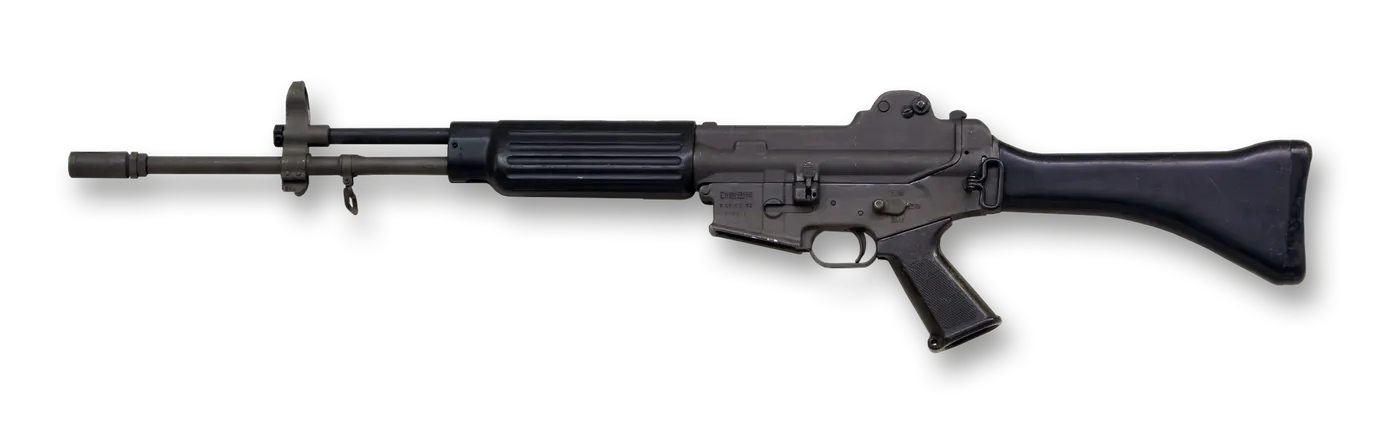

The Daewoo Precision Industries K2 has been the standard service rifle of the Republic of Korea Armed Forces since 1985, and by the 2020s it remained the most numerous rifle in South Korean hands even as the newer K2C1 variant spread through frontline units. It belongs to the assault rifles class, chambered in 5.56×45mm NATO, and it is one of the few Cold War era service rifles designed specifically to end a country's dependence on a foreign license rather than to win an open trials competition.
- AK-piston reliability with AR ergonomics and STANAG magazines
- Ambidextrous controls, folding stock, K201 grenade launcher compatible
- Combat-proven across three decades and a dozen-plus export customers
- Cheap, well under $1,000 a unit
- Went nearly 30 years with almost no modernization after adoption
- Iron-sight base version lagged rail-equipped Western rifles until K2C1
- 3-round burst rather than a more useful semi/full split favored by some export customers
- Reputation dented by counterfeit and black-market circulation in conflict zones
{{photo-req side=left q="Daewoo K2 rifle right side profile" caption="A base-model Daewoo K2 with its original iron sights and side-folding polymer stock" alt="Right side profile of a Daewoo K2 assault rifle"}}
That dependence problem was concrete. South Korea had been building the M16A1 under a 1974 Colt license, but the license capped how many rifles Daewoo could produce, and Seoul needed enough to arm not just its standing army but a mobilized reserve running into the millions in the event of a second war with North Korea.1 The Agency for Defense Development began an indigenous rifle program, internally called the XB project, in 1972, and the resulting weapon fielded in 1985 mixed a gas-piston-operated system borrowed from the AKM with a lower receiver and fire control group lifted almost directly from the M16.1
Externally the K2 resembles the German-influenced Steyr AUG generation of rifles that also chased a lightweight, polymer-furnitured silhouette, though the K2's layout stays conventional rather than bullpup. Design writers have repeatedly called it a hybrid of the AK-47 and the M16, and that framing holds up mechanically, not just cosmetically.2 Production has run under a chain of corporate names, from Daewoo Precision Industries through S&T Motiv to today's SNT Motiv, with Dasan Machineries added as a second production line in 2016.1
The Daewoo K2's 920 m/s muzzle velocity and 600 meter point effective range sit close to contemporary NATO service rifles, and its 30-round detachable magazine, a STANAG pattern, is interchangeable with M16 and M4 magazines, a deliberate logistics choice given South Korea's decades of M16A1 production.3 The rifle weighs 3.37 kg empty, keeps select-fire capability across safe, semi, three-round burst and full automatic, and cycles at roughly 800 rounds per minute, broadly in line with the gas-operated service rifles it was designed to match or beat.
- First Production Year1982
- Service Entry Year1985
- DesignerAgency for Defense Development and Daewoo Precision Industries
- Weight (Empty)3.37 kg
- Currently In ServiceYes
- Notable UsersRepublic of Korea Armed Forces, Iraqi Special Operations Forces, Lebanese Army, Cambodian Special Forces, Malawian soldiers
A Long-Stroke Piston Wearing an M16's Skin
The K2's operating system is where the AK/AR description earns its keep. Its long-stroke gas piston, over-the-bolt return spring, and four-position gas regulator trace directly to the Kalashnikov pattern, chosen because that mechanism tolerates poor ammunition and fouling far better than the M16's direct impingement system.4 Everything downstream of the piston, however, is M16 architecture, an aluminum alloy upper and lower receiver joined by a front pin and rear spring latch, a rotating multi-lug bolt, and a trigger group that will feel immediately familiar to anyone who has handled an ArmaLite AR-15.3 The design bureau reached this combination only after five earlier prototypes (XB-1 through XB-5) stuck with a pure AR-15 style direct-impingement layout and failed field trials before the piston system was substituted in the XB-6 prototype of 1975.1
- Cartridge5.56×45mm NATO ; .223 Remington
- Calibre5.56 mm
- Case Length44.7 mm
- Calibre Class5.56mm
- Bullet Weight4 g
- RimfireNo
- Caseless AmmunitionNo
{{photo-req side=right q="Daewoo K2 rifle South Korean soldier" caption="A Republic of Korea Army soldier with the K2 service rifle" alt="South Korean soldier holding a Daewoo K2 assault rifle"}}
- Action TypeGas-Operated
- Fire ModesSafe–Semi–Auto–Burst
- Select FireYes
- Feed SystemDetachable Magazine
- Magazine Capacity30
- Cyclic Rate of Fire800
The rifle's 465 mm barrel uses a 1:185.4mm (roughly 1-in-7.3-inch) right-hand twist across six grooves, tighter than the M16A1's original twist and closer to the faster-twist barrels NATO armies adopted once heavier 62-grain steel-core ammunition became standard.3 Furniture is polymer over a steel receiver, and the folding-collapsing stock folds to the right side rather than collapsing telescopically, a layout made possible specifically because the AK-style return spring sits above the bolt carrier instead of running back through a fixed buffer tube the way it does on an unmodified M16.4 Controls are fully ambidextrous, the rifle mounts a bayonet lug and is grenade-launch capable via the underslung DPI K201, a locally built near-copy of the American M203, and it carries an optic rail on later production.1
- Muzzle Velocity920 m/s
- Effective Range (point)600 m
- Maximum Range3,300 m
One quirk sets the K2 apart from almost every other NATO-pattern rifle still in first-line service. South Korean doctrine requires soldiers to physically collect and return their spent brass after training, both to recycle the metal and to prevent cartridge cases falling into the wrong hands, so the K2 was built to accept a dedicated brass-catcher basket that clips beneath the ejection port.4
- Barrel Length465 mm
- Rifling Twist1:185.4 mm right-hand
- Rifling Grooves6
- Sight TypeIron sights
- Optic RailYes
- Iron SightsYes
- Threaded BarrelNo
- Receiver MaterialSteel
- Furniture MaterialPolymer
- Folding / Collapsing StockYes
- Bullpup LayoutNo
- Ambidextrous ControlsYes
- ModularityPicatinny rail, folding stock, ambidextrous controls
- Production Start1982
- Unit Cost727 USD
- Variants4
South Korea's push for an indigenous rifle predates the K2 by more than a decade. Through the 1950s and 1960s the Republic of Korea Armed Forces relied on hand-me-down American M1 Garands and M1/M2 carbines, then M16A1s during and after the Vietnam War, always in quantities the government considered insufficient for a full mobilization against North Korea.1 President Park Chung Hee ordered an indigenous small-arms program in 1972, partly a response to the Nixon Doctrine's push toward Asian self-reliance and partly a hedge against Colt's licensing terms, which capped South Korea's own M16A1 output.1
{{photo-req side=left q="Park Chung Hee military South Korea 1970s" caption="South Korean president Park Chung Hee, who ordered the indigenous rifle program that produced the K2" alt="Park Chung Hee in military dress"}}
The Agency for Defense Development's XB project cycled through seven prototype generations between 1972 and 1982. The direct-impingement XB-1 through XB-5 designs gave way to the piston-driven XB-6 in 1975, which was rechambered from an earlier caliber to 5.56×45mm NATO as the XB-7 in 1977.1 Field trials with the Republic of Korea Army through 1982 and 1983 surfaced mechanical problems, notably an upper receiver that could shift under recoil, fixed by adding a locking key to the recoil spring guide before series production began under the designation K2 in 1984 and full fielding followed in 1985.1 Nigeria became the K2's first export customer almost immediately, buying 3,000 rifles in that same window before a further 30,000-rifle order followed in 2006.1
For nearly three decades after 1985 the rifle changed remarkably little. Firearms writers have attributed the stagnation to Cold War era doctrine that deprioritized small arms next to armor and artillery, an absence of any domestic competitor pushing Daewoo and its successor companies to iterate, and repeated corporate reorganizations as the manufacturer changed names five times between 1999 and 2021.1 A 5.56mm bullpup prototype, the XK8, was developed around 2003 to 2005 but never reached testing because the defense ministry instead bet on the far more ambitious K11 airburst rifle program, which itself collapsed after its 20x28mm grenade round proved unreliable and each unit cost roughly 14,000 dollars.5 Only after that failure did the ministry commit to upgrading the K2 itself rather than replacing it, producing the railed K2C1 from 2015 with roughly 200,000 fielded by 2016.5
South Korean troops carried the K2 into the Gulf War as part of the country's medical and engineering contingents, and later into United Nations peacekeeping duty during the United Nations Operation in Somalia II in the early 1990s.1 It remained the standard rifle of South Korean units deployed to Iraq and Afghanistan through the 2000s alongside coalition partners running the M4 and M16A4.
{{photo-req side=right q="Iraqi Golden Division special forces Mosul" caption="Iraqi Counter-Terrorism Service soldiers of the Golden Division, a K2C operator, during the battle for Mosul" alt="Iraqi special forces soldiers in urban combat gear"}}
Exported K2 and K2C rifles turned up on both sides of Iraq's fight against the Islamic State. Iraq's Counter-Terrorism Service, known as the Golden Division, received K2C carbines from roughly 2015 onward and used them through the assault on Mosul, where the division's lead brigade was the first Iraqi unit to enter the city in November 2016 and ultimately took a reported 40 percent casualty rate before the city's liberation was declared in July 2017.6 The same rifles then began surfacing in Islamic State hands, some captured directly from Iraqi forces and others reportedly bought on Syrian black markets, where Korean-made rifles proved easy to acquire despite never having been sold to any combatant in that civil war.6 K2 rifles have also been documented with Boko Haram and Islamic State affiliates in Africa, alongside their legitimate use by Nigerian government forces contending with the same insurgencies in the conflict in the Niger Delta.1
Closer to home, Fijian forces carrying K2 rifles acquired in the late 1980s were involved on both sides of the 2006 Fijian coup d'état, and the rifle has appeared in the long-running low-intensity Somali Civil War and in the turbulence of the Arab Spring era in the Middle East, largely through onward transfer and battlefield capture rather than direct South Korean export.1
The base K2 remained in production largely unchanged from 1985 into the 2010s. Two later derivatives account for most of what is now in service or sold abroad.
{{photo-req side=right q="K2C1 rifle Picatinny rail South Korea" caption="A railed K2C1, the 2015 modernization that finally gave the K2 family a full-length optics mount" alt="Daewoo K2C1 rifle with quad-rail handguard and collapsible stock"}}
The K2C, introduced in 2012, cuts the barrel to 310 mm, adds a top rail, and swaps the fixed folding stock for a retractable M4-style unit, primarily to compete for the carbine-length niche the K2's older sibling, the direct-impingement K1A, had occupied since 1981.7 Despite the shared name, the K1A is a separate design rather than a shortened K2, built around a different gas system with a slower 1-in-12 twist barrel and originally intended as a submachine-gun replacement for the M3 Grease Gun rather than a rifle.7 Special Warfare Command trials rated the K2C ahead of the older K1A, and export orders followed from Malawi, Cambodia, Papua New Guinea and Iraq.5
The K2C1, standardized from 2015, keeps the full-length 465 mm barrel but replaces the receiver's iron-sight base with a flat-top full-length Picatinny rail, adds a quad-rail handguard, and fits a Magpul influenced adjustable stock, addressing complaints that the original K2's fixed-height sights could not properly zero a red-dot optic once the frame's decades-old tooling had worn beyond factory tolerance.5 By the K2C1's first full year in frontline service, roughly 200,000 had reached South Korean troops, at a reported unit cost near 1,040 dollars, noticeably above the base K2's roughly 727 dollar figure.5
Civilian semi-automatic derivatives exist mainly for the American market as the DR-200 (post-1989 assault-weapon import restrictions forced Daewoo to redesign the original semi-auto AR-100 export model) and a 7.62×39mm chambered DR-300.3 A bullpup prototype, the XK8, and the dual-caliber K11 airburst rifle were both trialed as potential full replacements in the 2000s and both were rejected, leaving the K2 family as South Korea's rifle of record into the 2020s.5


| Year | Buyer | Quantity | Amount | Present Value (2025) |
|---|---|---|---|---|
| 2012 |  Cambodia | 128 | — | — |
| 2012 |  Malawi | 2,100 | — | — |
| 2011 |  Ecuador | — | — | — |
| 2008 |  Indonesia | 210 | — | — |
| 1980 |  Fiji | — | — | — |
| — |  Iraq | — | — | — |
| — |  Lebanon | — | — | — |
The Republic of Korea Armed Forces remains the K2's largest single operator by a wide margin, having fielded it as the standard infantry rifle since 1985.1 Export customers span four continents. Nigeria was the first foreign buyer in the mid-1980s and later took delivery of 30,000 more rifles in 2006, one of the largest single K2 export orders on record.1 Malawi received roughly 1,100 K2 and 1,000 K2C rifles from 2012, with further K2C deliveries running into 2013.1
{{photo-req side=left q="Nepal army soldiers rifles parade" caption="Nepalese Army soldiers on parade, one of the K2's most recent large export customers" alt="Nepalese Army soldiers in formation"}}
Nepal's 2022 order for 30,000 rifles was the K2's largest recent single sale, though Nepali press reports at the time described quality complaints about the delivered batch.1 Thailand (403 units), Indonesia (roughly 806 units delivered through 2011), Cambodia (128 K2 rifles for its Special Forces Regiment, plus separate K2C purchases), Senegal (100 units in 2003), the Philippines (a 2018 police contract for K2C1 carbines delivered in 2019), Ecuador, Mexico, Papua New Guinea, Peru (issued to Peruvian naval infantry) and Lebanon's army round out the confirmed government operators.1 Fiji has operated the rifle since the late 1980s. Iraq's use runs through both conventional army units and the Counter-Terrorism Service's Golden Division, which received K2C carbines from around 2015.6
The rifle most often set against the K2 is the Steyr AUG, another early-1980s NATO-caliber design that broke from pure M16 or FAL copying to build something mechanically distinct, though the AUG went bullpup while the K2 kept a conventional AR-length layout for compatibility with existing South Korean doctrine and equipment. Where the AUG's reputation rests on its compact overall length for a full-power barrel, the K2's selling point was always logistics, keeping the same magazines, the same magazine pouches, and largely the same manual of arms as the M16A1 it replaced, easing the transition for an army that had trained on Colt's rifle for over a decade.3
| Daewoo K2 | Steyr AUG | |
|---|---|---|
| Operating system | Long-stroke gas piston | Short-stroke gas piston |
| Layout | Conventional | Bullpup |
| Barrel length | 465 mm | 508 mm (standard) |
| Weight (empty) | 3.37 kg | 3.6 kg |
| Unit cost (approx.) | $727 | Higher, licensed-production dependent |
Against the AK-74, the comparison is less about which rifle is better and more about what each represents strategically. The AK-74 is the direct evolutionary product of the Kalashnikov line South Korea deliberately borrowed a piston system from, while the K2 exists specifically because Seoul refused to adopt a Soviet-aligned rifle and instead grafted that system's reliability onto an American-pattern receiver it was already licensed to build.4 In raw numbers the K2's muzzle velocity and effective range track closely with 5.45×39mm AK-74 variants, but the K2's STANAG magazine compatibility gives it an interoperability edge with the far larger pool of NATO-aligned operators the AK-74 was never designed to serve.
Modern Western designs like the Heckler & Koch HK416 show how far the K2's own concept has been refined since 1985, keeping a similar AK-inspired piston system but pairing it with a fully railed monolithic upper from first production rather than retrofitting rails three decades later the way South Korea did with the K2C1.5 Is the Daewoo K2 still competitive against these newer piston-driven ARs. In raw mechanical terms, yes. Its main disadvantage was never the operating system, it was the decades-long gap before South Korea modernized the rifle's sighting and rail infrastructure to match what HK416 buyers received from day one.


Is the Daewoo K2 still in service? Yes. It remains the primary service rifle of the Republic of Korea Armed Forces, with the modernized K2C1 variant now the most common version in frontline units.5
What caliber is the Daewoo K2? It fires 5.56×45mm NATO (interchangeable with .223 Remington) from a 30-round STANAG-pattern detachable magazine shared with the M16 and M4.3
Who manufactures the Daewoo K2? Originally Daewoo Precision Industries, now SNT Motiv, with Dasan Machineries as a second production source since 2016.1
How much does a Daewoo K2 cost? Reported unit cost for the base K2 has run around $727, rising to roughly $1,040 for the railed K2C1 upgrade.5
What is the Daewoo K2's effective range? Approximately 600 meters at the point target level, with a stated maximum range near 3,300 meters.3
Is the K2 an AK-47 or an M16 copy? Neither outright. It combines an AKM derived long-stroke piston with an M16 derived lower receiver, bolt and fire control group, a deliberate hybrid rather than a copy of either.2
- "Daewoo Precision Industries K2", Wikipedia — en.wikipedia.org ↩
- "Daewoo K2: The South Korean AK/AR Hybrid", Forgotten Weapons — forgottenweapons.com ↩
- "Daewoo / SNT Motiv K2, K2C and K2C1 assault rifle (South Korea)", Modern Firearms — modernfirearms.net ↩
- "Daewoo K2: A crossover between the AK-47 and M16", Combat Operators — combatoperators.com ↩
- "Guest Post: Korean K2 Rifle Upgrade History (2005-2017)", The Firearm Blog — thefirearmblog.com ↩
- "Korean K2C in Iraq, on both sides", The Firearm Blog — thefirearmblog.com ↩
- "Daewoo Precision Industries K1", Wikipedia — en.wikipedia.org ↩
- "Type 88 assault rifle", Wikipedia — en.wikipedia.org ↩
- "Northern Limit Line", Internet Movie Firearms Database — imfdb.org ↩