

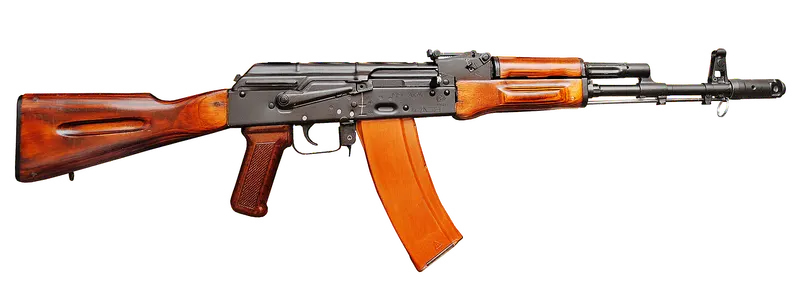

The AK-74 is a 5.45x39mm assault rifle adopted by the Soviet Army in 1974 as the replacement for the 7.62x39mm AKM. It kept the AKM's long-stroke, gas-operated action and roughly half of its parts unchanged, but everything downstream of the chamber was redesigned around a lighter, smaller-diameter cartridge chosen to flatten trajectory, cut recoil, and let a soldier carry more ammunition for the same weight. Soviet engineers at the Central Research Institute for Precision Machine Building began that cartridge program in the early 1970s after watching the United States field the 5.56x45mm Armalite AR-15 (the M16) in Vietnam, and the resulting 7N6 round became the AK-74's defining feature as much as the rifle itself.1 The design team, working under Mikhail Kalashnikov at what was then Izhmash (now Kalashnikov Concern), formalized the rifle by decree of the Council of Ministers on 19 January 1974, and it entered Soviet Army service the following year.2
- very high mechanical reliability in mud, sand, and cold
- light 5.45x39mm cartridge, low recoil, fast follow-up shots
- effective multi-port muzzle brake tames muzzle climb
- enormous parts and ammunition commonality across the former Soviet bloc
- cheap to produce and maintain, huge spare-parts base
- looser manufacturing tolerances limit practical accuracy versus Western rifles
- stamped iron sights and offset optic rail are dated by modern standards
- 5.45mm terminal performance beyond 300m trails larger-caliber rounds
- ergonomics (safety lever, magazine release) are slower to operate one-handed than an AR-pattern rifle
Roughly 5 million AK-74s were built at Izhmash between 1974 and 1991, with millions more produced under license or as direct derivatives across the Warsaw Pact and beyond.3 It remains the standard infantry rifle of Russia today, alongside newer AK-74M and AK-12 production, and it still equips forces across the former Soviet Union, the Balkans, the Middle East, and sub-Saharan Africa. As one of the many assault rifles built on the Kalashnikov pattern, the AK-74 sits at the point where the Soviet small-arms establishment finally abandoned the intermediate 7.62x39mm cartridge it had used since the AK-47 and followed the West into small-caliber, high-velocity ammunition. It answers several of the most common searches about the rifle directly: it is still in front-line service in 2026, its manufacturer is Kalashnikov Concern in Izhevsk, its production run and current unit cost vary enormously by market and country of origin, and its defining spec, the 5.45x39mm cartridge, is discussed in depth below.
The 5.45x39mm Cartridge and Its "Poison Bullet" Reputation
{{photo-req side=right q="Mikhail Kalashnikov portrait designer" caption="Mikhail Kalashnikov, the designer behind the AK-47, AKM, and the AK-74 that adapted his rifle to the 5.45x39mm cartridge." alt="Portrait of Mikhail Kalashnikov, designer of the AK rifle family"}} The AK-74's 7N6 cartridge fires a 3.43-gram bullet at a muzzle velocity of about 880 m/s, generating roughly 1,328 joules of muzzle energy from a 415mm barrel.4 The bullet's construction, a mild-steel core with an air gap left in the nose cavity ahead of a lead plug at the base, shifts its center of gravity toward the rear. In soft tissue this makes the projectile yaw and tumble far earlier than a conventional full metal jacket round, and in some documented wounds the bullet fragments at the cannelure, scattering steel core fragments through the wound track.5 Afghan fighters who came up against Soviet troops carrying the new rifle in the late 1970s nicknamed the round the "poison bullet", convinced its wounds were disproportionately lethal for such a small, light projectile.6 Ballistic researcher Martin Fackler's later gelatin and animal testing found the round behaves largely as expected for a military full-metal-jacket bullet at that velocity, without any exotic tumbling effect beyond ordinary yaw, tempering the myth without erasing the round's genuine reputation for nasty wound channels at the ranges Soviet troops actually fought at.7
- First Production Year1974
- Service Entry Year1975
- DesignerMikhail Kalashnikov
- Weight (Empty)3.07 kg
- Weight (Loaded)3.3 kg
- Currently In ServiceYes
- Notable UsersSoviet Union, Russia, Afghanistan, Azerbaijan, Cuba
A Distinctive Multi-Port Muzzle Brake
The AK-74's most visually distinctive feature is its long, multi-chambered muzzle brake, roughly four times the volume of the AKM's simple slant brake.8 Propellant gas vents out through two large forward ports and smaller side cuts, and the geometry is built to counter the rifle's natural tendency to climb up and to the right under automatic fire, the same problem every Kalashnikov design before it fought with a much simpler device. Kalashnikov Concern's own literature credits the brake with cutting felt recoil by around 60 percent relative to the AKM firing 7.62x39mm, a figure that lines up with the AK-74's reputation as noticeably easier to control on select-fire full-automatic bursts than its 7.62mm predecessor.9 The brake threads directly onto a barrel that, unlike the AKM's, was chrome-lined from the factory and cut with four right-hand rifling grooves rather than the AKM's typical arrangement, part of a broader tightening of manufacturing tolerances that Soviet planners pushed through alongside the caliber change.
- Cartridge5.45×39mm
- Calibre5.45 mm
- Case Length39 mm
- Bullet Weight3.43 g
- RimfireNo
- Caseless AmmunitionNo
Furniture, Stock, and the Standard AKS-74 Folding Variant
Early production AK-74s used laminated wood furniture broadly similar to the AKM's, then shifted through the 1980s to a distinctive orange-brown AG-4S glass-filled polymer for the handguards, pistol grip, and buttstock, chosen for lighter weight and better resistance to temperature extremes than wood.10 The rifle weighs 3.07 kg empty and about 3.3 kg loaded, uses a 30-round detachable magazine, and cycles at a theoretical 650 rounds per minute, though a trained soldier's practical rate of fire is closer to 100 rounds per minute.11 A side-folding metal stock version, the AKS-74, was built in parallel with the fixed-stock rifle from the outset for paratroopers and vehicle crews who needed a shorter overall length; the standard AK-74 carries a right-side scope rail for optics and night sights, and the design retains the AKM's bayonet lug and grenade-launch capability for the GP-25 underbarrel launcher.
- Action TypeGas-Operated
- Select FireYes
- Feed SystemDetachable Magazine
- Magazine Capacity30
- Cyclic Rate of Fire650
- Muzzle Velocity880 m/s
- Muzzle Energy1,328
- Barrel Length415 mm
- Rifling Grooves4
- Sight TypeAdjustable iron sights, front post and rear notch on a scaled tangent
- Optic RailYes
- Iron SightsYes
- Threaded BarrelYes
- Furniture Materialpolymer and laminated wood
- Folding / Collapsing StockYes
- Bullpup LayoutNo
- Ambidextrous ControlsNo
- Total Production10,000,000
- Width70 mm
- Height195 mm
{{photo-req side=right q="Soviet soldiers Afghanistan AK-74 rifle 1980s" caption="Soviet motor rifle troops in Afghanistan, where the AK-74 first saw sustained combat after 1979." alt="Soviet soldiers armed with AK-74 rifles during the Soviet-Afghan War"}} Soviet planners began the switch away from the 7.62x39mm intermediate cartridge in the late 1960s after concluding, from their own trials and from watching the American M16 in Vietnam, that a lighter, higher-velocity bullet improved hit probability and reduced recoil in automatic fire without giving up much lethality at infantry combat ranges.12 The 5.45x39mm 7N6 cartridge and the rifle built around it, initially referred to internally as the "Object 5.45", went through troop trials in the early 1970s before formal adoption on 19 January 1974. Full-rate production started that same year at Izhmash in Izhevsk, and the first units began fielding it in 1975, with the type reaching first-line motor rifle regiments by the end of the decade.13
The AK-74 first saw sustained combat when the Soviet-Afghan War began in December 1979.14 Because the rifle and its ammunition were new and initially issued only to elite and forward-deployed Soviet units, Western intelligence agencies were eager to get hold of one. The head of the Afghan bureau of Pakistan's Inter-Services Intelligence later claimed the American CIA paid a $5,000 bounty for the first AK-74 captured by mujahideen fighters, an extraordinary sum for a single rifle at the time and a sign of how little the outside world knew about Soviet small-arms development behind the Iron Curtain.15 Soldier of Fortune magazine subsequently obtained one of those captured rifles along with ammunition, giving Western readers their first detailed look at the weapon.
{{photo-req side=left q="East German National People's Army soldier rifle NVA" caption="A National People's Army soldier of East Germany, the first Warsaw Pact state to license-produce the AK-74 as the MPi-AK-74N." alt="East German soldier holding an MPi-AK-74N rifle"}} East Germany was the first Warsaw Pact state to license-produce the design, signing an agreement in 1981 and beginning manufacture in 1982-83 as the MPi-AK-74N, introduced to the National People's Army and police from 1985.18 East German production used a distinctive pebble-grain textured polymer buttstock and handguard, a Bakelite pistol grip on some batches, and a side-folding wire stock variant, the MPi-AKS-74N; a shortened carbine version for tank crews and airborne troops followed in 1987 as the MPi-AKS-74NK.19 The licensing terms reportedly barred East Germany from exporting its AK-74 production, part of a broader Soviet effort to keep control over the newer cartridge's proliferation even while sharing the manufacturing technology with its allies. Bulgaria, Romania, and other Warsaw Pact states also began domestic AK-74 pattern production through the 1980s, spreading the 5.45x39mm cartridge across the bloc's logistics chain well before the Soviet Union itself collapsed.
Soviet production of the original AK-74 ran until 1991, by which point roughly 5 million rifles had been built at Izhmash, a figure repeatedly confirmed by the manufacturer and independent researchers despite online claims running as high as 18 million when counting the entire AK-74 family and foreign-built copies together.20 Production shifted after 1991 to the modernized AK-74M, discussed in Variants below, which remains in current manufacture at Kalashnikov Concern.
{{photo-req side=left q="First Chechen War Grozny 1995 soldiers street" caption="Fighting in Grozny during the First Chechen War, where AK-74 and AKS-74U rifles equipped both Russian and Chechen forces." alt="Urban combat scene from the Battle of Grozny during the First Chechen War"}} The AK-74 has been present in nearly every major post-Soviet conflict. During the First Chechen War, Chechen fighters defending the Chechen capital of Grozny, within Russia, in the winter of 1994-95 relied heavily on AK-74 and AKS-74U rifles alongside RPG-7 launchers against a Russian armored assault of roughly 40,000 troops, and the close-range, building-to-building nature of that fighting became a widely studied case of how badly armored columns fare without dismounted infantry clearing buildings first.21 Both sides in that war and the Second Chechen War that followed in 1999 were armed with the same rifle family, since it had been the standard Soviet-era issue across Russian regular units, interior ministry troops, and Chechen forces that had inherited or captured Soviet stocks alike.
{{photo-req side=right q="Nagorno-Karabakh map conflict region" caption="The Nagorno-Karabakh region, where AK-74 rifles equipped both Armenian and Azerbaijani forces through repeated rounds of fighting." alt="Map of the Nagorno-Karabakh conflict region"}} The rifle equipped both belligerents again in the Russo-Georgian War of 2008 and in the long-running Georgian-Ossetian conflict, and it was standard issue on both the Armenian and Azerbaijani sides of the Second Nagorno-Karabakh War in 2020 and the smaller 2023 Azerbaijani offensive that followed.22 Azerbaijan has manufactured the AK-74M under license domestically since 2011 through its Ministry of Defence Industry, giving it an independent production base for the same rifle Armenia fields as its standard infantry weapon, a rare case of a Kalashnikov-pattern arms race between two neighboring, mutually hostile states each building the same basic design.23
The AK-74 and its shortened AKS-74U derivative also saw extensive use during the Iraq War and the Iraqi insurgency that followed, largely through captured and black-market Eastern Bloc stocks rather than official issue by Iraq's own armed forces, and it has appeared throughout the Yugoslav Wars, the Sri Lankan civil war, the Syrian civil war, and numerous African insurgencies from Somalia to the Democratic Republic of Congo-adjacent Lord's Resistance Army insurgency, following the same well-worn path of Cold War-surplus Kalashnikov rifles into essentially every conflict zone with a former Soviet-aligned arms pipeline.24 Since February 2022 it has been the primary Russian infantry rifle of the full-scale Russo-Ukrainian war, standard issue across mobilized and professional units alike, while Ukrainian forces field a mix of AK-74s inherited from Soviet-era stockpiles, more modern AK-12s, and Western-pattern rifles supplied by NATO members.25

{{photo-req side=right q="AKS-74U compact carbine rifle" caption="The AKS-74U, nicknamed the Krinkov, cut the AK-74's barrel to 206.5mm for a compact carbine used by special forces and vehicle crews." alt="AKS-74U compact carbine rifle with folding stock"}} The Soviet Union and its successors built an extensive AK-74 family rather than one fixed rifle. The AKS-74 is the side-folding-stock version of the standard rifle, built in parallel from 1974 for airborne and vehicle crews. The AKS-74U ("Krinkov" in Western slang), fielded from 1979, cuts the barrel to just 206.5mm and shortens the gas system to match, producing a compact 2.5kg carbine intended for special forces, helicopter and armored vehicle crews, and rear-echelon troops who needed something smaller than a full rifle.28 East Germany's locally built equivalents carried the MPi-AK-74N and MPi-AKS-74N designations, distinguishable by their pebble-textured polymer furniture and Bakelite grips, plus a shortened MPi-AKS-74NK version introduced in 1987 for tank and airborne troops.29
The post-Soviet AK-74M, standardized in Russian service from 1991, replaced wood or Bakelite furniture across the board with black polymer, added a folding polymer (rather than metal) side stock as standard, fitted a side optics rail to every rifle rather than a subset, and simplified the receiver for cheaper, more consistent manufacturing.30 The AK-101 through AK-105 export series, developed through the 1990s on the AK-74M pattern, cover a spread of calibers and lengths for the international market, including the 5.45x39mm AK-105 short carbine that effectively replaced the AKS-74U in current Russian issue, and the 5.56x45mm NATO-chambered AK-101 aimed at export customers already standardized on the Western round. The belt-fed light machine gun derivative, the RPK-74, shares the AK-74's cartridge and much of its receiver but adds a longer, heavier barrel, a bipod, and 45-round magazines for a sustained-fire support role within the same infantry squad.

{{photo-req side=right q="Egyptian army soldiers AK-74 rifle training" caption="An Egyptian soldier training with an AK-74-pattern rifle, one of the export customers beyond the former Soviet bloc." alt="Soldier holding an AK-74 rifle during training"}} The AK-74 remains the standard-issue rifle of Russia, where it has been in continuous front-line service since 1975 alongside progressively updated AK-74M and AK-12 production. Beyond Russia it equips or has equipped the armed forces of Ukraine, Armenia, Azerbaijan, Belarus, Georgia, Kazakhstan, Kyrgyzstan, Tajikistan, Turkmenistan, Uzbekistan, Moldova, Estonia, Latvia, Lithuania, Romania, and Bulgaria, a footprint that traces almost exactly onto the former Soviet Union and Warsaw Pact.31
Outside that core bloc it serves with Egypt, Cuba, Afghanistan, Syria, Yemen, Pakistan, Mongolia, the People's Republic of China in limited numbers, North Korea, Lebanon, Laos, Myanmar, and South Korea in small quantities, plus a long list of African states including Libya, Angola, Nigeria, Zambia, Rwanda, Burundi, Somalia, Madagascar, Chad, and Ivory Coast.32 In Europe, both Croatia and Greece hold AK-74-pattern rifles in inventory as legacies of Warsaw Pact-adjacent stockpiles and regional conflicts, while unified Germany inherited roughly 171,925 East German-built MPi-AK-74N and related rifles after 1990, most subsequently transferred, sold, or scrapped rather than retained in Bundeswehr service.33 Cyprus, Guatemala, and Lesotho also carry small AK-74 inventories, mostly acquired through Cold War-era arms transfers or later surplus purchases rather than direct Soviet issue.
The AK-74 and the American Armalite AR-15 platform (the M16/M4 family) were designed within a few years of each other, and each was a direct reaction to the other side's cartridge philosophy. Washington moved first, small-caliber 5.56x45mm chosen to let riflemen carry more rounds and control automatic fire more easily than the older 7.62x51mm battle rifles; Moscow followed with 5.45x39mm rather than concede the advantage, but the two rifles solve the same problem in almost opposite mechanical ways. The AR-15 pattern uses direct gas impingement into a lightweight bolt carrier, giving a smoother recoil impulse and inherently tighter tolerances that translate into better practical accuracy, at the cost of needing a cleaner operating environment and more frequent maintenance. The AK-74 kept Kalashnikov's long-stroke gas piston, which shrugs off sand, mud, and neglect at the cost of the looser tolerances and marginally worse accuracy the AK family has always traded for reliability.34
| AK-74 | Armalite AR-15 / M16 | |
|---|---|---|
| Cartridge | 5.45x39mm | 5.56x45mm NATO |
| Action | Long-stroke gas piston | Direct gas impingement |
| Muzzle velocity | ~880 m/s | ~930 m/s (M16A2, 20in barrel) |
| Empty weight | 3.07 kg | ~3.3-3.9 kg depending on variant |
| Cyclic rate | 650 rpm | 700-950 rpm depending on variant |
That reliability-versus-precision trade shaped how each rifle spread around the world. The AR-15 pattern, refined over decades into the Heckler & Koch HK416 and other piston-driven derivatives, became the preferred base for Western special operations units willing to pay more for tighter tolerances and modularity. The AK-74 spread instead through Soviet and post-Soviet client relationships, becoming the default rifle of armies that valued a weapon soldiers with minimal training could keep running with little maintenance, cheap ammunition, and abundant spare parts, a calculus that mattered more in the conflicts across Africa, the Caucasus, and Central Asia where the AK-74 has actually been fired in anger than raw group size at 300 meters ever did.
A closer domestic comparison is the AK-74's own predecessor, the 7.62x39mm AKM. The AK-74 is not a new rifle so much as the AKM re-engineered around a different cartridge, sharing roughly half its parts count, and the practical difference a soldier feels is mostly in recoil and magazine weight rather than handling. The AKM's larger cartridge retains a real edge in barrier penetration and terminal effect at longer range, which is one reason 7.62x39mm-pattern rifles never fully disappeared from Warsaw Pact-legacy arsenals even after the AK-74 became the standard-issue rifle.35


Is the AK-74 still in service? Yes. It remains Russia's standard infantry rifle alongside newer AK-74M and AK-12 production, and it equips dozens of other militaries across the former Soviet Union, the Middle East, and Africa as of 2026.36
What caliber does the AK-74 use? The AK-74 fires the 5.45x39mm cartridge, a smaller and lighter round than the 7.62x39mm used in the earlier AK-47 and AKM, chosen to flatten trajectory and cut recoil for faster follow-up shots.37
How does the AK-74 compare to the AK-47? The AK-74 replaced the AK-47's descendant, the AKM, in Soviet service starting in 1974. It uses the same long-stroke gas piston operating system and shares roughly half its parts with the AKM, but fires the smaller, faster 5.45x39mm cartridge instead of 7.62x39mm, trading some stopping power for lower recoil and a flatter trajectory.38
Who manufactures the AK-74? Kalashnikov Concern (formerly Izhmash) in Izhevsk, Russia, built the original AK-74 and continues to manufacture its AK-74M successor. Licensed and unlicensed variants were also produced in East Germany, Bulgaria, Romania, and Azerbaijan, among others.39
How much does an AK-74 cost? Original military-surplus and civilian semi-automatic AK-74 pattern rifles sell in the United States for roughly $800 to $1,400 depending on condition and importer, though direct importation of Russian-made firearms, including AK-74 pattern rifles, has been closed to the American civilian market since 2017.40
- "AK-74", Wikipedia — en.wikipedia.org ↩
- "A History of the AK-74 Rifle's Design and Development in the USSR", Ronin's Grips — blog.roninsgrips.com ↩
- "Heard Of The AK47? What About Russia's AK74?", Forces News — forcesnews.com ↩
- "5.45x39mm", Wikipedia — en.wikipedia.org ↩
- "5.45 vs. 5.56: The Power of The Poison Pill", Guns.com — guns.com ↩
- "The AK-74: From Soviet Small Arm To Resistance Symbol", American Rifleman — americanrifleman.org ↩
- "Terminal ballistics of the Russian AK 74 assault rifle: two wounded patients and experimental findings", PubMed — pubmed.ncbi.nlm.nih.gov ↩
- "AK-74 – History, Specifications & 5.45x39mm Development", ThinLineWeapons — thinlineweapons.com ↩
- "AK-74: Soviet Blaster for the 5.45x39mm Cartridge", Gun Digest — gundigest.com ↩
- "East Germany AKs - The Best In The World? Part 3: Less Known Variants", The Firearm Blog — thefirearmblog.com ↩
- "AK-74", Wikipedia — en.wikipedia.org ↩
- "AK-74 – History, Specifications & 5.45x39mm Development", ThinLineWeapons — thinlineweapons.com ↩
- "A History of the AK-74 Rifle's Design and Development in the USSR", Ronin's Grips — blog.roninsgrips.com ↩
- "AK-74: Shocking Facts & Role in Afghan War Revealed", Safar Publishing — safar-publishing.com ↩
- "List of military equipment used by the mujahideen during the Soviet-Afghan War", Wikipedia — en.wikipedia.org ↩
- "AK-74", Wikipedia — en.wikipedia.org ↩
- "Global Proliferation of the AK-74: A Technical and Historical Analysis of Licensed Foreign Production", Ronin's Grips — blog.roninsgrips.com ↩
- "East German AK History", Faktory 47 — faktory47.com ↩
- "MPi-AK-74", NamuWiki — en.namu.wiki ↩
- "Heard Of The AK47? What About Russia's AK74?", Forces News — forcesnews.com ↩
- "Russian Urban Tactics: Lessons from the Battle for Grozny", Defense Technical Information Center — apps.dtic.mil ↩
- "List of equipment of the Armenian Armed Forces", Wikipedia — en.wikipedia.org ↩
- "Azerbaijan Begins AK-74M Production", Armenian Weekly — armenianweekly.com ↩
- "AK-74", Wikipedia — en.wikipedia.org ↩
- "AK-74: The Mainstay Assault Rifle of Both Sides in the Russia-Ukraine War", HistoryNet — historynet.com ↩
- "List of military equipment used by the mujahideen during the Soviet-Afghan War", Wikipedia — en.wikipedia.org ↩
- "Global Proliferation of the AK-74: A Technical and Historical Analysis of Licensed Foreign Production", Ronin's Grips — blog.roninsgrips.com ↩
- "AK-74/Variants", Great Multiverse Wiki — greatmultiverse.fandom.com ↩
- "East German AK History", Faktory 47 — faktory47.com ↩
- "AK-74", Wikipedia — en.wikipedia.org ↩
- "AK-74", Wikipedia — en.wikipedia.org ↩
- "Weapon Identification Sheet Kalashnikov AK-74", Small Arms Survey — smallarmssurvey.org ↩
- "AK-74", Wikipedia — en.wikipedia.org ↩
- "AK-47 vs AK-74: An In-depth Comparison of the World's Most Iconic Weapons of War", SOFREP — sofrep.com ↩
- "AK-47 vs AK-74 - Difference and Comparison", Diffen — diffen.com ↩
- "AK-74: The Mainstay Assault Rifle of Both Sides in the Russia-Ukraine War", HistoryNet — historynet.com ↩
- "5.45x39mm", Wikipedia — en.wikipedia.org ↩
- "AK-47 vs AK-74 - Difference and Comparison", Diffen — diffen.com ↩
- "AK-74", Wikipedia — en.wikipedia.org ↩
- "AK74 New and Used Price, Value, & Trends 2026", TrueGunValue — truegunvalue.com ↩