


The StG 44 is the German rifle historians and firearms engineers point to when they need a single starting point for the modern assault rifles category. It combined an intermediate-power cartridge, a select-fire trigger group, and a detachable magazine in one shoulder-fired rifle years before any other army fielded the same formula at scale.1 Standardized in 1943 as the Maschinenpistole 43 and renamed Sturmgewehr 44 the following year, it entered mass service with the Wehrmacht on the Eastern Front during the final two years of World War II.1
- intermediate cartridge, controllable in full-automatic fire
- 30-round detachable box magazine, fast reload versus a bolt-action rifle
- selective fire, semi and full-auto in one trigger group
- exceptional reported reliability in eastern-front cold and mud
- heavier than the standard German bolt-action rifle it partly replaced
- stamped-steel construction wore quickly under sustained automatic fire
- came far too late and in far too small numbers to change the war
- effective range well short of full-power battle rifles of the era
Total wartime production reached roughly 425,000 rifles built across four factories between mid-1943 and April 1945, split between C. G. Haenel in Suhl, Sauer & Sohn also in Suhl, a state arsenal in Erfurt, and Steyr-Daimler-Puch in Austria.1 Chief designer Hugo Schmeisser led Haenel's development team, building on his earlier wartime submachine gun work, and the rifle he produced fired the 7.92×33mm Kurz cartridge, a shortened, lower-powered round purpose-built to be controllable in full-automatic fire at typical infantry engagement distances.1
{{photo-req side=right q="German soldier StG 44 assault rifle Eastern Front 1944" caption="A German infantryman with an StG 44, the rifle that introduced the assault rifle concept to mass production." alt="German soldier holding an StG 44 rifle on the Eastern Front"}}
Adolf Hitler initially opposed the program, insisting German infantry needed full-power cartridges rather than a shortened round, and the weapon's developers kept early production hidden from him under the deliberately bland designation Maschinenpistole 43 (machine pistol 43) rather than call it a new rifle class.2 Once frontline reports from the Eastern Front reached Hitler describing the weapon's effect against Soviet infantry armed with PPSh-41-pattern submachine guns, he reversed course, and the rifle was renamed Sturmgewehr 44, literally storm rifle, a name some historians credit to Hitler personally and others attribute to General Erich Jaschke with Hitler's sign-off.2 Either way, the German word gave the entire weapons category, assault rifle, its modern English name.3
The StG 44 never replaced the bolt-action Karabiner 98k as Germany's standard infantry rifle before the war ended, but small numbers stayed in service for decades afterward with Yugoslavia, East Germany, and several Middle Eastern and African states, and its basic recipe, an intermediate round fired from a select-fire rifle with a detachable box magazine, was picked up almost immediately by the postwar Soviet AK-47 program and, later, by American 5.56mm rifle designs.4 Whether the StG 44 is still in service anywhere today is a genuine question, since worn examples have resurfaced in militia and insurgent hands in the Syrian Civil War and Ukraine's Donbas fighting decades after Germany last produced one.5
A Gas-Operated Tilting Bolt Built for the 7.92×33mm Kurz
{{photo-req side=left q="Krummlauf curved barrel attachment StG 44" caption="The Krummlauf, a curved barrel attachment that let an StG 44 fire around corners without exposing the shooter." alt="Krummlauf curved barrel device mounted on an StG 44 rifle"}}
- First Production Year1943
- Service Entry Year1943
- DesignerHugo Schmeisser
- Weight (Empty)4.6 kg
- Weight (Loaded)5.13 kg
- Currently In ServiceYes
The StG 44 is gas-operated, tapping propellant gas from a port near the muzzle to drive a long-stroke piston that unlocks a tilting bolt, a mechanism closer in principle to the later Kalashnikov family than to a simple blowback submachine gun.1 Empty weight runs 4.6 kilograms, rising to about 5.13 kilograms loaded with a full 30-round magazine, noticeably heavier than the roughly 3.9-kilogram Karabiner 98k it fought alongside but still lighter than a full-power battle rifle with a comparable magazine capacity.6 The 420mm barrel drives the 7.92×33mm Kurz cartridge's 17.05 gram bullet to a muzzle velocity of 685 meters per second, giving the rifle an effective point-target range around 300 meters and a longer area-fire range out to roughly 600 meters, both figures well short of the 98k's full-power 7.92×57mm Mauser round but entirely adequate for the ranges at which most WWII infantry fighting actually happened.6
- Cartridge7.92×33mm Kurz
- Calibre7.92 mm
- Case Length33 mm
- Calibre Classintermediate
- Bullet Weight17.05 g
Ammunition fed from a curved 30-round detachable box magazine, an unusually generous capacity for 1943 that let a single rifleman sustain far more fire between reloads than any bolt-action contemporary, though the era's stamped steel and none-too-generous spring tolerances made the magazine itself one of the rifle's more failure-prone parts under hard field use.1 Cyclic rate of fire sat around 500 rounds per minute, tuned deliberately conservative so an average soldier could hold the rifle on a two or three-round burst rather than climbing off target the way a submachine gun firing a full pistol-caliber cartridge would.7 The rifle's sights were a simple adjustable rear V-notch and hooded front post, nothing exotic, because the weapon's real innovation sat in the cartridge and the receiver, not the optics.6
- Action TypeGas-Operated
- Fire Modesselective fire (semi-auto and full-auto)
- Select FireYes
- Feed SystemDetachable Magazine
- Magazine Capacity30
- Cyclic Rate of Fire500
The Krummlauf and Vampir, Wartime Field Modifications
German ordnance engineers built several accessory programs around the base rifle once it reached troops. The Krummlauf (German for curved barrel) was a bent barrel attachment, most commonly a 30-degree bend, fitted with a simple periscope sight so a soldier could fire from cover around a corner or from inside a tank hull without exposing himself.8 It came at real mechanical cost. The 30-degree version lasted only about 300 rounds before the stressed, curved barrel wore out, the 45-degree version lasted barely 160 rounds, and the sharp bend caused some bullets to fragment on the way out, producing an unintentional shotgun-like pattern at the muzzle.8 The Vampir infrared night sight was a separate, far heavier accessory, a large infrared-sensitive scope paired with an infrared spotlight and a battery pack carried on the soldier's back inside a modified gas mask canister, giving roughly 200 meters of night engagement range on about 15 minutes of battery life before the pack needed recharging.4 Neither accessory saw more than small-scale field issue before the war ended, but both point at how quickly German engineers tried to extend the base rifle's capability once it existed.
- Muzzle Velocity685 m/s
- Effective Range (point)300 m
- Effective Range (area)600 m
- Barrel Length420 mm
- Sight TypeAdjustable sights, rear: V-notch; front: hooded post
- Iron SightsYes
- Total Production425,977
- Production Start1943
- Production End1945
- Variants5
From the MKb 42 Trials to Hitler's Reluctant Approval
{{photo-req side=right q="Hugo Schmeisser German firearms designer portrait" caption="Hugo Schmeisser, the Haenel engineer who led development of the MKb 42(H) and the StG 44 that followed it." alt="Portrait of firearms designer Hugo Schmeisser"}}
The rifle's development traces back to a 1938 requirement from the German Army Weapons Office for a new rifle chambering a shortened, intermediate-power cartridge rather than the full-power round used in every prior generation of German infantry rifles and machine guns.1 C. G. Haenel and Walther both received contracts to build prototypes under the designation Maschinenkarabiner 1942, or MKb 42, and Hugo Schmeisser's design team at Haenel produced the first working MKb 42(H) prototypes by 1942, which underwent field trials on the Eastern Front that November and won strong support from troops who actually carried them into combat.1 Hitler, however, had personally insisted German infantry be issued only full-power rifle cartridges, so the weapon's champions inside the Wehrmacht deliberately obscured the program from him, first as a machine pistol rather than a new rifle class, then continuing limited-scale production under the bureaucratic cover of the designation Maschinenpistole 43.2
Word of the deception reached Hitler anyway. After learning small numbers of the new rifle were already fighting on the Eastern Front without his authorization, he demanded full combat reports rather than simply shutting the program down, and the reports that came back, describing markedly improved firepower against Soviet PPSh-41 and PPS-43 submachine guns in close infantry fighting, changed his mind entirely.2 Hitler ordered monthly production ramped to 30,000 rifles and, in a piece of wartime theater typical of the regime, personally approved the new name Sturmgewehr 44, tying his own propaganda machine to a weapon he had opposed barely a year earlier.2
Manufacturing Under Bombing and the War's Final Collapse
Production ramped through 1944 across all four factories even as Allied bombing increasingly disrupted German industry, and Hugo Schmeisser himself claimed after the war that the four plants built a combined 424,000 rifles between June 1943 and April 1945, a figure close to the roughly 425,000 total the type's own production records support.1 Steyr-Daimler-Puch's Austrian plant alone accounted for about 80,000 of that total, giving the rifle a genuinely dispersed, multi-site production base that partly protected output from any single bombing raid.1
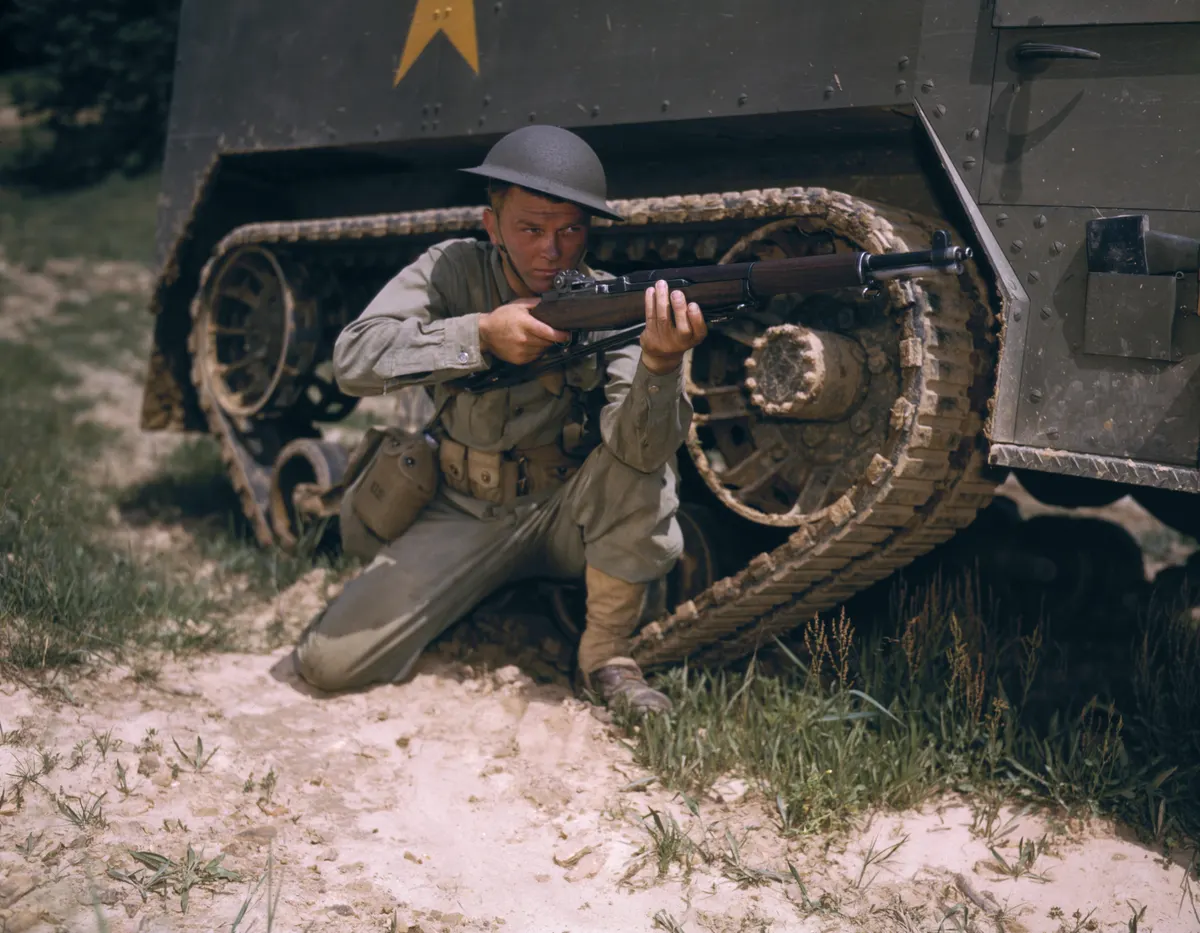
By late 1944 and into 1945, StG 44-equipped units gave outnumbered German formations a real, if localized, firepower edge in close defensive fighting, particularly against Allied and Soviet infantry still relying on bolt-action rifles for most riflemen. American troops advancing into Germany carried the semi-automatic M1 Garand, itself a generational leap over the bolt-action rifles most other WWII armies still issued, and encounters between the two rifles briefly put two genuinely different mid-century infantry rifle concepts against each other on the same battlefield.10 The StG 44 arrived too late and in too few numbers, alongside a collapsing logistics system and a shrinking pool of trained riflemen, to meaningfully change the outcome of the war.1
World War II, the Eastern Front and Germany's Final Defense
{{photo-req side=right q="Eastern Front map 1944 German Wehrmacht Soviet offensive" caption="The Eastern Front in 1944, the theater where the StG 44 first reached large numbers of German infantry." alt="Map of the Eastern Front during 1944"}}
The World War II Eastern Front was the StG 44's primary combat proving ground, where it equipped select infantry, mountain, and later Waffen-SS units fighting increasingly defensive battles against the advancing Russian Red Army from 1943 onward.1 Limited numbers also reached German units in the West by 1944 and 1945, including formations defending against the Allied advance following the Normandy landings, though the Eastern Front remained where the rifle saw its heaviest and best-documented use.1
Postwar, captured and Soviet-transferred StG 44s spread across a surprising range of Cold War-era conflicts. The First Indochina War saw small numbers reach Viet Minh forces fighting France's colonial army, valued alongside other captured German weapons for their firepower even though they never became standard-issue equipment.11 Examples later surfaced with Viet Cong and North Vietnamese fighters during the American phase of the Vietnam War, passed along by the Soviet Union, Czechoslovakia, and East Germany as those states retired the type from their own reserve stocks.11
The Syrian Civil War and a Weapon Outliving Its Century
{{photo-req side=left q="Syrian civil war fighter rifle rebel militia" caption="A fighter in Syria's civil war, a conflict where decades-old StG 44 rifles from a 1964 East German arms sale resurfaced in rebel hands." alt="Armed fighter during the Syrian Civil War"}}
The single most surprising chapter in the StG 44's combat history came seven decades after Germany stopped producing it. East Germany sold roughly 4,500 surplus StG 44 rifles, along with ammunition, to Syria in 1964, and those rifles were stored in Syrian government arsenals for decades rather than issued or destroyed.5 When the Syrian Civil War broke out in 2011 as part of the wider Arab Spring, some of that Cold War-era stockpile fell into rebel and insurgent hands, and photographs and video from the fighting repeatedly showed fighters carrying rifles that had been built under the Third Reich and stored under a Communist government before ever seeing combat.5 Similar East German export batches and older wartime-captured stocks turned up decades later in other conflicts too, including irregular use during the early years of the Russo-Ukrainian War's fighting in the Donbas, where at least one worn StG 44 was documented among militia small arms in 2014.12
Earlier Cold War and postcolonial fighting drew on the rifle just as heavily. The Algerian War and the Hungarian Revolution of 1956 both saw StG 44s in the hands of insurgents and revolutionaries working from captured or diverted Warsaw Pact stocks, while African conflicts including the Ogaden War between Ethiopia and Somalia drew on East Bloc-supplied StG 44s passed down through client-state arsenals.13 The Lebanese Civil War, the Iran-Iraq War, and even the 1990-1991 Gulf War all saw scattered use of the type among irregular forces and older reserve units still holding onto Cold War-era small arms decades after the rifle's original production run ended.13
{{photo-req side=right q="MKb 42(H) prototype rifle Haenel 1942" caption="An MKb 42(H) prototype, Hugo Schmeisser's 1942 forerunner to the production StG 44." alt="MKb 42(H) prototype assault rifle"}}
From MKb 42(H) to MP 43, MP 44, and StG 44 in Name Only
The rifle went through three official name changes without significant mechanical redesign between 1942 and 1944, a bureaucratic history almost as complicated as its technical one. Hugo Schmeisser's original MKb 42(H) prototype gave way to the slightly revised MP 43, itself soon renamed MP 44 for what was largely the same rifle with minor production refinements, before Hitler's 1944 approval finally settled on StG 44 as the permanent designation.1 Collectors and historians generally treat MP 43, MP 44, and StG 44 as functionally the same weapon across most of its production run, with the naming changes reflecting internal German bureaucracy and propaganda timing far more than any real mechanical revision.3
The Krummlauf, Vampir, and StG 44 (V) Development Lines
Beyond the curved-barrel Krummlauf and infrared Vampir accessories covered in Specs and Design, engineers explored a lighter-weight StG 44 (V) prototype series intended to trim the rifle's weight and simplify production further, though none reached large-scale manufacture before the war ended.1 A dedicated tank-mounted Krummlauf variant, built for use through a vehicle's pistol port to cover the close-range dead zone around a tank against assaulting infantry, was also tested, alongside experimental 60-degree and 90-degree bend barrels that never left prototype status.8
Postwar Attempts at License Production
No country ever built the StG 44 under a formal postwar production license the way several nations later licensed the AK-47. Argentina came closest, with the state arsenal CITEFA building trial copies in the late 1940s and early 1950s alongside roughly 100 rifles imported from Czechoslovakia in 1949, before Argentina ultimately adopted the FAL in 1955 instead.13 Yugoslavia never manufactured the type at all, relying entirely on a large inherited stock of ex-German wartime rifles and Soviet transfers that lasted the type's entire Yugoslav service career into the 1980s, when the last examples were transferred to territorial defense reserves or sold onward to friendly governments in the Middle East and Africa.1

East Germany's Volkspolizei and the Warsaw Pact's Leftover Stock

East Germany was the largest and longest-serving postwar operator of captured StG 44 stock, issuing it to the Volkspolizei (People's Police) under the local designation MPi.44 into the early 1960s, and to National People's Army reserve formations somewhat longer, with East German factories manufacturing 7.92×33mm Kurz ammunition domestically until 1962 and retaining rifles in reserve stores until at least 1969.4 From there, East Germany became the main conduit that spread surplus StG 44s to other states, selling rifles onward to Syria in 1964 and transferring smaller batches into Southeast Asian and African arsenals through the 1960s and 1970s.11
A Long Tail of Reserve and Irregular Users
Beyond East Germany and Yugoslavia, the StG 44's operator list stretched across an unusually wide geographic and political range for a rifle Germany itself only built for two years. Poland, Romania, Hungary, and other early Warsaw Pact states inherited Soviet-captured examples in the immediate postwar years before standardizing on Soviet-pattern rifles.1 Egypt, Algeria, Libya, Burkina Faso, and Somalia all received or captured examples through various African and Middle Eastern arms transfers across the Cold War, and small numbers have resurfaced with irregular forces in Somalia and elsewhere well into the 21st century, evidence of just how long a well-stored, gas-operated rifle chambered for a common Warsaw Pact-adjacent cartridge can remain functional in storage.13 Cyprus, Czech Republic, and France all show up in postwar inventory or captured-stock records as well, generally in small numbers tied to specific historical arms transfers rather than any large-scale standard-issue adoption.1
The StG 44 and the AK-47, a Popular Myth Worth Correcting
The claim that Mikhail Kalashnikov copied the StG 44 to build the AK-47 is one of the most persistent myths in small arms history, and it does not survive close comparison of the two rifles' actual mechanisms.14 The StG 44 locks its gas-operated action with a tilting bolt, while the AK-47 uses a rotating bolt driven by a long-stroke piston, a system Kalashnikov himself said drew far more directly from the American M1 Garand's trigger and bolt mechanism than from any German design.14 The two rifles' magazines are not interchangeable, and their firing mechanisms differ in ways a side-by-side disassembly makes obvious rather than subtle.14
| Spec | StG 44 | AK-47 |
|---|---|---|
| Action | Gas-operated, tilting bolt | Gas-operated, rotating bolt |
| Cartridge | 7.92x33mm Kurz | 7.62x39mm |
| Empty weight | 4.6 kg | approx. 3.47 kg |
| Magazine capacity | 30 rounds | 30 rounds |
What genuinely connects the two rifles is concept, not internal geometry. Both fire an intermediate-power cartridge from a select-fire action with a detachable box magazine, the core formula the StG 44 introduced at scale years before the AK-47 existed, and Hugo Schmeisser's own design bureau, relocated to the Soviet Izhevsk arms complex after the war, did work on refining early Soviet postwar rifle programs, which is likely the real source of the persistent copying claim.15 Kalashnikov's team benefited from that German expertise in manufacturing and refinement even if the AK-47's fundamental action traces to different roots.15
The StG 44 and the Karabiner 98k, Two Rifles From the Same Army
Unlike the AK-47 comparison, the Karabiner 98k comparison is about two rifles the same army issued side by side through the war's final two years. The 98k's Mauser bolt-action traced back to the 1890s, fed from a 5-round internal magazine, and fired the full-power 7.92×57mm Mauser cartridge to well over 800 meters per second, giving individual German riflemen more raw range and terminal energy per shot than the StG 44 offered.16 The StG 44 traded that per-shot power for sustained volume of fire and controllable automatic bursts at the shorter ranges where most infantry combat actually happened, the same tradeoff that later defined the entire assault rifle category the StG 44 helped create.1 Germany never had the industrial capacity in 1944 and 1945 to replace the 98k outright, so both rifles fought the war's last campaigns in the same squads, the 98k remaining the more common weapon by a wide margin even as the StG 44 pointed toward where infantry small arms were headed next.16


Is the StG 44 still in service today? No regular army issues the StG 44 as standard equipment, but worn examples from Cold War-era stockpiles have resurfaced with irregular and militia forces as recently as the Syrian Civil War and the early Donbas fighting in Ukraine, more than seven decades after Germany stopped producing it.5
What made the StG 44 the first true assault rifle? It was the first rifle built from the start around an intermediate-power cartridge, a select-fire trigger group, and a detachable box magazine in the same weapon, a combination mass-produced at meaningful scale before any other nation fielded the same formula, and the German name for the rifle, Sturmgewehr, is the direct source of the modern English term assault rifle.1
What caliber does the StG 44 use? The StG 44 is chambered for 7.92×33mm Kurz, a shortened intermediate cartridge firing a 17.05 gram bullet at approximately 685 meters per second, distinct from the full-power 7.92×57mm Mauser round the Karabiner 98k used.6
Is the StG 44 related to the AK-47? Only conceptually. Both use an intermediate cartridge and select-fire detachable-magazine layout, but the StG 44's tilting-bolt gas system is mechanically different from the AK-47's rotating-bolt, long-stroke piston action, which Mikhail Kalashnikov said drew more from the American M1 Garand than from any German design.14
How much does an original StG 44 cost today? A matching-numbers original StG 44 in excellent condition sold at a Rock Island Auction sale for $28,750, reflecting the rifle's rarity and historical significance to collectors, while modern semi-automatic .22-caliber reproductions sell new for a few hundred dollars.9
How many StG 44 rifles were produced? German factories built roughly 425,000 rifles between 1943 and 1945 across four plants, C. G. Haenel and Sauer & Sohn in Suhl, a state arsenal in Erfurt, and Steyr-Daimler-Puch in Austria.1
- "StG 44", Wikipedia — en.wikipedia.org ↩
- "Historical Trivia, How Hitler Coined the Term Sturmgewehr", Historical Firearms — historicalfirearms.info ↩
- "TBT, The Real Story Behind the Legendary Stg-44 Sturmgewehr Rifle", Military Times — militarytimes.com ↩
- "The Influential StG 44", Rock Island Auction — rockislandauction.com ↩
- "Meet the Sturmgewehr 44, the Nazi Assault Rifle Being Used in the Syrian Civil War", The National Interest — nationalinterest.org ↩
- "MKb.42, Maschinenkarabiner 42", Modern Firearms — modernfirearms.net ↩
- "Birth of the Assault Rifle, The Sturmgewehr 44", War History Online — warhistoryonline.com ↩
- "Krummlauf", Wikipedia — en.wikipedia.org ↩
- "German STG 44 WWII Machine Gun Sturmgewehr, $28,750", Rock Island Auction — rockislandauction.com ↩
- "M1 Garand", Wikipedia — en.wikipedia.org ↩
- "Unlikely Journey, The StG 44 in French Indochina and the Vietnam War", The Firearm Blog — thefirearmblog.com ↩
- "STG 44 In Ukraine", The Firearm Blog — thefirearmblog.com ↩
- "The StG-44 in Africa", Forgotten Weapons — forgottenweapons.com ↩
- "No, Germans Didn't Design the AK-47, Kalashnikov Conspiracy Theories and How to Refute Them", The Firearm Blog — thefirearmblog.com ↩
- "AK and StG, Kissing Cousins", Forgotten Weapons — forgottenweapons.com ↩
- "Enemies, Garand vs K98", The Armory Life — thearmorylife.com ↩