

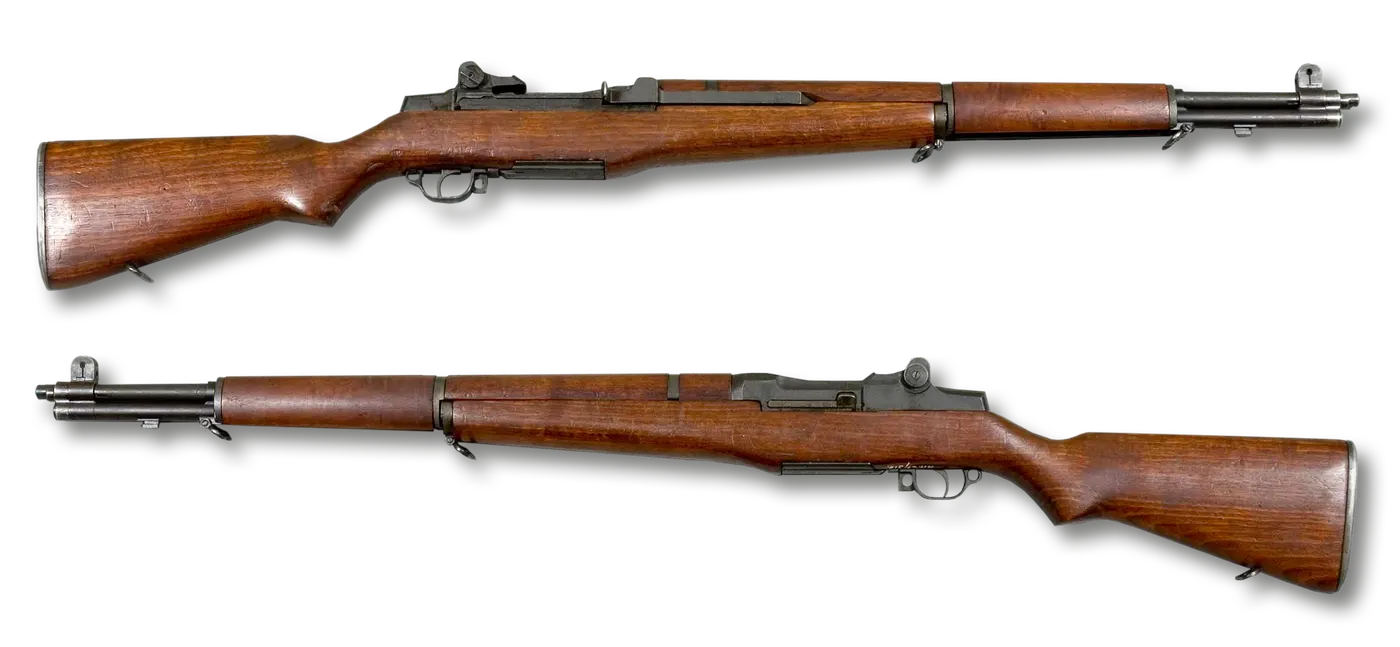

The M1 Garand is the semi-automatic rifle the United States Army standardized on January 9, 1936, becoming the first self-loading rifle to serve as the standard infantry arm of a major army.1 Designed by John Cantius Garand, an engineer at Springfield Armory in Massachusetts, the rifle chambers the .30-06 Springfield cartridge and fed from an 8-round en bloc clip rather than a detachable box magazine.1 Between 1937 and 1957, Springfield Armory, Winchester Repeating Arms, International Harvester, and Harrington & Richardson built a combined 5,468,772 M1 rifles, making it one of the most heavily produced semi-automatic rifles in history.2
- semi-automatic fire rate far exceeding contemporary bolt-actions
- robust gas-operated action tolerant of mud, sand, and combat abuse
- fast reload via 8-round en bloc clip
- strong retained accuracy at typical infantry engagement ranges
- fixed 8-round capacity, no partial reload without ejecting the clip
- distinctive clip-ejection *ping* (largely a myth as a combat liability, but a real design quirk)
- unloaded weight over 4 kilograms, heavy for smaller-statured soldiers
- no select-fire option in the standard-issue version
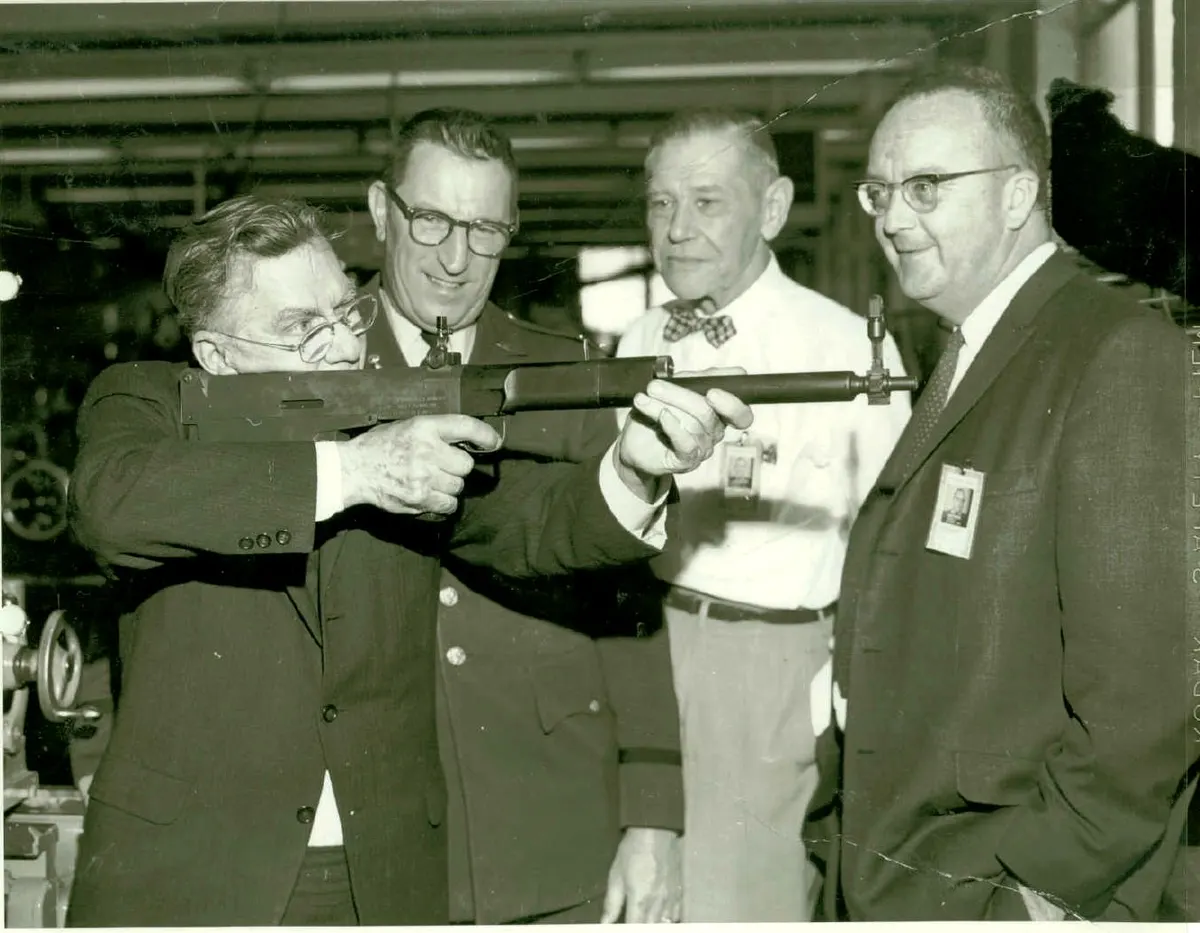
Garand never patented the rifle for personal profit. He assigned his design work to the U.S. government and drew only his Springfield Armory engineer's salary while more than six million of his rifles eventually left the arsenal floor.3 The M1 Garand replaced the bolt-action M1903 Springfield in front-line units through the late 1930s and early 1940s and went on to arm American forces through World War II and the Korean War before the M14, a direct successor built on the same gas-operated action, took over in 1957.4
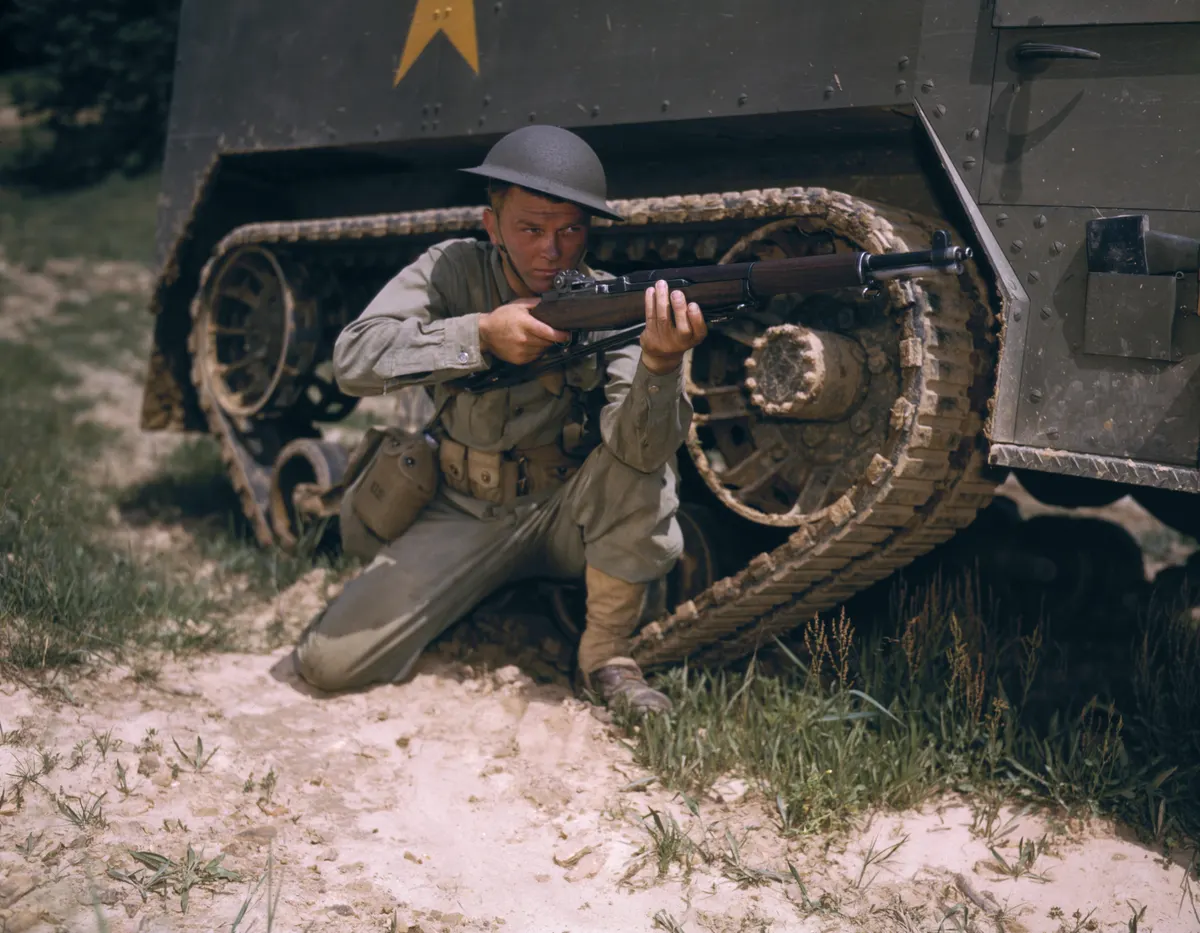
American infantry doctrine changed considerably once every rifleman, not just automatic-weapons crews, could deliver fast, aimed, semi-automatic fire. General George S. Patton wrote to the Army's Chief of Ordnance in January 1945 that the M-1 Rifle is the greatest battle implement ever devised, a line that has followed the weapon ever since.5
The M1 Garand's gas-operated action and rotating bolt locked into the same conceptual family as later U.S. service rifles, and the weapon's own semi-automatic-rifles category still traces back to Garand's basic mechanism. Beyond the United States, Italy, Denmark, Greece, Turkey, Japan, South Korea, and West Germany all issued the M1 Garand at some point during the Cold War, most of it delivered as American military aid or built under license by Beretta in Italy.6 Unit cost to the U.S. government in 1943 ran about $85 per rifle, a modest figure that reflected the scale of wartime mass production rather than any shortcut in materials or machining.2
The Gas-Operated Rotating Bolt That Redefined the U.S. Rifleman
John Garand's action taps propellant gas from the barrel to drive an operating rod rearward, which rotates a two-lug bolt out of engagement with the receiver and cycles the action.1 The M1 Garand is gas-piston operated, with the piston built into the operating rod rather than as a separate part, and it uses a rotating bolt that locks directly into the steel receiver rather than into a separate barrel extension. The rifle weighs 4.31 kilograms (9.5 pounds) unloaded, measures roughly 1.1 meters (43.6 inches) overall, and carries a 61 centimeter (24 inch) barrel rifled with 4 grooves.7
- First Production Year1936
- Service Entry Year1936
- DesignerJohn C. Garand
- Weight (Empty)4.31 kg
Ammunition feeds from an 8-round steel clip inserted into the top of the open action. Once the last round fires, the empty clip ejects automatically with a sharp metallic ring, the sound most shooters and historians call the Garand's ping.8 The .30-06 Springfield cartridge Garand chose for the rifle drives a 9.6 gram (150 grain) bullet at approximately 853 meters per second (2,800 feet per second), giving the M1 Garand real stopping power and a flat trajectory well past typical combat ranges.9
- Cartridge.30-06 Springfield
- Calibre7.62 mm
- Case Length63 mm
- Calibre Class7_62mm
- Bullet Weight9.6 g
The .276 Pedersen Question and Why .30-06 Won
Garand's early prototypes, including the T3E2, were chambered for the experimental .276 Pedersen cartridge and won a head-to-head trial against John Pedersen's own competing rifle in early 1931.10 A board recommended adopting the .276 caliber in January 1932, but Army Chief of Staff Douglas MacArthur personally overruled the switch that February, citing the enormous cost of replacing existing .30-caliber ammunition stocks across the entire Army, including machine guns.10 Garand's team spent the next several years reworking the rifle around the standard .30-06 round instead, a decision that shaped every M1 Garand that followed and, later, the M14's own 7.62x51mm NATO chambering.
- Action TypeGas-Operated
- Select FireNo
- Feed SystemClip
- Magazine Capacity8
Garand's design work traced back further still, through a series of trial rifles in the 1920s and early 1930s that culminated in the T1E2, redesignated the Semi-Automatic Rifle, Caliber .30, M1, in August 1933.1 Eighty hand-built Model Shop M1 rifles were tested in 1934, and the finalized design cleared for full procurement in November 1935 before standardization the following January.1
- Muzzle Velocity853 m/s
- Effective Range (point)0.5 m
Garand stayed at Springfield Armory as a government engineer from 1919 until his retirement in 1953, and continued experimenting with rifle designs, including a later bullpup-configuration prototype known as the T31, well after the M1's production run ended.3 He received the Meritorious Civilian Service Award in 1941 and was one of the first two recipients of the U.S. Medal for Merit in March 1944, an honor shared that year with radar pioneer Albert Hoyt Taylor.3 He died in Springfield, Massachusetts, in February 1974.3
- Barrel Length0.61 mm
- Rifling Grooves4
- Iron SightsYes
From Gas Trap to Gas Port
Springfield Armory's first roughly 50,000 production rifles, built between 1936 and 1940, used a complicated gas trap system built into a muzzle extension rather than a simple drilled gas port.11 Field experience exposed real problems, including an unstable front sight, a weak bayonet-mounting point, and at least one case where a loose muzzle-cap screw let a bullet strike the gas plug and blow the assembly off the rifle entirely.11 The Ordnance Department redesigned the barrel and gas system in 1940, replacing the gas trap with a straightforward drilled gas port, and recalled and reworked the early gas-trap rifles already in the field.11 Original 1936 to 1940 gas-trap Garands are now the rarest and most valuable production variant among collectors precisely because so few survived unmodified.11
- Overall Length1.1 mm
- Receiver MaterialSteel
- Furniture MaterialWalnut
- Total Production5,468,772
- Production Start1936
- Production End1957
- Unit Cost85 USD
Baptism by Fire in the Philippines

The M1 Garand's first shots in anger came within hours of Pearl Harbor, when Japanese forces invaded the Philippines on December 8, 1941.12 New M1 rifles had reached the Army's Philippine Department only months earlier and were issued alongside older M1903 Springfields still in Army and Philippine Scout hands.12 On January 10, 1942, the 3rd Battalion, 57th Infantry Regiment of the Philippine Scouts, commanded by Lieutenant Colonel Philip Fry, used Garands to repel a Japanese assault during the defense of Bataan, one of the earliest documented combat uses of the rifle.12
Bataan and Corregidor fell to Japan by May 1942, and most of the Garands there were lost or destroyed rather than proving the rifle's reputation. That reputation was built instead over the following three years, as Springfield Armory and Winchester ramped production and M1 rifles reached line infantry divisions across both the Pacific and Mediterranean theaters.13
From Guadalcanal to the Rhine
United States Marine Corps units that landed on Guadalcanal in August 1942 still carried the M1903 Springfield, but the Army's 164th Infantry Regiment arrived that October already equipped with M1 Garands, giving Guadalcanal a rare side-by-side comparison between the old bolt-action rifle and Garand's semi-automatic replacement in the same campaign.13 Marine units re-equipped with the M1 through 1943, and by the Central Pacific island-hopping campaigns of 1944, the Garand was the rifle nearly every American infantryman and Marine carried ashore.13
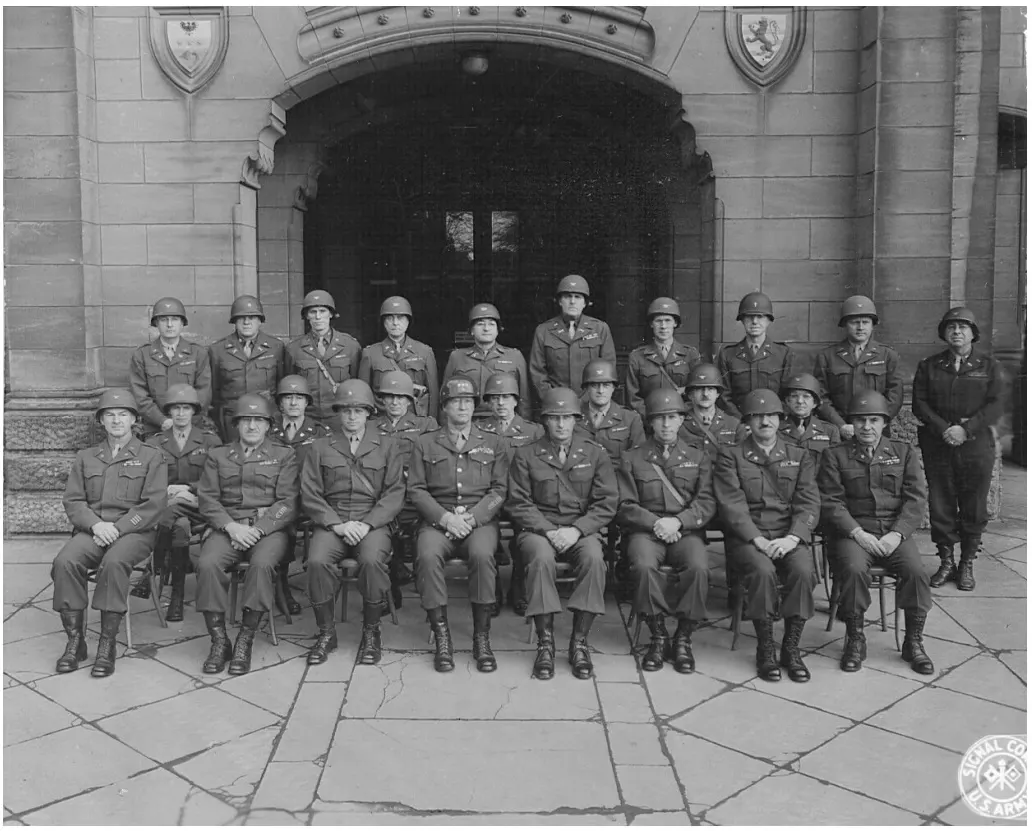
In Europe, the M1 Garand equipped American troops from the North African landings of Operation Torch in late 1942 through the Normandy invasion, the liberation of France, and the drive into Germany.13 General George S. Patton's January 1945 letter praising the rifle came in the middle of the Third Army's advance across France and into the Rhineland, at a moment when the M1's rate of fire was giving American squads a real edge over German infantry still armed primarily with the bolt-action Karabiner 98k.5
Combat reports throughout the war praised the M1 Garand's reliability in mud, sand, and jungle humidity, conditions that had crippled some earlier semi-automatic rifle designs tested by other armies. Total wartime production from Springfield Armory and Winchester reached 4,040,802 rifles by the end of 1945, a scale no other nation's semi-automatic infantry rifle came close to matching during the war.13
Saving Private Ryan is one of the few WWII films that accurately reproduces the M1 Garand's clip-ejection ping, and the rifle has appeared in nearly every World War II era Call of Duty game since the franchise began.14
Korea and the Retreat from the Changjin Reservoir
The M1 Garand remained the standard American infantry rifle through the Korean War, and the Department of Defense restarted wartime-scale production, awarding new contracts to Springfield Armory, International Harvester, and Harrington & Richardson between 1951 and 1953.15 Marines and soldiers withdrawing from the Changjin (Chosin) Reservoir in November and December 1950 fought in temperatures that reportedly dropped to 20 or 30 degrees below zero Fahrenheit, cold enough that standard lubricants froze solid inside the action and jammed the rifle.16
The M1 Garand's ruggedness under those conditions became part of its reputation within the Marine Corps and Army units that fought the retreat, even as commanders learned to change their maintenance routines for genuinely arctic conditions. Korean War production added roughly 1.4 million more M1 rifles across the three manufacturers before Springfield Armory finally halted M1 output in 1957 in favor of the incoming M14.15
World War II, the Pacific and European Theaters
The M1 Garand's largest and best-documented combat record comes from World War II, where it equipped American forces in nearly every theater, from the defense of the Philippines and the island campaigns of the Central Pacific to North Africa, Italy, and the liberation of Western Europe.13 It was standard issue for both the U.S. Army and, from 1943 onward, the U.S. Marine Corps, which had entered the war still carrying the M1903 Springfield in many front-line units.13
The Korean War
American, and later South Korean, forces relied on the M1 Garand as their primary infantry rifle throughout the Korean War, including during the fighting retreat from the Changjin Reservoir and the later static battles along the 38th parallel.16 South Korea continued issuing M1 Garands to its own army for years after the armistice, eventually supplying troops it deployed to the Vietnam War in the 1960s.6
Vietnam and the Rifle's Long Retirement
By the time the Vietnam War escalated in the mid-1960s, the M1 Garand was already a generation behind the M14 and, soon after, the M16 in American service, but it remained widely used by South Vietnam's own forces. More than 220,000 M1 rifles reached the Army of the Republic of Vietnam, though ARVN troops, on average smaller and lighter than the American soldiers the rifle was originally sized for, frequently preferred the lighter M1 Carbine.17
Captured M1 Garands also turned up in Viet Cong and North Vietnamese hands through the mid-1960s, valued for their range and punch even by fighters who generally favored lighter carbines and captured automatic weapons.17
The M1C and M1D Sniper Rifles
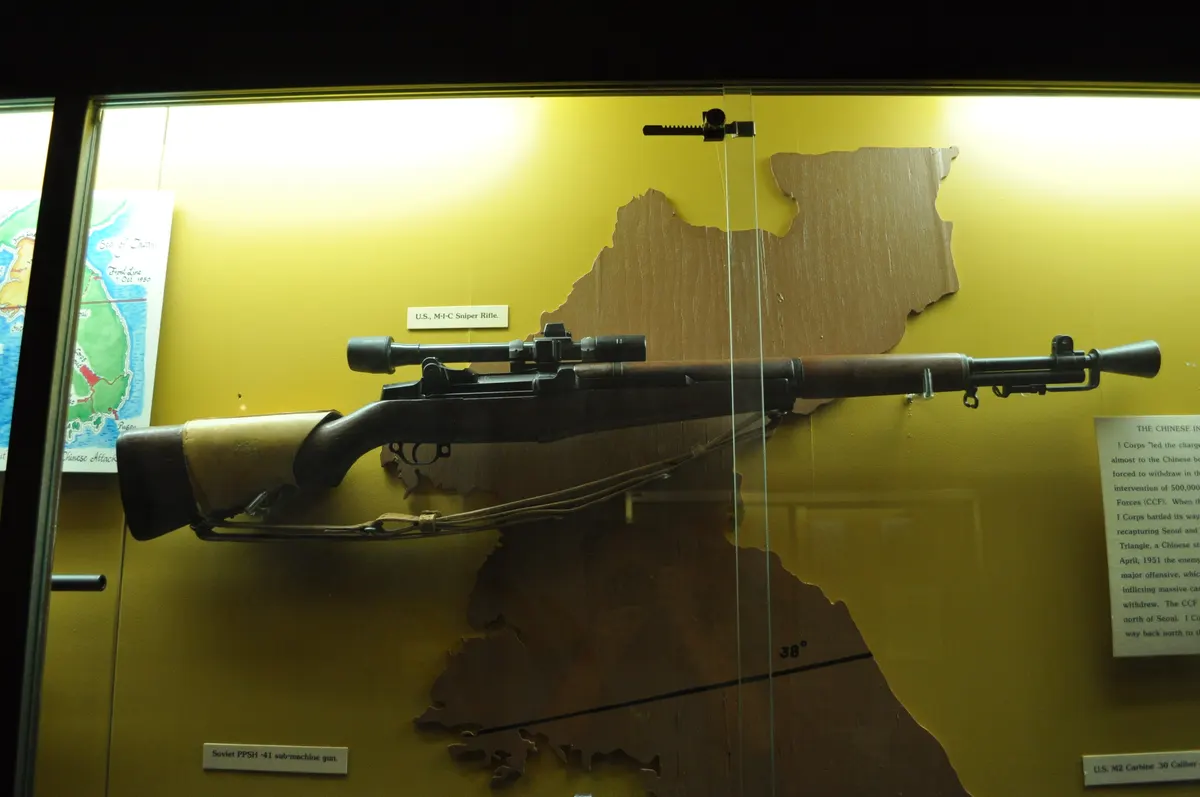
The U.S. Army adopted the M1C as its standard sniper rifle in June 1944 to supplement the aging M1903A4, fitting a Griffin & Howe scope mount to the receiver's left side along with a leather cheek pad and a flash hider in place of the bayonet lug.18 Wartime M1C production reached only 7,971 rifles, too few and too late to see wide combat use before the war ended.18
The M1D, standardized after the war, simplified the conversion by mounting the scope on a barrel-mounted bracket instead of the receiver, letting armorers convert a standard M1 Garand to sniper configuration with a simple barrel swap.18 Korean War production reached 4,796 more M1C rifles and 21,380 M1D rifles, though few M1Ds reached troops before the fighting ended.18
The T20 Selective-Fire Prototype and the Road to the M14
In 1944, Springfield Armory began work on the T20, a select-fire M1 Garand derivative feeding from a 20-round detachable magazine instead of the fixed en bloc clip.4 The T20 exceeded the Army's mandated 9-pound weight limit and never reached mass production before the war ended, though roughly 100,000 T20E2 rifles were ordered in 1945 before the contract was cancelled.4 The T20's mechanism carried forward almost unchanged into the postwar T44 prototype series, which combined the T20E2's breech and magazine catch with a gas system derived from other experimental rifles.4 The T44E4 variant was standardized as the M14 in 1957, closing the loop from Garand's own wartime selective-fire experiments to the rifle that replaced his original design in U.S. service.4
The T26 Tanker and Postwar Commercial Conversions
Near the end of World War II, Springfield Armory built a single prototype T26 Tanker Garand, a shortened M1 Garand with an 18-inch barrel intended for tank crews and airborne or jungle troops who needed a handier weapon than the full-length rifle.19 The T26 never entered production, but the concept re-emerged commercially decades later, when American gunsmiths began shortening surplus M1 Garands into tanker configurations for the civilian market, a conversion cheap and simple enough that unmodified original M1 Garand barrels remain in demand among collectors specifically because so many others were cut down.19


| Year | Buyer | Quantity | Amount | Present Value (2025) |
|---|---|---|---|---|
| 1964 |  Denmark | 49,000 | — | — |
| 1960 | Denmark | 20,000 | — | — |
| 1952 |  Italy | 100,000 | — | — |
| 1950 | Denmark | 20,000 | — | — |
NATO Standardization and Cold War Allies
The M1 Garand armed far more than just the United States military. Firearms researcher Bruce Canfield's survey of American military aid found M1 rifles delivered to dozens of countries after 1945, including Italy, Denmark, Greece, Turkey, France, West Germany, Japan, and South Korea, alongside a long list of Latin American, Middle Eastern, and Southeast Asian recipients.6 Most of this went out through American Mutual Defense Assistance Program aid as NATO and other allied armies rearmed in the early Cold War, before newer rifles like the M14 and, eventually, the FN FAL and G3 rendered the Garand obsolete in first-line European service.6
License Production in Italy and Denmark's Gevaer m/50
Italy formally adopted the M1 Garand as its standard battle rifle after the war and licensed Beretta and Breda to build it domestically starting in 1952, using tooling shipped over from Winchester's wartime production line.20 Roughly 100,000 Italian-made M1 rifles were produced through the 1950s, and Italy became NATO's official supplier of newly manufactured M1 Garands for other alliance members during that period.20 Denmark took delivery of 20,000 American-made M1 rifles on loan in 1950 under a bilateral defense agreement, later purchasing another 49,000 directly from the United States (including 1,000 M1D sniper rifles) and 20,000 more from the Italian production line, adopting the rifle as the Gevaer m/50.20
Beretta also filled M1 Garand contracts for Indonesia and Yemen, extending Italian-built Garands well outside NATO's own membership and giving the rifle a genuinely global service footprint that outlasted its American front-line career by more than a decade.20
Twilight Service and the Vietnam War
The M1 Garand's active military service outlived its official American retirement by years. Beyond South Korea and South Vietnam, the rifle stayed in reserve or second-line service with several NATO militaries into the 1960s and 1970s, and many countries only fully retired it once surplus M14s or M16-pattern rifles became available in quantity. In the United States itself, the rifle's public life continued long after its combat career ended, through the Director of Civilian Marksmanship program, formed in 1916, and its successor, the Civilian Marksmanship Program (CMP), created when Congress privatized the DCM in 1996.21 The CMP still sells surplus M1 Garands to eligible American buyers today, capping purchases at twelve rifles per customer per year as of a 2025 policy update.22
The M1 Garand vs the Karabiner 98k, Firepower Decided the Argument
Germany's standard infantry rifle for most of World War II, the Karabiner 98k, traced its basic Mauser bolt-action design back to the 1890s and fed from a 5-round internal magazine loaded with stripper clips.23 The M1 Garand's real advantage was sustained rate of fire in an actual firefight, not accuracy, since a skilled bolt-action shooter with a K98k could match a Garand shot for shot on a range.23 An American rifle squad armed with Garands could put far more aimed shots downrange in the same span of time than a German squad working bolts between every round, and that gap mattered most exactly where infantry combat happened most, at short and medium range under time pressure.23
| Spec | M1 Garand | Karabiner 98k |
|---|---|---|
| Action | Gas-operated, semi-automatic | Bolt-action |
| Feed | 8-round en bloc clip | 5-round internal magazine |
| Cartridge | .30-06 Springfield | 7.92x57mm Mauser |
| Unloaded weight | 4.31 kg | approx. 3.9 kg |
The Karabiner 98k held real advantages of its own. It was lighter, cheaper to manufacture, and easier to maintain in the field, and German snipers built some of the war's most effective sniper rifles on the same action.23 But by the numbers that decided most WWII infantry engagements, the M1 Garand's semi-automatic firepower gave American squads a sustained-fire advantage the Wehrmacht never matched with the K98k, a gap contemporary German soldiers themselves acknowledged in postwar accounts.23
The M14, John Garand's Own Successor
Where the Karabiner 98k comparison is about two different armies' rifles, the M14 comparison is about the M1 Garand's own replacement, built by the same arsenal on a mechanism carried forward directly from Garand's operating rod and rotating bolt. The M14 kept the Garand's basic gas system but swapped the fixed 8-round clip for a 20-round detachable magazine and added select-fire capability, addressing the two complaints leveled against the M1 Garand most often by the mid-1950s.4 Adopted in 1957, the M14 served barely a decade as America's standard rifle before the M16 replaced it in Vietnam, a far shorter run than the M1 Garand's own two full decades of front-line American service.

Is the M1 Garand still in service today? No standing military still issues the M1 Garand as a first-line weapon, though small numbers remain in ceremonial and honor-guard use in several countries, and it stayed in reserve stocks with some armies into the 1970s.6 In the United States, surviving examples circulate mainly as civilian collector's rifles sold through the Civilian Marksmanship Program.22
How does the M1 Garand's en bloc clip work? A shooter presses an 8-round steel clip straight down into the open receiver, and the bolt strips off and chambers the top round automatically. After the eighth shot fires, the empty clip ejects on its own with the rifle's signature ping, and the action locks open, ready for a fresh clip.8
What caliber does the M1 Garand use? The M1 Garand is chambered for the .30-06 Springfield cartridge, firing a 150-grain (9.6 gram) bullet at roughly 853 meters per second (2,800 feet per second).9
What replaced the M1 Garand? The U.S. Army and Marine Corps adopted the M14, a rifle developed directly from the M1 Garand's own gas system and John Garand's later wartime prototypes, as the standard-issue replacement in 1957.4
How much did the M1 Garand cost the U.S. government? Wartime government production cost ran about $85 per rifle in 1943, reflecting the scale of Springfield Armory and Winchester's mass production rather than any reduction in build quality.2
Can civilians buy an M1 Garand? Yes. Eligible U.S. citizens who join a Civilian Marksmanship Program affiliated club can purchase surplus M1 Garands directly from the CMP, which continues selling them from remaining government stock decades after the rifle's military retirement.22
- "Garand's Military Rifles: M1 To M14", American Rifleman — americanrifleman.org ↩
- "U.S. M1 Garand Rifle Production", Springfield Armory National Historic Site, U.S. National Park Service — nps.gov ↩
- "John Garand", Wikipedia — en.wikipedia.org ↩
- "The M14 Rifle, John Garand's Final Legacy", American Rifleman — americanrifleman.org ↩
- "Patton & the Garand, Greatest Battle Implement Ever Devised", The Armory Life — thearmorylife.com ↩
- "The M1 Garand & the Cold War", The Armory Life — thearmorylife.com ↩
- "M1 Garand", Wikipedia — en.wikipedia.org ↩
- "Myths & Misconceptions, the M1 'ping'", Armament Research Services — armamentresearch.com ↩
- "What Ammo Does the M1 Garand Use? A Complete Guide", Crate Club — crateclub.com ↩
- ".276 Pedersen and the Other Garand?", The Armory Life — thearmorylife.com ↩
- "What's a Gas Trap Garand?", The Armory Life — thearmorylife.com ↩
- "Days of Infamy, The M1 Garand's Baptism By Fire", American Rifleman — americanrifleman.org ↩
- "Battle History of the M1 Garand in WWII", The Armory Life — thearmorylife.com ↩
- "M1 Garand", Internet Movie Firearms Database — imfdb.org ↩
- "The International Harvester M1 Garand, A New Rifle For The Nuclear Age", American Rifleman — americanrifleman.org ↩
- "Arms Of The Chosin Few", American Rifleman — americanrifleman.org ↩
- "the M1 Garand in Vietnam", WWII After WWII — wwiiafterwwii.wordpress.com ↩
- "M1 Rifle variations and experimental models", Springfield Armory National Historic Site, U.S. National Park Service — nps.gov ↩
- "The Real T26 Tanker M1 Garand", Forgotten Weapons — forgottenweapons.com ↩
- "Danish Gevaer m/50, An American Gun Made in Italy", Forgotten Weapons — forgottenweapons.com ↩
- "Civilian Marksmanship Program", Wikipedia — en.wikipedia.org ↩
- "M1 Garand", Civilian Marksmanship Program — thecmp.org ↩
- "Enemies, Garand vs. K98", The Armory Life — thearmorylife.com ↩