

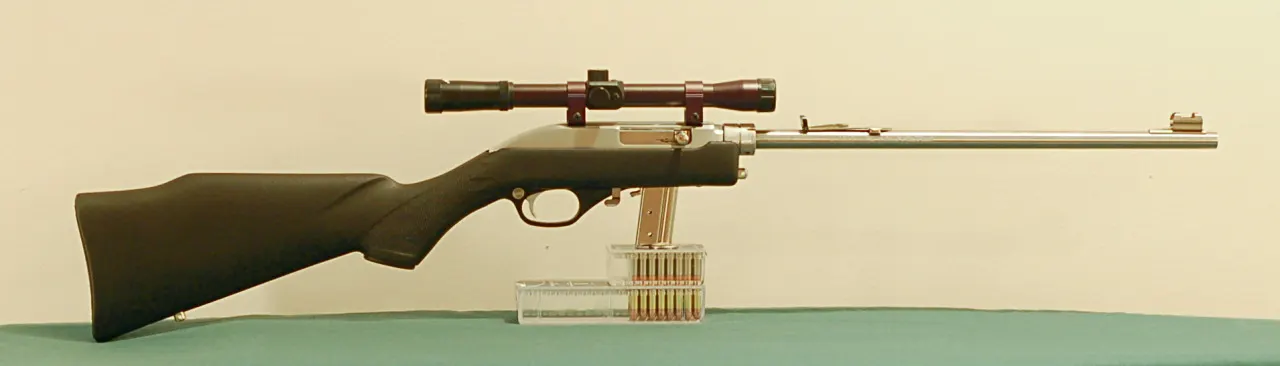

The Marlin Model 70P, nicknamed the Papoose, is a .22 Long Rifle semi-automatic takedown rifle built by Marlin Firearms of North Haven, Connecticut, starting in 1986. It is a compact, packable version of the standard Marlin Model 70, engineered so the barrel separates from the receiver in seconds and the whole rifle stores inside a padded case barely bigger than a rolled-up sleeping bag. Marlin built the Papoose for people who needed a rifle to travel as cargo rather than as a rifle, backpackers, canoeists, float-plane pilots and anyone assembling a compact survival kit.
- Barrel detaches and reattaches without tools or loss of zero
- Fits a padded case small enough for a backpack, boat locker, or aircraft seat pocket
- Reliable straight-blowback .22 LR action shared with the high-volume Model 60
- Sights mount to the barrel, so disassembly does not disturb the zero
- Stainless/synthetic 70PSS version resists rust in wet environments
- Standard 7-round magazine is small next to rivals with stock-stored spares
- Wood-stocked original 70P is noticeably heavier in the hand than its low empty weight suggests
- Open sights are dated compared to more modern takedown .22 rifles
- Aftermarket parts and magazines are scarcer than for the Ruger 10/22 platform
- No factory scope came standard, despite the rifle's built-in scope rail
The name comes from the Narragansett word for a young child carried on a parent's back, a reference to how the padded carrying case slings over the shoulder the way a Native American mother would carry an infant.1 Marlin leaned into that imagery in its own catalog copy, marketing the rifle explicitly to hikers and boaters rather than to hunters or target shooters.
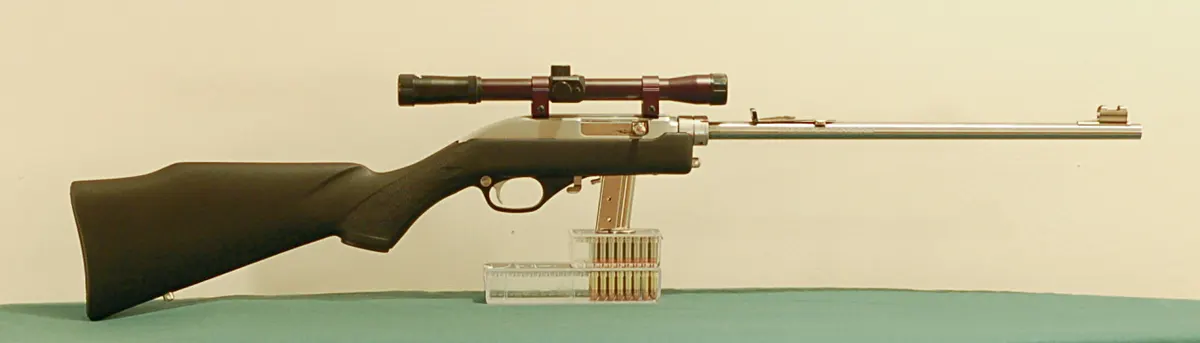
Mechanically the Papoose is a blowback-operated rimfire semi-automatic rifle, meaning it has no locked breech or gas system. The bolt's mass and a recoil spring hold the action shut just long enough for the low-pressure .22 LR cartridge to build and release pressure safely, a mechanically simple layout inherited from the older Marlin Model 60. It feeds from a detachable magazine with a standard capacity of 7 rounds, though Marlin also sold an optional factory 10-round magazine and aftermarket makers offered tubes holding up to 25 rounds over the rifle's production life.2 A 10-round figure is the one most often cited for the Papoose's magazine capacity, but that reflects the optional accessory magazine rather than the rifle's standard-issue 7-round unit.
Marlin priced the Papoose about thirty dollars above the standard Model 70 when it launched in 1986, at a $144.95 introductory MSRP, positioning it as an affordable specialist tool rather than a premium product.3 The rifle answers the recurring question of whether the Marlin Papoose is still in production clearly, it is not. Marlin discontinued the Model 70P line for good in 2015, and neither Remington nor Sturm, Ruger & Co., the two subsequent owners of the Marlin brand, has resumed manufacturing it.4 Surviving examples circulate only on the used market, where completeness of the original case and accessories drives price more than condition of the metal.
The Marlin Model 70P Papoose weighs 1.47 kg (3.25 lb) empty and measures about 895 mm (35.25 in) assembled, shrinking to roughly 533 mm (21 in) once the barrel is removed for storage.5 Its 413 mm (16.25 in) barrel is stainless steel on the later 70PSS and blued carbon steel on the original 1986 70P, rifled with Marlin's proprietary Micro-Groove system, a pattern of many shallow, low-profile grooves rather than the fewer, deeper grooves of conventional rifling. Marlin's own engineering rationale was that Micro-Groove deforms the bullet's jacket less on its way down the bore, which the company argued improved accuracy with thin-jacketed .22 LR ammunition.6 Independent test groups back that claim up in practice, one 2021 comparison test measured the Papoose as the most accurate of three takedown .22 rifles evaluated side by side, with five-shot groups as tight as 0.32 inches at 15 yards using Winchester Xpert high-velocity ammunition.7
- Weight (Empty)1.47 kg
What makes the Papoose distinct from an ordinary Model 70 is entirely in the takedown joint. A threaded steel sleeve fits permanently inside the receiver, and the barrel screws into it via a knurled barrel nut that the shooter loosens by hand or with a small supplied wrench (a coin works in a pinch). Marlin extended the bolt slightly at the breech end to bridge the gap created by the removable barrel, a small machining change from the fixed-barrel Model 70 that let the takedown joint sit forward of the chamber without compromising headspace.8 Both the ramp front sight, topped with a high visibility orange post under a hooded cover, and the adjustable open rear notch mount directly to the barrel rather than the receiver, so reassembling the rifle after a hike does not require re-zeroing it.9 The receiver itself carries an integral scope rail, called a tip-off mount in Marlin's own literature, for shooters who want to add an optic instead of relying on the iron sights.
- Cartridge.22 LR
- Calibre5.6 mm
- Case Length15.6 mm
- Bullet Weight2.6 g
- RimfireYes
The rifle ships with a cross-bolt safety at the rear of the trigger guard, and a manual bolt hold-open lever that is, unusually for a semi-automatic .22, also the only way to release the bolt and chamber a round after inserting a fresh magazine.10 That single detail routinely surprises first-time owners used to rifles that chamber automatically on magazine insertion, and gun-shop staff and reviewers alike flag it as the one control worth learning before a Papoose goes into a backpack for the first time.
- Fire ModesSemi-automatic
- Feed SystemDetachable Magazine
- Magazine Capacity7
Comparisons to the Papoose's most direct rival, the Ruger 10/22 Takedown, come up constantly in reviews, since both are .22 LR blowback semi-automatics designed to break into two carryable halves. The table below lines up the core numbers for the standard Papoose against the Ruger 10/22 Takedown.
- Barrel Length413 mm
- Rifling Grooves5
- Sight Typeadjustable open rear, ramp front with high visibility orange post
- Optic RailYes
- Iron SightsYes
| Spec | Marlin 70P Papoose | Ruger 10/22 Takedown |
|---|---|---|
| Empty weight | 1.47 kg (3.25 lb)5 | ~2.4 kg (5.2 lb)11 |
| Barrel length | 413 mm (16.25 in)5 | 470 mm (18.5 in)11 |
| Standard magazine | 7 rounds2 | 10 rounds (rotary)11 |
| Barrel takedown method | Threaded barrel nut | Spring-loaded lever and lug |
- Length (stock folded)533 mm
- Production Start1986
- Production End2015
- Variants2
Marlin introduced the Model 70P in 1986 as a purpose-built variant of the existing Model 70, itself descended from the Model 99 that Ewald Nichol designed for Marlin in the late 1950s and that evolved into the Model 60 by 1960.12 The Model 60 became one of the best-selling .22 rifles in American history, and Marlin's engineers used its proven action as the mechanical starting point when they set out to build a rifle that could be broken down small enough to disappear into a canoe pack or an aircraft's baggage compartment.
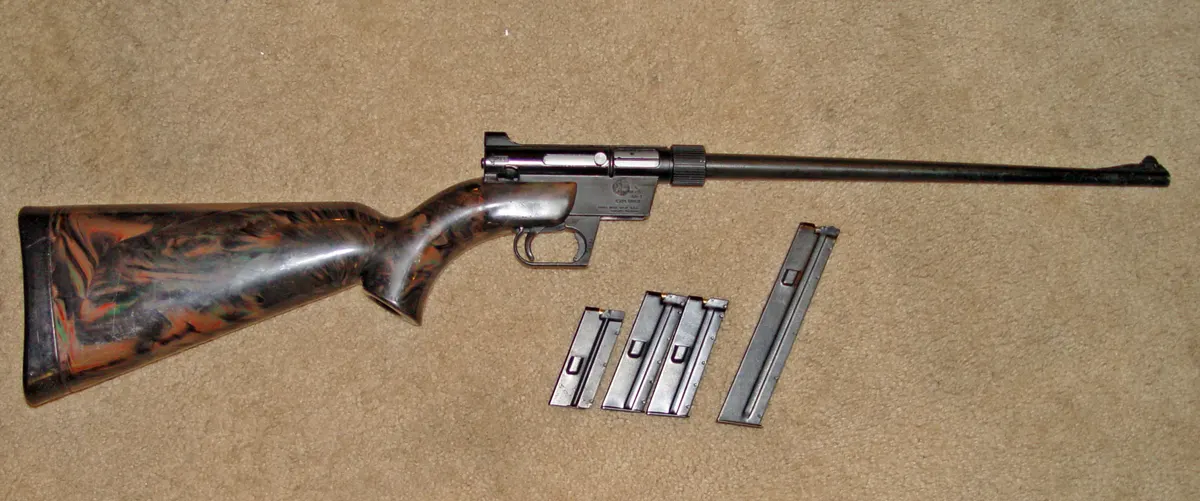
The Papoose entered a market already shaped by ArmaLite's AR-7, a rifle Eugene Stoner designed in 1959 that stored its own disassembled barrel and action inside a hollow, floating buttstock.13 Marlin took a different design approach, keeping a conventional stock but relying on a padded external case, also advertised as floatable, to carry the two halves of the disassembled rifle.14 Sales literature and period reviews pitched the Papoose at the same buyers the AR-7 already had, campers, boaters and private pilots who wanted a lightweight .22 they would not notice carrying until they actually needed it.
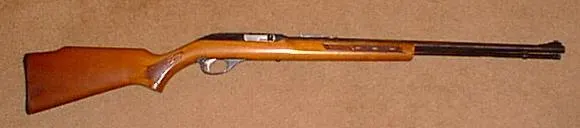
Marlin built the original blued-steel Model 70P from 1986 until 1994. In 1995 the company replaced it with the Model 70PSS, substituting a stainless steel barrel and receiver hardware and a synthetic, weather-resistant stock for the original's blued steel and hardwood, a change aimed squarely at the corrosion risk of carrying a takedown rifle in a boat or a rain-soaked pack.15 Remington Outdoor Company acquired Marlin Firearms in 2007 and kept the 70PSS in limited production through a period of well-documented quality-control problems at the North Haven factory, before discontinuing the model entirely in 2015.16 When Remington went through bankruptcy in 2020, Sturm, Ruger & Co. bought the Marlin brand and its tooling at auction, but Ruger has not brought the Papoose back into production, and the company does not stock parts for guns made after the Remington-era shutdown.17
No records surfaced of the Papoose being formally issued by a government agency or military service. Its market, then and now, is overwhelmingly civilian, sold through the same sporting-goods channels as the rest of Marlin's rimfire lineup rather than through any defense contract. That civilian focus is itself part of the answer to what the Marlin Papoose is used for, it was never meant to be a service weapon, only a practical, portable .22 for people already carrying a pack, a canoe, or a survival kit.
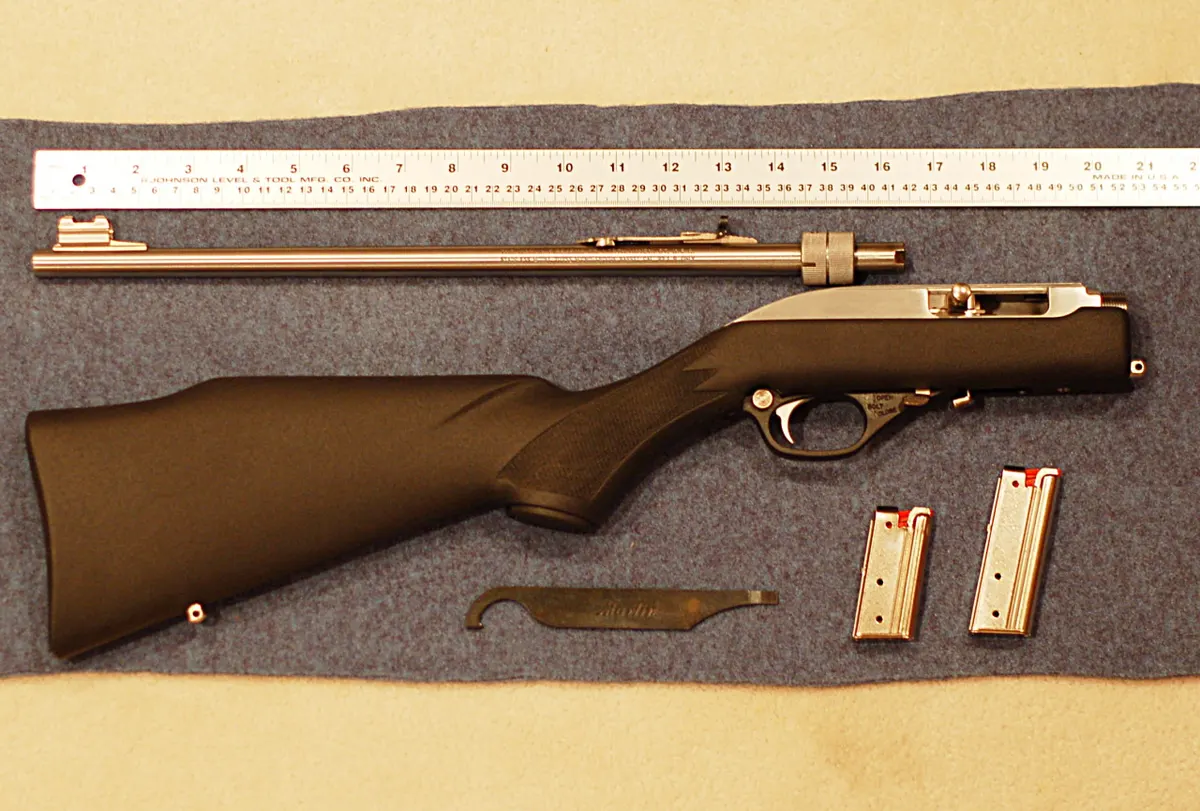
Marlin sold the Papoose in two main production generations. The original Model 70P, made from 1986 to 1994, used a blued carbon-steel barrel and receiver with a walnut-finished hardwood stock. The Model 70PSS, introduced in 1995 and built until the line's 2015 discontinuation, swapped in a stainless steel barrel and receiver hardware plus a black synthetic stock, trading a small amount of extra weight for meaningfully better corrosion resistance in the wet environments the rifle was actually designed for.15 Marlin also offered a nickel-plated finish on some Model 70P production runs and sold both 7-round and 10-round factory magazines across the line's life, with aftermarket manufacturers like Ramline, Champion and Pro-Mag later selling extended magazines holding 15 to 25 rounds.2
Both the Model 70P and Model 70PSS trace back to the fixed-barrel Marlin Model 70, sold today under the Marlin Model 795 name after a 1996 rebranding, and further back to the Model 60 action design. Marlin never marketed the Papoose in a different caliber or a select-fire configuration, and a variant count of just one undercounts the two distinct production generations (70P and 70PSS) that a complete variant history should reflect.


The Marlin Model 70P Papoose was sold almost entirely through United States civilian retail and mail-order channels from 1986 onward, the same distribution network Marlin used for the rest of its rimfire lineup.18 No government, military, or law-enforcement acquisition of the Papoose is documented in available sourcing, consistent with its status as a purely civilian sporting rifle rather than a service weapon.
It also reached Canada's civilian and outdoor-recreation market, a country where bush pilots operating in remote territory have long been expected to carry a survival firearm, a niche the Papoose's portability was explicitly marketed toward.19 Canadian and Alaskan float-plane operators in particular made up a recurring, if informal, customer base for takedown .22 rifles like the Papoose, valued for riding along as compact backup gear rather than as a primary defense weapon.
The Papoose and the ArmaLite AR-7 solved the same problem, a .22 rifle small enough to disappear into travel gear, with opposite engineering choices. Stoner's AR-7 stores its disassembled barrel, action and magazines entirely inside a hollow, buoyant polymer stock, so the rifle carries no separate case at all. The Papoose keeps a conventional one-piece stock and instead relies on an external padded case to hold its two halves together, a layout that makes the Papoose a few ounces lighter loaded but means losing or damaging that case leaves the rifle without proper storage, a vulnerability the AR-7's self-contained stock does not share.13 Reviewers who have tested both side by side generally rate the AR-7's stock-storage concept as more foolproof for true survival use, while rating the Papoose's fixed-barrel-mounted sights and Micro-Groove rifling as meaningfully more accurate on paper.20
Against the Ruger 10/22 Takedown, introduced in 2012, the comparison shifts from portability to ecosystem. Ruger's takedown mechanism, a spring-loaded lever and locking lug, separates the barrel with a quarter-turn and no tools, a faster operation than the Papoose's threaded barrel nut. The 10/22 Takedown also inherits the huge aftermarket support of the standard 10/22 platform, from replacement barrels to hundreds of stock and trigger options, a depth of parts support the lower-volume Papoose never built up. Where the Papoose still wins is raw compactness and weight, its 1.47 kg empty weight undercuts the roughly 2.4 kg Ruger 10/22 Takedown by nearly a kilogram, and its shorter 413 mm barrel packs into a noticeably smaller disassembled footprint.11 For a buyer weighing the Marlin Papoose vs Ruger 10/22 Takedown question, the practical answer tracks priorities, the Ruger wins on parts support and magazine capacity, the Marlin wins on raw pack weight and disassembled size.
| SPEC | Marlin Model 70P | Ruger 10/22 |
|---|---|---|
| Weight (Empty) | 1.47 kg | 2.27 kg |
| Barrel Length | 413 mm | 469.9 mm |
| Magazine Capacity | 7 count | 10 count |

Is the Marlin Papoose still in production? No. Marlin discontinued the Model 70PSS Papoose in 2015, and neither Remington nor current Marlin-brand owner Sturm, Ruger & Co. has resumed production.4
What caliber does the Marlin 70P Papoose use? The Marlin Model 70P Papoose is chambered exclusively in .22 Long Rifle, the same rimfire cartridge used by its Model 60 parent action.5
How much does a Marlin Papoose cost today? Since the rifle is discontinued, prices reflect the used market rather than a factory MSRP. A complete example with its original case commonly sells in the mid-to-high $300s to around $450 as of recent gun-shop listings, well above its 1986 introductory price of $144.95.3
How does the Marlin Papoose takedown mechanism work? The shooter locks the bolt open, loosens a knurled barrel nut by hand or with the supplied small wrench, and pulls the barrel forward out of a threaded steel sleeve fitted inside the receiver. Reassembly reverses the process, and because both sights mount to the barrel rather than the receiver, the rifle does not need to be re-zeroed afterward.8
What is the Marlin Papoose's magazine capacity? The Marlin Papoose's standard factory magazine holds 7 rounds of .22 LR, though Marlin also sold a 10-round factory magazine and aftermarket manufacturers offered magazines holding up to 25 rounds.2
- "Marlin Model 70P", Wikipedia — en.wikipedia.org ↩
- "Marlin Model 70P Papoose 22 LR", Gun Tests — gun-tests.com ↩
- "Gun Review: Marlin 70PSS (Take Down) 'Papoose' .22LR Rifle", The Truth About Guns — thetruthaboutguns.com ↩
- "Marlin 70P (Papoose) - Catt57's gun of the day #10", Oklahoma Shooters forum — okshooters.com ↩
- "Marlin Model 70PSS 'Papoose': Small Package, Big Fun, Survival Ready", GunsAmerica Digest — gunsamerica.com ↩
- "Marlin Model 60: Delivering Accuracy To Everyman", Gun Digest — gundigest.com ↩
- "Marlin Model 70P Papoose 22 LR", Gun Tests — gun-tests.com ↩
- "Featured Gun: The Marlin model 70P 'Papoose'", TINCANBANDIT's Gunsmithing — tincanbandit.blogspot.com ↩
- "Review: Marlin Papoose (Marlin 70PSS)", The Shooter's Log — blog.cheaperthandirt.com ↩
- "Marlin 70PSS 'Papoose' Review", The Hunting Gear Guy — huntinggearguy.com ↩
- "Ruger 10/22 Takedown", Ruger official product page — ruger.com ↩
- "Marlin Model 60", Wikipedia — en.wikipedia.org ↩
- "ArmaLite AR-7", Wikipedia — en.wikipedia.org ↩
- "Just Arrived: Marlin Papoose .22 Survival Rifle", Rocky Mountain Bushcraft — rockymountainbushcraft.blogspot.com ↩
- "Marlin 70pss", MarlinSpares.com — marlinspares.com ↩
- "Looking for discontinued Marlin 70PSS part", Marlin Firearms Forum — marlinowners.com ↩
- "Marlin 70P Papoose - Year of Manufacture", Marlin Firearms Forum — marlinowners.com ↩
- "Marlin / Glenfield 70P Papoose", Numrich Gun Parts — gunpartscorp.com ↩
- "Bush Pilot's Survival Kit", SuperCub.Org forum — supercub.org ↩
- "Marlin Model 70P Papoose 22 LR", Gun Tests — gun-tests.com ↩