

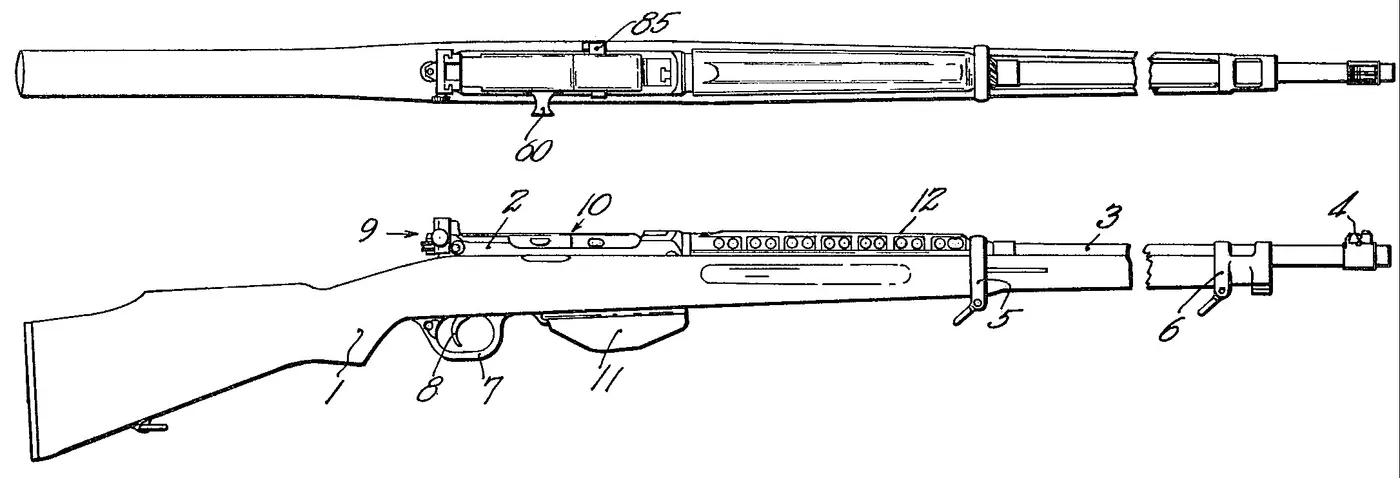

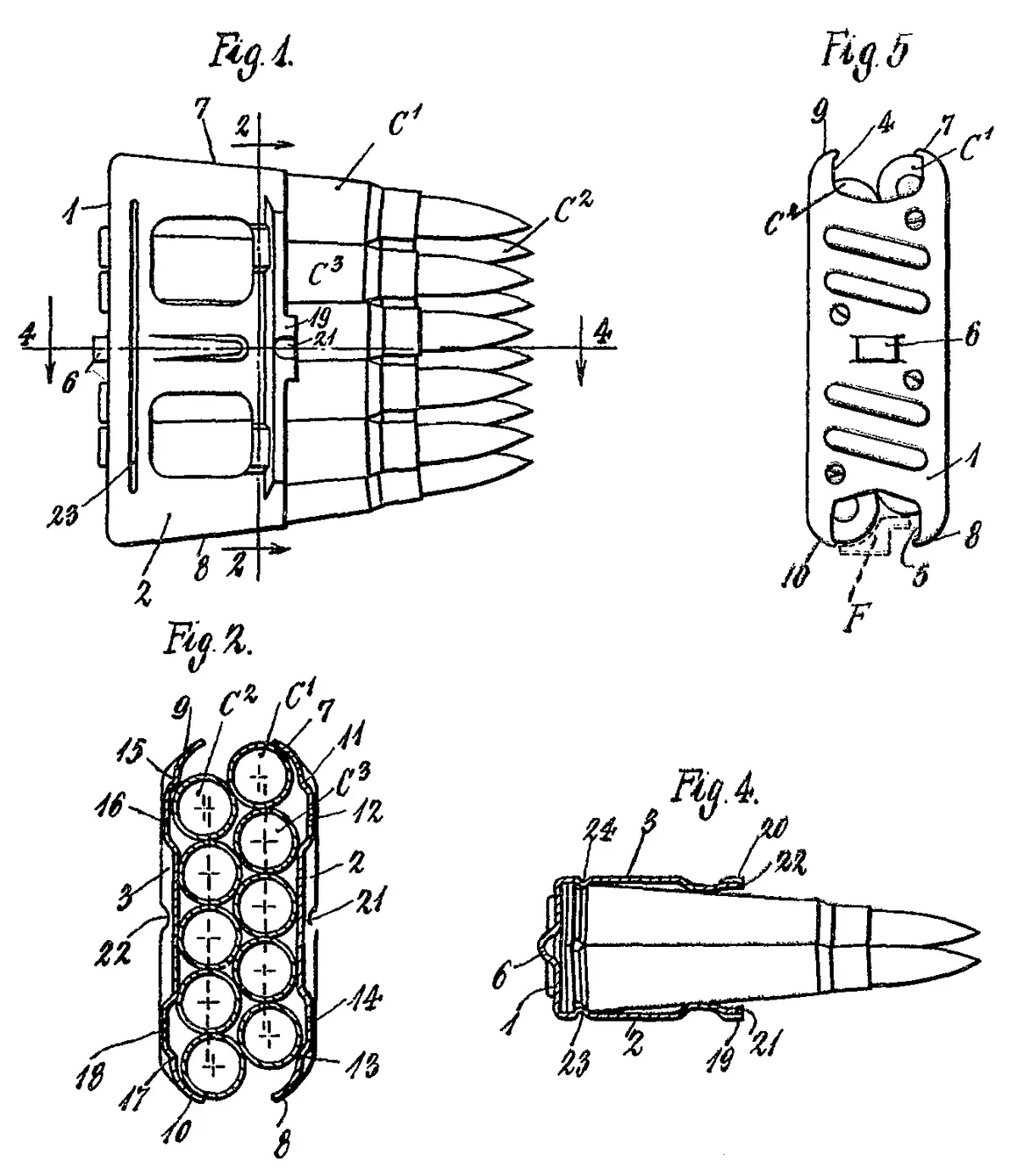
The Pedersen rifle, formally tested by U.S. Army Ordnance under the designation T1, came within a single board recommendation of becoming the standard American infantry rifle before losing out to the M1 Garand, John Garand's competing design.1 Designed by John D. Pedersen, a Remington Arms engineer already famous for his World War I era Pedersen device, a conversion unit that turned the bolt-action M1903 Springfield into a semi-automatic, pistol-caliber weapon, the rifle used an unusual delayed blowback toggle-lock action built around Pedersen's own .276 Pedersen cartridge rather than the Army's existing .30-06 Springfield round.2 It fed from a 10-round en bloc clip, much like the Garand rifle that eventually replaced the bolt-action Springfield in U.S. service, and it is one of the earliest semi-automatic rifles built around a genuinely intermediate-power rifle cartridge.3
- lighter, lower-recoil .276 Pedersen cartridge than .30-06
- smooth toggle-lock cycling once waxed ammunition was used correctly
- competitive accuracy against the rival Garand design in early trials
- simple aperture sights and a conventional wood stock familiar to Army riflemen
- required every cartridge to be waxed or the action would fail to extract
- wax coating risked collecting dirt and grit in field conditions
- more parts and higher production cost than the rival gas-operated Garand
- never adopted, so no combat record or spare-parts logistics ever developed
John Pedersen began development in 1924 under a 1923 Army Ordnance contract that included office space, a project budget, and royalty rights if his rifle reached adoption, an unusually generous arrangement that reflected how highly Ordnance rated him.4 John Moses Browning reportedly told Army ordnance officer Julian Hatcher that Pedersen was the greatest gun designer in the world, a reputation built on the Pedersen device and the commercial Remington Model 51 pocket pistol before he ever touched a service rifle.5 The Pedersen rifle's .276 Pedersen cartridge fired a 7mm bullet at about 792 meters per second (2,600 feet per second), generating noticeably less recoil and heat than the .30-06 Springfield the rifle was meant to replace.2
Roughly 150 Pedersen rifles and carbines were built in total across Springfield Armory, the British firm Vickers-Armstrongs, and a small Japanese trial batch, making it a genuinely rare weapon today even among prewar American prototype rifles.6 The design never entered production or active service with any army, and in_service status in Army terms was always testing rather than issue.1
The Toggle-Lock Action That Needed Waxed Ammunition
The Pedersen rifle's action was a delayed blowback toggle-joint mechanism, visually and mechanically similar to the toggle lock of the German Luger pistol.7 Three parts, the breech block head, the block body, and a hinged crank, worked together so that chamber pressure forced the toggle to fold and unlock only after the crank had cammed through a set geometry, delaying extraction long enough for pressure to drop to a safe level.7 The system let Pedersen avoid both the heavy operating rod of a gas-operated rifle and the violent recoil-driven cycling of a straight blowback design, and it let him build a rifle that, in early prototype form, weighed close to 4.1 kilograms (about 9 pounds) unloaded.8
- First Production Year1924
- DesignerJohn Pedersen
- Weight (Empty)4.1 kg
- Weight (Loaded)4.3 kg
- Currently In ServiceNo
- Notable UsersUnited States Army; Imperial Japan
The catch was ammunition. A pure blowback-style toggle action extracts the fired case while chamber pressure is still high, which tears a dry brass case apart unless the case can slide freely in the chamber. Pedersen's solution was to coat every .276 Pedersen cartridge in a thin, hard mineral wax film before loading.9 The coating was not sticky to the touch and worked well on the range, but Army testers worried openly that the wax would attract sand, dust, and battlefield grit over the coating's working life, and that fear became one of the strongest arguments against the rifle during formal trials.9
- Cartridge.276 Pedersen
- Calibre7.01 mm
- Case Length51 mm
- Calibre Classintermediate
- RimfireNo
- Caseless AmmunitionNo
The .276 Pedersen Cartridge and Why It Nearly Replaced .30-06
Pedersen designed the .276 Pedersen cartridge (7x51mm) specifically to make a lighter, easier-shooting semi-automatic infantry rifle practical, about half an inch shorter than .30-06 and roughly a quarter lighter overall.2 It fired a 140 or 150 grain 7mm bullet at approximately 792 meters per second (2,600 feet per second), comparable in trajectory to .30-06 out to normal combat ranges while producing markedly less recoil and about a third less chamber heat, an early example of the same intermediate-cartridge logic that later drove the development of 7.62x51mm NATO and eventually 5.56mm ammunition.2 The rifle itself carried a 610 millimeter (24 inch) barrel, adjustable aperture sights, and a conventional wood stock with a bayonet mount, fed by the same style of 10-round en bloc clip Pedersen had already used in earlier prototype work.3
- Action TypeDelayed Blowback
- Fire Modessemi-automatic
- Select FireNo
- Feed SystemClip
- Magazine Capacity10
By 1926, prototype rifles authorized under the T1 designation numbered twenty rifles plus five carbines, enough for the Army's Infantry Board to begin serious evaluation.4 The caliber class for .276 Pedersen sits between a full-power rifle round and a pistol cartridge, closer to what a modern reader would recognize as an intermediate rifle cartridge than to the .30-06 it was meant to displace.2
- Muzzle Velocity792 m/s
- Effective Range (point)274 m
- Barrel Length610 mm
- Optic RailNo
- Iron SightsYes
- Threaded BarrelNo
- Total Production150
- Production Start1924
- Variants4
Springfield Trials and the Rise of the Rival Garand
Testing of the Pedersen rifle began in February 1926 with results the Infantry Board called highly favorable, and by April 1928 the board actually recommended adopting a refined version, the T1E3, to replace both the bolt-action M1903 Springfield and the Browning Automatic Rifle in front-line infantry use.10 Lethality trials that summer, run against anesthetized pigs, found the .256, .276, and .30 caliber rounds under consideration all roughly equally effective at ordinary combat ranges, removing killing power as a decisive argument for any one cartridge.10
The joint Army, Navy, and Marine Corps Semiautomatic Rifle Board rated the T1E3 the stronger rifle overall in 1929 testing, but flagged John Garand's own gas-operated .276 caliber prototype, the T3, as more reliable in practical handling, and recommended building twenty T3 rifles for further service trials.11 That decision put Pedersen's toggle-lock design on a collision course with a rival mechanism built by an engineer working in the very same Springfield Armory building.
The 1931 Showdown and MacArthur's Veto
Infantry Board trials in 1931 were decisive. Garand's refined T3E2 needed only 60 parts against the Pedersen T1E3's 99, and testers judged it superior in both effective firepower and simplicity of construction, without any need for waxed ammunition.13 On January 4, 1932, the board recommended limited procurement of roughly 125 T3E2 Garand rifles in .276 caliber, a decision that effectively eliminated the Pedersen rifle from further consideration a full month before the moment most popular accounts blame for its rejection.14
That moment came the very next day. Army Chief of Staff Douglas MacArthur personally disapproved any change away from the existing .30 caliber round on January 5, 1932, citing the enormous cost of replacing the Army's stockpiled .30-06 ammunition and re-chambering machine guns across the force.15 On February 25, 1932, Adjutant General John B. Shuman formally ordered all work on .276-caliber rifles and ammunition stopped immediately, directing Ordnance to concentrate entirely on perfecting Garand's rifle in .30-06 instead.15 MacArthur's veto killed the .276 Pedersen cartridge project outright, but the Pedersen rifle itself had already lost the head-to-head competition against Garand's design before that veto ever landed, a distinction most retellings of the story compress into a single moment.
Garand spent the next several years reworking his own rifle around the .30-06 cartridge, a process that produced the M1 Garand, standardized in January 1936 as the first semi-automatic rifle to arm a major army's infantry as standard issue.16 Pedersen, for his part, briefly pursued a gas-operated .30-06 successor of his own under the internal designations GY and GX, but neither reached production once the Army had already committed fully to Garand's rifle.17
Vickers-Armstrongs and a Brief Chance in Britain
Even as the U.S. Army trials continued, Pedersen tried to find the rifle a market elsewhere. He traveled to the United Kingdom in 1930 to help Vickers-Armstrongs tool up production at its Crayford works, where the company built more than 200 rifles and a smaller number of carbines for testing by the British government and for possible sale to other countries.6 Surviving Vickers-made examples show detail differences from the Springfield-built originals, including a curved, symmetrical clip profile and a reshaped stock, evidence that Vickers reworked elements of Pedersen's design rather than simply copying the American prototype outright.6 Britain never adopted the rifle either, and the Vickers-Armstrongs production run remains the largest single batch of Pedersen rifles ever built, larger even than the original Springfield Armory prototypes.6
A Japanese Trial in 6.5mm
In 1932, Pedersen traveled to Japan himself to demonstrate the rifle in hopes of a foreign sale, and by 1935 the Koishikawa Arsenal in Tokyo had built roughly two dozen examples reworked to fire the Japanese Army's own 6.5mm service cartridge.18 General Yoshida, the arsenal officer overseeing the project, kept Pedersen's toggle-lock mechanism but replaced the American ten-round clip with a five-round Schoenauer-style spool magazine and fitted Arisaka-pattern sights and a Japanese bayonet lug.18 Roughly twelve rifles used a shorter 22.5 inch barrel and twelve a longer 26.5 inch barrel, giving Japanese testers a direct side-by-side comparison of handling length.18
The Japanese trial program collapsed by 1936, and one recurring explanation stands out. Japanese ordnance officers reportedly never fully grasped how important consistent case lubrication was to the toggle-lock action's reliability, the same waxed-cartridge weakness that had already worked against the design in the United States.18 No Japanese production version ever followed, and the Imperial Japanese Army continued issuing bolt-action Arisaka rifles as its standard infantry weapon for the rest of its existence.
The Pedersen rifle existed in more forms than the single T1 prototype most references cite. Springfield Armory built both a standard rifle and a shorter carbine version from the original 1926 authorization of twenty rifles and five carbines.4 Vickers-Armstrongs in Britain built its own production variant with a distinct clip shape and stock profile, the largest batch of any Pedersen-pattern rifle ever manufactured.6 The Koishikawa Arsenal in Japan built a 6.5mm conversion with a five-round Schoenauer-style magazine, Arisaka sights, and a Japanese bayonet lug, produced in both short and long barrel lengths for comparison testing.18 After the U.S. Army's 1932 rejection, Pedersen briefly pursued gas-operated .30-06 successors under the internal names GY and GX, distinct designs that abandoned the toggle-lock action entirely but never left the prototype stage.17


No army ever formally adopted the Pedersen rifle for issue. The United States Army tested it extensively between 1926 and 1932 through Springfield Armory and the Infantry Board before rejecting it in favor of the Garand.10 The United Kingdom evaluated the Vickers-Armstrongs production version starting around 1930 without adopting it either.6 Japan's Imperial Army trialed a 6.5mm conversion through the Koishikawa Arsenal between roughly 1935 and 1936 before abandoning the program.18 All three episodes were formal government trials rather than any kind of active service, and no Pedersen rifle of any variant ever issued to troops for combat use.
The Pedersen Rifle vs the M1 Garand, Two Roads to the Same Requirement
Both rifles chased the identical Army requirement of a semi-automatic infantry rifle to replace the bolt-action M1903 Springfield, and both were originally built and tested in the .276 Pedersen caliber before caliber politics intervened.2 Where the two designs genuinely diverged was mechanism. The M1 Garand used a gas-operated rotating bolt that cycled on ordinary dry ammunition, while the Pedersen rifle's delayed blowback toggle-lock only worked with waxed cartridges, a dependency Army testers treated as a serious field liability rather than a minor inconvenience.13 Garand's rifle also proved mechanically simpler, needing 60 parts to the Pedersen's 99 in their final 1931 trial configurations, a gap that mattered as much for wartime mass production as for peacetime reliability.13
| Spec | Pedersen Rifle (T1) | M1 Garand |
|---|---|---|
| Action | Delayed blowback toggle-lock | Gas-operated rotating bolt |
| Feed | 10-round en bloc clip | 8-round en bloc clip |
| Original cartridge | .276 Pedersen | .276 Pedersen, later .30-06 Springfield |
| Ammunition requirement | Waxed cases required | Standard dry ammunition |
| Adopted | Never | January 1936 |
The M1 Garand's real advantage was never raw accuracy, since both rifles shot well enough in testing to satisfy the Infantry Board.11 It was reliability without a maintenance dependency, a rifle that any Army ordnance depot could feed with existing ammunition stocks rather than a special waxed product line. That single difference decided which rifle armed millions of American soldiers through World War II and the Korean War and which rifle survives today only as a rare collector's prototype.16


What is the Pedersen rifle? The Pedersen rifle, tested by the U.S. Army as the T1, is a semi-automatic rifle designed by John D. Pedersen in the 1920s and early 1930s, chambered in his own .276 Pedersen cartridge and built around a delayed blowback toggle-lock action.1
Why was the Pedersen rifle rejected? The Infantry Board judged John Garand's rival gas-operated design simpler and more reliable in 1931 trials, and Army Chief of Staff Douglas MacArthur separately vetoed any switch away from the existing .30 caliber cartridge in early 1932, together ending the Pedersen rifle's chances of adoption.15
What cartridge did the Pedersen rifle use? It used the .276 Pedersen, a 7x51mm cartridge firing a 140 to 150 grain bullet at roughly 792 meters per second (2,600 feet per second), designed specifically for lighter recoil and a shorter action than .30-06 Springfield allowed.2
How does the Pedersen rifle's toggle-lock action work? A hinged toggle joint delays the breech opening after firing, similar in principle to the Luger pistol's mechanism, but the design only functioned reliably with cartridges coated in a thin wax lubricant to ease extraction.7
Did Japan use the Pedersen rifle? Japan never adopted it. The Imperial Japanese Army's Koishikawa Arsenal built roughly two dozen 6.5mm trial examples between 1935 and 1936 before abandoning the program.18
How many Pedersen rifles were made? Estimates put total production, across Springfield Armory prototypes, Vickers-Armstrongs production in Britain, and the Japanese trial batch, at somewhere around 150 rifles and carbines, making surviving examples genuinely rare today.6
Is an original Pedersen rifle valuable to collectors? Yes. Surviving examples, including Vickers-Armstrongs production rifles, regularly sell at specialist firearms auctions for prices reflecting their extreme rarity and their direct connection to the M1 Garand's development story.6
- "Pedersen rifle", Wikipedia — en.wikipedia.org ↩
- ".276 Pedersen", Wikipedia — en.wikipedia.org ↩
- "US Pedersen .276 Rifle", Forgotten Weapons — forgottenweapons.com ↩
- "Experimental semi-automatic rifle by John Pedersen, 1919-1931", Springfield Armory National Historic Site, U.S. National Park Service — nps.gov ↩
- "John Pedersen (arms designer)", Wikipedia — en.wikipedia.org) ↩
- "Vickers-Armstrongs Ltd. Pedersen Self-Loading Rifle", Rock Island Auction — rockislandauction.com ↩
- "The .276 Pedersen, The Almost Intermediate Cartridge", Global Ordnance News — globalordnancenews.com ↩
- "Springfield Armory U.S. T1 Rifle 276", Rock Island Auction — rockislandauction.com ↩
- ".276 Pedersen and the 'Other' Garand?", The Armory Life — thearmorylife.com ↩
- "Pedersen rifle", Grokipedia — grokipedia.com ↩
- "RIA: T3E2 Trials .276-Caliber Garand", Forgotten Weapons — forgottenweapons.com ↩
- "The Pedersen Device, A Secret Weapon Of WWI", American Rifleman — americanrifleman.org ↩
- "Collected Works of John Pedersen", Forgotten Weapons — forgottenweapons.com ↩
- "T1 Rifle Pedersen's Patent", Smithsonian National Museum of American History — si.edu ↩
- "Garand's Military Rifles, M1 To M14", American Rifleman — americanrifleman.org ↩
- "M1 Garand", Wikipedia — en.wikipedia.org ↩
- "Rare Serial Number 1 Prototype Pedersen Model GX Semi-Automatic", Rock Island Auction — rockislandauction.com ↩
- "RIA: Japanese Army Pedersen Copy Trials Rifle", Forgotten Weapons — forgottenweapons.com ↩