


More than 1,050,000 examples of the Remington Nylon 66 left the factory between 1959 and 1989, making it the best-selling .22 Long Rifle rimfire rifle Remington Arms ever built. The Remington Nylon 66 matters less as a hunting or sporting tool than as an engineering event. It was the first mass-produced rifle in the world with a stock and receiver housing molded from plastic rather than cut from wood or machined from steel, and that single decision turned a routine cost-cutting exercise at Remington's plant in Ilion, New York, into one of the best-selling semi-automatic rifles in the semi-automatic-rifles category ever made in any caliber.
- virtually maintenance-free blowback action
- molded nylon resists rust, rot, and warping
- light carry weight at 1.81 kg
- enormous surviving parts and shooter base
- genuinely unusual engineering history
- fixed tube magazine, no detachable box option
- long out of production since 1989
- point of impact shifts with how tightly the stock is gripped
- replacement parts increasingly scarce
The material was DuPont's Zytel 101, a nylon resin developed specifically for this rifle at Remington's request. Remington's own engineers, led by Wayne E. Leek with Charles H. Morse and Homer W. Young, designed the rifle around a blowback action feeding from a 14-round tubular magazine tucked into the buttstock, a layout borrowed from decades of earlier .22 rifles but wrapped for the first time in a receiver that owed nothing to a machine shop. Remington marketed it, without exaggeration for once, as the rifle of tomorrow.1 Buyers responded immediately, and demand through 1959 outran what the Ilion plant could injection-mold.2
Remington's own sales literature leaned hard on the material's resistance to fading, warping, shrinking, chipping, and the usual list of things that ruin a wood-stocked .22 rifle left in a barn or a boat locker.3 The claim held up well enough in the field that the Remington Nylon 66 became a fixture of American farm trucks, tackle boxes, and gun-safe corners for a generation, competing directly against wood-stocked contemporaries like the earlier Winchester Model 1903 and, decades later, against the detachable-magazine Ruger 10/22 that eventually took over the market the Nylon 66 had helped create. Even collectors who never fire theirs tend to know the specific shade names, Mohawk Brown, Apache Black, Seneca Green, stamped into Remington's own catalog copy from 1959 onward.
Production ran continuously from January 1959 until 1989, a 30-year span with almost no change to the basic mechanism. That consistency is part of why the Remington Nylon 66 still shows up so often at gun shows and estate sales relative to its age, and why so many are still shot regularly rather than kept as safe queens. The core specification, a 495 mm barrel, a 1.81 kg empty weight, and a fixed 14-round tube, changed hardly at all across three decades of manufacture, even as the color options and limited-edition runs multiplied around it.
Search interest in the Remington Nylon 66 has stayed remarkably steady for a rifle out of production since 1989, driven mostly by two questions, how much a given color or commemorative example is worth today, and how it stacks up against the Ruger 10/22 that inherited its slot in the American rimfire market. Both questions get a fuller answer further down, in the Variants and Comparison sections below.
Remington did not set out to build a plastic gun for its own sake. In the mid-1950s the company's engineers were looking for ways to cut production cost out of the two most labor-intensive parts of any .22 rifle, the wooden stock and the machined steel receiver.2 Rather than shave cost off a conventional design, Remington handed its corporate cousin DuPont an unusually demanding brief, a material that could be injection-molded into any shape, had high tensile-impact and flexural strength, resisted heat distortion and cold-weather embrittlement, would not keep burning if exposed to flame, shrugged off solvents, oils, mild acids, rodents, insects, and fungus, held a permanent color without fading, and needed no added lubrication against itself.2 DuPont's chemists returned an answer inside four months, a nylon-6,6 compound they branded Zytel 101.2
- First Production Year1959
- DesignerW.E. Leek, C.H. Morse, H.W. Young
- Weight (Empty)1.81 kg
- Currently In ServiceNo
- Notable UsersBolivian Police Forces
The stock and receiver housing were injection-molded in two long halves, one cut with a tongue and the other with a matching groove, then bonded together with an adhesive collectors still refer to today by its original commercial name, Duco cement.4 A thin sheet-steel cover snaps over the top of the nylon receiver to carry the bolt track and give the rifle its familiar silver or black metallic look, but the structural receiver underneath is entirely plastic. The blowback action inside cycles on the friction-free nylon-on-nylon surfaces Remington had specified, which is why period owners' manuals told shooters not to oil the action at all, only the exposed steel barrel and bolt face.2 That self-lubricating property made the rifle unusually popular with hunters and trappers working in sub-zero conditions, where a conventional oiled action can gum up and freeze solid.
- Cartridge.22 LR
- Calibre5.6 mm
- Case Length15.6 mm
- Calibre Classrimfire
- Bullet Weight2.6 g
- RimfireYes
- Caseless AmmunitionNo
Feeding comes from a 14-round tubular magazine housed inside the buttstock, loaded through a spring-loaded tube that telescopes out of the stock's toe, a system carried over from much older .22 autoloaders rather than invented for this rifle. That fixed-tube approach is the rifle's single biggest functional departure from the detachable-magazine rimfire rifles that came to dominate the market after it, most notably the Ruger 10/22, introduced in 1964 while the Nylon 66 was still in full production.
- Action TypeBlowback
- Fire Modessemi-automatic
- Select FireNo
- Feed SystemTube
- Magazine Capacity14
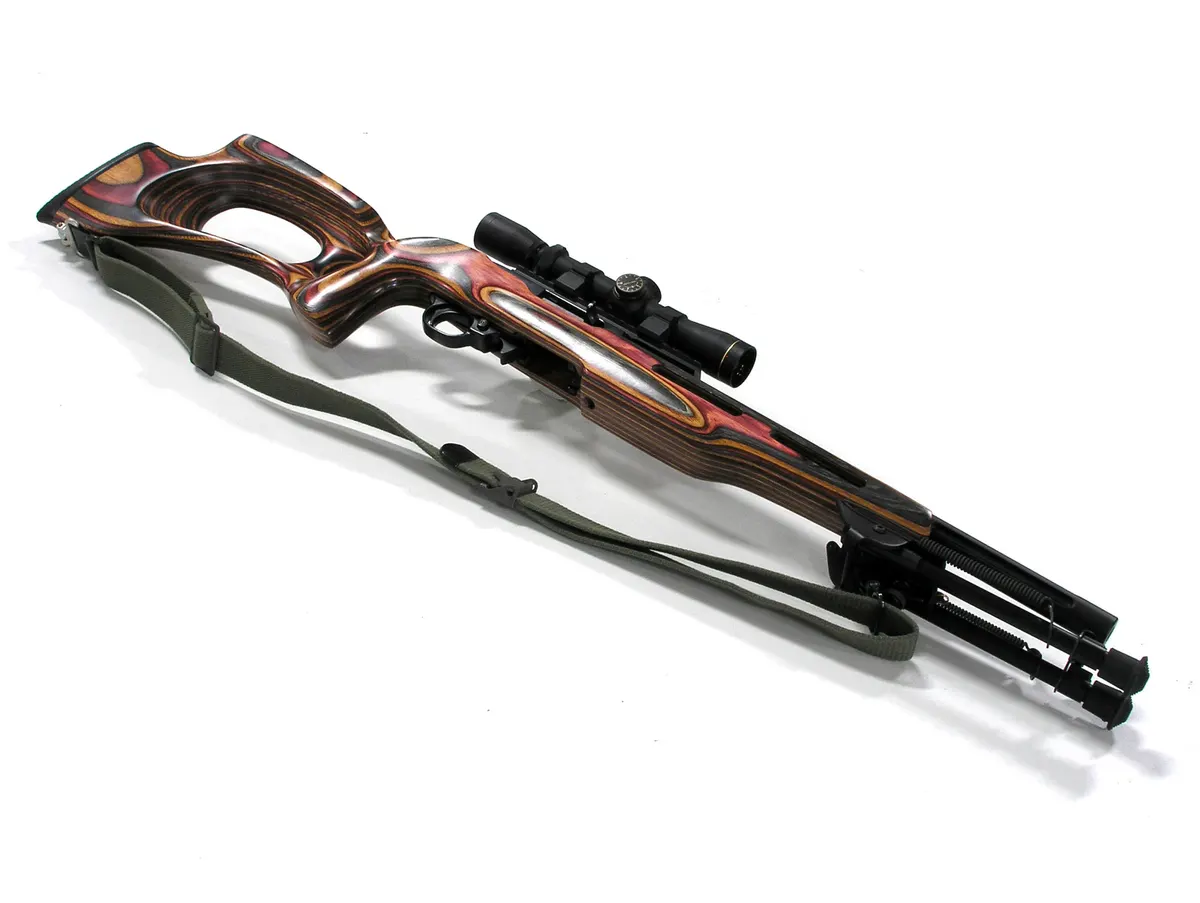
A tube-fed rifle like the Remington Nylon 66 reloads slower under time pressure, since every round has to be thumbed in one at a time through the loading port rather than swapped in a spare magazine, but it also has no magazine well to lose track of and nothing sticking out beneath the action to snag on brush or a truck seat. Sights are a fixed blade front post and an adjustable leaf rear, with the barrel's iron sights grooved along the top of the receiver cover for a period tip-off scope mount rather than a modern optic rail, reflecting a 1959 design brief built entirely around open-sight plinking and small-game hunting rather than the accessorized rimfire market of later decades. Barrel length runs 495 mm (19.5 in), and the complete rifle weighs 1.81 kg empty, light enough that Remington marketed it explicitly as a rifle a child or a smaller-framed adult hunter could carry and shoot comfortably all day.
- Barrel Length495 mm
- Sight Typeleaf sights
- Optic RailNo
- Iron SightsYes
- Threaded BarrelNo
None of the Nylon 66's specification changed much across its 30-year run, but the surrounding rimfire market did. By the time production ended in 1989, detachable-magazine rifles with steel receivers had become the norm, and the Nylon 66's molded nylon build, once its whole selling point, had turned into the reason gunsmiths today find it harder to service than a conventional wood-and-steel .22 of the same era.
- Receiver MaterialZytel 101 (nylon)
- Furniture MaterialZytel 101 (nylon)
- Folding / Collapsing StockNo
- Bullpup LayoutNo
- Ambidextrous ControlsNo
- Total Production1,050,350
- Production Start1959
- Production End1989
- Variants7
Remington's engineers first pitched the plastic-stock idea internally in the mid-1950s as a straightforward manufacturing economy, not as a marketing gimmick.2 Wayne E. Leek, Remington's chief rifle designer at the time, worked the DuPont brief personally and later credited several colleagues, alongside Charles H. Morse and Homer W. Young, with turning the Zytel 101 material into a working firearm rather than just a stronger stock blank.5 The rifle very nearly launched under a plain internal designation, Model 555, before Remington's marketing side renamed it after the polymer itself, nylon-6,6, a naming decision unusual enough that gun writers were still explaining it decades later.5

The rifle launched in January 1959 and immediately outsold Remington's production capacity, forcing the company to expand tooling at Ilion within the first year.2 Remington backed the launch with an unusually theatrical piece of promotion. In October 1959, company field representative and professional exhibition shooter Tom Frye spent two weeks of vacation time in Reno, Nevada attempting to beat a 52-year-old aerial-shooting record set in 1907 by Adolph Topperwein, who had hit 75,041 of 75,050 hand-tossed wooden blocks with a rifle, missing only nine.6 Frye used three standard Nylon 66 rifles, shooting roughly 1,000 rounds an hour for eight hours a day across 13 straight days, and finished having hit 100,004 of 100,010 thrown blocks, a new record, with the rifles cleaned only three times across the entire attempt.6,7
The record shoot is often misremembered decades later as belonging to Tom Knapp, the equally famous Remington-associated shotgun exhibition shooter of the 1980s and 1990s, but Knapp's clay-target records came with a shotgun and a generation after Frye's rifle feat.8 It was Frye, not Knapp, standing in a Reno field with three Nylon 66 rifles in October 1959.
Sales stayed strong through the 1960s and 1970s, briefly diversifying into a family of related nylon-stocked models, a lever-action Nylon 76 billed as the world's fastest lever rifle, and bolt-action Nylon 10, Nylon 11, and Nylon 12 variants, all produced only from 1962 to 1964 before Remington folded the experiment back down to the core semi-automatic Nylon 66 line.9 Remington marked its own milestones on the rifle too, building a limited 150th-anniversary run in 1966 and a Bicentennial edition in 1976, both aimed squarely at the collector market that had grown up around the gun. By the late 1980s, changing rimfire tastes and the rise of detachable-magazine competitors made the fixed-tube Nylon 66 look dated next to newer designs, and Remington discontinued it in 1989 after a production total of 1,050,350 rifles.1
The overwhelming majority of production was Mohawk Brown, a walnut-brown nylon with faint streaking meant to suggest wood grain, paired with a blued-steel receiver cover and barrel, accounting for roughly 675,000 to 716,000 of the total run depending on which Remington-derived production tally is used.1 Seneca Green, a dull olive shade that some owners find hard to distinguish from brown in poor light, ran only from 1959 to 1962 and totaled about 42,500 rifles, making it the scarcest of the mainline colors.1 Apache Black arrived in 1962 and stayed in the catalog through 1984, pairing glossy black nylon with a bright chrome receiver and barrel and white-diamond forearm inlays, roughly 221,000 built.1 A Black Diamond variant followed from 1978 to 1987 with a blued rather than chromed metal finish, around 56,000 made.1
Remington also issued genuine limited editions rather than simple color options. A 150th Anniversary model in 1966 carried a Remington 1816-1966 logo stamped into the blued receiver cover and was limited to 3,792 rifles, and a 1976 Bicentennial edition with an engraved eagle and the dates 1776 and 1976 ran to 10,268 units.10 Both are worth several times a standard Mohawk Brown example on today's collector market, with the rarer 150th Anniversary rifles commonly trading well above 1,000 dollars in good condition.11 A separate Gallery Special variant, built for shooting-gallery arcade use, was chambered for .22 Short only and remains the rarest documented Nylon 66 configuration, though Remington never published a firm production figure for it.
Beyond color and commemorative variants, Remington briefly spun the same Zytel construction into a small family of related but mechanically distinct rifles. The Nylon 76 Trail Rider replaced the blowback action with a short-stroke lever, the only lever-action rifle Remington ever sold under its own name, and the Nylon 10, Nylon 11, and Nylon 12 were single-shot, detachable-box, and tube-fed bolt actions respectively, all produced only from 1962 to 1964 in far smaller numbers than the semi-automatic Nylon 66 itself.9
CBC of Brazil, at the time linked to DuPont's Latin American ammunition operations, later produced its own Nylon 66 clone on tooling supplied directly by Remington rather than as an unlicensed copy, and these Brazilian-made rifles were imported into the United States through the importer FIE.12 Quality control on the Brazilian-made rifles was less consistent than on Ilion-built originals, and today they trade for a fraction of the value of a genuine Remington-marked example.12
Among collectors, the short-lived spinoff models generally command more than a standard Mohawk Brown Nylon 66 simply because so few were built, while the anniversary editions carry a premium tied to their fixed, documented production numbers rather than to any mechanical rarity. A genuine, all-original Nylon 66 in any color, with its matching stock finish and unbroken bonding line, is still considered the baseline reference example against which the rarer spinoffs and clones get judged.


The Remington Nylon 66 was built and sold almost entirely into the American civilian sporting market, for small-game hunting, pest control, and plinking, rather than adopted as an issued service weapon by any government. It never entered mainstream police or military service in the United States, and later trade-in listings advertising Nylon 66 rifles as police trade-ins generally refer to individual departments selling off small numbers of personally owned or gifted rifles rather than any formal issue program.13 Some published references, including unattributed entries in general reference works, list the rifle as used by Bolivian police forces, but no independent, sourced account of an actual Bolivian police contract or issue program for the Nylon 66 turned up anywhere outside that single unsourced reference, and Bolivia's own published small-arms inventories do not list it. That specific claim should be treated as unverified rather than as confirmed institutional service.
What is well documented is the rifle's enormous civilian install base. With more than a million built and an unusually high survival rate thanks to the corrosion-proof stock, the Remington Nylon 66 remains one of the most commonly encountered used .22 rifles at American gun shows, pawn shops, and estate sales more than three decades after the last one left the Ilion production line.
The Remington Nylon 66 and the Winchester Model 1903 share a role rather than a mechanism, both were autoloading .22-class rifles built for the same mass hunting and plinking market roughly half a century apart. The Model 1903 chambered Winchester's own proprietary .22 Winchester Automatic cartridge in a conventional walnut-stocked blowback rifle, and its self-contained rimfire round anticipated the friction-free, low-maintenance appeal Remington later chased with an entirely different approach, a synthetic stock rather than a proprietary cartridge. Where the Model 1903 solved for reliability through a purpose-built round that avoided rimlock in its own tube magazine, the Nylon 66 solved for reliability and low upkeep through the material the whole rifle was made from, running standard, widely available .22 LR ammunition instead of a cartridge unique to one manufacturer.
The more direct and longer-running rivalry is with the Ruger 10/22, introduced in 1964 and still in production today, more than 35 years after Remington discontinued the Nylon 66. The core functional difference is the magazine. Ruger built the 10/22 around a 10-round rotary detachable-magazine that can be swapped in seconds and replaced with aftermarket magazines of far higher capacity, where the Nylon 66's fixed 14-round tube has to be reloaded one cartridge at a time through a loading port in the stock. That single design choice shaped how the two rifles aged in the marketplace. The 10/22's detachable magazine and steel receiver made it endlessly serviceable and customizable, spawning one of the largest aftermarket parts industries of any rimfire rifle ever sold, while the Nylon 66, out of production since 1989 and built around a bonded nylon receiver that was never intended to be disassembled by an owner, has a shrinking parts supply and depends heavily on donor rifles and specialist gunsmiths for repair.
| Spec | Remington Nylon 66 | Ruger 10/22 |
|---|---|---|
| Cartridge | .22 LR | .22 LR |
| Feed system | 14-round fixed tube | 10-round detachable rotary |
| Action | Blowback | Blowback |
| Empty weight | 1.81 kg | approx. 2.2 kg |
| Production status | Discontinued 1989 | In production since 1964 |
Asked which rifle is better, most longtime rimfire shooters will not give a straight answer, and for good reason, both rifles are known for eating whatever ammunition is fed into them and running for tens of thousands of rounds with minimal cleaning.14 The practical difference today is availability rather than performance, a new Ruger 10/22 can be bought, accessorized, and repaired indefinitely, while a Remington Nylon 66 is a fixed, finite population of rifles that has not grown since 1989 and will only shrink from here.


Is the Remington Nylon 66 still in production? No. Remington built the Nylon 66 from 1959 to 1989, and the model has been out of production for more than three decades. All examples on the market today are used rifles, generally sold through gun shows, private sales, and secondhand dealers rather than new from a factory or importer.
What caliber is the Remington Nylon 66? It is chambered exclusively for .22 Long Rifle, a rimfire cartridge, with a small run of a Gallery Special variant chambered for .22 Short only for arcade shooting-gallery use.
How many rounds does a Remington Nylon 66 hold? The standard tubular magazine holds 14 rounds of .22 LR, loaded one at a time through a spring-loaded tube that telescopes out of the buttstock rather than through a detachable box magazine.
How much is a Remington Nylon 66 worth today? Standard Mohawk Brown examples in shootable condition commonly sell in the low hundreds of dollars, while scarce colors and limited editions such as the 1966 150th Anniversary and 1976 Bicentennial models routinely bring several times that, with well-preserved examples reaching well over 1,000 dollars.11
Is the Remington Nylon 66 a good rifle for beginners or plinking? It has a strong reputation for reliability and low recoil, and its light 1.81 kg weight and simple blowback action made it a common first rifle for younger shooters throughout its production run, though buyers today should weigh its increasingly scarce replacement parts against the far more serviceable, still-in-production Ruger 10/22.
What is the Remington Nylon 66's stock made of? The stock and receiver housing are molded from Zytel 101, a nylon-6,6 resin DuPont developed for Remington, injection-molded in two bonded halves rather than machined from wood or cast from metal.
- "Remington Nylon 66", Wikipedia — en.wikipedia.org ↩
- "Throwback Thursday, The Remington Nylon 66", American Rifleman — americanrifleman.org ↩
- "Remington Timeline, 1959, Nylon 66 Autoloading Rifle", Shooting Times — shootingtimes.com ↩
- "Ruger 10/22 vs Remington Nylon 66", Shooters Forum — shootersforum.com ↩
- "How It Got Named Model Nylon 66", Rimfire Central Firearm Forum — rimfirecentral.com ↩
- "Tom Frye", Trap Hall of Fame — traphof.org ↩
- "Exhibit features marksman-artist who hit 100,004 of 100,010 bricks tossed in the air", Billings Gazette — billingsgazette.com ↩
- "Tom Knapp", Wikipedia — en.wikipedia.org ↩
- "Remington (Rem.) Nylon .22 Rifles, Nylon 66, 76, 77, 10, 11, 12", Chuck Hawks — chuckhawks.com ↩
- "SOLD, Rare Remington Nylon 66, 1976 Bicentennial Edition", Legacy Collectibles — legacy-collectibles.com ↩
- "Remington Nylon 66 150th Anniversary", Blue Book of Gun Values — bluebookofgunvalues.com ↩
- "CBC (Brazil) Nylon 66 Clone", AR15.com — ar15.com ↩
- "Remington Nylon 66 .22LR Police Trade-In Rifle", Sportsman's Outdoor Superstore — sportsmansoutdoorsuperstore.com ↩
- "The Rimfire Report, Why The Ruger 10/22 Will Never Die", TheFirearmBlog — thefirearmblog.com ↩