

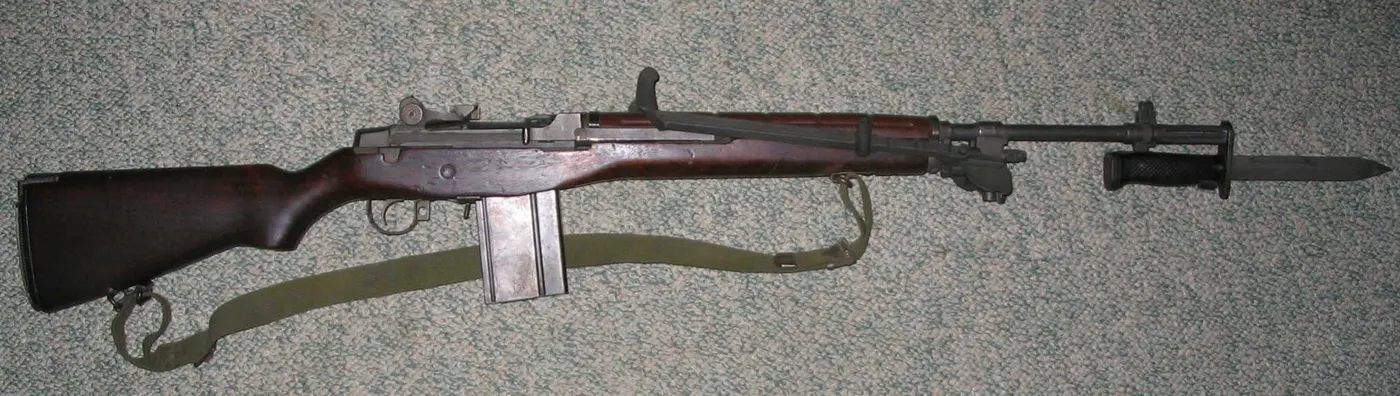

Production of the Springfield Armory M1A began in 1971, four years after the original US government Springfield Armory arsenal in Massachusetts, the plant that had built the military M14 rifle, closed for good.1 The M1A is a semi-automatic only civilian rebuild of the M14, chambered in 7.62x51mm NATO (.308 Winchester), and it exists because a Texas gun dealer named Elmer C. Ballance trademarked the dormant Springfield Armory name and started welding surplus M14 parts onto newly cast receivers for sale to hunters, target shooters and collectors.1,2 The Bureau of Alcohol, Tobacco and Firearms would not let Ballance call his product an M14, since that name was still tied to a select-fire military rifle, so the commercial gun was renamed M1A instead, a label with no official military meaning at all.2
- proven M14 gas system, decades of parts support
- heavy steel/walnut build shrugs off abuse and weather
- deep bench of National Match and Super Match accuracy options
- wide model range from 16 inch carbines to full-length target rifles
- 9 to 11 pound loaded weight versus lighter AR-10 pattern rifles
- fixed proprietary stock geometry, less modular than a modern chassis rifle
- two-stage military trigger is heavier than typical modern precision triggers
- no factory select-fire option for civilian buyers
The M1A is best understood as a parallel civilian product line rather than a surplus military rifle. It uses a gas-operated rotating bolt copied directly from the M14 action, feeds from a detachable magazine, and is built without the select-fire capability that defines the military weapon. Ballance's small Devine, Texas shop assembled roughly 2,000 rifles before Robert Reese bought the company in 1974 and relocated it to Geneseo, Illinois, where Springfield Armory, Inc. still builds the M1A today.2,3 The rifle sits in the semi-automatic rifles category rather than the battle rifles category that holds the M14 itself, and that distinction matters because the M1A was never issued to any army. Its customer base is overwhelmingly American civilian shooters, with a smaller footprint in US law enforcement patrol and marksmanship use.
Springfield Armory, Inc. is a completely different company from the government's original Springfield Armory arsenal, and the M1A is a completely different legal object from the M14 it copies. Both facts confuse buyers regularly enough that Springfield Armory's own marketing and gun press coverage return to them constantly, because the naming overlap was never accidental. Ballance chose the name specifically to trade on the government arsenal's reputation once the original site shut down.2 The company has now built the M1A continuously for more than fifty years, longer than the US Army ever fielded the select-fire M14 it is copied from, and it remains one of the most recognizable .308 Winchester semi-automatic rifles on the American market.
The Springfield Armory M1A carries over the M14's tilting-bolt, gas-operated action essentially unchanged, a mechanism piston operated enough that gun writers routinely praise it for shrugging off dirt and neglect that would stop a direct-impingement design. Standard models use a 22 inch barrel with a 1 in 11 inch right-hand twist, feeding from a detachable 5 or 10 round box magazine and a two-stage military trigger breaking around 4.5 pounds.2,5 Springfield's factory-listed weight for that Standard configuration is close to 9.3 pounds (4.2 kg) unloaded, noticeably heavier than the figure currently on file for this entry, which appears to describe the shorter SOCOM-length carbine rather than the 22 inch Standard/National Match rifle the rest of its listed specifications (National Match sights, two-stage trigger, 1 in 11 twist) actually match.6,7
- First Production Year1971
- DesignerElmer C. Ballance
- Weight (Empty)4.2 kg
- Currently In ServiceNo
- Notable Userslaw enforcement
One real, meaningful difference from the military gun sits in the receiver. GI M14 receivers were drop forged, while Springfield Armory M1A receivers are investment cast from AISI 8620 alloy steel.1 Collectors and M14 forum contributors have argued about forged-versus-cast strength for decades, but the consensus among gunsmiths is that modern investment casting is more than strong enough for a semi-automatic .308 rifle, and Springfield has shipped cast receivers since day one without a documented pattern of failures traceable to the process itself.
- Cartridge7.62×51mm NATO
- Calibre7.62 mm
- Case Length51 mm
- Calibre Class.308
- RimfireNo
- Caseless AmmunitionNo

Sights are a National Match front blade paired with a match-grade hooded aperture rear sight adjustable in half-minute-of-angle clicks, a detail worth separating from actual group size. The current on-file accuracy figure of 0.5 MOA appears to describe that sight-click increment rather than real shot dispersion. Springfield's own literature guarantees 1 MOA only on the heavier-barreled Super Match, while independent reviewers report the standard National Match model grouping closer to 1.0 to 1.5 MOA with good ammunition and a Standard model landing around 2 MOA.5,7 California-compliant M1A rifles ship with a plain muzzle brake instead of a threaded flash suppressor and without a bayonet lug, a legal accommodation rather than a performance change, and one that also applies nationwide since Springfield Armory dropped the bayonet lug from every M1A after the 1994 federal ban and never restored it.1 Beyond the classic 7.62 NATO chambering, Springfield now also sells M1A variants in 6.5mm Creedmoor, a modern addition aimed at long-range shooters who want the M1A's action in a flatter-shooting cartridge.1
- Action TypeGas-Operated
- Fire Modessemi-automatic
- Select FireNo
- Feed SystemDetachable Magazine
- Magazine Capacity5
- Trigger Typetwo-stage military
- Muzzle Velocity762 m/s
- Accuracy1
- Barrel Length559 mm
- Rifling Twist1:11 right-hand
- Sight TypeNational Match front blade, match-grade hooded aperture
- Optic RailYes
- Iron SightsYes
- Threaded BarrelNo
- Overall Length1,126 mm
- Receiver MaterialAISI 8620 alloy steel
- Furniture Materialwalnut or synthetic
- Folding / Collapsing StockNo
- Bullpup LayoutNo
- Ambidextrous ControlsNo
- Modularityaccessory rail
- Production Start1971
- Unit Cost1,900 USD
- Variants10
Elmer C. Ballance began building semi-automatic M14-pattern rifles in Devine, Texas in 1971, using investment-cast receivers finished out with genuine GI M14 parts pulled from military surplus stock.1,2 His timing mattered. The Army had declared the M14 obsolete for general infantry issue years earlier, replacing it with the M16, and a flood of surplus M14 parts and tooling made a civilian semi-automatic copy commercially realistic for the first time.
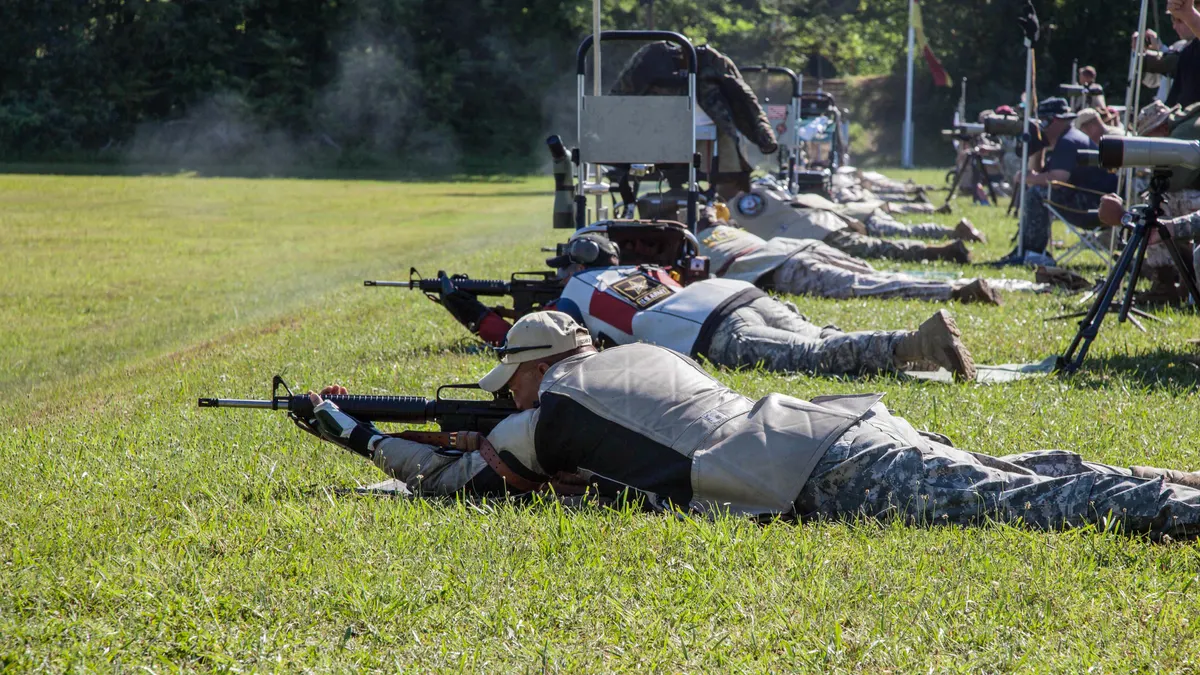
Getting the rifle onto a competition line took a fight. In 1962 the government's own Springfield Armory had briefly built modified semi-automatic M14s for National Match competition, but Major General Nelson M. Lynde of the Civilian Marksmanship Program blocked their use because they could not be reconverted to select-fire military configuration in an emergency.2 When Ballance's new company petitioned to enter M1A rifles in 1974 competition, the DCM relented on the condition that the rifle keep the outward appearance of a military M14 apart from its selector, and Springfield Armory introduced the National Match M1A that same year, a rifle built specifically to win service rifle matches.2 The M1A and remaining surplus M14s went on to dominate NRA High Power and National Trophy competition through the 1970s and 1980s, a run that did not end until the Army Marksmanship Unit won the National Trophy Team Match in 1991 with AR-15 pattern rifles, the opening move in a shift toward AR-10 style .308 rifles that continues in competitive shooting today.4
1974 also brought new ownership. Robert Reese bought Springfield Armory, Inc. from Ballance and moved production to Geneseo, Illinois, setting up shop in a former diner on South State Street.3 Reese's teenage son Dennis Reese hand-built early Geneseo M1A rifles alongside his father and younger brothers, after the family mortgaged their farm to finance the purchase. Dennis Reese later said plainly that his parents risked everything on their 19-year-old son and his younger brothers in this new venture.3 That gamble built the company that still owns the M1A today.
Springfield Armory ran a Full Auto Department at the Geneseo plant into the mid-1980s, producing a small number of genuine select-fire M14-pattern rifles for civilian registration before the Firearm Owners Protection Act froze new machine gun registrations for civilians on May 19, 1986.1 Fewer than fifty select-fire M14-type rifles are believed to have been registered under that window industry wide, and the M1A itself, always semi-automatic only, was unaffected by the freeze since it was never a machine gun to begin with.1 The 1994 federal assault weapons ban hit the M1A differently, through its two-features test rather than an outright ban. Springfield Armory dropped the bayonet lug and swapped the flash suppressor for a muzzle brake to keep the rifle compliant, and even after the ban expired in September 2004 the company never brought the bayonet lug back.1
Springfield Armory has sold well over a dozen distinct M1A configurations since 1971, ranging from full-length target rifles to compact carbines. The Standard model uses the classic 22 inch barrel and walnut or synthetic stock. The National Match, introduced in that same pivotal 1974 competition season, adds the air-gauged medium-weight barrel, glass-bedded action and match sights described above.2 The Super Match goes further with a heavier stainless barrel and a McMillan fiberglass stock, and it is the only variant Springfield Armory backs with a formal 1 MOA accuracy guarantee.7
Compact variants trace a fairly clear line. An early 1990s carbine known simply as the Bush Rifle cut the barrel to 18 inches for the first time. Springfield Armory replaced it in the late 1990s with the Scout Squad, adding a forward Picatinny rail for long-eye-relief scout scopes and a muzzle brake that made the rifle California-compliant, and aiming the model specifically at law enforcement buyers who wanted a shorter, handier M1A for vehicle carry.8,11 The SOCOM 16, introduced in 2004, cut the barrel further to a stubby 16.25 inches and added a purpose-built muzzle brake to tame the extra recoil and blast that come with losing nearly six inches of barrel. The SOCOM II followed in 2005 with an extended quad rail across the forend for lights, optics and other accessories, at the cost of roughly two extra pounds compared with the plain SOCOM 16.1
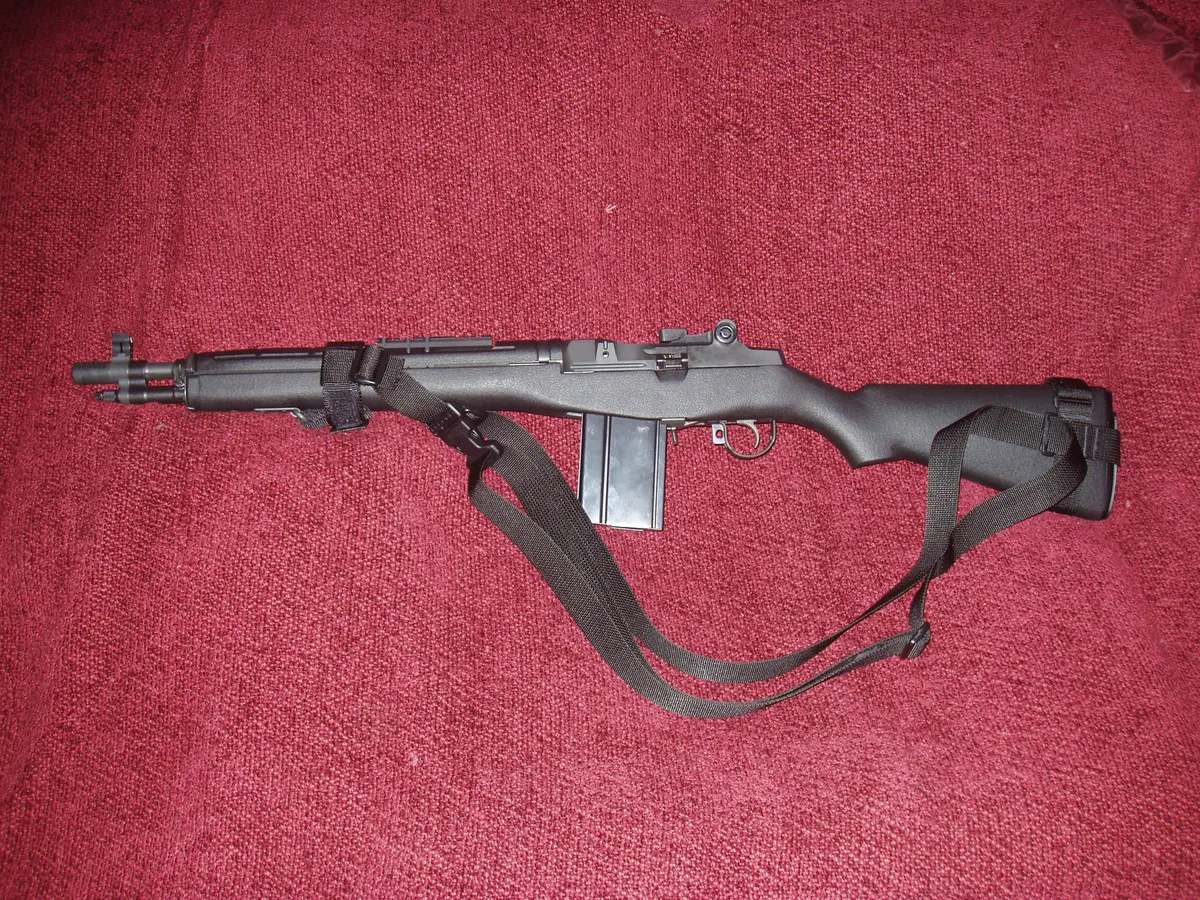
A more recent Tanker model uses the SOCOM 16's 16.25 inch barrel and gas system but returns to a plain walnut stock without the top rail, deliberately styled after the T26 Tanker Garand, a shortened M1 Garand prototype built in World War II that never reached combat before the war ended, rather than any real M14 wartime variant since none existed.11 Springfield Armory also currently offers the M1A Loaded series, which packages the National Match barrel with a choice of stocks at a lower price point than the full competition guns, and has recently added chamberings in 6.5mm Creedmoor alongside the historic 7.62 NATO option.1


The M1A was never adopted by any nation's armed forces, and describing it as a military-issue rifle anywhere would be inaccurate. Its real user base is the American civilian market, made up of hunters, National Rifle Association High Power competitors and collectors who have kept the rifle in continuous production for over fifty years.1,4
A smaller but genuine second market exists in US law enforcement. Departments began adding rifle-caliber weapons to patrol duty after the September 11 attacks and the 1997 North Hollywood shootout exposed the limits of handgun-only patrol loadouts, and some agencies, particularly rural ones needing longer engagement range than an AR-15 pattern carbine typically offers, adopted the M1A Scout Squad specifically for that role.8,9 That use is real but limited, a niche addition alongside the far more common AR-15 pattern patrol rifle in American law enforcement. No publicly documented case shows a foreign government purchasing the M1A for military or police service. Any foreign presence of M1A-pattern rifles abroad almost always traces back to private import and civilian ownership rather than government contracts.
The Army Marksmanship Unit's 1991 win in the National Trophy Team Match, fielding AR-15 pattern rifles against a field that had leaned on the M14 and M1A for two decades, set up the Springfield Armory M1A's most durable modern rivalry, the AR-10 pattern .308 rifle epitomized by descendants of Eugene Stoner's original ArmaLite AR-10. The two designs answer the same question, a reliable semi-automatic .308 Winchester rifle, in almost opposite ways. The M1A carries a fixed proprietary stock, a heavy stamped and machined receiver, and a gas system inherited unchanged from a 1950s military action. The AR-10 pattern rifle offers a modular free-float handguard, an adjustable stock, and the same basic manual-of-arms as an AR-15, letting owners swap optics, grips and triggers without gunsmithing. That modularity is exactly why AR-10 pattern rifles began overtaking M14 and M1A rifles in NRA High Power and tactical precision competition after the Army Marksmanship Unit's 1991 win, even though the M1A had dominated that circuit for the better part of two decades before it.4
| Trait | Springfield Armory M1A (Standard) | ArmaLite AR-10 pattern rifle |
|---|---|---|
| Cartridge | 7.62x51mm NATO / .308 Win | 7.62x51mm NATO / .308 Win |
| Action | Gas-operated, tilting bolt | Gas-operated, rotating bolt (AR pattern) |
| Stock | Fixed walnut or synthetic | Adjustable, modular |
| Unloaded weight | approx 9.3 lb (4.2 kg) | typically 7.5 to 8.5 lb depending on build |
Price also separates the two families less than buyers expect. A new Standard M1A currently runs roughly $1,450 to $2,100 depending on retailer and configuration, squarely inside the price band of a quality AR-10 pattern rifle, so the real choice for most buyers comes down to handling preference and parts compatibility rather than cost.13 Against its own military parent, the M1A trades the M14's select-fire capability and forged receiver for legal civilian ownership and an investment-cast receiver, a swap that has nothing to do with combat effectiveness since the M1A was never built to be issued to troops in the first place.


Is the Springfield Armory M1A the same rifle as the military M14? No. The M1A shares the M14's gas-operated action, stock pattern and 7.62 NATO chambering, but it is built semi-automatic only from an investment-cast receiver, while the military M14 was a forged, select-fire service rifle. Federal law would not allow Springfield Armory to sell a rifle under the M14 name at all.1,2
Is the Springfield Armory M1A still in production? Yes. Springfield Armory, Inc. has built the M1A continuously in Geneseo, Illinois since 1974, and current model lines include the Standard, National Match, Super Match, Loaded, Scout Squad, SOCOM 16, SOCOM II and Tanker rifles.1,3
How much does a Springfield Armory M1A cost? Current retail prices run roughly $1,450 to $2,500 depending on the specific model, with the Standard and Loaded lines at the lower end and the 50th Anniversary and Super Match models at the top.13
What caliber does the M1A rifle use? The standard chambering is 7.62x51mm NATO, interchangeable with commercial .308 Winchester ammunition, and Springfield Armory now also sells M1A rifles chambered in 6.5mm Creedmoor.1
How accurate is the Springfield Armory M1A? A Standard M1A typically groups around 2 MOA with quality ammunition, the National Match model tightens that to roughly 1.0 to 1.5 MOA, and the Super Match carries a factory 1 MOA guarantee.7
- "Springfield Armory M1A", Wikipedia — en.wikipedia.org ↩
- "The Springfield Armory M1A Story", American Rifleman — americanrifleman.org ↩
- "Betting the Farm, The Story Behind the M1A", The Armory Life — thearmorylife.com ↩
- "The Springfield M1A National Match & Its Legacy", Athlon Outdoors — athlonoutdoors.com ↩
- "M1A Standard Issue Rifles", Springfield Armory — springfield-armory.com ↩
- "Springfield Armory M1A Standard", Guns.com — guns.com ↩
- "Springfield M1A Review, SOCOM 16 & National Match", Pew Pew Tactical — pewpewtactical.com ↩
- "Why the M1A Scout Squad is the ultimate rural patrol rifle", Police1 — police1.com ↩
- "Springfield Armory's M1A Rifle", Police Magazine — policemag.com ↩
- "How many Springfield Armory, Inc. M-1A rifles have been made?", M14 Forum — m14forum.com ↩
- "Wood and Steel, the Springfield Armory M1A Tanker", The Mag Life — gunmagwarehouse.com ↩
- "Call of Duty, Infinite Warfare", Internet Movie Firearms Database — imfdb.org ↩
- "Springfield Armory M1A, Price, Value & Trends 2026", TrueGunValue — truegunvalue.com ↩