

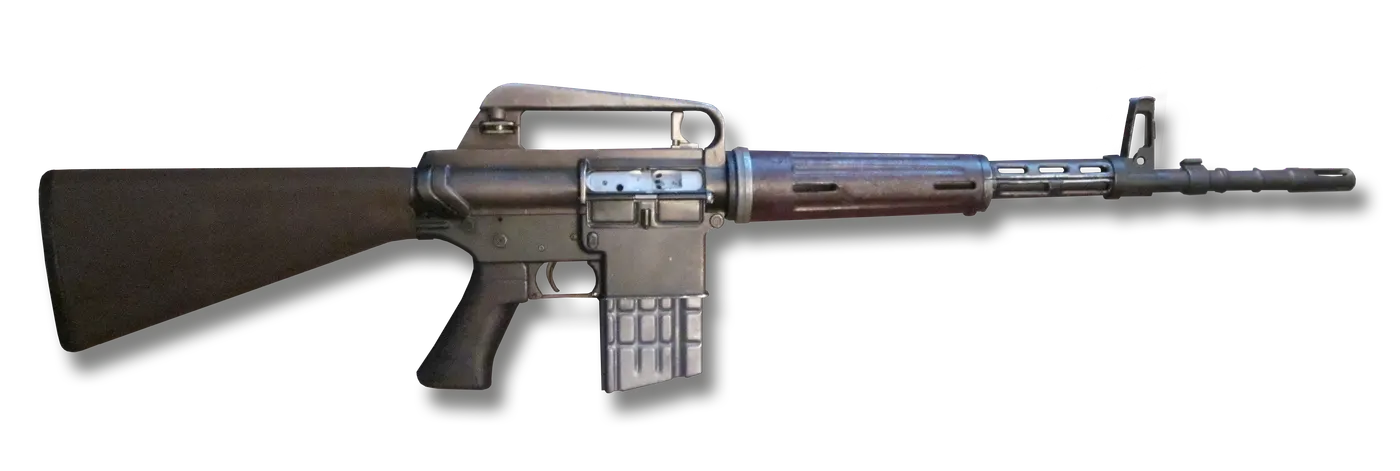

The ArmaLite AR-10 is a select-fire battle rifle chambered in 7.62x51mm NATO, designed by Eugene Stoner at ArmaLite, a small design division of the Fairchild Engine and Airplane Corporation working out of a machine shop in Hollywood, California.1 ArmaLite built the first prototypes in 1955 and 1956, and although the rifle never won a major contract in its country of origin, it stands as the direct mechanical ancestor of the AR-15 and M16, the rifle family that would go on to arm the United States military for the rest of the century.2 The AR-10 introduced a forged aluminum-alloy receiver, a fiberglass-reinforced composite stock and handguard drawn from Fairchild's aircraft-industry materials, and a gas system in which the bolt carrier itself serves as the gas cylinder while the bolt acts as a stationary piston. Stoner patented that system in 1956, and it remains the basic operating principle of the M16, M4, and their many derivatives today.2,3
- Roughly 1 lb lighter than contemporary rivals like the M14
- Straight-line stock and barrel axis gave unusually controllable recoil for a full-power rifle
- Gas system became the direct basis for the AR-15/M16 family
- Chrome-lined parts and forged alloy receiver were advanced for 1956
- Accurate at long range with service ammunition
- Lost the 1957 US Army trials after a widely publicized barrel failure
- Composite stock and handguard proved fragile under sustained combat use
- Never adopted by a major NATO power in its original form
- Production ended by 1961 after fewer than 10,000 rifles were built
- Reputation permanently muddled by an unrelated 1990s rifle sold under the same name

ArmaLite itself never mass-produced the AR-10. After licensing the design in 1957 to the Dutch state arms manufacturer Artillerie-Inrichtingen, total output across all production patterns reached 9,900 rifles by the time the line closed around 1960 and 1961, a modest number against the millions built of the era's dominant NATO rifles.4 The great majority went to two customers, Sudan and Portugal, with smaller batches reaching Guatemala, West Germany, Cuba, Italy, Burma, and the Netherlands' own trials.4,5 Financial strain forced ArmaLite to sell the AR-10 and AR-15 designs to Colt's Manufacturing Company in 1959, and it is Colt's scaled-down, modified version of the AR-10's mechanism, not the original rifle, that most people today associate with the name Stoner made famous.2
The rifle's US Army rejection in 1957 followed a widely publicized barrel failure during trials at Springfield Armory, an incident tied to an experimental test barrel rather than to Stoner's underlying gas system, though the reputational damage was done regardless. The Army selected the M14 instead, while the smaller, licensed-out AR-10 went on to see its heaviest combat use far from Washington, in Portugal's colonial campaigns in Africa.
The Stoner Gas System and Its Mechanical Legacy
The AR-10's most consequential feature is its operating system. Instead of routing gas through a separate piston and op-rod, as the FN FAL and M14 both do, Stoner's design taps gas from a port partway down the barrel and channels it directly rearward through a thin tube into the bolt carrier, which then functions as its own gas cylinder around a bolt that acts as a fixed piston.3
- First Production Year1956
- Service Entry Year1958
- DesignerEugene Stoner
- Weight (Empty)3.3 kg
- Weight (Loaded)4.05 kg
- Currently In ServiceNo
- Notable UsersPortugal, Sudan
The result is a mechanism with fewer moving parts and less reciprocating mass than a conventional gas-piston rifle. Stoner filed the patent in 1956, and it was granted in September 1960.3 When ArmaLite scaled the same operating system down for a smaller cartridge two years later, the resulting AR-15 kept this gas system essentially unchanged, and so did Colt's M16 after it.2 Every direct-impingement AR-pattern rifle built since, civilian or military, traces its gas system back to the AR-10.
- Cartridge7.62x51mm NATO
- Calibre7.62 mm
- Case Length51 mm
- Calibre Class7.62mm
- Bullet Weight9.5 g
- RimfireNo
- Caseless AmmunitionNo
Weight was the AR-10's other headline selling point. The fourth prototype, later nicknamed the Hollywood model, weighed about 3.1 kg (6.85 lb) empty, over 1 lb lighter than the M14's roughly 3.8 kg.6 Production weight varied by contract. Sudanese-pattern rifles ran close to 3.3 kg empty, while the later, final Portuguese-pattern rifles were noticeably heavier, carrying a thicker chrome-lined barrel, wider bolt lugs, a stronger extractor, and a forward bolt assist.7 The straight-line layout, with the stock in line with the bore rather than angled below it as on the M14 or FAL, reduced muzzle rise in automatic fire by directing recoil straight back into the shooter's shoulder instead of pivoting the muzzle upward.6
- Action TypeGas-Operated
- Fire Modessemi-automatic, fully automatic
- Select FireYes
- Feed SystemDetachable Magazine
- Magazine Capacity20
- Cyclic Rate of Fire700
Furniture on the AR-10 was fiberglass-reinforced phenolic composite rather than wood or steel, a direct import from Fairchild's aircraft manufacturing expertise, and the receiver was forged aluminum alloy with chrome-lined steel wear parts.1 That combination made the AR-10 markedly lighter than an all-steel-and-wood contemporary, but the composite stock and handguards also proved less durable under sustained hard use. Portuguese paratroop units serving in Africa retrofitted some rifles with all-metal buttstocks after the added stress of prolonged field service, and repeated recoil, cracked the original phenolic pieces.7 Feeding came from a 20-round detachable aluminum magazine with a distinctive corrugated, waffle-patterned surface, and later production models added an adjustable three-position gas regulator and a three-prong flash suppressor in place of the earlier muzzle compensator.7
- Muzzle Velocity820 m/s
- Effective Range (point)600 m
- Effective Range (area)700 m
- Sighting Range700 m
- Barrel Length528 mm
- Sight TypeAdjustable aperture rear sight, fixed post front sight
- Optic RailNo
- Iron SightsYes
- Threaded BarrelNo
- Receiver Materialforged alloy
- Furniture Materialphenolic composite
- Folding / Collapsing StockNo
- Bullpup LayoutNo
- Ambidextrous ControlsNo
- Modularityno
- Total Production9,900
- Production Start1956
- Production End1961
- Unit Cost225 USD
ArmaLite and the Hollywood Machine Shop
ArmaLite Corporation was incorporated on 1 October 1954 as a small-capital division of Fairchild, founded by George Sullivan, a former Lockheed patent attorney, as a design house rather than a manufacturer.1 Sullivan met Eugene Stoner while Stoner was independently testing the AR-5 survival rifle, and hired him as chief design engineer. Working out of a modest machine shop, ArmaLite's small team produced AR-10 prototypes through 1955 and into early 1956, and hurriedly submitted two hand-built rifles, based on the fourth prototype design, to the US Army and Springfield Armory in the fall of 1956 for the Army's ongoing search for a new standard rifle.1,2
The 1957 Springfield Armory Trials and the Barrel That Failed
Testing of the two submitted rifles, serial numbers 1002 and 1004, continued into early 1957.8 For these specific test guns, ArmaLite president George Sullivan, a patent lawyer with no metallurgical or firearms-engineering background, insisted on an experimental composite barrel, aluminum swaged around a thin rifled 416 stainless-steel liner, over Stoner's strong objections.8 The decision on the steel liner itself was made by engineer L. James (Jim) Sullivan, no relation to George Sullivan, who at the time also lacked the metallurgical expertise the call required.8
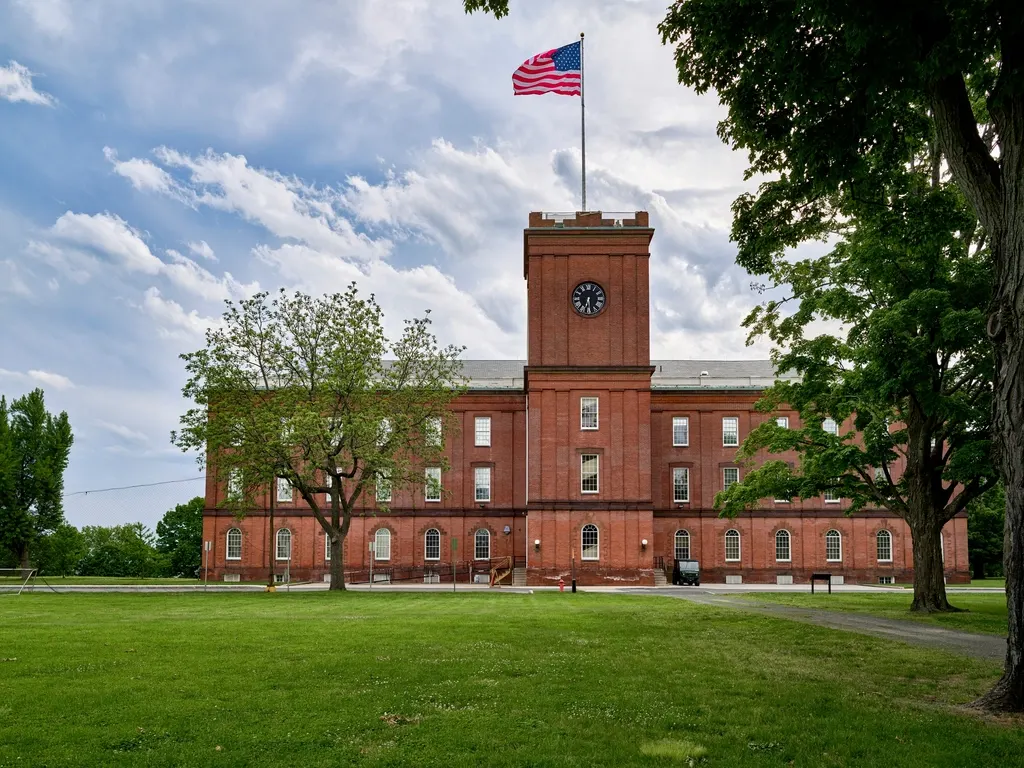
During full-automatic torture testing, rifle serial 1002 suffered a rupture roughly 8 inches long along the left side of the barrel, at round 5,564.8 Post-failure metallurgical analysis found stress cracks across the entire surface of the 416 stainless liner, which could not withstand the sustained strain of the test.8 ArmaLite quickly replaced the design with a conventional steel barrel for further testing, but the reputational damage from a very public rifle failure at the Army's own proving ground was already done. The failure traced to a specific, overridden materials decision on the test articles themselves. It was not a flaw in Stoner's underlying gas system or receiver design, a distinction commonly lost in popular retellings that treat the incident as proof the AR-10 itself was unsafe.8
Springfield Armory's final report recommended against adopting the AR-10, concluding it would take five years or more to bring the design through further testing to adoption, a timeline some historians read as also protecting Springfield's own in-house T44 rifle program and institutional position.8,9 The AR-10 had, in any case, entered the competition late, joining only in the 1956 to 1957 phase rather than the earlier arctic trials that had already narrowed the field to the T44 and the American-built FN FAL, tested by the US Army as the T48.9 The Army ultimately chose the T44, standardized as the M14, favoring its lighter weight, simpler parts count, and self-compensating gas system, along with the mistaken belief at the time that it could be built largely on existing M1 Garand tooling.9 The AR-10, arriving from a tiny design shop with no production track record, was never seriously in contention on timing alone.
From AR-10 to AR-15, and the Sale to Colt
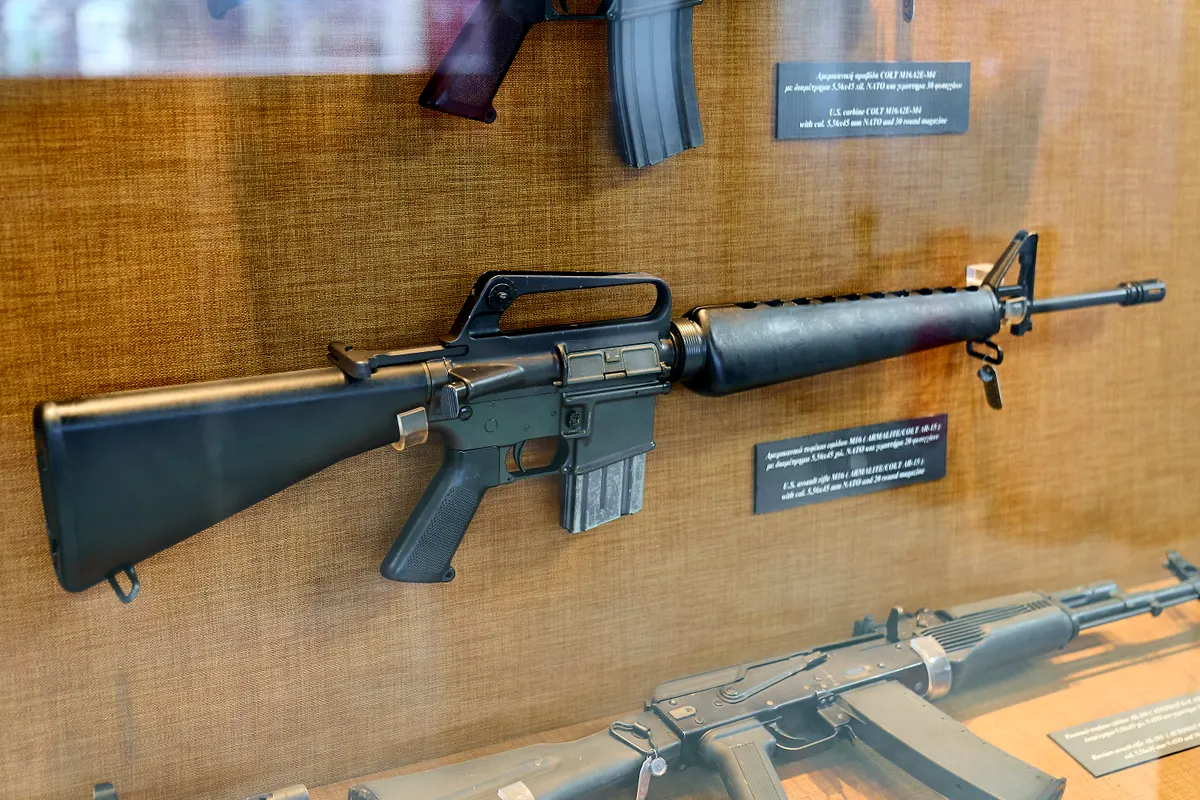
In 1957 the US Army's Continental Army Command asked industry for a lightweight, roughly 6-pound, high-velocity, select-fire rifle firing a small-caliber round. ArmaLite engineers Eugene Stoner, Jim Sullivan, and Bob Fremont responded by scaling the AR-10's operating system down to a smaller cartridge rather than starting from a clean sheet, completing the AR-15 prototype in 1958 chambered in .223 Remington.2 The receiver architecture, general layout, and above all the gas system carried straight over from the AR-10, simply resized.
By 1959, financial strain led ArmaLite to sell the rights to both the AR-10 and the AR-15 to Colt's Manufacturing Company.2 Colt modified the smaller design, moving the charging handle from under the carry handle to the rear of the receiver and standardizing the cartridge as 5.56x45mm NATO, and the result became the M16.2 Colt kept the AR-15 trademark for its own civilian semi-automatic line. Stoner himself left ArmaLite in 1961 for Cadillac Gauge, and decades later, in the 1990s, partnered with C. Reed Knight II at Knight's Armament Company to combine AR-10 principles with M16A2-era refinements into the SR-25, sharing roughly 60 percent parts commonality with the M16A2.2 The US military later adopted derivatives of that rifle as the Mk 11 Mod 0 and the M110 semi-automatic sniper system, closing a design loop that started with the AR-10 nearly four decades earlier.
Licensed Production at Artillerie-Inrichtingen
On 4 July 1957, Fairchild ArmaLite licensed AR-10 production for five years to Artillerie-Inrichtingen, the Dutch state arms manufacturer based at Hembrug-Zaandam, under an agreement covering 2,000 rifles in the first year, then 10,000 per month, plus per-unit royalties.4 Artillerie-Inrichtingen had to convert ArmaLite's imperial-unit drawings to metric, build new tooling, and implement a string of ArmaLite-requested design changes, including an adjustable gas regulator, a gas tube repositioned from the side to the top of the barrel, a three-prong flash suppressor, fiberglass handguards over the original brass tubes, and fluted barrels.4 ArmaLite sent Art Miller, Stoner's assistant, to the Netherlands to oversee production, and Miller later became ArmaLite's own chief designer after Stoner's 1961 departure.4
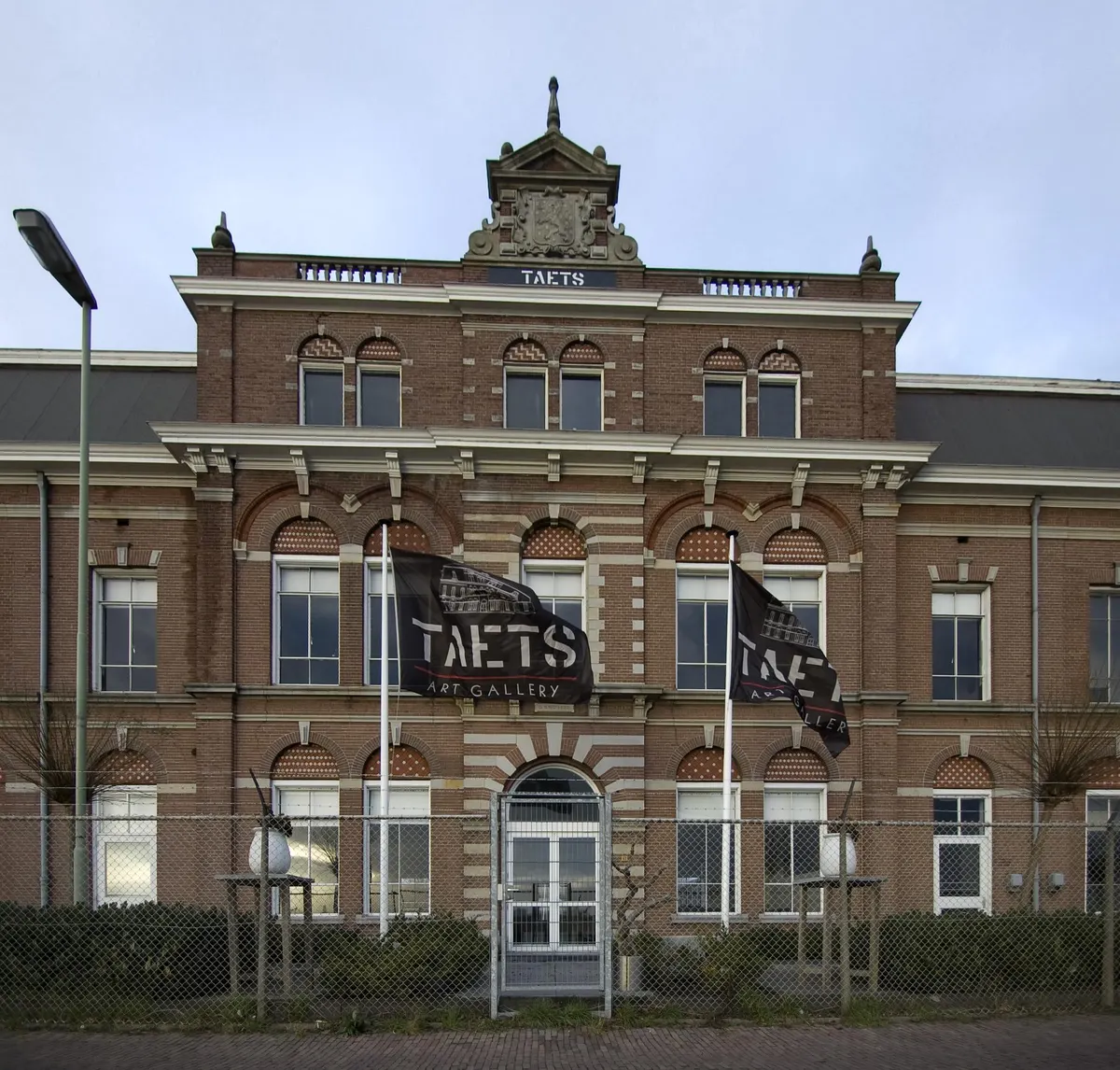
Production moved through several successive patterns, generally known by their principal customer or contract, from an early Cuban and Sudanese pattern through a transitional design to a final, heaviest Portuguese pattern with a chrome-lined barrel and simplified three-position gas regulator.7 Artillerie-Inrichtingen also entered its own AR-10 in a Dutch domestic trial in 1957, delivering 20 rifles to compete against the FN FAL for the Netherlands' own army contract. The AR-10 proved accurate but suffered parts breakage, and the FAL won, meaning the rifle lost even in its own manufacturer's home country.4 A similar result followed in South Africa, where the AR-10 competed against the FAL, the Spanish CETME rifle, and the Swiss StG 57 for a contract that included local production rights, and placed second.4
The line closed by around 1960 to 1961. Dutch export licensing grew increasingly restrictive as the government became reluctant to keep arming Portugal over its African colonial policy, and without a large military order to sustain the tooling, Artillerie-Inrichtingen wound the program down.4 Barrel-making tooling was reportedly sold to Israel in the early 1960s, and other tooling and parts were scrapped or sold off piecemeal.4
Portugal's Colonial War
Portugal was the AR-10's primary combat user by a wide margin. Portuguese paratrooper battalions, the Caçadores Páraquedistas, adopted the rifle starting in 1960 and carried it through the Portuguese Colonial War, fighting counter-insurgency campaigns across Angola, Mozambique, and Portuguese Guinea from 1961 to 1974, with some units still carrying it into the 1975 emergency surrounding the Indonesian invasion of East Timor.11 Portuguese paratroopers valued the rifle for its accuracy and reliability under harsh jungle and savanna conditions despite the added recoil stress of extended field use, and some units fitted 3x or 3.6x scopes to individual rifles for a designated-marksman role.11
The rifle's built-in gas cutoff let Portuguese troops fire Energa rifle grenades without adjusting the gas system, and the action would still cycle and eject the spent blank cartridge, allowing a soldier to reload for a follow-up grenade shot without extra steps.11 An Aberdeen Proving Ground test in November 1960 recorded roughly 25 mm groups at 100 meters with service ammunition, a genuinely tight result for a full-power rifle of the period.12 Field accounts from the theater were similarly favorable. One Congo-based police instructor who trained with the rifle called it a good combat weapon that never failed him, describing it as a bit too long for house-to-house fighting but well suited to engagements between 400 and 800 meters.10
Dutch export restrictions eventually cut off further Portuguese orders as the Netherlands grew increasingly unwilling to keep arming Lisbon's colonial campaigns, and Portugal subsequently switched to the collapsible-stock version of the Heckler & Koch G3 for later deployments in Africa.4,11
Sudan and the First Sudanese Civil War
Sudan received roughly 2,500 AR-10 rifles in October 1958 at a contract price of about 225 US dollars per rifle, including a cleaning kit and four magazines, a rare hard price point from the era's sales records.4 These Sudanese-pattern rifles were distinguished by a lightweight fluted barrel, a three-prong flash suppressor, a bayonet lug, and Arabic sight markings.4
These rifles saw service through the First Sudanese Civil War and remained in Sudanese special forces use until 1985.4,13 Sourcing on any continued use into the later Second Sudanese Civil War is considerably thinner, and this article treats that later phase with appropriate caution rather than asserting continued combat use.
Cuba, Batista, and the Dominican Republic Invasion
A smaller but more colorful chapter runs through Cuba. The Batista government ordered around 100 AR-10 rifles of the Transitional pattern in 1958. After Fidel Castro's takeover in December 1958, Castro personally test-fired examples of the rifle outside Havana, was reportedly impressed, and paid for the shipment his predecessor had ordered.10 Castro then passed these ex-Batista rifles to a group of Dominican Republic exiles training in Cuba as part of a wider wave of Caribbean exile invasions that spring, alongside similar efforts aimed at Panama and Nicaragua.10,14 In June 1959 these fighters landed in the Dominican Republic in what became known as the Luperón and Constanza landings. Forces loyal to Rafael Trujillo crushed the invasion, killing roughly 217 of 224 invaders and capturing the remaining seven, and AR-10 rifles from the original Batista shipment were found on the bodies of the guerrillas.14 The AR-10-specific detail of that battlefield discovery rests on a single source, even though the invasion itself is independently well documented, so it should be read with that caveat in mind.
Cuban, Sudanese, Transitional, and Portuguese Patterns
Artillerie-Inrichtingen's production moved through a recognizable sequence of patterns as ArmaLite kept requesting design changes. The earliest Cuban pattern, and the closely related early export rifles, retained much of the original prototype's detailing. The Sudanese pattern of 1958 introduced the lightweight fluted barrel, three-prong flash suppressor, bayonet lug, fiberglass furniture, and Arabic sight markings that went to Sudan's contract.4,7
A Transitional pattern followed, feeding into the final and heaviest Portuguese pattern of 1960, which added a thicker chrome-lined barrel, wider bolt lugs, a stronger extractor, a simplified three-position gas regulator, a forward bolt assist, and an optional bipod.4,7 ArmaLite itself hand-built around 50 Hollywood-model demonstrator rifles at its own shop before the Artillerie-Inrichtingen license began, a separate line from the Dutch-made contract patterns.4
The Modern AR-10 and a Trademark's Second Life
The name AR-10 causes persistent confusion today because it now mostly describes a completely different rifle. A separate, later company, ArmaLite Inc., holds the current US trademark on the name today, a corporate identity with no ownership connection to the 1954 Fairchild division covered in this article.15 Former US Army ordnance officer Mark Westrom, owner of Eagle Arms, bought that trademark in 1995 and 1996. Westrom's reissued AR-10B started from an AR-15A2 pattern scaled up to fire 7.62mm NATO, a mechanically distinct rifle that reuses only the original's name and general concept, without reference to the 1956 engineering drawings.15 Other manufacturers building AR-15-pattern rifles in .308 during the 1990s could not use the trademarked AR-10 name, so DPMS Panther Arms created the designation LR-308 instead, and DPMS's own receiver and magazine pattern became the de facto industry standard for large-frame AR-pattern rifles.15 Two incompatible receiver patterns, generally called the DPMS pattern and the ArmaLite pattern, coexist across the modern rifle market today, and both differ mechanically from Stoner's 1956 original covered here.


 Sudan
 Germany
Portugal fielded the AR-10 as its largest and most sustained operator, issuing it to paratroop units from 1960 through the end of the Colonial War in 1974, with residual use into 1975.11 Sudan took delivery of roughly 2,500 rifles in 1958 and kept them in special forces service until 1985.4,13 Guatemala purchased somewhere between 200 and 600 rifles around 1959, one of the less well-documented contracts.4 West Germany bought 135 rifles, delivered in August 1958, purely as a trial purchase that did not lead to adoption.4 Cuba received around 100 Transitional-pattern rifles under the Batista government in 1958, later inherited by Castro's government.10 Italy's navy commando unit, COMSUBIN, fielded small numbers.4 The Netherlands tested the rifle domestically in 1957 but never adopted it, losing to the FAL in its own home trial, and South Africa trialed the rifle for a production-and-adoption contract in the same period and placed second behind the FAL.4
Several other countries are sometimes listed as AR-10 operators but do not hold up under scrutiny. The United States never adopted the rifle at all, having rejected it at Springfield Armory in 1957. Thailand and the Philippines only saw failed sales demonstrations rather than any purchase. Nicaragua ordered 7,500 rifles in 1957 but cancelled the entire contract after the bolt-lug failure described above, before a single production rifle was delivered, and so never actually operated the weapon.
AR-10 vs. M14, the Rifle That Lost the Trial It Should Have Won on Paper
Against the M14, the AR-10 held a real technical edge on several points that ultimately did not matter to the outcome. It was lighter by roughly a pound, used a more modern direct-impingement gas system rather than the M14's Garand-derived op-rod and tilting bolt, and its straight-line stock gave markedly better control in automatic fire. The M14, by contrast, earned a reputation as nearly uncontrollable on full-auto, and most units in service simply disabled the selector and issued it as a semi-automatic rifle in practice. The AR-10 lost the contract on trial-timing and institutional politics, arriving late into a competition Springfield Armory's own report arguably tilted toward the Armory's in-house T44 design, compounded by the barrel-burst incident, rather than on any clear technical shortfall in Stoner's rifle.
| Parameter | ArmaLite AR-10 | M14 |
|---|---|---|
| Empty weight | About 3.3 kg (Sudanese pattern)7 | About 3.8 kg6 |
| Operating system | Direct gas impingement3 | Gas piston, tilting bolt (Garand-derived)9 |
| Adopted by US Army | No, rejected 19578,9 | Yes, standardized 19579 |
| Automatic-fire control | Straight-line stock, comparatively controllable6 | Poor, often disabled in service9 |
| Total production | 9,9004 | Roughly 1.5 million9 |
AR-10 vs. FN FAL, a Late Entrant Against a NATO-Wide Seller
Against the FN FAL, the comparison is less about a single trial and more about timing and industrial scale. Both rifles were built to the same NATO 7.62mm doctrine and reached the market at roughly the same moment, but the FAL had a multi-year manufacturing and political head start that the AR-10, arriving from a tiny American design shop with no existing production base, could never overcome. The FAL went on to equip roughly 90 countries in original or licensed form, while the AR-10 topped out at a handful of contracts and 9,900 total rifles. The two rifles even met directly in the same conflict. Portugal issued both the AR-10 and the FAL, alongside the Heckler & Koch G3, to different units fighting the same Colonial War, with the AR-10 favored particularly by paratroop battalions.7


What are the ArmaLite AR-10's basic specifications? The original AR-10 fires 7.62x51mm NATO from a 20-round detachable magazine, weighs roughly 3.3 kg empty depending on the production contract, and uses a direct gas-impingement action, the same gas system later scaled down for the AR-15 and M16.1,3
How does the AR-10's gas system work? Gas tapped from the barrel travels directly through a thin tube into the bolt carrier, which functions as its own gas cylinder around a bolt acting as a stationary piston, eliminating the separate piston and op-rod used by rifles like the FAL and M14.3
Is the ArmaLite AR-10 still in service? The original 1950s rifle is not in service anywhere today. Its last confirmed military use was with Sudanese special forces into 1985. What is sold today under the AR-10 name is a mechanically unrelated modern rifle built by a different, later ArmaLite company.13,15
AR-10 vs. M14, which rifle was actually better? The AR-10 was lighter and more controllable in automatic fire, but it lost the 1957 US Army trials after an experimental test barrel burst at Springfield Armory, a failure in a component forced onto the test guns rather than in Stoner's underlying design. The M14's selection is generally regarded by historians as institutional and political as much as technical.8,9
What was the ArmaLite AR-10's unit cost? The clearest documented figure is the Sudanese contract price of about 225 US dollars per rifle in 1958, which included a cleaning kit and four magazines.4
Why do people confuse the AR-10 with a modern .308 rifle of the same name? Because a different company, ArmaLite Inc., bought the AR-10 trademark in the mid-1990s and released a new rifle under that name built on AR-15A2 architecture scaled up to 7.62mm NATO, not on Stoner's original 1956 engineering drawings. The two rifles share only a name and a general concept.15
- "ArmaLite AR-10", Wikipedia — en.wikipedia.org ↩
- "The Rifle That Changed the World, ArmaLite's AR-10", Forgotten Weapons — forgottenweapons.com ↩
- "Eugene Stoner", Wikipedia — en.wikipedia.org ↩
- "ArmaLite AR-10, Development and Production History", Small Arms Defense Journal — sadefensejournal.com ↩
- "AR-10", Modern Firearms — modernfirearms.net ↩
- "M14 rifle", Wikipedia — en.wikipedia.org ↩
- "AR-10 Variants, Cuban, Sudanese, Transitional and Portuguese Patterns", Forgotten Weapons — forgottenweapons.com ↩
- "The AR-10 Springfield Armory Trials and the Barrel Burst", American Rifleman — americanrifleman.org ↩
- "M14 Battles the FAL", The Armory Life — thearmorylife.com ↩
- "ArmaLite AR-10", Wikipedia (Combat history and Sales tour sections) — en.wikipedia.org ↩
- "Portuguese Colonial War", Wikipedia — en.wikipedia.org ↩
- "Aberdeen Proving Ground rifle test records", ArmaLite AR-10 (via Wikipedia citation) — en.wikipedia.org ↩
- "First Sudanese Civil War", Wikipedia — en.wikipedia.org ↩
- "1959 Dominican Republic invasion (Luperón and Constanza landings)", Wikipedia — en.wikipedia.org ↩
- "AR-10", Wikipedia (Modern production section) — en.wikipedia.org ↩