

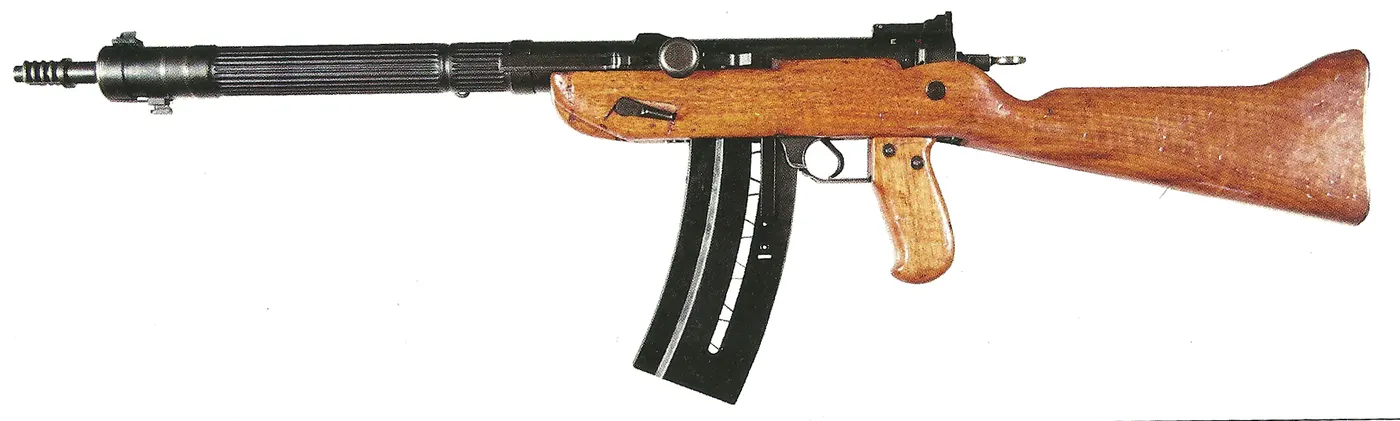

Despite its name, the SIG AK53 has no connection to the Soviet Kalashnikov rifle series. AK53 is SIG's own in-house Swiss factory code, and multiple reference sources flag the coincidence explicitly because it confuses readers so often.1 The rifle itself was an experimental battle rifle built at Neuhausen am Rheinfall in the early 1950s, and roughly 50 examples were made for Swiss government trials between 1952 and 1953. None entered service, and none were sold or exported.1
- genuinely unique blow-forward operating system
- chambered for the full-power 7.5x55mm GP11 service round
- select-fire with a low, controllable cyclic rate
- compact prototype run preserved in national collections
- reciprocating barrel hurt practical accuracy
- more prone to jamming than a conventional gas gun
- raised concern over cook-off in a closed, heat-soaked chamber
- rejected in trials, no production order followed
Switzerland entered the postwar era still carrying the K31 straight-pull bolt-action rifle as its standard infantry arm, alongside the Lmg 25 light machine gun and Suomi-derived submachine guns.2 Swiss neutrality policy discouraged simply buying a finished NATO or Soviet-bloc design, so the army pushed for a wholly domestic self-loading rifle chambered for the existing 7.5x55mm Swiss GP11 cartridge rather than adopting a foreign round.2,3 SIG had already tried once and failed, with the commercially unsuccessful SK-46 of 1946 to 1950, before starting the AK53 project.3
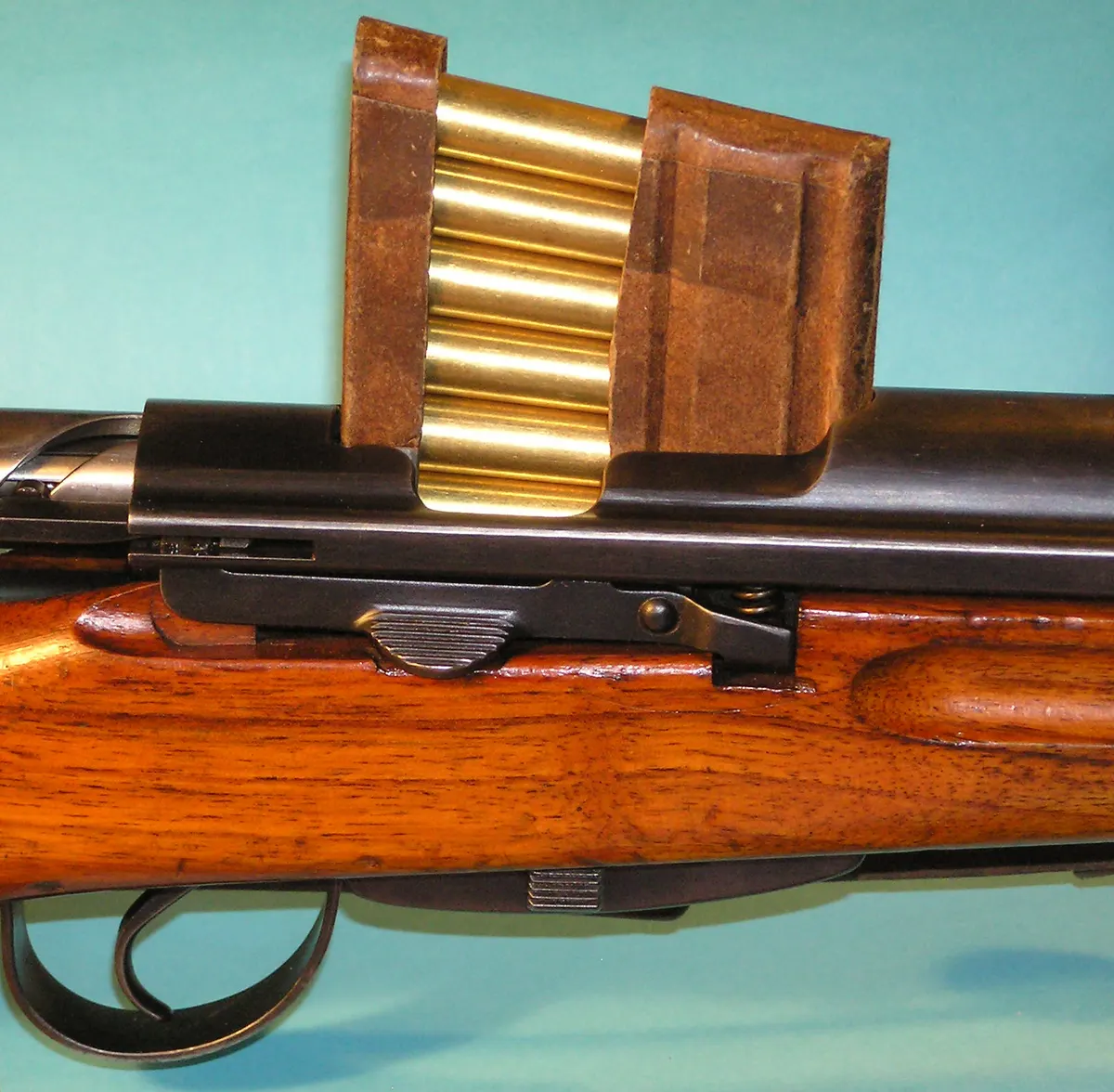
The AK53 is best understood as the middle step in a three-design chain. SIG tried the conventional gas-operated SK-46, then the radically different AK53, and only succeeded on the third attempt with a design that became the SIG SG 510, adopted by Switzerland in 1957 as the Stgw 57.3,4 As one of the battle rifles built for full-power rifle cartridges in the early Cold War, the AK53 never left prototype status, but its failure is a documented, direct cause of how its far more successful successor was designed.4
Ten of the AK53 prototypes went to the Swiss War Technical Service on 9 September 1952 for extended field evaluation, after Waffenfabrik Bern test-fired each one and reported that it functioned correctly under limited initial checks.1 The wider run reached about 50 rifles, with survivors later dispersed into military pattern rooms and collections, including the Royal Armouries' National Firearms Centre in the United Kingdom.1
A Barrel That Moves and a Breech That Doesn't
The AK53's defining feature is its operating system, a blow-forward gas-assisted action with a fixed, non-reciprocating breechblock and a barrel that cycles forward and backward on every shot.1 That is the reverse of almost every other self-loading rifle, where the barrel stays fixed and the bolt or bolt carrier does the moving. A period German-language auction description of a surviving example calls it a Gasdrucklader mit nach vorne gleitendem Lauf, a gas-pressure loader with a forward-sliding barrel, which matches the mechanical account independently.5
- First Production Year1953
Propellant gas tapped near the muzzle drives an annular piston rearward, compressing a return spring that wraps around the barrel.1 As chamber pressure drops, the compressed spring snaps the barrel forward. That forward motion strips the fired case off the stationary breechface and ejects it, after which the barrel returns under spring tension, chambers a fresh round from the magazine, and relocks against the receiver through a set of flapper locks. The breechblock itself never moves through the entire cycle.1
- Cartridge7_5_55mm_swiss
- Calibre7.5 mm
- Case Length55 mm
- Bullet Weight10.4 g
Blow-forward action is a rare category generally, more familiar from small blowback pistols and submachine guns such as the prewar SEMAG/Sauer designs or the later Steyr GB, than from a locked, magazine-fed rifle.1 Building it into a gas-assisted, locked rifle chambered for a full-power service cartridge made the AK53 mechanically unusual even within that already uncommon family, and this is the detail every serious technical account of the rifle leads with.1 It is also worth stating plainly that the AK53 is not related to delayed-blowback roller-locking systems. That mechanism belongs to its successor, not to the AK53 itself, a point covered in History below.
- Action TypeGas-Operated
- Select FireYes
- Feed SystemDetachable Magazine
- Magazine Capacity20
Fire Control, Rate of Fire, and Feed
The fire selector is marked E for Einzelfeuer (semi-automatic) and M for Mitraillieren (full-automatic), making the AK53 a genuine select-fire rifle.1 Its cyclic rate is an unusually low 300 to 350 rounds per minute, roughly half the 550 to 700 rpm typical of contemporary battle and assault rifles.1,6 That is a direct mechanical consequence of cycling an entire barrel back and forth, a far slower stroke than moving a light bolt carrier.
- Muzzle Velocity747 m/s
- Muzzle Energy3,500
- Effective Range (point)500 m
- Effective Range (area)800 m
- Maximum Range2,800 m
- Sighting Range600 m

Feed is by detachable magazine, and sources disagree on exact capacity. Most references, including Wikipedia and Military Factory, cite 20 rounds, while Forgotten Weapons' own period-documentation citation gives a higher 24 to 30 round range.1,6 The lower 20-round figure is the majority-sourced number and the one used here, though the discrepancy is worth flagging rather than treating as settled.
- Sight TypeIron sights
- Iron SightsYes
The trials also raised a specific safety concern tied to the fixed-breech layout. Because the chamber stays closed and hot through the firing cycle, evaluators worried about a cook-off risk, a chambered round igniting prematurely from accumulated heat during sustained fire.1 Combined with reduced practical accuracy from a reciprocating barrel disturbing shot-to-shot harmonics, and a higher jamming tendency than a conventional design, this is one of the concrete reasons the AK53 never advanced past trials.1
Dimensions and Furniture
Overall length runs to roughly 1,000 mm (about 39 to 39.5 in), with a barrel around 600 mm (about 23 to 23.6 in) and an unloaded weight near 4.9 kg (about 10.8 lb).6 The stock is a one-piece wood design with a pistol grip, and sighting is by simple front and rear iron sights.6 Muzzle velocity is best sourced at approximately 747 m/s (2,450 ft/s) for GP11 ball ammunition, a figure consistent with typical GP11 loadings out of a rifle-length barrel.6
- Total Production50
- Production Start1953
Ten Rifles to Wallenstatt
After the initial function checks at Waffenfabrik Bern, the ten evaluation rifles moved to Wallenstatt, a Swiss Army weapons-trials range, for extended field testing.1 The broader production run for trials purposes reached about 50 rifles in total.1 The relatively high serial number recorded on the surviving example (161, out of a run of roughly 50) suggests SIG used a continuous internal numbering sequence spanning several prototype projects rather than an AK53-exclusive range starting at one, a minor nuance rather than a contradiction of the production total.5
Trial evaluators found the AK53 wanting on several fronts at once. Its practical rate of fire was low even by the design's own modest cyclic-rate standard, jamming increased because of the moving-barrel and fixed-breech arrangement, and practical accuracy suffered because the barrel itself is a reciprocating mass whose harmonics shift with every shot, unlike a conventional fixed-barrel design.1 Evaluators judged that the AK53 offered no real advantage over a conventional gas-operated rifle while being mechanically more complex, with more coordinated springs, a stationary-breech assembly, and more intricate feed geometry.1 No production order followed, and the rifle never left prototype status.1
From AK53 to Stgw 57
SIG's postwar drive for a Swiss self-loading service rifle ran through three distinct in-house designs before it succeeded. The SK-46, built between 1946 and 1950, was a conventional gas-operated, tilting-bolt design styled after the K31's own stock and offered commercially without any sales.3 The AK53 followed with its blow-forward mechanism and was rejected in trials as described above. Only the third attempt, the AM55 of 1955, solved the problem.3,4
The AM55 is credited to SIG engineer Rudolf Amsler, from a family of Swiss firearms engineers, and it abandoned the blow-forward concept entirely for a roller-delayed blowback action with a conventional fixed barrel and a moving two-piece bolt.4 That mechanism traces to late-war German work, variously cited as the Mauser Gerät 06H and StG.45(M) roller-delay experiments.
The same wartime work, carried onward through engineer Ludwig Vorgrimler's postwar move to Spain, separately produced the CETME rifle and later the Heckler & Koch G3.4 SIG's own route to the mechanism was an independent in-house adaptation rather than a direct transplant from CETME, with Swiss engineers reworking the roller geometry into pivoting flaps between the bolt head and bolt body.4
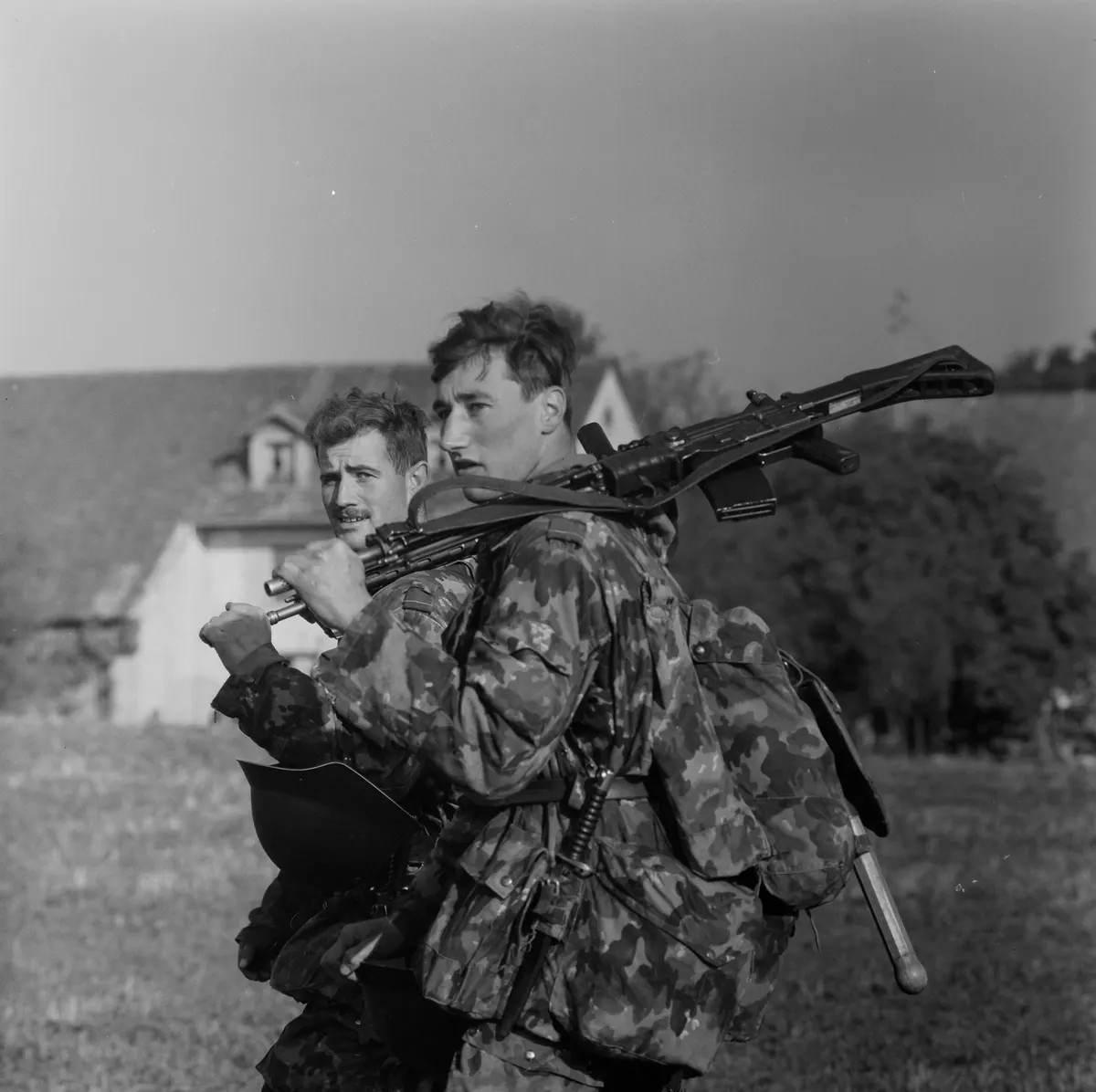
Refined for Swiss Army trial feedback, with plastic furniture replacing wood and a folding trigger guard sized for winter mittens in mountain conditions, the AM55 was formally adopted in 1957 as the Stgw 57 and marketed abroad as the SIG SG 510 family in 7.62x51mm NATO and 7.62x39mm chamberings.4,2 It served as Switzerland's standard rifle from 1957 until replacement by the SIG SG 550 beginning in 1990, and it also retired the K31, the Suomi-pattern M-43/44 submachine gun, the Lmg 25, and the Zf. Kar. 55 sniper rifle from Swiss service.2 The AK53's real significance is negative but formative. It is the design SIG had to fail at, after the SK-46 also failed, before arriving by an entirely different operating principle at one of the more respected battle rifles of the Cold War.1,2

No country ever adopted the AK53. Switzerland is the only government to have tested it, evaluating the design through the Swiss War Technical Service in 1952 and 1953 before rejecting it in favor of the later AM55/Stgw 57.1 Surviving trial rifles are now held only as museum and collector pieces rather than service weapons.
SIG built the AK53 and its eventual successor around completely different operating principles, and the failure of one directly shaped the other. The AK53 is blow-forward with a moving barrel and a fixed breech, while the SIG SG 510 (Stgw 57) is roller-delayed blowback with a conventional fixed barrel and a moving two-piece bolt.1,4 Where the AK53 managed only a 300 to 350 rpm cyclic rate and drew criticism for jamming and accuracy problems, the Stgw 57 went on to serve as Switzerland's standard rifle for more than three decades.2
| SIG AK53 | SIG SG 510 (Stgw 57) | |
|---|---|---|
| Operating system | Blow-forward, fixed breech1 | Roller-delayed blowback4 |
| Cyclic rate | 300 to 350 rpm1 | Approximately 600 rpm2 |
| Adopted | Never (prototype only)1 | 1957, Swiss Army2 |
| Units built | Approximately 501 | Tens of thousands, 1957 to 19852 |
It is worth being precise about a common point of confusion. The roller-delayed blowback mechanism that connects the CETME rifle and the Heckler & Koch G3 to a shared German wartime design belongs to the AM55/Stgw 57. The AK53 itself has no meaningful mechanical relationship to that roller-lock group, and treating the two SIG designs as mechanically interchangeable misses the entire reason the AK53 was abandoned.


Is the SIG AK53 related to the AK-47 or other Kalashnikov rifles? No. AK53 is SIG's own internal Swiss factory designation, unrelated to the Soviet Avtomat Kalashnikova naming that produced the AK-47. The overlap in initials is coincidental, and several reference sources note the confusion explicitly.1
How does the SIG AK53's blow-forward action work? Gas tapped near the muzzle drives a piston that compresses a spring around the barrel. The spring then snaps the barrel forward to extract and eject the fired case, before the barrel returns to chamber a new round, all while the breechblock itself stays completely still.1
Was the SIG AK53 ever adopted by any military? No. Around 50 were built for Swiss government trials in 1952 and 1953, evaluators rejected the design, and SIG moved on to develop what became the Stgw 57.1
What replaced the SIG AK53 in SIG's development program? The AM55, adopted by Switzerland in 1957 as the Stgw 57 and sold abroad as the SIG SG 510, using an unrelated roller-delayed blowback mechanism.4
How many SIG AK53 rifles were built, and where are they now? Approximately 50, all for government trials, with none exported or sold commercially. Survivors are held in military pattern rooms and collections, including the Royal Armouries' National Firearms Centre and private Swiss collections.1,5
- "SIG AK-53: A Truly Weird Forward-Operating Rifle", Forgotten Weapons — forgottenweapons.com ↩
- "SIG SG 510", Wikipedia — en.wikipedia.org ↩
- "Swiss SK-46", Forgotten Weapons — forgottenweapons.com ↩
- "Giant Swiss Battle Rifle, The SIG SG 510", Last Stand on Zombie Island — laststandonzombieisland.com ↩
- SIG AK53 trial rifle auction listing, Swisswaffen — swisswaffen.com ↩
- "SIG AK53", Military Factory — militaryfactory.com ↩