


Dutch soldiers of the early 1960s called their new service rifle Het Licht Automatisch Geweer (The Light Automatic Rifle), often shortened to LAG. It was the Netherlands' license-built version of the Belgian FN FAL, chambered in 7.62x51mm NATO, and it carried the Royal Netherlands Army, Korps Mariniers and Koninklijke Luchtmacht from the early 1960s until 1995.1 The rifle replaced the M1 Garand, which Dutch ordnance nomenclature had itself labeled Geweer M1 a generation earlier, a naming detail that matters because it has occasionally been confused with the FAL that succeeded it.
- 7.62mm NATO stopping power and range over the Garand it replaced
- genuine domestic production share via Artillerie-Inrichtingen
- simple, reliable [gas-operated](/en/glossary/gas-operated) action familiar across NATO
- semi-auto-only lock kept the standard rifle controllable and ammunition-frugal
- heavier and longer than the rifles that eventually replaced it
- full-automatic fire required switching to the separate FALO variant
- no folding-stock paratrooper version was ever adopted despite one existing in the wider FAL family
Unlike a straightforward import, the Dutch LAG was genuinely co-produced. Half of the run came off FN Herstal's lines in Belgium and the other half was assembled domestically by Artillerie-Inrichtingen at Zaandam, giving the Netherlands real industrial content in a rifle that is often treated abroad as a pure Belgian export.3,4 Standard-issue rifles fired semi-automatic only, a deliberate Dutch choice that pushed the FAL's full-automatic capability onto a separate heavy-barrel sibling rather than handing it to every rifleman.
Manufacturing was split roughly 50/50 between FN Herstal in Belgium and Artillerie-Inrichtingen at Zaandam, Netherlands, giving the Dutch rifle genuine domestic industrial content rather than being a straight import.
Mechanically the Dutch rifle followed the standard FN FAL 50.00 pattern almost exactly. It used a gas-piston-operated short-stroke system with a tilting bolt, fed from a detachable magazine holding 20 rounds, with overall length around 1,100mm and a 533mm barrel.5
- First Production Year1961
- Service Entry Year1964
- DesignerDieudonne Saive (FN Herstal)
- Weight (Empty)4.3 kg
- Currently In ServiceNo
- Notable UsersRoyal Netherlands Army, Korps Mariniers, Koninklijke Luchtmacht
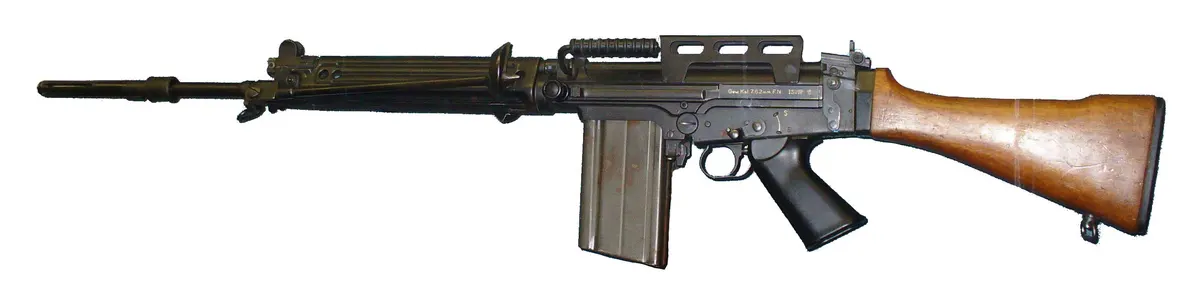
Empty weight ran roughly 4.3 to 4.5kg depending on furniture and production batch.5,6 What set the Dutch rifle apart was on the outside, not inside the action. It used a fully hooded front sight and a winged, shielded rear sight adjustable only for windage, with range corrections made at the front sight instead, a configuration reported nowhere else in the wider FAL family.3 A pressed sheet-metal front handguard, nicknamed koekjesblik (cookie tin) by the troops who carried it, covered early rifles alongside a wooden stock and steel buttplate.7 Around 1980 conscripts began receiving updated rifles with black synthetic stocks and handguards, and the fold-out bipod or monopod legs fitted to earlier rifles were removed to save weight, with the rear sight fixed at a preset 250m.7
- Cartridge7.62x51mm NATO
- Calibre7.62 mm
- Case Length51 mm
- Calibre Classfull-power rifle cartridge
The standard rifle's fire selector was locked to semi-automatic only, a point Dutch sources state explicitly rather than leave implied.7 Full-automatic fire belonged to the FALO, a heavy-barrel version with a 30-round magazine that functioned as the squad's automatic weapon, fielded mainly by the Korps Mariniers and the air force. Cyclic rate on the automatic-capable action ran around 650 to 700 rounds per minute.6 A scoped long-range configuration, the Kijker Richt Recht AI 62 (KRR62), extended practical range to about 800m against roughly 600m for the iron-sighted standard rifle, and later Cold War-era rifles received STANAG scope mounts adapted for early image-intensifier night sights with external infrared illuminators.4,6
- Action TypeGas-Operated
- Fire Modessemi-automatic (standard-issue rifle), full-automatic on FALO heavy-barrel variant
- Select FireNo
- Feed SystemDetachable Magazine
- Magazine Capacity20
- Cyclic Rate of Fire650
- Effective Range (point)600 m
- Sighting Range250 m
- Barrel Length533 mm
- Sight Typeiron sights, hooded front and shielded windage-adjustable rear, KRR62 telescopic sight on Geweer Lange Afstand variant
- Optic RailYes
- Iron SightsYes
- Overall Length1,100 mm
- Receiver Materialsteel
- Furniture Materialwood and steel buttplate (early production), black synthetic polymer (from c. 1980)
- Folding / Collapsing StockNo
- Bullpup LayoutNo
- Ambidextrous ControlsNo
- Total Production120,000
- Production Start1961
- Production End1995
- Variants4
The Netherlands needed a 7.62mm NATO rifle to replace its M1 Garands (locally Geweer M1) as NATO standardized ammunition in the late 1950s, and the choice was not as automatic as it looks in hindsight.1 Artillerie-Inrichtingen already produced the American ArmaLite AR-10 under license at its Hembrug works, and by several accounts the AR-10 was the obvious home-team pick before it underperformed against the FAL in trials.1,8

Before either import competed, Dutch ordnance even tried a third, cheaper path. With roughly 55,000 relatively new Garands already in inventory, Artillerie-Inrichtingen built two prototype conversions of the M1 Garand to 7.62mm NATO, feeding from AR-10-pattern 20-round detachable magazines instead of the Garand's internal clip.9 Both prototypes survive today in the Nationaal Militair Museum's collection, a rifle line that in the end existed as only two hand-built guns.10
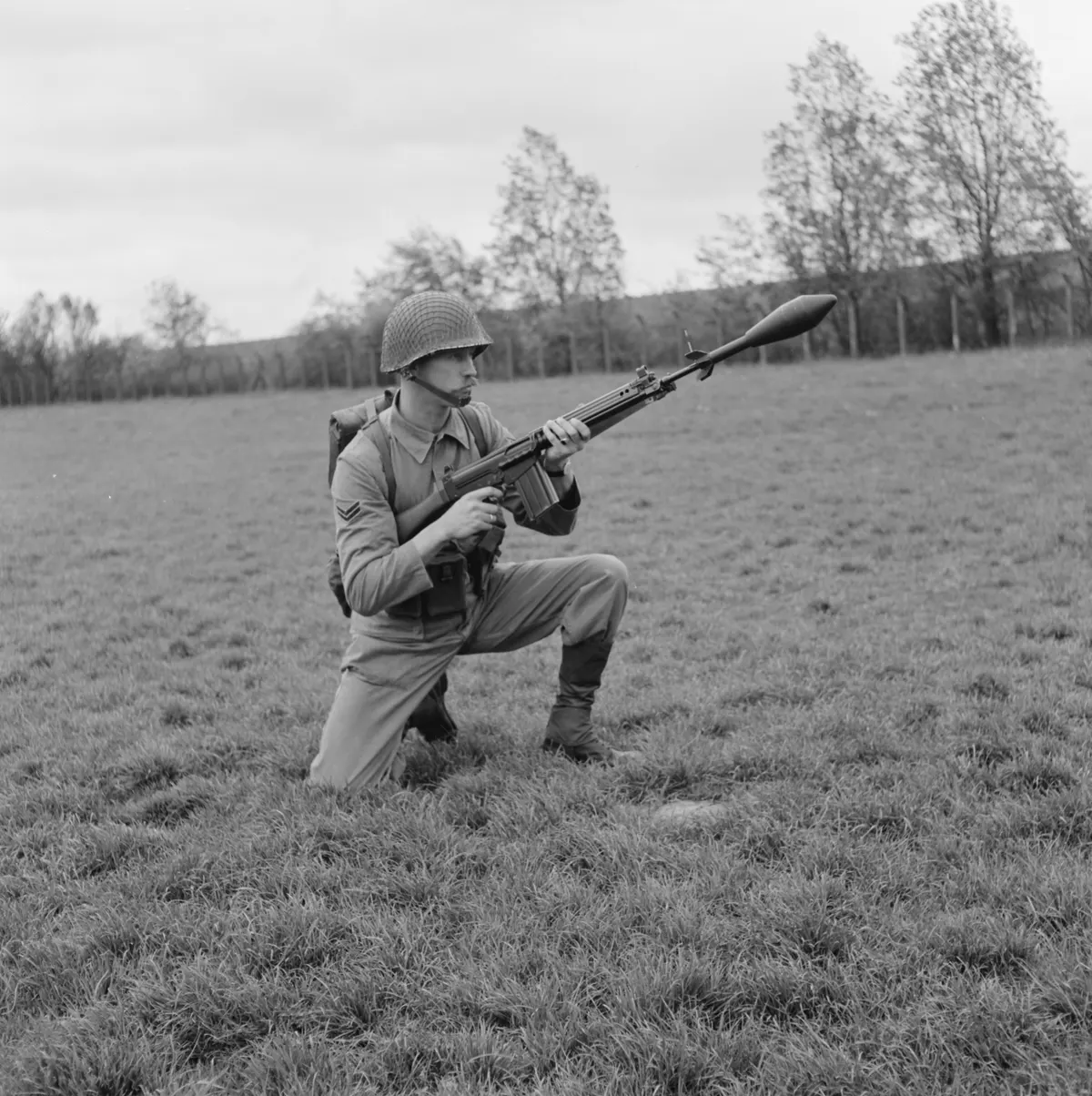
Sources place the FAL's formal Dutch adoption anywhere from 1961 to 1965 depending on what is being measured. Procurement itself began around 1961, the Infantry Cadre School at Vught first fired the newly issued rifle in 1964, and at least one source dates full fleet-wide replacement of the Garand to 1965.1,3 That spread overlaps the tail end of the West New Guinea dispute with Indonesia (1961 to 1962), but the best-documented small arm for Dutch Marines in that specific conflict remains the M1 Garand rather than the FAL, so a direct FAL role in that dispute should be treated as unconfirmed rather than assumed by proximity of dates.
The rifle's own retirement is far better documented than its arrival. In 1994 the Dutch Ministry of Defense signed with Canada's Diemaco for 52,285 C7 rifles, a licensed derivative of the Colt M16A2, beating the Steyr AUG, Colt M16A2 and Israeli Galil in the competition at a contract value of roughly 100 million Dutch guilders.11 The changeover, completed around 1995, retired the FAL, the FALO, the Uzi submachine gun and any remaining Garands in one move.11
Direct, named combat use of the Dutch FAL is thin in the available sourcing, and it is worth stating that plainly rather than filling the gap with inference. As the standard Dutch infantry rifle from the mid-1960s to 1995, it equipped the Netherlands' NATO contribution in West Germany throughout the Cold War, though that is contextual rather than tied to any specific documented engagement.
The Netherlands also contributed an infantry battalion, known as Dutchbatt and drawn from Regiment Infanterie Johan Willem Friso, to the United Nations Interim Force in Lebanon (UNIFIL) from 1979 to around 1983.12,13 Over 800 troops rotated through that deployment carrying DAF YP-408 armored personnel carriers, 120mm mortars and TOW missiles, and since the FAL was the Dutch army's standard rifle for the entire window, it is reasonable to infer Dutchbatt riflemen carried it. No source, however, names the personal rifle issued to that battalion specifically, so this should be read as a plausible inference rather than a confirmed fact.12,13
- Standard Licht Automatisch Geweer. The semi-automatic-only infantry rifle, with hooded front sight, winged rear sight and metal (later plastic) handguard, issued from the early 1960s to 1995.
- **FALO / Zwaar Automatisch Geweer.** The heavy-barrel, select-fire squad automatic version, with a 30-round magazine, issued mainly to the Korps Mariniers and the air force.6
- Geweer Lange Afstand (KRR62 sniper configuration). A scoped long-range configuration using the Dutch-made KRR62 telescope, roughly 1,000 of which were produced by Artillerie-Inrichtingen's optics division, extending effective range to about 800m.4,6
- Post-1980 modernized-furniture rifles. The same action in black synthetic stock and handguard, with the bipod and monopod removed to cut weight.7
A true folding-stock Para version, built elsewhere in the FAL family for Belgian paratroopers to sling across the chest inside cramped aircraft, does not appear to have been adopted by the Dutch armed forces. Available sourcing indicates the Netherlands instead ordered fixed-stock rifles with a Para-style rear sight rather than an actual folding stock, though this specific point rests on a single secondary source and would benefit from stronger confirmation.14
Later Cold War-era rifles are also noted by collectors for heavy-duty STANAG mounts adapted to carry first-generation night sights with external infrared illuminators, evidence the platform kept receiving investment through the 1970s and 1980s rather than sitting static until the Diemaco changeover.4
Across every configuration above, the underlying gas-piston action and receiver stayed the standard FN FAL design, with the visible differences confined to sights, furniture and barrel weight.6

The Netherlands was the sole operator of this specific national FAL configuration. It served the Royal Netherlands Army as the standard infantry rifle, the Korps Mariniers (which also fielded the FALO automatic variant), and the Koninklijke Luchtmacht for base-security roles, with total Dutch procurement across the whole program reaching roughly 120,000 rifles.1,6
Frontline service ended with the 1994 to 1995 Diemaco C7 changeover, and some units reportedly retained the FAL in a designated-marksman role for a period afterward before it was phased out from that niche as well, though the exact end date of that residual use was not found in available sourcing.3 The Royal Netherlands Navy is separately reported to still use FAL-pattern rifles today for firing a line across water between vessels or to shore, a specialized non-combat task that keeps the platform technically active decades after its combat retirement.3
Every FN FAL licensee solved the same problem, a 7.62mm NATO rifle for a NATO member, with a different configuration choice, and the Netherlands' answer, semi-automatic-only standard rifles paired with a distinct automatic-fire sibling, sits at one extreme of that range. Israel's FN FAL kept full-automatic capability in its standard-issue rifles and used the FAL as a stopgap for barely over a decade before moving to the indigenous Galil, a far shorter service life than the Dutch rifle's three decades. West Germany's G1 never got the chance to develop its own long story at all, serving only briefly before Bonn switched to the domestically-designed G3, making the Dutch commitment to the FAL platform unusually long by comparison with either.
| Dutch LAG | FN FAL ROMAT (Israel) | |
|---|---|---|
| Fire control (standard rifle) | Semi-automatic only | Select-fire |
| Service span | c. 1961/64 to 1995 | c. 1955 to late 1960s |
| Replaced by | Diemaco C7 (5.56mm) | IMI Galil (5.56mm) |
Against the inch-pattern Commonwealth family represented by the L1A1, the distinction is mechanical rather than doctrinal. The Netherlands used the metric FN-Herstal pattern common across Continental Europe, meaning Dutch and Commonwealth FALs share a general layout but not interchangeable parts, magazines or accessories, a detail that mattered whenever NATO partners operated alongside each other. Austria's StG 58 followed a similar co-production model to the Dutch rifle, with Steyr also part-manufacturing its own FAL variant domestically rather than importing complete rifles, though Austria kept full-automatic fire standard rather than reserving it for a separate variant.


**What does Geweer M1 actually mean?** It refers to the M1 Garand, the American rifle the FAL replaced in Dutch service, not the FAL itself. Every Dutch-language source calls the Dutch FAL Het Licht Automatisch Geweer instead.2
What are the Licht Automatisch Geweer's specifications? It is a gas-operated, 7.62x51mm NATO battle rifle firing from a 20-round detachable magazine, roughly 1,100mm long and 4.3 to 4.5kg empty, with a 533mm barrel.5,6
How does the Dutch FAL differ from a standard FN FAL? Mechanically it is nearly identical. The differences are external, a hooded front sight and shielded rear sight unique to Dutch service, a distinctive metal handguard, and a standard rifle locked to semi-automatic fire with full-auto capability moved to the separate FALO variant.3,7
Is the Licht Automatisch Geweer still in service? Not as a frontline infantry rifle, it was retired from that role by the 1994 to 1995 Diemaco C7 changeover. Reports indicate the Royal Netherlands Navy still uses old FAL-pattern rifles for the non-combat task of firing a mooring line.3
What replaced the Dutch FN FAL? The Diemaco C7, a Canadian-built licensed derivative of the Colt M16A2, under a 1994 contract for 52,285 rifles.11
- "FN FAL", gunsite.jouwweb.nl — gunsite.jouwweb.nl ↩
- "De Nederlandse M1-Garand site", M1-Garand.nl — m1-garand.nl ↩
- "Dutch FAL", weaponsandhistory.com — weaponsandhistory.com ↩
- "The Dutch FAL's", FN Forum — fnforum.net ↩
- "FN FAL / L1A1 / C1 / SLR", Modern Firearms — modernfirearms.net ↩
- "FN FAL", Wikipedia (Dutch) — nl.wikipedia.org ↩
- "Michiel Mans met Wapens, FN FAL", TPO.nl — tpo.nl ↩
- "The AR-10 versus the FN FAL, tactical and technical requirements, 1961", 20thcenturyplatoons.com — 20thcenturyplatoons.com ↩
- "Nederlandse M1 Garand met AR-10 magazijn", Artillerie Inrichtingen Hembrug — artillerieinrichtingenhembrug.wordpress.com ↩
- "Garand-AI proefmodel", Nationaal Militair Museum collectie — collectie.nmm.nl ↩
- "Materieel van toen, FAL, Uzi en Diemaco", Defensie.nl Materieelgezien magazine — magazines.defensie.nl ↩
- "1979-02 UNIFIL", NIMH encyclopedie internationale operaties — nimh.nl ↩
- "Dutchbatt", Wikipedia (Dutch) — nl.wikipedia.org ↩
- "FAL Paratrooper 50.63", Forgotten Weapons — forgottenweapons.com ↩