


ArmaLite's modern AR-10 began reaching customers in January 1996, roughly forty years after Eugene Stoner's original AR-10 first appeared in the mid 1950s.1 The two rifles carry the same name and a similar external silhouette. Their internal engineering has almost nothing in common. This one is a semi-automatic, gas-operated rifle chambered in 7.62mm NATO and .308 Winchester, built by ArmaLite Inc. at its factory in Geneseo, Illinois, and sold primarily into the American civilian and law enforcement markets as one of many modern battle rifles.1,2
- Modern flat-top receiver with [optic rail](/en/glossary/optic-rail) and iron sights
- Wide caliber spread beyond .308, from 6.5mm Creedmoor to .338 Federal
- Suppressor ready with a factory [threaded barrel](/en/glossary/threaded-barrel)
- Only manufacturer legally permitted to use the AR-10 trademark
- Semi-automatic only, no select-fire military variant
- No confirmed national military adoption anywhere
- Two mechanically incompatible magazine families across its own product history
- Sits at a premium price point against cheaper .308 AR clones
The company behind it is not the original ArmaLite. In 1994, Mark Westrom, a former US Army ordnance officer and owner of the AR-15 parts maker Eagle Arms, bought the dormant ArmaLite trademark and associated intellectual property from John Ugarte, the last president of the original ArmaLite division.2 The purchase closed in early 1995, and Eagle Arms was folded into a reorganized ArmaLite Inc.2 That is a different corporate history from the one behind ArmaLite's original AR-10, which Eugene Stoner designed at a Fairchild Engine and Airplane subsidiary in 1954, and which Colt bought the rights to in 1959 after fewer than 10,000 rifles had been built.1,3
Because ArmaLite holds that trademark, the wider clone market that grew up around the .308 AR-pattern rifle has to describe its own products as AR-10-style rather than AR-10. That happens to be the exact phrase attached to this weapon in casual reference, even though the rifle it actually describes is the one manufacturer allowed to use the real name.4 No country has adopted the modern ArmaLite AR-10 as a service rifle. Its documented institutional user base is smaller and more specific, running from hunters and competitive shooters to at least one Canadian police tactical unit, covered further in Operators below.1
How ArmaLite Scaled the AR-15A2 Into a .308 Rifle
The 1996 rifle, internally called the M-10 project and sold as the AR-10B, was not built from Stoner's 1956 drawings.1 Westrom's engineering team instead scaled up the AR-15A2 pattern, the M16A2-generation rifle Eagle Arms already knew intimately, to handle 7.62x51mm using computer-aided design tools rather than reviving the original straight-line-stock, phenolic-furniture layout.1,5 The result is a forged 7075-T6 aluminum alloy receiver running a direct impingement gas system, a detachable magazine feed, and a modular rail interface that the original 1950s rifle never had.6 Every civilian ArmaLite AR-10 built since 1996 is semi-automatic only. None have been sold with the original's select-fire capability.
- First Production Year1996
- Service Entry Year1996
- Weight (Empty)4.3 kg
- Weight (Loaded)4.8 kg
- Currently In ServiceYes
The M14 Magazine Workaround and What Replaced It
One design choice traces directly to the political climate of 1994. The Federal Assault Weapons Ban made new-production, large-capacity rifle magazines legally complicated just as ArmaLite needed a magazine for a .308 rifle that had no purpose-built commercial option yet.5 Westrom's team adapted the AR-10B to feed from steel M14 magazines, which were cheap, plentiful as military surplus, and already legal.5 That improvisation defined the early AR-10B line's parts compatibility. ArmaLite later redesigned the follow-on AR-10A series to accept the earlier waffle-pattern AR-10 magazines and their clones instead, meaning the modern AR-10 product family has run on two mechanically distinct magazine standards across its own three-decade history.1
- Cartridge.308 Winchester
- Calibre7.62 mm
- Case Length51 mm
- Calibre Class7.62x51mm NATO
- Bullet Weight9.7 g
- RimfireNo
- Caseless AmmunitionNo
Barrel, Twist Rate, and a Caliber Lineup Beyond .308
The best-documented configuration, the AR-10A4, ships with a 20-inch stainless heavy barrel, weighs around 9.6 pounds unloaded, and uses a 1 in 11.25-inch right-hand rifling twist suited to 150 to 175-grain bullets.7,8 ArmaLite's current Tactical line spans a 14.5-inch NFA-regulated short-barrel model, 16-inch and 18-inch carbines, a 20-inch rifle, and a 22-inch 6.5mm Creedmoor variant, all built around the same gas-operated action and a Picatinny flat-top upper.9 Beyond the original .308 Winchester chambering, ArmaLite now offers current AR-10-family models in .243 Winchester, .260 Remington, 6.5mm Creedmoor, 7mm-08 Remington, and .338 Federal, drawing barrels from outside suppliers including Ballistic Advantage, Wilson Combat, and DPMS.1 Trigger specification varies across the range. Standard Tactical models run a single-stage trigger, while the National Match-oriented AR-10T uses a two-stage trigger broken at roughly 2.5 pounds first stage and 4.5 pounds second stage, with ArmaLite claiming around 1 MOA accuracy at 100 yards for that configuration.10 One published review reported firing more than 250 rounds of mixed surplus and commercial .308/7.62 ammunition through a Tactical-line rifle without a malfunction, and groups around 5/8 inch at 50 yards using 147-grain NATO ball.11
- Action TypeGas-Operated
- Fire Modessemi-automatic
- Select FireNo
- Feed SystemDetachable Magazine
- Magazine Capacity20
- Cyclic Rate of Fire700
- Practical Rate of Fire40
- Trigger Typesingle-stage
- Safety Typelever
- Muzzle Velocity853 m/s
- Muzzle Energy3,500
- Effective Range (point)500 m
- Effective Range (area)800 m
- Maximum Range3,725 m
- Sighting Range800 m
- Penetration300 mm
- Accuracy3
- Barrel Length508 mm
- Rifling Twist1_11_25
- Rifling Grooves4
- Sight Typeadjustable iron sights
- Sight Radius559 mm
- Optic RailYes
- Iron SightsYes
- Threaded BarrelYes
- Receiver Materialaluminum alloy
- Furniture Materialsynthetic or wood
- Folding / Collapsing StockNo
- Bullpup LayoutNo
- Ambidextrous ControlsNo
- Modularityhigh
- Production Start1956
- Width88 mm
- Height228 mm
From Fairchild's ArmaLite to a Dormant Trademark, 1954 to 1995

The original ArmaLite Corporation was founded in 1954 as a small-arms research subsidiary of Fairchild Engine and Airplane.3 Eugene Stoner's AR-10 followed in 1956, a select-fire rifle built in under 10,000 units through 1959, sold mostly on foreign military contracts to Sudan, Portugal, Italy, Nicaragua, Guatemala, and Cuba, with the Dutch firm Artillerie-Inrichtingen producing much of that run under license.1 That history belongs to the original AR-10 rifle rather than the modern product covered here.
ArmaLite sold the AR-10 and AR-15 design rights to Colt in 1959, and the ArmaLite name went largely dormant on the rifle side for the next three and a half decades.1,3 No new AR-10-pattern rifle carried the ArmaLite name again until the mid 1990s.
Two Buyers, Two Generations, 1994 to 1996
Mark Westrom's 1994 to 1995 purchase of the trademark from John Ugarte reactivated the ArmaLite brand without inheriting Stoner's original engineering. Westrom, a former US Army ordnance officer, already owned the AR-15 parts maker Eagle Arms, and folded it into a reorganized ArmaLite Inc, set up in Geneseo, Illinois, with a sister facility later established in Phoenix, Arizona.2
Deliveries of the new semi-automatic AR-10B began in January 1996, engineered from the AR-15A2 pattern rather than from Stoner's drawings.1 ArmaLite began using the AR-10 name commercially from that point onward.
Formal USPTO trademark registration did not follow immediately. It took until October 2002 for ArmaLite to cement legal ownership of the AR-10 name, six years after the rifle itself first shipped.1,4
Two Decades of Model Growth
From that single 1996 rifle, ArmaLite's AR-10 line expanded steadily. Model names have included the AR-10A2, AR-10A4, the National Match-oriented AR-10T, and a limited-run retro AR-10B reviving the 1950s Sudanese-pattern handguard and top-mounted charging handle look for collectors.1 The current catalog groups most production under the Tactical line by barrel length, alongside the precision-oriented Super SASS Gen II.9
ArmaLite's pricing today runs from roughly $2,518 to $2,524 for standard Tactical rifles up to about $3,824 for the Super SASS Gen II, against older reviews citing street prices closer to $1,300 to $1,500 in earlier years of the line.9,11
The Tactical Line, the AR-10T, and the Super SASS Gen II
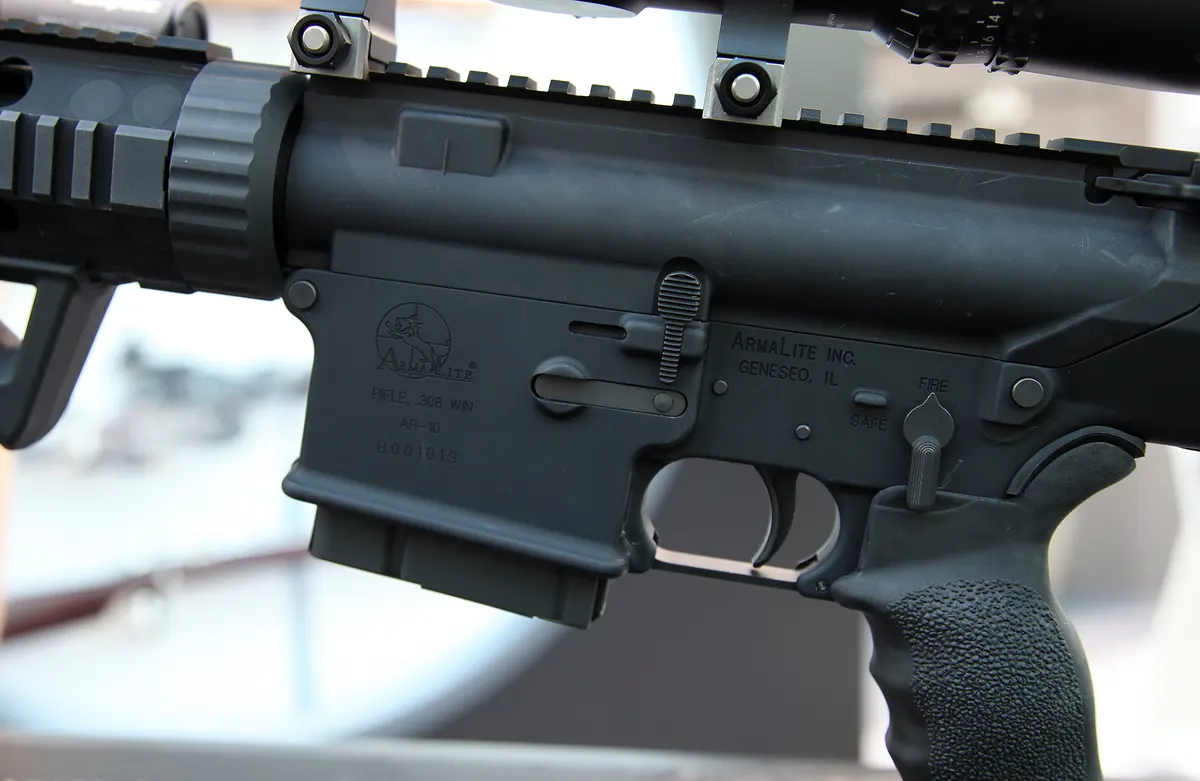
ArmaLite currently sells the AR-10 across six standing configurations. The lineup spans a 14.5-inch NFA-regulated short-barrel Tactical, 16-inch and 18-inch Tactical carbines, a 20-inch Tactical rifle, a 22-inch 6.5mm Creedmoor Tactical, and the precision-oriented Super SASS Gen II.9 The AR-10 20-inch Tactical uses a KeyMod handguard extending 15 inches past the breech over a rifle-length gas system, still built on the same forged 7075-T6 receivers as the rest of the line.6 The AR-10T, ArmaLite's National Match target model, pairs a two-stage trigger with a claimed 1 MOA accuracy standard at 100 yards, aimed squarely at competitive and precision shooters rather than a tactical buyer.10
Legacy model names still referenced in the used-gun market include the AR-10A2 and AR-10A4, the latter closely matching the specification most commonly cited for the platform (20-inch stainless barrel, roughly 9.6-pound weight, 1 in 11.25-inch twist).7,8 A limited retro AR-10B run revived the original Sudanese-pattern handguard and top charging handle purely as a nod to the 1950s rifle's appearance, built on entirely modern internals.1 None of these variants introduced a select-fire option. Every AR-10 ArmaLite has sold since 1996 remains semi-automatic only, a legal and market requirement for the civilian rifle it was designed to be from the outset.

Hunters, Competitors, and a Canadian Tactical Unit
No national military has adopted the modern ArmaLite AR-10 as an issued service rifle. Its user base sits almost entirely in the civilian and law enforcement markets it was built for. The best documented institutional user is Canada's Ontario Provincial Police Tactics and Rescue Unit, which has fielded the rifle.1 Beyond that specific unit, ArmaLite markets the platform broadly to hunters and competitive shooters, reflected in the caliber spread into 6.5mm Creedmoor, .260 Remington, .243 Winchester, 7mm-08 Remington, and .338 Federal that a purely military-oriented rifle would have no reason to offer.1
The Super SASS Gen II's name nods to semi-automatic sniper system trials terminology used elsewhere in the .308 AR-pattern market, positioning it toward designated-marksman and precision-competition roles rather than general patrol use.9 That is a narrower, civilian-adjacent version of the role that Knight's Armament's SR-25-derived rifles filled formally within the US military as the Mk 11 Mod 0 and M110 Semi-Automatic Sniper System, discussed further below. ArmaLite's own AR-10 never crossed into that kind of formal government contract.
Two rifles trade on the exact same ArmaLite AR-10 name today, and only one of them is the weapon most people picture when they hear it. The original 1956 Stoner AR-10 used a straight-line phenolic-furniture stock, a forged-alloy Stoner gas system, and select-fire capability, built by a corporate entity that stopped making rifles in 1959. The 1996 rifle covered here is a scaled-up AR-15A2 running direct impingement, semi-automatic only, built by a company that only acquired the ArmaLite name and reorganized around it in 1994 and 1995. Beyond the trademark and the general AR-pattern silhouette, almost nothing mechanical connects them.1,5
A closer engineering relative sits outside ArmaLite's own catalog entirely. After leaving the original ArmaLite decades earlier, Eugene Stoner refined the same basic 7.62mm AR concept a third time at Knight's Armament in the early 1990s, applying M16A2-era lessons to produce the SR-25, named by combining the 10 and 15 from AR-10 and AR-15.12 The SR-25 emphasizes parts interchangeability with the M16 and M4 family more than ArmaLite's own AR-10 does, and military derivatives of it, the Mk 11 Mod 0 and the M110 Semi-Automatic Sniper System, reached formal US service designated-marksman roles that ArmaLite's own commercial AR-10 never approached.12
Pricing separates the .308 AR market into clear tiers. Knight's Armament SR-25 rifles retail from roughly $5,760 and up. Premium duty-grade .308 ARs from Daniel Defense and LWRC International run about $3,000 to $4,500. ArmaLite's own Tactical-line AR-10s sit lower, around $2,500, with the flagship Super SASS Gen II reaching about $3,824.13,9
| Rifle | Action | List price (approx) | Accuracy guarantee |
|---|---|---|---|
| ArmaLite AR-10 Tactical | Direct impingement, semi-auto | ~$2,520 | Not specified |
| ArmaLite Super SASS Gen II | Direct impingement, semi-auto | ~$3,824 | 1 MOA |
| KAC SR-25 / SR25EM | Piston, semi-auto | $5,760+ | 0.5 MOA |
Below ArmaLite on price sit the wider .308 AR clone makers, DPMS, Rock River Arms, and others building rifles on the same general pattern. None of them can legally call their product an AR-10, a direct consequence of ArmaLite's own trademark, and at least one published review specifically credited ArmaLite's fit and finish as superior to DPMS-brand competitors in the same price bracket.11


Is the ArmaLite AR-10 still in production? Yes. ArmaLite continues to sell the AR-10 Tactical line, the AR-10T, and the Super SASS Gen II directly through its current catalog.9
How does the modern ArmaLite AR-10 compare to the original 1956 AR-10? They share a name and a general outline only. The 1996 rifle is a scaled-up AR-15A2 design, semi-automatic only, while the 1956 rifle was a separately engineered select-fire military rifle sold to Colt in 1959.1
Can civilians buy an ArmaLite AR-10? Yes, subject to normal US firearms purchase requirements. It is sold as a civilian sporting and tactical rifle, not a restricted military-only weapon.9
What is the difference between an ArmaLite AR-10 and an AR-10-style rifle? ArmaLite legally owns the AR-10 trademark. Every competing .308 AR-pattern rifle from another manufacturer has to be marketed as an AR-10-style or .308 AR rifle instead.4
What calibers does the ArmaLite AR-10 come in? Beyond the standard 7.62x51mm NATO and .308 Winchester, current models are also offered in .243 Winchester, .260 Remington, 6.5mm Creedmoor, 7mm-08 Remington, and .338 Federal.1
What does an ArmaLite AR-10 cost? Current standard Tactical-line models list around $2,518 to $2,524, with the precision Super SASS Gen II reaching about $3,824.9
- "ArmaLite AR-10", Wikipedia — en.wikipedia.org ↩
- "A Historical Review Of Armalite", Ammoland — ammoland.com ↩
- "ArmaLite", Wikipedia — en.wikipedia.org ↩
- "Must Read! Armalite AR-10 is the Only AR-10", AR308.com — ar308.com ↩
- "The Original Retro AR-10", Forgotten Weapons — forgottenweapons.com ↩
- "Today's Armalite AR-10 Battle Rifle", GunsAmerica Digest — gunsamerica.com ↩
- "ARMALITE, INC. AR-10A4 Rifle", Gun Digest Values — gunvalues.gundigest.com ↩
- "ArmaLite AR10A4 Carbine", Atlantic Firearms — atlanticfirearms.com ↩
- "AR10 Tactical Rifles", ArmaLite Inc. — armalite.com ↩
- "The Armalite AR-10T", Small Arms Defense Journal — sadefensejournal.com ↩
- "Gun Review: ArmaLite AR-10", The Truth About Guns — thetruthaboutguns.com ↩
- "Comprehensive Guide To The AR-10/SR-25 Platform", The Mag Shack — themagshack.com ↩
- "Best AR-10 2026, Budget to Premium", RifleConfigurator — rifleconfigurator.com ↩