

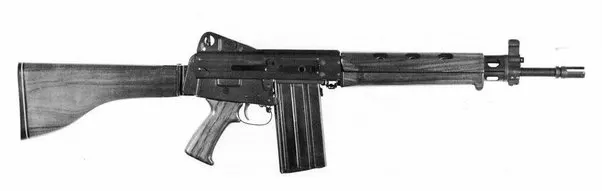

No military ever adopted the ArmaLite AR-16. No country tested it, no army bought it, and only four were ever built. Yet the rifle's stamped-steel receiver and short-stroke gas piston became, through a direct line of descent, the mechanical basis for the British SA80, the German Heckler & Koch G36 and its own HK416 offspring, and the Japanese Howa Type 89. Few failed prototypes in small arms history have had that kind of afterlife.
- cheap stamped-steel construction, no forging plant required
- short-stroke piston avoided the AR-10's patent entanglement
- folding stock and interchangeable-upper concept ahead of its time
- mechanically the direct ancestor of the AR-18 gas system
- never reached serial production, only four prototypes exist
- arrived after FN FAL, G3 and M14 had already won the market
- ArmaLite lacked the sales reach to place it with any buyer
- overshadowed within the company by its own AR-10/AR-15 predecessors
The AR-16 was designed by Eugene Stoner for ArmaLite, a small firearms design firm in the United States, between 1959 and 1961, chambered for 7.62x51mm NATO and built around a gas-operated, select-fire action. It belongs to the same generation of battle rifles as the FN FAL, the H&K G3 and the M14, rifles designed to arm NATO and allied forces with the newly standardized 7.62mm cartridge. ArmaLite had already lost that competition once with its own AR-10, an aluminum-forged, direct-impingement rifle that fell to the FAL in NATO trials earlier in the decade.5 The AR-16 was ArmaLite's second attempt at a 7.62mm service rifle, this time aimed at smaller, budget-constrained militaries that could not afford the AR-10's forged-aluminum construction.1,7
By 1959 ArmaLite was a small, undercapitalized firearms design shop inside the Fairchild Engine and Airplane Corporation, with more engineering talent than manufacturing muscle. It had just sold the AR-10 and the AR-15, along with Stoner's direct-impingement gas patent, to Colt, in large part because it lacked the capital and production capacity to exploit either design itself.4 The AR-16 was ArmaLite's attempt to find a new product line after giving up its two flagship rifles, built for a market segment the AR-10 had never properly served, nations that wanted a modern selective-fire rifle but had no aluminum-forging industry to build one.1,7
The rifle's marketing pitch went beyond price. ArmaLite told prospective buyers that the machine tools needed to stamp and weld the AR-16's steel receiver could be repurposed for agricultural equipment or office furniture production between military orders, turning a rifle contract into a small step toward industrial self-sufficiency.1 It was a genuine industrial-policy argument aimed at newly independent states building their first domestic arms capacity, not simply a claim that the rifle itself was inexpensive.
A Stamped-Steel Receiver Built Around Colt's Patent Wall
The AR-16's defining feature is how it was built, a question that matters more here than its caliber or rate of fire, both of which it shares with contemporaries. Where the AR-10 used a machined and forged aluminum receiver, the AR-16's receiver was heavy-gauge sheet steel, stamped, welded and riveted together, the same manufacturing approach that made the Soviet AKM and the German StG 44 cheap to mass-produce.7,9 ArmaLite specified that the rifle could be built with automatic screw machines, lathes and stamping presses rather than the precision forging equipment the AR-10 required, putting it within reach of a much smaller industrial base.1
- First Production Year1959
- DesignerEugene Stoner
- Weight (Empty)3.97 kg
- Currently In ServiceNo

The operating system changed just as much as the receiver, and for a more specific reason. When ArmaLite sold the AR-10 and AR-15 to Colt in 1959, it also transferred the licensing rights to Stoner's direct-impingement gas system, the same design used in both rifles.9,7 Any new ArmaLite rifle needed a gas system that did not infringe on the design Colt now controlled, so Stoner turned to a short-stroke gas piston, sometimes described as a Tokarev-type layout, driving a square bolt carrier through twin recoil springs rather than a single central buffer spring.9,6 That decision, forced as much by patent law as by engineering preference, is what makes the AR-16 mechanically distinct from every rifle in the Stoner AR-10/AR-15/M16 family that came before it.
- Cartridge7.62x51mm NATO
- Calibre7.62 mm
- Case Length51 mm
- Calibre Class7.62mm
- RimfireNo
- Caseless AmmunitionNo
Beyond the receiver and gas system, the AR-16 kept a 20-round steel box magazine on a rock-and-lock mount, a folding stock, and a rate of fire around 650 rounds per minute.7,1 The charging handle moved to the side of the receiver, a change driven directly by the stamped-metal layout, since the AR-10's top-mounted charging handle relied on the carry-handle sight assembly that the AR-16's construction did not replicate.7 ArmaLite's engineering drawings went further still, sketching an interchangeable-upper concept that would let a single AR-16 lower receiver mount different uppers, including a proposed 9mm submachine gun and a civilian sporting rifle. Neither was ever built.7,1
- Action TypeGas-Operated
- Fire Modesselective-fire
- Select FireYes
- Feed SystemDetachable Magazine
- Magazine Capacity20
- Cyclic Rate of Fire650
- Barrel Length508 mm
- Production Start1959
- Production End1961
- Variants2
ArmaLite's 1959 Predicament and a Rifle Nobody Bought
Development began in 1959 with an unfinished stepping-stone design, internally known as the AR-12, which paired a stamped receiver with Stoner's original direct-impingement gas system before the Colt sale made that gas system unusable. After the sale, the design was revised, briefly carrying the internal name AR-14, and matured into what ArmaLite marketed as the AR-16.6
Exactly four AR-16 prototypes were built at ArmaLite between 1959 and 1961, two full-length rifles and two carbines.8 By the time any of them were ready to show to a potential buyer, the market they targeted had largely closed. Most militaries shopping for a 7.62mm NATO rifle in this period had already committed to the FN FAL, the H&K G3, or the American M14, the same three rifles that had already beaten ArmaLite's own AR-10 in earlier trials.6,5 Forgotten Weapons, which examined the surviving prototypes directly, stated the outcome plainly. There were no buyers.6
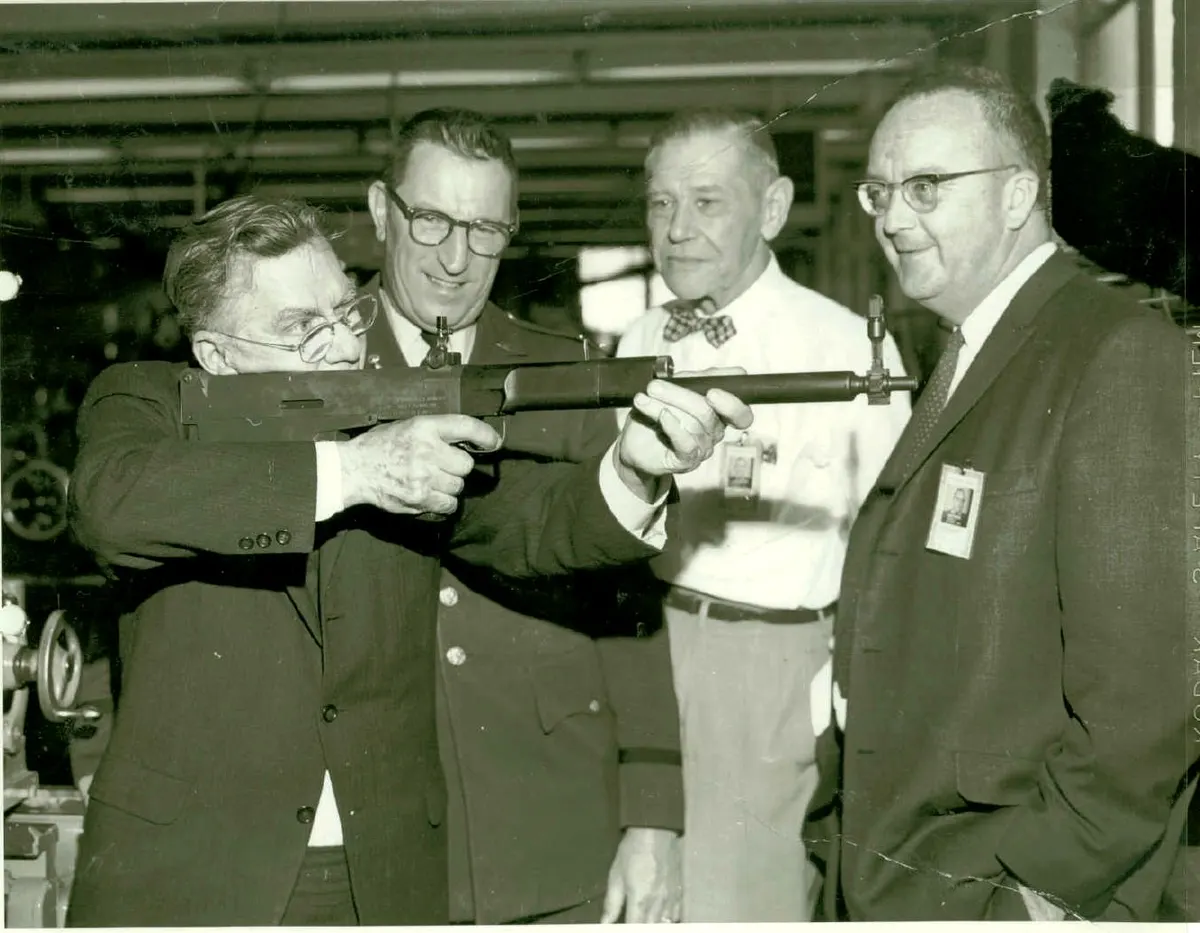
ArmaLite's own weakness compounded the timing problem. Having already sold its two flagship designs to Colt for lack of capital and manufacturing capacity, the company had neither the sales network nor the production base to chase contracts in the developing-world defense market it was targeting.4 The AR-16 was marketed briefly in the early 1960s and then quietly dropped.1,2
From the AR-16 to the AR-18, a Piston System That Went Global
Eugene Stoner left ArmaLite in 1961, before the AR-16 program reached a finished production design. He went on to consult for Colt and then joined Cadillac Gage, where he designed the Stoner 63 modular weapons system.3,8 His departure did not end the AR-16 concept. ArmaLite engineer Arthur Miller, working with George Sullivan and Charles Dorchester, took over the project and, beginning around 1963, rescaled the 7.62mm design down to the 5.56x45mm cartridge. The result was the ArmaLite AR-18, the rifle that carried the AR-16's stamped-steel receiver, short-stroke piston and folding stock into a much longer commercial and technical life.2,10 Miller was later granted the US patent covering the design, in 1969.2
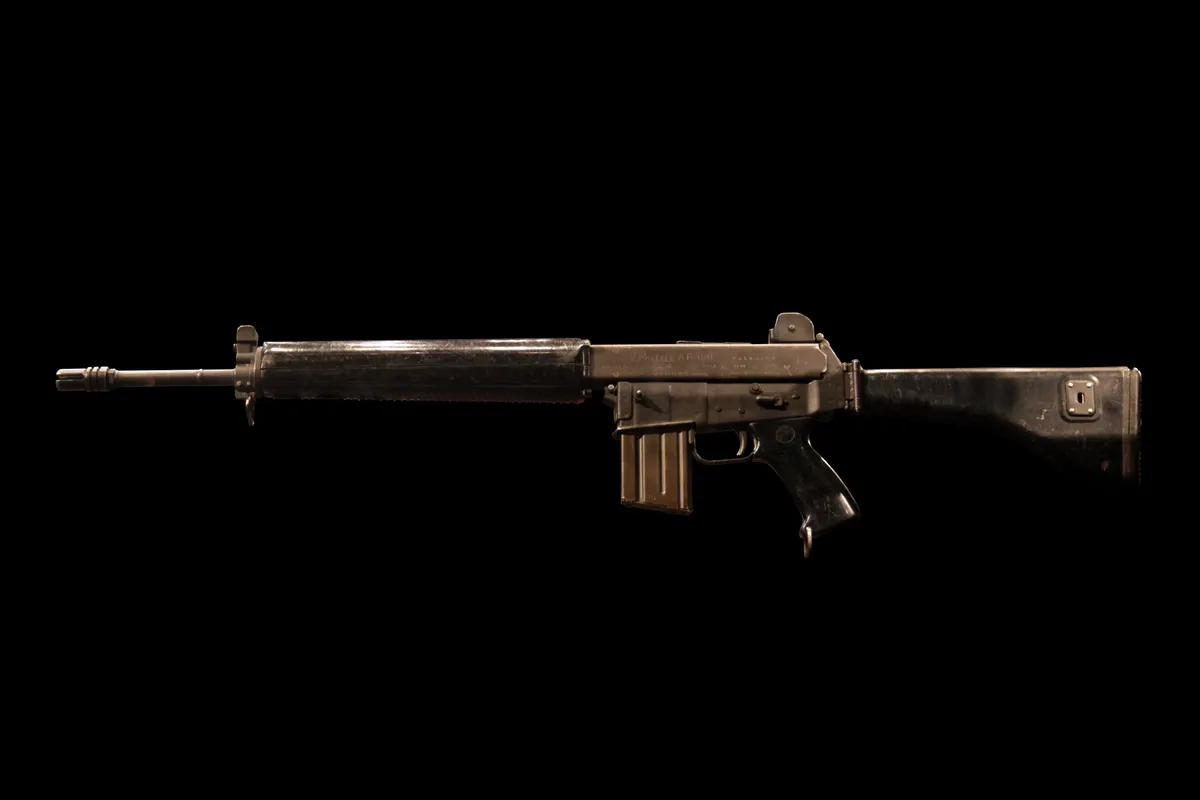
The AR-18 itself was never adopted as a standard-issue rifle by any national military either. Its production license was sold abroad regardless, to Howa in Japan and to Sterling in the United Kingdom, and its short-stroke piston gas system went on to become one of the most widely copied operating systems in modern rifle design.10,2 Early SA80 prototypes in Britain literally mated ArmaLite-built AR-18 upper receivers to a prototype bullpup lower, and the finalized SA80 family still uses a gas system and bolt carrier group descended from the AR-18.10
Germany's Heckler & Koch G36 uses a gas piston system described by multiple sources as partially derived from the AR-18, and that system carried forward again into the HK416 and HK417.10,2 Japan's Howa Type 89 has been described by researchers as essentially an AR-18 modernized for the Japan Self-Defense Forces.10 The same operating principle, refined and re-engineered by other manufacturers, also appears in the FN F2000 and FN SCAR, the Steyr AUG, the CZ 805 BREN, Singapore's SAR-80 and SR-88, Taiwan's T65 and T86 rifle families, and China's QBZ-95.10,11
Reed Knight's Institute of Military Technology now holds two of the four AR-16 prototypes ever built, the only physical evidence the design ever existed outside ArmaLite's own engineering drawings. Forgotten Weapons was given direct access to film both examples, describing them as the sole surviving witnesses to a rifle that never fired a shot in anyone else's hands.6,8
The AR-16 itself produced no service history and no combat record. Its significance sits entirely in the operating system it worked out under commercial pressure, later refined by other engineers into hardware that armed the British, German and Japanese armed forces for decades.
Two configurations of the AR-16 were physically built. The standard rifle carried a 20 inch (508mm) barrel and weighed about 8.75 lb (3.97 kg) empty. The carbine used a shorter barrel, given as either 16.1 or 18.3 inches depending on the source, and weighed about 6.6 lb (3.0 kg).1,8 Both used the same folding stock, the same 20-round magazine, and the same short-stroke piston action, differing only in barrel length and the weight that came with it.
No further variant reached even the prototype stage. The interchangeable-upper concept, one lower receiver accepting different caliber uppers, anticipated a modularity idea that later Stoner and ArmaLite designs pursued more successfully, from the Stoner 63 system to the AR-15 platform's own eventual family of purpose-built uppers. For the AR-16 itself, the concept stayed on paper.
With only four prototypes ever built, the rifle and carbine are best understood as two points on a single unfinished development effort rather than distinct production models. Both proved the same stamped-steel, piston-driven concept at slightly different scales, and both were abandoned at the same moment, when Stoner left ArmaLite in 1961.

The AR-16 never competed against the FN FAL or the H&K G3 in any formal trial, but the three rifles were built to solve the same problem for different budgets. The FAL and the G3 both won NATO-era contracts by combining proven gas-operated or delayed-blowback actions with production processes their home industries could already support at scale. The AR-16 arrived afterward, aimed at militaries that could not afford either rifle's manufacturing base, and by the time it existed as hardware, both had already been adopted by dozens of countries.
| AR-16 | FN FAL | H&K G3 | |
|---|---|---|---|
| Cartridge | 7.62x51mm NATO | 7.62x51mm NATO | 7.62x51mm NATO |
| Action | short-stroke gas piston | gas-operated | roller-delayed blowback |
| Receiver | stamped steel | machined/forged | stamped steel |
| Adopted by any military | none | dozens of countries | dozens of countries |
The more meaningful comparison is with the AR-18, the rifle the AR-16 became after Stoner's departure. Both share the stamped-steel receiver and the short-stroke piston action, and both failed to secure a standard-issue military contract of their own. The difference is what happened next. The AR-18's license sales to Howa and Sterling put real production rifles into circulation and, more importantly, put its gas system in front of engineers at Heckler & Koch, Fabrique Nationale, and Steyr, who each adapted it for their own service rifle programs. The AR-16 never got that far. It stopped at four hand-built prototypes and a set of engineering drawings, leaving the AR-18 to do the work of proving the concept commercially viable enough to copy.


What is the ArmaLite AR-16? The AR-16 is a 7.62x51mm NATO battle rifle designed by Eugene Stoner for ArmaLite between 1959 and 1961, built with a stamped-steel receiver and a short-stroke gas piston action. Only four prototypes were ever built, and no military adopted it.1,8
How does the AR-16's gas system work? It uses a short-stroke gas piston that strikes the bolt carrier and separates from it early in its stroke, rather than the direct-impingement system used in Stoner's earlier AR-10 and AR-15. The bolt carrier is driven home by twin recoil springs instead of a single buffer spring.9,6
Is the AR-16 still in service anywhere? No. It was never adopted by any military, was marketed only briefly in the early 1960s, and only two of the four prototypes built are known to survive today, both held by the Institute of Military Technology.1,6
What is the difference between the AR-16 and the AR-18? The AR-18 is a 5.56x45mm rifle developed by ArmaLite engineer Arthur Miller after Stoner left the company in 1961, scaled down from the AR-16's 7.62mm design but keeping its stamped-steel receiver and short-stroke piston system. The AR-18 reached far wider (if still limited) production, through licensed manufacture in Japan and the United Kingdom.2,10
Why didn't any country adopt the AR-16? It arrived too late. By the time ArmaLite had working prototypes, most militaries shopping for a 7.62mm NATO rifle had already committed to the FN FAL, the H&K G3, or the M14, the same rifles that had already beaten ArmaLite's own AR-10 in earlier competitions. ArmaLite also lacked the sales network to reach the smaller, budget-limited militaries it was targeting.6,4
How much did an AR-16 cost? No unit price is documented. The rifle never reached a sale to any government, and ArmaLite's own pitch centered on lower production cost through stamped-steel manufacturing rather than a published per-unit price.1
- "Armalite AR-16", Wikipedia — en.wikipedia.org ↩
- "ArmaLite AR-18", Wikipedia — en.wikipedia.org ↩
- "Eugene Stoner", Wikipedia — en.wikipedia.org ↩
- "ArmaLite", Wikipedia — en.wikipedia.org ↩
- "ArmaLite AR-10", Wikipedia — en.wikipedia.org ↩
- "AR-16, ArmaLite's Lost Battle Rifle", Forgotten Weapons — forgottenweapons.com ↩
- "Armalite AR-16", Historical Firearms — historicalfirearms.info ↩
- "ArmaLite Reunion on Eugene Stoner's 70th Birthday", Small Arms Review — smallarmsreview.com ↩
- "The Largely Forgotten AR-18 Was Not a Stoner Design (Entirely)", Gun Mag Warehouse — gunmagwarehouse.com ↩
- "How the AR-18 Influenced a Generation of Service Rifles", Sandboxx — sandboxx.us ↩
- "The Other ArmaLite, The AR-18", Sandboxx — sandboxx.us ↩