

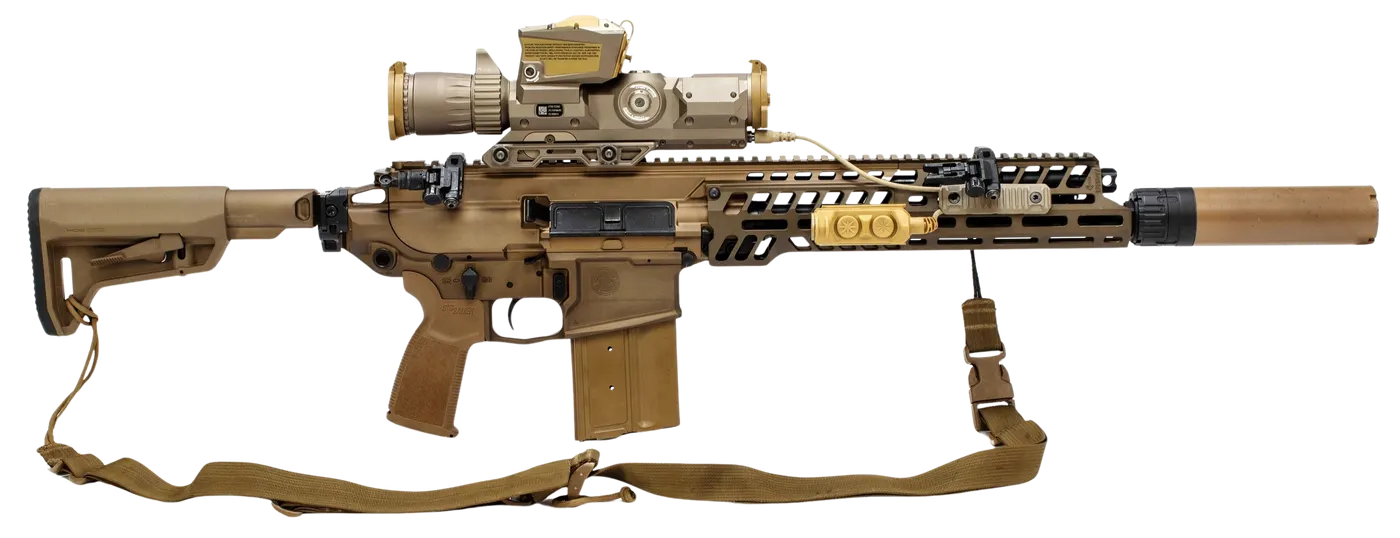
The M7 rifle is the current standard-issue service rifle of the United States Army, built by SIG Sauer around its MCX-SPEAR platform and chambered in the 6.8x51mm Common Cartridge, commercially named the .277 SIG Fury.1 It won the Army's Next Generation Squad Weapon Rifle (NGSW-R) competition on April 19, 2022, entered service under the designation XM7, and was formally type classified as the M7 rifle in May 2025.1 The weapon replaces the M4 carbine in Army close-combat units, the first wholesale rifle change in American service since the M16-to-M4 transition of the 1990s.2
- defeats modern body armor at extended range
- standard-issue quick-detach suppressor (SIG SLX)
- integrated M157 fire control optic with rangefinder and ballistic solver
- familiar M4-style manual of arms for training
- heavier than the M4A1 it replaces
- 20-round magazine versus the M4A1's 30 rounds
- ammunition costs several times more per round than 5.56mm
- early reports of barrel wear under sustained fire
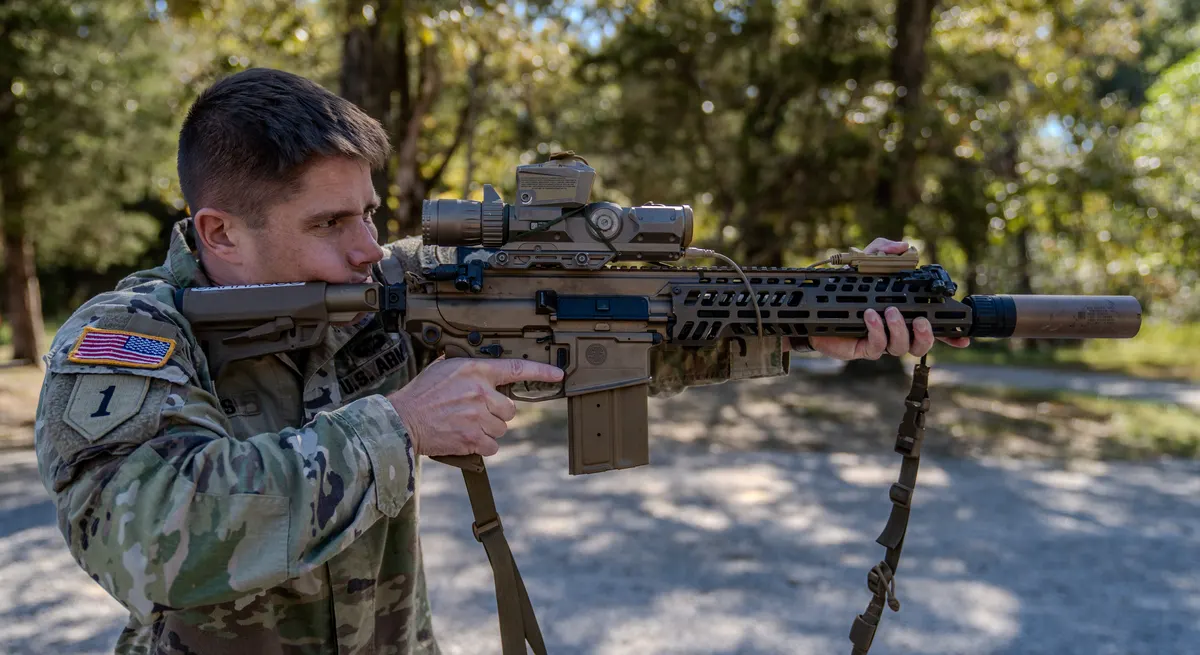
The program grew out of intelligence gathered during the war in Afghanistan, which suggested that standard 5.56mm NATO ammunition could no longer reliably defeat body armor issued to Russian and Chinese-aligned forces, and struggled to hit targets accurately much past 300 meters.3 The Army formally launched the Next Generation Squad Weapon program in January 2019 to replace the M4 carbine, the M249 squad automatic weapon, and part of the M240 machine gun role with two new weapons built around a common higher-pressure cartridge, a rifle and an automatic rifle.3
By mid-2026 the M7's future inside the Army is more complicated than a simple rifle swap. The Army has paired the M7 with a shorter, lighter carbine derivative called the XM8, shifted its NGSW production line toward that carbine, and the Marine Corps has separately declined to adopt the M7 at all, choosing to keep the 5.56mm M27 instead.4,5 The sections below cover the weapon's design, the sometimes rocky path from prototype to standard issue, the criticism it has attracted over weight and ammunition capacity, and where the program stands today.
The 6.8x51mm Common Cartridge and Its Hybrid Case
The M7 fires a cartridge developed specifically for the NGSW program, referred to in military documents as the 6.8x51mm Common Cartridge and sold commercially by SIG Sauer as the .277 SIG Fury.1 Both names describe the identical round. Its case is a three-piece hybrid built from a stainless-steel head that contains the pressure, a brass body that handles extraction and expansion, and an aluminum locking washer that joins the two.1 The case shares the external dimensions of the .308 Winchester, but the chamber runs at roughly 80,000 psi (550 megapascals), close to double a typical 5.56mm or 7.62mm NATO load, which is how a barrel little longer than the M4A1's manages the extra velocity and penetration the Army wanted.1
- Service Entry Year2024
- Weight (Empty)3.8 kg
- Weight (Loaded)4.46 kg
Standard rifle loads use a 0.277-inch (7.03mm) bullet weighing between 135 and 155 grains, with a muzzle velocity of approximately 915 meters per second (3,000 feet per second) from the M7's barrel.1 That figure is well corroborated across sources describing the round. The higher pressure and heavier bullet come at a cost. Military unit-cost estimates for 6.8mm ammunition have ranged from roughly 3 to 15 dollars per round depending on the source and how far production has scaled, against about 47 cents for a round of standard 5.56mm M4 ammunition, a gap that recurs constantly in criticism of the program's long-term sustainment cost.6
- Cartridge6.8x51mm Common Cartridge / .277 SIG Fury
- Calibre7.03 mm
- Case Length51 mm
The M157 Fire Control Optic
Every M7 is issued with the M157 Next Generation Fire Control System, formerly designated XM157, built by Vortex Optics under a fixed-price contract worth up to 2.7 billion dollars for as many as 250,000 units over ten years.7 The optic is a 1-8x30 variable-power sight combining a laser rangefinder, a ballistic calculator that factors in temperature and other atmospheric conditions, a digital compass, visible and infrared aiming lasers, and an illuminated digital reticle, all linked wirelessly to other networked soldier equipment.7 At roughly 2.2 kilograms it is considerably heavier and bulkier than the red-dot or low-power optics typically mounted on an M4A1, and it is a direct contributor to complaints about the overall bulk of the M7 system.7
- Magazine Capacity20
Weight, the SIG SLX Suppressor, and the M7 PIE Fix
The M7 was the first rifle fielded as standard issue across the US Army with a quick-detach suppressor, the SIG SLX, built into the base package rather than sold as an accessory.1 As originally fielded the rifle weighed about 8.38 pounds (3.80kg) unloaded, and roughly 9.84 pounds (4.46kg) with the suppressor attached, compared with about 7.62 pounds for an M4A1 carrying a sling and a loaded magazine.6 Combined with the heavier M157 optic and heavier 6.8mm ammunition, soldiers consistently reported the M7 as noticeably heavier and bulkier to carry and maneuver than the carbine it replaced.6
- Muzzle Velocity915 m/s
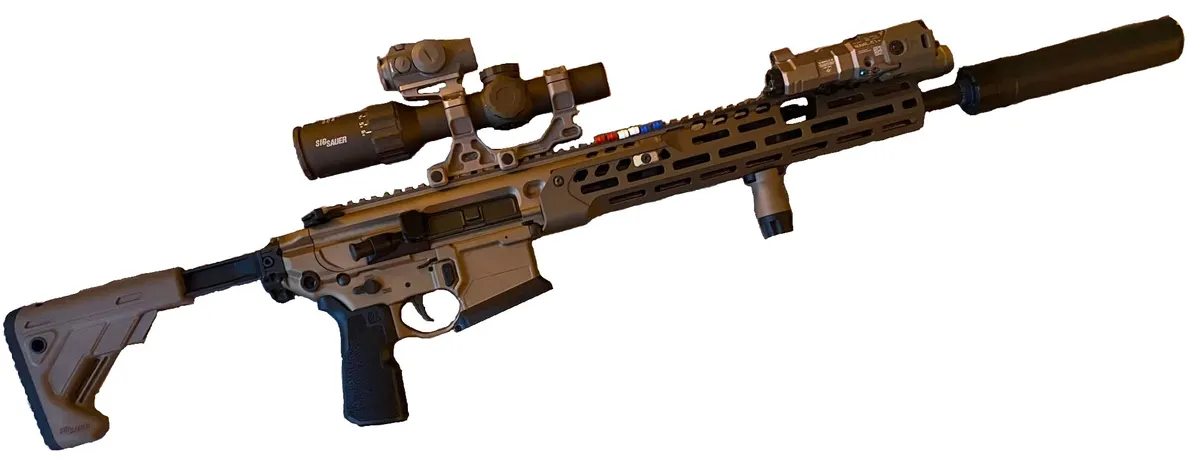
SIG Sauer responded with a Product Improvement Effort informally called the M7 PIE, shown publicly at the DSEI exhibition in London in September 2025 and formalized the following month at the AUSA conference in Washington.8 The redesign trims the upper receiver, thins the barrel profile, lightens internal components, and removes the stock's folding hinge (soldiers reportedly preferred saving the weight over keeping a fold-flat capability), cutting the baseline unloaded weight from about 8.38 pounds to roughly 7.6 pounds (3.4kg), a reduction of about ten percent.8 The redesigned SLX suppressor was also shortened and paired with a lightweight thermal shield that delays a heated barrel from showing up under night-vision and thermal optics, pushing the point at which the barrel becomes visible from around 40 rounds fired to around 100.8
- Barrel Length342.9 mm
- Sight TypeM157 (formerly XM157) Next Generation Fire Control System (NGFCS)
- Optic RailYes
The following table compares the M7 as originally fielded against the M4A1 it replaces.
| Spec | M7 rifle (original) | M4A1 carbine |
|---|---|---|
| Cartridge | 6.8x51mm / .277 SIG Fury1 | 5.56x45mm NATO |
| Unloaded weight | 3.80 kg (8.38 lb)6 | approx. 3.0 kg |
| Magazine capacity | 20 rounds (25-round optional)6 | 30 rounds |
| Barrel length | 343mm (13.5 in)1 | 368mm (14.5 in) |
- Production Start2019
Three Competing Teams
Following the January 2019 launch of the Next Generation Squad Weapon program, the Army announced three finalist teams in August 2019 to build prototype rifles and automatic rifles.3 Textron Systems partnered with Heckler & Koch on the guns and Winchester on ammunition, offering a conventional-layout design built around a polymer-and-steel case-telescoped round, but withdrew before the final down-select.3 General Dynamics-OTS, later continued by its ammunition partner True Velocity's subsidiary LoneStar Future Weapons alongside Beretta, submitted the RM277, a bullpup rifle with a 20-inch barrel paired with True Velocity's composite-case cartridge, reportedly held back in part by unresolved questions over its automatic-rifle variant's suppression performance against a demanding belt-fed requirement.3
SIG Sauer submitted the MCX-SPEAR rifle and a matching automatic-rifle derivative, both built in-house around its own 6.8x51mm ammunition, while retaining M4-like ergonomics and controls to ease the transition for soldiers already trained on the carbine.3 That combination, an integrated in-house rifle-and-ammunition package with a familiar manual of arms, is widely cited as the deciding factor in SIG's win.3 The loss left lasting friction. In April 2024 True Velocity and LoneStar sued SIG Sauer in Vermont, alleging the company misappropriated trade secrets tied to a separate .338-caliber medium machine gun effort by recruiting away engineers who had worked on the underlying recoil-mitigation technology, allegations SIG Sauer has denied.9
From XM5 to M7, a Five-Stage Path to Standard Issue
The Army awarded SIG Sauer a ten-year, 20.4 million dollar initial contract on April 19, 2022, for the rifle (then designated XM5) and its automatic-rifle counterpart, the XM250, closing a 27-month prototype and evaluation phase.1 Separately, in late January 2022, the Army selected Vortex Optics to build the fire-control optic under the XM157 designation.7 By January 2023 the rifle had been renamed from XM5 to XM7 to avoid conflicting with Colt's existing M5 carbine trademark.1
Developmental test rifles reached the 101st Airborne Division and the 75th Ranger Regiment in September 2023 for pre-fielding user evaluation, ahead of any official issue.10 That same month, Army acquisition chief Doug Bush disclosed that testing had surfaced small issues with accuracy and with excess gas and fumes venting from the XM7 and XM250, delaying the originally planned fielding timeline, though he described the early fixes SIG Sauer applied as very positive without declaring the matter closed.10
Formal fielding began on March 29, 2024, when 1st Battalion, 506th Infantry Regiment of the 101st Airborne Division became the first operational unit issued the complete XM7, XM250, and XM157 system.1 The Army completed an Operational Assessment of the full NGSW system in October 2024, and in December 2024 finished limited lethality testing of a 6.8mm special-purpose armor-piercing load, clearing the way for the ammunition and fire-control programs to move from a rapid Middle Tier Acquisition pathway into standard major-capability acquisition programs.1 Type Classification-Standard, the Army's formal certification that a weapon meets operational, safety, and sustainment standards for full adoption, was reached in May 2025, at which point the XM7 became the M7 rifle and the XM250 became the M250.1 Fielding continued into 2026, with the 25th Infantry Division training on the M7 at Schofield Barracks, Hawaii in January and February 2026, alongside earlier reports of Pacific-oriented special operations units receiving the weapon in 2024 and 2025.11
Weight Controversy and the M7 PIE Response
The most sustained public criticism of the M7 came from an unclassified, personally authored paper by Army Captain Braden Trent, presented at the Marine Corps Expeditionary Warfare School around April 2025, which called the XM7 a tactically outdated service rifle better suited to a designated-marksman role than to general infantry use, and described it as mechanically unsound for sustained combat against a peer adversary.6 Trent's report pointed to the 20-round magazine against the M4A1's 30 rounds, a reduction of about a third, and calculated that a standard seven-magazine combat load carried 140 rounds of 6.8mm ammunition versus 210 rounds of 5.56mm, a 70-round gap.6 He also cited live-fire observation of soldiers exhausting most of their ammunition within about 15 minutes of a suppression exercise, and early barrel wear and gouging in every sampled rifle that had fired more than roughly 2,000 rounds, which he attributed to the cartridge's high chamber pressure.6
Brig. Gen. Phil Kinniery, commandant of the Infantry School, publicly countered that the 6.8mm round's greater stopping power against body armor outweighs the reduction in rounds carried, arguing the round stops an enemy more effectively than a smaller-caliber alternative, and SIG Sauer defended the rigor of its quality and safety testing.6 The Army proceeded to Type Classify the M7 and M250 in May 2025 regardless, treating Trent's findings as a serious critique rather than a disqualifying one.6 The M7 PIE weight-reduction effort unveiled later that year at DSEI and AUSA directly addresses several of the same complaints, and the Army has continued issuing formal operational test reports on the program through the Pentagon's Director of Operational Test and Evaluation office in fiscal years 2024 and 2025 and again in March 2026, indicating the oversight is ongoing rather than closed.12
The rifle's real-world adoption timeline overlapped closely with its arrival in video games. The MCX-SPEAR appeared in Call of Duty, Modern Warfare III as the BAS-B battle rifle within months of the Army's April 2022 selection, and a prototype version of the same weapon became the default service rifle in Battlefield 2042 under the designation M5A3, with a production-pattern version later added to Battlefield 6 as the M277, named for the cartridge's commercial .277 Fury designation.13
The XM8 Carbine
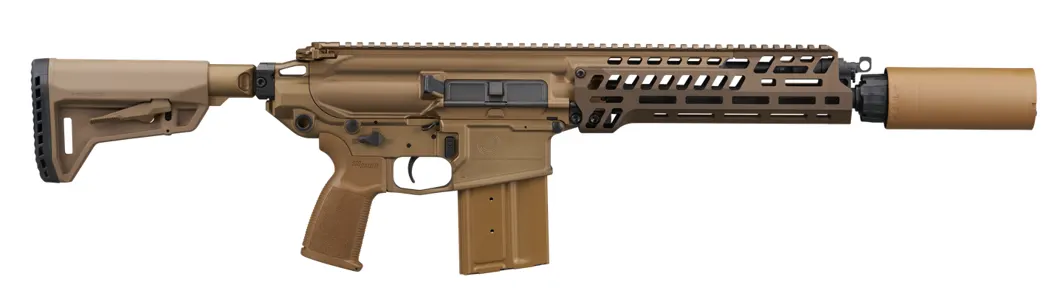
In December 2025 the Army stood up a shorter, lighter carbine derivative of the M7 called the XM8, built in direct response to soldier feedback on the rifle's weight and length.4 The XM8 carries a 10.9-inch barrel against the M7's 13.1 to 13.5-inch barrel, runs roughly 3.5 inches shorter overall, and weighs a little over a pound less, while keeping full compatibility with the M157 optic and the same weapon-mounted accessories as the M7.4 It also adopts a fixed stock with a softer buttpad and a stiffer handguard for mounting equipment, changes drawn directly from complaints about the original M7.14
The Army accepted its first XM8 deliveries from SIG Sauer in early April 2026, and by mid-2026 had shifted its Next Generation Squad Weapon production line to prioritize the carbine over the rifle, with the Army confirming it had not purchased any additional M7 rifles since the fiscal year began on October 1, 2025.15 SIG Sauer has stated the M7 remains in service and is not being retired, describing it as an exceptionally capable rifle the Army will likely continue fielding in certain roles even as the XM8 becomes the default close-combat weapon, and National Defense Magazine reported roughly 40,000 M7 rifles already in the Army's inventory as of mid-2026.4,15
The M250 Automatic Rifle
Alongside the rifle, SIG Sauer builds the belt-fed M250 (formerly XM250) automatic rifle on the same 6.8x51mm cartridge, intended to replace the M249 squad automatic weapon and take over part of the M240 medium machine gun's role at the squad level.3 The M250 shares the M157 optic and much of the NGSW program's testing history, including the same 2023 accuracy and gas-venting issues and the same May 2025 Type Classification milestone as the M7.1

| Year | Buyer | Quantity | Amount | Present Value (2025) |
|---|---|---|---|---|
| 2022 |  United States | — | $20.4 M | $22.4 M |
The United States Army is the M7's sole confirmed operator. Fielding began with the 101st Airborne Division's 1st Battalion, 506th Infantry Regiment in March 2024, followed by the 75th Ranger Regiment, Pacific-oriented special operations elements reported receiving the weapon during 2024 and 2025, and the 25th Infantry Division, which trained on the M7 at Schofield Barracks, Hawaii in January and February 2026 with support from the Army Marksmanship Unit.11 No comprehensive public figures describe the total number of rifles fielded or what share of the Army's close-combat force has converted so far, and the program is better described as an expanding rollout than a completed Army-wide swap.11
The Marine Corps considered adopting the M7 and declined in February 2026, opting to keep the 5.56mm M27 Infantry Automatic Rifle instead.5 A Marine Corps Combat Development Command spokesperson said the M27 better aligns with the service's amphibious doctrine and modernization priorities and preserves interoperability with joint and coalition forces still using 5.56mm weapons, while stating the Marine Corps would continue monitoring the M7's development for future requirements.5
Despite the criticism over weight and magazine capacity and the production shift toward the XM8, no public reporting through mid-2026 points to the M7 being paused or canceled. The clearer pattern is continued fielding of the roughly 40,000 M7 rifles already in Army hands, layered together with the lighter XM8 as a running product-improvement response rather than a wholesale reversal.
M7 versus M4A1, Range and Penetration Traded for Weight and Rounds Carried
The M7 and the M4A1 it replaces represent different bets about what an infantry rifleman most needs. The M4A1 is lighter, carries 30 rounds per magazine instead of 20, and fires ammunition that costs a small fraction of what 6.8mm ammunition costs, but its 5.56mm round loses effectiveness against modern body armor and against targets much past 300 meters. The M7 trades those advantages for greater penetration and a longer effective range, a standard-issue suppressor, and an integrated fire-control optic, at the cost of extra weight, fewer rounds per magazine, and a considerably more expensive round to produce and transport at scale. Program defenders argue that early friction over weight, barrel wear, and magazine capacity mirrors the M16's own difficult introduction during Vietnam and is being fixed iteratively through the M7 PIE weight cuts and the XM8 carbine, while critics led by Trent's 2025 report argue the underlying premise is wrong for most riflemen, who fight at much closer ranges than the doctrine assumes, and that a heavier marksman-style rifle should be issued more selectively rather than to an entire close-combat force.
The Roads Not Taken
SIG Sauer's win over Textron/Heckler & Koch and over General Dynamics-OTS and LoneStar's bullpup RM277 was not a foregone conclusion. The RM277 used a 20-inch barrel inside a bullpup layout to reach the Army's ballistic requirements in a shorter overall package than a conventional rifle, paired with True Velocity's polymer-and-steel composite-case ammunition rather than SIG's steel-and-brass hybrid design, and reportedly fell short chiefly on questions about its automatic-rifle variant's sustained-suppression performance. The Textron submission, built with Heckler & Koch and using a case-telescoped round from Winchester, withdrew before the final evaluation. SIG's advantage was less about any single component and more about offering a complete in-house rifle-and-cartridge package that soldiers could learn on using the same manual of arms as the M4 they already knew.


Is the M7 rifle still in service? Yes. The Army fully type classified the M7 as standard issue in May 2025 and continues fielding it to additional units into 2026, though new-production purchases have shifted to the shorter XM8 carbine derivative rather than the M7 itself.15
What replaced the M4 carbine? The M7 rifle replaced the M4A1 carbine in US Army close-combat units starting with the 101st Airborne Division's 1st Battalion, 506th Infantry Regiment in March 2024, though the M4 family remains in wide use across units not yet converted.1
How does the M7 rifle differ from the M4 carbine? The M7 fires a larger 6.8x51mm cartridge at roughly double the chamber pressure of 5.56mm NATO for greater range and penetration against body armor, carries fewer rounds per magazine (20 versus 30), weighs more, and comes standard with a suppressor and an integrated fire-control optic that the M4A1 lacks.1,6
What does the M7 rifle cost per round? Estimates for 6.8mm Common Cartridge ammunition have ranged from roughly 3 to 15 dollars per round depending on production scale and source, compared with about 47 cents for standard 5.56mm M4 ammunition.6
Is the M7 being replaced already? Not exactly. The Army has shifted its production line toward a shorter, lighter carbine derivative called the XM8, first delivered in April 2026, and paused new M7 purchases for the fiscal year that began in October 2025, but SIG Sauer and Army officials describe the M7 as remaining in service rather than being withdrawn.15
- "M7 rifle", Wikipedia — en.wikipedia.org ↩
- "Army Introduces New XM8 Carbine For Close Combat Ops", National Defense Magazine — nationaldefensemagazine.org ↩
- "Next Generation Squad Weapon", Wikipedia — en.wikipedia.org ↩
- "US Army accepts first delivery of XM8 Carbine", Army.mil — army.mil ↩
- "Stick to your guns, why the Marine Corps is opting for the M27 over the Army's M7", Military Times — militarytimes.com ↩
- "The U.S. Army Replaced the M4 With a More Powerful Rifle, Then Gave Soldiers 70 Fewer Rounds to Fight With", 19FortyFive — 19fortyfive.com ↩
- "Sig Sauer's XM7 Rifle Gets Army's Seal Of Approval Despite Controversy", TWZ — twz.com ↩
- "AUSA 25, SIG SAUER Displays Lighter NGSW Product Improvement Effort Weapons", Soldier Systems Daily — soldiersystems.net ↩
- "True Velocity sues Sig Sauer, alleging stolen trade secrets", Defense News — defensenews.com ↩
- "Army 'not declaring victory,' NGSW fix improves fume and accuracy issues", Breaking Defense — breakingdefense.com ↩
- "U.S. Army Officially Deploys M7 6.8mm Rifle to Replace M4A1 in Combat Units", Army Recognition — armyrecognition.com ↩
- "AUSA 2025, Sig Sauer M7 rifle gets lighter and reshapes balance between mobility and lethality", Army Recognition — armyrecognition.com ↩
- "M5A3", Battlefield Wiki (Fandom) — battlefield.fandom.com ↩
- "Hands On With SIG Sauer's XM8 Carbine", Armourer's Bench — armourersbench.com ↩
- "Army says M7 'production line has changed to the XM8' carbine", Task & Purpose — taskandpurpose.com ↩