

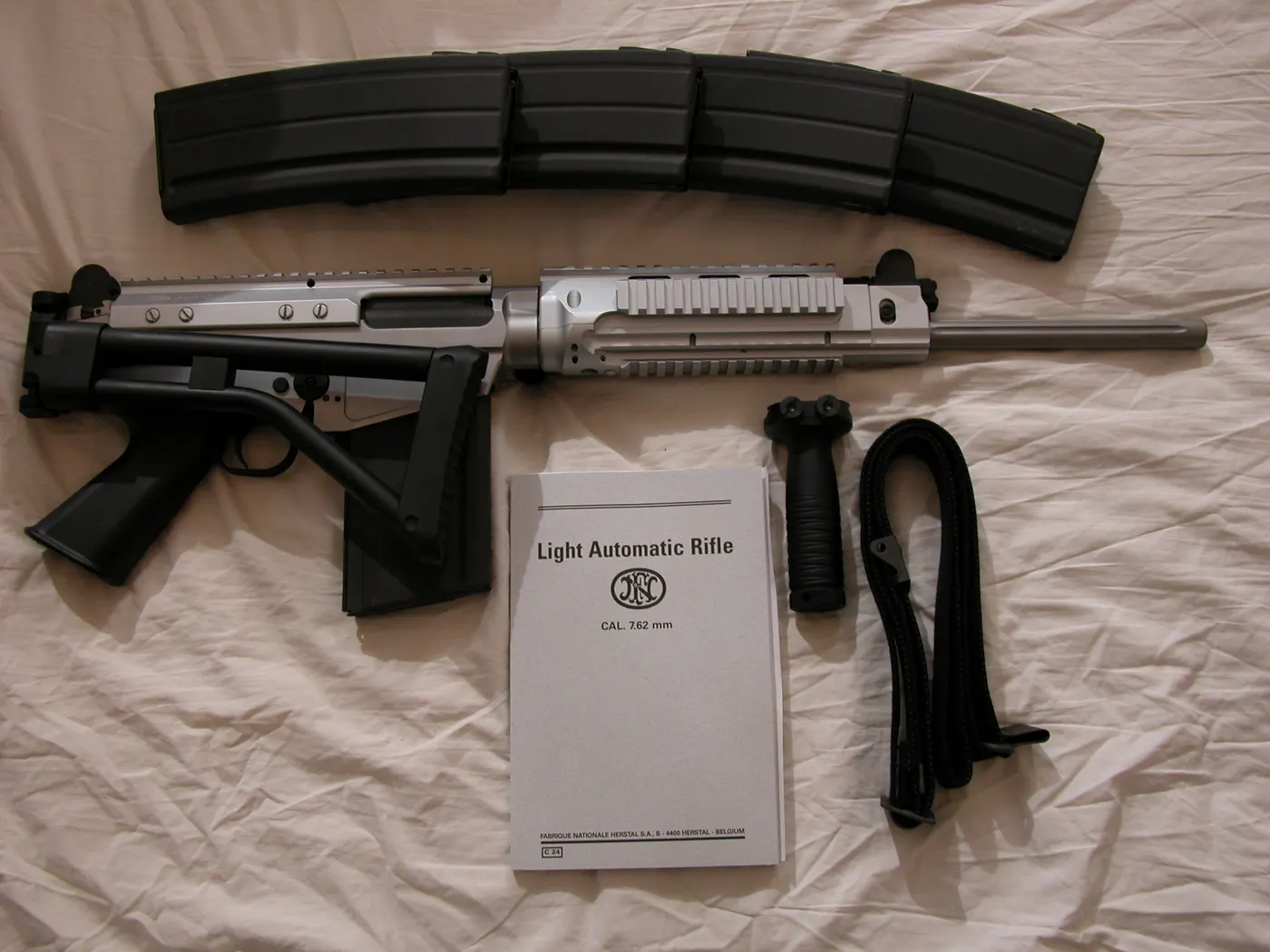
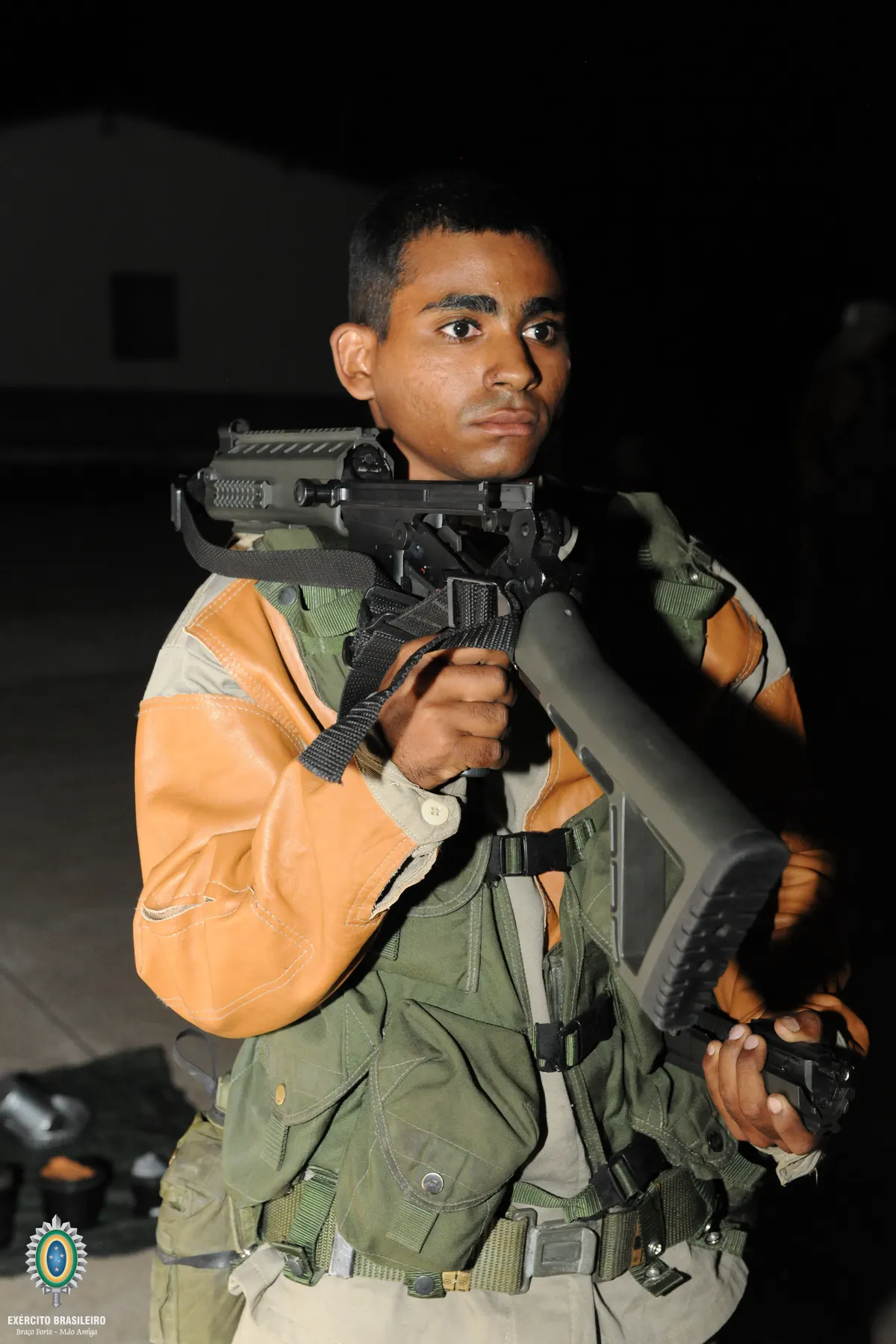
Most ParaFAL rifles issued to Brazilian troops today did not start life as ParaFALs. A program the Brazilian Army launched in October 2009 has IMBEL pull worn, roughly three-decade-old M964 rifles out of long-term storage and rebuild them into the compact folding-stock configuration using a dedicated conversion kit, recovering old service rifles rather than manufacturing new ones.1,2 Officially designated the M964A1 (the fixed-stock parent rifle is the M964), the ParaFAL is Brazil's own folding-stock derivative of the licensed FN FAL, one of the battle rifles that armed dozens of Cold War militaries.3,4 The name shortens para, from paraquedista (Portuguese for paratrooper), reflecting the original design goal of a shorter, lighter rifle for airborne troops, special forces and police who need something easier to carry through an aircraft door or a confined stairwell than the full-length rifle.5
- Folding stock and shorter barrel cut length by roughly a third versus the standard rifle
- Inherits the FAL's proven, field-maintainable gas-piston action
- 2009 retrofit program keeps rifles in service cheaply without new manufacture
- Full-power 7.62x51mm NATO cartridge, unlike the lighter carbines that replaced it
- IMBEL-developed polymer furniture trims weight versus older wood and alloy parts
- Numeric specs (weight, barrel length) vary noticeably across Brazilian sources
- Shorter sight radius and a closer-ranged Para sight versus the standard ladder sight
- No confirmed large-scale export record for the Para pattern specifically
- Largely superseded in first-line Army service by the IMBEL IA2 since 2014
Brazil evaluated Belgian-built FAL rifles from 1954 and ran troop trials through 1958 to 1962 before formally adopting the design in 1964, giving the rifle its M964 designation for the adoption year.4 Licensed production started soon after at IMBEL's plant in Itajubá, in the state of Minas Gerais, and full domestic manufacture of both the fixed-stock M964 and the folding-stock M964A1 was achieved by 1973.6,7 IMBEL had built roughly 200,000 rifles across the M964 family by the late 1980s.4,8
IMBEL IA2, IMBEL's 5.56x45mm NATO carbines rifle adopted in 2014, has gradually taken over first-line Brazilian Army service since then, but the ParaFAL has not disappeared. It remains in Army reserve and some front-line use, in Air Force and special-operations service, and with several state Military Police forces, decades after the standard-length rifle it derives from stopped being Brazil's default infantry weapon.6,9
Brazil achieved full domestic (nationalized) manufacture of both the fixed-stock M964 and folding-stock M964A1 ParaFAL by 1973 at IMBEL's Itajubá plant, and the ParaFAL's polymer furniture was developed in-house by IMBEL rather than imported from FN Herstal. Rifles in current service are themselves domestically retrofitted from existing Brazilian-made stock under the 2009 IMBEL conversion program, reinforcing the indigenous-industry story.
The ParaFAL fires the same 7.62x51mm NATO cartridge as the standard FAL, cycled by a gas-piston-operated action with a short-stroke piston driving a tilting breechblock that locks into the receiver, the same mechanism FN engineered for the parent rifle.4 It is select-fire, capable of semi-automatic and full-automatic fire, and feeds from a 20-round detachable box magazine built to the same pattern as the standard M964's magazine.1
- Service Entry Year1973
- DesignerIMBEL engineering team (Itajubá plant), adapting FN Herstal's licensed FAL design
- Weight (Empty)4.4 kg
- Currently In ServiceYes
- Notable UsersBrazilian Army airborne, jungle, armored and mechanized units; Brazilian Air Force security personnel; Army Special Operations Platoon (Pelopes); Rio de Janeiro and São Paulo state Military Police
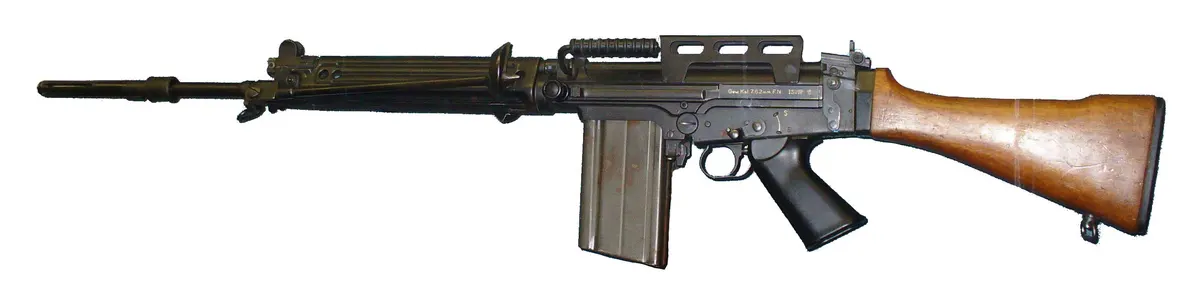
Brazilian retailer and defense-press sources most often list the ParaFAL's unloaded weight at about 4.4 kilograms, though one comparison piece instead puts it closer to 3.8 kilograms, consistent with the general framing of the Para variant as a lightened derivative of the fixed-stock rifle.9 No official IMBEL datasheet was available to resolve the gap, so 4.4 kilograms is treated here as the more widely repeated figure.9 Overall length runs to about 990 millimeters with the stock extended and folds down to roughly 750 millimeters, a substantial reduction from the standard M964's approximately 1,090 millimeters, the entire point of the Para conversion being easier stowage in a vehicle, a helicopter, or a jump aircraft.1
- Cartridge7.62x51mm NATO
- Calibre7.62 mm
- Case Length51 mm
- Bullet Weight9.5 g
- RimfireNo
- Caseless AmmunitionNo
Barrel length is reported with some variance across sources, from about 437 to 450 millimeters, clustering close to the roughly 440-millimeter barrels FN itself used on its own factory Para-pattern FAL rifles.1,9,10 Rifling is 4 grooves with a right-hand 1 in 12 inch twist.1 Collector and forum discussion describes the dedicated Para-pattern rear sight as a flip-type aperture calibrated for two closer ranges, roughly 150 and 250 meters, in place of the standard rifle's longer 200 to 600 meter ladder sight, a reasonable trade for a weapon built around close-quarters and airborne use rather than long-range engagement. That specific figure comes from firearm-collector discussion rather than a published manual and carries only moderate confidence.11
- Action TypeGas-Operated
- Fire ModesSemi-automatic and full-automatic (select-fire)
- Select FireYes
- Feed SystemDetachable Magazine
- Magazine Capacity20
- Cyclic Rate of Fire600
FN's own Para models also introduced a dedicated folding charging handle, so the handle would not foul the folded stock, and IMBEL carried that same feature into the ParaFAL.10 Brazil's own contribution was to replace the wood and aluminum-alloy furniture used on earlier FN-pattern rifles with high-impact polymer parts developed in-house, cutting weight further and simplifying the fold mechanism.1,2 IMBEL's receivers are late-pattern, slab-sided forgings that omit the external lightening cuts seen on Belgian-made FN receivers, a production shortcut that also appears on Brazil's fixed-stock M964.4,7
- Barrel Length440 mm
- Rifling Twist1 in 12 in, right-hand
- Rifling Grooves4
- Sight TypeFlip-type rear aperture sight for approximately 150 and 250 m, post front sight (Para-pattern configuration; moderate-confidence, sourced from collector/forum discussion rather than an official manual)
- Optic RailNo
- Iron SightsYes
IMBEL has also offered a further tactical evolution of the Para pattern, the M964A1/Pelopes, named for the Brazilian Army's Special Operations Platoon (Pelotão de Operações Especiais). It cuts the barrel further, to about 16.5 inches, and adds a Picatinny rail for a flashlight and optic along with a three-point sling, a configuration built specifically around Pelopes' close-quarters mission set.4
- Overall Length990 mm
- Length (stock folded)750 mm
- Receiver MaterialSteel (IMBEL slab-sided Type 3 forged receiver)
- Furniture MaterialHigh-impact polymer, developed in-house by IMBEL
- Folding / Collapsing StockYes
- Bullpup LayoutNo
| Parameter | ParaFAL (M964A1) | Standard M964 / FN FAL |
|---|---|---|
| Barrel length | Approximately 440 mm1,9,10 | 533 mm4 |
| Overall length | 990 mm extended, 750 mm folded1 | Approximately 1,090 mm4 |
| Weight, empty | Approximately 4.4 kg9 | 4.25 kg4 |
| Stock | Folding, polymer1,2 | Fixed4 |
| Sights | Flip aperture, approximately 150/250 m11 | Ladder, 200 to 600 m4 |
- Production Start1973
Brazil's relationship with the FAL began in 1954, when FN Herstal of Belgium supplied rifles for evaluation. Troop trials ran from 1958 to 1962, and the Brazilian Army formally adopted the design in 1964 as the M964.4 Licensed production ramped up at IMBEL's Itajubá plant through the 1960s, and by 1973 the company had achieved full domestic manufacture of both the fixed-stock M964 and the folding-stock M964A1, the rifle that would become known as ParaFAL.6,7

The folding-stock concept itself predates Brazil's own program by roughly two decades. FN developed a family of factory Para variants of its own, the 50.61 with a full-length barrel, the 50.62 (Para 18) with a 457 millimeter barrel, and the 50.63 (Para 16), the shortest at around 440 millimeters, with its own folding charging handle. FN built the 50.63 specifically so a folded rifle, slung across a paratrooper's chest, would fit through the door of a C-119 Flying Boxcar transport aircraft.10 Brazil's ParaFAL sits closest in concept to the 50.62/50.63 pattern, a short barrel paired with a folding stock and folding handle, but is a Brazilian-engineered adaptation using IMBEL's own polymer furniture rather than an FN import.10
IMBEL also built a separate civilian export line through the late 1980s, selling semi-automatic-only FAL-pattern rifles into the United States commercial market through Springfield Armory, marketed as the SAR-48 and SAR-4800, including a folding-stock PARASAR-4800 Bush model sold roughly between 1985 and 1990.7 Those commercial rifles are a distinct product line from the military ParaFAL, built for the American civilian market rather than Brazilian service, but they share the same Itajubá manufacturing base and explain why IMBEL-made FAL receivers remain popular with American parts-kit builders today.7
The defining chapter in the ParaFAL's modern service life came in October 2009, when the Brazilian Army formally contracted IMBEL to convert existing M964 rifles, by then roughly three decades old, into the Para configuration through a dedicated retrofit kit.2 The program targeted paratrooper, airborne, jungle, armored and mechanized units, and was framed explicitly as an interim modernization step ahead of a planned MD97-A2 rifle with improved ergonomics, a retractable stock and an optics rail, expected around 2010.2 By mid-2010, converted ParaFAL rifles were already in Army units.1
IMBEL's own attempts at a full replacement, the MD-1, MD-2 and MD-3 prototypes of the 1980s, never fully displaced the FAL family in Brazilian service.14 That took the IMBEL IA2, a 5.56x45mm NATO rifle the Army officially adopted on October 23, 2014, explicitly intended to complement and gradually replace the long-serving 7.62mm M964/M964A1 family.6 IA2 fielding has continued through the 2020s, and Brazil's heavy-barrel FAL derivative, the FAP squad automatic weapon, was separately replaced by the FN Minimi around 2013 to 2014.4 The FAL and ParaFAL have not fully left Brazilian service even so. They remain in use with several state Military Police forces and auxiliary units, and are sought by sport shooters and collectors on the domestic civilian market.9
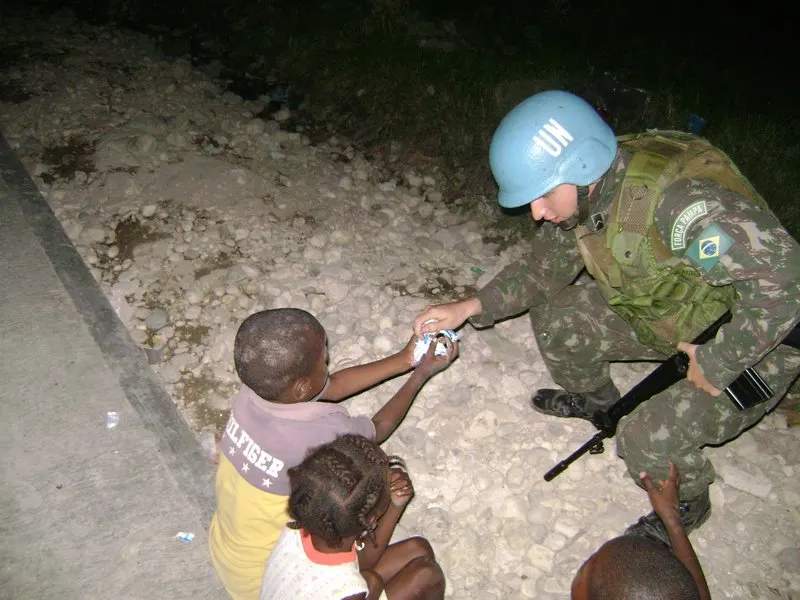
Brazil's ParaFAL has seen far more peacekeeping and policing use than conventional interstate combat. Brazilian Air Force security and infantry troops deployed to Haiti as part of the United Nations stabilization mission there carried the 7.62mm M964A1 ParaFAL, reportedly chosen specifically to keep ammunition and equipment standardized with Brazilian Army peacekeepers deployed alongside them.15
Inside Brazil, the ParaFAL became a fixture of Military Police special units combating organized crime, most visibly Rio de Janeiro's BOPE (Batalhão de Operações Policiais Especiais). BOPE carried the FN Para FAL among its inventory during raids into the city's favelas as part of the broader war on drugs in Brazil, the urban conflict most associated with the unit's black-skull insignia.13 At least one account suggests BOPE has since moved toward AR-10-pattern rifles, though that shift is documented by a single commentary source rather than an official policy statement and should be read with some caution.13

Several other Brazilian state Military Police forces adopted the ParaFAL for similar reasons, citing its precision, lighter weight and portability compared to the full-length rifle, in particular units in Rio de Janeiro and São Paulo.3 Paraguay's civilian gun trade also lists ParaFAL-pattern rifles for sale, a minor data point on cross-border commercial availability rather than evidence of Paraguayan military adoption.16
Documented combat use of the Para variant specifically, as opposed to the standard-length M964, is thin outside these policing and peacekeeping roles. Brazil has not fought a major interstate war during the ParaFAL's service life, and its combat record sits closer to internal security and international stabilization missions than to the battlefield use that defined the standard FAL in Africa and the Middle East.
The Para-pattern FAL line has two core configurations in Brazilian service. The base ParaFAL, the M964A1, pairs the roughly 440 millimeter barrel and folding stock described above with standard infantry furniture. The M964A1/Pelopes goes further, with a shorter roughly 16.5 inch barrel, a three-point sling and a Picatinny rail for a flashlight and optic, built for the Army's Special Operations Platoon.4
Brazil's split between a folding-stock Para branch and a separate heavy-barrel squad-automatic branch is not unique to Brazil. Argentina's state arsenal Fabricaciones Militares built its own licensed FAL family in parallel, including its own folding-stock Para version and a heavy-barrel FAP (Fusil Automático Pesado), mirroring Brazil's identically named Fuzil Automático Pesado variant. Israel's licensed FAL production followed a similar heavy-barrel path with a perforated barrel sleeve, though without a Para-pattern counterpart produced in comparable numbers.4
IMBEL's own line of intended successors traces from the 5.56 millimeter MD-1 prototype of around 1983, through the MD-2, which explicitly borrowed the FAL Para variant's side-folding buttstock and shared many parts with it, to the fixed-stock polymer MD-3.14 None of these fully replaced the FAL or ParaFAL in first-line service. That took the IMBEL IA2, adopted in 2014, underlining that the 2009 ParaFAL retrofit program was itself a stopgap between a series of limited MD-series adoptions and the eventual full-scale replacement.6,14

| Year | Buyer | Quantity | Amount | Present Value (2025) |
|---|---|---|---|---|
| 2009 |  Brazil | — | — | — |
Brazil is the ParaFAL's only confirmed operator. The Brazilian Army issued the M964A1 to paratrooper, airborne, jungle, armored and mechanized units under the 2009 conversion program, and it remains in reserve and some front-line use as IA2 fielding continues.2,6 The Brazilian Air Force separately fields the same M964A1 configuration with its security and infantry troops, including the Haiti peacekeeping deployment described above.15 The Army's Special Operations Platoon, Pelopes, uses the short-barreled, rail-equipped M964A1/Pelopes variant.4
Several Brazilian state Military Police forces acquired the ParaFAL for its lighter weight, precision and portability relative to the full-length rifle, most notably in Rio de Janeiro and São Paulo.3 Rio's BOPE remains the best-documented police user, though at least one source suggests the unit has since transitioned toward AR-10-pattern rifles.13
Outside government service, ParaFAL and M964A1 rifles and parts circulate in Brazil's regulated civilian sport-shooting and collector market, and separately in the United States, where decommissioned IMBEL parts kits are rebuilt onto US-made receivers.9,12 A Paraguayan commercial retailer has also listed the ParaFAL pattern for sale, though that reflects cross-border civilian availability rather than confirmed military adoption by Paraguay.16
Argentina and Brazil solved the same problem in almost the same way without any direct cooperation. Both countries licensed the FAL in the 1960s, and both later split their production into a folding-stock Para branch and a separate heavy-barrel Fusil Automático Pesado branch for squad automatic fire, Argentina's built by Fabricaciones Militares, Brazil's by IMBEL.4 The two countries even settled on the same Spanish-derived name for their nearly identical heavy-barrel derivatives, a coincidence of parallel Cold War-era small-arms development rather than any shared program.4
Set against Brazil's own fixed-stock M964, the ParaFAL trades a substantial amount of the standard rifle's reach for portability. The roughly 440 millimeter barrel and folding stock cut overall length from about 1,090 millimeters to 990 millimeters extended and 750 millimeters folded, and the flip-type Para sight trims the standard ladder sight's 200 to 600 meter range down to a reported 150 and 250 meter setting.1,9,11 None of that makes the ParaFAL a worse rifle in an absolute sense. It reflects a genuinely different role, a compact weapon for paratroopers exiting an aircraft, vehicle crews, and police officers working close urban distances, rather than a rifle meant to engage at the M964's longer sight settings.1
| Parameter | Brazil (IMBEL) | Argentina (Fabricaciones Militares) |
|---|---|---|
| Folding-stock (Para) variant | ParaFAL / M964A14 | FAL Para4 |
| Heavy-barrel squad variant | FAP, Fuzil Automático Pesado4 | FAP, Fusil Automático Pesado4 |
| Licensed production began | 19644 | Early 1960s4 |
The Falklands War is the clearest example of the wider FAL family fighting itself. Argentine forces carried the FN FAL and heavy-barrel FALO/FAP against British troops armed with the semi-automatic-only L1A1, a shared design turned into opposing rifles by decades of separate licensing decisions. Brazil was not a combatant in that war, but its own FAL production belongs to the same broad set of national FAL branches the conflict put into direct contact.4


What are the ParaFAL's specifications? The ParaFAL (M964A1) fires 7.62x51mm NATO from a barrel of approximately 440 millimeters, weighs about 4.4 kilograms unloaded, and measures roughly 990 millimeters with its stock extended or 750 millimeters folded, feeding from a 20-round detachable box magazine.1,9
How does the ParaFAL differ from the standard FN FAL? It uses the same gas-piston, tilting-breechblock action as the standard M964 and full-length FN FAL, but replaces the fixed stock with a folding stock, shortens the barrel to roughly 440 millimeters from 533 millimeters, and swaps the long-range ladder sight for a shorter-ranged flip aperture sight, changes aimed at compact, close-quarters and airborne use.4,1,11
Is the ParaFAL still in service? Yes, in a secondary role. The IMBEL IA2 has gradually replaced the FAL and ParaFAL as Brazil's first-line service rifle since 2014, but the ParaFAL remains in Army reserve and some front-line units, Air Force security service, and use with several state Military Police forces.6,9
What is the ParaFAL's unit cost? No verifiable government contract price for the ParaFAL itself was found. Most rifles in current service come from the 2009 kit-conversion program rather than new manufacture, and Brazilian military procurement contracts of this kind are not consistently published. Only secondary civilian parts-kit prices, roughly 800 to 1,250 dollars per kit in the US surplus market, are publicly available, and those describe a different product entirely from a government retrofit contract.12
How does the ParaFAL compare to Argentina's FAL Para variant? Both are folding-stock derivatives of the same licensed FAL design, built by state arsenals, IMBEL in Brazil and Fabricaciones Militares in Argentina, that independently split their FAL production into a Para branch and a heavy-barrel FAP squad-automatic branch during the same general period.4
- "O 'novo' Parafal", Forças Terrestres — forte.jor.br ↩
- "EB transforma FAL em PARAFAL", Forças Terrestres — forte.jor.br ↩
- "ParaFAL", Wikipedia — en.wikipedia.org ↩
- "FN FAL", Wikipedia — en.wikipedia.org ↩
- "Curiosidades sobre o Parafal", Supremacia Militar — supremaciamilitar.com.br ↩
- "The IA2 Rifle Family from IMBEL", Small Arms Defense Journal — sadefensejournal.com ↩
- "FN FAL, Production and Use, Brazil", Liquisearch — liquisearch.com ↩
- "IMBEL", Wikipedia — en.wikipedia.org ↩
- "FAL vs ParaFAL, entenda as diferenças entre os gigantes do exército brasileiro", ecoleo.org.br — ecoleo.org.br ↩
- "FAL Paratrooper 50.63", Forgotten Weapons — forgottenweapons.com ↩
- "Zeros for Para Flip Sights", FAL Files forum — falfiles.com ↩
- "IMBEL FN FAL Metric M964 7.62x51 NATO/.308 Win Parts Kit", Centerfire Systems — centerfiresystems.com ↩
- "The Guns of BOPE", Armory Blog — armoryblog.com ↩
- "IMBEL MD", Wikipedia — en.wikipedia.org ↩
- "Brazilian Air Force Infantry Weapons", The Firearm Blog — thefirearmblog.com ↩
- "Fuzil 7,62 M964A1 MD3 Parafal", Loja Armas PY — armaspy.com ↩
- "IMBEL M964 A1 ParaFAL", Internet Movie Firearms Database — imfdb.org ↩