

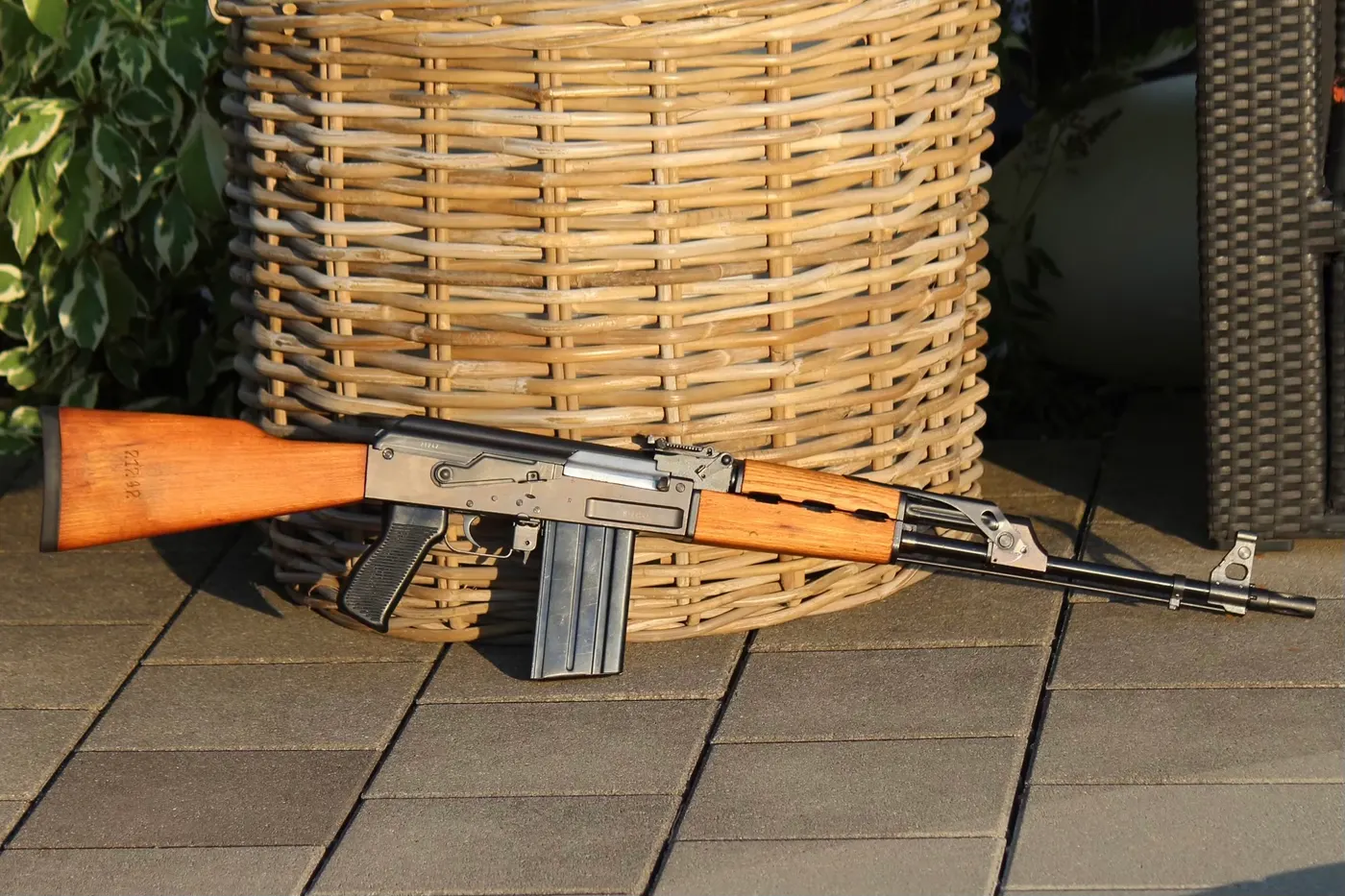

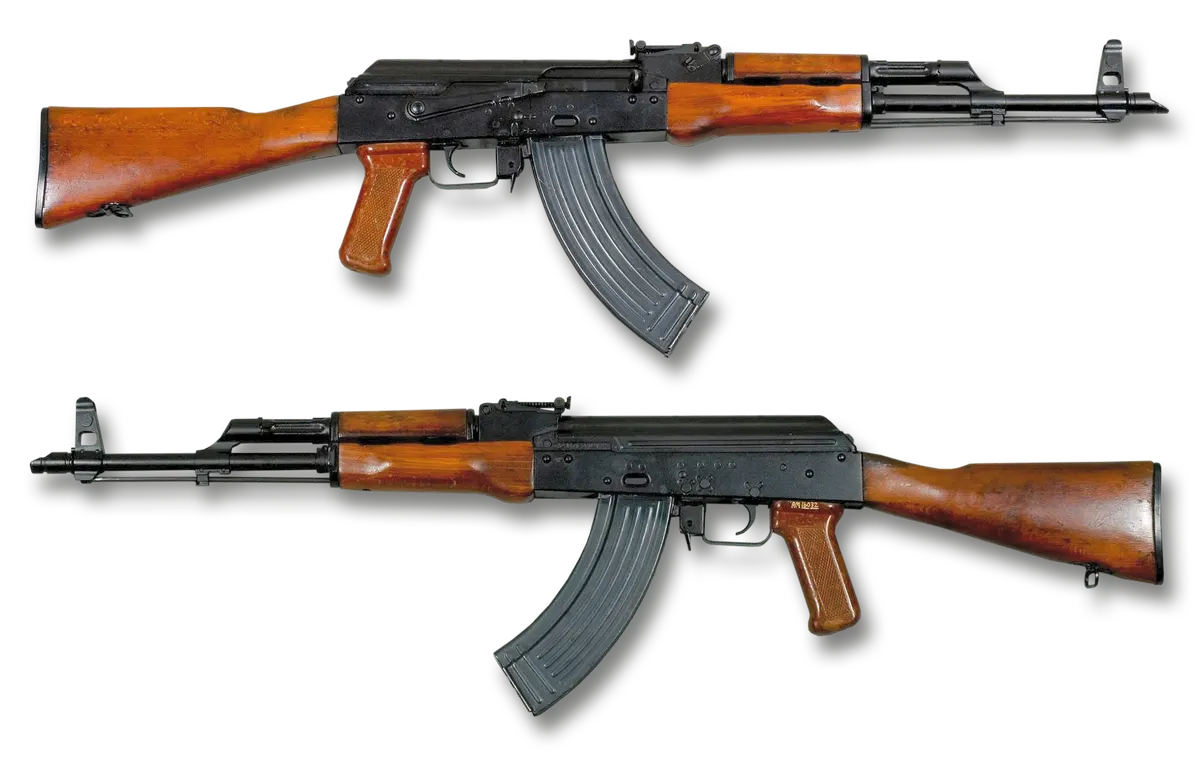
The Zastava M77 looks like it belongs to the same family as the FN FAL, the M14 and the British L1A1, the trio of Western battle rifles chambered for 7.62x51mm NATO. It does not work like any of them. Underneath the wood furniture and NATO-length barrel sits a scaled-up Kalashnikov action, a long-stroke gas piston and rotating bolt lifted straight from the Zastava M70, Yugoslavia's own copy of the Soviet AKM. Zastava Arms took that 7.62x39mm rifle, enlarged the receiver, strengthened the bolt and bolt carrier, lengthened the barrel and cut a new magazine well, then dropped in the heavier NATO cartridge.1,2 The result was a rifle built specifically to be sold, not to be issued to Yugoslav troops.
- battle-tested Kalashnikov mechanism
- long-stroke piston tolerant of dirt and neglect
- familiar manual of arms for AK-trained users
- modernized rail option for optics
- civilian PAP/ZPAP line still imported new
- never adopted as Yugoslavia's own service rifle
- no confirmed production totals
- lost its one documented modern trials bid
- thin, mostly secondary-source documentation
Zastava Arms, the state arsenal in Kragujevac, Serbia, began the M77 program in the late 1970s aimed at the same export customers the FAL and G3 already served.1,3 No individual designer is credited in any available source, the rifle is attributed to Zastava's design bureau as a group effort. It never became the standard rifle of the Yugoslav People's Army, that role stayed with the 7.62x39mm M70. What survives of the M77 today is a select-fire military line that is effectively out of production and a semi-automatic civilian export line, sold in the United States as the PAP and ZPAP M77, that is still actively imported.4,5
An AKM Action Stretched to a NATO Cartridge

The M77's action-type is a direct scale-up of the M70, itself a licensed-pattern AKM. A long-stroke gas piston drives a rotating bolt through the same basic tilting dust-cover, rear-sight-block and trunnion architecture found on any Kalashnikov, just built to a larger physical scale to survive the pressure and length of 7.62x51mm NATO.1,2 The rifle is select-fire capable of semi-automatic and automatic fire, feeds from a curved detachable magazine, and mounts a Western-pattern flash suppressor on a threaded barrel rather than the slant brake typical of Soviet-pattern AKs.1 Barrel length runs 500mm and muzzle velocity is rated around 840 m/s, both figures consistent across every technical source.1,2
- First Production Year1977
- Service Entry Year1977
- Weight (Empty)4.35 kg
- Currently In ServiceYes
Receiver Generations, From Milled Steel to Stamped RPK Pattern
The earliest M-77 and M-77A rifles used a milled receiver and a fixed wood stock. Production then moved to the M77 B1, built on a stamped 1.5mm receiver of the same pattern used on the Soviet RPK light machine gun, still with fixed wood furniture, and this became the mainstream select-fire military rifle.6 A distinct M77 AB1 paired that stamped receiver with a metal underfolding stock instead of wood, but it was built almost exclusively for military use and essentially never reached export markets, unlike every other M77 variant.6 Wood furniture and an underfolding stock never appeared together on a real production M77, the two traits describe two separate rifles.
- Cartridge7.62×51mm NATO
- Calibre7.62 mm
- Case Length51 mm
- Calibre Classbattle rifle
- RimfireNo
- Caseless AmmunitionNo
The B1's adjustable gas system, added to support suppressed fire, along with its 4.35kg weight, roughly 620rpm cyclic rate and 800m listed effective range, are figures specific to that stamped-receiver B1 variant. The earlier milled M-77 is a heavier, slightly different rifle at around 4.8kg with a shorter listed effective range of 600m, and the two sets of numbers should not be mixed.1,2
- Action TypeGas-Operated
- Fire Modesselective fire
- Select FireYes
- Feed SystemDetachable Magazine
- Magazine Capacity20
- Cyclic Rate of Fire620
Standard military magazines for both the M77 and M77 B1 hold 20 rounds. A 10-round magazine exists, but only as the specific configuration used on early PAP M77 PS civilian rifles imported into the United States in 2014 and 2015 to satisfy import-point compliance rules, not as a military-issue magazine.7,8
- Muzzle Velocity840 m/s
- Effective Range (point)800 m
A Railed Dust Cover for Modern Optics
Later, modernized production added a railed top cover modeled on the Soviet PKM machine gun's optics rail, bolted over the same basic AK dust cover, letting a magnified scope sit on an otherwise unmodified stamped-receiver rifle. Zastava used this configuration to pitch the M77 as a designated-marksman-adjacent NATO-caliber rifle in a 2016 foreign trials competition, described further below.4
- Barrel Length500 mm
- Sight TypeAdjustable iron sights, optional mount required for optical sights, flip up sights for rifle grenades
- Optic RailYes
- Iron SightsYes
- Threaded BarrelYes
- Furniture Materialwood
- Folding / Collapsing StockNo
- Bullpup LayoutNo
- Modularitylimited
- Production Start1977
- Variants2
Built in Kragujevac for a Market the JNA Didn't Need
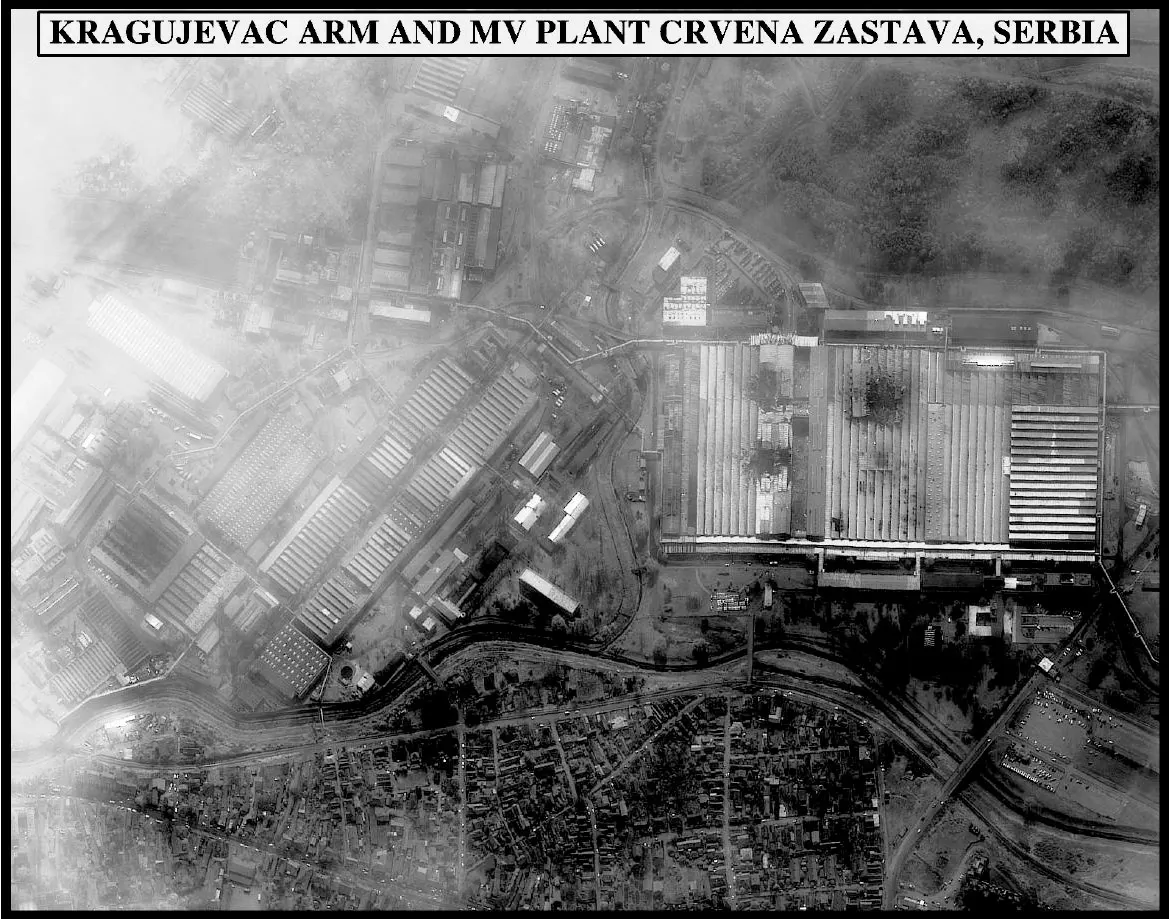
Zastava Arms launched the M77 program in the late 1970s, with sources consistently dating the introduction to 1977.1,3 Non-aligned Yugoslavia had no domestic reason to switch its own infantry rifle away from 7.62x39mm, the M70 filled that role adequately and cheaply. What Yugoslavia did have was a state arms industry that needed hard-currency export sales, and a large pool of prospective customers, mostly non-aligned or NATO-adjacent militaries, who wanted a 7.62x51mm rifle and were shopping against the FN FAL, M14 and L1A1.1,3 Building a NATO-caliber rifle on a mechanism Zastava already knew how to manufacture at scale was the practical answer.
Scattered, Hard-to-Verify Use in the Yugoslav Wars
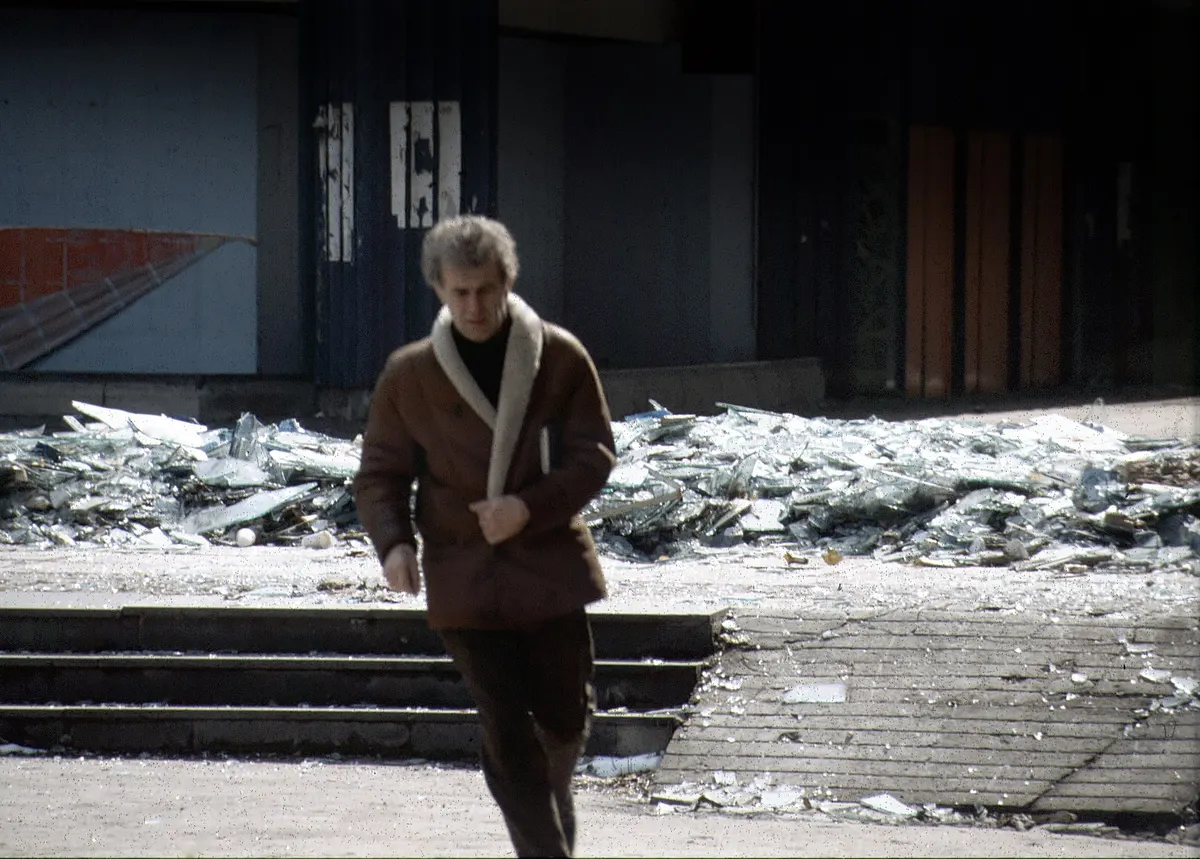
Documentation of the M77 in the Yugoslav Wars is thin and mostly anecdotal. One frequently cited account describes at least two M77 rifles surfacing in Sarajevo during the war's opening phase, reportedly taken from an NCO school and used by Bosniak forces during the siege of Sarajevo, though the same account cautions that how many M77s and related M80 rifles actually saw use remains questionable.6 That hedge should be taken seriously, this reads as a specific, low-volume anecdote rather than evidence of widespread issue to any faction in Bosnia and Herzegovina.
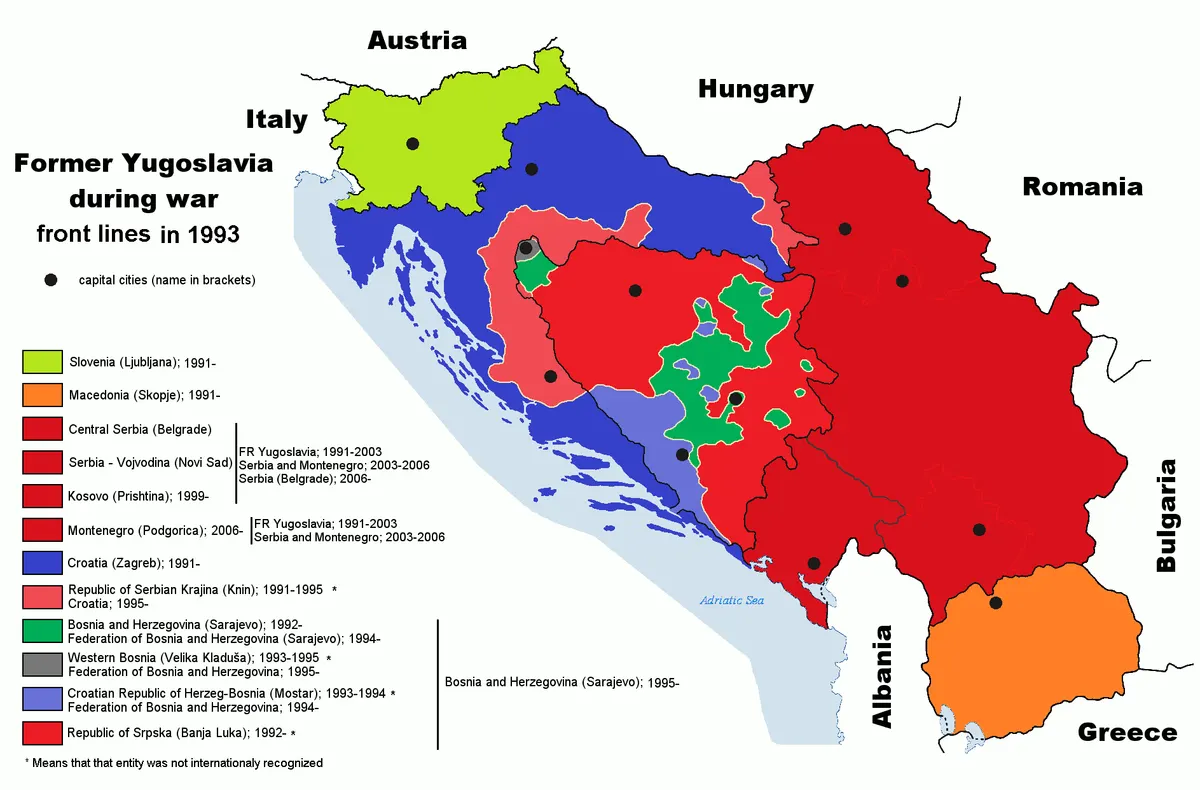
Wikipedia's infobox for the M77 also lists the Lebanese Civil War among the conflicts it was used in, without narrative detail or independent corroboration beyond that listing.1 Separately, Cyprus's National Guard has been reported, in lower-confidence secondary sources rather than a single strong citation, to have operated the M77 B1 at some point and to have since scaled back its use.11 Both claims are included here for completeness but should be read as thinly sourced.
A Near Miss in Pakistan's 2016 Rifle Trials
The M77's clearest, best-documented modern moment came in 2016, when Pakistan ran a large rifle trial to replace its aging G3 battle rifles and Chinese Type 56 AK clones. A modernized, railed 7.62x51mm M77 was one of the contenders, alongside the FN SCAR-H, CZ Bren 2 BR, Beretta ARX200, Turkish MPT-76 and an American PWS entry.12,13 Reporting at the time described the endurance phase as brutal, with each competing rifle expected to fire on the order of 10,000 rounds across desert heat and high-altitude cold.10
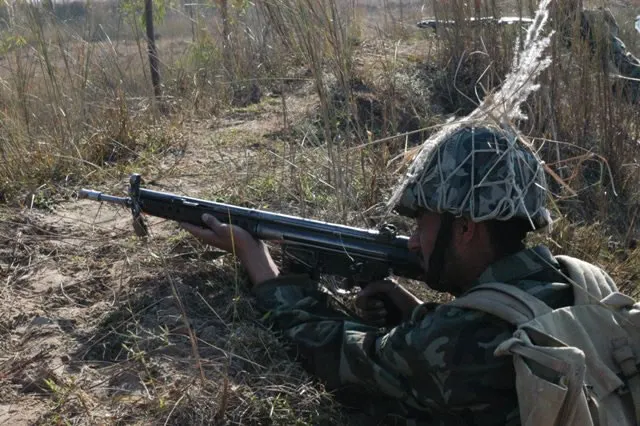
The FN SCAR-H came out ahead in the evaluation, but the program's practical outcome went a different direction entirely, Pakistan later bought 140,000 AK-103 rifles from Russia instead of fielding any of the trial entrants at scale.10 The M77 was eliminated somewhere along the way, a genuine, well-documented attempt at renewed military relevance that did not convert into a contract.
| Variant | Receiver | Stock | Status |
|---|---|---|---|
| M-77 / M-77A | Milled | Fixed wood | Earliest production, late 1970s |
| M77 B1 | Stamped, RPK pattern | Fixed wood | Mainstream select-fire military rifle |
| M77 AB1 | Stamped | Metal underfolder | Rare, almost entirely military, not exported |
| M05N1 / M05N2 | Modern stamped | Various | Later stamped-generation successors |
| PAP M77 / PAP M77 PS | Stamped | Fixed, some thumbhole | Semi-auto civilian export, early US imports |
| ZPAP M77 | Stamped | Fixed | Current semi-auto US import, resumed 2022 |
The civilian line is where the M77 has actually stayed in continuous commercial life. A semi-automatic-only PAP M77 PS reached the US market in 2014 and 2015, using a thumbhole stock and the 10-round magazine required for import-point compliance at the time.7,8 Zastava Arms USA resumed importing a fixed-stock ZPAP M77 with the standard 20-round magazine in 2022, and that version remains an active commercial product as of the most recent listings.14,8
A separate stamped, RPK-style squad-automatic development of the same platform, adding a folding bipod and finned barrel for sustained fire, is tracked as its own light machine gun entry rather than as an M77 rifle variant. No standalone sniper or designated-marksman sub-variant of the M77 could be confirmed in any accessible source, despite a forum thread title alluding to one, and none is asserted here.


Confirming a current operator list for the M77 specifically is difficult. No primary-source military procurement document, defense ministry record or Small Arms Survey entry naming M77 unit holdings turned up in research, every claim about who used it traces back to a Wikipedia infobox entry or an aggregated secondary summary.1 Serbia's own armed forces never fielded the M77 as a standard rifle, that role went to the Zastava M70 and later the 5.56mm Zastava M21.9 What can be said with reasonable confidence is that residual, legacy M77 and M77 B1 stock likely exists in Serbian and regional stores at a scale nobody has published, that Cyprus reportedly operated and has since reduced its use of the type, and that Pakistan evaluated but did not adopt it in 2016.11,12
Pitting the M77 against the M14 is less a fight between two similar rifles than a fight between two different answers to the same 7.62x51mm requirement. The M14 kept John Garand's tilting-bolt, gas-operated action and machined-steel construction, a mechanism that traces directly to the M1 Garand of the Second World War. The M77 threw that mechanism out entirely and scaled up a Kalashnikov action instead, betting that AK-pattern reliability and cheap stamped-steel manufacture would sell better to non-aligned buyers than a Western pedigree would. Both rifles ended up heavier and harder to control in automatic fire than the cartridge really rewards, a problem 7.62x51mm battle rifles shared across the board before 5.56mm rifles displaced most of them.
| Trait | Zastava M77 (B1) | M14 |
|---|---|---|
| Action | Long-stroke gas piston, rotating bolt (AK pattern) | Gas-operated, tilting bolt (Garand pattern) |
| Receiver | Stamped steel | Machined steel |
| Weight (empty) | 4.35 kg | 4.17 kg |
| Magazine | 20-round detachable | 20-round detachable |
Neither rifle became its home country's long-term standard infantry weapon in the caliber it was chambered for, the US Army moved to the M16 within a few years of the M14's adoption, and Yugoslavia never moved off the M70 at all. Both survive today largely through commercial and collector demand rather than active military issue.


What action does the Zastava M77 use? A long-stroke gas piston driving a rotating bolt, the same basic mechanism as the Zastava M70 and the wider AKM family, scaled up to handle 7.62x51mm NATO rather than the M70's 7.62x39mm.1,2
Is the Zastava M77 based on the FN FAL? No. Despite sharing the 7.62x51mm NATO cartridge and a battle-rifle role with the FAL, M14 and L1A1, the M77's internal mechanism is a Kalashnikov derivative built from the Zastava M70, not an FN design.1,2
Is the Zastava M77 still in service? Not as any country's standard-issue rifle. The select-fire military line is effectively out of production, and it was never Yugoslavia's or Serbia's standard rifle to begin with. The semi-automatic PAP and ZPAP M77 civilian line, however, is actively produced and imported into the United States as of the most recent listings.8,14
How much does a Zastava M77 cost? No confirmed military contract price has been published for the M77. The civilian ZPAP M77 sells through the normal US semi-automatic rifle retail market via Zastava Arms USA and its dealer network.8
Does the Zastava M77 use a 20-round magazine? The standard military magazine holds 20 rounds. A 10-round magazine exists only as the specific US-import-compliant configuration used on early PAP M77 PS civilian rifles.7,8
- "Zastava M77", Wikipedia — en.wikipedia.org ↩
- "Zastava M77 B1", Wikipedia — en.wikipedia.org ↩
- "Zastava M77", Modern Firearms — modernfirearms.net ↩
- "Serbian AKs, Part 5, Rising from the Ashes", TheFirearmBlog — thefirearmblog.com ↩
- "Zastava Arms", Wikipedia — en.wikipedia.org ↩
- "Explaining the Yugoslav/Zastava M70 Series of Rifles", Forgotten Weapons — forgottenweapons.com ↩
- "Zastava PAP series", Wikipedia — en.wikipedia.org ↩
- "PAP M77 Semi-Automatic Sporting Rifle", Zastava Arms USA — zastavaarmsusa.com ↩
- "Serbia's unique Zastava M21", Sandboxx — sandboxx.us ↩
- "Winner Of Pakistani Trials To Be Locally Produced", TheFirearmBlog — thefirearmblog.com ↩
- "List of military equipment of Cyprus", Wikipedia — en.wikipedia.org ↩
- "Pakistan Army to test CZ-Bren 2, Zastava M77 and FN SCAR-H", Army Recognition — armyrecognition.com ↩
- "Pakistan Seeks New Service Rifle, Upgraded Ordnance Facilities", Defense News — defensenews.com ↩
- "Battle Rifle Breakdown, ZPAP M77 vs. Classic 7.62 NATO Builds", Zastava Arms USA — zastavaarmsusa.com ↩