


Portugal fielded two separate 7.62mm rifles at once during the Colonial War, and the FN FAL was the junior partner in that pair. Adopted in 1961 as the Espingarda Automática 7,62 mm FN m/962, it never became the standard-issue infantry weapon its stablemate the Heckler & Koch G3 did.1 Instead it served as a supplementary, limited-standard rifle for over a decade, purchased complete from three separate countries rather than built at home.2
- Lighter handling than the G3 in close bush contacts
- Combat-proven [gas-operated](/en/glossary/gas-operated) FAL action, already fielded across NATO
- Preferred weapon of Portugal's elite light-infantry commandos
- Multiple source countries kept rifles flowing even as one pipeline slowed
- Never license-built in Portugal, total dependence on imports
- Judged harder for conscripts to train on than the G3
- Relegated to secondary status despite reaching Africa in real numbers first
- Left Portuguese service entirely by the mid-1970s, with no later surplus chapter like the G3's
That three-country sourcing is the single most distinctive fact about Portugal's FAL. Rifles reached Portuguese units from FN Herstal in Belgium, as secondhand G1 rifles bought from West Germany, and as Vektor-built R1 rifles bought from South Africa, all folded under the single m/962 designation regardless of which factory had actually built the individual rifle.3,4 Portugal's own m/ (modelo) naming convention, the same system that produced m/961 for the G3, records only the year of adoption, not the country of manufacture, which is how three genuinely different production runs ended up sharing one Portuguese name.1
An initial 1961 Army order brought in 3,835 FN FAL rifles, 970 of them fitted with bipods, alongside 2,400 G3 rifles that same year, a batch that likely represents only the earliest Belgian-sourced tranche before the German and South African pipelines opened.2 Search-derived totals for the wider Colonial War period put roughly 30,000 FAL-pattern rifles in Portuguese inventory once fighting had spread across all three African territories, a fleet actually larger at that early date than the still-ramping-up G3 production run, though the G3 overtook it in total numbers once domestic tooling caught up through the mid-1960s.3 One of the battle rifles that armed Portugal's colonial forces, the m/962 is best understood not as a failed rival to the G3 but as the rifle the Army's own light-infantry specialists actually preferred, even after policy moved the bulk of the force onto the other design.
No m/962 FAL was ever manufactured on Portuguese soil, unlike the domestically license-built G3 sibling (m/961). Every rifle under the m/962 designation was imported complete, from Belgium (FN Herstal direct purchase), from secondhand West German G1 stock, and from South African Vektor/Lyttelton R1 production, an interesting three-source sourcing story but not an indigenous-manufacture one.
One Designation, Three Factories
No m/962 rifle was ever manufactured on Portuguese soil. That distinguishes it sharply from the m/961 G3, which Fábrica Militar do Braço de Prata built under license in Lisbon from 1962 onward. Every m/962 FAL arrived complete from abroad, through three distinct channels folded under one Portuguese name.2,3
- First Production Year1961
- Service Entry Year1961
- DesignerFN Herstal design team (Dieudonne Saive); Portugal never manufactured the rifle domestically, importing complete rifles from Belgium (FN Herstal), West Germany (secondhand G1 stock), and South Africa (Vektor/Lyttelton R1 production)
- Weight (Empty)4.3 kg
- Currently In ServiceNo
- Notable UsersPortugal (Army, colonial forces, Caçadores Especiais commandos, primary/limited-standard user 1961-1975); South Africa (1975 auction acquisition, rebuild with domestic barrels); Rhodesia (secondhand transfer via South Africa, Rhodesian Bush War, c.1976-1979)
The first channel was direct purchase from FN Herstal in Belgium, standard FAL 50.00-pattern rifles bought new from the original manufacturer. The second was secondhand, roughly 15,000 G1 rifles bought from West Germany, itself a country that had never built a single FAL domestically and was simply passing along Belgian-made stock it no longer needed after adopting the G3 for its own Bundeswehr.3 The third was South African, on the order of 12,500 rifles built under license at what became Vektor's Lyttelton production line, itself another country's own FAL variant, the R1 rifle, sold onward to Portugal rather than kept exclusively for South African Defence Force use.4
- Cartridge7.62x51mm NATO
- Calibre7.62 mm
- Case Length51 mm
- RimfireNo
- Caseless AmmunitionNo
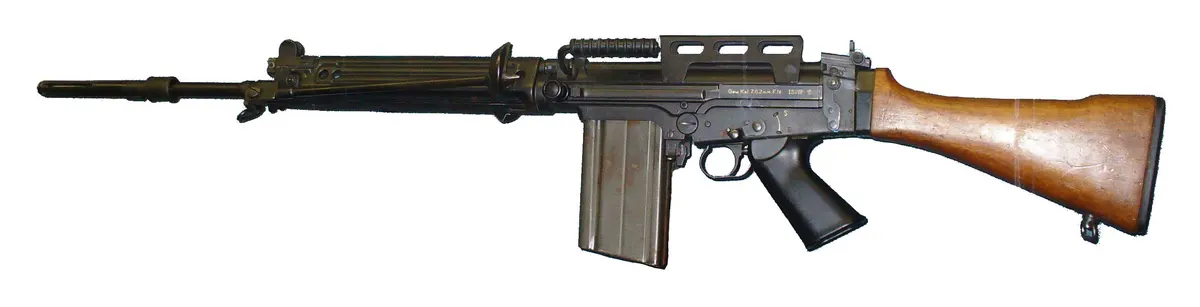
These figures rest on search-engine synthesis of a source (militaeraktuell.at) that could not be directly verified through a live fetch, so treat the precise 15,000 and 12,500 counts as reasonably reliable rounded figures rather than exact totals. The round 15,000 figure for the German transfer is corroborated independently in the sibling G1 article's own sourcing, which lends it more confidence than the South African figure carries alone.3,4
- Action TypeGas-Operated
- Fire Modessafe, semi-automatic, full-automatic
- Select FireYes
- Feed SystemDetachable Magazine
- Magazine Capacity20
- Cyclic Rate of Fire650
The Standard FAL 50.00 Mechanism
Mechanically, every m/962 rifle is the same weapon regardless of its country of manufacture, a gas-operated action using a short-stroke piston and a tilting breechblock that locks against the receiver rather than rotating, the mechanism behind the FAL's Cold War reputation as the right arm of the free world.5 It feeds from a detachable magazine, standard 20 rounds, chambered for 7.62x51mm NATO, and is capable of select-fire operation in its full military configuration.5
- Muzzle Velocity840 m/s
- Effective Range (point)400 m
- Sighting Range600 m
Empty weight runs approximately 4.3 kg, overall length 1,090 mm, and barrel length 533 mm, figures consistent across the Belgian, German, and South African production lines since all three built to the same core FAL 50.00 pattern.5 Cyclic rate is generally cited around 650 rounds per minute, muzzle velocity around 840 meters per second, and effective range about 400 meters with iron sights, extending to roughly 600 meters at maximum sight setting.5 The standard rifle carried a fixed wooden or synthetic buttstock. No source surfaced confirming Portugal issued the separate folding-stock FAL 50.63 paratrooper pattern under the m/962 designation, so the light-barrel FAL rifles described in some commando-issue accounts most likely refer to a shorter or lighter-barrel configuration rather than a formally distinct folding-stock model.6
- Barrel Length533 mm
- Optic RailNo
- Iron SightsYes
- Overall Length1,090 mm
- Receiver Materialsteel
- Furniture Materialfixed wood or synthetic buttstock (standard FAL 50.00 infantry pattern)
- Folding / Collapsing StockNo
- Bullpup LayoutNo
- Production Start1961
- Production End1975
Two Rifles for One War, Arriving Within Months of Each Other
Lisbon needed rifles immediately once fighting broke out in Angola in February 1961, and it ran evaluation and initial issue of both the FAL and the G3 in parallel rather than settling on a single design first.2 Search-engine synthesis of period sources describes an early operational idea of splitting the two African theaters, G3s for Angola and FALs for Mozambique, though that division reportedly did not hold as a strict rule once both rifles were in general circulation across the force.2
Troops and officers reportedly indicated an early preference for the FAL over the G3, but the Army ultimately judged the G3 better suited to conscripts and colonial troops without extensive prior training, a decision about training pipelines rather than raw combat performance.2 Combined with the G3's lower cost once domestic license production ramped up, that judgment is why the G3 became Portugal's primary standard rifle while the FAL was pushed into supplementary, limited-standard status despite arriving in comparable numbers at the outset.2
The Caçadores Especiais Preferred the Lighter Rifle
That institutional decision did not settle the matter for every unit. The Caçadores Especiais (Special Hunters), Portugal's elite light-infantry commando companies, four of which had already been operating in Angola since 1960 under the Special Operations Troops Centre, consistently favored the FAL over the G3 for ambush and patrol work, citing its lighter weight and better handling in the bush.7 It is the clearest illustration in the whole Portuguese small-arms picture of which soldier got which rifle. Conscript infantry, trained quickly and in large numbers, carried the G3. The sharpest light-infantry specialists, who could absorb a harder-to-master weapon and valued its handling in close terrain, gravitated to the FAL.7
Fighting Across Three African Theaters
The FAL's combat record ran through the same three simultaneous theaters as the G3, Angola from February 1961 against the MPLA, FNLA, and later UNITA in the Angolan War of Independence, Guinea-Bissau from 1963 against the PAIGC in the Guinea-Bissau War of Independence, and Mozambique from 1964 against FRELIMO in the Mozambican War of Independence, all under the umbrella Portuguese Colonial War.8 Search sources place FAL-pattern rifles, whether Belgian, German-sourced, or South African, as used mainly in Guinea-Bissau and Angola.2

Weapons moved in both directions across the front lines through the war. MPLA and PAIGC fighters captured and reused Portuguese rifles, while Portuguese colonial forces captured Soviet-pattern weapons from guerrilla fighters and issued them back to their own colonial troops, though the guerrilla movements' primary arms supply came from state sponsors rather than battlefield capture.1 By the war's final years, the G3 had become so dominant numerically that the FAL's role had shrunk to specialist and secondary units, a fact with a direct consequence for how the war is remembered in photographs.
A Correction Worth Stating Directly, the Carnation Revolution Photographed a Different Rifle
The iconic images of 25 April 1974, Lisbon soldiers with red carnations pushed into their rifle barrels as the Estado Novo regime fell, show G3 rifles, not the FN FAL.9 By then the G3 had become the overwhelmingly dominant Portuguese standard rifle, with roughly a quarter million examples produced domestically, and no sourced account places an m/962 FAL in the famous photographs from that day.9 The rifle credited with the Carnation Revolution's imagery belongs to the G3 sibling article, and the FAL's absence from that iconography is itself a marker of how thoroughly the G3 had eclipsed it as the face of the Portuguese Army by 1974.
A Different Postwar Fate Than the G3
Portugal's rapid withdrawal from Angola, Guinea-Bissau, and Mozambique through 1975 emptied its colonial arsenals fast, and a large quantity of small arms, including FAL stock, reportedly went to auction in late 1975.10 South Africa won that auction. Interarms, a major American arms dealer, reportedly bid but lost, and the rifles left the open commercial market entirely.10
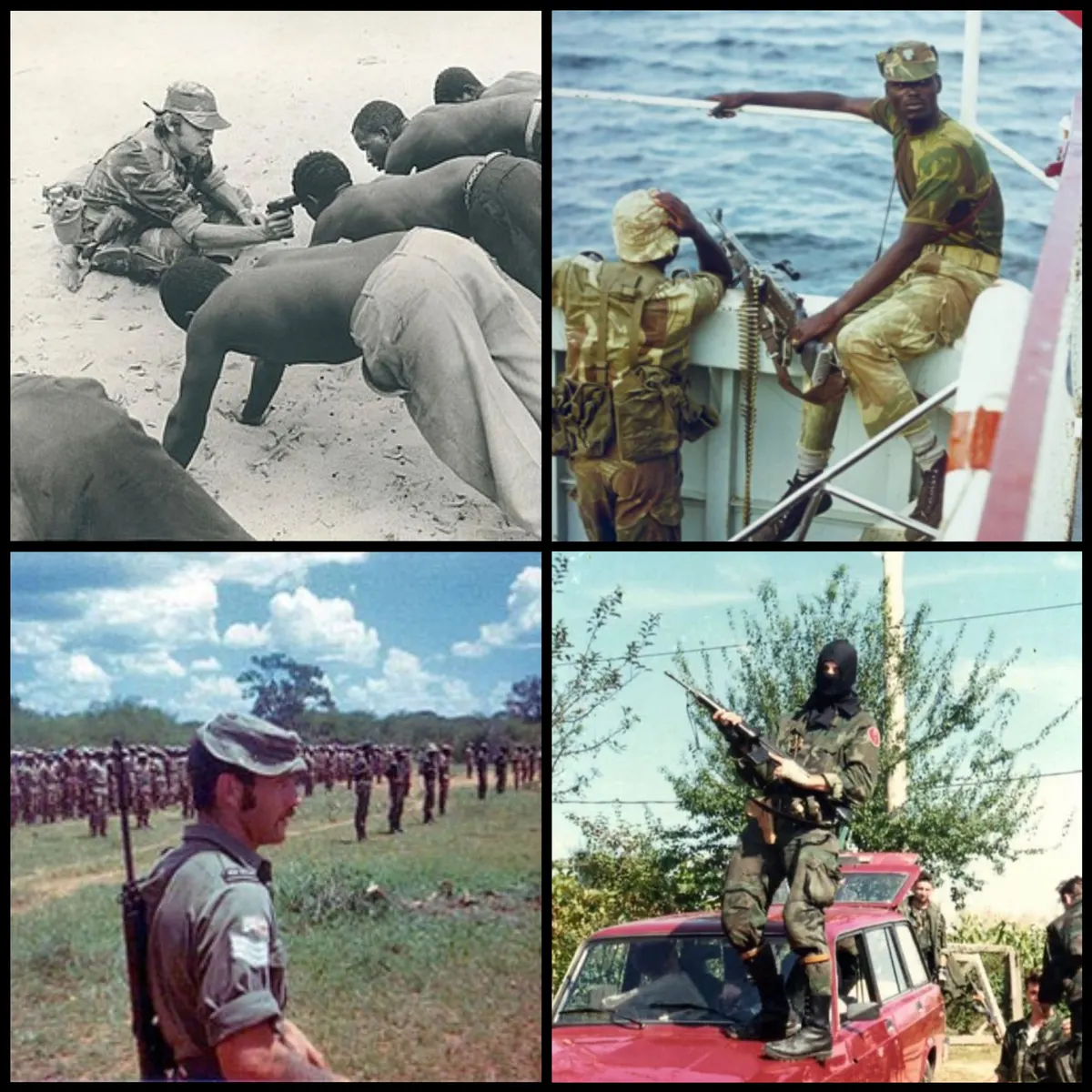
Portuguese-contract FALs that surfaced afterward in South African hands were reportedly rebuilt with South African-made barrels, and some were transferred onward to Rhodesia for use in the Rhodesian Bush War, with one forum-sourced estimate placing that further transfer around 1976 to 1979.10,11 This runs geographically parallel to, but is a separate supply chain from, the ex-German G1's own route into Rhodesia, which moved directly from the West-Germany-to-Portugal batch rather than through the 1975 South African auction.3
No sourced evidence surfaced of any later Portuguese FAL surplus disposal comparable to the G3's 2022 donation to Ukraine. The FAL appears to have left Portuguese hands entirely by the mid-to-late 1970s, well before Portugal's most recent rifle-fleet modernization to the FN SCAR-L.
The Portuguese Colonial War is the m/962's entire combat record, fought across three overlapping fronts between 1961 and 1975. In Angola, fighting began in February 1961 against the MPLA, FNLA, and later UNITA, the Angolan War of Independence.8 In Guinea-Bissau, the Guinea-Bissau War of Independence against the PAIGC ran from 1963, and search sources identify it as one of the two theaters, alongside Angola, where FAL-pattern rifles saw the heaviest use.2 In Mozambique, the Mozambican War of Independence against FRELIMO began in 1964.8
The rifle's postwar life added a fourth conflict to its record at one remove. Portuguese-contract FALs rebuilt and passed on by South Africa after the 1975 auction reached Rhodesian security forces and saw use in the Rhodesian Bush War into the late 1970s, a conflict Portugal itself was never a party to.10,11
Independence in 1975 did not end the fighting these rifles had been part of. Guinea-Bissau and Angola's post-independence forces inherited stocks of captured and abandoned Portuguese weapons that outlasted colonial rule itself, feeding into the successor conflicts that followed the Portuguese withdrawal across all three former territories.
Portugal's m/962 was never a single uniform rifle, but three distinct manufacture-origin sub-variants sharing one designation. The Belgian-built FN 50.00 pattern, purchased new and direct from FN Herstal, formed the earliest procurement tranche.2 The secondhand West German G1 stock, roughly 15,000 rifles built at FN's Herstal plant for the Bundeswehr before being sold on once West Germany itself adopted the G3, made up the second and largest single block.3
The South African-built R1 rifle, roughly 12,500 examples from what became Vektor's Lyttelton line, formed the third stream, itself a license-built FAL variant that South Africa had adopted as its own standard rifle before selling a further batch onward to Portugal.4 All three streams used the same core FAL 50.00 hardware, differing mainly in manufacturing marks and minor furniture details rather than in mechanism.


| Year | Buyer | Quantity | Amount | Present Value (2025) |
|---|---|---|---|---|
| 1975 |  South Africa | — | — | — |
| 1961 |  Portugal | 3,835 | — | — |
| 1961 | Portugal | 15,000 | — | — |
| 1961 | Portugal | 12,500 | — | — |
Portugal is the m/962's primary operator, fielding it as a supplementary, limited-standard rifle alongside the G3 from 1961 until its withdrawal from African service by the mid-1970s.2 South Africa became a secondary operator in 1975, winning the auction for Portugal's surplus stock and rebuilding rifles with domestic barrels.10 Rhodesia received a further secondhand transfer of that South African-rebuilt stock, reportedly around 1976 to 1979, arming security forces during the final years of the Rhodesian Bush War.10,11
Portugal's own two 7.62mm rifles make the clearest comparison, because the choice between them was a real, contemporaneous decision rather than a later replacement. The G3 and the FAL entered Portuguese service within months of each other in 1961, both chambered for 7.62x51mm NATO, both rushed into Africa as fighting broke out in Angola. What separated them was training, not performance. The Army judged the roller-delayed G3 easier to teach large numbers of conscripts and colonial troops, and cheaper to build once Fábrica Militar do Braço de Prata's domestic license line came online, so the G3 became the primary rifle while the gas-operated FAL was downgraded to supplementary status.2 The soldiers who could afford to be choosier, the Caçadores Especiais commandos, picked the FAL anyway for its lighter handling.7
| FN FAL m/962 (Portugal) | G3 m/961 (Portugal) | |
|---|---|---|
| Action | Gas-operated, tilting breechblock | Roller-delayed blowback |
| Manufacture | Imported only (Belgium, West Germany, South Africa) | Domestic license production from 1962 |
| Role in Portuguese service | Supplementary, limited standard | Primary standard rifle |
| Postwar fate | Sold to South Africa at 1975 auction, left Portuguese service by the mid-1970s | Remained standard issue into the 2000s, partly donated to Ukraine in 2022 |
The FAL's West German connection runs through the G1, West Germany's own FN FAL, and the two articles describe overlapping but genuinely separate rifles under this same Portuguese story. Roughly 15,000 of Portugal's m/962 rifles were ex-German G1 stock, sold on once West Germany itself replaced the FAL with the G3 in 1959, meaning Portugal ended up running a smaller version of the same FAL-then-G3 transition West Germany had already made a few years earlier, just with both rifles kept in service together rather than one fully replacing the other.3 Both countries' FAL stock later reached Rhodesia through separate routes, the German-Portuguese G1s transferred directly, the wider Portuguese FAL stock via the 1975 South African auction, a parallel but distinct pair of supply chains into the same Bush War.10,3
A more distant comparison sits with Israel's FN FAL Romat, another national FAL variant adopted at almost the same time, in 1955, for very different reasons. Israel obtained its FAL through a manufacturing-rights trade with FN Herstal involving the Uzi submachine gun and built the rifle domestically at Israel Military Industries, while Portugal never built a single m/962 domestically and instead assembled its fleet from three separate countries' factories. Both rifles ultimately gave way to designs judged better suited to their army's actual soldiers, the Romat to the lighter Galil after chronic desert jamming, the m/962 to the domestically produced G3 after a judgment about training difficulty rather than reliability.


Is the FN FAL m/962 the same rifle as the Carnation Revolution rifle? No. The 25 April 1974 photographs of Lisbon soldiers with carnations in their rifle barrels show the G3, Portugal's other 7.62mm rifle, which had become the dominant standard-issue weapon by 1974.9
Was Portugal's FAL built under license domestically? No. Unlike the G3, which Fábrica Militar do Braço de Prata built under license in Lisbon from 1962, every m/962 FAL was imported complete, from Belgium, from secondhand West German G1 stock, and from South African R1 production.2,3,4
Why did Portugal use both the G3 and the FAL at the same time? Both rifles were rushed into service in 1961 as fighting broke out in Angola, and the Army ran them in parallel rather than choosing a single winner immediately. The G3 was later judged easier to train conscripts on and cheaper to build domestically, so it became the primary rifle while the FAL was kept as a supplementary, limited-standard weapon that specialist units continued to prefer.2
Is the FN FAL m/962 still in service anywhere? No. Portugal's FAL stock left service by the mid-1970s, sold to South Africa at a 1975 arms auction and partly transferred onward to Rhodesia by the late 1970s. No later surplus chapter comparable to the G3's 2022 Ukraine donation has been documented for the FAL.10,11
- "List of weapons of the Portuguese Colonial War", Wikipedia — en.wikipedia.org ↩
- "What kind of G3 rifle did the Portuguese use in Angola and elsewhere in Africa", Gunboards forum — gunboards.com ↩
- "Technical curiosities of the Portuguese colonial army in Africa", militaeraktuell.at — militaeraktuell.at ↩
- "Portuguese Equipment in the Colonial War", Steven's Balagan — balagan.info ↩
- "FN FAL", Wikipedia — en.wikipedia.org ↩
- "FAL Paratrooper 50.63", Forgotten Weapons — forgottenweapons.com ↩
- "Caçadores", Wikipedia — en.wikipedia.org ↩
- "Portuguese Order of Battle during the Portuguese Colonial War", Steven's Balagan — balagan.info ↩
- "Portuguese Colonial War", Wikipedia — en.wikipedia.org ↩
- "The History and travels of this Portuguese contract, Rhodesian used FAL", Northeastshooters.com forum — northeastshooters.com ↩
- "Rhodesian FALs, A Brief History and How to Spot One in the Wild", The Kommando Blog — kommandoblog.com ↩