

A battle rifle is a self-loading or select-fire infantry rifle built around a full-power rifle cartridge, most often the 7.62x51mm NATO round or a close equivalent. The category sits between two others covered on this site. The bolt-action rifles that battle rifles replaced fired the same full-power ammunition one round at a time. The assault rifles that later replaced most battle rifles in frontline infantry service fire a smaller, lighter intermediate cartridge instead. A battle rifle keeps the older cartridge's range and stopping power while adding automatic or semi-automatic fire, and that combination defined nearly every infantry rifle debate of the mid-twentieth century.
The full-power cartridge is the real dividing line. A 7.62x51mm round carries roughly twice the recoil energy of the 5.56x45mm round that most modern assault rifles fire. That makes a battle rifle heavier, harder to control on automatic fire, and more expensive to feed with ammunition, but also more capable at long range and better at penetrating cover. This tradeoff is why battle rifles never fully disappeared even after most armies switched to smaller-caliber assault rifles. Today the surviving battle rifle role has narrowed toward the designated marksman rifle, issued one per squad for precision fire at distances an assault rifle cannot reliably reach. That role is distinct from the true sniper rifle, which trades rate of fire entirely for accuracy.
The term itself is retroactive. No army called its 1950s infantry rifle a battle rifle at the time, since the word only came into common use decades later, once collectors and firearms writers needed a way to separate these full-power self-loaders from both their bolt-action predecessors and the carbines and semi-automatic rifles that share some of the same operating principles at a smaller scale. The category as this article treats it covers roughly sixty distinct rifles fielded by more than forty countries across twelve decades, from the earliest hand-built prototypes of 1900 to full-power rifles still entering service in 2025. Where exactly a given rifle sits on the boundary with the designated marksman rifle or the semi-automatic rifle categories is often a matter of judgment rather than a hard technical line, and several rifles in this article have been classified differently by different sources over the decades.
01Early Attempts at a Self-Loading Full-Power Rifle
Self-loading rifles chambered for full-power ammunition existed decades before anyone used the term battle rifle. Italian officer Amerigo Cei-Rigotti demonstrated a gas-operated, select-fire rifle as early as 1900, built around a shortened 6.5mm Carcano cartridge. Italian and Austrian trials both rejected it for unreliable feeding and excessive weight. The Cei-Rigotti is nonetheless recognized as one of the earliest true attempts at a self-loading service rifle in a military-issue caliber.1
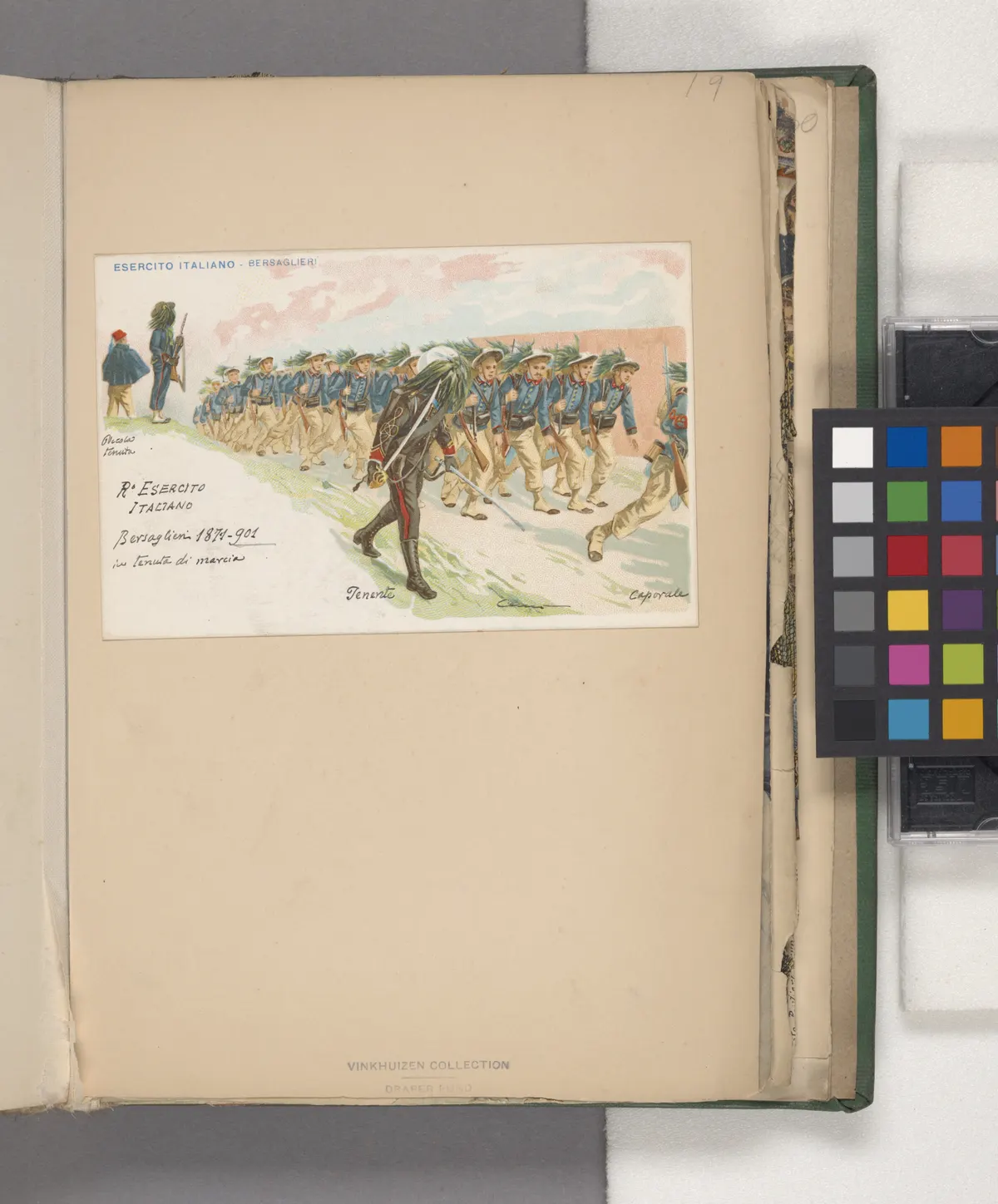
Imperial Russia went further before the First World War even began. Captain Vladimir Fyodorov built a rifle chambered for a reduced 6.5mm cartridge and later adapted it to a Japanese 6.5x50mm round already sitting in Russian army stores. The resulting Fyodorov Avtomat reached limited production and saw combat on the Eastern Front and in the Russian Civil War.1 Fyodorov's own reduced-power cartridge choice anticipated the intermediate-cartridge assault rifle by three decades, though the rifle is usually classed alongside the full-power designs that followed it because of its role and battlefield function rather than its ballistics. Russia returned to the full-power self-loading rifle question again in the 1930s with the AVS-36, a select-fire rifle chambered for the standard 7.62x54mmR round. It reached modest production before the Winter War exposed a fragile locking mechanism and unpredictable full-automatic behavior.1
None of these early rifles solved the two problems that keep resurfacing across the whole battle rifle story. A full-power cartridge produces enough recoil that automatic fire from a shoulder-fired weapon is hard to control, and a rifle strong enough to survive automatic fire in that caliber tends to be heavy. Every major rifle covered in the rest of this article represents a different attempt to manage that same tension.
01The Airborne Answer of the Second World War
The Second World War produced the first battle rifles built for a specific tactical problem rather than as a general infantry replacement. Germany's paratroop arm needed a weapon that could do the job of a rifle, a light machine gun and a submachine gun at once, because airborne troops jumped without heavier support weapons. The result was the FG 42, a select-fire rifle chambered for the full-power 7.92x57mm Mauser cartridge, fitted with an in-line stock to fight its recoil and a bipod for sustained fire. Fewer than 20,000 were built across the war, in large part because its complex machined construction made it expensive. It saw its heaviest use at the Battle of Monte Cassino and in the airborne defense of Carentan during the Normandy campaign.2

The Soviet Union answered a different problem. Its existing semi-automatic rifles were reliable but slow, and the AVT-40, a select-fire conversion of the standard-issue Tokarev SVT-40, was rushed into production specifically to add automatic fire to front-line units without waiting for a new design. Soviet troops carried it through the Battle of Stalingrad, though many soldiers reportedly disabled the automatic-fire setting themselves. The seven-kilogram rifle climbed off target within a burst of two or three rounds and burned through ammunition the army could not easily replace at the front.3
The United States took a smaller, more specific approach rather than converting an existing rifle. Marine Corps officer Melvin Johnson's M1947 Johnson auto carbine and the parallel Model 45A both tried to give small units of paratroopers and raiders a lighter automatic option. Neither reached the production scale of the standard M1 Garand or the submachine guns already in service, and both stayed limited to specialist units rather than general infantry issue.4
01NATO's Cartridge Compromise and Its Rifle Problem
The battle rifle only became a distinct, named category after the Second World War, when the newly formed NATO alliance tried to standardize ammunition across its member armies. The United States pushed for a full-power round close to its existing .30-06 cartridge. Britain and Belgium separately argued for a shorter, lighter round that would be easier to control on automatic fire. NATO settled in 1954 on the 7.62x51mm cartridge, a compromise close to the American position, and every rifle in this article's next several sections was designed or adapted to fire it.
The compromise itself had already been years in the making. The US Army's Frankford Arsenal had spent much of the late 1940s developing a shortened experimental round known as the T65, built around the same case length as the .30-06 it was meant to replace but loaded to lower pressure, and American negotiators presented the T65 to NATO partners as an already mature, production-ready option rather than a fresh design competing on equal footing. British and Belgian negotiators argued through the early 1950s that a genuinely smaller intermediate round would let a soldier carry more ammunition and control automatic fire far more easily, but American ordnance officers countered that a single full-power cartridge would let every allied army resupply from the same wartime stockpile, an interoperability argument that ultimately weighed more heavily on the final decision than any single rifle's trial performance.
Belgium's Fabrique Nationale, known today as FN Herstal, had already built the FN Model 1949, a semi-automatic rifle sold to a dozen countries in a variety of full-power calibers before the NATO standard even existed. FN engineer Dieudonné Saive used that design as the direct basis for the select-fire FN FAL, chambered from the outset for the new 7.62x51mm round.5

Britain had actually developed its own candidate first. The bullpup EM-2 rifle, built around a smaller intermediate round Britain had proposed to NATO, was formally adopted by the British Army in 1951, before the United States refused to accept anything but a full-power cartridge and forced Britain to cancel the EM-2 and adopt a licensed FN FAL instead, badged the L1A1 Self-Loading Rifle. West Germany, barred from developing its own weapons industry immediately after the war, turned to Spain's state design house CETME and its roller-delayed blowback rifle, which German industry later reimported and rebuilt as the Heckler & Koch G3.6 Three of the four eventual NATO rifle families, the FAL, the L1A1 and the G3-CETME line, all trace back to this single standardization argument, even though none of the three original national candidates the argument was meant to unify, America's cartridge, Britain's EM-2, Belgium's Model 1949, survived it unchanged.
01The FN FAL Becomes the Rifle of the Free World
No battle rifle spread further or wider than the FN FAL. Gun writers nicknamed it the right arm of the free world, a label that reflected how many NATO and Commonwealth-aligned armies eventually carried it. Belgium adopted it in 1953, Britain and its Commonwealth partners followed through the licensed L1A1, Canada built its own inch-pattern version as the FN C1 rifle, and both Australia and India adopted closely related metric or inch variants of the same basic design.7
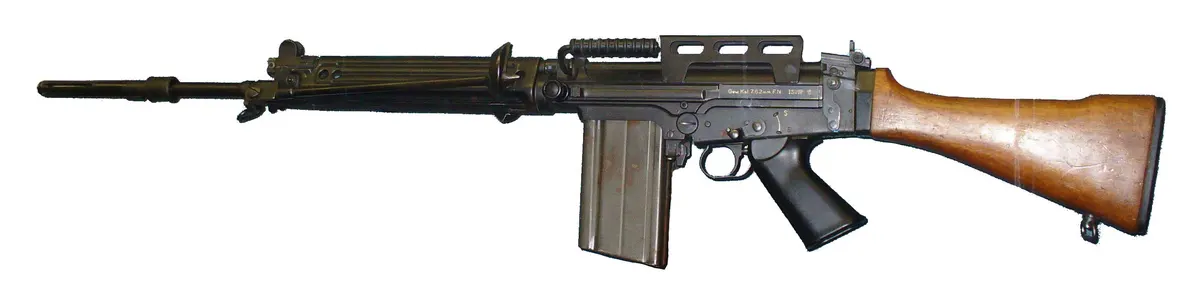
Israel adopted a locally modified metric-pattern FAL as the FN FAL Romat, built partly under license by what later became Israel Weapon Industries, and carried it through the Six-Day War and the Yom Kippur War. Austria fielded its own shortened variant as the Steyr StG 58, Brazil's army built the folding-stock ParaFAL for its own paratroopers, and Belgium later issued a shortened paratroop variant of its own as the FN FAL m/962. The Netherlands fielded its own designation of the same rifle as the Licht Automatisch Geweer, and West Germany's own first FAL purchase, before it settled on the rival G3, is remembered today as the FN FAL G1.7
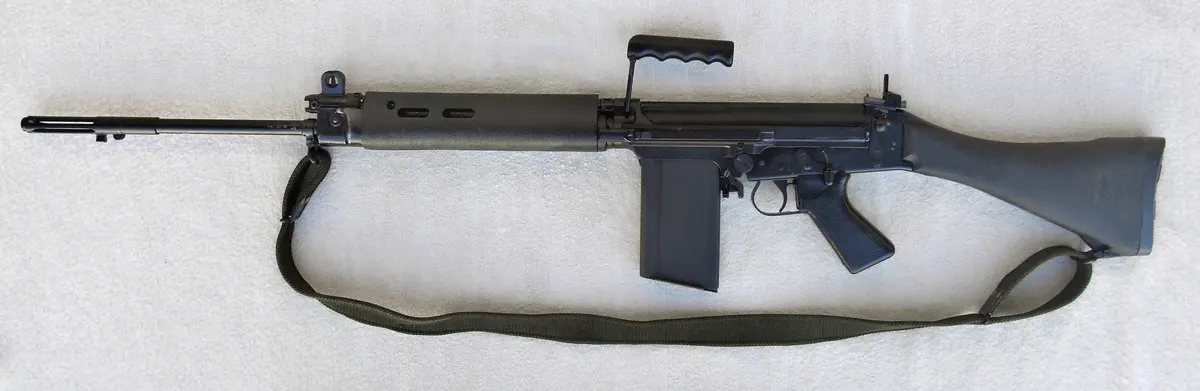
South Africa built its own FAL derivative domestically as the R1 rifle, produced by the state arms group now known as Armscor, and carried it through the Angolan Civil War and the Rhodesian Bush War.8 The FAL's most striking coincidence came in 1982, when Argentina's licensed FN FAL and Britain's L1A1, the same basic rifle wearing two different national badges, faced each other across the Falklands War.
Latin America absorbed a large share of FAL production of its own well before that conflict. Venezuela, among the earliest export customers outside Europe, issued the rifle for decades, and Argentina, Chile and several other South American armies followed for the same reason NATO members did, a proven design already backed by a mature parts and training pipeline. Gun writers occasionally paired the FAL nickname with an opposite number, calling the Soviet-designed AK-47 the rival rifle of the Communist bloc's infantry, a pairing that says more about Cold War rhetoric than about any formal count of which rifle actually equipped more soldiers worldwide.
01Germany's Roller-Delayed Rival Spreads Just as Far
The G3's roller-delayed blowback mechanism, inherited from the Spanish CETME rifle and refined by Heckler & Koch, proved just as exportable as the FAL's gas system. West Germany adopted it in 1959, and the rifle went on to equip more than sixty countries in original or license-built form.9
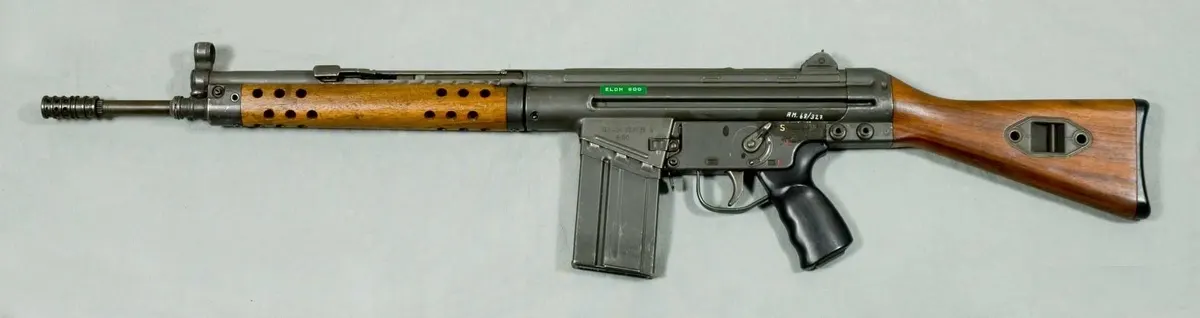
Spain kept building the original CETME rifle domestically even as Germany's redesigned version overtook it commercially. Pakistan's Pakistan Ordnance Factories built its own license copy as the POF G3 and issued it through the 1965 and 1971 wars with India and the Bangladesh Liberation War. Portugal fielded a licensed variant as the G3 rifle m/961 during its long colonial wars in Africa, and Turkey's state arsenal built its own version, the MKEK G3, which remained a front-line Turkish infantry rifle for decades.9
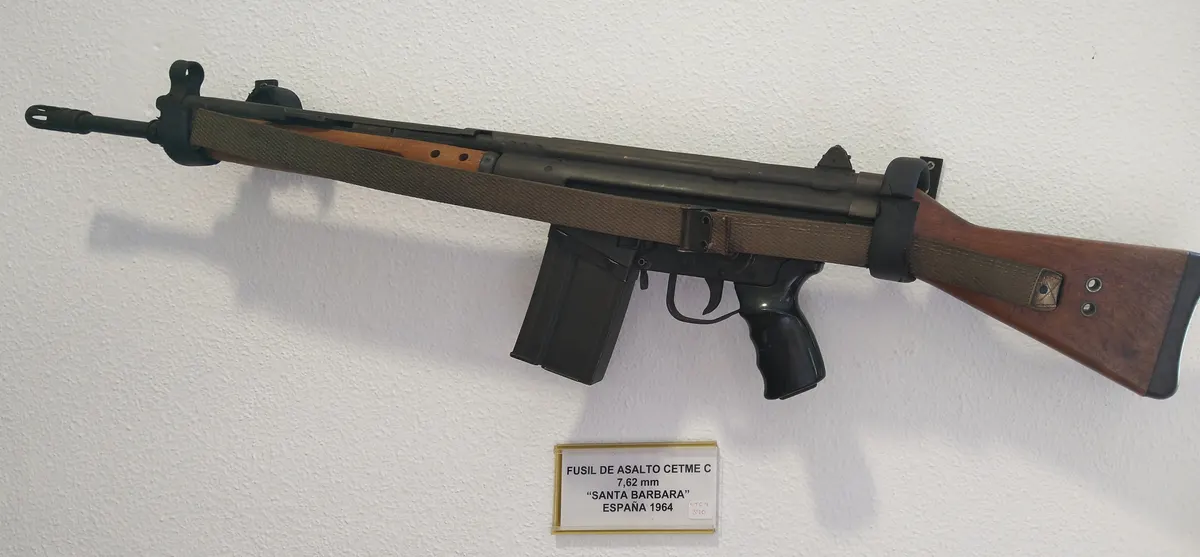
Scandinavia took the G3 design in its own direction rather than adopting it outright. Sweden's Ak 4 rifle was a directly licensed G3 with only minor local modifications, while Norway's AG-3 followed the same path and stayed in Norwegian reserve and home-guard service far longer than most of its Cold War contemporaries.9
The roller-delayed mechanism itself works by slowing the bolt's rearward movement with a pair of rollers rather than locking it fully closed, a simpler and cheaper approach to manufacture than the FAL's tilting-bolt gas system, though it demanded tighter tolerances on the chamber and on ammunition to function reliably. That relative manufacturing simplicity is a large part of why state arsenals with limited machining capacity, from Pakistan's POF to Turkey's MKEK, could put the G3 into production without the more complex tooling the FAL's gas system required. Heckler & Koch never abandoned the roller-delayed system, and its modern HK417, covered later in this article, still uses a version of the same locking principle the CETME rifle introduced in the 1950s.
01Other NATO Members Choose a Third Path
Not every NATO or NATO-adjacent army fell in behind the FAL, the G3 or the American M14 covered in the next section. Italy converted its own wartime M1 Garand rifles into a home-grown select-fire design, the Beretta BM 59, adopted in 1959 as the other NATO cartridge trials were settling elsewhere. The BM 59 kept the Garand's basic operating system rather than adopting either the FAL's tilting bolt or the G3's roller-delayed system, and it remained the standard Italian infantry rifle for two decades.10
France tried a different route entirely. Its state arsenal built the full-power FA-MAS Type 62 prototype in the early 1960s as a candidate to replace France's aging semi-automatic MAS-49 rifles, but French planners ultimately abandoned the full-power NATO cartridge and waited for a smaller intermediate round instead, a decision that eventually produced the bullpup FAMAS rifle rather than a battle rifle at all.10

That French detour is a useful reminder of how narrow the real battle rifle adoption window actually was. Nearly every army covered so far made its full-power rifle decision within a single decade, the 1950s, and a nation that waited past that decade, as France did, generally skipped the category altogether and adopted an intermediate-caliber assault rifle instead.
01America's Reluctant M14
The United States took the longest and most expensive path to its own battle rifle. Springfield Armory's development effort, competing against Eugene Stoner's ArmaLite AR-10, eventually produced the M14 rifle, adopted in 1957 as the standard US infantry rifle after trials critics later argued had been tilted in the government-run Springfield Armory's favor over the privately developed ArmaLite design.11
The Army tested a third contender in those same trials, an American-built version of the FN FAL itself, designated the T48 rifle. The T48 lost narrowly enough that later analysts argued a preference for a domestic design mattered as much as the trial results, since several NATO partners who ran their own comparative trials around the same time chose the FAL over the M14 instead.11
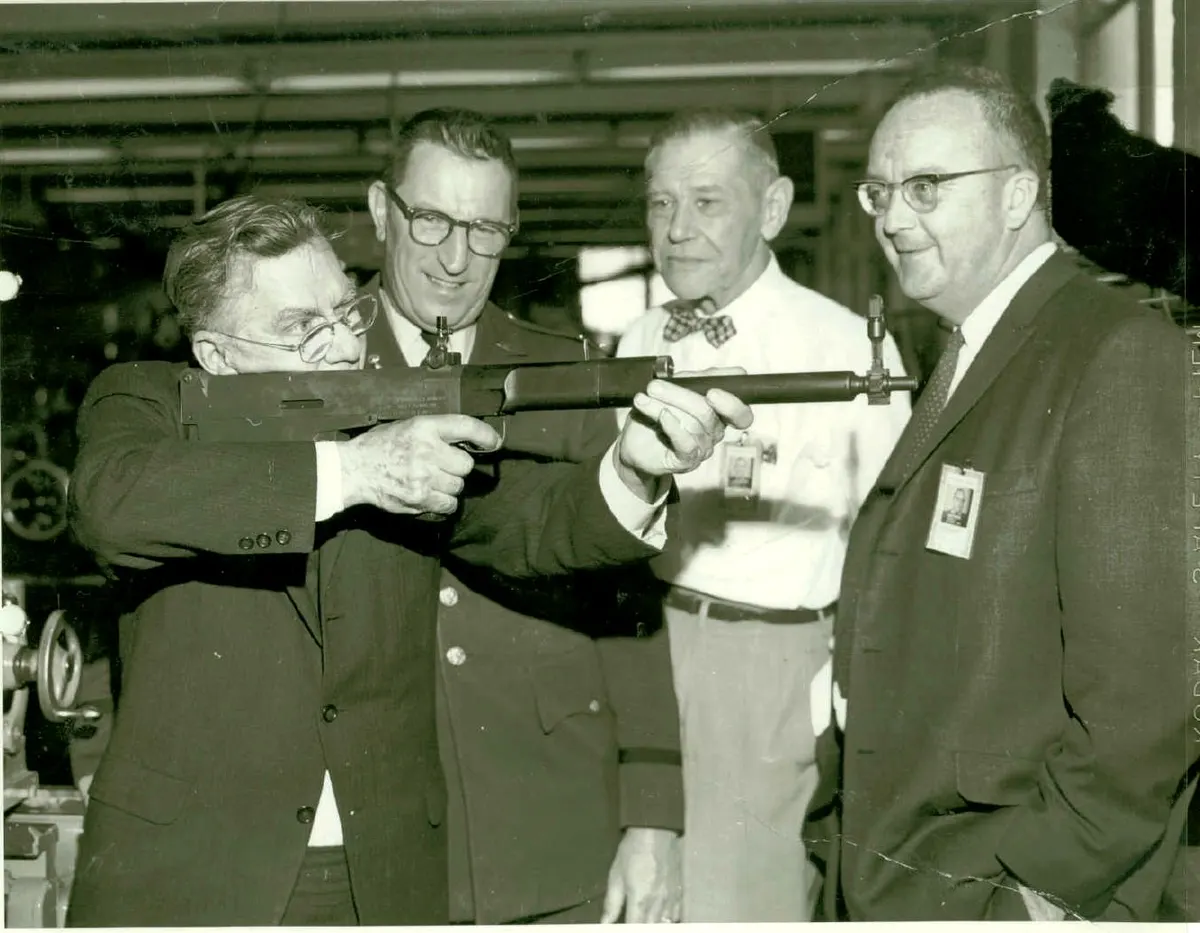
The M14's service life was short and controversial. Its full-power cartridge made automatic fire almost unusable in an average soldier's hands, and jungle conditions in the early Vietnam War exposed both that recoil problem and the rifle's length and weight next to the enemy's shorter automatic weapons. The Army began replacing it with the M16 and its intermediate 5.56mm cartridge within a decade of adoption, one of the fastest full reversals of a standard infantry rifle in modern military history. A dedicated automatic-fire variant, the M14A1, tried to fix the control problem with a folding forward grip and a straight-line stock, but it arrived too late to change the M16's momentum.11
The M14 never fully left US service even after its replacement. Its accuracy and cartridge made it a natural base for a marksman's rifle, and the Army converted selected match-grade M14 receivers into the M21 sniper rifle during the Vietnam War itself, one of the earliest instances of a battle rifle crossing directly into the dedicated sniper rifle role rather than staying a general-issue infantry arm. Decades later the Marine Corps and Army rebuilt further surplus M14 receivers into the Mk 14 Enhanced Battle Rifle, fitted with a modern chassis stock and optics, for the designated marksman role this article returns to below.11
01Neutral Armies, Independent Designs
Not every battle rifle grew out of the NATO standardization argument. Switzerland, which joined no military alliance, developed the SIG SG 510 independently through the manufacturer now known as SIG Sauer, adopting it in 1957 as the Stgw 57 and keeping it in front-line Swiss militia service for more than three decades. An earlier Swiss prototype, the Sturmgewehr 52, never reached full production but directly informed the SG 510's roller-delayed mechanism.12
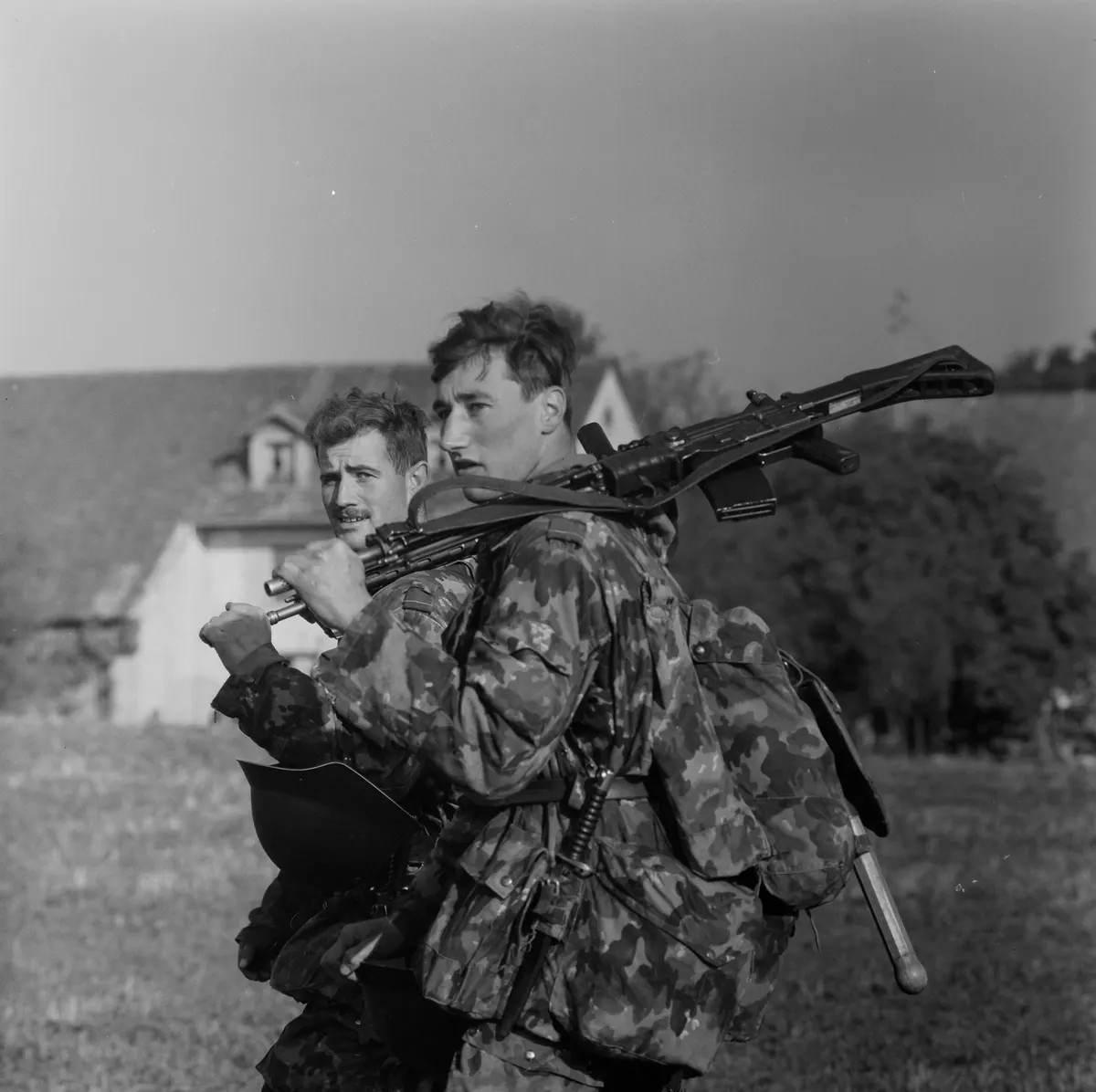
Sweden pursued the same independent path in several directions at once, licensing the G3 as the Ak 4 covered above while also developing its own domestic designs, the FM57 rifle and the later prototype GRAM 63 battle rifle, neither of which reached the production scale of the licensed Ak 4.12 Finland, another historically non-aligned state, waited until the twenty-first century to field a purpose-built battle rifle of its own, a development covered in the final section of this article.
01Smaller National Programs Across Three Continents
Several smaller arms industries built their own full-power self-loading rifles without ever expecting to compete with the FAL or the G3 for export volume. Denmark's Dansk Industri Syndikat built the semi-automatic Madsen LAR in the late 1950s and sold it mainly to South American and African militaries, rather than to Denmark's own NATO-aligned forces, which chose the G3-derived Ak family covered above instead.13
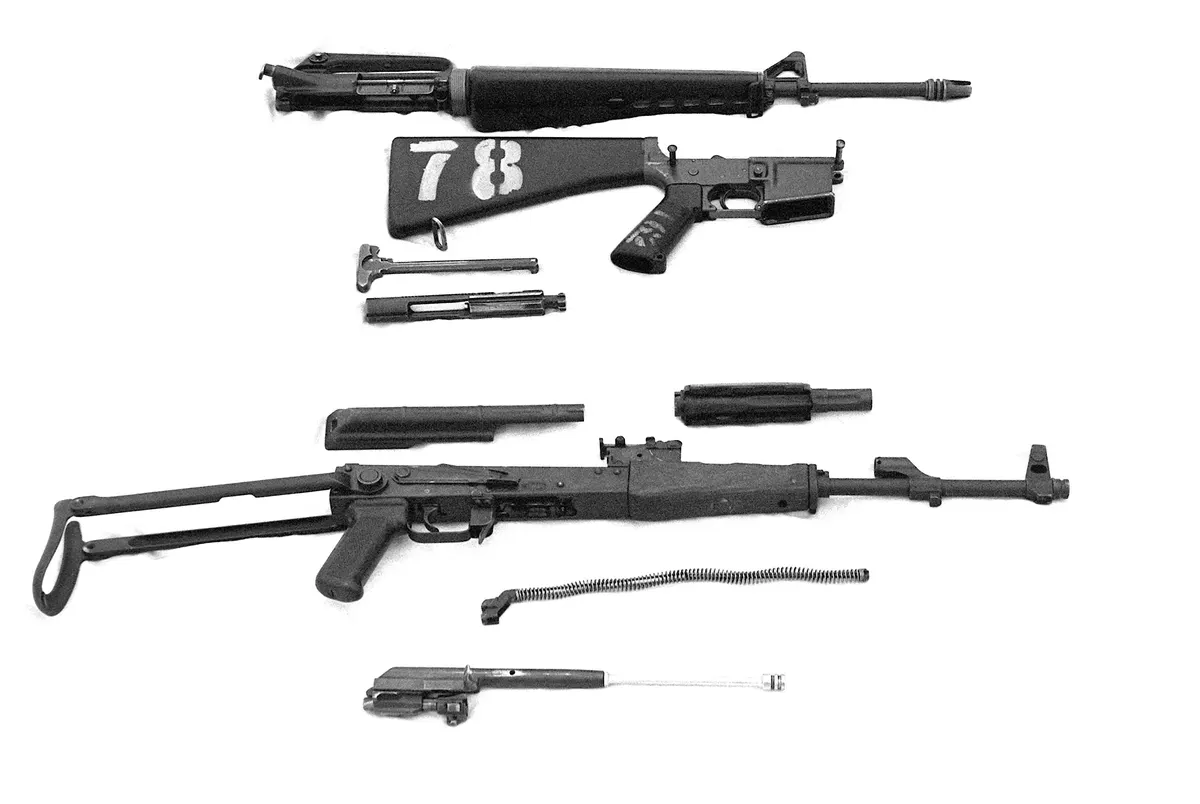
Switzerland's path to the SIG SG 510 ran through an earlier prototype of its own, the SIG AK53, a roller-locked design tested alongside the rival Sturmgewehr 52 before the Swiss army chose the SG 510's refined mechanism for full adoption. Belgium's FN Herstal experimented even further afield with the SLEM-1, a wartime prototype built during the German occupation and tested only after liberation, one of the design threads that eventually fed into the FN Model 1949 and, from there, the FAL itself.13
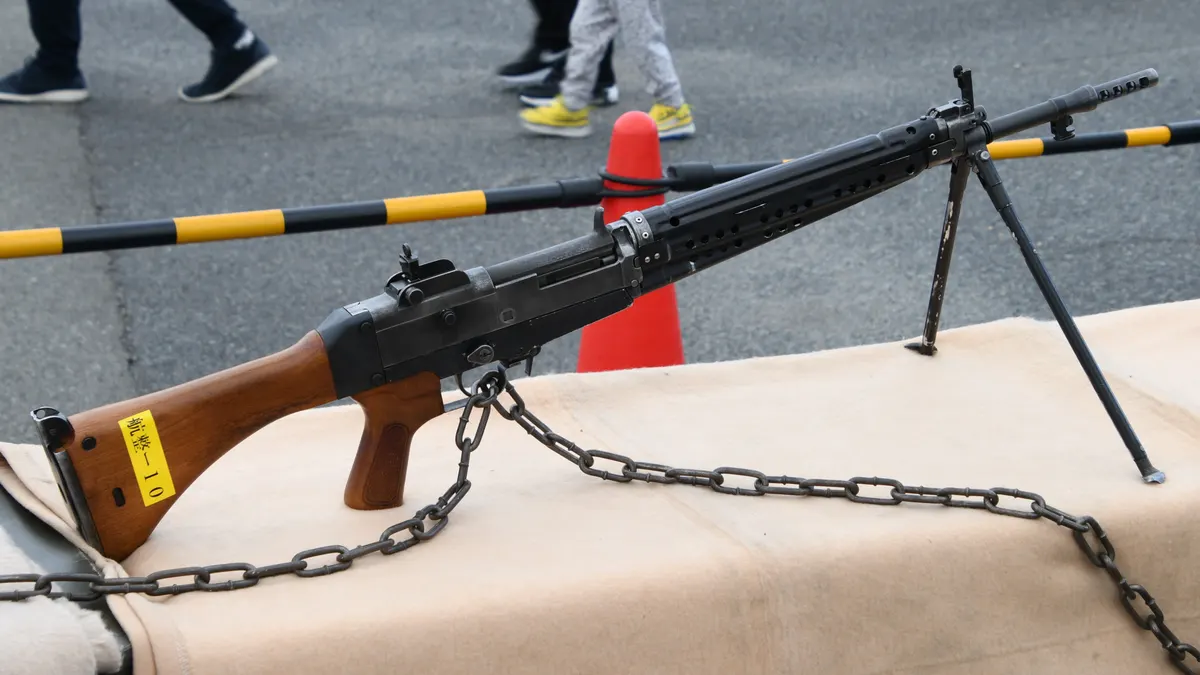
Greece built its own locally modified FAL-pattern rifle, the Chropi rifle, adapting the basic FN design to domestic production needs rather than importing complete FN-built rifles. Japan's Howa Type 64, adopted by the Japan Self-Defense Forces in 1964, deliberately reduced the power of its 7.62x51mm chambering to suit the smaller stature and lighter build of average Japanese soldiers at the time, a rare case of a full-power cartridge being downgraded for its own issuing army rather than kept at full NATO specification.13
Britain's own industry produced a rarer semi-automatic-only derivative of its submachine gun expertise in the Sterling 7.62, built for police and export markets by the same company known for its Sterling submachine gun, though it never displaced the L1A1 in British military service.13 Taken together, these smaller programs make the same point the larger FAL and G3 stories already make at greater scale. Almost no arms-producing country sat out the full-power self-loading rifle question entirely during the 1950s and 1960s, even when its own program never came close to matching the export volume of the two dominant families.
01Battle Rifles in Insurgency and Limited War
Battle rifles fought most of their real combat not in a large-scale NATO-versus-Warsaw-Pact war that never came, but in the colonial, post-colonial and insurgent conflicts of the 1960s through the 1980s. Britain's L1A1 saw action against Yemeni tribal forces during the Aden Emergency and against Irish republican paramilitaries during the Troubles. Portugal fought its long African colonial wars, including the Angolan War of Independence, with G3 rifles built under the license covered above.
Belgium's own former colony saw FN FAL rifles on more than one side of the Congo Crisis of the early 1960s, issued both to the departing Belgian-trained national army and to the various factions it split into once independence collapsed into civil conflict. Nigeria's federal army carried L1A1 and FN FAL rifles through its own 1967 to 1970 civil war, fought at ranges and in terrain not unlike the bush wars covered elsewhere in this section, reinforcing the same lesson about a full-power rifle's weight cost in close, dense terrain.
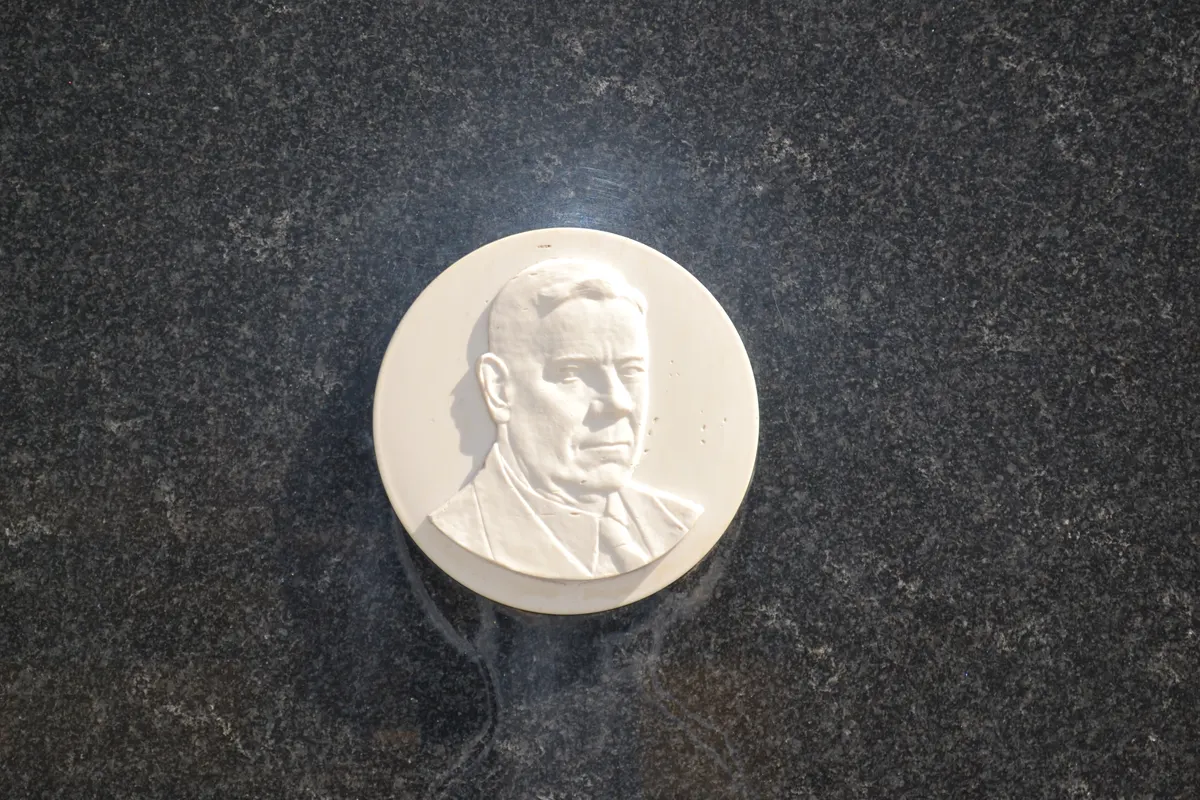
South Africa's domestically built R1 rifle, and the shorter R4 assault rifle that eventually replaced it, carried South African and allied Rhodesian forces through the bush wars named above, conflicts fought mostly at the short-to-medium ranges where a battle rifle's long-range advantage over a lighter assault rifle mattered far less than its weight disadvantage. That tradeoff, a full-power rifle's range advantage set against its weight and control penalty in close terrain, is the central reason armies eventually moved away from the battle rifle as a standard infantry weapon, a shift the next section covers directly.
01Why Assault Rifles Took Over, and Why Battle Rifles Stayed
The rifle that started the intermediate-cartridge idea predates even the NATO cartridge argument covered earlier in this article. Germany's own Sturmgewehr 44, fielded from 1944 in small numbers, had already demonstrated the core assault rifle concept, a select-fire weapon built around a reduced-power cartridge, years before NATO settled on the full-power 7.62x51mm compromise. The Soviet Union drew its own lesson from that wartime design almost immediately, and the AK-47's 1949 adoption put an intermediate-cartridge rifle into mass Soviet service years before most NATO armies had even finished testing their own full-power candidates.
The lesson every army drew from Vietnam, Aden, Algeria and the Congo was largely the same. Most infantry combat happens at ranges well under three hundred meters, distances where a lighter, more controllable assault rifle firing a smaller intermediate cartridge lets a soldier carry more ammunition and place more hits under stress than a heavier battle rifle firing full-power ammunition. The AK-47's roughly 4.3-kilogram loaded weight against the FN FAL's nearly 5-kilogram loaded weight told much of the same story from the opposite direction, since the Soviet design had reached the same lighter, more controllable conclusion years before most NATO armies acted on it. By the late 1970s almost every major army had adopted or was adopting an assault rifle as its standard infantry weapon, and the battle rifle's role as a general-issue arm was effectively over within thirty years of the NATO cartridge decision that had created the category.
A handful of countries kept a full-power rifle as their standard infantry arm well past that transition. India's licensed Ishapore 1A1 rifle, built by the Ishapore Rifle Factory, remained standard issue for Indian infantry into the 1990s.14 Serbia's Zastava Arms kept building the Zastava M77 battle rifle for decades after most of Europe had switched to assault rifles, largely for export and reserve issue rather than as its own standard front-line arm.14

What survived the assault rifle transition was a narrower, specialized role rather than the old general-issue mission. Modern armies now issue one designated marksman rifle per squad, built around the same full-power cartridge a 1950s battle rifle carried, to reach targets beyond an assault rifle's effective range without committing a soldier to a dedicated, slower-firing sniper rifle. That designated marksman role is where nearly every battle rifle still in frontline production today actually serves, a revival the next section covers in detail.
01The 7.62mm Revival
Beginning in the 1990s and accelerating after the Afghanistan and Iraq wars exposed the limits of 5.56mm ammunition at longer ranges, several armies rebuilt or newly designed full-power rifles for exactly the designated marksman role described above. The Marine Corps' Mk 14 Enhanced Battle Rifle, already covered in the M14 section, was one of the earliest of these conversions. Heckler & Koch built a purpose-designed successor from scratch, the HK417, adopted directly by German and other European special forces, and FN Herstal answered with the heavier-caliber FN SCAR-H variant of its modular SCAR rifle family, adopted by US special operations units alongside several NATO partners.15
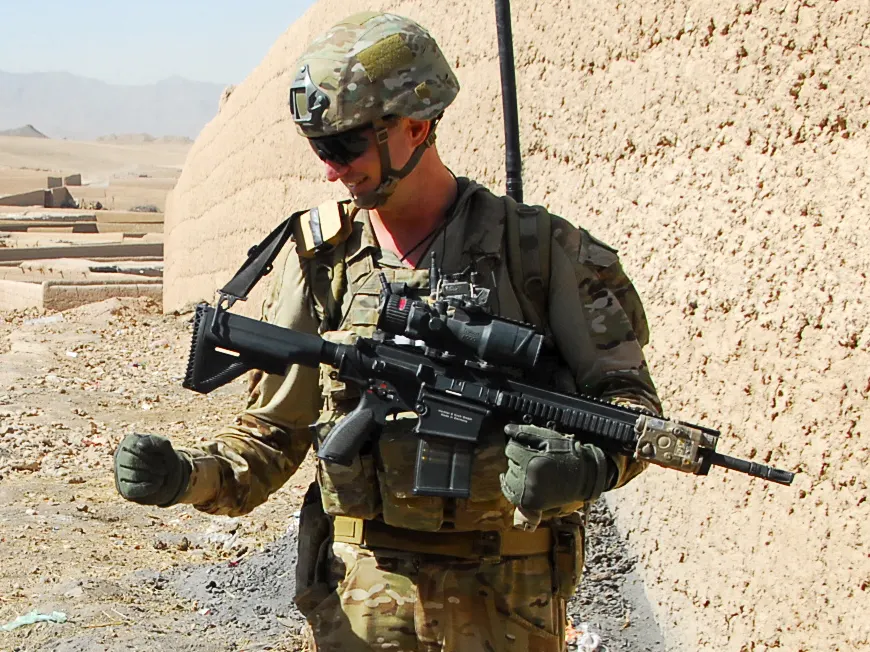
American manufacturers built their own entries into the same market. Colt's Manufacturing Company offered the piston-operated Colt CM901, and SIG Sauer built the SIG 716 around the same AR-10 pattern Eugene Stoner had originated decades earlier. Israel Weapon Industries scaled up its bullpup Tavor design into the full-power IWI Tavor 7, and the Czech firm behind the CZ Bren 2 BR built its own designated marksman rifle around the same modular family as its intermediate-caliber assault rifle.15

Much of this modern generation shares more hardware in common than the Cold War-era rifles ever did. The HK417, the SIG 716, the Colt CM901 and several other designated marksman rifles all trace their basic layout back to Eugene Stoner's original AR-10, which means magazines, optics mounts and many small parts are broadly interchangeable across rifles built by otherwise competing manufacturers, a level of practical standardization the FAL, G3 and M14 families never achieved with one another despite NATO's own cartridge standardization decades earlier.
The US Army's own recent M7 Rifle, adopted from the Next Generation Squad Weapon program, is the most ambitious of these revivals. It replaces the 5.56mm M4 carbine entirely with a new higher-pressure full-power round, rather than issuing a full-power rifle alongside an intermediate-caliber one as every earlier revival on this list did.15
01New Battle Rifles for a New Era of War
Russia's full-scale invasion of Ukraine in 2022, and the trench warfare and long engagement ranges it produced, renewed several countries' interest in fielding a modern full-power rifle again. Finland, which had waited longer than most non-aligned states to build a purpose-designed battle rifle, fielded the Sako M23 in 2022 through Sako, built around the same 7.62x51mm cartridge that has defined the category since NATO's 1954 standardization decision.16

Italy's Beretta fielded its own modern designated marksman rifle, the Beretta ARX200, sharing much of its architecture with Beretta's intermediate-caliber ARX160 assault rifle. Serbia updated its own long-serving Zastava line with the Zastava M05N, and Iran unveiled its own domestically developed entry, the Masaf rifle, in 2025, one of the newest rifles in the entire category covered on this site.16
Other modern programs took the same designated marksman logic in several directions at once. Turkey fielded the MPT-76 as its own new-generation infantry rifle, chambered for the full NATO round rather than the intermediate cartridge most of its NATO partners had settled on decades earlier, and issued it during operations tied to the Arab Spring's aftermath along Turkey's southern border. Australia developed the KAL1 General Purpose Infantry Rifle for the same designated marksman niche, and Indonesia's state arms maker built the Pindad SS4 as a full-power variant of its existing SS-series rifle family.17
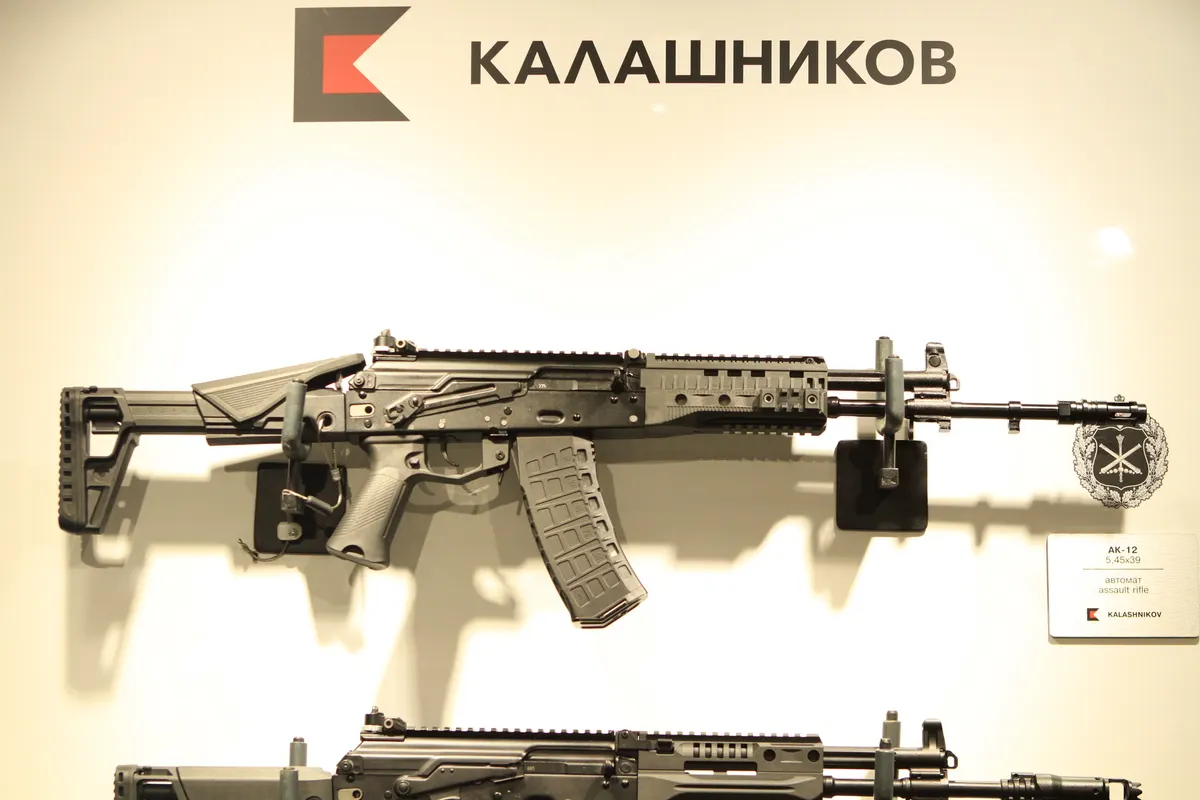
Russia pursued two parallel tracks of its own. It rebuilt the basic Kalashnikov system in full-power form as the AK-308, aimed largely at export customers already familiar with Kalashnikov maintenance and parts, and separately developed the prototype AVB-7.62 for the same designated marksman requirement that has driven nearly every program covered in this section.17
01The Category That Refuses to Disappear
The battle rifle's history runs in a loop rather than a straight line. Full-power self-loading rifles appeared before the First World War, matured into a named category through NATO's 1954 cartridge decision, spread across dozens of countries through the FAL and G3 families covered above, lost their place as a standard infantry arm to the lighter assault rifle by the late 1970s, and then returned through the designated marksman role once modern conflicts again demanded range the intermediate cartridge could not deliver. Finland's Sako M23, Iran's Masaf rifle and the US Army's own M7 Rifle each represent that same return happening again in real time, decades after most observers assumed the battle rifle's working life was over.
What has stayed constant across more than a century of this cycle is the underlying tradeoff every full-power self-loading rifle in this article was built to manage. A heavier cartridge gives a soldier more range and more penetration against cover than a lighter one, at the direct cost of controllable automatic fire and the number of rounds that soldier can carry into a fight. Every rifle covered here, from the 1900 Cei-Rigotti to the 2025 Masaf, represents a different answer to that same arithmetic. The fact that armies keep returning to full-power rifles whenever a conflict again demands long-range accuracy is the clearest evidence that the tradeoff itself, rather than any single rifle's technical merits, is what actually defines the category.
The same FAL and G3 designs that armed Cold War infantry also seeded a large civilian and sporting market, particularly across North America, where semi-automatic-only versions of both rifles remain popular target and collector rifles today under the broader semi-automatic rifles category this article opened by distinguishing from the battle rifle proper. That commercial afterlife, entirely separate from any army's procurement decision, is itself evidence of how thoroughly these two rifle families came to define what a full-power self-loading rifle looks like, well beyond the strictly military context this article has otherwise covered throughout.
02Notes and Sources
- Battle Rifles archive, Cei-Rigotti, Fyodorov Avtomat, AVS-36, Military Archive, /en/weapons/cei-rigotti, /en/weapons/fyodorov-automat, /en/weapons/avs-36 ↩
- Battle Rifles archive, FG 42, Military Archive, /en/weapons/fg-42 ↩
- Battle Rifles archive, AVT-40, Military Archive, /en/weapons/avt-40 ↩
- Battle Rifles archive, M1947 Johnson auto carbine, Model 45A, Military Archive, /en/weapons/m1947-johnson-auto-carbine, /en/weapons/model-45a ↩
- Battle Rifles archive, FN Model 1949, FN FAL, Military Archive, /en/weapons/fn-model-1949, /en/weapons/fal ↩
- Battle Rifles archive, L1A1 Self-Loading Rifle, Heckler & Koch G3, Military Archive, /en/weapons/l1a1-self-loading-rifle, /en/weapons/heckler-koch-g3 ↩
- Battle Rifles archive, FN C1 rifle, FN FAL Romat, Steyr StG 58, ParaFAL, FN FAL m/962, Licht Automatisch Geweer, FN FAL G1, Military Archive, /en/weapons/fn-c1-rifle, /en/weapons/fn-fal-romat, /en/weapons/steyr-stg-58, /en/weapons/parafal, /en/weapons/fn-fal-m-962, /en/weapons/fn-fal-geweer-m1, /en/weapons/g1-rifle ↩
- Battle Rifles archive, R1 rifle, Military Archive, /en/weapons/r1-rifle ↩
- Battle Rifles archive, CETME rifle, POF G3, G3 rifle m/961, MKEK G3, Ak 4 rifle, AG-3, Military Archive, /en/weapons/cetme-rifle, /en/weapons/pof-g3-rifle, /en/weapons/g3-rifle-m-961-portugal, /en/weapons/mkek-g3-rifle, /en/weapons/ak-4-rifle, /en/weapons/ag-3 ↩
- Battle Rifles archive, Beretta BM 59, FA-MAS Type 62, Military Archive, /en/weapons/beretta-bm-59, /en/weapons/fa-mas-type-62 ↩
- Battle Rifles archive, M14 rifle, ArmaLite AR-10, T48 rifle, M14A1, Mk 14 Enhanced Battle Rifle, Military Archive, /en/weapons/m14, /en/weapons/armalite-ar-10, /en/weapons/t48-rifle, /en/weapons/m14a1-rifle, /en/weapons/mk-14-enhanced-battle-rifle ↩
- Battle Rifles archive, SIG SG 510, Sturmgewehr 52, FM57 rifle, GRAM 63 battle rifle, Military Archive, /en/weapons/sig-sg-510, /en/weapons/sturmgewehr-52, /en/weapons/fm57-rifle, /en/weapons/gram-63-battle-rifle ↩
- Battle Rifles archive, Madsen LAR, SIG AK53, SLEM-1, Chropi rifle, Howa Type 64, Sterling 7.62, Military Archive, /en/weapons/madsen-lar, /en/weapons/sig-ak53, /en/weapons/slem-1, /en/weapons/chropi-rifle, /en/weapons/howa-type-64, /en/weapons/sterling-7-62 ↩
- Battle Rifles archive, Ishapore 1A1 rifle, Zastava M77, Military Archive, /en/weapons/ishapore-1a1-rifle, /en/weapons/zastava-m77 ↩
- Battle Rifles archive, HK417, FN SCAR-H, Colt CM901, SIG 716, IWI Tavor 7, CZ Bren 2 BR, M7 Rifle, Military Archive, /en/weapons/heckler-koch-hk417, /en/weapons/fn-scar-h, /en/weapons/colt-cm901, /en/weapons/sig-716, /en/weapons/iwi-tavor-7, /en/weapons/cz-bren-2-br, /en/weapons/m7-rifle ↩
- Battle Rifles archive, Sako M23, Beretta ARX200, Zastava M05N, Masaf rifle, Military Archive, /en/weapons/sako-m23, /en/weapons/beretta-arx200, /en/weapons/zastava-m05n, /en/weapons/masaf-7-62-mm-rifle ↩
- Battle Rifles archive, MPT-76, KAL1 General Purpose Infantry Rifle, Pindad SS4, AK-308, AVB-7.62, Military Archive, /en/weapons/mpt-76, /en/weapons/kal1-general-purpose-infantry-rifle, /en/weapons/pindad-ss4, /en/weapons/ak-308, /en/weapons/avb-7-62 ↩


