


Israel adopted the FN FAL in 1955, barely two years after the Belgian rifle entered production, and gave it a Hebrew designation, Romat (רומ״ט).1 The acronym itself is disputed. English-language sources gloss it as Rov've Mitta'enn, translated as self-loading rifle, while Hebrew-language sources parse it instead as רובה מטען, closer to magazine-fed rifle.1,2 Both readings describe the same weapon, and no single IDF ordnance document has surfaced to settle which one is technically correct.
- Proven [gas-operated](/en/glossary/gas-operated) FAL mechanism with strong accuracy
- Powerful 7.62x51mm NATO cartridge effective at long range
- Locally adaptable furniture and fire-control changes
- Heavy-barrel Makleon gave squads an organic automatic-fire option
- Chronic jamming in fine desert sand and dust
- Selector-blocked semi-auto-only configuration limited suppressive fire early on
- Heavy-barrel variant lacked a quick-change barrel or true sustained-fire capability
- No spare-magazine belt-feed option, unlike a dedicated light machine gun
The rifle arrived through an unusual arrangement. Israel is reported to have traded FN Herstal production rights to the Uzi submachine gun in exchange for FAL manufacturing rights, a reciprocal deal rather than a straight purchase.3 Israel Military Industries (IMI, known in Hebrew as Ta'as) held the license and gradually took over production of nearly every component except the receiver, which continued to follow FN's own manufacturing standard.1,3
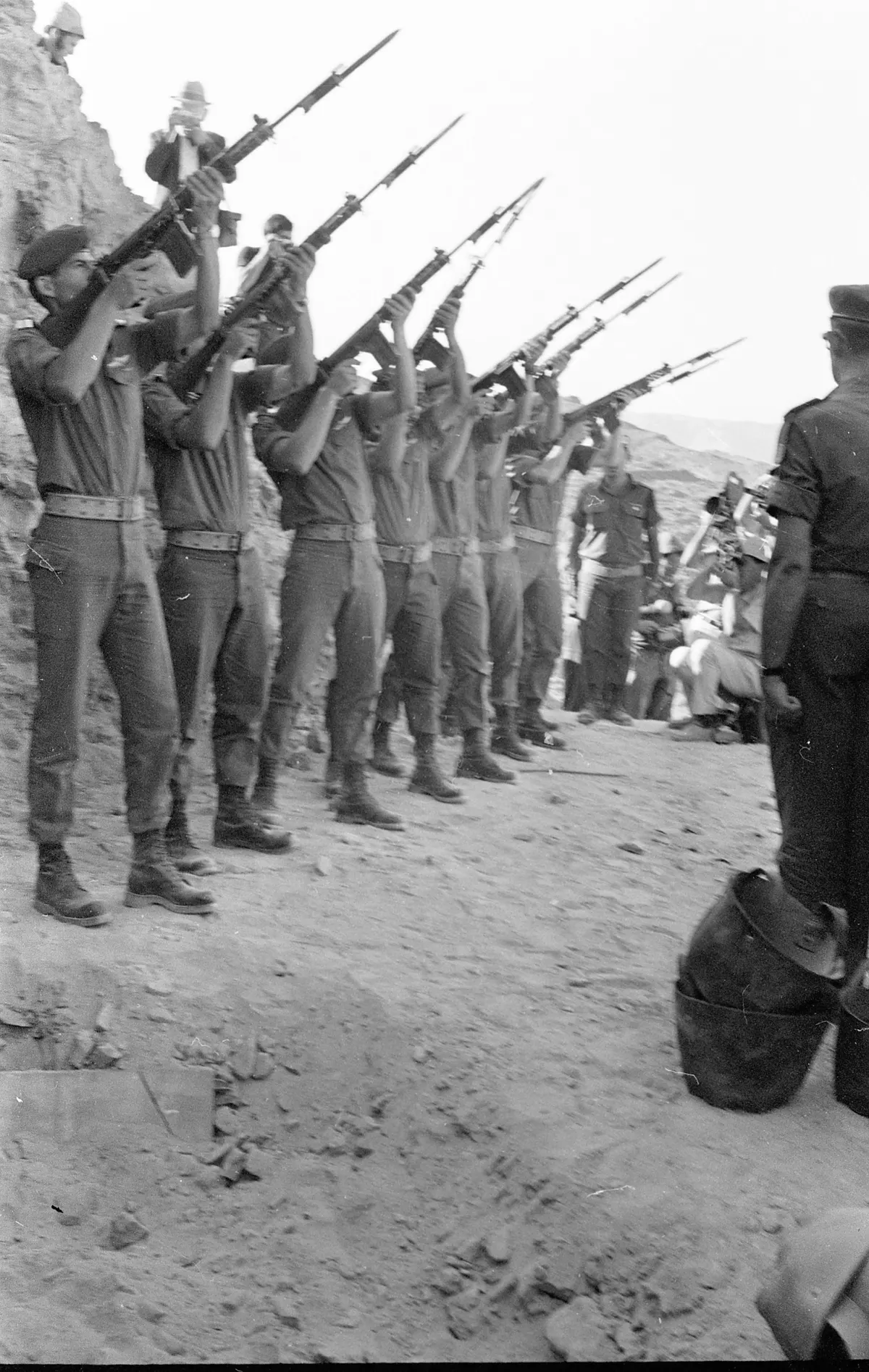
Visually, an Israeli-built FAL is easiest to spot by its handguard, a perforated sheet-metal forward section unlike the wood or plastic handguards used by most other FAL licensees.1 Standard light-barrel rifles left the factory selective-fire, but Israel fitted selector-blocking pins that restricted ordinary infantry rifles to semi-automatic fire only, a deliberate ammunition-conservation measure.2 Those pins were removed during the War of Attrition and the Yom Kippur War, when sustained suppressive fire became worth the ammunition cost again.2
The Romat's own weakness in Israel's desert terrain would go on to shape the country's next rifle, the Galil, making the Romat's service record as important for what it caused as for what it did.
Mechanically the Romat is a standard FN FAL, gas-operated with a tilting breechblock and chambered for 7.62x51mm NATO.2 Unloaded weight for the light-barrel rifle runs around 4.3 kg (9.5 lb), with an overall length near 1,090 mm and a barrel around 533 mm (21 in), figures shared across the wider FN FAL family since the Israeli light-barrel version keeps early-generation FN internals rather than a redesigned action.4,5 Feed is by a detachable magazine, standard 20 rounds, and cyclic rate is usually quoted between 600 and 700 rounds per minute, with a Hebrew-language source giving 605 rpm specifically for the Israeli rifle against the wider FAL baseline of 650 to 700.2,5
- First Production Year1955
- Service Entry Year1955
- DesignerDieudonne Saive and Ernest Vervier (FN Herstal, original Belgian FAL design); Israeli production licensed to Israel Military Industries (IMI)
- Weight (Empty)4.3 kg
- Currently In ServiceNo
- Notable UsersIsrael Defense Forces (1955-1972/1974/75), standard-issue infantry rifle during the Suez Crisis, Six-Day War, War of Attrition, and Yom Kippur War
The select-fire capability was present in the base design from the start, since FN's FAL was built as a selective-fire rifle from the outset, but Israel chose to physically block it on standard-issue Romats. Rather than accept the weight and complexity of a true squad automatic weapon, the IDF simply constrained its standard rifle's fire control and relied on a separate heavy-barrel variant, described below, for automatic fire at the squad level.
- Cartridge7.62x51mm NATO
- Calibre7.62 mm
- Case Length51 mm
- Calibre ClassFull-power rifle cartridge
- RimfireNo
- Caseless AmmunitionNo
Furniture differs by configuration. The light-barrel service rifle uses the distinctive perforated-metal handguard noted above, while the heavy-barrel Makleon uses wood furniture with a heat shield around the barrel, a more traditional light-machine-gun-style build.1 Receivers are steel on both.
- Action TypeGas-Operated
- Fire ModesSemi-automatic and full-automatic (selector-blocked to semi-auto only on early light-barrel Romats, restored during War of Attrition and Yom Kippur War)
- Select FireYes
- Feed SystemDetachable Magazine
- Magazine Capacity20
- Cyclic Rate of Fire650
- Muzzle Velocity840 m/s
- Effective Range (point)600 m
- Sighting Range600 m
- Barrel Length533 mm
- Optic RailNo
- Iron SightsYes
- Overall Length1,090 mm
- Receiver Materialsteel
- Furniture MaterialPerforated sheet-metal handguard (light-barrel Romat); wood furniture with heat shield (Makleon/FALO heavy-barrel variant)
- Folding / Collapsing StockNo
- Bullpup LayoutNo
- Production Start1955
- Production End1974
- Variants2
Israel's adoption of the FN FAL in 1955 fit a broader push to standardize infantry small arms in the young state's army, alongside the domestically produced Uzi.1,3 The earliest Romats fielded that year were complete Belgian-made imports from FN Herstal rather than Israeli-manufactured rifles.1 One Hebrew-language source places the start of true IMI domestic license production considerably later, around 1966, a figure not independently corroborated elsewhere and treated here as a single-sourced but plausible detail rather than a settled fact.2
The Romat's first combat use came in the 1956 Suez Crisis (Operation Kadesh), still in relatively small numbers given how recently it had been adopted.1,2 The IDF's Paratroopers Brigade carried out its era's sole operational combat parachute drop near the eastern approaches to the Mitla Pass during that campaign, followed by a 300 km overland link-up, 200 km of it through enemy-held territory, completed in a 28-hour push.7 By the 1967 Six-Day War the Romat was the IDF's standard-issue infantry rifle, carried by paratrooper reservists who took part in the capture of East Jerusalem on 7 June 1967 as Israeli forces swept across the West Bank to the Jordan River.7,1
It was the Six-Day War that produced the Romat's most consequential legacy. Israeli forces captured large numbers of Egyptian AK-47s during the fighting and found them noticeably more reliable in sand and dust than their own FALs, a direct result of the FAL's tight manufacturing tolerances, which gave excellent accuracy but left little margin for grit in the action.6,8 The problem was made worse by how the rifles were carried. Israeli infantry rode largely in open-topped half-tracks, constantly exposed to wind-blown sand, and the fast pace of mobile desert operations often left little time to clean weapons between contacts.1
That captured-rifle experience directly triggered a formal IDF program for a new service rifle combining AK-pattern reliability with FAL or M16-level accuracy.6 Designer Yisrael Galili, working with co-designer Yakov Lior, based the resulting rifle's action on the Finnish Valmet Rk. 62, itself an AK-47 derivative, engineered specifically for desert reliability.6 Trials through the late 1960s and early 1970s tested the Galili and Lior prototype against the AK-47 itself, the Stoner 63, the M16, the HK33, the AR-18, the Steyr AUG, the AR-70, and an experimental 5.56mm design called the GAL, and the Galili and Lior design won.6 Both designers received the Israel Defense Prize in 1973, the same year the outgoing Romat was still fighting its last major war.6
The Romat's phase-out afterward is genuinely contested in the sourcing rather than a single clean date. English-language sources place the start of replacement in 1972, with the Galil formally taking over in 1974, while Hebrew-language sources describe all FAL rifles leaving IDF service only in 1975, alongside a broader shift to the Galil's 5.56mm and short 7.62mm ammunition families.1,2 Read together, the Romat's first-line IDF career ran roughly 17 to 20 years, a long service life for a Cold War battle rifle, with 1972 to 1975 standing as a genuine range rather than one settled year.

The Romat's combat record runs through four of Israel's defining wars of the era. In the Suez Crisis of 1956 it equipped a still-small pool of IDF infantry during Operation Kadesh.1 By the Six-Day War of 1967 it was the standard rifle of an army fighting on three fronts at once, including the capture of East Jerusalem and the advance to the Jordan River.7,1
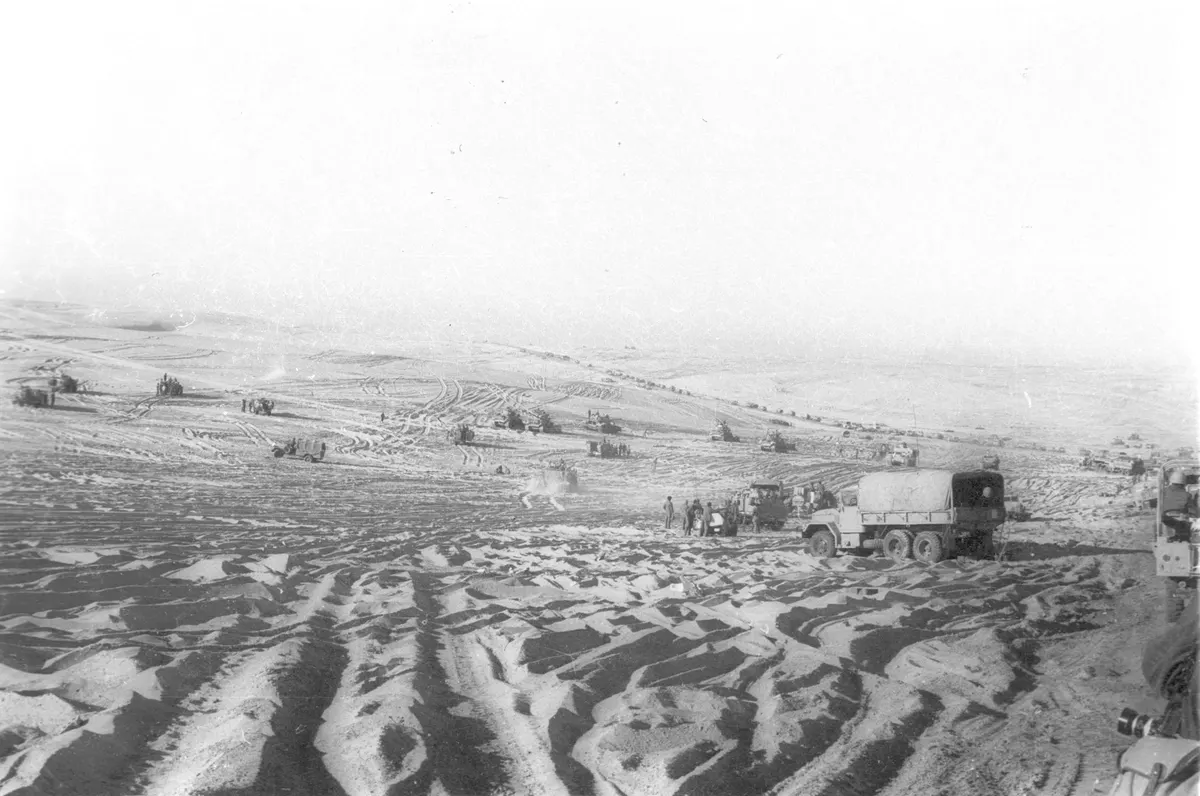
During the War of Attrition (1967 to 1970) the rifle saw continued use in cross-border raids and ambush operations, including actions in the Jordan Valley against Jordanian and Palestinian fedayeen infiltration.2 By the Yom Kippur War of October 1973, the Romat was still in front-line service across the Sinai and Golan fronts even as its replacement was already being finalized, a rifle fighting its last major war just as the weapon that would retire it was being formally honored.1,6
No credible evidence surfaced of Romat or Makleon combat use by any force beyond Israel's own. This is an absence of evidence rather than a documented negative, since export or third-party use, if it happened, may simply be unrecorded in the sources checked, but nothing found across Wikipedia, collector databases, or specialist firearms sites points to Romat use outside the IDF.
Israel's heavy-barrel automatic-fire variant, nicknamed the Makleon (מקלעון, roughly little machine gun) and known in English-language sources as the FALO, was intended as a section-level replacement for the BAR.3 It kept the FAL's 20-round box magazines rather than a belt feed, added a heavier bull barrel for sustained fire, a perforated metal heat shield, and a folding bipod attached directly to the barrel.1,3
The concept did not work especially well. Without a quick-change barrel or a genuine high-capacity feed system, reviewers and historians describe the Makleon as falling short of a proper squad automatic weapon, closer to a rifle with a heavier barrel than to a true light machine gun.3 Thirty-round magazines were tried and reportedly caused feeding problems, so most Makleons stayed with the standard 20-rounder, further limiting sustained fire.3 One specialist source bluntly concludes the concept died an early death and never gained much popularity as a squad-support weapon.3

The Romat and its Makleon variant were built for a single customer, the Israel Defense Forces, from 1955 through the mid-1970s phase-out described above.1,2 No other nation is documented to have received or used either configuration. This stands in contrast to Israel's other major small-arms export of the same period, the Uzi, which reached dozens of armies worldwide, and to the Galil that eventually replaced the Romat, which was later adopted or licensed by South Africa (as the basis for the Vektor R4) and evaluated elsewhere.6 The likeliest explanation is simply that Israel came to the FAL as one licensee among many, alongside Britain, Canada, Australia, South Africa, and Brazil, so there was little external demand for an Israeli-specific sub-variant of a rifle already available from its Belgian source or other licensees.
The clearest comparison for the Romat is its own replacement, the Galil, since the two are connected by a single documented failure mode rather than a typical rivalry. The Galil exists specifically because the Romat jammed in sand and the AK-47 did not, so their relationship is less a spec contest than a cause and effect. Where the Romat kept the FAL's tight-tolerance, high-accuracy gas action, the Galil borrowed the AK's looser-tolerance rotating bolt (via the Valmet Rk. 62) precisely to trade a little accuracy for reliability in exactly the terrain where the Romat had struggled.
Among fellow FAL licensees, the closest parallels are the FN FAL G1, West Germany's brief FAL license before it switched to the G3, and the Austrian Steyr StG 58, both of which, like the Romat, adapted the Belgian design's furniture and fire control to local requirements rather than building an unmodified copy. The Dutch Licht Automatisch Geweer and the Commonwealth L1A1 followed the same licensing pattern with their own local changes, the L1A1 most notably locking out full-automatic fire entirely rather than blocking it with a removable pin as Israel did.


What does Romat mean? Sources disagree. English-language references gloss it as an acronym meaning self-loading rifle, while Hebrew-language sources parse the same letters as closer to magazine-fed rifle. Both describe the same self-loading, magazine-fed weapon, and neither reading is asserted as the sole correct one.1,2
Is the FN FAL Romat still in service? No. It was phased out of IDF front-line service between roughly 1972 and 1975, replaced by the Galil and, in some units, the M16, though sources vary on the exact final year.1,2
How does the Romat differ from a standard FN FAL? The most visible difference is the perforated sheet-metal handguard. Mechanically it is the same gas-operated, tilting-breechblock action, but Israel physically blocked full-automatic fire on its standard-issue rifles with selector pins, later removed during wartime.1,2
Was the FN FAL Romat exported? No confirmed export or foreign use has been found in the available sourcing. It appears to have been built strictly for Israel's own army.
What replaced the Romat? The Galil, developed specifically in response to the Romat's desert reliability problems after Israel captured and evaluated Egyptian AK-47s in the 1967 Six-Day War.6
- "FN FAL", Wikipedia — en.wikipedia.org ↩
- "רובה FN FAL", Hebrew Wikipedia — he.wikipedia.org ↩
- "The Israeli FN FALO", The Hebrew Hammer — thehebrewhammer.net ↩
- "Israeli Light-Barrel FAL (from DS Arms)", Forgotten Weapons — forgottenweapons.com ↩
- "FN FAL", War History Online — warhistoryonline.com ↩
- "Yisrael Galili (inventor)", Wikipedia — en.wikipedia.org) ↩
- "Paratroopers Brigade (IDF)", Wikipedia — en.wikipedia.org) ↩
- "The Galil, A Review of an Israeli Icon", The Mag Life — gunmagwarehouse.com ↩
- "Heavy Barrel Israeli SBL Industries SA FAL Rifle with Bipod", Rock Island Auction — rockislandauction.com ↩