

About 8,300 to 8,350 of the roughly 1.38 million M14 rifles built for the US military were pulled back through Springfield Armory between 1963 and 1966 and rebuilt with a pistol-gripped stock, a bipod, and a folding buttplate.1,6 The reworked rifle entered field trials in 1963 as the M14E2, and after three years of testing it was formally standardized in 1966 as the US Rifle, 7.62mm, M14A1 (Alteration 1). Collectors still use M14E2 and M14A1 interchangeably, with E2 stock the common shorthand for the furniture package itself.1,8
- Same 7.62mm NATO firepower and range as the base rifle
- Bipod and pistol grip improve control on burst fire
- Shared parts and ammunition with the standard M14
- Overheats fast in sustained automatic fire
- 20-round magazine, not a belt, limits volume of fire
- Heavier and more awkward than the BAR it replaced
The whole point of the conversion was to give infantry squads a real automatic-rifle capability equivalent to the M1918 Browning Automatic Rifle that the Army had just retired.7 The BAR had been a dedicated squad support weapon, and pairing it with the semi-automatic M14 meant one design covering two very different jobs. The M14A1 tried to close that gap using the existing M14 receiver, gas-operated action, and 20-round detachable magazine, rather than fielding an entirely new weapon.6
Nothing about the barrel, cartridge, or select-fire mechanism changed from the standard M14. What changed was the furniture wrapped around it, built to let a rifleman hold the line during full-automatic fire instead of watching the muzzle climb toward the sky.2 That distinction, same gun mechanically, different equipment package for a different job, is the whole story of the M14A1.
The E2 Stock Package
The conversion added an in-line, full pistol-gripped stock in place of the M14's semi-pistol stock, changing the recoil line to keep the muzzle from rising as sharply under automatic fire.7 A folding vertical forward grip was mounted under the handguard for the support hand, and the upper handguard was switched to a synthetic material, chosen partly to save weight and partly to resist the swelling that plagued wood furniture in humid conditions.7,11
- Weight (Loaded)6.58 kg
A hinged steel buttplate with a rubber recoil pad cushioned the shoulder through sustained bursts, and a muzzle stabilizer, essentially a muzzle brake, clamped onto the existing flash suppressor to fight climb further.7 An M2-type adjustable bipod attached near the gas cylinder, and the older BAR-pattern sling carried over for continuity with the weapon it replaced.7 A winter-trigger option, a larger trigger guard sized for a gloved finger, was also available on both the standard M14 and the M14A1.7
- Cartridge7.62x51mm NATO
- Calibre7.62 mm
- Case Length51 mm
Same Action, More Weight

Because every mechanical change sat in the stock and muzzle hardware, the ballistics were identical to the base M14. Both fired 7.62x51mm NATO from a 22-inch (55.9cm) barrel at roughly 2,800 ft/s (853 m/s), fed from the same 20-round detachable magazine, and cycled at about 700 to 750 rounds per minute on full automatic.12,13 Effective range is given differently across sources, around 460m (500 yards) per GlobalSecurity and VietnamGear, versus roughly 550m per FAS.org, and this research pass could not resolve which is more authoritative.12,13,3
- Action TypeGas-Operated
- Fire Modesselective_fire
- Select FireYes
- Feed SystemDetachable Magazine
- Magazine Capacity20
- Cyclic Rate of Fire700
Weight is where the two configurations pull apart. A standard M14 weighed roughly 8.7 to 9.2 lb (3.9 to 4.2 kg) empty and about 10.1 to 11.0 lb (4.6 to 5.0 kg) loaded.12 The M14A1, per the Army's own May 1965 field manual, weighed 14.5 lb loaded, nearly 4 lb heavier for exactly the same firepower.6 That added weight came from the bipod, the reinforced stock, and the muzzle stabilizer, none of it from a mechanism better suited to sustained fire.
- Muzzle Velocity853 m/s
- Effective Range (point)460 m
- Barrel Length558.8 mm
- Iron SightsYes
- Threaded BarrelYes
- Receiver Materialsteel
- Total Production8,350
The M15 That Came First
The M14A1 was not the Army's first attempt to solve this problem. When the M14 was adopted in 1957 as a joint replacement for the M1 Garand rifle and the M1918 Browning Automatic Rifle, a heavy-barreled variant of the same T44 design was adopted on paper that same year as the M15 (T44E5), with two pistol grips, a hinged buttplate, and a bipod, weighing around 13.5 to 14.1 lb against the BAR's 19 to 20.8 lb.4,2 Testing by the Marine Corps and the Infantry Board found a plain M14 with a bipod bolted on performed about as well as the dedicated M15, so the M15 was cancelled by 1959 without a single production rifle being issued. One reference specimen survives at the Springfield Armory National Historic Site.4
That conclusion turned out to be wrong once M14s actually reached line units, and by the early 1960s the Army was back where it started, needing a genuine squad automatic weapon built around the M14 action.4 The M14E2 program, and eventually the M14A1, was the second attempt to answer the question the M15 had failed to settle.
From Field Trials to Standardization
M14E2 rifles reached troops for evaluation in 1963 and were carried in doctrine under that name for years before the Army formally adopted the M14A1 designation in 1966.1,8 The Army's field manual, US Rifle 7.62mm M14 and M14E2, dated 7 May 1965, covered both rifles together rather than issuing the M14A1 its own manual, a sign the service treated it as a stock kit for an existing rifle rather than a distinct weapon system.6
M14A1s reached Vietnam in modest numbers starting in the mid-1960s, with only a few hundred of the roughly 8,300 converted rifles believed to have actually been issued in-country.6 Combat feedback was consistently poor.
One firearms publication summarized the verdict bluntly, describing the M14A1 as clearly inferior to the BAR and a genuine embarrassment that never delivered on the automatic-rifle mission it was built for.9 The rifle was still difficult to control on automatic fire, overheated quickly in sustained bursts, and its 20-round box magazine sharply limited how much suppressive fire a rifleman could deliver compared to a real automatic weapon.6,9
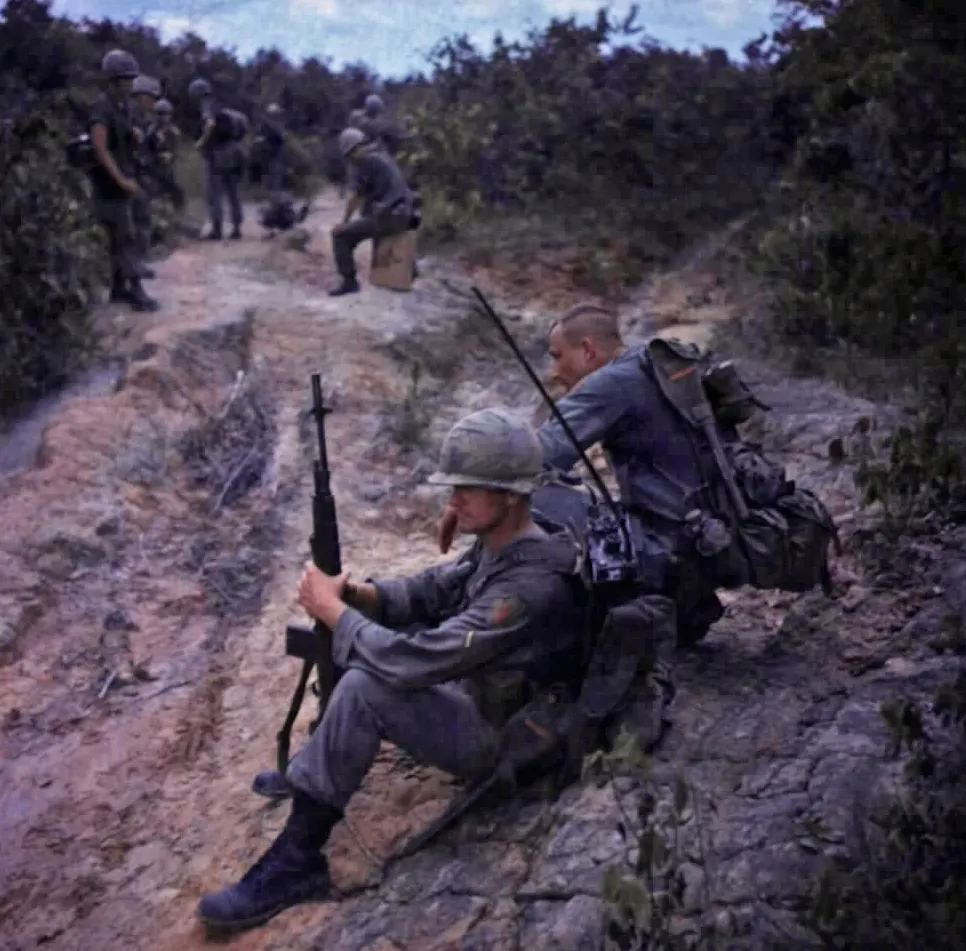
Some unit accounts place M14A1 use with US Army riflemen in the Ho Bo Woods area in early 1966, though this research pass could not independently verify the date and location against a primary source, so it should be read as plausible rather than settled. Better documented is the broader pattern, troops in Vietnam relied mainly on semi-automatic fire from M14-family rifles and reserved automatic bursts for moments demanding a sudden volume of fire, consistent with the M14A1 never sustaining true automatic-weapon fire.10
Humidity compounded the problem, since the walnut and birch E2 stocks swelled in jungle conditions the same way standard M14 wood furniture did.11 USMC Vietnam veteran Dale Dye, who served from 1965 to 1970 across 31 major combat operations, later recalled Marines carrying the base M14 with enthusiasm early in the war and quietly trying to hold on to their rifles once word came down that M16s were replacing them, a sign of how attached troops stayed to the standard rifle even as the M14A1 automatic-rifle variant was failing in its own separate role.11
The rifle was withdrawn from the automatic-rifle role quickly. The belt-fed M60 machine gun took over sustained and suppressive fire at the squad and platoon level, while the incoming M16 took over as the individual rifle, and the M14A1's specific mission disappeared within a few years of it reaching the field.6
By the time the last M14A1s left front-line inventories in the early 1970s, most riflemen in Vietnam were already carrying the M16 rather than any M14 variant.6
 M14A1
Collectors distinguish two generations of the E2 stock itself. Earlier stocks were walnut with no metal liner in the barrel channel. A later batch, made from birch with a steel liner in the forearm, is specifically what collectors call the M14A1 stock rather than the E2 stock, tied to a drawing dated April 1966, around when the M14A1 designation was formally adopted.8 These details come from collector and forum research rather than an official Army record, so treat the specific drawing dates as plausible rather than fully verified.8
Beyond the stock, the winter-trigger option (a larger trigger guard for gloved use) was offered on both the standard M14 and the M14A1, and no evidence surfaced of any other M14A1-specific configuration, unlike the base M14 which spawned sniper and match variants of its own.7

The M14A1 was a US-only program, converted from existing stock to fill a US Army and Marine Corps squad-automatic-weapon requirement, and no evidence surfaced of another country adopting the configuration, in contrast to the base M14, which was exported and licensed more broadly.6
The M14A1 also never reached the civilian market. Because the M14 platform is select-fire capable, federal transfer rules bar the Civilian Marksmanship Program from ever taking possession of M14 or M14A1 rifles.14 The CMP does loan semi-automatic National Match M14 rifles to junior marksmanship clubs, but that involves the civilian-legal National Match rifle, not the full-auto-capable M14A1.14
The M14A1 and the M1918 Browning Automatic Rifle were built to do the same job a generation apart, and the comparison is unflattering to the newer gun. The BAR fed from a 20-round magazine too, but its heavier barrel and dedicated automatic-weapon design tolerated sustained fire in a way the M14 action, built first as a semi-automatic rifle, never really could.2,7 Adding a bipod and pistol grip to the M14 changed how a rifleman held the gun, not how the mechanism handled heat and recoil over a long burst, which is why period assessments kept concluding that the M14A1 could not match the BAR it was meant to replace.9
| Spec | M14A1 | M60 |
|---|---|---|
| Cartridge | 7.62x51mm NATO | 7.62x51mm NATO |
| Feed | 20-round detachable box | Disintegrating-link belt |
| Weight, loaded | ~14.5 lb (6.6 kg) | ~23 lb (10.4 kg) |
| Cyclic rate | ~700-750 rpm | ~550-650 rpm |
The weapon that actually replaced the M14A1 in Vietnam was the M60 general-purpose machine gun, and the contrast explains why the M14A1 failed where the M60 succeeded.15 The M60 was heavier and belt-fed rather than magazine-fed, trading portability for a feed system built to sustain fire far longer, at a somewhat lower cyclic rate that made it more controllable over a long burst.15 Where the M14A1 tried to turn a rifle into a light machine gun through its furniture alone, the M60 was built from the ground up as a belt-fed gun, and it held the squad automatic role for decades after the M14A1 was quietly withdrawn.6,15


What is the M14A1 rifle? It is the automatic-rifle version of the M14, converted from standard M14 rifles starting in 1963 and standardized in 1966 with a pistol-gripped stock, bipod, and muzzle stabilizer intended for the squad automatic weapon role.1,6
How is the M14A1 different from the M14? The cartridge, barrel, muzzle velocity, and 20-round magazine are identical to the standard rifle. The M14A1 adds a pistol-gripped stock, folding forward grip, bipod, folding buttplate with a recoil pad, and a muzzle stabilizer, at a loaded weight of about 14.5 lb versus roughly 10 to 11 lb for the standard rifle.12,6
Why did the M14A1 fail in Vietnam? Its magazine-fed action still overheated in sustained automatic fire and could not deliver the volume of fire of a real automatic weapon, leading sources to describe it as inferior to the BAR it was meant to replace and quickly withdrawn in favor of the M60 machine gun and M16 rifle.9,6
Is the M14A1 still in service? No. It was withdrawn from active US service by the early 1970s as the M60 and M16 took over its role, and because it is select-fire capable it was never released to the civilian market by the Civilian Marksmanship Program.6,14
How many M14A1 rifles were made? Roughly 8,300 to 8,350 standard M14s were converted to M14A1 configuration, a small share of the 1.38 million M14 rifles built in total, and it was a conversion program rather than a separate production line.6,5
- "M14 rifle", Wikipedia — en.wikipedia.org ↩
- "Why the M14 Remains America's Most Controversial Military Rifle", The National Interest — nationalinterest.org ↩
- "M14 Rifle", VietnamGear.com — vietnamgear.com ↩
- "M15 Automatic Rifle (aka T44E5), Adopted But Not Produced", Forgotten Weapons — forgottenweapons.com ↩
- "Why Isn't there an M15?", GAT Daily — gatdaily.com ↩
- "Did the M14 Fail the BAR?", The Armory Life — thearmorylife.com ↩
- "M14/M14A1 Rifle", ArmyRanger.com — armyranger.com ↩
- "Difference between M14A1 and M14E2", M14 Battle Rifle Forum — m14br.com ↩
- "M14 vs M16 in Vietnam", Small Arms Review — smallarmsreview.com ↩
- "M14E2 SOG", Military Conflict, Vietnam Wiki — wiki.militaryconflictvietnam.com ↩
- "The M14 In Country", The Armory Life — thearmorylife.com ↩
- "M14 7.62mm Rifle, Specifications", GlobalSecurity.org — globalsecurity.org ↩
- "M14 7.62mm Rifle", FAS.org — man.fas.org ↩
- "CMP Sales", Civilian Marksmanship Program — thecmp.org ↩
- "M60 7.62mm Machine Gun, Specifications", GlobalSecurity.org — globalsecurity.org ↩