

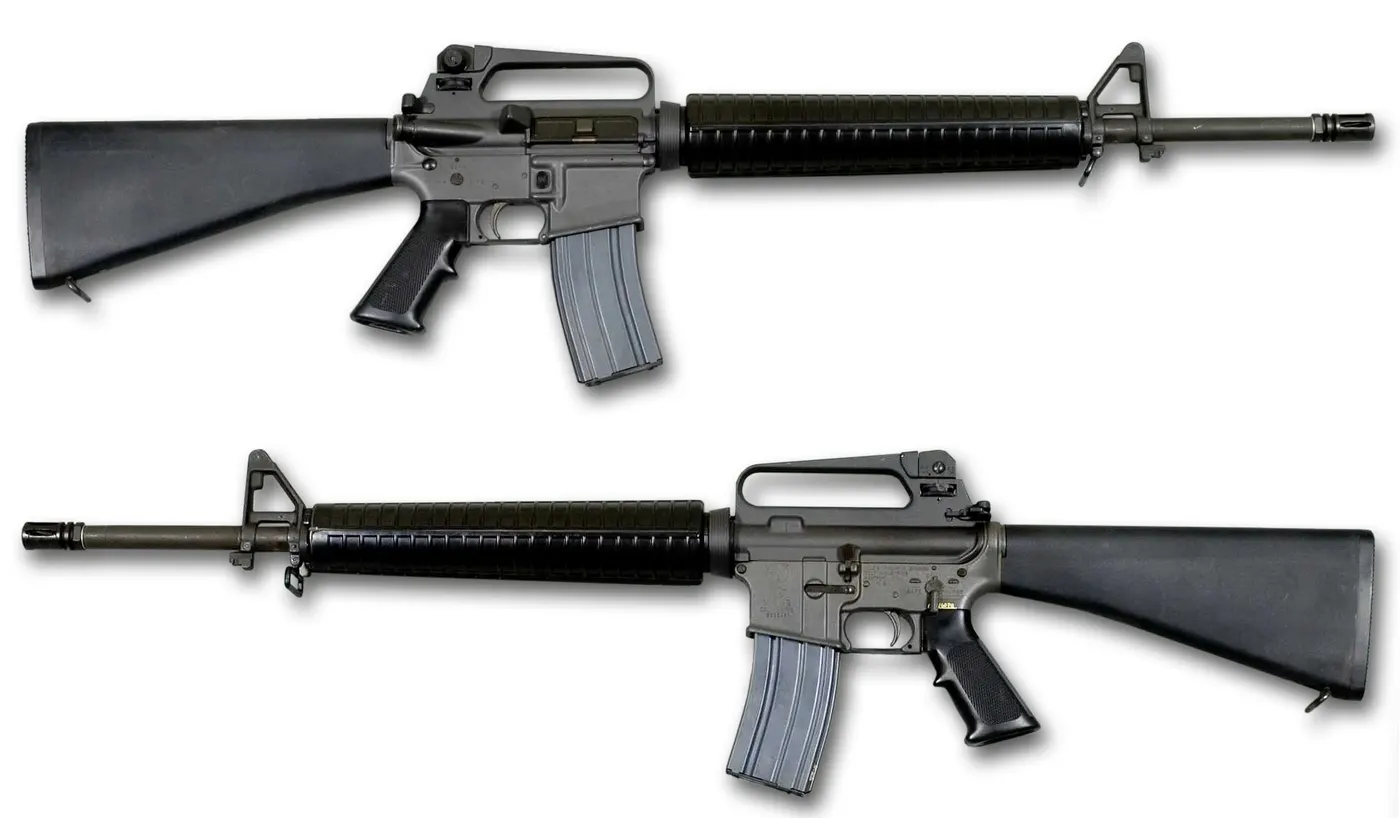

The M16 rifle entered United States military service in the early 1960s as the standardized version of Eugene Stoner's AR-15 design, and it became the rifle most closely associated with the American war in Vietnam. This article covers the original M16 and its early Army twin, the XM16E1, the rifles issued from 1963 through the late 1960s before the improved M16A1 took over as the standard-issue version in 1967. Chambered for the 5.56×45mm NATO intermediate cartridge, the original M16 weighed only 2.9 kg empty, a dramatic drop from the M14 rifle it was meant to replace, and it fed from a detachable magazine holding 30 rounds.
- far lighter than the M14 it replaced
- high ammunition capacity per soldier for the same carried weight
- controllable in automatic fire due to low recoil
- accurate at typical infantry engagement ranges
- catastrophic reliability collapse in 1966 to 1967 combat use
- no chrome-lined bore or chamber on early production
- issued without cleaning kits during its worst period
- three-pronged flash suppressor snagged on vegetation
{{photo-req side=right q="M16 rifle Vietnam War soldier 1966" caption="A US infantryman with an M16 rifle in South Vietnam during the mid-1960s" alt="US soldier holding an M16 rifle in the field in Vietnam"}}
The M16's early history is really two stories layered on top of each other. The rifle itself was a genuinely capable, lightweight weapon that soldiers who received clean stick-powder ammunition rated highly. At the same time, the rifle reached combat troops in Vietnam faster than the supply chain, training pipeline, and ammunition specification could keep pace with it, and the resulting failures cost lives and produced a congressional investigation. The M16 is one of the few small arms whose problems were serious enough to generate a US House of Representatives subcommittee report, the 1967 Ichord Report, named for its chairman Richard Ichord.
The M16 was built by Colt's Manufacturing Company, which had purchased the manufacturing rights to Stoner's design from ArmaLite in 1959, after ArmaLite's parent company, the Fairchild Engine and Airplane Corporation, found it could not scale production on its own.1 The rifle's designation reflects a Department of Defense naming convention rather than a designer's personal branding, and the M16 number places it in a sequence of Army small-arms designations that had reached the M14 rifle only a few years earlier.
The US military did not yet use the term assault rifles in the early 1960s, and the category the M16 belongs to met every real technical marker of that later label anyway, a select-fire weapon firing an intermediate cartridge from a detachable box magazine, built for individual infantry use rather than as a squad support weapon. Many people searching for M16 specifications or M16 rifle caliber are really asking about this original Vietnam-era rifle and its direct successor, and the two are frequently confused in casual references because the visual silhouette barely changed across the upgrade.
The original M16 used Stoner's direct impingement operating system, a gas-operated mechanism that routes propellant gas through a thin tube straight back into the bolt carrier rather than driving a separate piston, as most rival rifles of the era did. This kept the rifle lighter and simpler mechanically, but it also meant that combustion residue was blown directly into the action with every shot, a detail that mattered enormously once the ammunition specification changed in 1964 (see History).
- First Production Year1963
- Service Entry Year1964
- DesignerEugene Stoner (AR-10) ; L. James Sullivan (AR-15)
- Weight (Empty)2.9 kg
- Weight (Loaded)3.6 kg
- Currently In ServiceYes
- Notable UsersUnited States Armed Forces; Taliban; Canadian Forces; Israel Defense Forces; Philippine marines; South Korean soldiers; Vietnamese Rangers; Afghan National Army; Colombian military; Brazilian Marine Corps; Royal Brunei Armed Forces; Malaysian Army; Indonesian Military Academy Cadets; Palestinian Security Forces; Azerbaijani special forces
Stoner built the upper and lower receivers from aluminum alloy rather than the milled or stamped steel common on contemporaries like the AK-47, cutting weight substantially. The stock, handguard, and pistol grip were plastic, another first for a standard-issue US service rifle, chosen for cost and weight over the wood furniture still standard on the M14. Sighting used simple iron sights, a rear aperture and a front post, mounted on a fixed carrying handle. The original rifle had no optic rail at all, unlike the Picatinny rail-equipped M16 variants that followed decades later.
- Cartridge5.56×45mm NATO
- Calibre5.56 mm
- Case Length45 mm
- Calibre Classintermediate
- Bullet Weight4 g
- RimfireNo
- Caseless AmmunitionNo
The M16 was select-fire, offering safe, semi-automatic, and fully automatic settings through a single rotating selector lever, a layout borrowed almost unchanged from the AR-15 commercial pattern. Cyclic rate of fire was specified around 700 to 800 rounds per minute in Colt's original documentation, though the switch to a different powder type in 1964 measurably raised the real-world cyclic rate and became one of the root causes of the reliability crisis described below. Muzzle velocity for the 5.56mm round was rated near 960 m/s, giving an effective point-target range of roughly 550 meters, well short of the M14's 7.62mm reach but adequate for the close jungle and urban engagements that dominated Vietnam. The rifle was suppressor-ready with a threaded barrel, carried a bayonet lug, and could mount an underbarrel launcher, making it grenade-launch capable once the M203 arrived later in the decade.
- Action TypeGas-Operated
- Fire Modessafe, semi-automatic, automatic
- Select FireYes
- Feed SystemDetachable Magazine
- Magazine Capacity30
- Cyclic Rate of Fire700
- Practical Rate of Fire15
- Trigger Typeselector lever
- Safety Typeselector lever
A distinguishing external feature of the earliest rifles was the three-pronged flash suppressor, an open duckbill-style design that vented muzzle flash effectively but caught on vines, branches, and equipment straps in the field, a complaint repeated often enough in soldier surveys that it was one of the visible fixes made on the M16A1.3
- Muzzle Velocity960 m/s
- Muzzle Energy1,780
- Effective Range (point)550 m
- Effective Range (area)800 m
- Maximum Range3,600 m
- Sighting Range800 m
- Penetration300 mm
- Accuracy4
{{photo-req side=left q="M16 rifle three prong flash suppressor closeup" caption="The distinctive three-pronged flash suppressor fitted to early M16 and XM16E1 rifles" alt="Close-up of an M16 rifle muzzle with a three-pronged flash suppressor"}}
- Barrel Length508 mm
- Rifling Twist1:12
- Rifling Grooves6
- Sight TypeIron sights: ; Rear: aperture; L-type flip ; Front: wing-protected post ; Various aiming optics
- Sight Radius660 mm
- Optic RailNo
- Iron SightsYes
- Threaded BarrelYes
Dimensionally the original M16 was compact for a full-length service rifle, with a 508 mm (20 inch) barrel and an overall width of only about 50 mm across the receiver, figures that made it far easier for smaller-statured soldiers, a real consideration in an ARVN allied force, to carry and shoulder than the older M14. Rated accuracy came in around 4 MOA, adequate for the point and area engagement ranges of jungle and close urban combat rather than long-range marksmanship work.
- Receiver Materialaluminum alloy
- Furniture Materialplastic; metal
- Folding / Collapsing StockNo
- Bullpup LayoutNo
- Ambidextrous ControlsNo
- Modularityupper receiver, lower receiver, barrel, handguard, stock, pistol grip, fire control group
The rifle's modularity was limited by later standards, essentially an upper receiver, lower receiver, barrel, handguard, stock, pistol grip, and fire control group with no tool-free accessory attachment, a stark contrast with the rail-covered M16 and M4 descendants that followed decades later.
- Total Production8,000,000
- Production Start1963
- Variants15
- Width50 mm
- Height200 mm
Eugene Stoner developed the AR-15 at ArmaLite, then a small arms division of the Fairchild Engine and Airplane Corporation, by scaling down his earlier 7.62mm AR-10 battle rifle design to the smaller, lighter 5.56mm cartridge between 1957 and 1959.4 ArmaLite could not fund production at military scale, and in 1959 it sold the AR-15 and AR-10 manufacturing rights to Colt's Manufacturing Company, whose sales team then pitched the rifle directly to service leadership.
{{photo-req side=right q="Eugene Stoner AR-15 designer portrait" caption="Eugene Stoner, the ArmaLite engineer who designed the AR-15 that became the M16" alt="Portrait photograph of firearms designer Eugene Stoner"}}
The rifle's path into military service ran through an unlikely venue. According to Colt's own company history, salesman William Mullen brought a demonstration AR-15 to a July 1960 barbecue attended by General Curtis LeMay, then Vice Chief of Staff of the Air Force, who was impressed enough by the weapon that the Air Force began adopting it soon after.5 The US Air Force designated the rifle the M16 upon its 1962 adoption, initially for base security and Strategic Air Command use rather than front-line infantry combat. Around the same period, roughly 1,000 AR-15 rifles reached the Army of the Republic of Vietnam for combat trials, an early and largely favorable field test that helped build the case for wider adoption.6
The US Army adopted its own version in 1964 under the designation XM16E1, mechanically the same rifle as the Air Force's M16 but with an added forward assist device, a plunger allowing a soldier to manually seat a stuck bolt, a feature the Air Force considered unnecessary and the Army insisted on.7 In November 1963, Colt received a $13.5 million production contract covering 104,000 rifles, a Time magazine profile of Colt's new rifle business coincidentally ran the same week as President Kennedy's assassination, giving the story a strange historical footnote.8
The rifle's combat debut at the Battle of Ia Drang Valley in November 1965 went well. Lieutenant Colonel Hal Moore's 1st Battalion, 7th Cavalry held its position against a much larger North Vietnamese force, and Moore later credited the XM16E1's light weight and volume of fire as a real factor in the unit's survival.9 Early ammunition used the stick powder specified in Stoner's original design, produced by Remington, and reliability at this stage was good.
{{photo-req side=left q="Ia Drang valley Vietnam battlefield 1965" caption="Landing zone terrain in the Ia Drang Valley, site of the M16 rifle's first major combat test in November 1965" alt="Vietnam War era landscape photograph of the Ia Drang Valley region"}}
That reliability record collapsed within a year. The Army switched to a different, cheaper ball powder for mass production of 5.56mm ammunition, a change that raised the rifle's real cyclic rate, burned dirtier than the original stick powder, and fouled the direct-impingement gas system far faster than intended.10 By October 1966, unit commanders in Vietnam were formally reporting that malfunctions had degraded confidence in the weapon, and the failures kept mounting through 1967, when a survey of 1,585 soldiers found that roughly 80 percent had experienced a stoppage with their M16 in combat.11 The XM16E1 had also reached the field without cleaning rods or cleaning kits, on the mistaken assumption (encouraged by some early marketing) that the rifle was self-cleaning, a claim that earned it the bitter nickname Jamming Jenny among troops.12
The political fallout produced the Special Subcommittee on the M-16 Rifle Program, chaired by Missouri Congressman Richard Ichord, which held hearings across the summer of 1967 and issued its final report that October. The subcommittee concluded the ball propellant had an adverse effect on the rifle's operation and that the weapon needed a manufacturing and design overhaul, while also finding that inadequate maintenance and a chronic shortage of cleaning kits had compounded the problem.14 The Army's technical response, ordered by General William Westmoreland, included a six-week field assistance program and, more permanently, a chrome-lined chamber and bore, a redesigned closed flash suppressor to replace the snag-prone three-pronged type, and standard-issue cleaning kits. Combined with the forward assist already present on Army rifles, these changes were folded into the M16A1, formally standardized in February 1967 and fully replacing the M16 and XM16E1 in Army and Marine Corps hands by around 1970.15
The M16 and XM16E1's defining conflict was the Vietnam War, where American, South Vietnamese, and allied forces used the rifle through both its best and worst periods. Beyond the 1st Cavalry Division's early trials, US Marine Corps units fighting the Hill Fights near Khe Sanh in 1967 suffered some of the worst-documented jamming incidents of the war, with multiple after-action accounts describing Marines killed while trying to clear stuck rounds from their rifles under fire.19 These accounts fed directly into the political pressure that produced the Ichord hearings.
{{photo-req side=right q="Vietnam War map Indochina military regions" caption="A map of South Vietnam and the wider Indochina theater where the M16 and XM16E1 saw their first combat use" alt="Map of Vietnam War military regions in Southeast Asia"}}
Allocation of the rifle to allied forces lagged behind US units for a period. In December 1966 the Secretary of Defense deferred planned M16 shipments to South Vietnamese and South Korean units so that all available production could re-equip American troops first, and it was only in March 1967 that this policy reversed, with the first M16 shipments reaching the Army of the Republic of Vietnam the following month.20
{{photo-req side=left q="ARVN soldier M16 rifle Vietnam War" caption="A South Vietnamese soldier armed with an M16-pattern rifle during the Vietnam War" alt="South Vietnamese ARVN soldier carrying an M16 rifle"}}
South Korea's roughly 300,000 rotating troops in Vietnam, including the 9th White Horse Infantry Division and the 2nd Blue Dragon Marine Brigade, were also equipped with the rifle from 1966 to 1967 onward, once the same allocation policy reversed in their favor.21
{{photo-req side=right q="South Korean White Horse Division Vietnam War soldiers" caption="South Korean troops of the White Horse Division on operations in Vietnam" alt="South Korean soldiers in the Vietnam War"}}
By the time later conflicts such as the Gulf War and the Iraq War were fought, the US military had long since transitioned to the M16A1, M16A2, and eventually the shorter M4 carbine, so combat use of the specific original M16/XM16E1 configuration is essentially confined to the Vietnam-era window of roughly 1964 to 1970. Surplus and derivative-pattern rifles from the same production era did continue to surface in later conflicts and insurgencies across the developing world for decades, but by then they were mechanically closer to later-model AR-pattern rifles than to the specific configuration covered here.
By 1968 and 1969, as chrome-lined M16A1 pattern rifles reached full-scale distribution, isolating combat data for the specific un-upgraded XM16E1 configuration becomes harder in after-action archives, since field reports and even official records frequently used the single label M16 to describe the entire evolving rifle family. That blending of records is itself part of why the original rifle's own contribution to the Vietnam War narrative gets flattened into the wider M16 story rather than treated on its own terms.
The original M16/XM16E1 sits at the root of what became an enormous rifle family, and this article intentionally does not retell that whole story since the M16A1 and M16A2 entries cover it in depth. A handful of variants belong specifically to the original rifle's own generation rather than to its later descendants.
The M231 Firing Port Weapon adapted the basic M16 mechanism for firing from the ports of a Bradley Fighting Vehicle, deleting the shoulder stock and standard sights in favor of a fixed high cyclic rate intended purely for suppressive fire from inside the vehicle, a specialized niche application that shows how far the base action could be adapted from its original infantry role.
Colt also produced shortened CAR-15 carbine variants alongside the standard-length rifle during the same period, intended for special operations and vehicle crews who needed a more compact weapon, though these stayed outside the formal M16/XM16E1 designation and are more properly treated as a separate commercial family.


The United States Armed Forces were the M16 and XM16E1's first and largest operator, adopting the rifle in 1964 and issuing it broadly to Army and Marine Corps units through the rest of the decade before the M16A1 replaced it in front-line service.15 South Korea received the rifle from 1966 to 1967 for its Vietnam-deployed divisions, later manufacturing derivative rifles domestically. Australia issued the M16 in limited numbers to special forces units operating in Vietnam alongside American troops, while continuing to field the self-loading rifle as its own standard infantry weapon.
South Vietnam's own forces, the Army of the Republic of Vietnam, received an initial trial batch as early as 1962 and larger deliveries from 1967 once the earlier allocation freeze lifted, making them one of the rifle's most significant non-American users during the war itself.6,20
The M16's most direct rival through the Vietnam years was the Soviet-designed AK-47, and the pairing became one of the most discussed rifle rivalries in modern military history precisely because the two weapons solved the same problem in opposite ways. The AK-47 used a long-stroke gas piston and generous internal clearances that tolerated dirt, mud, and neglect at the cost of accuracy and recoil control, while Stoner's direct impingement system delivered a flatter-shooting, lighter, more controllable rifle that demanded much more disciplined cleaning to keep running. Vietnam exposed that tradeoff at its worst, US troops facing an enemy whose rifle rarely jammed while their own, during 1966 to 1967, jammed at alarming rates for reasons that had nothing to do with the underlying design concept and everything to do with a rushed ammunition change and inadequate fielding.
| M16 (original/XM16E1) | AK-47 | |
|---|---|---|
| Cartridge | 5.56×45mm NATO | 7.62×39mm |
| Empty weight | 2.9 kg | approx. 3.8 to 4.3 kg (steel receiver) |
| Cyclic rate | approx. 700 to 800 rpm (rated) | approx. 600 rpm |
| Operating system | direct gas impingement | long-stroke gas piston |
Once the reliability fixes matured into the M16A1, the practical gap between the two rifles narrowed considerably, and the M16 platform's much larger magazine capacity relative to weight, combined with genuinely superior accuracy at range, became the more decisive comparison than raw jam frequency. The M14 rifle it directly replaced in US service is a different kind of comparison entirely, a full-power 7.62mm battle rifle that the Army judged too heavy and too hard to control on automatic fire for the close engagement ranges that dominated jungle warfare, which is exactly the case the M16 was built to make.


Is the original M16 rifle still in service anywhere today? No standard military still fields the specific 1960s-production M16/XM16E1 configuration. Its direct successors, the M16A1 through the M16A4, and the M4 carbine family, remain in widespread service, and the original design's core mechanism survives essentially unchanged inside them.
What caused the M16's reliability problems in Vietnam? A 1964 change to a dirtier-burning ball propellant raised the rifle's real cyclic rate and fouled its direct-impingement gas system faster than intended, and the earliest rifles reached the field without cleaning rods, a combination documented in detail by the 1967 Ichord congressional subcommittee.11,14
How much did an original M16 rifle cost? Colt's Air Force contract price for the AR-15/M16 was around $107 per rifle as of late 1962, rising modestly across subsequent Army production contracts through the mid-1960s.22
What is the difference between the M16 and the XM16E1? They were mechanically almost identical Colt rifles, the Air Force's M16 lacked a forward assist plunger that the Army specified for its own XM16E1 variant, a small mechanical difference that became one of several inter-service disputes during the rifle's early fielding.7
What replaced the original M16 rifle? The M16A1, standardized in February 1967, replaced it in US service with a chrome-lined bore and chamber, a closed flash suppressor, and a redesigned buffer system, fixes drawn directly from the failures documented in Vietnam.15
- "The AR-15/M16: The rifle that was never supposed to be", Gun Digest — gundigest.com ↩
- "Report of the Special Subcommittee on the M-16 Rifle Program", US House of Representatives (1967) — archive.org ↩
- "Evolution of the M16 Rifle - Part II: The M16A1", Small Arms Review — smallarmsreview.com ↩
- "Eugene Stoner", Wikipedia — en.wikipedia.org ↩
- "The Air Force was the first branch to adopt the M16 rifle", We Are The Mighty — wearethemighty.com ↩
- "Vietnam's Overburdened M16", Forgotten Weapons — forgottenweapons.com ↩
- "Feeling nostalgic: read up on the M16A1 Service Rifle", Bad Moon Armory — badmoonarmory.com ↩
- "Colt M16: American Legend", Rock Island Auction — rockislandauction.com ↩
- "\"This is My Rifle\" - From the Hill Fights in Vietnam to Today: The History of the M16", Marine Corps Association — mca-marines.org ↩
- "What Happened with the M16 Rifle in Vietnam", The National Interest — nationalinterest.org ↩
- "The M16's Darkest Days: How the Rifle Failed Soldiers in Vietnam", 19FortyFive — 19fortyfive.com ↩
- "How And Why The M16 Failed In Vietnam (And Is It Reliable Today?)", Pew Pew Tactical — pewpewtactical.com ↩
- "The M16 in Vietnam", Small Arms Review — archive.smallarmsreview.com ↩
- "Ichord Subcommittee Hearing Transcripts and Final Report - 1967", AR15.COM — ar15.com ↩
- "U.S. M16: A Half-Century of America's Combat Rifle", American Rifleman (NRA) — americanrifleman.org ↩
- "The Original M16 Manual Was a Vietnam War Comic Book", Military.com — military.com ↩
- "Eugene Stoner: The Forgotten History of the Man Who Created \"America's Rifle\" - the AR-15", Ammo.com — ammo.com ↩
- "The True Story Behind the Mattel M16 Rifle", The Armory Life — thearmorylife.com ↩
- "US Troops in Vietnam Hated the M16 So Much They Picked Up the Enemy's AK-47s", War History Online — warhistoryonline.com ↩
- "South Vietnam - New Equipment", GlobalSecurity.org — globalsecurity.org ↩
- "The M-16 And The Vietnam War", History on the Net — historyonthenet.com ↩
- "How much did an M16 cost during the Vietnam War?", Quora (sourcing DTIC M16 Rifle Review Panel procurement data) — quora.com ↩