


An optic rail is a machined or molded track on top of a rifle's receiver or handguard, cut with a repeating pattern of transverse slots and raised crossbars that let a shooter clamp on a sight without any gunsmithing. A rifle built around this interface swaps between a red dot, a magnified scope, a night vision device or an infrared laser in minutes, on the same mounting surface every time. A rifle that lacks the feature relies on iron sights, the fixed front post and rear notch or aperture welded, pinned or milled into the barrel and receiver, unable to change without machine work.
The rail does more than serve as a flat shelf for an optic. Its cross-slots act as positive mechanical stops, engaging matching lugs on a mount so recoil is carried by steel-on-steel contact rather than clamping friction alone. That is the real difference from an older two-hole scope base, drilled and shaped for one scope tube and one rifle model, refitted by a gunsmith whenever the optic changes. Rifles across the semi-automatic rifles leaf show both approaches.
01Picatinny Arsenal and the Move to a Common Standard
The rail's common name comes from the Picatinny Arsenal in New Jersey, tasked by the United States Army in the early 1990s with fixing a real problem. No commercial scope mount on the market shared a common footprint. Richard Swan of the accessory maker A.R.M.S. had already patented a slotted rail design in the 1980s, and Picatinny engineer Gary Houtsma carried a refined version through military testing.1 The result, adopted February 3, 1995 as MIL-STD-1913, standardized slot spacing and crossbar dimensions so any compliant mount clamps onto any compliant rail, regardless of manufacturer.2
The paperwork moved just as fast as the testing did. The Army type-classified the M16A2E4 and M4E1 flat-top upper receivers, the first service rifles built around the new rail, in December 1994, two months before MIL-STD-1913 itself was formally adopted.1 Swan's own patent on the slotted design outlived the government standard it inspired. He later sued Colt and Troy Industries over infringement, and courts examining Troy's rail sections found them nearly identical to the MIL-STD-1913 drawing, a reminder that the military specification and Swan's commercial patent were never quite the same document.1
Within a few years the United States ordered M16 and M4 upper receivers with a rail milled into the flat-top receiver, turning a carry-handle-to-optic swap into a routine armorer job instead of a rebuild.
02The Weaver Rail's Standardization Problem
The rail Picatinny replaced already carried thirty years of history behind it. William Ralph Weaver founded his scope company, W.R. Weaver Co., in 1930, and the low dovetail base with rounded slots that came to bear his name became the first widely adopted scope mount in American shooting.5 Weaver himself kept his own tolerances tight, but he never published a dimensional specification for anyone else to build against. Other manufacturers cut their own versions of the slot spacing by eye, so a Weaver-pattern ring from one company did not always seat reliably on a base from another, even though the 0.180 inch slot width itself stayed close to consistent between makers.5
That inconsistency, more than any flaw in the clamping idea itself, was the real gap MIL-STD-1913 closed. The Picatinny rail widened the locking slot to 0.206 inches, fixed the crossbar spacing at exactly 0.394 inches center to center and cut the slot depth to 0.118 inches, all locked into a single published military drawing rather than left to one company's private tooling.2 Because the newer standard is a slightly larger, more tightly toleranced version of the older one, a Weaver-pattern ring still clamps onto a Picatinny rail today, though a Picatinny mount will not fit a Weaver base without machining, a one-way compatibility that outlived the format war itself.
03How the Slotted Rail Actually Clamps an Optic
MIL-STD-1913 fixes the geometry precisely, an even rail width, crossbars spaced roughly ten millimeters apart, and slots wide enough for a mount's cross-bolt or lever to drop in and lock. The pattern repeats along the rail's full length, so an optic sits forward, aft or centered to match a shooter's eye relief without any new drilling. A dedicated mount built for one scope tube, common on early sniper conversions, rejects a different sight family without a new machined base.
The full military drawing goes further than round numbers suggest. MIL-STD-1913 specifies a locking slot width of 0.206 inches (5.23 millimeters), a slot center-to-center spacing of 0.394 inches (10.01 millimeters) and a slot depth of 0.118 inches (3.00 millimeters), cut into a cross section shaped like a flattened T with a hexagonal top.2 Most AR-pattern rifles machine or mold that section from 6061-T6 or 7075-T6 aluminum, light enough for a carbine handguard, while heavier-recoiling platforms and belt-fed guns use 4140 chromoly or stainless steel sections bolted or welded to the receiver, where the repeated shock of automatic fire would eventually work an aluminum rail's mounting screws loose.

The NATO Accessory Rail, formalized as STANAG 4694, refines the same idea rather than replacing it.3 NATO's Army Armaments Group ratified the standard in 2009 and published the final drawings in 2011, developed with design input from Aimpoint, Beretta, Colt, FN Herstal and Heckler & Koch.3 It keeps the original crossbar spacing so Picatinny accessories still fit, but redraws the tolerances in metric units roughly 50 percent tighter than the American original, and references alignment off the rail's flat top instead of its angled sides, after NATO's own testing found the original geometry let a mounted optic shift slightly under recoil.3
A companion standard pushed the same idea further. NATO announced a powered-rail concept in 2009 and weighed two competing designs, the Wilcox Fusion Rail from Wilcox Industries and the Tworx I-Rail, before selecting the I-Rail approach in 2012.3 Ratified in 2015 as STANAG 4740, the powered rail keeps the same mechanical grabber geometry as STANAG 4694 but adds two lines of electrical contacts along the rail's flat top, letting a mounted optic, laser or camera draw power and exchange data with the rifle's own battery over an Ethernet-derived protocol instead of carrying a separate cell in every accessory.
01M-LOK, KeyMod and the Handguard Rail Format War
A full-length top rail solves the optic problem, but a handguard wrapped entirely in Picatinny slots is heavy and studded with sharp edges a shooter's support hand has to grip around. KeyMod, introduced in 2012 by VLTOR Systems and Noveske Rifleworks, answered that with a lighter alternative, a row of keyhole-shaped cutouts machined directly into the handguard itself. An accessory's mounting plate carries rounded pegs that drop into the wide part of each keyhole, then slide back and lock under a lever or screw, with no separate rail segment bolted on at all.
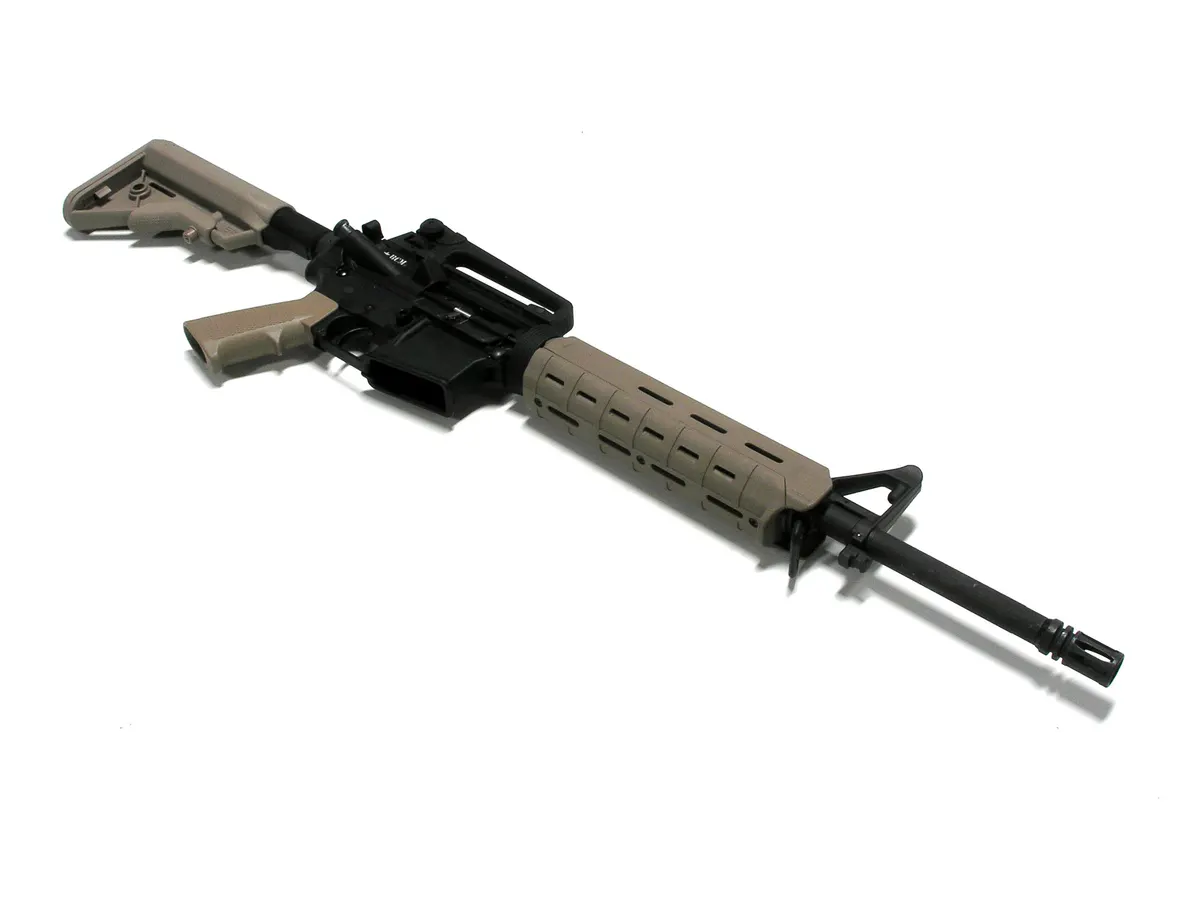
Magpul answered with its own competing system in 2014, M-LOK, replacing KeyMod's round keyholes with a uniform elongated slot and its round pegs with a T-shaped lug. Because the M-LOK slot stays the same width along its entire length rather than widening only at fixed keyhole points, an accessory clamps in at almost any position, not just the handful of predrilled anchor points KeyMod allows.
United States Special Operations Command tested both systems before choosing between them, and the results were not close. In drop testing, KeyMod-mounted accessories held on only about a third of the time, while M-LOK held every attachment through the same test. Optics remounted on M-LOK held their point of aim within roughly 1.3 minutes of angle after removal and reinstallation, about a quarter of the shift measured on rival systems.6 SOCOM adopted M-LOK as its preferred handguard interface soon after, and the commercial market followed within a couple of years, leaving KeyMod a shrinking share of legacy handguards on rifles like early production AR-15 clones while nearly every new design switched to Magpul's format.
01From Dedicated Scope Mounts to a Rail on Every Service Rifle
The Belgian FN Model 1949, built by FN Herstal, shipped with fixed iron sights and no scope provision at all. The German paratrooper rifle FG 42 went further, machining a proprietary side rail into its own receiver for one dedicated scope, a fix for that rifle alone.

Cold War rifles solved the same problem with dedicated mounts instead of a shared rail. The American M14, built in part by Springfield Armory, has no factory rail. Its M21 sniper variant used a scope base bolted to the receiver's left side, and the retrofit rail adapters sold for the M14 today exist only because the original design predates MIL-STD-1913 by three decades.4
Sweden's locally built Ak 4 rifle, a licensed Heckler & Koch G3 derivative, saw comparable retrofits once the designated marksman role called for optics its fixed iron sights could not support.

Modern rifles design the rail in from the start instead of adding one later. The FN SCAR-H and the German Heckler & Koch HK417 ship with a full-length top rail and rail sections on the handguard, letting either serve as a battle rifle with iron sights one day and a marksman's rifle with a magnified scope the next, on the same receiver.
Turkey's MPT-76, the Czech Republic's CZ Bren 2 BR and Serbia's Zastava M77, built by Zastava Arms, follow the same pattern. The ArmaLite AR-10 (Modern Production) goes further still, relying on the rail as its only sighting interface with no iron sights fitted at all.
01Civilian and Recreational Market Adoption
Military adoption reached the commercial market almost immediately. Sturm, Ruger & Co. began shipping its Ruger Mini-14 Ranch Rifle with a factory-milled Picatinny section well before most other civilian manufacturers bothered, and aftermarket rail adapters for older bolt-action and lever-action hunting rifles became a standard gunsmith service through the early 2000s.2
The same slotted geometry has since spread well outside firearms entirely. Airsoft replicas, paintball markers, gel blasters and foam dart blasters all now carry the identical crossbar pattern purely so their owners can swap the same red dot sights, flashlights and foregrips sold for real rifles, evidence that the clamping geometry Picatinny Arsenal fixed in 1995 solved a problem bigger than the rifle it was built for.2
02Notes and Sources
- "Picatinny rail", Wikipedia — en.wikipedia.org ↩
- "History of the Picatinny Rail", Hi-Lux Optics — hi-luxoptics.com ↩
- "NATO Accessory Rail", Wikipedia — en.wikipedia.org ↩
- "Installing the M14/M1A Picatinny Rail", Hi-Lux Optics — hi-luxoptics.com ↩
- "Weaver rail mount", Wikipedia — en.wikipedia.org ↩
- "KeyMod vs M-LOK: Military Chooses The Winner", Pew Pew Tactical — pewpewtactical.com ↩


