

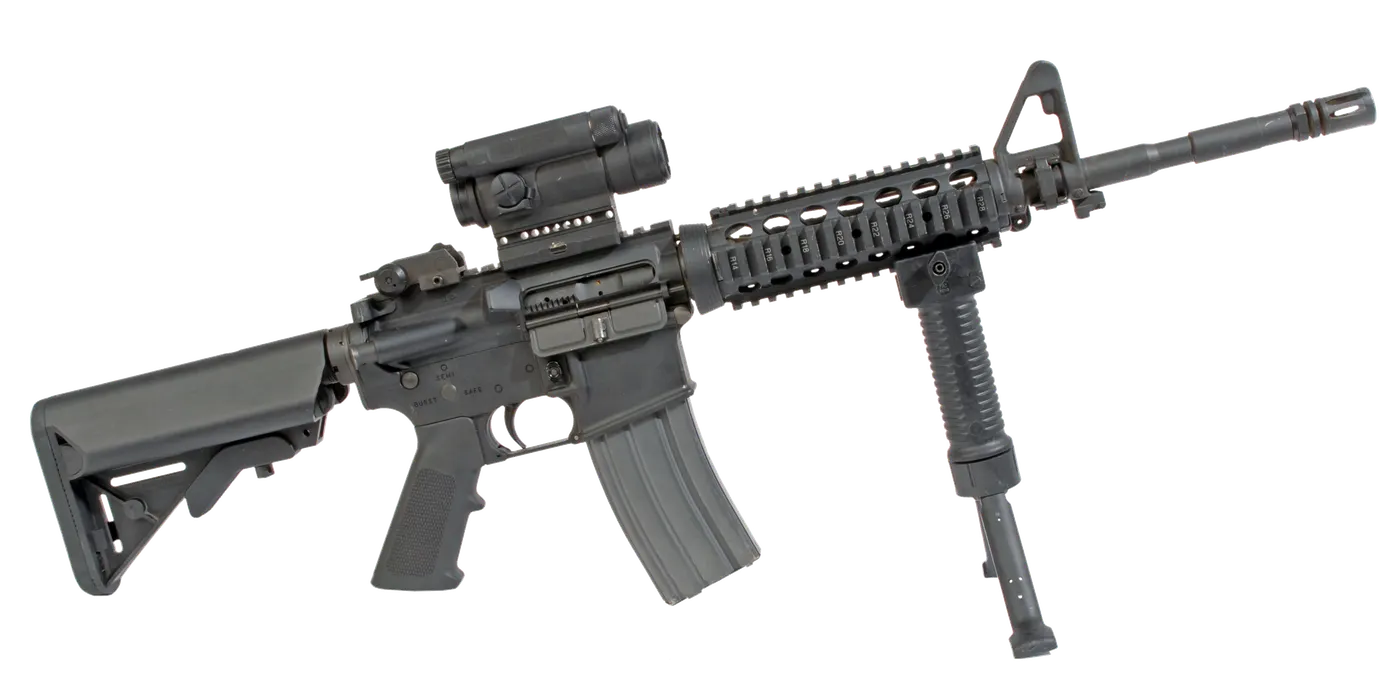
The M4 carbine is the shortened, carbine-length descendant of the M16 rifle, chambered in 5.56×45mm NATO and built around the same gas-operated, direct-impingement action that Eugene Stoner and L. James Sullivan designed for the original ArmaLite AR-15 in the 1950s. It weighs 2.92 kg empty and 3.51 kg loaded with a 30-round magazine, carries a 368 mm (14.5-inch) barrel roughly ten inches shorter than the M16A4's, and fires from a closed bolt at a cyclic rate commonly listed around 700 rounds per minute.1 The United States Army formally adopted it in August 1994, and it has since become one of the most widely issued assault rifles (technically a carbine-class weapon) on earth, standard issue for the entire US Armed Forces and in service with more than 60 countries.2
- short, maneuverable in vehicles and buildings
- deep parts commonality with the M16 family
- extremely modular (SOPMOD rails, optics, lights, grenade launchers)
- enormous global logistics and spare-parts base
- decades of combat-proven service history
- shorter barrel cuts muzzle velocity and effective range versus the M16
- direct-impingement gas system runs hotter and dirtier than piston designs
- lighter government-profile barrel overheats under sustained automatic fire
- lost a widely publicized 2007 Army dust test to newer competitors
Unlike a fresh clean-sheet design, the M4 carbine is functionally an evolution of the CAR-15 and XM177 commando carbines fielded in small numbers during the Vietnam War, refined over three decades into the current standard-issue rifle.1 Standard fire modes are safe, semi-automatic and 3-round burst for most Army configurations, or safe, semi-automatic and fully automatic for the select-fire M4A1 variant used by special operations units.3 Its detachable magazine system, optic rail, and compatibility with the SOPMOD accessory kit make the M4 carbine one of the most searched terms in small-arms procurement discussions, and "M4 carbine specifications" or "M4 vs M16" remain two of the most common queries anyone runs into researching modern US infantry weapons.
Colt's Manufacturing Company built the original production carbines, with FN Herstal and Remington Arms later winning competitive Army contracts to produce the same design, and companies such as Bushmaster Firearms International, Lewis Machine & Tool Company, U.S. Ordnance, and SME Ordnance building AR-15/M4-pattern derivatives for military and law-enforcement buyers.4 Estimated total production across variants and licensees exceeds 500,000 units, at a government unit price historically quoted around $700 per carbine.5
A Direct-Impingement System Inherited From the AR-15
The M4 carbine did not reinvent the AR-15's operating system. It uses the same gas-operated, direct-impingement mechanism as the M16, venting propellant gas through a small port near the muzzle, back through a thin steel tube, and directly into the bolt carrier to cycle the action, rather than driving a separate piston as later rivals such as the Heckler & Koch HK416 do.6 The design keeps the receiver lighter and the point of impact more consistent, but it also dumps hot, carbon-laden gas straight into the action, which is the root of most of the fouling and heat-related reliability complaints that have followed the M4 carbine since the 2000s.7
- First Production Year1991
- Service Entry Year1994
- DesignerColt's Manufacturing Company; FN Herstal; Remington Arms
- Weight (Empty)2.92 kg
- Weight (Loaded)3.51 kg
- Currently In ServiceYes
- Notable UsersUnited States Armed Forces; over 60 countries worldwide
The 14.5-Inch Barrel and the Velocity Trade-Off
Shortening the M16's 508 mm barrel down to 368 mm (14.5 inches) for the M4 was the whole point of the carbine program, but it comes at a real ballistic cost. Muzzle velocity with standard M855 ball ammunition drops to roughly 905 m/s, several hundred feet per second below what the same round achieves from a full-length M16 barrel, and the US Army lists the carbine's point-target effective range at about 500 m against the M16's longer reach.8 Maximum listed range for the 5.56×45mm NATO round fired from the M4 is around 3,600 m, though that figure describes the bullet's flight distance, not a usable combat engagement range.9 The shorter barrel is precisely what made the M4 popular for mounted troops, vehicle crews, and close-quarters urban fighting, where the M16A2's near-1-metre length was a genuine handicap.
- Cartridge5.56×45mm NATO
- Calibre5.56 mm
- Case Length44.7 mm
- Calibre Classintermediate
- Bullet Weight4 g
- RimfireNo
- Caseless AmmunitionNo
{{photo-req side=right q="US Army soldier M4 carbine SOPMOD rail accessories" caption="An M4 carbine fitted with SOPMOD rail accessories, optics, and a foregrip." alt="US soldier holding an M4 carbine with rail-mounted accessories"}}
- Action TypeGas-Operated
- Fire Modessafe, semi-automatic, burst, automatic
- Select FireYes
- Feed SystemDetachable Magazine
- Magazine Capacity30
- Cyclic Rate of Fire700
- Practical Rate of Fire150
- Trigger Typesingle-stage
- Safety Typelever
SOPMOD and the Rise of a Truly Modular Rifle
What separates the M4 from most of its contemporaries is not the receiver, it is the accessory ecosystem built around it. The Naval Surface Warfare Center at Crane, Indiana published the first SOPMOD (Special Operations Peculiar Modification) kit manual in 1999, cataloguing rail-mounted optics, visible and infrared lasers, suppressors, and vertical grips that could be bolted onto the same M4 receiver depending on mission.10 That program is largely why the DB records the weapon's modularity as "highly modular with SOPMOD accessories" rather than a fixed configuration, and why the M4 remains suppressor-ready, retains a bayonet lug, and is grenade-launch compatible with the M203 and M320 underbarrel launchers out of the box.10 The carbine also has ambidextrous controls on later production and upgrade kits, letting left-handed shooters operate the safety and magazine release without shifting their firing grip.
- Muzzle Velocity905 m/s
- Muzzle Energy1,700
- Effective Range (point)500 m
- Effective Range (area)600 m
- Maximum Range3,600 m
- Accuracy3.5
The Collapsible Stock and SOCOM Heavy Barrel
The M4's telescoping buttstock, adjustable across several positions to fit body armor and different arm lengths, was one of its defining features from the start and a deliberate departure from the M16's fixed stock. Special Operations Command adopted a heavier "SOCOM profile" barrel for its M4A1s in 1999 specifically to survive sustained automatic fire without the barrel warping or the accuracy degrading, a lesson learned from early full-auto testing that showed the lighter government-profile barrel heating dangerously fast.12 That heavier barrel, together with a full-auto-only trigger group (rather than the three-round-burst group on standard-issue Army M4s), later became standard across the wider Army fleet as older M4s were rebuilt into the M4A1 configuration.
- Barrel Length368 mm
- Rifling Twist1:7
- Rifling Grooves6
- Sight TypeIron sights or various optics
- Sight Radius533 mm
- Optic RailYes
- Iron SightsYes
- Threaded BarrelYes
- Receiver Materialaluminum alloy
- Furniture Materialpolymer
- Folding / Collapsing StockNo
- Bullpup LayoutNo
- Ambidextrous ControlsYes
- Modularityhighly modular with SOPMOD accessories
- Total Production500,000
- Production Start1987
- Unit Cost647 USD
From CAR-15 to a Formal Army Requirement
Compact AR-15-derived carbines were nothing new by the 1980s. Colt had built a limited number of CAR-15 and XM177 commando carbines for special units in Vietnam two decades earlier, and those weapons directly informed the M4 program.1 The US government formally asked Colt for a carbine version of the M16A2 in 1982, and the Army redesignated an interim design as the XM4 that same year. The 9th Infantry Division requested a dedicated 5.56mm carbine under a Quick Reaction Program in 1983, prototypes went through Army testing that June, and by 1987 the Marine Corps had already taken delivery of 892 production examples under the "carbine, 5.56mm, M4" designation, years before the Army placed its own large-scale order.13
The Battle of Mogadishu and an Accelerated Adoption
The push to make the M4 carbine, not the M16, the Army's default weapon owes a lot to a single, brutal 1993 firefight. During the Battle of Mogadishu, Army Rangers carrying full-length M16A2s reported the weapon as unwieldy in the tight streets and vehicle interiors of the city, while Delta Force operators equipped with the shorter CAR-15/M4-pattern carbines in the same battle had no such complaints.14 That contrast, combined with broader lessons from the 1991 Gulf War, gave the Army's carbine program new urgency. Colt received its first production contracts for the M4 in May and July 1993, and SOCOM ordered the fully automatic M4A1 variant in February 1994. Both the M4 and M4A1 were formally adopted as US Army standard in August 1994.13
{{photo-req side=left q="US Army Rangers Mogadishu 1993 Somalia" caption="US Army Rangers in Mogadishu, Somalia, 1993, the battle that accelerated the M4 carbine's adoption." alt="US soldiers during urban operations in Mogadishu"}}
Becoming the Default US Infantry Weapon
The carbine's role expanded steadily through the 2000s and 2010s. Since its 1994 adoption, the M4 has gone through more than 90 individual engineering modifications aimed at ergonomics, modularity, and reliability, without changing the base designation.17 By the mid-2010s the US Marine Corps formally endorsed replacing the M16A4 with the M4 as the standard infantry rifle, completing a shift that had effectively already happened across most of the US Army years earlier.18 A 2011 Product Improvement Program converted roughly 300,000 existing M4s into the M4A1 configuration, adding the SOCOM heavy barrel, the ambidextrous selector, and a full-auto trigger group in place of the three-round-burst mechanism.19
Urban Warfare in Iraq
The Iraq War made the case for the M4 carbine's compact footprint better than any test range could. During the Second Battle of Fallujah in late 2004, Marines fought house to house through narrow hallways, stairwells, and alleyways where a full-length M16A4 was a genuine liability, and after-action surveys found that roughly 94 percent of soldiers rated the M4 as an effective weapon system in that environment.20 The carbine's shorter length and lighter weight, about a pound lighter than the M16A4, made it markedly easier to bring to bear when clearing a room or dismounting from a vehicle under fire, and Fallujah is frequently cited as the engagement that cemented the M4 as the preferred infantry weapon for urban combat rather than a specialist tool.20
{{photo-req side=right q="US Marines Fallujah 2004 urban combat" caption="US Marines during the Second Battle of Fallujah, November 2004, fighting that highlighted the M4 carbine's advantages in close urban combat." alt="US Marines conducting house-clearing operations in Fallujah"}}
The 2007 Dust Test and a Public Reliability Fight
The M4 carbine's reputation took a public hit in 2007. Prompted by Senator Tom Coburn's questions about the roughly $375 million the Army planned to spend on the M4 through fiscal 2009 without testing newer alternatives, Aberdeen Proving Ground ran a severe "Carbine Extreme Dust Test" pitting the M4 against the HK416, HK's XM8, and FNH USA's SCAR.21 Each weapon fired 6,000 rounds under repeated heavy dust exposure, and the M4 finished last, recording 882 stoppages, far more than the other three entrants. The Army publicly defended the weapon, noting a separate 98 percent no-stoppage rate under different conditions and arguing the dust test did not reflect typical operational use, but the result fed a reliability debate that has followed the M4 carbine ever since.21
The Battle of Wanat and a Disputed Overheating Report
The most consequential single incident tied to M4 reliability came on 13 July 2008, when roughly 100 to 200 Taliban fighters attacked a small outpost held by 48 soldiers of Chosen Company, 2nd Battalion, 503rd Infantry Regiment, in the War in Afghanistan, an engagement now known as the Battle of Wanat.23 Soldiers described cycling through multiple M4s as each one overheated and jammed after sustained firing, in one case burning through roughly 360 rounds in about 30 minutes. The Army's official history attributed the failures to combat conditions rather than to weapons maintenance or design flaws, but a former Army historian who helped compile that report later told journalists his findings on the weapon had been altered by superiors before publication, keeping the reliability question open even after the official inquiry closed.23 Nine US soldiers died at Wanat, and the battle remains the most frequently cited real-world case of M4 carbines failing under sustained combat fire.
{{photo-req side=left q="Wanat Afghanistan Kunar province map" caption="Kunar Province, Afghanistan, site of the July 2008 Battle of Wanat." alt="Map of Kunar Province, Afghanistan"}}
Donated to Ukraine
Following Russia's full-scale invasion in February 2022, the United States included thousands of M4A1 carbines in its early military aid packages to Ukraine, with roughly 7,000 small arms including M4A1s reported delivered by May 2022 as part of the broader Russo-Ukrainian War assistance effort, alongside later shipments that also included M16A4 rifles.24 Ukrainian units photographed with pristine, still-packaged M4A1s in mid-2022 marked one of the more visible small-arms transfers of the war's opening months, adding Ukraine to the long list of foreign forces that have fielded the carbine outside US service.
M4A1: The Full-Automatic Special Operations Carbine
The M4A1 replaces the standard M4's semi-automatic/burst trigger group with a full-automatic one and was, for its first years of service starting in 1994, restricted to SOCOM operators rather than conventional Army units.25 It originally paired with the same government-profile barrel as the M4 before adopting the heavier SOCOM barrel in 1999, and the Army's later Product Improvement Program eventually rebuilt roughly 300,000 standard M4s to the M4A1 standard, effectively making the once-restricted SOCOM configuration the Army-wide baseline.19
Mk 18 CQBR: The Close-Quarters Cut-Down
Special operations units also fielded the Mk 18 Close Quarters Battle Receiver (CQBR), an even shorter 10.3-inch-barrel derivative of the M4A1 built specifically for vehicle crews, close protection details, and building-clearing teams where even the standard M4's 14.5-inch barrel was longer than ideal.10 The shorter barrel costs additional muzzle velocity and range, trading it for maneuverability in the tightest spaces.
{{photo-req side=right q="Mk18 CQBR carbine special operations" caption="A Mk 18 Close Quarters Battle Receiver, a shortened M4A1 derivative built for close-quarters and vehicle-borne use." alt="Special operations soldier with a short-barreled M4A1 derivative rifle"}}
The Barrett M468 and 6.8mm Upper Conversions
Because the M4's lower receiver, magazine well, and general architecture are shared across the wider AR-15 platform, several manufacturers built alternative upper receivers chambered in different calibers to address complaints about 5.56mm terminal performance at range. The Barrett M468, built around the 6.8mm Remington SPC cartridge, is one of the better documented of these conversions, bolting onto a standard M4 lower to trade some magazine capacity for a heavier bullet and improved performance at extended ranges, without requiring troops to retrain on an unfamiliar rifle.26
 AfghanistanACTIVE
 AlbaniaACTIVE
 Antigua and BarbudaACTIVE
 ArgentinaACTIVE
 AustraliaACTIVE
 AzerbaijanACTIVE
 BahrainACTIVE
 BelizeACTIVE
 BoliviaACTIVE
 BrazilACTIVE
 ColombiaACTIVE
 Costa RicaACTIVE
 CroatiaACTIVE
 Czech RepublicACTIVE
 Dominican RepublicACTIVE
 EcuadorACTIVE
 EgyptACTIVE
 El SalvadorACTIVE
 FranceACTIVE
 GeorgiaACTIVE
 GhanaACTIVE
 GreeceACTIVE
 HungaryACTIVE
 IndiaACTIVE
 IndonesiaACTIVE
 IraqACTIVE
 IsraelACTIVE
 ItalyACTIVE
 JamaicaACTIVE
 JapanACTIVE
 JordanACTIVE
 KenyaACTIVE
 KosovoACTIVE
 KuwaitACTIVE
 LebanonACTIVE
 MalaysiaACTIVE
 MexicoACTIVE
 MoroccoACTIVE
 NepalACTIVE
 New ZealandACTIVE
 North MacedoniaACTIVE
 OmanACTIVE
 PakistanACTIVE
 PalestineACTIVE
 PanamaACTIVE
 People's Republic of ChinaACTIVE
 PeruACTIVE
 PhilippinesACTIVE
 PolandACTIVE
 QatarACTIVE
 RomaniaACTIVE
 RussiaACTIVE
 Saudi ArabiaACTIVE
 SenegalACTIVE
 SerbiaACTIVE
 SingaporeACTIVE
 SlovakiaACTIVE
 South KoreaACTIVE
 SwedenACTIVE
 TaiwanACTIVE
 ThailandACTIVE
 TongaACTIVE
 TunisiaACTIVE
 TurkeyACTIVE
 UgandaACTIVE
 UkraineACTIVE
 United Arab EmiratesACTIVE
 United StatesACTIVE
 UruguayACTIVE
 YemenACTIVE
| Year | Buyer | Quantity | Amount | Present Value (2025) |
|---|---|---|---|---|
| 1994 |  United States | — | — | — |
| 1993 | United States | — | — | — |
| 1986 | United States | 892 | — | — |
The Backbone of US Small Arms
The M4 carbine is standard issue across the US Armed Forces, with the Army, Marine Corps, and special operations components all fielding it in some configuration, and it remains, as of 2026, in active service decades after its 1994 adoption despite periodic reliability debates and repeated Army studies into potential successors.2 Beyond the United States, the carbine or licensed AR-15/M4-pattern derivatives equip forces across every populated continent, a spread driven partly by NATO interoperability, partly by decades of US foreign military sales and security assistance programs to partners such as Israel, Iraq, Jordan, and Kuwait, all of which fielded the M4 as part of post-2003 security cooperation.2
{{photo-req side=left q="multinational military exercise soldiers M4 carbine" caption="Soldiers from a partner nation training alongside US forces with M4 carbines during a joint exercise." alt="Multinational troops carrying M4 carbines during a joint military exercise"}}
A Wide, Uneven Adoption Curve
Not every operator on the list acquired the M4 the same way or at the same scale. Countries such as Croatia, Bahrain, Albania, and several Caribbean and Central American states received relatively small consignments, often tied to counter-narcotics or counter-terrorism assistance packages rather than a full standard-rifle replacement, while larger forces such as Egypt, Saudi Arabia, India, and Turkey operate the M4 alongside domestically produced rifles rather than as a wholesale replacement.2 That uneven pattern, a mix of full adoptions, niche special-forces buys, and small security-assistance transfers, is typical of how a decades-old, widely licensed US small arm spreads globally, and it is part of why "M4 carbine operators" returns such a long, geographically scattered country list compared to most other assault rifles.
The HK416 Rivalry Is a Gas System Argument, Not Just a Brand Fight
The most consequential rival to the M4 carbine is the Heckler & Koch HK416, and the disagreement between the two designs is really an argument about gas systems. Former Delta Force weapons expert Larry Vickers worked with Heckler & Koch to fit a short-stroke gas piston onto an M4-pattern rifle specifically to eliminate the direct-impingement system's heat and fouling inside the receiver, and the HK416 beat the M4 decisively in the same 2007 Aberdeen dust test that embarrassed the Army.6 France and Norway both later selected the HK416 (as the HK416F and HK416 N, respectively) as their standard service rifles, decisions that were shaped in part by that reliability comparison.27 The M4 counters with a shorter recoil impulse, lighter weight, a far larger existing US logistics and spare-parts base, and a substantially lower unit cost, since the HK416 typically runs several times the M4's roughly $700 government price.6
| M4 Carbine | HK416 | |
|---|---|---|
| Operating system | Direct impingement, gas-operated | Short-stroke gas piston |
| Barrel length | 368 mm (14.5 in) | 368-419 mm (variant-dependent) |
| Weight (empty) | 2.92 kg | approx. 3.3-3.6 kg |
| Approx. unit cost | approx. $700 | several times the M4's price |
A Different Kind of Comparison: the AK-74's Philosophy of Simplicity
Where the HK416 comparison is about refining the same basic architecture, the AK-74 represents a genuinely different design philosophy the M4 has to be measured against on the world stage. The AK-74 keeps the loose-tolerance, long-stroke piston system of the original AK-47 family, prioritizing function under neglect and minimal cleaning over the tighter accuracy and rail-mounted modularity the M4 platform offers.28 In practice, that means the M4 carbine wins on ergonomics, sighting options, and adaptability to mission-specific accessories, while the AK-74 wins on tolerance for poor maintenance and battlefield abuse, a trade-off that has shaped which weapon different armed forces around the world have chosen to standardize on since the 1990s.


Is the M4 carbine still in service? Yes. It remains the standard-issue rifle across the US Armed Forces as of 2026, more than three decades after its August 1994 adoption, and it is fielded by more than 60 other countries.2
What caliber does the M4 carbine use? The M4 fires the 5.56×45mm NATO cartridge from a 30-round detachable magazine, the same intermediate-power round used by the M16 rifle family.1
How much does an M4 carbine cost? Government unit pricing has historically run around $700 per carbine, with a competitively awarded 2013 FN Herstal contract pricing 120,000 M4A1s at roughly $642 each.5,16
What is the difference between the M4 and the M16? The M4 carbine is a shortened derivative of the M16, with a 368 mm (14.5-inch) barrel versus the M16A4's 508 mm barrel, a collapsible stock instead of a fixed one, and a corresponding reduction in muzzle velocity and effective range in exchange for better handling in vehicles and close quarters.8
Is the M4 carbine fully automatic? The standard Army M4 fires safe, semi-automatic, and 3-round burst. The M4A1 variant, originally restricted to special operations units, replaces the burst group with a true fully automatic setting and has since become the Army-wide standard configuration through the Product Improvement Program.25
- "M4 carbine", Wikipedia — en.wikipedia.org ↩
- "35 Facts About The M4 Rifle", Facts.net — facts.net ↩
- "The M4 carbine and M4A1 carbine (USA)", Modern Firearms — modernfirearms.net ↩
- "Army Awards New M4/M4A1 Contract to FN", Military.com — military.com ↩
- "How Much Does an M4 Carbine Cost?", Crate Club — crateclub.com ↩
- "About Those 2007 M4 Dust Tests", The Firearm Blog — thefirearmblog.com ↩
- "The M4 Carbine: The Fighting Rifle (Arguably) Perfected", Gun Digest — gundigest.com ↩
- "M4 / M4A1 5.56mm Carbine", GlobalSecurity.org — globalsecurity.org ↩
- "M4 carbine", Wikipedia — en.wikipedia.org ↩
- "History of SOPMOD, Part I", SWAT Survival — swatmag.com ↩
- "M4 Carbine: Why It Took 30 Years to Field a Shortened M16", Hook & Barrel — hookandbarrel.com ↩
- "M4A1: How This Military Carbine Stayed Relevant For 30 Years", Coffee or Die — coffeeordie.com ↩
- "M4 carbine", Wikipedia — en.wikipedia.org ↩
- "Firearm Icons of the GWOT", The Mag Life — gunmagwarehouse.com ↩
- "The M4 carbine was never meant to be a primary infantry weapon", We Are The Mighty — wearethemighty.com ↩
- "FN America Lands M4 Contract Valued at Nearly $120 Million", American Rifleman — americanrifleman.org ↩
- "What is the M4 Carbine? An In-Depth Exploration of Its Features, History, and Impact", Crate Club — crateclub.com ↩
- "Marine officials endorse infantry's plan to ditch M16 for M4", Marine Corps Times — marinecorpstimes.com ↩
- "Converting the M4 to the M4A1 Configuration", Soldier Systems Daily — soldiersystems.net ↩
- "Second Battle of Fallujah", Wikipedia — en.wikipedia.org ↩
- "M4 Comes in Last Place in Dust Test", Military.com — military.com ↩
- "The Truth about the M4 Carbine's Dust test and the Battle of Wanat", Texas Gun Talk — texasguntalk.com ↩
- "Army historian says report on deadly Afghan battle was altered to absolve faulty gun", The Washington Times — washingtontimes.com ↩
- "M4A1 5.56mm assault rifles donated by US are now in service with Ukraine army", Army Recognition — armyrecognition.com ↩
- "M4 carbine | Military Wiki", Fandom — military-history.fandom.com ↩
- "M4-WAC-47 Assault Rifle / Assault Carbine", Military Factory — militaryfactory.com ↩
- "Eugene Stoner", Wikipedia — en.wikipedia.org ↩
- "AR-15-style rifle", Wikipedia — en.wikipedia.org ↩