

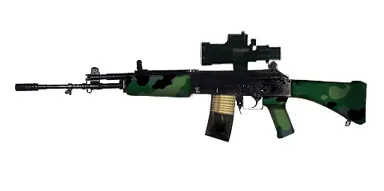

The INSAS rifle (Indian Small Arms System) is the 5.56x45mm NATO service rifle developed by India's Armament Research and Development Establishment in Pune to replace the license-built 7.62x51mm L1A1 Self-Loading Rifle that had armed the Indian Army since 1961. It is one of the more heavily debated assault rifles fielded by a major army in the post Cold War period, praised on paper as India's first genuinely indigenous infantry rifle and criticized in practice for a string of reliability failures that surfaced the moment it was tested in combat. Manufactured by the state owned Ordnance Factory Board at its Ishapore and other factories, the INSAS entered service in 1990 and by the late 2010s had been produced in numbers estimated between 700,000 and 900,000 units, yet it never fully escaped its reputation as an unreliable rifle.1,2
- cheap to produce and maintain
- familiar AKM-derived operating system for existing troops
- compatible with rifle grenades and a bayonet
- simple to field-strip
- integral bipod useful in the LMG role
- polymer magazines cracked in cold weather during the Kargil War
- gas regulator prone to breaking
- documented oil/lubricant spray into the firer's face
- inconsistent quality control traced to heat-treatment defects
- outclassed on ergonomics and modularity by newer rifles
Design work started in the mid-1980s after the Indian Army issued a staff requirement for a 5.56mm rifle to replace the aging L1A1, and ARDE studied several existing designs, mainly the AKM, before settling on a hybrid.
{{photo-req side=right q="INSAS rifle Indian Army soldier" caption="An Indian Army soldier with an INSAS assault rifle" alt="Indian soldier holding an INSAS assault rifle"}}
The rifle borrows its gas-operated rotating bolt and long-stroke piston from the AKM, a manual gas regulator reminiscent of the FN FAL, a charging handle position that echoes the Heckler & Koch G3, and translucent polymer magazines styled after the Steyr AUG's.1,2 The result carries the INSAS name (Indian Small Arms System) because it was conceived as a whole family, an assault rifle, a carbine, and a light machine gun sharing the same receiver and many parts, rather than a single weapon.
Today the INSAS is being phased out of frontline Indian Army units in favor of the Russian designed AK-203, but it remains in widespread use across India's paramilitary and police forces, and it is still carried by several smaller foreign militaries that received it through Indian defense assistance programs. Understanding why a rifle that performed so poorly in its first war has stayed in service for over three decades says as much about India's defense-industrial constraints as it does about the weapon itself.
The INSAS assault rifle fires the 5.56x45mm NATO cartridge from a 30-round (or 20-round) curved detachable magazine, with a quoted muzzle velocity of 915 m/s and a claimed effective range of 400 meters against a point target. It weighs 4.018 kg empty, measures roughly 960mm overall with a 464mm barrel, and is chambered around a chrome-lined, six-groove bore.1 The rifle offers select-fire capability across semi-automatic, a 3-round burst setting, and fully automatic fire, controlled by a left-side selector lever, a layout that put fire-control directly under the firing thumb in a way the older L1A1 never offered.
- First Production Year1994
- Service Entry Year1990
- DesignerArmament Research and Development Establishment
- Weight (Empty)4.018 kg
- Currently In ServiceYes
- Notable UsersIndian Armed Forces, Nepalese Army
{{photo-req side=left q="INSAS rifle field stripped parts" caption="A field-stripped INSAS rifle showing its AKM-derived gas piston and bolt group" alt="Disassembled INSAS rifle components laid out"}}
- Cartridge5.56×45mm NATO
- Calibre5.56 mm
- Case Length45 mm
Mechanically the INSAS is a gas-operated rifle with a rotating bolt and long-stroke gas piston, effectively an AKM derivative adapted to a smaller, higher-velocity cartridge and reworked with a manually adjustable gas regulator similar to the one on the FN FAL. It has a gas-piston operated action rather than a direct-impingement system, which trades some weight for a mechanism that tolerates fouling better in theory. The weapon includes an integral bipod, a bayonet lug, and the capacity to launch NATO-standard rifle grenades, three features the older SLR generation of Indian infantry weapons also carried and that ARDE preserved deliberately for continuity with existing doctrine.
- Action TypeGas-Operated
- Fire Modessemi-automatic, 3-round burst, fully automatic
- Select FireYes
- Feed SystemDetachable Magazine
- Magazine Capacity30
- Cyclic Rate of Fire3
Furniture on early production rifles was wood, later switched largely to polymer, with butt and forend shapes that owe more to the Israeli Galil than to the AKM they otherwise resemble mechanically. A folding stock variant was also produced for airborne and mechanized infantry units who needed a shorter weapon in vehicles and during parachute descent. Where the design ran into trouble was not the layout on paper but manufacturing consistency, a state auditor's later review of INSAS defect investigations traced repeat failures, including case bursts in the chamber and cracked breech blocks, to inconsistent heat treatment and hardness deviations in the barrels and receiver components coming out of the ordnance factories, not to the underlying mechanism itself.3
- Muzzle Velocity915 m/s
- Effective Range (point)400 m
- Effective Range (area)700 m
- Barrel Length464 mm
- Sight TypeIn-built iron sights, mount point for telescopic or night sight
- Iron SightsYes
- Total Production900,000
- Variants4
Development began after the Indian Army decided in the mid-1980s to move away from the 7.62x51mm L1A1, a decision driven partly by NATO's own shift to smaller-caliber 5.56mm rifles and partly by a desire to build India's first fully domestic infantry rifle rather than license another foreign design. ARDE ran trials through the late 1980s, completed development by 1989, and the rifle was formally adopted in 1990. A first batch of roughly 1,500 rifles was handed to the Army by the Ishapore ordnance factory in the early 1990s, but full mass production did not begin until 1997, held back in part by India's own limited domestic supply of 5.56mm ammunition, which forced large purchases of ammunition from Israel Military Industries in the interim.1,2 The INSAS was formally paraded for the first time at the 1998 Republic Day parade in New Delhi, eight years after its official adoption.
{{photo-req side=left q="Kargil War Indian Army soldiers Kargil 1999" caption="Indian Army soldiers during the 1999 Kargil War, the INSAS rifle's combat debut" alt="Indian soldiers in mountainous terrain during the Kargil War"}}
The INSAS rifle's combat debut came in the 1999 Kargil War, fought at altitudes above 4,500 meters in the Himalayas where temperatures dropped as low as -20 degrees Celsius. The results were poor. Soldiers reported translucent polymer magazines, made by the Indian plastics firm Nilkamal, cracking in the extreme cold, gas regulators occasionally failing outright, weapons set to 3-round burst instead firing on full automatic, and lubricant spraying back into the firer's face during sustained use.4,1 Indian troops who had spent decades on the heavier 7.62mm L1A1 also complained the smaller 5.56mm round lacked stopping power at altitude, a criticism echoed almost verbatim years later by Nepalese soldiers using the same rifle.
The rifle's reputation never fully recovered from Kargil. Over the following two decades it saw the introduction of upgraded 1A1, 1B, and 1B1 sub-variants, the 1B1 arriving in 2001 with fixes drawn directly from Army after-action feedback, alongside a series of proposed replacements and modernization programs that repeatedly stalled. An Excalibur upgrade package was trialed starting around 2016 and formally scrapped in 2018 after failing to satisfy the Army's revised General Staff Qualitative Requirements. Only with the 2019 agreement establishing a joint Indo-Russian production line for the AK-203 did India settle on a definitive INSAS successor for frontline infantry units.2,6
Beyond the Kargil War, the INSAS saw sustained use across nearly every internal security commitment India has faced since the 1990s. It has been issued to the Border Security Force and Central Armed Police Forces fighting the long-running Naxalite-Maoist insurgency in eastern and central India, where Maoist fighters have repeatedly looted or stolen INSAS rifles from killed or overrun police units, in one case police recovering an SLR and an INSAS rifle together from a Naxalite weapons cache in Chhattisgarh.7 The rifle has also armed Indian forces engaged in the ongoing insurgency in Jammu and Kashmir, where militant groups including Hizbul Mujahideen have on occasion captured INSAS weapons from security forces.
{{photo-req side=right q="Red Corridor Naxalite insurgency affected states India map" caption="A map of the Red Corridor, the belt of eastern and central Indian states most affected by the Naxalite-Maoist insurgency" alt="Map of Naxalite-affected states in India"}}
The Central Reserve Police Force, India's lead counter-Naxalite paramilitary force, became the sharpest institutional critic of the rifle, its director general publicly stating in the mid-2010s that the force had formally requested Kalashnikov-pattern rifles to replace the INSAS because it jammed far more often than AK-pattern rifles or the Israeli Tavor X95 used by other units.5
{{photo-req side=left q="CRPF Central Reserve Police Force India patrol" caption="Central Reserve Police Force personnel, among the heaviest users of the INSAS rifle in counter-insurgency operations" alt="Indian paramilitary police on patrol"}}
The rifle's reliability problems were not confined to India. Nepal received roughly 26,000 INSAS rifles from India at a 70 percent subsidy starting in 2001 for use against Maoist rebels during the Nepalese Civil War.8 In a 2005 battle at Kalikot, Nepalese Army INSAS rifles reportedly overheated and seized during a ten-hour firefight in which 43 soldiers were killed, a claim the Indian embassy in Nepal later disputed, citing follow-up trials that attributed the stoppages to poor maintenance rather than a design flaw.1,4
More recently, the 1B1 variant of the rifle has surfaced in the hands of anti-junta People's Defence Force fighters during the Myanmar Civil War, reflecting the wider regional circulation of Indian-supplied small arms.1
The INSAS family was conceived from the outset as three interlocking weapons sharing a common receiver and operating system, the assault rifle, a carbine, and a light machine gun, though only the rifle and LMG reached full production at scale. Assault rifle sub-variants progressed from the original 1A through the 1A1, 1B, and finally the improved 1B1 introduced in 2001. The LMG variant uses the same 30-round magazine (and can accept the rifle's 20-round magazine) but adds a longer 535mm barrel with a revised rifling twist and a fixed bipod, and it was for years the standard section automatic weapon in Indian infantry platoons before being scheduled for replacement by the Israeli IWI Negev.1
{{photo-req side=left q="Steyr AUG bullpup rifle" caption="The Steyr AUG, whose translucent polymer magazine design influenced the INSAS" alt="Steyr AUG bullpup rifle with translucent magazine"}}
Several derivative designs followed. The Excalibur rifle, developed as a modernization package with a folding stock and 20 or 30-round magazines, was intended to fix ergonomic complaints but was ultimately dropped in 2018. The Amogh carbine and a separate DRDO close-quarter-battle carbine scaled the system down for vehicle crews and rear-echelon troops.
The Kalantak micro assault rifle shortened the platform further for a personal-defense-weapon role with an effective range around 300 meters, while the proposed MSMC (Modern Sub-Machine Carbine) reworked the action to fire a shortened 5.56x30mm cartridge in a compact, Uzi-like package aimed at close-quarters and vehicle-crew use, though it saw only limited adoption. In 2019, an Indian Army officer, Lieutenant Colonel Prasad Bansod, reverse-engineered a working bullpup configuration of the INSAS receiver as an unofficial demonstration project.1


| Year | Buyer | Quantity | Amount | Present Value (2025) |
|---|---|---|---|---|
| 2001 |  Nepal | 26,000 | — | — |
India remains by far the largest operator, with the INSAS still issued across the Indian Armed Forces' second-line and reserve units, the Border Security Force, the Central Armed Police Forces, the Central Industrial Security Force, and numerous state police services, even as frontline Army infantry battalions convert to the AK-203. Nepal's Army received about 26,000 INSAS rifles under a subsidized Indian supply arrangement beginning in 2001, and the rifle remains in Nepalese service. Bhutan's Royal Army also fields the INSAS, reflecting India's role as the Himalayan kingdom's principal defense supplier.
{{photo-req side=right q="Royal Army of Oman soldiers" caption="Royal Army of Oman personnel, who began fielding the INSAS rifle in 2010" alt="Omani Army soldiers"}}
Further afield, the Royal Army of Oman adopted the INSAS in 2010 under a bilateral defense agreement signed with India in 2003, though the rifles have since been superseded there and placed in storage.9 Eswatini's armed forces have also fielded small numbers of INSAS rifles.
Most recently, in April 2026, the Indian Navy handed over 100 INSAS rifles along with 50,000 rounds of ammunition to the Kenyan Navy during a port call by the frigate INS Trikand at Mombasa, part of India's MAHASAGAR regional maritime-security assistance initiative, extending the rifle's operator list into East Africa more than three decades after its original adoption.10
The INSAS and the AKM it drew its operating system from illustrate how much reliability can hinge on manufacturing discipline rather than mechanical layout. Both rifles share the same long-stroke gas piston and rotating bolt concept, and on paper the INSAS should have inherited the AKM's legendary tolerance for dirt, cold, and rough handling. In practice it did not, Indian government audits traced repeat INSAS failures to heat-treatment and hardness defects in Indian-made components, not to the borrowed Kalashnikov mechanism itself, meaning the rifle's reputation problem was substantially a production quality issue layered on top of a sound-enough design.3 The AKM (and the wider Kalashnikov family, including the direct import AK-47) remains the benchmark for battlefield reliability that INSAS was measured against and ultimately found wanting by its own users, which is precisely why the Indian Army's eventual INSAS replacement, the AK-203, returned to a Kalashnikov-pattern rifle built to Russian production standards rather than a further Indian redesign.
| Spec | INSAS | AK-203 |
|---|---|---|
| Cartridge | 5.56x45mm NATO | 7.62x39mm |
| Empty weight | 4.018 kg | ~3.8 kg |
| Muzzle velocity | 915 m/s | ~715 m/s |
| Effective range | 400 m | ~400 m |
The comparison with the Steyr AUG, a rifle that also influenced the INSAS's translucent polymer magazine, is a comparison of design eras rather than concepts. The Steyr AUG's bullpup layout, integrated optics, and modular barrel system represented a genuinely modern rethink of the rifle when it entered service in the late 1970s, while the INSAS, developed a decade later, chose a conventional AKM-pattern layout for familiarity and lower production risk. That conservatism did not pay off the way ARDE intended, the INSAS ended up scoring lower than the AUG on ergonomics, modularity, and overall reliability in independent assessments, even though it was the newer of the two designs.


Is the INSAS rifle still in service? Yes, though it is being phased out of frontline Indian Army infantry roles in favor of the AK-203 and the SIG 716 battle rifle. It remains standard issue across India's paramilitary forces, state police services, and reserve Army units, and continues in service with Nepal, Bhutan, and other smaller operators.6,11
What caliber does the INSAS rifle use? The INSAS fires the 5.56x45mm NATO cartridge, a deliberate break from the older 7.62x51mm NATO L1A1 rifle it replaced, matching the caliber most NATO-aligned armies had already adopted by the 1980s.1
Why was the INSAS rifle replaced? Persistent reliability problems first exposed during the 1999 Kargil War, including cracked magazines, gas regulator failures, and inconsistent quality control traced to manufacturing defects, led India's Central Reserve Police Force and eventually the Army itself to push for Kalashnikov-pattern replacements, culminating in the AK-203 production agreement.3,5,6
How does the INSAS rifle compare to the AK-47? The INSAS borrows its core gas-operated, rotating-bolt mechanism from the AKM (the modernized AK-47 derivative) but chambers the smaller 5.56x45mm NATO round instead of 7.62x39mm and adds a manually adjustable gas regulator, a bipod, and rifle-grenade capability the base AKM lacks.1,2
What is the INSAS rifle's effective range? Official figures list an effective range around 400 meters for the assault rifle against point targets, roughly comparable to other 5.56mm service rifles of its generation, with the light machine gun variant rated further for area suppression.1
- "INSAS rifle", Wikipedia — en.wikipedia.org ↩
- "Indian Army Plans to Upgrade the INSAS Rifle. Part 1, History", The Firearm Blog — thefirearmblog.com ↩
- "Why India's homemade INSAS rifle failed to fire", The Week — theweek.in ↩
- "The INSAS, Is this the worst assault rifle ever made?", Sandboxx — sandboxx.us ↩
- "India's Anti-Terror Troops Despise Their Assault Rifle", War Is Boring (Medium) — medium.com ↩
- "Why AK-203 rifles are replacing INSAS along India's borders", News Defence — defence.newsd.in ↩
- "Chhattisgarh: SLR, INSAS rifle, ammunition hidden by Naxalites recovered in Sukma", The Tribune — tribuneindia.com ↩
- "Nepalese Civil War", Wikipedia — en.wikipedia.org ↩
- "Royal Army of Oman", Wikipedia — en.wikipedia.org ↩
- "Indian Navy handed over 100 INSAS rifles & 50,000 rounds to Kenyan Navy", Indian Defence Research Wing — idrw.org ↩
- "5 Reasons Why INSAS is Still Used by the Indian Army", SSBCrack — shop.ssbcrack.com ↩