

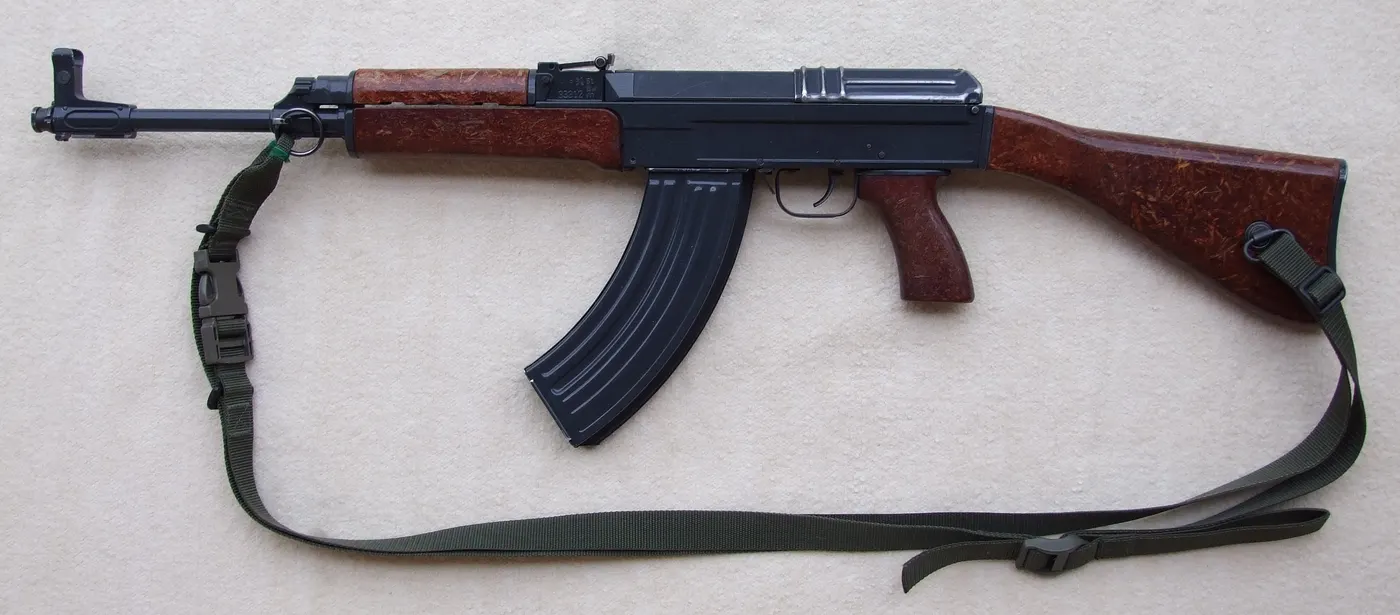

At a glance the vz. 58 looks like a Kalashnikov clone, curved 30-round magazine, wooden stock, distinctive front sight hood, and Czech soldiers carried it exactly where a Warsaw Pact army was expected to carry an AK-47. It is not one. Not a single part interchanges between the two rifles, and the internal mechanism, a short-stroke gas piston driving a tilting locking block, has more in common with the Belgian FN FAL than with anything designed at Izhevsk. That gap between appearance and engineering is the whole story of the weapon.
- Reliable short-stroke piston action, no gas regulator to foul
- Aluminum-alloy magazine roughly half the weight of a steel AK magazine
- Bolt hold-open on the last round, a feature the AK-47 lacks entirely
- Cheap and plentiful on the surplus and gray-arms market for decades
- Simple stamped/machined steel construction suited wartime production
- Furniture and small parts are not interchangeable with AK-pattern rifles
- No gas regulator means no adjustment for suppressed or adverse conditions
- Fixed iron sights with no factory optic-mounting rail on most variants
- Obsolete by the 1970s against rifles with modular sighting and furniture
- Selector/safety placement criticized as slower to manipulate than the AK's
The rifle's full designation is Samopal vzor 58 ("model 1958 submachine gun," a Czechoslovak naming holdover from before "assault rifle" became standard terminology), commonly abbreviated Sa vz. 58. It was developed at the Konstrukta Brno design bureau under chief engineer Jiří Čermák, whose team began work in 1956 under the internal codename Koště ("broom"), and it entered production in 1959 chambered in the Soviet 7.62×39mm intermediate cartridge, the same round the AK-47 fired.1,2 That cartridge choice was not really a choice at all. When the Soviet Union pushed for ammunition standardization across the Warsaw Pact in the late 1950s, Czechoslovakia was the only member state that responded by designing and adopting its own indigenous rifle around the Soviet round rather than simply license-building or importing the AK.3,4 Manufacturing was handled by Česká zbrojovka Uherský Brod, and by the time production wound down roughly 920,000 vz. 58 rifles had been built, a run that made it one of the most widely distributed non-Kalashnikov rifles of the Cold War.1
Czechoslovakia kept building and issuing the vz. 58 for decades after most of its Warsaw Pact neighbors had already standardized on Kalashnikov-pattern weapons, and the rifle remained the standard-issue assault rifle of the Czechoslovak, and later Czech and Slovak, armed forces until the Czech Republic began replacing it with the indigenous CZ 805 BREN starting in 2011.5 Slovakia kept the vz. 58 in first-line service considerably longer. Decades of surplus exports and Cold War-era arms transfers to allied and non-aligned states put the rifle into the hands of forces across Africa, the Middle East, and Southeast Asia, and Czech government donations put thousands more into Ukrainian hands after 2022, keeping a rifle designed in the 1950s in active combat use into the 2020s.6
A Short-Stroke Piston With No Gas Regulator
The vz. 58's gas system is the single biggest mechanical difference from the AK-47. Propellant gas is tapped from a port roughly 215mm from the chamber and vents into a cylinder above the barrel, where it strikes a short-stroke piston in one abrupt impulse.2 The piston itself travels only about 19mm before a shoulder on its rod hits its seat and stops, at which point the piston's own return spring drives it back forward while the separate bolt carrier continues rearward under its own momentum, cycling the action.2 Czechoslovak engineers deliberately omitted a gas regulator, a component common on rifles like the FN FAL and the SVD Dragunov to tune gas pressure for different conditions or a suppressor. The vz. 58 simply vents excess gas to atmosphere through two ports on the underside of the cylinder once the piston has traveled far enough, a simpler, harder-to-foul, but less adjustable solution.2
- First Production Year1959
- Service Entry Year1958
- DesignerJiří Čermák
- Weight (Empty)3.9 kg
- Currently In ServiceYes
- Notable UsersCzechoslovakia, Cuba, Angola, Burundi, Ethiopia, Guatemala, India, Indonesia, Iraq, Kurdistan, Laos, Libya, Mozambique, Philippines, Vietnam, Cyprus, Eritrea, Ivory Coast, Cuba, Cyprus, Eritrea, Ethiopia, Guinea, India, Indonesia, Iraq, Kurdistan, Laos, Libya, Mozambique, Philippines
{{photo-req side=right q="vz 58 rifle disassembled field strip parts" caption="A disassembled vz. 58, showing the short-stroke gas piston, bolt carrier, and tilting locking block that share no parts with the Kalashnikov design." alt="Field-stripped vz. 58 rifle components laid out"}}
- Cartridge7.62×39mm
- Calibre7.62 mm
- Case Length39 mm
- Calibre Classintermediate
- RimfireNo
- Caseless AmmunitionNo
The Tilting Locking Block, Not a Rotating Bolt
Where the AK-47 locks its rotating bolt directly into the barrel extension, the vz. 58 uses a hinged locking piece carried inside the bolt carrier. A cam surface on the carrier lifts this locking piece up out of engagement shoulders machined into the receiver's rails, after which the bolt itself, which does not rotate, travels straight back.8,9 It is a tilting-block concept closer in spirit to the SKS carbine or the FN FAL than to any gas-operated Kalashnikov derivative, and it is one of the clearest single proofs that the vz. 58 is an independent Czechoslovak design wearing an AK-shaped silhouette rather than a licensed or reverse-engineered copy.8 The rifle also uses a linear striking hammer rather than the AK's pivoting hammer, mounts its mainspring below rather than above the recoil spring, and closes its top dust cover only halfway down the receiver, retained by a cross pin instead of the AK's full-length hinged cover.8
- Action TypeBreak Action
- Fire Modesselective fire
- Select FireYes
- Feed SystemDetachable Magazine
- Magazine Capacity30
- Cyclic Rate of Fire800
- Trigger Typesingle-stage
- Safety Typemanual safety
The vz. 58 is chambered for the detachable-magazine-fed 7.62×39mm cartridge, feeding from curved 30-round box magazines, and is capable of select-fire semi-automatic and full-automatic fire at a cyclic rate around 800 rounds per minute.2 Sources give the empty barreled rifle's weight as approximately 3.1 to 3.5 kilograms depending on stock type and accessories, noticeably lighter than the roughly 3.8 to 4.3kg loaded weight commonly cited for a comparably configured AKM, a difference that matters over a long infantry patrol.10,2 Much of that weight saving comes from the magazine. The vz. 58's box magazine is machined from aluminum alloy rather than stamped steel, and weighs roughly half what a steel AK magazine weighs, a detail that mattered when a soldier was expected to carry six or more loaded magazines.11 The magazine also includes a bolt-hold-open function on the last round fired, a feature the standard AK-47 and AKM never had.11
- Muzzle Velocity705 m/s
- Muzzle Energy1,988
- Effective Range (point)400 m
- Maximum Range2,800 m
- Sighting Range800 m
Furniture, the Flash Hider, and "Beaver Barf"
Early production vz. 58 rifles used solid beechwood furniture, but Czechoslovak arms plants shifted during the 1960s to a cheaper resin-impregnated wood-chip composite, nicknamed "beaver barf" by English-speaking collectors decades later for its mottled brown texture, before moving to synthetic plastic furniture on later-production and postwar civilian guns.12 The standard 390mm barrel carries a proprietary flash hider on a right-hand M14x1 thread, incompatible with standard AK-pattern muzzle devices without an adapter.13 Czechoslovak engineers also experimented with mounting solutions for rifle grenades and a purpose-built 26.5mm underbarrel grenade launcher, the VG-70, developed in the late 1960s with its own trigger and a rubber recoil pad built into the stock, but the VG-70 and other grenade-launching attachments for the vz. 58 were never formally adopted for Czechoslovak service, remaining trial hardware rather than standard-issue kit.14
- Barrel Length390 mm
- Rifling Twist1:10 (right-hand)
- Sight Typeiron sights with sliding rear tangent and shrouded front post
- Sight Radius353 mm
- Optic RailNo
- Iron SightsYes
- Threaded BarrelNo
- Receiver Materialsteel
- Furniture Materialsynthetic (plastic impregnated wood, older versions wooden)
- Folding / Collapsing StockYes
- Bullpup LayoutNo
- Ambidextrous ControlsNo
- Modularitystock interchangeable between P and V variants
- Total Production920,000
- Production Start1959
- Variants12
- Width57 mm
- Height255 mm
From "Koště" to a Warsaw Pact Outlier
Jiří Čermák's design team started work on a new Czechoslovak service rifle in 1956, only a year after Czechoslovakia formally joined the newly formed Warsaw Pact.1 The pact's logic pointed toward every member simply adopting the Soviet Union's own AK-47, and most did. Czechoslovakia's arms industry, however, had a design and manufacturing tradition stretching back to the Austro-Hungarian era and had no interest in becoming a mere AK production line.3,15 The compromise that emerged was the vz. 58, a rifle firing the same Soviet-standardized 7.62×39mm cartridge and feeding from similarly shaped magazines, satisfying Warsaw Pact logistics, while being mechanically, and legally, an entirely Czechoslovak design that owed the Kalashnikov nothing beyond its ammunition.3,4 It formally entered Czechoslovak People's Army service in 1959, the only Warsaw Pact ground force of the era to field a standard rifle that was not an AK variant.4
{{photo-req side=left q="Czechoslovak People's Army soldiers 1960s parade rifles" caption="Czechoslovak troops during the Cold War, the only Warsaw Pact army to standardize on a rifle other than an AK-pattern design." alt="Czechoslovak soldiers on parade during the Cold War"}}
Production ran at Uherský Brod from 1959 into the mid-1980s, reaching roughly 920,000 rifles across military, police, and later civilian-market variants.1 Exports moved through the same Czechoslovak state arms-trading channels that supplied Soviet-aligned and non-aligned governments and liberation movements across Africa, the Middle East, and Southeast Asia throughout the 1960s, 70s, and 80s, which is how a rifle built to arm a small Central European country's own soldiers ended up documented in the hands of forces in Angola, Ethiopia, Iraq, and Vietnam alike.6,16
Western film and television productions have long used the vz. 58 as an easily available stand-in for genuine Kalashnikov rifles. In Stanley Kubrick's Full Metal Jacket, the climactic Viet Cong sniper is armed with a vz. 58 rather than an AK-47.19 The rifle also appears in the James Bond film A View to a Kill, carried by Soviet soldiers, and in Lord of War, standing in for AK-pattern rifles in a scene depicting a former Soviet arms depot in Ukraine, reportedly because renting several thousand real vz. 58 rifles was cheaper than sourcing that many prop guns.19 It has also appeared in numerous military-themed video games, including early entries in the ArmA and Operation Flashpoint series.19
Post-Communist Service and the CZ 805 BREN Transition
After the 1993 dissolution of Czechoslovakia, both the newly independent Czech Republic and Slovakia inherited large vz. 58 stocks and kept the rifle as their standard infantry weapon well into the 2000s. The Czech Army began fielding the domestically developed CZ 805 BREN starting in 2011, a modular, NATO-standard 5.56×45mm rifle purpose-built to replace the vz. 58 in first-line units, and by the following decade the vz. 58 had been withdrawn from Czech front-line service, though it remained in reserve and ceremonial roles.5 Slovakia's transition away from the vz. 58 moved more slowly, with the Slovak military pursuing its own domestically produced replacement into the later 2020s. The CZ 805 BREN itself is worth noting as a genuinely separate weapon rather than an update of the vz. 58. It shares essentially no parts, magazines, or mechanical lineage with its Cold War predecessor beyond both being Czech Army service rifles, and it exists as its own record rather than a variant of the vz. 58 covered here.
Vietnam, Africa, and the Cold War Arms Pipeline
Czechoslovak-supplied vz. 58 rifles reached North Vietnamese and allied Viet Cong forces during the Vietnam War, part of the broader Soviet-bloc small-arms pipeline into Southeast Asia, and the rifle also armed various factions through the Cambodian Civil War and the subsequent Cambodian-Vietnamese War as Cold War-era stockpiles kept circulating through the region for decades after the fighting that first brought them there.6,16 In Africa, vz. 58 rifles were documented in the hands of Biafran forces during the Nigerian Civil War, and Czechoslovak arms exports and later secondary transfers put the rifle into service, in varying numbers, with forces involved in the South African Border War, the Eritrean War of Independence, and later the Burundi Civil War.6,16
{{photo-req side=right q="Vietnam War era communist forces Kalashnikov type rifle jungle" caption="Soviet-bloc small arms, including Czechoslovak vz. 58 rifles, moved into Vietnam through Cold War-era supply channels." alt="Communist forces armed with Soviet-bloc rifles during the Vietnam War"}}
Northern Ireland, the Gulf, and Post-2003 Iraq
Not every vz. 58 in circulation traveled through a state-to-state arms deal. During The Troubles in Northern Ireland, a batch of vz. 58 rifles was smuggled into the country in the late 1980s as part of a joint Ulster Resistance and Ulster Defence Association weapons shipment, reportedly alongside other Eastern Bloc-sourced arms. One individual rifle from that shipment, serial R18837, was later linked by Irish police to as many as a dozen killings across a string of loyalist attacks between 1990 and 1991, including a March 1991 shooting at Boyle's Bar in Cappagh, County Tyrone that killed four men.17 The rifle's presence in government and irregular arsenals in Iraq, a legacy of decades of Czechoslovak and later Czech arms sales, meant it also surfaced during the Gulf War, the 2003 Iraq War, and the Iraqi Civil War of 2014-2017, including reported use by Islamic State fighters drawing on captured Iraqi Army stockpiles.6
{{photo-req side=left q="Ulster Defence Association Ulster Resistance weapons Northern Ireland Troubles" caption="Smuggled Eastern Bloc arms, including vz. 58 rifles, entered Northern Ireland in the late 1980s and were later linked to a string of loyalist killings." alt="Weapons seized during the Northern Ireland Troubles"}}
Syria and the Russo-Ukrainian War
The vz. 58 has continued to appear in active combat well past its Cold War origin. It has been documented in the hands of multiple factions in the Syrian Civil War, drawn from older Cold War-era stockpiles that moved through regional arms markets, and it turned up again in the Libyan crisis that followed the fall of Muammar Gaddafi's government.6 Most recently, the Czech Republic donated roughly 5,000 vz. 58 rifles, along with other surplus equipment, to Ukraine following Russia's February 2022 full-scale invasion of the Russo-Ukrainian War, part of a wider Czech military-aid package assembled in the war's opening months.6 The donated rifles, chambered in the same 7.62×39mm ammunition already standard in Ukrainian and ex-Soviet-bloc stocks, went primarily to territorial defense and volunteer units rather than Ukraine's regular frontline formations, which by then were increasingly standardized on NATO-caliber weapons.6,18
The Czechoslovak military fielded three principal vz. 58 configurations. The vz. 58 P (Pěchotní, "infantry") carried a fixed synthetic or wood buttstock and served as the standard infantry rifle.19 The vz. 58 V (Výsadkový, "airborne") replaced that fixed stock with a side-folding metal wire stock that folded to the right of the receiver, intended for paratroopers and vehicle crews who needed a shorter overall weapon.19 The vz. 58 Pi (Pěchotní s infračerveným zaměřovačem, "infantry with infrared sight") added a dovetail rail bracket for mounting an NSP-2 night-vision sight, together with a folding bipod and an enlarged conical flash suppressor, for designated night-fighting roles.19 All three shared a common receiver and used an interchangeable universal stock-mounting screw, so a P-pattern fixed stock and a V-pattern folding stock could, with the right parts, be swapped onto the same rifle.
{{photo-req side=right q="vz 58 folding stock paratrooper variant" caption="A vz. 58 V with its side-folding wire stock, the paratrooper configuration of the Czechoslovak rifle." alt="vz. 58 V rifle with folding metal stock"}}
Later civilian and export semi-automatic variants, sold under names including the CZ 858 and the vz. 58 Sporter, removed select-fire capability for the American and European commercial markets and were offered in configurations with barrel lengths from roughly 295mm up to 482mm.19 A small number of experimental vz. 58 derivatives were also built and tested chambered for NATO-standard 7.62×51mm and 5.56×45mm ammunition during the 1960s and 1970s, evaluating whether the platform could be adapted for export sale outside the Warsaw Pact, though none of these NATO-caliber variants reached series production.1

| Year | Buyer | Quantity | Amount | Present Value (2025) |
|---|---|---|---|---|
| — |  Iraq | — | — | — |
The vz. 58 armed the Czechoslovak People's Army from 1959 until the country's 1993 split, after which both the Czech Republic and Slovakia inherited it as their standard service rifle.5 The Czech Republic formally retired the vz. 58 from first-line service by 2011 in favor of the CZ 805 BREN, while Slovakia has continued fielding it for longer. Decades of Czechoslovak state arms exports spread the rifle far beyond Central Europe, and it remains, or has recently been, in service or reserve stocks with forces in Cuba, Cyprus, Eritrea, Ethiopia, Guinea, India, Indonesia, Iraq, Laos, Libya, Mozambique, the Philippines, Somalia, South Sudan, Syria, Tanzania, Vietnam, and Ukraine, among others.6,16 Afghanistan's security forces also fielded the vz. 58 among a mix of Soviet-bloc and Western small arms until the government's collapse in 2020.6 Turkey, Guatemala, and Burundi are also documented current or recent operators, and Nigeria received a smaller quantity, roughly 732 rifles by some counts, that has since been retired from active service.6
{{photo-req side=left q="Slovak army soldier rifle training exercise" caption="A Slovak Army soldier, one of the last European forces to keep the vz. 58 in first-line service decades after its Czechoslovak origin." alt="Slovak soldier during a training exercise"}}
The vz. 58's closest real analogue is not the AK-47 it is constantly compared to, but the wider generation of Cold War rifles that solved the same problem, a reliable, low-maintenance intermediate-caliber service rifle, without directly copying the Kalashnikov. Judged against the AK-47 specifically, the vz. 58 trades a small amount of parts commonality and worldwide magazine availability for a lighter overall package (aluminum magazines, a somewhat lighter receiver) and a distinct locking system that several small-arms writers rate as offering marginally tighter tolerances and better accuracy potential, though field accuracy differences between the two at typical combat ranges are modest.8,9 Both rifles fire the identical 7.62×39mm round at broadly similar velocities and both cycle at a comparable rate of fire, so the practical difference a soldier feels is less about lethality and more about handling, weight on the march, and, critically, the total absence of parts and magazine interchangeability between the two families.7,8
| vz. 58 | AK-47 | |
|---|---|---|
| Gas system | Short-stroke piston, no regulator | Long-stroke piston |
| Locking | Tilting locking block | Rotating bolt |
| Magazine | Aluminum alloy, ~half AK weight | Steel |
| Empty weight | ~3.1-3.5 kg | ~3.8-4.3 kg (AKM) |
| Cartridge | 7.62×39mm | 7.62×39mm |
Where the vz. 58 clearly loses ground is modularity and sustainment. The AK-47 and its descendants were produced by more countries, in far greater total numbers, and remain supported by an enormous global parts and ammunition ecosystem that a niche Czechoslovak design never matched.1 The vz. 58's successor within Czech service, the CZ 805 BREN, addresses that gap differently again, moving to a NATO-standard 5.56×45mm chambering, a fully modular rail system, and a piston-driven short-stroke action that is a direct mechanical descendant of vz. 58-era Czech engineering philosophy even though it shares no parts with the older rifle, illustrating that Czechoslovak and Czech small-arms design continued making the same basic bet, independent mechanisms over licensed Kalashnikov copies, across two very different eras of the Czech Army's history.5


Is the vz. 58 the same as an AK-47?
No. Despite a similar external profile and identical 7.62×39mm chambering, the vz. 58 uses a completely different gas system (short-stroke piston with no regulator) and locking mechanism (a tilting locking block rather than a rotating bolt), and no parts, including magazines, interchange between the two rifle families.7,8
What caliber does the vz. 58 use?
The vz. 58 is chambered in 7.62×39mm, the same Soviet intermediate cartridge used by the AK-47 and AKM, giving it broad ammunition compatibility with other Warsaw Pact and ex-Soviet-bloc small arms.2
Is the vz. 58 still in service?
Yes, in reduced numbers. The Czech Republic largely retired the vz. 58 from first-line units after adopting the CZ 805 BREN starting in 2011, but Slovakia and a range of other operators from Cuba to Vietnam to Iraq continue to field it, and Ukraine received roughly 5,000 additional vz. 58 rifles as Czech military aid in 2022.5,6
Who manufactured the vz. 58?
The vz. 58 was manufactured by Česká zbrojovka Uherský Brod in what was then Czechoslovakia, based on a design led by chief engineer Jiří Čermák at the Konstrukta Brno design bureau.1
How much does a vz. 58 cost?
Original military-surplus vz. 58 rifles and their semi-automatic civilian derivatives have historically sold on Western commercial markets for a few hundred to around a thousand US dollars depending on configuration and import restrictions, reflecting the large surplus stock built up during nearly three decades of Czechoslovak production.1
- "vz. 58", Wikipedia — en.wikipedia.org ↩
- "How does the Sa vz. 58 work", Combat Operators — combatoperators.com ↩
- "Czech Vz. 58: Not Soviet, not an AK", Safar Publishing — safar-publishing.com ↩
- "The Czechoslovakian vz. 58, Development of the...", Historical Firearms — historicalfirearms.info ↩
- "Bren 805: A Rifle for the Post-Communist Czech Army", Forgotten Weapons — forgottenweapons.com ↩
- "Bohemian Brotherhood: List Of Czech Military Supplies To Ukraine", Oryx — oryxspioenkop.com ↩
- "Firearms History, Technology & Development: Differences Between the VZ-58 and the AK", Firearms History Blog — firearmshistory.blogspot.com ↩
- "10 Reasons Why Vz. 58 is NOT an AK", The Firearm Blog — thefirearmblog.com ↩
- "CZ's Vz 58, Not Another AK Knockoff", Gun Digest — gundigest.com ↩
- "vz. 58", The Gun Database — thegundatabase.com ↩
- "How much does your VZ-58 weigh", CZ Firearms Forum — czfirearms.us ↩
- "VZ58 Wood Chip Furniture Kit (Unissued)", VZ58 USA — vz58usa.com ↩
- "VZ.58 Flash Hiders New", Assault Rifle vz.58 — assault-rifle-vz-58.com ↩
- "VG-70", Armed Conflicts — armedconflicts.com ↩
- "The legendary Vz.58 rifle, CZ's answer to the AK-47", CZTalk — cztalk.com ↩
- "Samopal vzor 58", Modern Firearms — modernfirearms.net ↩
- "The blood-soaked journey of R18837, how a powerful gun smuggled into the north by loyalists has been linked to up to 12 murders", The Irish News — irishnews.com ↩
- "List of equipment of the Armed Forces of Ukraine", Wikipedia — en.wikipedia.org ↩
- "Sa vz. 58", Internet Movie Firearms Database — imfdb.org ↩