

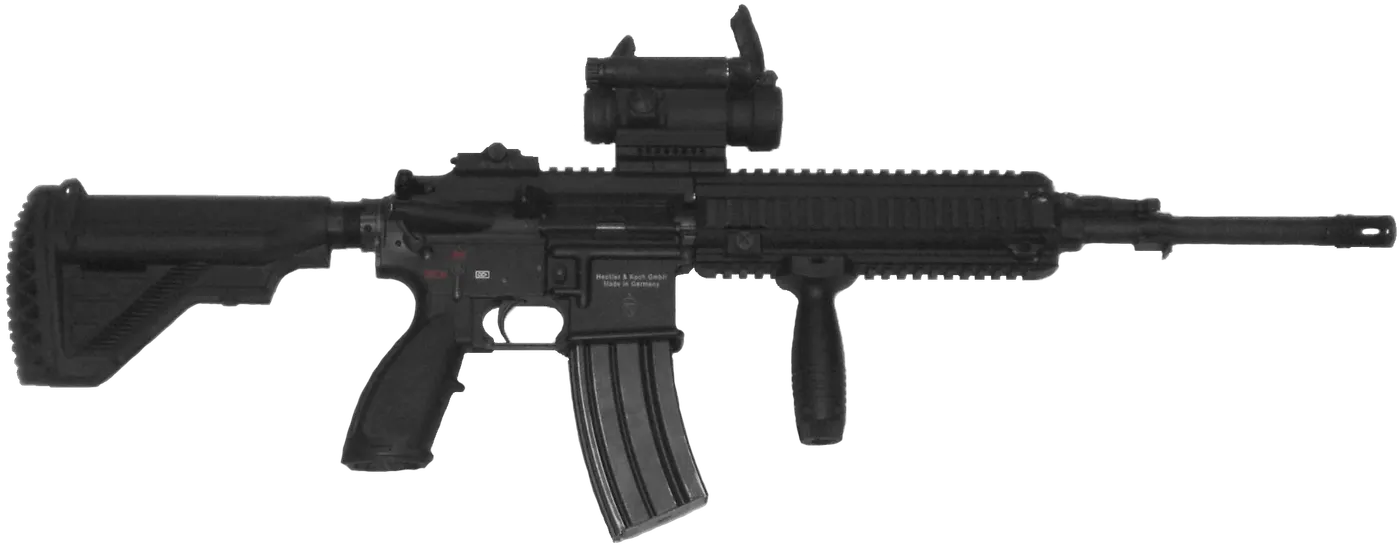

The Heckler & Koch HK416 is a 5.56×45mm NATO select-fire carbine that grew out of a private program between the German manufacturer Heckler & Koch and the United States Army's Delta Force in the 1990s. It belongs to the assault rifles category, and its defining feature is not the outer shape, which is unmistakably a Colt M4 pattern carbine, but what is inside the handguard. Where the M4 vents propellant gas straight back into the bolt carrier through a tube (direct impingement), the HK416 replaces that tube with a short-stroke gas piston borrowed from Heckler & Koch's own Heckler & Koch G36 rifle. That single change, keeping hot combustion gas out of the action, is the entire premise of the weapon and the reason armies that had grown tired of M4 stoppages started buying it.
- Gas piston keeps the action cleaner than direct impingement
- Drop-in compatibility with existing AR-15/M4 accessories and magazines
- Proven in extreme dust and high round-count testing
- Highly modular rail system, easy to reconfigure for different roles
- Piston system adds weight and a slight forward center of balance
- Meaningfully more expensive than a comparable M4 or AR-15
- Reciprocating piston rod can accelerate carrier tilt wear if not maintained
- Germany, France and Norway all needed years-long tenders before large-scale adoption
Delta Force operators, working through the unit's small-arms specialist Larry Vickers, pushed Heckler & Koch to solve two specific complaints. The Heckler & Koch MP5 submachine gun's 9mm round was judged too weak for the kind of barricaded, body-armored targets US special operations units were increasingly facing, and the M4 carbine, especially with a suppressor attached, ran hot and dirty enough that operators did not fully trust it in a sustained gunfight. Heckler & Koch's answer, first called the "HK M4," borrowed the AR-15 lower receiver's basic architecture (so existing furniture, optics and STANAG magazines would still fit) and married it to the piston system it had already refined on the G36 and on the abortive US Army XM8 program. Colt Defense, which held the M4 trademark, sued over the name, and Heckler & Koch renamed the rifle HK416, a designation deliberately built from "4" (M4) and "16" (M16).
Delta Force quietly adopted the HK416D in March 2005, after trials showed the piston design cut malfunctions and extended parts life compared with the unit's M4A1s.1 Within a few years the rifle had spread to the Navy SEAL Development Group and other Joint Special Operations Command elements, some of which reportedly bought early batches with their own discretionary funds rather than wait for a formal contract.2 It later became a flagship national-issue rifle for several NATO militaries, most visibly France, Norway and, from 2025, Germany itself, a notable turn given that a German company's rifle spent two decades as an unofficial special-forces favorite before it became the German Army's own standard-issue weapon.
{{photo-req side=right q="HK416 rifle Heckler Koch closeup rail system" caption="An HK416 fitted with a modular rail handguard and optic, the configuration most operators run in the field." alt="Heckler and Koch HK416 rifle with optic and rail accessories"}}
The HK416 is chambered for the standard NATO 5.56×45mm cartridge, weighs about 3.12 kg empty, and cycles at roughly 850 rounds per minute in full automatic. Its gas-piston operating system is often described as this article's central technical story, and for good reason: nearly every design decision after 2000, from the barrel life quoted by Heckler & Koch to the way military buyers justified the price premium over an M4, traces back to that one substitution of a piston rod for a gas tube.
Searches for "HK416 specifications" and "HK416 vs M4" both lead back to the same piston-versus-impingement question, and it remains the single most repeated talking point in reviews of the rifle nearly two decades after it entered service, precisely because the underlying mechanical difference never changed even as barrel lengths, rail systems and national designations multiplied around it.
At the core of the Heckler & Koch HK416 sits a gas-operated, rotating-bolt action that uses a short-stroke piston rather than direct gas impingement.1 Gas tapped from a port partway down the 419 mm barrel drives a piston forward of the chamber, which pushes an operating rod rearward to unlock and cycle the bolt carrier group. The piston and rod never contact the bolt itself, so fouling, carbon and unburned powder stay largely confined to the piston housing instead of coating the inside of the upper receiver and the bolt's locking lugs, which is the chronic complaint against the M4's direct-impingement system.3 Heckler & Koch engineers carried this system over almost directly from the Heckler & Koch G36, adapting it to fit inside an AR-15-pattern upper so existing rails, sights, stocks and pistol grips built for the M4 family would still bolt on.
- First Production Year2004
- Service Entry Year2004
- DesignerHeckler & Koch
- Weight (Empty)3.12 kg
- Weight (Loaded)3.74 kg
- Currently In ServiceYes
- Notable UsersNorwegian Armed Forces, United States Marine Corps, French Armed Forces, German Army, Delta Force, SEAL Team Six
The Short-Stroke Piston and Why Armies Paid More For It
Independent testing gave the design's proponents their strongest evidence. In a 2007 US Army dust chamber test that fired roughly 60,000 rounds through each rifle under simulated desert conditions, the HK416 recorded 233 stoppages against 882 for a comparable M4 (239 of which were traced to magazines rather than the rifle itself).3 Heckler & Koch's own factory demonstrations claimed 10,000 rounds fired fully automatic without a stoppage, and separate endurance runs pushed a test rifle past 40,000 rounds while it stayed within accuracy specification.4 Those numbers, more than any single combat anecdote, are what persuaded buyers to accept a unit price several times an M4's to re-equip whole battalions.
- Cartridge5.56×45mm NATO
- Calibre5.56 mm
- Case Length45 mm
- Calibre Classintermediate
- Bullet Weight4 g
- RimfireNo
- Caseless AmmunitionNo
The rifle's receiver is machined aluminum alloy with polymer furniture, and it carries MIL-STD-1913 Picatinny rail or, on later variants, M-LOK interfaces on all four sides of a free-floating handguard, so the barrel never touches the rail and point of impact does not shift when accessories are added.1 A folding, telescoping stock with several length-of-pull settings is standard, and every control, the safety/fire selector, magazine release and bolt catch, is ambidextrous.1 It feeds from detachable STANAG-pattern magazines, most commonly 30 rounds, and ships suppressor-ready with a tool-less adjustable gas regulator on later A5 and A7 models so the action can be tuned down when a can is fitted.5 Barrel steel is cold hammer forged with a 1:178 mm (1:7 inch) right-hand twist across six grooves, rated by the manufacturer for roughly 20,000 rounds of service life.6
- Action TypeGas-Operated
- Fire Modesselective fire
- Select FireYes
- Feed SystemDetachable Magazine
- Magazine Capacity30
- Cyclic Rate of Fire850
- Practical Rate of Fire36
- Trigger Typesingle-stage
- Safety Typeambidextrous selector
Muzzle velocity for the standard 419 mm barrel runs close to 853 m/s, giving an effective point-target range around 550 m and an effective area-target range near 700 m, figures broadly in line with other 5.56mm carbines of similar barrel length.1 The trigger is a conventional single-stage design, and the rifle is offered across a wide span of barrel lengths, from 10.4 inch close-quarters versions up to 20 inch designated-marksman configurations, all sharing the same gas-piston operated receiver set.
- Muzzle Velocity853.5 m/s
- Effective Range (point)550 m
- Effective Range (area)700 m
- Maximum Range3,600 m
- Sighting Range800 m
- Barrel Length419 mm
- Rifling Twist1:178 mm
- Rifling Grooves6
- Sight TypePicatinny rail–mounted front and rear iron sights, optional removable gas block-mounted flip-up front sight post
- Optic RailYes
- Iron SightsYes
- Receiver Materialaluminum alloy
- Furniture Materialpolymer
- Folding / Collapsing StockYes
- Bullpup LayoutNo
- Ambidextrous ControlsYes
- Modularityhighly modular with MIL-STD-1913 and M-LOK rails
- Production Start2004
- Width64 mm
- Height190 mm
The HK416's origin story begins not with a procurement office but with a unit that historically bought what it wanted and worried about paperwork later. Through the 1990s, Delta Force ran the Heckler & Koch MP5 for close-quarters work and the M4 carbine for anything requiring more range or penetration, but neither fully satisfied assaulters who increasingly faced body armor and needed a suppressed weapon that would not choke on carbon after a few hundred rounds.8 Unit armorer Larry Vickers is widely credited as the driving force on the American side, later calling the collaboration with Heckler & Koch engineer Ernst Mauch "the proudest success I've ever had in the firearms industry."9
{{photo-req side=left q="Larry Vickers firearms instructor portrait" caption="Larry Vickers, the former Delta Force operator and unit armorer credited with pushing Heckler & Koch to develop what became the HK416." alt="Larry Vickers, former Delta Force operator and HK416 development figure"}}
Heckler & Koch built the first prototypes around 2002, initially marketing the design as the "Heckler & Koch M4," a name that provoked an immediate trademark suit from Colt Defense, the M4's manufacturer of record.10 The company settled on HK416 instead, a designation formed from the M4 and M16 lineages it borrowed from. Development leaned heavily on Heckler & Koch's existing piston work, most directly the Heckler & Koch G36 already in German service, and on lessons from the abandoned US Army XM8 program and the British SA80 A2 upgrade, both of which the company had worked on in parallel.1
{{photo-req side=right q="Delta Force operators M4 carbine training 2000s" caption="US special operations personnel training with M4-pattern carbines in the years before the HK416 entered service." alt="US special operations soldiers with M4 carbines during training"}}
Delta Force formally began fielding the HK416D ("D" for Delta) in March 2005, after live-fire comparison testing against unit M4A1s showed markedly fewer stoppages and longer parts life under sustained automatic fire.2 Word of the rifle's reliability spread through the small American special-operations community quickly, and by 2006 elements of Joint Special Operations Command, including the Navy's SEAL Development Group (SEAL Team Six) and the Air Force's 24th Special Tactics Squadron, were running HK416s purchased outside standard Army procurement channels.11 That informal, operator-driven adoption path (units effectively buying their own rifles before any large service-wide contract existed) is unusual for a weapon that would go on to become a national standard-issue rifle in three NATO countries, and it shaped the HK416's reputation as an elite operator's weapon years before ordinary infantry battalions carried one.
{{photo-req side=left q="Abbottabad Pakistan map compound location" caption="A map of Abbottabad, Pakistan, where Osama bin Laden's compound stood at the time of the May 2011 raid." alt="Map showing Abbottabad, Pakistan"}}
The rifle's reputation crystallized publicly on May 2, 2011, when operators from SEAL Team Six's Red Squadron used HK416s as their primary weapon during Operation Neptune Spear, the raid on Osama bin Laden's compound in Abbottabad, Pakistan.12 Bin Laden was killed with 5.56mm rounds fired from an HK416, alongside a suppressed MP7 and a Mark 48 machine gun carried for support, and the mission's aftermath turned a rifle that had spent six years as a niche special-operations item into a household name.12
National-level adoption followed unevenly. Norway signed a contract in April 2007 to replace its aging AG-3 battle rifles (a domestic G3 derivative) with the HK416N, fielding roughly 40,000 rifles to the regular armed forces plus additional short-barreled variants for the Home Guard, becoming the first country to issue the HK416 as a full national infantry rifle rather than a special-operations item.14 France followed in September 2016, when the Direction Générale de l'Armement selected the HK416F to replace the notoriously ammunition-sensitive FAMAS bullpup, awarding a contract for 93,080 rifles split between a short 280 mm-barrel version and a longer 368 mm version compatible with underslung grenade launchers and the FÉLIN soldier system.13 First deliveries reached French units in May 2017, and the FAMAS is expected to remain only in reserve and training use through the late 2020s.13
The HK416 first saw sustained combat use with US special operations forces in the War in Afghanistan (2001–2021) and the Iraq War, where Delta Force and SEAL elements carried it alongside conventional units still issued the M4, and later spread to French and other NATO special-operations contingents fighting under the umbrella of the broader War on Terrorism.2 French forces used the FAMAS-era predecessor through most of that period, but French special units had already adopted HK416s well before the wider FAMAS replacement program, and they carried them during Opération Serval and its successor Opération Barkhane in Mali against Islamist insurgents during the Mali War.15
{{photo-req side=right q="French soldiers Operation Barkhane Mali patrol" caption="French troops on patrol during Opération Barkhane in the Sahel, where HK416-armed units operated against Islamist insurgent groups." alt="French soldiers on patrol during Operation Barkhane in Mali"}}
German special forces used HK416-family rifles (initially under the G38 designation) during operations tied to the Operation Inherent Resolve coalition campaign against the Islamic State, and French air and special-operations elements ran the same weapon family under Opération Chammal, France's contribution to the same anti-ISIS effort in Iraq and Syria.16 The rifle also appeared on both irregular and government sides of unrest during the Arab Spring and the subsequent Arab Winter, largely through captured or transferred stock from special-operations and interior-ministry units in the region, and it has been documented in the hands of Iraqi counter-terrorism forces during the Iraqi Civil War of 2014–2017 fight against the Islamic State.17
The most consequential single combat use remains the May 2011 raid on Bin Laden's compound, which is credited with accelerating interest in the rifle across allied special-operations communities that had watched America's most secretive units quietly re-equip with it years earlier.12 More recently, HK416-pattern rifles supplied by Western partners, principally the Netherlands, have appeared in Ukraine among units equipped during the Russian invasion, though most Ukrainian small arms remain Kalashnikov-pattern rather than HK416s.18
Heckler & Koch has produced the HK416 across an unusually wide span of barrel lengths and receiver revisions since 2004, and several major military customers have their own nationally designated versions.
- HK416D (10.4in / 14.5in / 16.5in / 20in): the original Delta Force-derived family, identified by the letter suffixes RS, denoting the rail system fitted.1
- HK416C: an ultra-compact 9.0in-barrel prototype developed for a US Army compact carbine requirement; it never entered full production and lost that competition to the LWRC M6A2.19
- HK416A5: the major mid-2010s revision, adding fully ambidextrous controls, a tool-less adjustable gas regulator for suppressed fire, an angled magazine well for broader STANAG magazine compatibility, and a slimmer non-adjustable stock derived from the Heckler & Koch HK417 marksman rifle's.5
- HK416A7 / A8: the current generation, with 45/90-degree selector options, a revised H-Key quick-detach handguard system, and relocated serial markings; the A8 forms the basis of Germany's G95 family.20
- M27 Infantry Automatic Rifle: the US Marine Corps' adaptation of the 16.5in D16.5RS, adopted in 2011 as a squad automatic weapon and, from 2018, as the Corps' standard infantry rifle, eventually displacing the M249 SAW, M16A4 and M4A1 across entire rifle squads.21
- HK416F: the French national variant delivered from 2017, offered in short (280 mm barrel) and standard (368 mm barrel) lengths, the latter compatible with the HK269F 40 mm grenade launcher and FÉLIN electronics.13
- HK416N: Norway's designation, including short-barreled HK416K and a designated-marksman HK416S variant issued alongside the standard-length rifle.14
- G38: Germany's earlier limited-issue special-forces designation for the HK416A5, adopted by Germany's Kommando Spezialkräfte special forces command in 2014 ahead of the later, much larger G95 program.20
- G95 / G95A1 / G95KA1: Germany's 2021-selected national standard rifle, based on the HK416A8, contracted for roughly 250,000 rifles to replace the Heckler & Koch G36 fleet-wide, with first deliveries to Bundeswehr infantry units beginning in May 2025.22
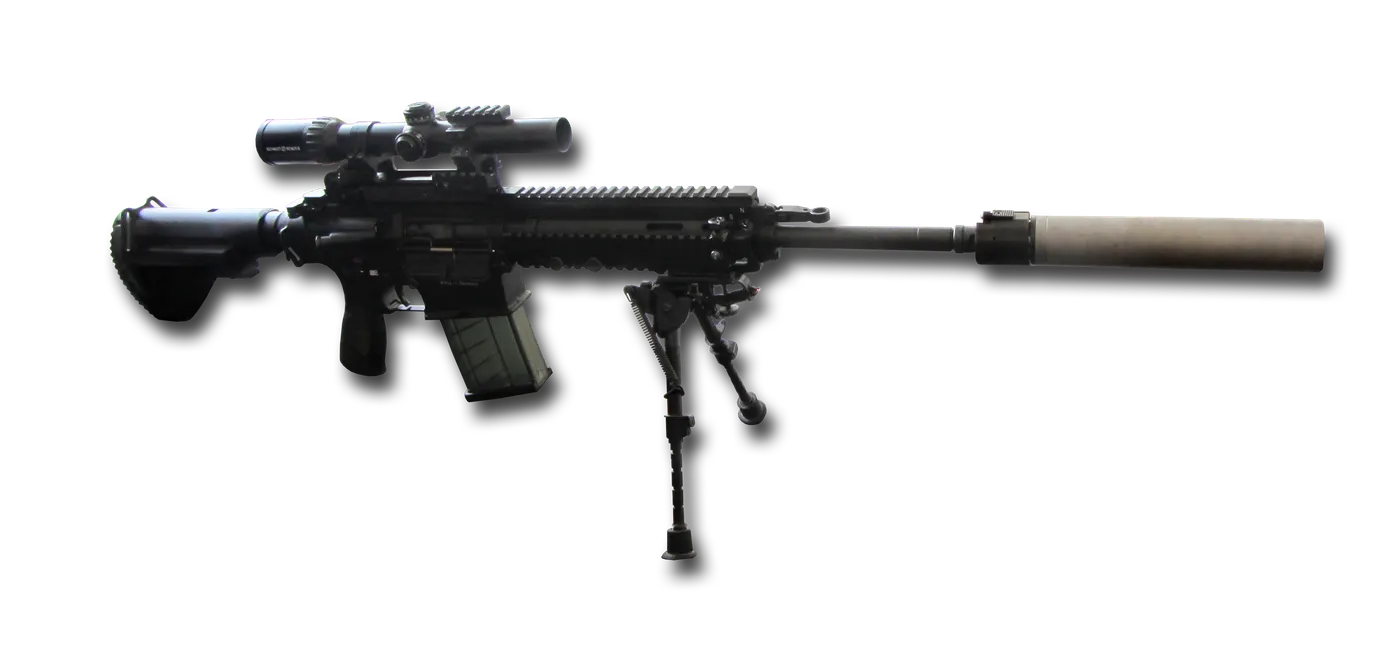
- HK417: a scaled-up 7.62×51mm NATO derivative sharing the same piston operating system, used as a designated-marksman and battle rifle rather than a standard-issue carbine.23
Civilian semi-automatic derivatives (the MR223/MR308 for the European market and MR556/MR762 for the United States) followed from 2007 onward, and Heckler & Koch's own engineers later left to found rival piston-AR programs, most notably the SIG516 and CAR816 lines at other manufacturers, after working on the HK416's original design.24
The sheer number of national designations, D, A5, A7, A8, F, N, G38, G95, is itself a useful answer to "is the HK416 still in production," since Heckler & Koch has kept the same core receiver in active manufacture continuously since 2004 by selling each generation of improvements as a new contract rather than a wholesale replacement rifle.


The HK416 is fielded across an unusually broad mix of national armies, special-operations units, and police tactical teams, reflecting its dual identity as both an elite operator's weapon and, in several countries, an ordinary infantry rifle.
{{photo-req side=right q="Bundeswehr soldier G95 rifle infantry 2025" caption="A German Army infantryman with the G95A1, the Bundeswehr's HK416A8-based rifle issued from May 2025." alt="German Bundeswehr soldier with G95A1 rifle"}}
Among the largest national contracts, Germany ordered roughly 250,000 G95A1/G95KA1 rifles beginning deliveries in 2025 to replace the G36 fleet-wide, France fields around 117,000 HK416Fs issued from 2017 to replace the FAMAS, and Norway equipped its regular armed forces and Home Guard with the HK416N from 2008 onward.13,14,22 In the United States, the rifle remains concentrated in special-operations units, principally Delta Force and the Navy's SEAL Development Group, plus roughly 14,100 M27 IARs issued Marine Corps-wide between 2011 and 2019.21 The United Kingdom issues HK416-family rifles to select special-operations elements rather than as a general-issue infantry weapon.
Smaller special-operations and police contracts span a long list of countries, including Ireland's Army Ranger Wing (from 2010), the Australian Defence Force and federal police (from around 2010), Brazil's Federal Police tactical units (from 2012), Poland's special operations command, Indonesia's Kopassus and Detachment 88, Malaysia's PASKAL naval special warfare unit, Singapore's and South Korea's police tactical teams, and NATO members Hungary, Lithuania, Estonia, Slovakia, Romania, Italy, Portugal, Luxembourg, Turkey, Sweden, Montenegro, Albania and Jordan, most of them equipping special-operations, gendarmerie or counter-terrorism units rather than whole armies.25 Serbia and the Kingdom of the Netherlands field it in their special-operations commands, and Dutch-supplied HK416A2 rifles form part of the small arms mix issued to some Ukrainian units since 2022.18 Philippine and Thai counter-terrorism units and Japan's Special Boarding Unit round out the operator list among Asian security forces.
Croatia briefly issued around 550 HK416s to its Special Operations Battalion between 2012 and 2015 before retiring the type, after which the unit shifted toward other rifle types in national service, an unusual case among HK416 operators of an early adopter stepping back rather than expanding its holdings.26
The HK416's closest ideological rival is not another 5.56mm carbine's stock chassis but the direct-impingement Colt M4 it was built to answer, and the argument between the two has never really been about accuracy or handling, both perform similarly at carbine ranges, but about what happens to the action after several thousand rounds and heavy suppressor use. Where the M4 vents hot gas straight into the bolt carrier, the HK416's piston keeps that fouling largely out of the receiver, at the cost of a few hundred grams of added weight and a small forward shift in balance that some shooters find changes recoil impulse under full-auto fire.3
A more useful comparison for procurement purposes is the FN SCAR-L, a Belgian rifle developed around the same period for the same US Special Operations Command market, and also gas-piston operated. Both rifles were built explicitly to solve the direct-impingement reliability question, but SOCOM ultimately narrowed its SCAR buy to the 7.62mm SCAR-H variant and continued procuring HK416/M4-family carbines in 5.56mm, effectively conceding the smaller-caliber contest to Heckler & Koch's design by 2010.3 The Steyr AUG, a bullpup with a similar gas-operated pedigree from the same era of NATO rearmament, competes on a different axis entirely, compactness without a folding stock versus the HK416's rail-driven modularity, and the two rarely appear as head-to-head contenders in the same tender.
| Spec | HK416 (16.5in) | FN SCAR-L | Colt M4 |
|---|---|---|---|
| Operating system | short-stroke gas piston | long-stroke gas piston | direct impingement |
| Cartridge | 5.56×45mm NATO | 5.56×45mm NATO | 5.56×45mm NATO |
| Weight (empty) | ~3.12 kg | ~3.29 kg | ~2.88 kg |
| Cyclic rate | ~850 rpm | ~625 rpm | ~800 rpm |
The clearest divide, though, is national-scale adoption. Both France's HK416F and Norway's HK416N replaced older-generation domestic rifles (the FAMAS and the Norwegian AG-3, a Heckler & Koch G3 derivative) rather than another AR-15-pattern weapon, which meant the comparison those governments actually cared about was piston reliability and modularity against an aging, harder-to-accessorize domestic design, not the HK416 against another carbine on a shooting range.13,14


What makes the HK416 different from a standard M4 carbine? The HK416 replaces the M4's direct gas impingement system with a short-stroke gas piston adapted from the Heckler & Koch G36, keeping combustion gases out of the bolt carrier and reducing fouling-related stoppages during sustained or suppressed fire.1
Is the HK416 still in service today? Yes. It remains in active service across dozens of militaries and police forces, and Germany began issuing its G95A1 variant, based on the HK416A8, to Bundeswehr infantry units starting in May 2025.22
What caliber and cartridge does the HK416 use? The standard HK416 is chambered in 5.56×45mm NATO. A larger 7.62×51mm NATO derivative exists separately as the Heckler & Koch HK417.23
How much does an HK416 cost? Military and law-enforcement contract prices have historically run from roughly 1,500 to 3,000 US dollars per rifle depending on configuration and order size, notably higher than a comparable M4 or civilian AR-15, which buyers have generally accepted in exchange for the piston system's reliability record.27
Was the HK416 used to kill Osama bin Laden? Yes. Members of SEAL Team Six's Red Squadron carried HK416s as their primary weapon during the May 2011 raid on bin Laden's compound in Abbottabad, Pakistan.12
What is the effective range of the HK416? With the standard 419 mm barrel, the HK416's point-target effective range is around 550 meters, extending to roughly 700 meters against area targets, broadly typical for a 5.56mm carbine of that barrel length.1
- "Heckler & Koch HK416", Wikipedia — en.wikipedia.org ↩
- "HK416 | Delta Force", American Special Ops — americanspecialops.com ↩
- "The Pentagon Has Slowly Fallen In Love With H&K's Take On The AR-15", The War Zone — twz.com ↩
- "10 Things You Didn't Know About the HK416", Motorsektionen — en.motorsektionen.dk ↩
- "HK 416 / HK416-A5 5.56mm x 45", Heckler & Koch USA — hk-usa.com ↩
- "The HK416: Heckler & Koch's Improved Fighting Rifle", American Rifleman — americanrifleman.org ↩
- "What's so special about the HK416?", HKPRO Forums — hkpro.com ↩
- "The history of the HK416 in modern warfare", Task & Purpose — taskandpurpose.com ↩
- "Larry Vickers on the HK416", X (formerly Twitter) — x.com ↩
- "Why is the HK416 Called the M416? Unpacking the Confusion and the Real Story", gloomba — gloomba.com ↩
- "AUSTRIA ARMS: H&K 416 CAG Style, the weapon of the Delta Force", SPARTANAT — spartanat.com ↩
- "Heckler & Koch's HK416, The Rifle that Killed Osama bin Laden", The National Interest — nationalinterest.org ↩
- "France Orders 12,000 German Heckler & Koch HK416 Assault Rifles To Replace Its FAMAS Guns", Eurasian Times — eurasiantimes.com ↩
- "Norwegian Home Guard Gets More HK416s and MP7s as AG-3 is Phased Out", The Firearm Blog — thefirearmblog.com ↩
- "Opération Barkhane", Wikipedia — en.wikipedia.org ↩
- "Operation Inherent Resolve", Wikipedia — en.wikipedia.org ↩
- "Iraqi Civil War (2014–2017)", Wikipedia — en.wikipedia.org) ↩
- "Small arms of the Ukrainian Ground Forces", Wikipedia — en.wikipedia.org ↩
- "HK416 Variations", HKPRO Forums — hkpro.com ↩
- "Germany to Replace G36 Rifle with New H&K G95A1 to Enhance Infantry Lethality", Army Recognition — armyrecognition.com ↩
- "Breakdown: M27 IAR vs. HK416", Military Times — militarytimes.com ↩
- "Bundeswehr Launches Transition to New G95 Rifles Based on HK416", Militarnyi — militarnyi.com ↩
- "Heckler & Koch HK417", Wikipedia — en.wikipedia.org ↩
- "Heckler & Koch HK416 rifle series", Internet Movie Firearms Database — imfdb.org ↩
- "Heckler & Koch HK416", Grokipedia — grokipedia.com ↩
- "List of equipment of the Croatian Army", Wikipedia — en.wikipedia.org ↩
- "How much does the HK416A5 cost MIL/LE?", HKPRO Forums — hkpro.com ↩