

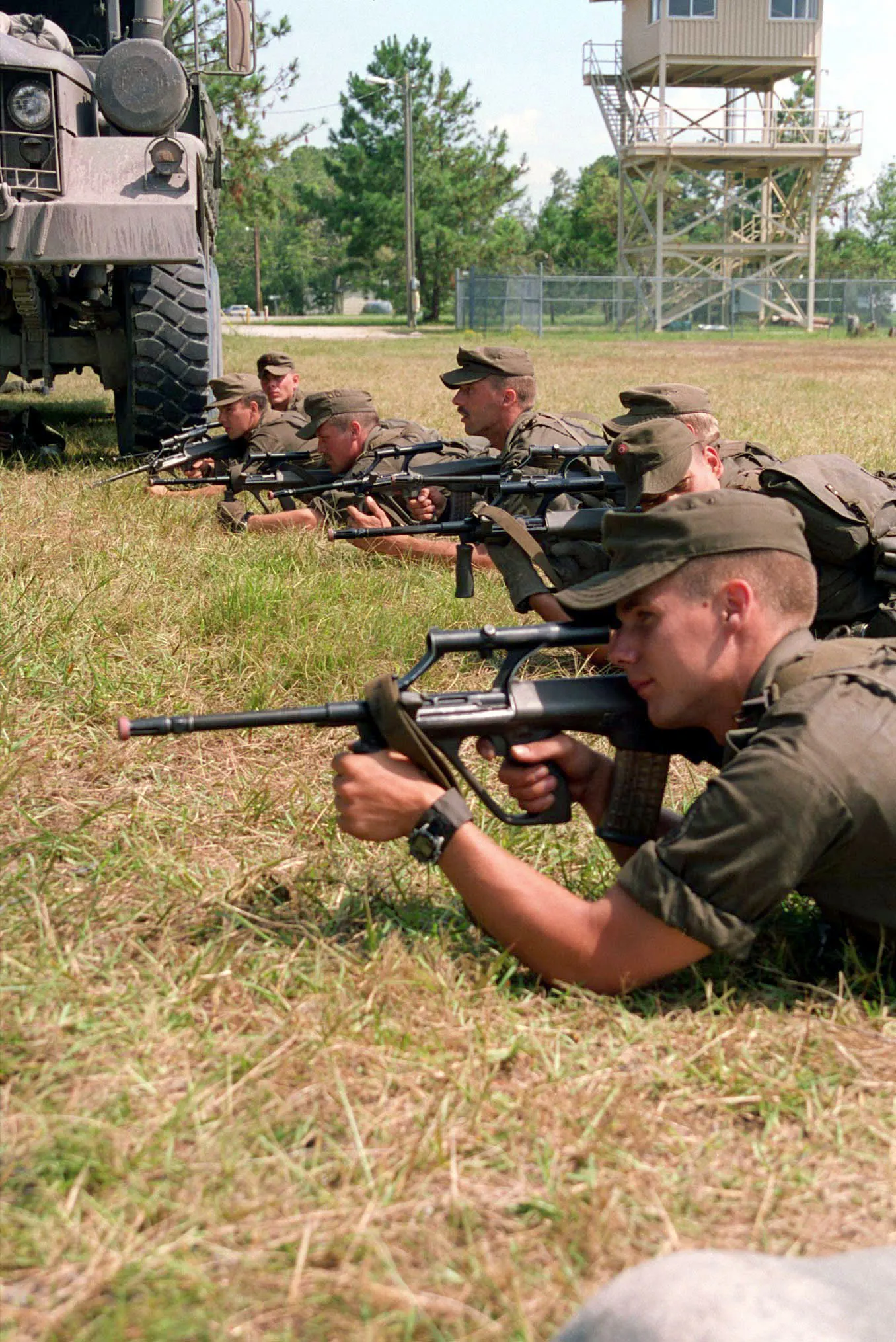

Few rifles changed the visual language of infantry weapons as sharply as the Steyr AUG. Adopted by the Austrian Armed Forces in 1977 as the Sturmgewehr 77 (StG 77), it was the first bullpup rifle to see genuinely widespread military service rather than a small trial run, and its production only started in earnest a year later, in 1978. The name AUG stands for Armee-Universal-Gewehr, German for army universal rifle, a label that reflects the original design brief. Steyr-Daimler-Puch (now Steyr Arms) wanted one receiver that could be reconfigured, by swapping the barrel and a few parts, into a carbine, a standard rifle, a sniper-length weapon, or a squad automatic. That single-receiver, multiple-role concept is one of the reasons the AUG is still cited today as an early modular weapon system, in any assault rifles discussion of the category.
- Compact overall length for a full-length barrel
- Modular barrel swap between carbine/rifle/HBAR roles
- Fully ambidextrous with a bolt and ejection-port swap
- Integrated 1.5x optic on the original A1
- Very high production quality and reliability record
- Bullpup balance shifts weight toward the shooter's shoulder
- Left-handed shooters need a parts swap, not a lever
- Original optic is fixed magnification, dated by modern standards
- Reloading drills differ from AR-pattern rifles taught in most NATO armies
- Never adopted by a NATO first-tier power (USA, UK, France, Germany)
The rifle fires the gas-operated, gas-piston-operated 5.56x45mm NATO cartridge from a rotating bolt, cycling through a long-stroke piston rather than direct impingement, a choice that keeps combustion gas out of the receiver and simplifies cleaning in the field. In the classic A1 form, the trigger itself sets the fire mode. A half pull fires one round, and pulling through to the back of the trigger travel switches to full automatic, a design decision the Austrians made instead of fitting a conventional select-fire lever. The stock A1 receiver also carries a built in 1.5x telescopic sight made by Swarovski Optik, with an emergency aiming notch pressed into its housing for use if the glass is damaged.
Because the working parts and magazine sit behind the pistol grip, the overall length of the Steyr AUG is roughly that of a submachine gun while the barrel remains full rifle length, at 508 mm (20 inches). That geometry is the entire argument for the bullpup layout, and the AUG's success is a large part of why later rifles such as the French FAMAS, the Chinese Type 95, and the Israeli Tavor adopted the same configuration.1 More than thirty countries have fielded the AUG since 1977, including Australia, New Zealand, Ireland, Saudi Arabia, Malaysia, and Tunisia, which makes it the most widely adopted bullpup rifle in history.2
{{photo-req side=right q="Steyr AUG rifle Austrian Army soldier" caption="An Austrian Army soldier with the Steyr AUG, the bullpup rifle that became the StG 77." alt="Soldier holding a Steyr AUG bullpup rifle"}}
The Steyr AUG's design work began in the late 1960s under Colonel Walter Stoll, who was tasked with finding a lighter intermediate cartridge and a rifle to fire it, after Austria's existing StG 58 (a licensed FN FAL) proved too heavy and too long for a smaller-statured conscript army.3 The engineering team, Horst Wesp, Karl Wagner, and Karl Möser, produced the first working prototype around 1970. Wesp in particular is remembered inside Steyr as the driving force behind the bullpup layout and the use of high-impact polymer for the receiver housing, a material choice that was unusual for a military rifle at the time and that kept the AUG's empty weight down to 3.6 kg.4
- First Production Year1977
- Service Entry Year1978
- DesignerHorst Wesp; Karl Wagner; Karl Möser
- Weight (Empty)3.6 kg
- Currently In ServiceYes
- Notable UsersAustrian Army, Australian Defence Force, Irish Defence Forces
The action rod that drives the bolt carrier does double duty. One end of it acts as a built-in carbon scraper for the gas cylinder, so routine field maintenance removes fouling as a byproduct of normal disassembly rather than requiring a separate tool.5 The magazine itself was translucent polymer from the start, a detail that reads as ordinary today but was a genuine novelty in 1977, letting a soldier glance down and see the remaining round count without pulling the magazine or counting shots fired.6 Steyr also fielded a 42-round magazine alongside the standard 30-round detachable-magazine box, decades before extended magazines of similar capacity became common on other rifle platforms.7
- Cartridge5.56×45mm NATO
- Calibre5.56 mm
- Case Length45 mm
- Calibre Classintermediate
- RimfireNo
- Caseless AmmunitionNo
Later variants refined rather than replaced the core layout. The AUG A2, introduced in December 1997, swapped the fixed telescopic sight for a detachable mount and added a Picatinny rail option, letting units fit red-dot or magnified optics as they became standard NATO equipment.8 The AUG A3 carries a full-length Picatinny rail across the receiver top and adds an external bolt release, closing one of the few genuine ergonomic complaints about the earlier models (the original bolt release is recessed inside the magazine well). A civilian A3 M1 and semi-automatic AUG/SA line have also been produced for the American market, though the fully-automatic military-pattern rifle itself has never been importable into the United States since 1989.9
- Action TypeGas-Operated
- Fire Modesselective fire
- Select FireYes
- Feed SystemDetachable Magazine
- Magazine Capacity30
- Cyclic Rate of Fire680
A dedicated squad-support version, the AUG HBAR (Heavy Barrelled Automatic Rifle, also marketed as the AUG LMG), swaps in a longer 621 mm heavy barrel with an integral bipod and fires from an open bolt rather than the closed-bolt setting used on the standard rifle, reducing the risk of a cook-off during sustained fire.13 A sniper-oriented HBAR-T variant adds a STANAG scope rail in place of the fixed optic, typically mounting a Schmidt & Bender or Kahles telescopic sight for designated-marksman work.14 Steyr also built a submachine gun branch of the family, the AUG Para chambered in 9x19mm Parabellum, later followed by the AUG A3 XS in the same caliber with interchangeable short barrels.
- Muzzle Velocity970 m/s
- Effective Range (point)300 m
- Maximum Range2,700 m
- Barrel Length508 mm
- Rifling Twist1:9
- Sight TypeSwarovski 1.5× telescopic sight, emergency battle sights, and Picatinny rail for various optics
- Optic RailYes
- Iron SightsYes
- Folding / Collapsing StockYes
- Bullpup LayoutYes
- Ambidextrous ControlsYes
- Modularitymodular weapon system
- Production Start1977
Austria adopted the rifle in 1977 to replace the StG 58, and the first units reached front-line infantry by 1979.15 The Steyr AUG's early export success came quickly. Australia ordered 67,000 rifles in 1985, manufactured under license by Australian Defence Industries (now Thales Australia) at the Lithgow Small Arms Factory, and fielded them as the F88 Austeyr starting in January 1989, replacing both the M16A1 and the L1A1 in Australian Army service.16 New Zealand followed with 5,000 Austrian-built rifles entering service in 1988 as the Individual Weapon, Steyr (IW Steyr), supplemented later by 15,000 more built in Australia.17 Ireland adopted the AUG A1 the same year, 1988, and ran a modernization program in 2014 that produced the locally-designated Steyr AUG Mod 14.
{{photo-req side=left q="F88 Austeyr Australian Army rifle" caption="The F88 Austeyr, the Australian license-built Steyr AUG variant produced at Lithgow." alt="Australian soldier with an F88 Austeyr rifle"}}
The United States market briefly carried a semi-automatic civilian AUG/SA in the 1980s, at a retail price around $1,099, before President George H.W. Bush's 1989 executive order banned the import of foreign-made semi-automatic rifles judged to lack legitimate sporting use. The AUG was one of the named platforms.19 Surviving pre-ban examples now trade as collector pieces, commonly $1,700 to $3,200 and occasionally higher depending on configuration, a price history that says more about American import law than about the rifle's original cost to a government buyer.20
Malaysia began licensed AUG production through SME Ordnance in 1991, later entering a joint-production agreement with Steyr in 2004 before a contract dispute over Malaysia's withdrawal from that arrangement led to litigation between the two parties.1 Steyr has separately fielded the AUG's derivatives with Dasan Machineries in South Korea and, more recently, with an Indian partnership involving Bharat Forge for F90-based production, extending the licensed-manufacture footprint well beyond its Austrian origin.
The AUG's compact, futuristic silhouette also made it a favorite prop choice for filmmakers well outside any real military context. It appears as Karl's rifle in Die Hard (1988), as police-issue hardware in RoboCop (1987) and The Running Man (1987), and later as a recurring weapon for The Governor in The Walking Dead (seasons 3 to 4). On the game side it became one of the signature rifles of Counter-Strike, and it has shown up across several James Bond licensed games including Agent Under Fire (2001).25
Argentine special-operations units carried a small number of AUGs during the 1982 Falklands War, where they supplemented the standard-issue FN FAL, marking one of the rifle's earliest documented combat appearances.18 The Falkland Islands Defence Force separately adopted the AUG in the early 1990s as its standard infantry rifle, a choice unrelated to the earlier Argentine use, and only began transitioning away from it toward the L85A2 roughly three decades later.21
The AUG has since appeared in the Gulf War, the Yugoslav Wars of the 1990s, the East Timorese crises of 1999 and 2006 (relevant to Australian and New Zealand peacekeeping deployments), the Syrian Civil War, and the War in Afghanistan (2001-2021), where it was carried by several of the smaller NATO-partner contingents whose national armies already used the AUG as a standard rifle, alongside larger-scale coalition deployment of American AR-15-pattern weapons.1
{{photo-req side=right q="Falkland Islands Defence Force soldiers rifles" caption="Falkland Islands Defence Force personnel, who armed themselves with the Steyr AUG as a standard rifle from the early 1990s." alt="Falkland Islands Defence Force soldiers with rifles"}}
More recently, Austrian-made rifles from the AUG family have surfaced on both sides of the Russian invasion of Ukraine. Reporting has documented Steyr Mannlicher bolt-action rifles reaching Russian army snipers through third-country intermediaries despite EU sanctions, and separate footage has shown AUG-pattern rifles in Ukrainian hands as well, though neither case reflects an official government-to-government export contract and both should be read as irregular battlefield-sourced weapons rather than confirmed state deliveries.22
Oman's army lists the Steyr AUG as its primary standard rifle, issued broadly across conventional infantry units, with M16 and M4-pattern rifles reserved mainly for specialist task units.23 Saudi Arabia received AUG rifles finished in desert tan furniture rather than the standard olive or black, a small but visible marker of a Gulf-specific order.2

The AUG A1 is the original production standard, with the fixed 1.5x optic-rail-integrated telescopic sight and a choice of olive or black polymer furniture. The AUG A2 (1997) replaced the fixed scope with a detachable mount and a Picatinny rail option. The AUG A3 added a full-length top rail and an external bolt release, and a .300 AAC Blackout chambering appeared on the A3 line in 2019 for the American market. A submachine gun branch, the AUG Para and later AUG A3 XS, is chambered in 9x19mm Parabellum with interchangeable short barrels for close-quarters and vehicle-crew use. Steyr also lists a semi-automatic AUG/SA and later USR (modified to comply with the 1994-2004 U.S. Federal Assault Weapons Ban) for the civilian and law-enforcement markets, plus the current-production civilian AUG A3 M1.
Australia's F88 Austeyr, built by Thales Australia at Lithgow, is the most significant foreign derivative, having evolved through several sub-variants (F88C carbine, F88S sniper-optic version) into the substantially redesigned EF88 rifle and the export-oriented Thales F90, a lighter, shorter development that Thales has also marketed internationally as a standalone rifle rather than strictly an AUG derivative.24 Malaysia's SME Ordnance produced its own AUG line locally from 1991, and South Korea's Dasan Machineries built the related DSR-90.
{{photo-req side=left q="Steyr AUG HBAR heavy barrel bipod" caption="The AUG HBAR, the heavy-barreled squad-support variant with an integral bipod, designed to fill a light machine gun role." alt="Steyr AUG HBAR with bipod deployed"}}

The Steyr AUG remains in active service with its country of origin, Austria, as well as Australia, New Zealand, Ireland, Luxembourg, Belgium, Malaysia, Saudi Arabia, Oman, Tunisia, Argentina, Uruguay (which fields roughly 15,000 units, one of the larger single national inventories outside the licensed-production countries), Pakistan, Morocco, Bangladesh, Sri Lanka, and a long list of smaller operators across Africa, the Balkans, and Southeast Asia, including Croatia, Serbia, Poland, Romania, Bulgaria, Czech Republic, and Moldova in the post-Yugoslav and post-Soviet space.2 Total confirmed production across all licensed and Austrian lines runs into the hundreds of thousands of rifles, though Steyr's own Austrian-built figures are comparatively modest, in the range of a few hundred thousand units, given how much of the worldwide AUG inventory was built abroad under license in Australia, Malaysia, and South Korea rather than in Austria itself.
{{photo-req side=right q="Steyr Arms factory production small arms" caption="Small arms production at a Steyr Arms facility in Austria." alt="Firearms manufacturing at a Steyr Arms plant"}}
The Steyr AUG and the Swiss SIG SG 550 both entered service within a few years of each other and both chase the same era's demand for a lighter, more compact 5.56mm rifle, but they solved the problem in opposite ways. Steyr shortened the rifle by moving the action behind the trigger group, while SIG kept a conventional layout and instead trimmed the SG 550's mass and length through material choice and a folding stock. The result is that the AUG achieves a shorter overall package with a full 508 mm barrel, something the SG 550 cannot match without giving up barrel length in its folded state, but the SG 550's conventional manual of arms is far closer to what most NATO-trained infantry already know, which is one reason Switzerland's rifle found buyers among European police and paramilitary units that never seriously considered a bullpup.
Set against the Israeli IWI Tavor X95, a rifle explicitly developed decades later to modernize the bullpup concept the AUG pioneered, the comparison is closer to lineage than rivalry. The Tavor X95 relocates its charging handle and improves ambidextrous ejection without a parts swap, addressing exactly the complaints (an awkward reload angle, the bolt-swap requirement for left-handed shooters) that critics have raised about the AUG for forty years. Where the AUG still wins is depth of combat and field-service history, four decades and over thirty operators, against the Tavor's newer and comparatively narrower service record.
| Spec | Steyr AUG | SIG SG 550 |
|---|---|---|
| Layout | Bullpup | Conventional |
| Barrel length | 508 mm | 528 mm |
| Empty weight | 3.6 kg | 4.1 kg |
| Muzzle velocity | 970 m/s | 920 m/s |
| Magazine capacity | 30 (42 optional) | 30 |
The Steyr AUG is still in service in Austria and in roughly thirty other militaries as of the mid-2020s, though several long-time operators are now transitioning toward newer platforms as their AUG inventories age out. The rifle's role as a formative bullpup design, rather than its raw combat record, is what secures its place alongside the SG 550 and the Tavor family in any serious discussion of late Cold War era small arms.


What does AUG stand for on the Steyr AUG rifle? AUG is short for Armee-Universal-Gewehr, German for army universal rifle, reflecting the original brief for one receiver reconfigurable into a carbine, rifle, or squad-support weapon.15
What caliber does the Steyr AUG use? The standard Steyr AUG is chambered for 5.56x45mm NATO, the same intermediate cartridge used by the AR-15 family and most modern NATO service rifles, though 9x19mm Parabellum submachine gun variants and a .300 AAC Blackout civilian A3 also exist.9
Is the Steyr AUG legal to own in the United States? The original fully-automatic military-pattern AUG has not been importable since the 1989 executive order restricting foreign semi-automatic rifle imports. Semi-automatic civilian versions, including the current AUG A3 M1, are produced domestically and remain legal to purchase in most states.19
How much does a Steyr AUG cost? A 1980s-era civilian AUG/SA retailed around $1,099. Pre-ban collector examples now commonly sell for $1,700 to $3,200, and current-production civilian AUG A3 M1 rifles are priced in a comparable modern range, well above the rifle's original cost due to import-ban scarcity rather than any change in manufacturing cost.20
What replaced the Steyr AUG in Australian service? Thales Australia's EF88, a substantially redesigned evolution of the license-built F88 Austeyr, has progressively replaced earlier F88 rifles in Australian Army service since the mid-2010s.
- "Steyr AUG", Wikipedia — en.wikipedia.org ↩
- "Steyr AUG: service rifles from around the world", Sandboxx News — sandboxx.us ↩
- "The Illustrious History of the AUG", Steyr Arms USA — steyr-arms.us ↩
- "The Steyr AUG: A Revolutionary Bullpup in Military History", Bereli Inc. — bereli.com ↩
- "Steyr AUG: Five Things You Didn't Know About It", The Firearm Blog — thefirearmblog.com ↩
- "7 Things You Didn't Know About the Steyr AUG", Motorsektionen — en.motorsektionen.dk ↩
- "Steyr AUG: Five Things You Didn't Know About It", The Armory Life Forum — thearmorylife.com ↩
- "Steyr AUG", Alchetron — alchetron.com ↩
- "Steyr AUG-A3: One of the Best Tactical Rifles/Carbines Available", Athlon Outdoors — athlonoutdoors.com ↩
- "At the Range: Steyr AUG", American Rifleman — americanrifleman.org ↩
- "The Steyr AUG: A Legendary Bullpup Rifle Built for Performance", Heresy Design — heresydesign.com ↩
- "AUGMENTATION: The Steyr AUG HBAR Light Machinegun", The Free Library — thefreelibrary.com ↩
- "Steyr AUG HBAR", Military Wiki — military-history.fandom.com ↩
- "Steyr AUG-LMG Light Machine Gun (LMG)", Military Factory — militaryfactory.com ↩
- "Steyr AUG Assault Rifle / Carbine Assault Weapon", Military Factory — militaryfactory.com ↩
- "Land Warfare - Austeyr: Small arms big business", Australian Defence Magazine — australiandefence.com.au ↩
- "Three Rifles, Three Countries: Australia - F90", GritrSports Blog — blog.gritrsports.com ↩
- "How did the Falkland Islands Defence Force end up being armed with the Austrian Steyr AUG bullpup assault rifle?", Quora — quora.com ↩
- "Steyr AUG SA Pre-Ban Firearm Guide", We Buy Guns — webuyguns.com ↩
- "How Much Can I Sell My Steyr AUG For? (2026 Value Update)", Cash For Arms — cashforarms.com ↩
- "Falkland Islands Defense Force retires Steyr AUG", militaeraktuell.at — militaeraktuell.at ↩
- "Russian snipers use Austrian rifles in war against Ukraine, despite EU sanctions", Euromaidan Press — euromaidanpress.com ↩
- "What military uses the Steyr AUG?", Quora — quora.com ↩
- "Thales EF88 / F90 assault rifle", Modern Firearms — modernfirearms.net ↩
- "Steyr AUG", Internet Movie Firearms Database — imfdb.org ↩