

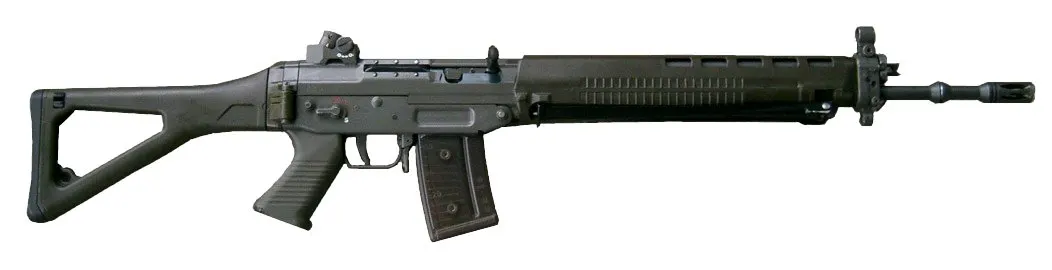

Every Swiss household with a serving conscript has, at some point, kept one of these rifles in a closet. The SIG SG 550, known domestically as the Sturmgewehr 90 (Stgw 90) or Fusil d'assaut 90, is the standard service rifle of the Swiss Armed Forces and one of the defining assault rifles of the late Cold War. It replaced the SG 510 battle rifle and its 7.5x55mm cartridge with a 5.56x45mm platform built specifically around Switzerland's unusual militia system, in which conscripts train with the weapon, then take it home for the length of their reserve obligation. Roughly 600000 units have been produced since 1986, and the design remains in first-line Swiss service more than three decades after adoption.
- exceptional accuracy for a service rifle
- passed extreme sand, mud, and cold-weather trials without failure
- modular family (carbine, compact, sniper, DMR variants)
- ambidextrous controls and folding stock
- magazines can be clipped together for fast reloads
- heavier than most NATO peers at over 4 kg empty
- expensive to manufacture compared to stamped-steel rivals
- US civilian variants faced repeated import and classification hurdles
- limited large-scale export compared to AR- and AK-pattern rifles
{{photo-req side=right q="SIG SG 550 rifle Swiss army" caption="A Swiss Armed Forces SG 550, the standard-issue Stgw 90, with its folding stock extended." alt="SIG SG 550 assault rifle"}}
The SIG SG 550 is gas-operated, fires from a closed bolt, and offers select-fire capability across safe, semi-automatic, three-round burst, and fully automatic settings, controlled by an ambidextrous selector lever. It was designed and originally built by Schweizerische Industrie Gesellschaft (SIG) at Neuhausen am Rheinfall, an arms division that was later spun off, renamed Swiss Arms, and eventually rebranded again in 2019 as SIG Sauer AG, the same Neuhausen entity now carrying the wider SIG Sauer brand name. The rifle chambers the Swiss 5.6x45mm GP 90 cartridge, which is dimensionally and ballistically compatible with 5.56x45mm NATO, and it feeds from a detachable magazine holding 20 or 30 rounds.
The SIG SG 550 sits alongside the AK-74, the Armalite AR-15 family, and the Steyr AUG as one of the small-caliber rifles that defined late Cold War infantry small arms. Unlike most of its NATO contemporaries, it was engineered less around low unit cost and more around the specific demands of a citizen-militia force, an origin story that still shapes how the rifle is discussed today.
The SIG SG 550's gas-operated system is a long-stroke, gas-piston design descended directly from the earlier SIG SG 540 and SG 541 prototypes. Propellant gas vents through a port in the barrel into a cylinder above it, driving the piston and a rotating bolt carrier rearward. A manually adjustable gas valve gives the shooter two settings, one for normal use and a second for heavy fouling or icing, a detail that reflects the rifle's alpine operating environment. The rotating bolt locks with two lugs into the barrel extension, a mechanism functionally similar in principle to the Kalashnikov system, though SIG's execution uses tighter tolerances and different metallurgy.1
- First Production Year1986
- Service Entry Year1990
- DesignerSchweizerische Industrie Gesellschaft
- Weight (Empty)4.1 kg
- Currently In ServiceYes
{{photo-req side=left q="SIG SG 551 carbine folding stock" caption="The SG 551 carbine variant with its side-folding stock collapsed, showing the compact profile used by mechanized and vehicle crews." alt="SIG SG 551 carbine with folded stock"}}
- Cartridge* 5.56×45mm NATO * 7.62×39mm (SG 553R, SG 556R & SIG563R) * .300 AAC Blackout (SG 553 BK and SIG563 BK) * 6.5mm Creedmoo
- Calibre5.56 mm
- Case Length45 mm
- Calibre Classintermediate
- Bullet Weight4.1 g
- RimfireNo
- Caseless AmmunitionNo
Muzzle velocity with standard GP 90 ammunition runs to roughly 911 m/s from the rifle's 528mm barrel, and the sighted effective range is rated at 400 meters, respectable figures for an intermediate 5.56mm cartridge. The 254mm (10-inch) rifling twist was optimized specifically for the 4.1 gram GP 90 projectile rather than for the heavier 62-grain bullets common in later NATO loadings, a distinction that matters to anyone trying to reproduce factory accuracy with generic 5.56mm ammunition.2
- Action TypeGas-Operated
- Fire Modesselective fire
- Select FireYes
- Feed SystemDetachable Magazine
- Magazine Capacity30
- Cyclic Rate of Fire700
The rear sight is a rotating diopter drum offering settings from 100 to 400 meters, with two tritium inserts flanking the short-range notch for low-light aiming, mounted on a 540mm sight radius that is long for a rifle of this length.1 The receiver accepts a Kern 4x24 telescopic sight on a proprietary quick-detachable bracket for designated-marksman use, and later production runs added optic rails compatible with modern red-dot and magnified sights, alongside the standard iron sights.3
- Muzzle Velocity911 m/s
- Effective Range (point)400 m
- Sighting Range400 m
Construction mixes a stamped-steel receiver with green or black high-strength polymer furniture for the folding stock, pistol grip, and handguards. Internal steel components, including the barrel, bolt, and bolt carrier, are gas-nitrided and hardened, and external steel surfaces carry a ceramic-reinforced enamel coating branded Ilaflon, a corrosion-resistance measure aimed squarely at decades of storage in Swiss basements and attics rather than a single deployment cycle.1 The skeletonized side-folding stock locks into a stud on the handguard and can be adjusted for cheek weld, and the trigger guard pivots open to either side to allow firing with heavy winter gloves, a feature few other NATO-era rifles bothered to include.4
- Barrel Length528 mm
- Rifling Twist254 mm (1:10 in)
- Sight Typediopter drum with tritium inserts
- Sight Radius540 mm
- Optic RailYes
- Iron SightsYes
The translucent polymer magazines hold 5, 10, 20, or 30 rounds and carry integral studs on their sides so two or three magazines can be clipped together for rapid changes, a jungle-style reload method borrowed from earlier AK and M16 field practice but built into the magazine itself rather than improvised with tape.3 An integral folding aluminum bipod stows inside the lower handguard, and the rifle accepts a GL 5040 or GL 5140 underbarrel 40mm grenade launcher that replaces the standard handguard, along with a Victorinox-made (formerly Wenger-made) bayonet compatible with NATO STANAG mounts.1
- Receiver Materialsteel
- Furniture Materialpolymer
- Folding / Collapsing StockYes
- Bullpup LayoutNo
- Ambidextrous ControlsYes
- Modularitymodular weapon system with multiple variants
- Total Production600,000
- Production Start1986
Switzerland began looking for a replacement for its 7.5x55mm SG 510 battle rifle in 1978, driven by the same logistical logic that pushed most of NATO toward smaller-caliber intermediate cartridges during the 1970s. Two Swiss designs competed for the contract, the state-run Waffenfabrik Bern's W+F C42 and SIG's SG 541, itself an evolution of the export-oriented SG 540. An experimental 6.45mm cartridge, the GP 80, was tested and ultimately rejected in 1981 in favor of a more conventional 5.6x45mm round, the GP 90, dimensionally compatible with the emerging 5.56x45mm NATO standard.1,2
{{photo-req side=left q="Jungfraujoch Swiss Alps glacier" caption="The Jungfraujoch glacier saddle in the Bernese Alps, where the SG 550 prototype underwent extreme cold-weather trials before adoption." alt="Jungfraujoch alpine testing location"}}
SIG's SG 541 design won the competition, and Switzerland's Federal Council publicly announced the selection in February 1983. The rifle was formally redesignated SG 550 in October 1984, with a shortened carbine variant becoming the SG 551. Budget constraints delayed full production until 1986, and the rifle only entered official Swiss military service in 1990, taking its Swiss designation Sturmgewehr 90 from that adoption year.1
{{photo-req side=right q="Swiss soldier militia rifle home storage" caption="A Swiss militia soldier with a Stgw 90, reflecting the country's tradition of conscripts keeping their service rifle at home." alt="Swiss conscript soldier with rifle"}}
Before adoption, the design underwent the kind of environmental torture testing that has since become part of its reputation. Sand and dust trials, run to NATO AC/225 protocols, involved dragging loaded rifles through sand at a fixed angle and speed and then requiring five clean shots afterward, all test rifles passed without malfunction. Cold-weather trials were conducted at the Jungfraujoch, a high-altitude glacier saddle in the Bernese Alps, simulating the kind of extreme alpine cold a Swiss mountain infantry unit might actually encounter.5
Production for the Swiss military has since ended, with the domestic order largely fulfilled, but the SIG SG 550 family continued in export and law-enforcement production for years afterward, and derivative sport-shooting and police variants remain in current manufacture.3 Switzerland's own militia culture, in which the assault rifle genuinely lives in a family home rather than a barracks, shaped design choices, from the corrosion-resistant coatings to the deliberately over-engineered receiver, that a purely military procurement process might not have prioritized.4
Switzerland's own armed forces have not fought a war since the SIG SG 550 entered service, so most of the rifle's combat exposure has come through export operators rather than Swiss deployments. Egypt, an SG 550-family operator, has used carbine variants among its security and counterterrorism units during the long-running Sinai insurgency against Islamic State-aligned militants in the northern Sinai Peninsula, an insurgency that began in 2011 and has drawn Egyptian regular and special forces into sustained counterinsurgency operations.7
{{photo-req side=left q="Sinai Peninsula map Egypt" caption="The northern Sinai Peninsula, where Egyptian security forces have conducted a long counterinsurgency campaign against Islamic State-aligned militants." alt="Map of the Sinai Peninsula"}}
Saudi Arabia operates SG 556 SWAT and related short-barreled carbines with its naval and special operations units, forces that were folded into the Saudi-led coalition intervention in the Yemeni Civil War beginning in 2014, though independent confirmation of the specific rifle in frontline Yemeni combat photography is thinner than for more widely photographed coalition small arms.8
Elsewhere, the SG 551 and SG 553 SOW carbines equip elite units whose parent states, including France's Special Operations Command and Germany's GSG 9 and state SWAT teams, contributed special operations forces to the War in Afghanistan, though the SIG carbines there served alongside, rather than in place of, each country's more commonly issued rifles.3 Because the SG 550 family was never adopted as a first-line NATO rifle and was comparatively expensive to procure at scale, it appears in these conflicts mainly in the hands of special forces, police tactical units, and dignitary-protection details rather than as a mass-issue infantry weapon.
The SIG SG 550 spawned one of the more thoroughly developed rifle families of the late twentieth century. The SG 551 is the standard carbine, with a shorter 363mm barrel and no bayonet lug or grenade-launching capability, built for vehicle crews, paratroopers, and support troops who need a more compact package than the full-length rifle.1
The SG 552 Commando, released in 1998, shortened the platform further to a 226mm barrel with an internal redesign, the gas piston fixed directly to the bolt carrier and the recoil spring relocated behind the bolt, more reminiscent of an AK-47's internal layout than the original SG 550/551 arrangement. That redesign introduced reliability complaints in harsh conditions, which SIG addressed with the SG 553 in 2008, restoring a recoil spring wrapped around the piston rod as on the SG 550/551 and allowing the SG 553 to accept the earlier models' charging handle.1 Later SG 553 variants extended to different calibers entirely, including the SG 553 R chambered for 7.62x39mm and compatible with AK magazines, and the SG 553 BK in .300 AAC Blackout, both aimed at export and law-enforcement customers wanting ballistics closer to a short-barreled AK-pattern carbine.
{{photo-req side=left q="SIG 556 rifle civilian STANAG magazine" caption="The SIG 556, the American civilian variant built in Exeter, New Hampshire with an aluminum lower accepting standard M16 magazines." alt="SIG Sauer 556 civilian rifle"}}
A dedicated marksman line grew out of the family as well. The SG 550-1 Sniper, introduced for Swiss police in 1988, added a two-stage trigger, a longer 650mm hammer-forged barrel, an adjustable cheek piece, and no flash hider, and is no longer in production.9 SIG later announced full-power SG 750 (6.5mm Creedmoor) and SG 751 SAPR (7.62x51mm NATO) variants in 2004, with the SG 751 subsequently adopted by Switzerland as a designated marksman rifle.
In the United States, import restrictions on foreign military-pattern rifles blocked direct sale of Swiss-built SG 550-family guns, so SIG Sauer built a partially American-made civilian variant, the SIG 556, assembled in Exeter, New Hampshire, with an aluminum lower receiver that accepts standard M16 STANAG magazines instead of the proprietary SIG magazine well.10 The SIG 556 line ran through several sub-variants, including the SIG 556 Classic, SIG 556 DMR, and a 7.62x39mm SIG 556R introduced in 2012, before SIG Sauer discontinued the whole 556 series in May 2017 in favor of newer platforms like the SIG MCX.3 Semi-automatic-only sport versions of the original Swiss design, sold as the SG 550/551/552 SP, PE 90, and SIG Sport, remain popular with civilian shooters and collectors, particularly in Switzerland itself, where they trade at a considerable premium over most other semi-automatic rifles.11


The Swiss Armed Forces remain by far the largest operator, with roughly 450000 SG 550-family rifles in the national inventory, more than three quarters of total production.1 Beyond Switzerland, the rifle serves in more than 30 countries, concentrated heavily in special forces, police, and paramilitary roles rather than as a general-issue infantry rifle. France's Special Operations Command and its National Gendarmerie Intervention Group use SG 551 and SG 553 SOW carbines, Germany's GSG 9 counterterrorism unit and various state police tactical teams field the SG 553 SOW, and Poland's elite GROM unit historically issued the SG-551P, though GROM has since transitioned much of its inventory toward the Heckler & Koch HK416.3
{{photo-req side=right q="Pontifical Swiss Guard rifle Vatican" caption="A member of the Pontifical Swiss Guard, one of the more unusual operators of the SIG SG 550 family, on duty at the Vatican." alt="Pontifical Swiss Guard soldier with rifle"}}
India's National Security Guard acquired around 675 SG 551 carbines following the 2008 Mumbai attacks as part of a broader post-attack equipment upgrade, while Malaysia fields SG 553 LB and SB variants with its Grup Gerak Khas special forces and PASKAU air force commandos, and Indonesia issues SG 550, SG 552, and SG 550-1 variants across Kopassus, Kopaska naval special warfare, and Marine Corps units.1 In the United States, the DEA, FBI, and US Capitol Police SWAT teams have all fielded SG 551 or SG 553 SOW carbines, and the Pontifical Swiss Guard, the ceremonial and protective force of Vatican City, carries SG 550 and SG 552 rifles as a rare case of a genuinely military-grade rifle serving a body whose public image is almost entirely ceremonial.1
Other confirmed operators include Argentina, Brazil (Federal Police and Air Force PARA-SAR), Canada, Egypt, Finland, Romania, Saudi Arabia, Serbia, Slovakia, Spain, Taiwan, Tunisia, Turkey, and several United Kingdom police constabularies. Canada's relationship with the civilian PE 90 variant has been unusually turbulent, semi-automatic versions were reclassified as prohibited weapons in February 2014 after a dealer imported them, reversed by the federal government in 2015 following lobbying from firearms owners, then prohibited again by order-in-council in May 2020 following the Nova Scotia mass shooting.12
Switzerland and Austria solved almost the same problem in opposite ways within a few years of each other. Austria adopted the Steyr AUG in 1978, and Steyr went bullpup to shorten overall length without sacrificing barrel length, while SIG kept a conventional rifle layout and instead built a folding stock and modular carbine family around it, betting that a militia force that stores rifles in bedroom closets values field-serviceability and familiar handling over the AUG's more compact silhouette. The SG 550 outweighs the AUG by a noticeable margin empty, but Swiss trials data and independent civilian range testing both consistently rate the SG 550's practical accuracy as better than the AUG's factory-standard 1.5 MOA ceiling.13
Against the Armalite AR-15 family that dominates US and much of NATO's small arms inventory, the comparison is really one of procurement philosophy rather than mechanism. Both rifles are gas-operated and select-fire capable in military form, but the AR-15's direct-impingement or short-stroke piston variants were engineered from the outset for mass, low-cost production across a huge industrial base, while the SG 550's long-stroke piston system and machined-steel internals were engineered for a small, wealthy country's decades-long ownership cycle. That difference shows up directly in price, a used SIG SG 550/551 civilian rifle in the United States commonly sells in the $3500 to $6500 range depending on configuration and condition, several times the cost of a comparable semi-automatic AR-15, a price gap that has limited the SIG design's civilian market share despite its reputation for superior out-of-box accuracy.14
| Spec | SIG SG 550 | Steyr AUG |
|---|---|---|
| Cartridge | 5.56x45mm NATO (GP 90) | 5.56x45mm NATO |
| Layout | Conventional, folding stock | Bullpup |
| Weight (empty) | 4.1 kg | approx. 3.6 kg |
| Effective range | 400 m | 300 to 500 m depending on variant |
| Adopted | 1990 (Switzerland) | 1978 (Austria) |
The SIG SG 550 is still in service. It remains the primary Swiss service rifle more than three decades after adoption, and the family continues in production for police, sport, and export markets even though the original Swiss military production run has ended.


What caliber does the SIG SG 550 use? The SIG SG 550 is chambered for the Swiss 5.6x45mm GP 90 cartridge, which is dimensionally interchangeable with standard 5.56x45mm NATO ammunition, though the rifle's 10-inch rifling twist was optimized for GP 90's lighter 4.1 gram bullet.2
Is the SIG SG 550 still in service? Yes. It remains the standard-issue rifle of the Swiss Armed Forces and continues in service with more than 30 other operators worldwide, mostly in special forces, police, and paramilitary roles, even though large-scale Swiss military production ended years ago.1
How much does a SIG SG 550 cost? Civilian semi-automatic SG 550/551 rifles in the United States typically sell between roughly $3500 and $6500 depending on configuration, condition, and import history, a price well above most AR-15 or AK-pattern civilian rifles.14
What is the difference between the SIG SG 550 and SG 551? The SG 550 is the full-length rifle with a 528mm barrel, bayonet lug, and grenade-launching capability. The SG 551 is a shorter carbine, at 363mm barrel length, intended for vehicle crews, paratroopers, and support troops, without the bayonet lug or grenade launcher mount.1
Why is the SIG SG 550 so expensive to manufacture? The rifle uses a stamped and machined steel receiver, gas-nitrided internal components, and a corrosion-resistant ceramic enamel coating, all chosen for multi-decade durability under Switzerland's militia system, where conscripts store their personal rifle at home for years rather than returning it to a central armory after each training cycle.1,4
Why can't Americans buy the original Swiss-made SIG SG 550? US import restrictions on foreign-made military-pattern rifles blocked direct import of the Swiss SG 550/551/552, which is why SIG Sauer built the domestically assembled SIG 556 variant in New Hampshire instead, with a modified magazine well accepting standard M16-pattern magazines.10
- "SIG SG 550", Wikipedia — en.wikipedia.org ↩
- "SIG 550 / Stgw 90: The Swiss Kalashnikov", Forgotten Weapons — forgottenweapons.com ↩
- "SIG 550 series", Modern Firearms — modernfirearms.net ↩
- "The Swiss SIG SG 550 – Service rifles from around the world", Sandboxx News — sandboxx.us ↩
- "SIG 550 / 551 Technical Data and Test Documentation", Biggerhammer.net — biggerhammer.net ↩
- "2011 Swiss gun control initiative", Wikipedia — en.wikipedia.org ↩
- "Sinai insurgency", Wikipedia — en.wikipedia.org ↩
- "Saudi-led intervention in the Yemeni civil war", Wikipedia — en.wikipedia.org ↩
- "SIG 550-1 Sniper: Answering a Question Nobody Asked", Forgotten Weapons — forgottenweapons.com ↩
- "SIG556", NamuWiki — en.namu.wiki ↩
- "SG 550 rifle price and historical value", TrueGunValue — truegunvalue.com ↩
- "Swiss Arms Export Ban: Consequences and Challenges for SIG and B&T", Ronin's Grips — blog.roninsgrips.com ↩
- "Is the Sig Sg 550 the most accurate of all assault rifles?", Quora — quora.com ↩
- "SIG Sauer SG 550 For Sale, Review, Price", GunCritic — guncritic.com ↩