

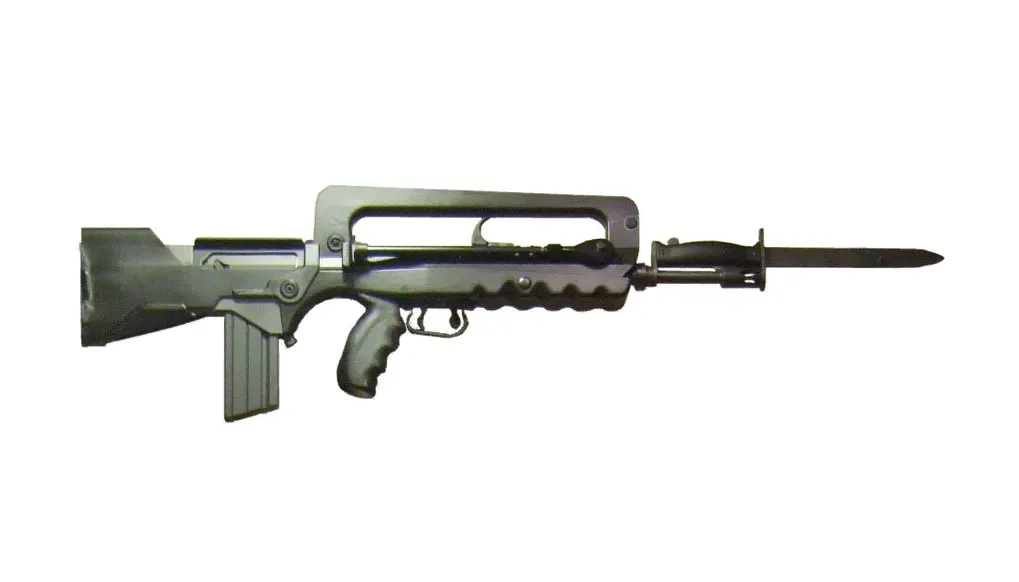

The FAMAS is a French bullpup assault rifle chambered for 5.56×45mm NATO, adopted by the French Army in 1978 and manufactured at the state-owned Manufacture d'Armes de Saint-Étienne (MAS) plant in Saint-Étienne.1 Troops nicknamed it le Clairon (the Bugle) for the flared, horn-like shape of its carrying handle and muzzle assembly, and the name stuck harder than the rifle's official designation ever did.2 For nearly four decades it was the rifle every French conscript and professional soldier trained on, fired for the first time on a firing range, and in many cases carried into combat from Chad to Afghanistan.
- compact bullpup length with a full-length barrel
- genuinely ambidextrous controls, safety and ejection
- light weight for a NATO-caliber rifle
- controllable at 1,000 rpm cyclic rate
- simple to strip and clean in the field
- proprietary steel-cased ammunition dependency (F1)
- fragile polymer furniture, especially the cheek riser
- incompatible with standard STANAG magazines (F1)
- ejection close to a left-handed shooter's face
- production tooling lost when MAS closed in 2002
What sets the FAMAS apart mechanically from almost every other 5.56mm service rifle of its generation is its operating system. Instead of tapping propellant gas to cycle the action like the M16 family, the Steyr AUG, or the AK-74, the FAMAS uses a lever-delayed blowback mechanism, a system with roots in Hungarian designer Pál Kiráfy's interwar experiments and previously used in the French AA-52 machine gun.3 Lead designer Paul Tellié, a French Army officer, adapted that lever-delayed principle for a compact, magazine-fed, select-fire rifle, and the resulting weapon became one of the first NATO-standard bullpups ever put into mass production, alongside the Steyr AUG that entered Austrian service the same year.4
Roughly 400,000 to 410,000 FAMAS rifles were built across F1 and G2 production runs between 1978 and the early 2000s, the overwhelming majority for the French armed forces themselves.5 Exports never approached the scale of the AK family, the M16/M4 line, or the FN FAL, but a small cluster of former French client states and one notable post-2022 wartime buyer (Ukraine) kept the rifle circulating well past its planned retirement.6 France began replacing the FAMAS in frontline units with the Heckler & Koch HK416, locally designated HK416F, starting in 2017, with full drawdown from active service not expected before 2028.7
{{photo-req side=right q="FAMAS F1 rifle French soldier bullpup" caption="A French Army FAMAS F1, the bullpup rifle that armed most of France's ground forces from 1978 into the 2010s." alt="French soldier holding a FAMAS F1 bullpup assault rifle"}}
The Lever-Delayed Blowback System That Makes the FAMAS Mechanically Unique
The FAMAS does not use a gas piston or a rotating bolt to control its cycle of fire. Instead, a pivoting lever inside the receiver multiplies the bolt's effective mass during the instant of peak chamber pressure, delaying its rearward travel just long enough for pressure to drop to a safe level before the case is extracted.3 Paul de Kiráfy pioneered the underlying concept before the Second World War, and French ordnance engineers had already proven a similar delayed-blowback design in the AA-52 machine gun before Tellié scaled the idea down to rifle size.3 The result is a mechanically simple action with no gas port, no gas tube, and no gas piston to foul with carbon, which is part of why the FAMAS is classed as not gas-piston operated despite being a fully select-fire automatic weapon.
- First Production Year1975
- Service Entry Year1978
- DesignerPaul Tellie
- Weight (Empty)3.61 kg
- Currently In ServiceYes
- Notable UsersFrench Armed Forces, GIGN, Brazilian Special Forces, Cameroonian BIR, Chadian Presidential Guard and Army, Djibouti, Gabon, Central African Republic, Cambodia, Argentina
That simplicity came with a real cost. The original FAMAS F1's lever-delayed action was tuned specifically around French-made steel-cased 5.56×45mm ammunition, not the brass-cased NATO-standard rounds used by allied armies.8 Firing standard brass-cased NATO ammunition in an F1 can produce excessive case friction against the chamber walls and, in some documented instances, case ruptures during extraction.8 This single design choice, made to save money on ammunition production in the 1970s, would come back to complicate French logistics for the rest of the rifle's service life.
- Cartridge5.56×45mm NATO
- Calibre5.56 mm
- Case Length45 mm
- Calibre Classintermediate
- Bullet Weight55 g
- RimfireNo
- Caseless AmmunitionNo
Bullpup Layout, Ambidextrous Controls and the *Le Clairon* Silhouette
Placing the action and magazine behind the trigger group, the classic bullpup layout, let MAS fit a 488mm barrel into a rifle only 757mm long overall, shorter than a folded-stock AK-74 yet with a longer barrel than an unfolded one.10 At roughly 3.6 to 3.8 kg unloaded, the FAMAS was also one of the lightest 5.56mm service rifles of its generation, noticeably lighter than the contemporaneous Steyr AUG.11 Tellié's team built genuine ambidextrous controls into the design from the outset, with a reversible ejection port cover and a selector/safety usable from either side, a feature many rival bullpups of the era (including early AUG variants) did not offer as standard.12 The tradeoff of any bullpup remains ejection proximity to the shooter's face on the off side, and left-handed FAMAS users still had to either fire from the right shoulder or accept spent brass ejecting close to their cheek.
- Action TypeLever Action
- Fire Modessemi-automatic, automatic, 3-round burst
- Select FireYes
- Feed SystemDetachable Magazine
- Magazine Capacity25
- Cyclic Rate of Fire1,000
- Trigger Typesingle-stage
- Safety Typeselector switch
{{photo-req side=left q="Steyr AUG bullpup rifle Austrian army" caption="The Steyr AUG, Austria's contemporary bullpup, reached NATO service the same year as the FAMAS and offers a direct design comparison." alt="Steyr AUG bullpup assault rifle on display"}}
- Muzzle Velocity930 m/s
- Effective Range (point)300 m
- Maximum Range3,200 m
The furniture is largely fiberglass-reinforced polymer over a steel receiver, chosen to keep weight down, but it proved to be one of the rifle's recurring weak points.13 Early F1s in field use developed a reputation for cracking cheek risers and other snapped polymer components under hard use, a criticism that surfaces repeatedly in French veterans' accounts of the rifle decades later.13 The FAMAS carries a top-mounted accessory rail (added or revised across variants), fixed iron sights with tritium night inserts on the rear aperture, an integral bipod folded into the fore-end, a bayonet lug, and grenade-launching capability via its muzzle device, all standard equipment for a NATO rifle of the late Cold War.
- Barrel Length488 mm
- Rifling Twist1/12 inch (F1), 1/9 inch (G2)
- Sight TypeRear aperture fitted with tritium night inserts, front post
- Optic RailYes
- Iron SightsYes
- Threaded BarrelNo
F1 versus G2, Steel Cases and the STANAG Magazine Problem
The original FAMAS F1 used proprietary 25-round magazines and would not reliably feed standard NATO STANAG magazines at all.14 That incompatibility became a serious interoperability problem once France began operating alongside NATO partners more routinely after the Cold War, when resupply from a coalition ammunition point or a captured/borrowed magazine simply would not work in an F1. MAS answered with the FAMAS G2 in 1994, redesigning the magazine well and magazine catch to accept common 30-round STANAG magazines, tightening the barrel's rifling twist to 1 turn in 9 inches so it could handle both 55-grain and heavier 62-grain NATO ammunition, and enlarging the trigger guard for use with winter gloves.15 Despite the G2 fixing the exact interoperability flaw that would eventually help doom the FAMAS in French service, the French Army itself never adopted the G2 in large numbers, leaving it mainly to the French Navy, which purchased G2s from 1995 for its Fusiliers Marins and Commandos Marine.16
- Receiver Materialsteel
- Furniture Materialfiberglass, plastic
- Folding / Collapsing StockNo
- Bullpup LayoutYes
- Ambidextrous ControlsYes
- Modularityaccessory rail for optics, FÉLIN system integration
- Total Production410,000
- Production Start1975
- Production End2000
- Unit Cost1,500 USD
- Variants5
From a 1967 General Staff Requirement to the 1978 F1 Adoption
Development began in 1967, when the French general staff asked for a compact rifle able to replace both the aging MAS-49/56 battle rifle and the submachine guns then equipping vehicle crews and support troops.17 General Paul Tellié, working within the state arsenal system, produced a working prototype by the end of the 1960s, and French military trials ran through the early 1970s.17 By 1976 the design was essentially finalized, and in late 1978 the French military formally accepted it as the standard-issue FAMAS F1, with the first production rifles reaching troops from 1979.1 Full-scale fielding across the French Army, Air Force, and Navy took several more years, meaning the FAMAS did not fully displace the older MAS-49/56 in every unit until the early-to-mid 1980s.
Combat Debut in Chad, the Gulf War and the Rifle's Reliability Record
French troops carried the newly issued FAMAS into Chad during Opération Manta in the early 1980s, an early proving ground for the rifle in harsh, dusty conditions far from a European armory.19 It saw far larger exposure less than a decade later, when French ground forces carried the FAMAS during the 1990-1991 Gulf War as part of the coalition that liberated Kuwait, operating in similarly abrasive desert environments.20 Field reports from that era generally describe the FAMAS as comfortable to shoulder, accurate at typical infantry engagement ranges, and easy to control in three-round-burst or full-automatic fire given its light weight and low recoil impulse, without the kind of chronic jamming complaints that dogged rival bullpups like Britain's contemporary SA80.21
{{photo-req side=right q="Operation Desert Storm French army 1991 Daguet division" caption="French troops of Division Daguet during the 1990-1991 Gulf War, one of the FAMAS's largest early combat deployments." alt="French Gulf War soldiers of Division Daguet in 1991"}}
The FÉLIN Program, the G2's Quiet Navy Career, and Manufacturing Collapse
MAS itself stopped producing weapons in 2001 when the historic Saint-Étienne arsenal was folded into the state defense conglomerate GIAT Industries, later rebranded Nexter and today part of the Franco-German KNDS group that includes KNDS France.22 Losing the dedicated MAS production line meant France lost the ability to build new FAMAS rifles domestically, and the specialized steel-case ammunition the F1 depended on stopped being manufactured not long after, both factors that later pushed the French military toward a foreign-made replacement rather than a FAMAS refresh.23 A dedicated FÉLIN-integrated FAMAS variant appeared around 2010 for infantry units equipped with France's digital soldier system, adding rail space and electronics compatibility without changing the underlying action.24
Selecting a Replacement, the Path to the HK416F
France opened a formal competition to replace the FAMAS in the 2010s, weighing the Heckler & Koch HK416, the FN SCAR-L, and other NATO-standard rifles against continued domestic production.25 In August 2016 the French Ministry of Defence selected the HK416, adopted under the French-specific designation HK416F (F for France), with deliveries and unit conversions beginning in 2017.7 The switch did not happen overnight, French special operations units, the Foreign Legion, and later a rolling schedule of conventional infantry regiments transitioned in stages, and reserve, training, and some rear-echelon roles were expected to keep the FAMAS in inventory into 2028.7
The FAMAS's combat record runs almost entirely through French deployments rather than through the smaller number of foreign operators. Beyond its early service in Chad and the 1990-1991 Gulf War, French FAMAS-armed troops deployed during the 1982 Lebanon War as part of the multinational force sent into Beirut, in the Bosnian War as UN and later NATO peacekeepers through the 1990s, and repeatedly across French Africa policy interventions in Ivory Coast, Rwanda, and Djibouti.26
{{photo-req side=left q="French army Rwanda Operation Turquoise 1994" caption="French troops during Opération Turquoise in Rwanda, 1994, one of several African interventions where FAMAS-armed units deployed." alt="French soldiers during Operation Turquoise in Rwanda, 1994"}}
Those French units deployed as part of the Rwandan Civil War intervention known as Opération Turquoise in 1994. France's involvement in the broader War on Terrorism put the FAMAS into Afghanistan from 2001 and into post-invasion Iraq in support and stabilization roles, though French frontline combat exposure in Iraq itself was limited compared with the UK and US contributions.27 The rifle's most sustained recent combat use came in the Sahel, where French forces carried the FAMAS during Operation Serval in Mali starting in January 2013 and its 2014-2022 successor, Opération Barkhane, fighting jihadist groups across Mali, Niger, Burkina Faso, and Chad even as the HK416F transition was already underway in parallel units.28
{{photo-req side=right q="Operation Barkhane French soldiers Mali Sahel patrol" caption="French troops on patrol during Opération Barkhane in the Sahel, one of the last major combat theaters where the FAMAS remained in widespread front-line use." alt="French soldiers on patrol during Operation Barkhane in Mali"}}
Away from formally declared wars, the FAMAS is closely associated with France's domestic counter-terrorism response. During the November 2015 Paris attacks, including the Bataclan siege, television footage and photographs repeatedly showed the elite gendarmerie unit GIGN carrying FAMAS rifles at cordons and staging points around Paris, even though the FAMAS was already a secondary weapon for GIGN's own assault teams by then, who more often carried HK416s and HK417s for entry work.29 More recently, roughly 1,000 surplus FAMAS rifles were reported transferred to Ukraine following Russia's 2022 invasion, putting Cold War-era French bullpups into a very different, contemporary conflict.30
{{photo-req side=left q="GIGN gendarmerie operator Paris rifle 2015" caption="French GIGN gendarmerie operators, seen here armed for a security operation, carried the FAMAS as a standard-issue weapon well into the 2010s." alt="GIGN gendarmerie operators armed with rifles in Paris"}}
- F1, the original 1978 production standard, 25-round proprietary magazines, steel-cased ammunition dependency, 1/12in barrel twist.14
- G2, a 1994 NATO-compliant redesign, STANAG-compatible 30-round magazines, 1/9in twist for heavier NATO ammunition, larger trigger guard, adopted mainly by the French Navy from 1995.15
- FAMAS Commando, a shortened 285mm-barrel export variant aimed at close-quarters and vehicle-crew users. It drew little international interest and only a handful of prototypes were built.9
- FÉLIN-integrated FAMAS, fielded around 2010 for infantry units outside the full digital FÉLIN rollout, adding rail interfaces without changing the base action.24
- Valorisé upgrade package, a mid-life F1 refit with a lowered carry-handle rail and repositioned bipod, applied to part of the existing fleet rather than sold as a distinct model.32
- MAS .223 semi-automatic, a semi-automatic-only civilian/export variant, some of which reached the pre-1994 US civilian market before import restrictions closed that window.33


 Argentina
France remains overwhelmingly the FAMAS's largest operator, having fielded on the order of 700,000 rifles across its armed forces since 1979, dwarfing every other country combined.5 The rifle's foreign footprint is comparatively modest and geographically concentrated in current or former French client states across Africa and a scattering of other users. Djibouti, Gabon, Cameroon (equipping the BIR rapid-reaction force), Chad, Ivory Coast, the Central African Republic, and Senegal all field the FAMAS in some capacity, generally supplied through defense cooperation agreements rather than open commercial export deals.6
{{photo-req side=right q="Djibouti armed forces soldier rifle" caption="Djibouti's armed forces, a long-standing FAMAS operator through French defense cooperation, in a formation exercise." alt="Djibouti military personnel in formation"}}
Outside Francophone Africa, the FAMAS reached Argentina in limited numbers around 1990, Cambodia, Indonesia (limited to special forces units), Lebanon, Papua New Guinea, Serbia (retired, formerly police and special units), Suriname from 2023, Tunisia, Vanuatu from 2009, and post-2011 civil-war Iraq and Syria, where captured or transferred rifles have surfaced sporadically among various armed factions rather than as formal state inventory.6 Brazil's special forces and Brazilian Navy units are also documented FAMAS users.1 Ukraine's roughly 1,000-rifle transfer since 2022 is the newest and largest single foreign acquisition the FAMAS has seen in decades.30
The FAMAS and the Steyr AUG entered service the same year, 1978, making them the two rifles that effectively proved the bullpup layout could work as a mainline NATO service weapon rather than a niche design. The AUG achieved something the FAMAS never managed, genuine international commercial success, being adopted by Austria, Australia, Ireland, and more than twenty other militaries over the following decades, largely because Steyr built it around conventional gas operation and standard STANAG magazines from the start rather than a proprietary steel-cased cartridge.35 The FAMAS's lever-delayed blowback action is mechanically simpler and lighter, and the F1 undercuts the AUG's weight by several hundred grams, but that same simplicity is what tied the F1 to non-standard ammunition and locked it out of easy NATO interoperability for most of its service life.
| Spec | FAMAS F1 | Steyr AUG A1 |
|---|---|---|
| Cartridge | 5.56×45mm (steel-cased optimized) | 5.56×45mm NATO |
| Action | Lever-delayed blowback | Gas-operated, rotating bolt |
| Weight (empty) | ~3.6 kg | ~3.9 kg |
| Magazine | 25-round proprietary | 30-round STANAG |
| Cyclic rate | ~1,000 rpm | ~680-750 rpm |
Against its own eventual replacement, the HK416F, the comparison is less about raw performance and more about industrial sustainability. Heckler & Koch's short-stroke gas-piston action shares almost nothing mechanically with the FAMAS's lever-delayed blowback system, but the decisive factor in France's 2016 decision was that the HK416 runs on ordinary brass-cased NATO ammunition off any coalition supply line, uses universal STANAG magazines, and comes from a manufacturer still actively producing and supporting the platform, none of which remained true for the FAMAS once the Saint-Étienne production line closed in 2002.23


Is the FAMAS still in service? Yes, though in shrinking numbers. France began replacing it with the HK416F in 2017 and expects the FAMAS to remain in reserve, training, and some rear-echelon roles until around 2028, and it remains a primary rifle in several African operator states.7
What caliber does the FAMAS use? The FAMAS fires the intermediate 5.56×45mm cartridge, the F1 variant tuned specifically for French steel-cased ammunition and the G2 tuned for standard NATO brass-cased loads.14
How does the FAMAS's action work? It uses a lever-delayed blowback system rather than gas operation, a pivoting lever that delays bolt opening long enough for chamber pressure to drop safely, a mechanism shared with the earlier French AA-52 machine gun.3
Why doesn't the FAMAS take standard STANAG magazines? The original F1 was built around a proprietary 25-round magazine well. Only the later G2, adopted mainly by the French Navy from 1995, was redesigned to accept standard 30-round NATO STANAG magazines.15
What does the FAMAS cost? Historical French procurement figures put the F1 near 1,500 euros per unit and the G2 closer to 3,000 euros, modest by NATO rifle standards even after adjusting for inflation.36
**Why is the FAMAS called Le Clairon?** French troops nicknamed it after the flared, bugle-like shape of its carrying handle and muzzle device, a nickname that became more common in everyday use than the formal FAMAS acronym itself.2
What replaced the FAMAS? The Heckler & Koch HK416, adopted as the HK416F in August 2016 and fielded from 2017.7
- "FAMAS", Wikipedia — en.wikipedia.org ↩
- "FAMAS bullpup assault rifles: le 'Bugle'", Guns.com — guns.com ↩
- "FAMAS: The French Bullpup That Became More Than a Rifle", Drill and Defense — drillanddefense.com ↩
- "FAMAS F1, G2 assault rifle (France)", Modern Firearms — modernfirearms.net ↩
- "MAS FAMAS Bullpup Assault Rifle", Military Factory — militaryfactory.com ↩
- "Non-French use of the FAMAS rifle", Safar Publishing — safar-publishing.com ↩
- "France Is Phasing Out Its FAMAS Rifle - But What Will Replace It?", Forces News — forcesnews.com ↩
- "FAMAS: This French Rifle Is Weird, Unique, and Very Effective", The National Interest — nationalinterest.org ↩
- "FAMAS", NamuWiki — en.namu.wiki ↩
- "FAMAS - Bullpup assault rifle", Global Military — globalmilitary.net ↩
- "French FAMAS F1", Forgotten Weapons — forgottenweapons.com ↩
- "Classic Guns: French FAMAS Bullpup Rifle", Shooting Illustrated (NRA) — shootingillustrated.com ↩
- "The Shocking Truth: Why the French Military Is Abandoning Its Iconic FAMAS Rifle for the German-Made HK416", GSAP News — goodshepherd-asiapacific.org.au ↩
- "FAMAS | Gun Wiki", Fandom — guns.fandom.com ↩
- "France Replaces Bullpup With HK416", The Loadout Room — loadoutroom.com ↩
- "What Rifle Does the French Army Use: The HK416F?", LegalClarity — legalclarity.org ↩
- "Manufacture d'armes de Saint-Étienne", Wikipedia — en.wikipedia.org ↩
- "Guest Post: The French Army And The Search To Replace the Famas Rifle", The Firearm Blog — thefirearmblog.com ↩
- "How The FAMAS Rifle Became A Game-Changer For The French Military", The National Interest — nationalinterest.org ↩
- "Introducing FAMAS: The French Army's Deadly Assault Rifle", The National Interest — nationalinterest.org ↩
- "France's Classic Assault Rifle: The FAMAS 1", The National Interest — nationalinterest.org ↩
- "Manufacture d'armes de Saint-Étienne", Grokipedia — grokipedia.com ↩
- "Why did the French military stop using the FAMAS rifle?", Quora — quora.com ↩
- "FAMAS", Military Wiki, Fandom — military-history.fandom.com ↩
- "Meet Heckler & Koch's HK416: The Rifle You Need To Know About", The National Interest — nationalinterest.org ↩
- "FAMAS bullpup assault rifles: le 'Bugle'", Before It's News — beforeitsnews.com ↩
- "7 Things You Didn't Know About the FAMAS", Motorsektionen — en.motorsektionen.dk ↩
- "France Is Getting a Bad-Ass New Infantry Rifle", Medium (War Is Boring) — medium.com ↩
- "The Guns of GIGN", Shooting Illustrated (NRA) — shootingillustrated.com ↩
- "FAMAS", Wikidata — wikidata.org ↩
- "FAMAS: The 'Die Hard' Assault Rifle Is a Powerhouse Gun", 19FortyFive — 19fortyfive.com ↩
- "FAMAS Pre-Ban Firearm Guide", WeBuyGuns — webuyguns.com ↩
- "Classics: The French FAMAS Battle Rifle", Shooting Illustrated (NRA) — shootingillustrated.com ↩
- "Real-Steel-Facts - GunPoint Famas GBB-Rifle", Home of FAMAS — home-of-famas.com ↩