

A threaded barrel ends in a muzzle machined with external screw threads, cut to a pitch matched to the bore diameter so a suppressor, muzzle brake, flash hider, or blank firing adapter can be screwed on directly. The pitch follows one of a small number of industry standard sizes rather than a proprietary cut, letting a single rifle accept off the shelf muzzle devices from many different manufacturers.1
A rifle without this feature ends in a plain crown instead, a recessed lip machined purely to protect the rifling and let propellant gas release evenly, with no attachment point at all. A threaded muzzle ships with a thin protective cap over the exposed threads, and removing it to fit a can or brake is the modularity a plain crown cannot offer.1 A threaded barrel describes only the physical cut in the steel. Whether a whole rifle actually runs well with a suppressor attached is the broader question covered under suppressor ready design.
01From Pinned Prongs to a Shared Screw Thread
Before threaded muzzles became common, American service rifles mounted muzzle hardware by press fit, pinning, or welding. The M1 Garand's wartime M1C sniper variant carried an open prong flash suppressor, and the M14 that replaced it in 1957 used a closed prong suppressor doubling as the bayonet lug mount, a rifle specific fitting rather than anything interchangeable across makers.2
The M16 and its civilian AR-15-style rifle descendant carried a 1/2x28 threaded muzzle forward as military specification, later inherited by the civilian aftermarket, widely understood as why 1/2x28 became the default for 5.56mm NATO and .223 Remington rifles.3 SAAMI publishes the voluntary standards most United States manufacturers converge on instead of one mandatory rule, while European calibers are harmonized under CIP and ISO metric threads such as M14x1 and M15x1.1
021/2x28, 5/8x24, and the Metric Threads That Compete With Them
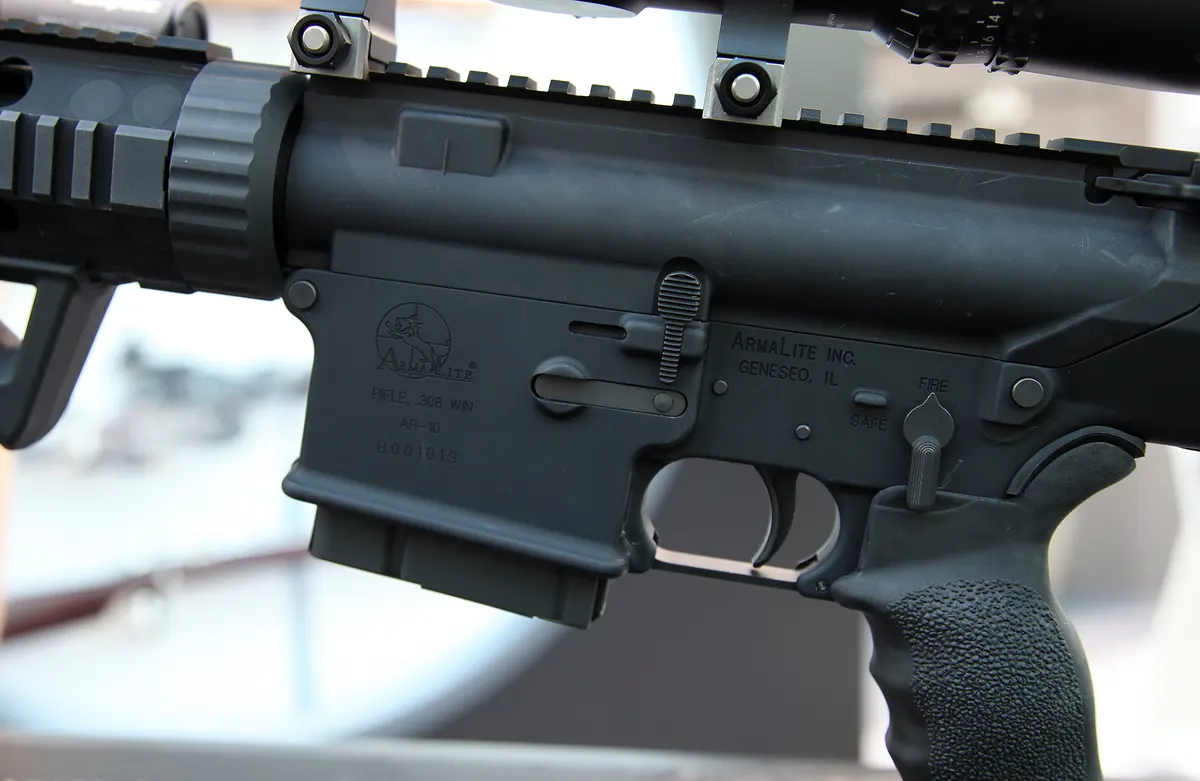
Two imperial pitches dominate the American market. 1/2x28 threads per inch cover calibers up to about .224 inch, meaning .22 LR, .223 Remington, 5.56mm NATO, and 9mm carbines, while 5/8x24 covers .224 to .30 caliber, including .308 Winchester, 7.62mm NATO, 6.5 Creedmoor, and .300 Blackout, the bracket the ArmaLite AR-10 Modern Production rifle threads into.4 The split has a real engineering reason. 1/2x28 leaves too little metal between the rifling grooves and the thread root for a true .30 caliber bore, which is why .308 class rifles standardized on the larger 5/8x24 pitch.4
European and HK pattern rifles often skip the imperial system altogether. M13.5x1 left hand threads appear on many 9mm HK, SIG, and Glock pattern pistols, M15x1 on some HK 5.56mm rifles, and M14x1 left hand threads on several Eastern Bloc 7.62mm designs, none interchangeable with the American standards or each other without an adapter.5
A muzzle brake vents gas sideways and rearward to cut recoil and muzzle rise, some brakes claiming close to 94 percent felt recoil reduction, while a flash hider instead scatters muzzle flash to protect night vision.6 A blank firing adapter restricts gas escape at the muzzle just enough to build the back pressure a semi automatic action needs to cycle on blanks, and is made deliberately visible so range staff can confirm one is fitted first.7,6
01From the M110's Suppressor Mount to the AR-15 Aftermarket
Knight's Armament Company's M110 Semi-Automatic Sniper System, descended from the earlier SR-25 design, threads its 5/8-24 muzzle to a proprietary Knight's brake, and the KAC QDSS quick detach suppressor locks onto that brake rather than the bore threads directly.8 The later M110A1 Squad Designated Marksman Rifle and M110A2 Semi-Automatic Sniper System carried the same mount into newer generations of the same DMR family.
Heckler and Koch's civilian MR308, the semi automatic version of the HK417 designated marksman rifle, reportedly threads its muzzle to M15x1 right hand rather than the AR-10 style 5/8x24 pattern, limiting off the shelf compatibility to devices cut for that pitch.9 As the HK MR308, it lost Germany's original Bundeswehr designated marksman rifle trials in 2010, though the same family was later developed into the G28 rifle Germany eventually adopted.10
Sako's M23 family, built for Finland's and Sweden's militaries, ships with a suppressor ready muzzle device as standard equipment, continuing a pattern set by the earlier TRG series it descends from.11 Far more common is the plain 1/2x28 thread inherited straight from the M16 specification. The Colt AR-15, Ruger SR-556, and Heckler and Koch MR223 all ship threaded to that same pitch across most semi-automatic rifles built on the AR-15 platform.3
01Notes and Sources
- "What Is a Threaded Barrel?", Silencer Shop — silencershop.com ↩
- "Flash Suppressor/Flash Hider?", M14 Forum — m14forum.com ↩
- "AR-15 Flash Hiders", Primary Arms — primaryarms.com ↩
- "Understanding Barrel Thread Pitch for Suppressors and Muzzle Devices", Silencer Central — silencercentral.com ↩
- "Common Muzzle Thread Reference", Armanov — armanov.com ↩
- "Muzzle Brake vs. Flash Hider", US Arms Co — usarmsco.com ↩
- "Blank-firing adapter", Wikipedia — en.wikipedia.org/wiki/Blank-firing_adapter ↩
- "U.S. Army M110 SASS", Sniper Central — snipercentral.com ↩
- "HK417/MR308 Barrel Thread Questions", HKPRO Forums — hkpro.com ↩
- "HK417 did not pass German Army DMR tests", The Firearm Blog — thefirearmblog.com ↩
- "Sako TRG", Sako — sako.global ↩


