

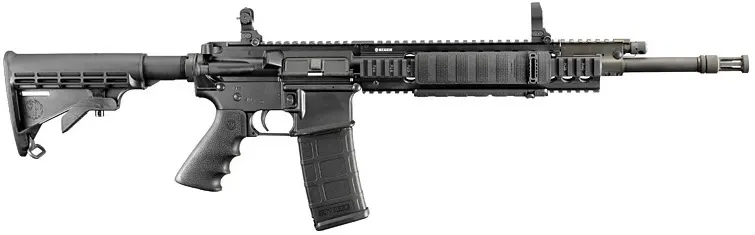

The Ruger SR-556 is a piston driven, semi-automatic semi-automatic rifle chambered in 5.56x45mm NATO and .223 Remington, built by Sturm, Ruger and Co. as the company's first entry into the AR-15 pattern rifle market.1 Ruger unveiled it on May 15, 2009, and the launch mattered less for the rifle's caliber (a well worn 5.56mm chambering shared with dozens of other AR-15 clones) than for its operating system.2 Instead of copying the direct impingement gas tube used by the original Colt AR-15 and the M16 family, Ruger fitted the SR-556 with a two-stage gas piston operated short-stroke system, joining a wave of piston conversions from companies like Heckler and Koch, LWRC International, and Adams Arms that had been reshaping the AR-15 market since the mid-2000s.3
- Two-stage piston keeps carbon out of the bolt carrier
- Chrome lined, cold hammer forged barrel
- Four-position adjustable gas regulator
- Compatible with standard AR-15 magazines including PMags
- Troy Industries folding iron sights and quad rail included stock
- Nearly 8 lb unloaded, heavier than most direct impingement carbines
- Roughly double the price of an entry-level AR-15 at launch
- Front-heavy balance criticized by multiple reviewers
- No confirmed military or large-scale law enforcement adoption
- Discontinued after about seven years on the catalog
At launch the Ruger SR-556 carried a suggested retail price near $2,000, roughly double what a comparable direct impingement AR-15 cost at the time, and reviewers immediately questioned whether the piston system justified the premium.4 The rifle was also criticized for its weight, at nearly 8 lb unloaded it ran heavier than most direct impingement carbines, a direct consequence of the piston hardware bolted to the barrel.3 Sturm, Ruger and Co. answered both complaints over the following two years, first with the lighter SR-556C carbine in 2010 and then with the stripped down SR-556E in 2011, before eventually building an entirely separate direct impingement rifle, the Ruger AR-556, to compete on price alone.5
Is the Ruger SR-556 still in production? No. Ruger discontinued the core SR-556 line in January 2016 after roughly seven years on the market, replacing it with a takedown variant before dropping the family entirely.6 The rifle never secured a confirmed military contract, and Ruger's own marketing leaned on law enforcement test and evaluation programs rather than a standing service adoption.7 What the SR-556 unit cost was, how the two-stage piston actually functioned, and why Ruger's own budget AR eventually outsold its premium piston flagship are the questions this article answers in detail below.
Ruger positioned the SR-556 against established piston competitors rather than against its own AR-15 clones, and that framing shaped the entire product line. The five and one half pound to eight pound weight range across variants, the $1,200 to $2,000 price spread between the SR-556E and the standard rifle, and the eventual retreat into the SR-556 Takedown all reflect a company adjusting a premium product to a market that, in the end, preferred cheaper direct impingement rifles from Bushmaster, Colt's Manufacturing Company, and Smith and Wesson.8
The Two-Stage Piston System That Set the SR-556 Apart
The core of the Ruger SR-556's design is a patent pending, two-stage short-stroke piston.3 A smaller diameter nipple on the piston head moves roughly three sixteenths of an inch to unlock the action, and only after that initial movement does the piston's larger surface area take over, driven by gas pressure metered through a four-position adjustable gas regulator.9 Ruger's stated goal was a smoother, less abrupt power stroke than typical single-stage AR piston systems, intended to reduce felt recoil and lower stress on the detachable magazine well and bolt carrier over the rifle's service life.9 The bolt carrier itself was redesigned around the piston, replacing the AR-15's gas key with an integral lug, and Ruger chrome plated the piston, regulator, and bolt carrier components to resist the residue that a piston gun still produces, just further from the action than in a direct impingement rifle.1
- First Production Year2009
- Service Entry Year2009
- Designersturm_ruger_co
- Weight (Empty)3.6 kg
- Currently In ServiceNo

The 5.56x45mm NATO cartridge feeds from a 30-round detachable magazine, with the rifle shipping three Magpul PMAG magazines in most configurations.9 Ruger cut the 409mm (16.1 in) barrel from chrome-lined, cold hammer forged steel with a 1 turn in 229mm (1 in 9 in), six-groove, right-hand twist, chosen to stabilize the mid-weight 55 to 62 grain bullets most common in .223/5.56 hunting and defensive ammunition.1 The barrel carries a threaded muzzle, threaded barrel fitted with a flash suppressor whose shape borrows directly from Ruger's own Mini-14GB and AC-556 rifles, a rare case of a modern Ruger AR quoting an older Ruger design rather than the AR-15 pattern.1
- Cartridge5.56x45mm NATO / .223 Remington
- Calibre5.56 mm
- Case Length45 mm
- Calibre Class223_5_56
- RimfireNo
- Caseless AmmunitionNo
Furniture and structure follow familiar AR-15 conventions, a 7075-T6 aluminum upper and lower receiver carrying polymer furniture, a six-position folding, collapsible stock, and a Hogue rubberized pistol grip.1 Ruger fitted a full-length quad optic rail handguard from Troy Industries, along with Troy's folding iron sights, giving the rifle a usable sighting system straight out of the case without an optic.9 Every configuration is suppressor ready, and Ruger rates the rifle's modularity high, the rail accepts any standard optic, light, or grip, and the takedown variant later split the upper and lower for compact transport.6 Unlike the select-fire rifles issued to conventional militaries, the SR-556 is strictly semi-automatic, it was never catalogued in a select-fire configuration for civilian sale, which kept it outside NFA registration requirements in the United States.1
- Action TypeGas-Operated
- Fire Modessemi_automatic
- Select FireNo
- Feed SystemDetachable Magazine
- Magazine Capacity30
- Cyclic Rate of Fire800
- Practical Rate of Fire100
Reviewers who put the two-stage piston through extended range sessions found the practical payoff real. One long-form test ran five 30-round magazines through an SR-556E as fast as possible without a malfunction, then noted the bolt carrier stayed cool to the touch, a contrast with direct impingement ARs that can heat up sharply after a single magazine.10 Accuracy tester groups clustered around 1.5 to 2 MOA with practical ammunition, tightening further with match handloads, respectable for a piston gun but not a clear improvement over a well-built direct impingement AR-15 firing the same barrel length and twist.10 The tradeoff, as most reviews concluded, was weight and balance rather than accuracy, the piston assembly shifts the SR-556's center of mass forward, and several testers described the rifle as front-heavy even before an optic was mounted.11
- Muzzle Velocity945 m/s
- Effective Range (point)500 m
- Maximum Range3,600 m
- Barrel Length409 mm
- Rifling Twist1_229
- Rifling Grooves6
- Sight Typeiron sights
- Optic RailYes
- Iron SightsYes
- Threaded BarrelYes
- Receiver Materialaluminum
- Furniture Materialpolymer
- Folding / Collapsing StockYes
- Bullpup LayoutNo
- Ambidextrous ControlsNo
- Modularityhigh
- Production Start2009
- Production End2018
- Unit Cost2,000 USD
- Variants7
- Width63.5 mm
- Height197 mm
From NRA Show Debut to a Crowded Piston Market
Ruger announced the SR-556 on May 15, 2009, timed to the NRA Annual Meeting, under CEO Michael O. Fifer, who had been steering the company toward its first modern sporting rifles after decades focused on revolvers, bolt actions, and the semi-automatic Ruger Mini-14.2 Fifer had spent several years pushing Ruger's engineering culture toward faster product cycles, and the SR-556 became one of several launches that year, alongside the LCR revolver and SR1911 pistol, that reviewers cited as evidence the change had taken hold.12
The timing put the Ruger SR-556 into a piston AR-15 market that had matured quickly since the mid-2000s. Heckler and Koch's proprietary short-stroke piston, adapted from its G36 rifle family for the HK416, had already built a reputation with special operations units by the time it appeared before U.S. Army officials reviewing carbine technology in November 2008.13 Smaller firms Adams Arms and POF-USA had spent 2007 and 2008 building piston retrofit kits and complete uppers, and LWRC International was fielding its own gas piston carbines to law enforcement and military buyers.14 Ruger entered this field as a mainstream, high-volume manufacturer rather than a boutique piston specialist, and that positioning cut both ways, it gave the SR-556 wide retail distribution but invited direct price comparisons with the cheaper AR-15s Ruger itself would later sell.4
Ruger expanded the line quickly. The SR-556C carbine, announced May 13, 2010, shaved about half a pound off the standard rifle and shipped with three 10-round magazines for magazine-restricted states.15 In August 2010 Ruger added the SR-556/6.8, chambering the same receiver and two-stage piston for the 6.8mm Remington SPC cartridge with a 1 in 10 twist barrel, aimed at hunters who wanted more downrange energy than 5.56mm offers without leaving the AR-15 platform.16 The budget focused SR-556E followed in 2011, trading the quad rail handguard, three-magazine set, and premium furniture for a simplified rail and single magazine at roughly $1,200, a direct response to complaints that the standard rifle priced out casual buyers.7
In April 2014, Ruger issued a safety recall covering the SR-556VT varmint and target model, after a vendor supplied disconnectors in the two-stage trigger that had not been properly heat treated. The defect could cause the rifle to fire late after the trigger was pulled or, in rare cases, double fire.17 Ruger reported no confirmed injuries, replaced the affected part free of charge, and limited the recall strictly to SR-556VT trigger groups rather than the wider SR-556 family.18
By January 2016, Ruger discontinued the entire original SR-556 lineup and replaced it with the SR-556 Takedown, a redesigned variant with a lightweight KeyMod handguard that split into two halves for storage and transport, introduced through 2017.6 The takedown model remained in Ruger's catalog for roughly two more years before it, too, was quietly dropped, closing out the SR-556 name entirely and leaving the direct impingement Ruger AR-556, launched in 2015 at a third of the price, as Ruger's primary AR-15 pattern rifle going forward.19
Ruger built the SR-556 family around one receiver and piston system, with roughly seven cataloged configurations differing mainly in weight, furniture, caliber, and price.
- SR-556 (standard), the original 2009 rifle, quad rail handguard, three Magpul PMAGs, Troy Industries folding sights, roughly $2,000 retail.1
- SR-556C (Carbine), announced May 2010, roughly half a pound lighter, sold with three 10-round magazines for magazine-capacity-restricted states, and without a flash suppressor or full collapsible stock in some state-compliant configurations.15
- SR-556/6.8 (SR-556U), announced August 2010, chambered in 6.8mm Remington SPC with a 1 in 10 twist barrel and 5-round and 25-round magazines, marketed toward hunters.16
- SR-556VT (Varmint/Target), built with a solid stock and a lighter, two-stage target trigger, plus a tighter 1 in 8 twist barrel intended to stabilize heavier bullets for improved accuracy, subject to the April 2014 trigger recall.17
- SR-556E (Essential), introduced 2011, a lower cost configuration around $1,200 with simplified furniture and a single magazine, aimed at buyers priced out of the standard rifle.7
- SR-556 Takedown, introduced through 2016 to 2017, split into upper and lower halves with a lightweight KeyMod handguard, the last piston SR-556 variant Ruger sold.6
- Ruger SR-762, introduced 2013, a 7.62x51mm NATO / .308 Winchester AR-10 pattern rifle sharing the two-stage piston system and using SR-25 pattern magazines, effectively the SR-556's big-bore sibling.15
None of the variants changed the underlying two-stage piston or the gas operated short-stroke architecture Ruger introduced in 2009, the differences sit in barrel profile, twist rate, furniture, and caliber rather than the operating system itself.9
Across the whole family, the pattern is consistent, Ruger used the SR-556 name for every piston variant it sold and reserved the AR-556 name entirely for its later, unrelated direct impingement rifles, so the two product lines never actually shared a model designation despite sharing a barrel and receiver footprint.5

The Ruger SR-556 never secured a confirmed government contract as a standard-issue service rifle. Ruger marketed the rifle to law enforcement and military buyers through test and evaluation programs, offering departments a 90-day trial period on fixed and takedown configurations, but available reporting shows adoption limited to individual department purchases and personal duty weapon selections rather than fleet-wide contracts.7 The rifle's primary market throughout its production run was civilian sporting and defensive use in the United States, where its price and piston system positioned it as a premium alternative to mainstream direct impingement AR-15s from Bushmaster, Colt's Manufacturing Company, and Smith and Wesson.8
Individual officers in agencies that allow personally-purchased patrol rifles were a more realistic path to law enforcement use than a centralized contract, since many U.S. departments qualify officers on a rifle they buy themselves rather than issuing a single standardized model.22 No source consulted for this article documents a confirmed foreign military buyer or a named U.S. agency that adopted the SR-556 as its standard rifle, and the absence should be read as thin sourcing on operators rather than confirmed non-adoption.
By contrast, the direct successor Ruger AR-556 found a genuinely large civilian and duty market once its price fell below $750, illustrating how much of the SR-556's limited institutional reach traced back to cost rather than performance.19
Ruger's own later rifle, the Ruger AR-556, makes the most instructive comparison for the SR-556, more instructive than any outside rival. Both share the same 409mm chrome-lined barrel and six-groove twist, so accuracy and ballistics are close to identical, the entire difference between the two rifles is the operating system and everything Ruger built around it.5 The SR-556's two-stage piston keeps the bolt carrier cleaner and cooler over extended firing, at the cost of roughly a pound and a half of extra weight and, at launch, more than double the price.10 The AR-556, introduced in 2015 with a conventional direct impingement system and a $749 launch price, undercut the SR-556 so directly that it effectively replaced its own piston sibling in Ruger's catalog within a year.19
Against the Heckler and Koch HK416, the SR-556 tells a different story, one of pedigree rather than price. The HK416's short-stroke piston, derived from the G36 rifle, had already been adopted by special operations units and later by conventional armed forces before Ruger's rifle reached retail shelves, and the HK416 commands a price and reputation built on that combat record.13 The SR-556 offered a comparable operating principle to civilian and law enforcement buyers at a fraction of the HK416's institutional price, without the years of vetted service history behind it, a tradeoff several reviewers summarized as the SR-556 suiting recreational and duty use while a compact HK416 variant remained the choice for dedicated close-quarters security work.21
| Spec | Ruger SR-556 | Ruger AR-556 |
|---|---|---|
| Operating system | Two-stage gas piston | Direct impingement |
| Barrel length | 409mm (16.1 in) | 409mm (16.1 in) |
| Weight (empty) | 3.6 kg (7.9 lb) | 2.95 kg (6.5 lb) |
| Launch price | approx. $2,000 (2009) | approx. $749 (2015) |


How does the Ruger SR-556's piston system work? The Ruger SR-556 uses a two-stage, short-stroke gas piston. A small diameter piston nipple first travels about three sixteenths of an inch to unlock the action, then a larger piston surface, metered by a four-position adjustable gas regulator, drives the bolt carrier rearward to cycle the rifle.9
Is the Ruger SR-556 still in production? No. Sturm, Ruger and Co. discontinued the original SR-556 lineup in January 2016, replaced it with the SR-556 Takedown through 2017, and dropped that variant from the catalog by around 2018 to 2019.6
What caliber does the Ruger SR-556 use? The standard rifle is chambered in 5.56x45mm NATO and .223 Remington. Ruger also sold an SR-556/6.8 variant chambered in 6.8mm Remington SPC and the related SR-762 in 7.62x51mm NATO / .308 Winchester.16
What is the difference between the Ruger SR-556 and the Ruger AR-556? The SR-556 uses a two-stage gas piston system and launched in 2009 at roughly $2,000. The AR-556 uses a conventional direct impingement system, launched in 2015 at roughly $749, and shares the same 409mm barrel and rifling twist.5
How much did a Ruger SR-556 cost? Retail pricing ranged from roughly $1,200 for the stripped-down SR-556E to about $2,000 for the standard rifle with quad rail handguard and three magazines, a price gap of nearly $800 within the same product family.7
- "Ruger SR-556", Wikipedia — en.wikipedia.org ↩
- "Ruger Redefines the AR Platform with the New SR-556", Ruger — ruger.com ↩
- "Ruger's SR-556", Small Arms Defense Journal — sadefensejournal.com ↩
- "Ruger SR-556: Ruger's New Piston Driven AR-15", Guns Holsters and Gear — gunsholstersandgear.com ↩
- "Ruger Goes Direct Impingement with AR-556", Gun Digest — gundigest.com ↩
- "Tested: Ruger SR-556 Takedown", American Rifleman — americanrifleman.org ↩
- "Ruger SR-556E: Economical, reliable, but noticeably lacking", Guns.com — guns.com ↩
- "Meet Ruger's AR-556: The Best 'Affordable' AR-15?", The National Interest — nationalinterest.org ↩
- "Ruger SR 556", Small Arms Review — smallarmsreview.com ↩
- "Review: Ruger SR-556E AR-Style Rifle", AllOutdoor — alloutdoor.com ↩
- "Ruger SR-556 Review, Benefits of Gas Piston Technology", Athlon Outdoors — athlonoutdoors.com ↩
- "Interview: Ruger CEO Talks Sagging Gun Sales, New Product Intros", Grand View Outdoors — grandviewoutdoors.com ↩
- "Heckler & Koch HK416", Wikipedia — en.wikipedia.org ↩
- "Adams Arms (AA) Moves to Dominate the Gas Piston/Op-Rod Tactical AR-15 Rifle Market", Defense Review — defensereview.com ↩
- "Ruger SR-556 Semi-Automatic Rifle", Military Factory — militaryfactory.com ↩
- "6.8 SPC Adds Muscle to Ruger's SR-556", Rifle Shooter — rifleshootermag.com ↩
- "SR-556VT Product Safety Warning and Recall Notice", Ruger — ruger.com ↩
- "Ruger Issues Recall for SR-556VT AR-15 Rifle", The Truth About Guns — thetruthaboutguns.com ↩
- "SR 556 Takedown, New and Used Price, Value, and Trends", True Gun Value — truegunvalue.com ↩
- "Ruger CEO Mike Fifer to Retire, Goes Out on High Note", GunsAmerica — gunsamerica.com ↩
- "AR-15 Review: The Ruger SR556", Gun Digest — gundigest.com ↩
- "Product Review: Ruger SR556", Police1 — police1.com ↩