

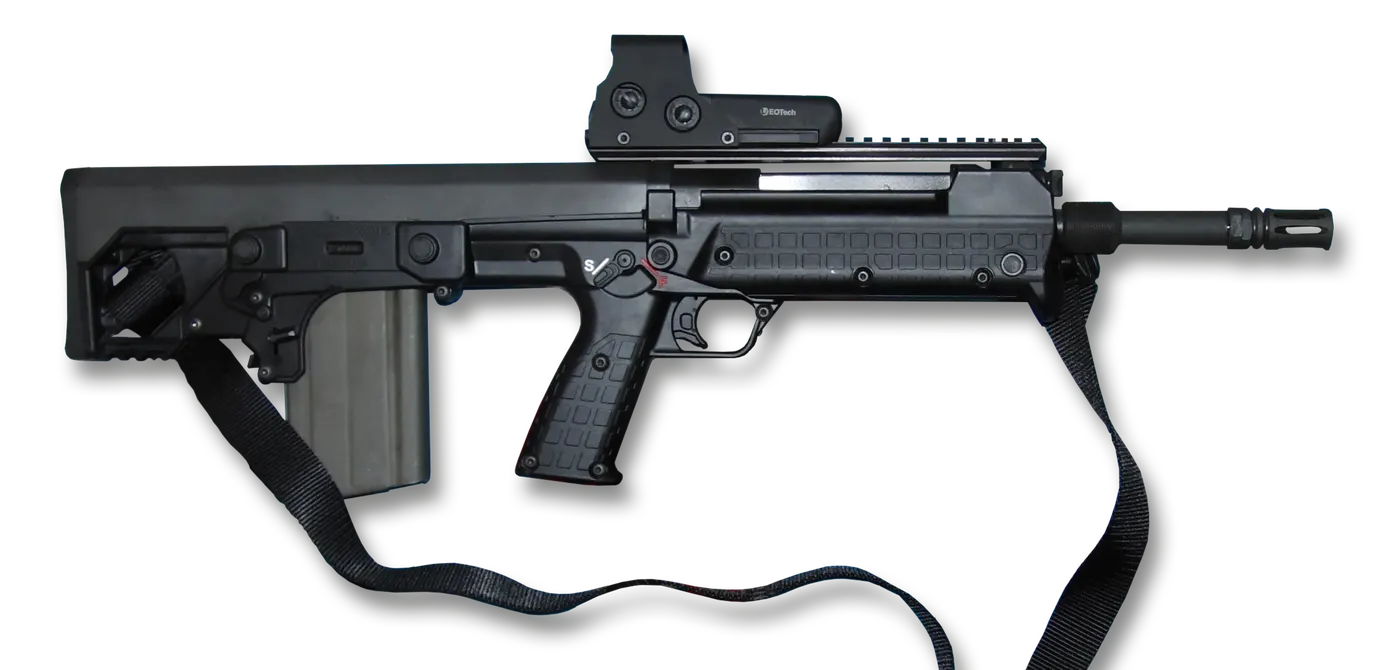

Spent cartridge cases leave the Kel-Tec RFB through a chute above the barrel and land near the shooter's feet, out in front of the muzzle rather than beside the shooter's cheek. That single mechanical choice is the reason the rifle exists at all, and it explains the name, Rifle, Forward-ejection, Bullpup.1 Designed by George Kellgren and built by Kel-Tec of Cocoa, Florida, the RFB is a semi-automatic, gas-operated 7.62x51mm NATO rifle in a bullpup layout, meaning the action and magazine sit behind the trigger group rather than in front of it.1,2 That layout lets Kel-Tec fit a full-length 18 to 24 inch barrel into a rifle barely 26 to 32 inches long overall, shorter than most AR-15 carbines despite firing a much larger 7.62mm cartridge.2,3
- full-power .308 ballistics from a compact bullpup footprint
- genuinely ambidextrous, no ejection port swap needed
- accepts common metric FN FAL magazines
- 4140 steel construction, chrome-lined barrel
- gas system needs careful tuning, especially with a suppressor
- magazine can seat low and needs to be pulled or kicked free
- forward ejection chute makes clearing a jam harder to see and reach
- no aftermarket grips, stocks or forends
Every other bullpup rifle on the market solves the same underlying problem in a different way. A right-handed bullpup normally throws hot brass backward past the shooter's cheek, so most manufacturers either ban left-handed shooters outright or sell a separate ejection-port conversion kit, the approach IWI uses on the Tavor.4 Kel-Tec instead built a rifle that never ejects sideways at all. The RFB uses a patented dual-extractor bolt that carries the fired case forward and drops it out through a port ahead of the handguard, which is why the rifle ships fully ambidextrous with no parts to swap.1,5 The idea took years of trial and error to make reliable, and it remains the RFB's defining feature among 7.62x51mm semi-automatic rifles, a category where forward ejection is otherwise almost unheard of.5
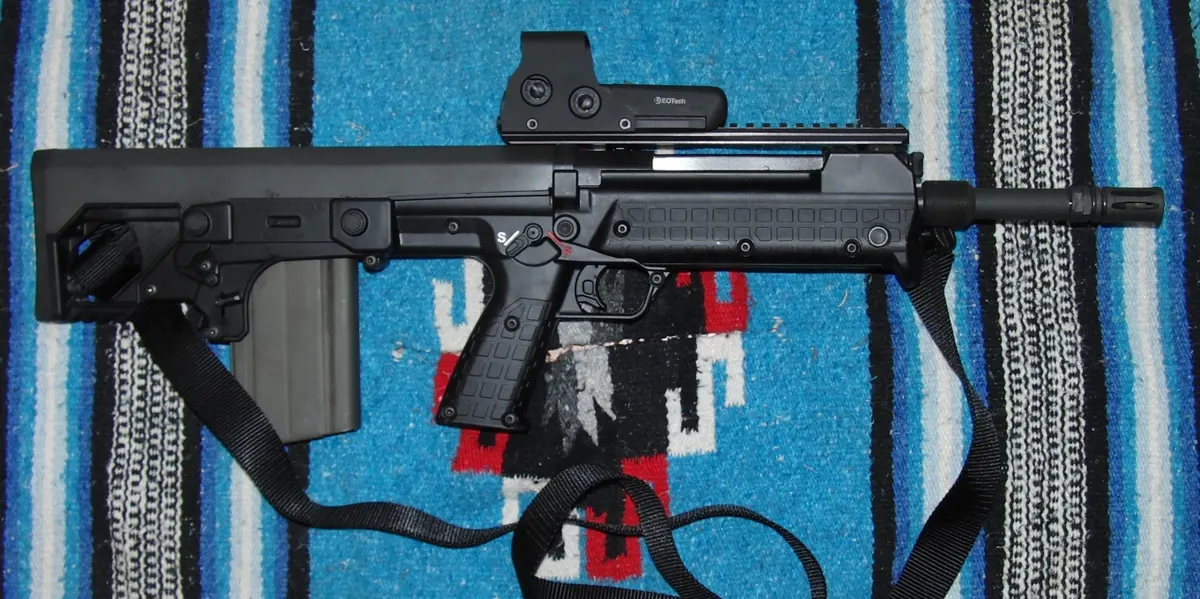
Kel-Tec markets the RFB today in two configurations, an 18.5 inch barreled model and a 24 inch Hunter model, at manufacturer suggested prices of $1,845 and $2,050 respectively.3 Both feed from 20-round detachable box magazines built to the metric FN FAL pattern, a magazine compatibility choice that has nothing to do with any shared internal mechanism between the two rifles.1,6 The RFB was never adopted by any military or police force, and its user base is almost entirely American civilian shooters, hunters and competitive marksmen, a market position it shares with most other members of the semi-automatic rifles category.7
The Kel-Tec RFB's gas-operated action uses an adjustable short-stroke piston, piston operated rather than direct impingement, tapping gas through an oversized port to drive the piston rearward roughly an inch.5,8 That piston stroke lifts the rear of a square-faced, hollow bolt clear of a locking shoulder machined into the receiver, freeing the entire bolt assembly to travel backward on a 4.4 inch stroke while dual extractor wings, pivoting on their own axes, grip the spent case on both sides.5 During the last part of that rearward travel, raceways cut into the receiver walls cam the extractor unit upward, tilting the case about 15 degrees so it lines up with a chute running forward over the barrel.5 As the bolt returns to chamber the next round, the spent case is pushed out of the extractors and slides forward, exiting through an opening in the gas block ahead of the handguard. Cases can queue several deep inside the chute, roughly five at a time, before they drop clear when the muzzle dips, the charging handle cycles, or a following case pushes the queue along.8,9
- First Production Year2003
- Designergeorge_kellgren
- Weight (Empty)3.67 kg
- Weight (Loaded)4.08 kg
- Currently In ServiceYes
Kel-Tec's own engineers have been candid that getting this right took real work. Too much bolt velocity and the action jams, too little and the case never clears the chute, and early development consumed considerable trial and error before the mechanism ran reliably with standard 7.62 NATO ball ammunition.5 The company was not the first to build a forward-ejecting bullpup. FN Herstal in Belgium had already fielded one, the select-fire FN F2000, roughly seven years before the RFB reached distributors, though the two rifles solve the problem in almost opposite ways. The F2000 uses a fixed extractor and a simple rotating bolt, directing cases into a chute where a separate mechanism ejects them only once the cycle reaches a set point, a comparatively simple approach. The RFB's tilting bolt and pivoting extractor accomplish the same forward path with more moving parts, and reviewers have found it correspondingly more prone to case buildup and jams inside the chute than FN's older design.4
- Cartridge7_62_51mm_nato
- Calibre7.62 mm
- Case Length51 mm
- Calibre Class308
- RimfireNo
- Caseless AmmunitionNo

The trigger was built specifically for a bullpup and not adapted from a rifle designed the conventional way. A floating linkage bar connects the sear to the hammer, letting the sear itself sit above the trigger the way it would in a normal-length rifle, which avoids the long, mushy trigger pull that plagues many converted bullpup designs.1,5 Kel-Tec's own figures put lock time, the delay between trigger break and firing pin fall, at around 4.5 milliseconds, faster than a typical AR-15 and faster than many World War Two bolt-action service rifles, a real contributor to the accuracy Kel-Tec advertises for the RFB.5 Factory trigger pull runs close to 5 pounds on current production models, and independent testing has measured it just over 6 pounds with a crisp, single-stage break.3,8
- Action TypeGas-Operated
- Fire Modessemi_automatic
- Select FireNo
- Feed SystemDetachable Magazine
- Magazine Capacity20
Barrels are chrome-lined 4140 chrome-molybdenum ordnance steel, rifled at roughly 1 in 11.25 inches twist on current production, though earlier independent tests reported a 1 in 12 twist, a discrepancy that likely reflects a running production change rather than an error in either source.3,8 The receiver itself is stamped and welded from 4130 aircraft-grade sheet steel with a Cerakote finish, and Kel-Tec deliberately built in two layers of steel between the shooter's face and the action, a safety margin that matters more in a bullpup than in a conventional rifle because the chamber sits so much closer to the shooter.8 Muzzle velocity with standard M80 7.62 NATO ball ammunition runs close to 884 m/s (2,900 ft/s), and Kel-Tec rates the RFB's effective range at roughly 500 meters, figures in line with any other 18 to 24 inch barreled .308 rifle rather than anything the bullpup layout changes.1,3 Reviewers have reported very tight groups from the RFB on a good day, including a three-shot, sub-inch cluster at 100 yards with 168-grain match ammunition, though gas system tuning and magazine fit have both been recurring complaints in owner forums, particularly when a suppressor is added without readjusting the gas valve.8,10
- Muzzle Velocity884 m/s
- Effective Range (point)500 m
- Barrel Length457 mm
- Rifling Twist1_11_25
- Sight Typeholographic
- Optic RailYes
- Iron SightsNo
- Threaded BarrelYes
- Overall Length660 mm
- Receiver Materialsteel
- Bullpup LayoutYes
- Ambidextrous ControlsYes
- Production Start2009
- Unit Cost1,845 USD
- Variants4
George Kellgren, a Swedish-born designer who had already worked on firearms for Husqvarna and Interdynamics AB in Sweden before co-founding Interdynamic of America in Miami in 1979, opened a small CNC machine shop in Cocoa, Florida in 1991 that became Kel-Tec.11,12 The company began shipping its own firearms, starting with compact pistols, in 1995, and by the early 2000s Kellgren was already experimenting with forward ejection on a compact .223 Remington bullpup prototype called the SUB-16.2 The 1994 federal assault weapons ban halted that project before it reached production, and Kellgren set the concept aside for close to a decade.2
Kellgren revived the idea around 2003 in 7.62x51mm rather than .223, and by 2005 the project had a name, the SRT-8, envisioned as a semi-automatic sniper-pattern rifle.2 In November 2006 the project was renamed RFB, and Kel-Tec showed a prototype publicly for the first time at the 2007 SHOT Show.1,2 Commercial release slipped repeatedly after that. Kel-Tec had originally targeted a fourth-quarter 2008 launch, pushed that back to February 2009 over production process changes, and finally shipped the first RFB rifles to distributors in the first week of March 2009.1
Early production was rougher than the company's marketing suggested. A subcontractor-made safety disconnector ran out of spec and too long, which caused some early rifles to read an in-battery bolt as out of battery and engage the safety on their own, a problem Kel-Tec traced to the part and fixed with a revised disconnector.13 A separate issue involved a detent pin on the adjustable gas valve that wore round instead of staying sharp-edged, letting the valve gradually close during a shooting session until the rifle stopped cycling, another problem Kel-Tec resolved with replacement pins once enough early rifles had surfaced the pattern.13 Kel-Tec pushed back hard against the idea that the RFB was unreliable. At a 2009 National Defense Industrial Association symposium at Nellis Air Force Base in Nevada, three shooters fired more than 1,000 rounds through RFB rifles in dusty, sandy range conditions without a documented malfunction, engaging LaRue Tactical steel silhouette targets out to 400 meters with iron sights and basic optics.5
Demand outpaced supply for years afterward. Owners and dealers described the RFB as a near-unicorn item through the mid-2010s, in and out of stock unpredictably even as Kel-Tec expanded its Cocoa, Florida factory specifically to increase RFB output.2,14 By around 2015, persistent forum reports held that Kel-Tec wanted to wind the RFB down in favor of its newer 5.56mm bullpup, the Kel-Tec RDB, which was drawing far fewer complaints in a simpler design.15 The RFB never actually disappeared. It remains a current Kel-Tec product as of 2026, sold alongside the RDB rather than replaced by it, even though the RDB's own history says something telling about the RFB's original engineering. The RDB uses a seven-lug rotating bolt whose extractor sits at the bottom of the bolt head, so cases simply cant downward and drop out beneath the rifle, a far simpler mechanism than the RFB's tilting bolt and forward chute, and one Kel-Tec adopted specifically because the RFB's true forward ejection turned out to be more complexity than the practical benefit required.15
Kel-Tec has sold the RFB in three main barrel lengths since 2009, though only two remain in the current catalog. The Carbine, with an 18 inch barrel and about 26 inches of overall length at 8.1 pounds, was the first configuration to ship in 2009 and forms the basis of the current 18.5 inch standard model.1,3 The Sporter, sold today as the Hunter, extends the barrel to 24 inches and overall length to roughly 32 inches, at a claimed weight near 8.7 to 9.1 pounds depending on the production year.1,3 A heavier Target variant, built around a 32 inch barrel, 40 inches overall and 11.3 pounds, added a five-way adjustable trigger tunable from 2 to 6 pounds of pull, and reached limited retail availability only after starting as a prototype-only configuration in 2009. It does not appear in Kel-Tec's current lineup.1,17
Kel-Tec also built a dedicated export version, the RFB-C, with an 18.5 inch barrel chosen specifically to meet Canada's non-restricted rifle length requirement.1 That export history ended in December 2024, when Canada's federal government named the RFB and RDB directly, along with their variants, in an expanded schedule of prohibited firearms, converting a rifle that had been legally non-restricted in Canada for over a decade into a banned one.18 A planned 5.56mm NATO variant referred to internally as the CFB was discussed publicly as early as 2009 but never reached production, and none of the additional chamberings Kel-Tec floated at the same time, including .260 Remington, 7mm-08 and .243 Winchester, ever shipped either.5 Kel-Tec's total production count for the RFB across all these variants has never been published.

The Kel-Tec RFB has never been adopted by any nation's armed forces or issued as standard police equipment. Its entire user base sits in the American civilian market, made up of hunters, target shooters and rifle collectors drawn to a rifle that fires a full-power 7.62x51mm cartridge from a footprint shorter than most 5.56mm carbines.2,7 Reports from owners describe using the RFB on deer and hog hunts at ranges out to roughly 130 to 150 yards without complaint once past the rifle's initial break-in period, though several forum threads also describe persistent feeding and ejection problems on individual rifles that never fully resolved.10,19
Outside the United States, the RFB's clearest institutional footprint was in Canada, where the RFB-C variant sold as a non-restricted rifle for years before the December 2024 prohibition order ended new sales and set a registration and grandfathering process in motion for existing owners.18 No confirmed military or law enforcement contract for the RFB exists in any country, a contrast with Kel-Tec's other products, since the company has separately donated pistol-caliber SUB2000 carbines to Ukraine's defense effort, a program that did not include the RFB.20
Kel-Tec did not invent the forward-ejecting bullpup. FN Herstal built one first, in the FN F2000, a 5.56x45mm select-fire rifle that Belgium's Special Forces Group adopted in 2004 and that Slovenia bought in bulk not long after, eventually fielding roughly 14,000 rifles as its standard infantry weapon.21,22 The RFB and the F2000 answer completely different questions even though both throw spent brass forward past the muzzle. The F2000 is a military service rifle built for a NATO army, chambered in the intermediate 5.56mm cartridge, select-fire, and backed by a factory support and spare parts pipeline that a government contract requires. The RFB is a civilian-only, semi-automatic 7.62x51mm sporting and target rifle sold directly to individual buyers, with no government customer at all.1,21
| Trait | Kel-Tec RFB | FN F2000 |
|---|---|---|
| Cartridge | 7.62x51mm NATO / .308 Win | 5.56x45mm NATO |
| Fire control | Semi-automatic only | Select-fire |
| Ejection mechanism | Tilting bolt, dual pivoting extractors | Fixed extractor, rotating bolt |
| Primary market | US civilian sales | National military contracts |
The two ejection systems also age differently under use. The F2000's simpler fixed-extractor chute, built around a rotating bolt that most modern service rifles already trust for durability, has not attracted the same volume of jam complaints that follow the RFB's more mechanically involved tilting-bolt design.4 That gap matters more than it might for a purely civilian rifle, because a NATO government buying thousands of service rifles has far less tolerance for chute jams than an individual hunter does. Kel-Tec's own later bullpup, the Kel-Tec RDB, effectively sided with FN's logic by trading true forward ejection for a simpler downward-ejecting rotating bolt in the RFB's own product line, while keeping the ambidextrous handling that made forward ejection worth attempting in the first place.15
Price also separates the RFB from the closest AR-10 pattern .308 semi-automatic rifles less than the design difference might suggest. A new RFB currently runs $1,845 to $2,050 at manufacturer suggested retail, comparable to a mid-tier AR-10 pattern rifle, so buyers choosing between them are mostly weighing the RFB's compact bullpup footprint and ambidextrous ejection against the AR-10 pattern's simpler manual of arms and much wider aftermarket parts support.3,19

Is the Kel-Tec RFB still in production? Yes. Kel-Tec currently sells the RFB in 18.5 inch and 24 inch Hunter configurations, despite persistent forum rumors around 2015 that the company planned to discontinue it in favor of the newer Kel-Tec RDB.3,15
What caliber is the Kel-Tec RFB chambered in? The RFB fires 7.62x51mm NATO, interchangeable with commercial .308 Winchester ammunition, and feeds from metric FN FAL-pattern detachable magazines.1,6
How does the Kel-Tec RFB's forward ejection system work? A gas-operated tilting bolt with dual pivoting extractors carries the fired case upward and forward into a chute above the barrel, where it slides out through an opening ahead of the handguard instead of ejecting to the side.5,8
How much does a Kel-Tec RFB cost? Manufacturer suggested retail prices currently run from $1,845 for the 18.5 inch standard model to $2,050 for the 24 inch Hunter.3
Is the Kel-Tec RFB reliable? Kel-Tec's own 2009 endurance demonstrations showed strong results, but the gas system requires careful adjustment, and owner forums describe recurring magazine seating and forward-ejection chute jams on some individual rifles, particularly before a roughly 100-round break-in period.5,10,19
Is the Kel-Tec RFB legal in Canada? No. Canada's federal government prohibited the RFB and its variants by name in December 2024, ending the rifle's earlier status as a legally imported non-restricted firearm.18
- "KelTec RFB", Wikipedia — en.wikipedia.org ↩
- "Kel-tec RFB", Modern Firearms — modernfirearms.net ↩
- "RFB Rifle, RFB 18 and 24, Forward Thinking Bullpup, .308Win", KelTec — keltecweapons.com ↩
- "Kel-Tec's Forward-Ejecting Bullpup Rifle, Everything We Know", The National Interest — nationalinterest.org ↩
- "An Interview with Matt at Kel-Tec on the RFB", Shall Not Be Questioned — pagunblog.com ↩
- "F2000 vs Kel-tec RFB", Sniper's Hide Forum — snipershide.com ↩
- "Kel Tec RFB Review, Worthy Bullpup", Gun University — gununiversity.com ↩
- "KEL-TEC RFB BULLPUP", Small Arms Review — smallarmsreview.com ↩
- "How does the Kel Tec RFB function", The Gun Zone — thegunzone.com ↩
- "RFB Reliability issues", Community for Kel-Tec Shooters — thektog.org ↩
- "George Kellgren", Wikipedia — en.wikipedia.org ↩
- "Kellgren and KelTec, A Retrospective", Inside Safariland — inside.safariland.com ↩
- "Mechanical Problems with RFB", Kel-Tec Forum — keltecforum.com ↩
- "30 Years of Innovation, The History of KelTec", KelTec Blog — blog.keltecweapons.com ↩
- "Tested, Kel-Tec RFB and RDB Bullpups", American Rifleman — americanrifleman.org ↩
- "Kel-Tec RFB Value 2026, Current Prices and Worth Guide", Cash My Guns — cashmyguns.com ↩
- "SWORD Of Justice, Kel-tec RFB Target rifle", Facebook / Wizard of Armory — facebook.com ↩
- "Regulations Amending the Regulations Prescribing Certain Firearms and Other Weapons, Components and Parts of Weapons, Accessories, Cartridge Magazines, Ammunition and Projectiles as Prohibited or Restricted", Canada Gazette — gazette.gc.ca ↩
- "Kel-Tec RFB Review, Complete Guide", Guns Corner — gunscorner.com ↩
- "US Navy pilot-turned-gunmaker is supplying hundreds of rifles to Ukraine", Task and Purpose — taskandpurpose.com ↩
- "FN F2000", Wikipedia — en.wikipedia.org ↩
- "Slovenia's Specialized Bullpup, the F2000S", Forgotten Weapons — forgottenweapons.com ↩