


Assembled from just 39 metal parts, only twelve of which needed milling, the Volkssturmgewehr was built to be handed to old men and teenage boys who had never fired a service rifle before.1 It is a German semi-automatic rifle, chambered for the 7.92x33mm Kurz cartridge, that entered production in January 1945 as Germany's war was already collapsing on both fronts.1,4,2 The design belongs to engineer Karl Barnitzke of the arms combine Wilhelm-Gustloff-Stiftung, commonly known by its factory name Gustloff-Werke, and it runs on an unusual gas-delayed blowback system Barnitzke devised specifically to let a stamped-steel receiver survive full-power cycling without a locking bolt.1,3
- semi-automatic firepower from a design cheap enough for a collapsing war economy
- shares 30-round detachable magazines with the StG 44, no new logistics chain needed
- only 39 parts and 12 machined components, buildable with unskilled labor
- gas-delayed blowback avoids a locking bolt entirely, simplifying manufacture further
- accuracy was poor even by the standards of an emergency rifle
- frequent feed jams reported in both wartime and postwar test firing
- fixed sights set for 100 meters only, no windage or elevation adjustment
- no Waffenamt proof marks or standard quality control on most examples
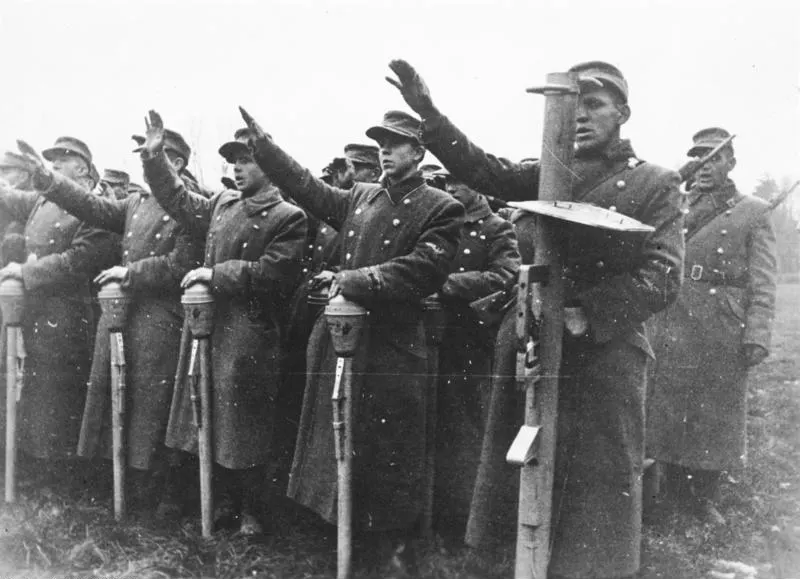
The rifle is often called the VG 1-5, a name that is technically a misnomer. Five separate emergency rifle designs came out of the same wartime Primitiv-Waffen-Programm (primitive weapons program), numbered VG 1 through VG 5 and built by five different companies, and only the Gustloff design used Barnitzke's gas-delayed blowback action.1,7 Carl Walther GmbH built the VG 1, a simple bolt-action rifle, Spreewerk built the VG 2, Rheinmetall the VG 3, Mauser the VG 4, and Steyr-Daimler-Puch the VG 5, also called the VK 98.1,6,7 Wartime paperwork referred to Barnitzke's own rifle as the MP 507, and postwar collectors are the ones who attached the VG 1-5 label to it, so the name most people search for and the weapon's actual wartime designation are two different things.1,3
Anyone asking how the Volkssturmgewehr works or what caliber it fires is really asking how Nazi Germany tried to arm a militia of civilians in the last five months of World War II after its regular arms factories had been bombed into rubble.1,7 The short answer is that Barnitzke's design worked, sometimes, at the cost of accuracy and reliability that no professional army would have accepted from a standard-issue rifle. The sections below cover the Volkssturmgewehr's specifications and design, its brief production and combat history in the defense of the Eastern Front, and how it compares to the two other German rifles it shared parts and factories with, the StG 44 and the Gewehr 43.
The Barnitzke Gas-Delayed Blowback System and Its Four Gas Ports
The Volkssturmgewehr weighs 4.6 kg (10.1 lb) unloaded, measures 885 mm (34.8 in) overall, and carries a 378 mm (14.9 in) barrel.1,5
- First Production Year1945
- Service Entry Year1945
- DesignerKarl Barnitzke
- Weight (Empty)4.6 kg
- Currently In ServiceNo
- Notable UsersVolkssturm (German WWII national militia, 1944-1945)
Karl Barnitzke's action is neither a true locked breech design nor a simple blowback action with nothing resisting the bolt at all. The bolt is permanently pinned to a long tubular slide that runs almost the full length of the barrel, and the front of that slide forms an open sleeve around the barrel itself.1,3 Four gas ports drilled near the chamber bleed hot propellant gas forward into that sleeve, and the trapped gas pushes back against the slide's own rearward momentum, resisting the bolt's opening for the fraction of a second the bullet needs to clear the muzzle.1,3 Firearms historians classify this as delayed blowback, though Forgotten Weapons' own test firing found the rifle cycles almost as well with the gas ports plugged, suggesting Barnitzke's delay mechanism did less real work than its designer intended.3 There is no piston, no rotating bolt lugs, and no separate locking mechanism of any kind, which is exactly why the design could be built from stamped sheet steel rather than machined forgings.1,4
- Cartridge7.92x33mm Kurz
- Calibre7.92 mm
- Case Length33 mm
- Bullet Weight8.1 g
- RimfireNo
- Caseless AmmunitionNo
7.92x33mm Kurz Chambering and StG 44-Compatible Magazines
The Volkssturmgewehr fires the intermediate 7.92x33mm Kurz cartridge from a 30-round detachable magazine, the same magazine used by the MKb 42, MP 43, and StG 44 family of assault rifles.1 That compatibility was deliberate. By late 1944 Germany already had millions of 7.92x33mm rounds and hundreds of thousands of StG 44 magazines in the supply chain, and building a new militia rifle around existing ammunition and magazines meant one less logistics problem for an army that was running out of almost everything else.1,7 Reported muzzle velocity runs around 660 m/s (2,165 ft/s), broadly in line with other 7.92x33mm Kurz weapons of the period.5 The rear sight is a simple fixed notch set for 100 meters with no windage or elevation adjustment at all, a stark contrast to the tangent sights found on contemporary German service rifles.1,4
- Action TypeDelayed Blowback
- Fire Modessemi-automatic only (early Wehrmacht-tested prototype was select-fire, full-auto removed before production)
- Select FireNo
- Feed SystemDetachable Magazine
- Magazine Capacity30
Thirty-Nine Parts and No Waffenamt Proofing
Barnitzke's rifle used a welded two-piece stamped steel receiver, a fixed non-removable barrel, and a crude wooden stock and foregrip permanently attached rather than fitted with any takedown pins.1,4 Contemporary examiners have found individual rifles stamped with only a serial number and no Waffenamt acceptance marks at all, evidence that final assembly happened under regional Nazi Party direction rather than normal Wehrmacht ordnance inspection.8 One surviving example, produced late in the run and marked simply Th. 9307, shows this pattern clearly, a bare serial with none of the proof stamps a Mauser or Walther military rifle would carry.8 Production ran out of Thuringian workshops around Suhl under the regional authority of Gauleiter Fritz Sauckel, and period accounts claim individual rifles could be finished in roughly three hours of labor, an extraordinary pace only possible because so few parts required precision machining.8
- Muzzle Velocity660 m/s
- Effective Range (point)100 m
- Barrel Length378 mm
- Optic RailNo
- Iron SightsYes
- Threaded BarrelNo
- Overall Length885 mm
- Folding / Collapsing StockNo
- Bullpup LayoutNo
- Ambidextrous ControlsNo
- Total Production10,000
- Production Start1945
- Production End1945
The Deutscher Volkssturm, a national militia of men aged 16 to 60 not already in uniform, was formally decreed on 18 October 1944 as Germany's manpower and industrial base collapsed under sustained Allied bombing and advancing fronts on both sides.1 Arming hundreds of thousands of untrained conscripts with standard-issue Karabiner 98k rifles was never realistic given how badly Germany's arms factories had already been damaged, so the Wehrmacht ordnance office launched the Primitiv-Waffen-Programm, calling on multiple manufacturers to design rifles that skilled workers, deported laborers, or even prisoners could build with minimal machine tools.1,7
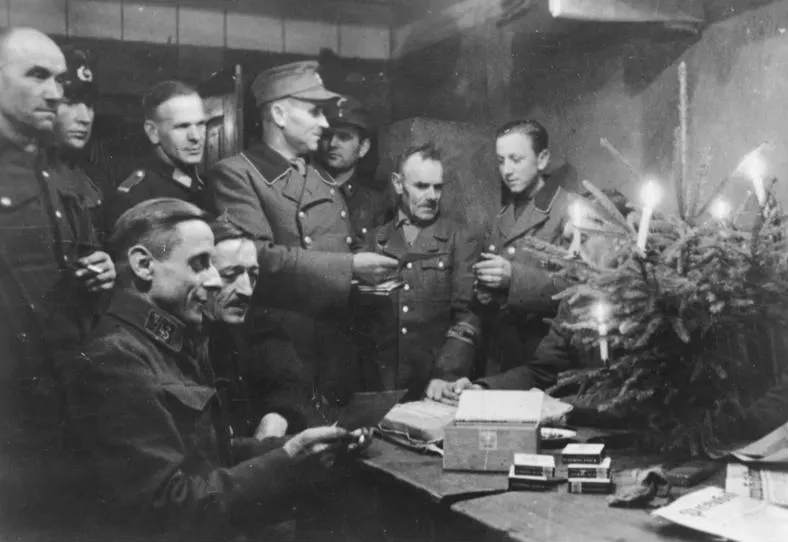
Barnitzke's design was not conceived from nothing for the Volkssturm. An earlier prototype of the same gas-delayed blowback mechanism had been tested for the Wehrmacht months before the militia rifle program began, and that prototype was capable of full automatic fire.1 When the requirements for the militia rifle came down, they called for semi-automatic fire only, so the continuous-fire capability was stripped out of the version that actually reached production.1 A related derivative, the MP 508, went further in the opposite direction, essentially a modified StG 44 fitted with Barnitzke's gas brake and a recoil-operated cycling system, but the evaluating commission rejected it for not simplifying manufacture enough over the existing StG 44 to justify a new production line, and it was never built in series.1
Gustloff-Werke production ramped through January and February 1945, with contemporary photographic and newsreel evidence showing the finished rifles reaching Volkssturm units on the Oder Front east of Berlin by that spring.8 Fewer than 100 examples of the whole Volkssturmgewehr family are believed to survive today, and specifically for the Gustloff pattern only around 27 to 28 confirmed surviving examples have been documented worldwide, a survival rate under one percent of the roughly 10,000 built.1
The Volkssturmgewehr's entire combat history sits inside a five-month window between February and May 1945, fought almost exclusively on German soil during the final Soviet drive of the Eastern Front.1 Volkssturm units carrying the rifle were concentrated along the Oder Front, the defensive line Germany tried to hold during the Battle of the Oder-Neisse in April 1945, before Soviet forces broke through toward the capital.1,8
Neither Soviet nor American test results were kind to the rifle. Soviet ordnance testing of a captured example found that only half of shots fired at 100 meters landed inside a 10.2 cm radius circle, and all shots landed somewhere inside a much wider 19.8 cm circle, a genuinely poor grouping for a rifle whose fixed sights assumed exactly that range.1 At 300 meters the spread widened further still, to a 25 cm half-sample radius and nearly 50 cm for the full group.1
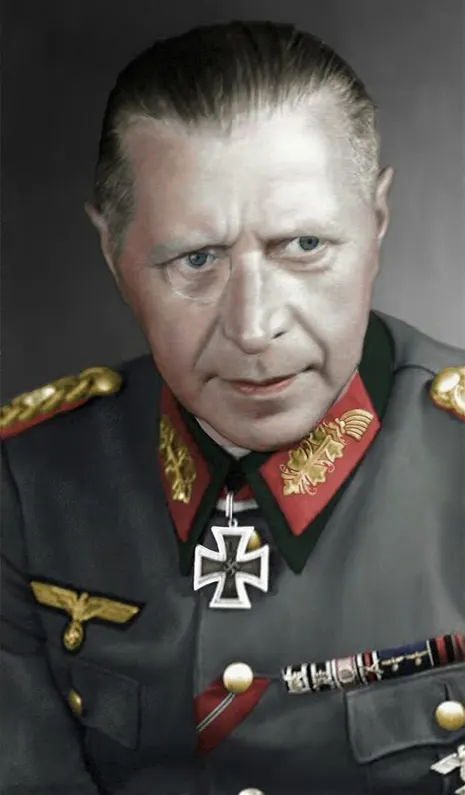
From the Oder Front, surviving Volkssturm formations and the weapons they carried were pulled into the close-quarters street fighting of the Battle of Berlin itself, where barricades, cellars, and rubble replaced any conventional front line.1 The commander overseeing Berlin's final defense, General Helmuth Weidling, inherited a garrison stiffened with exactly this mix of underequipped Volkssturm battalions and whatever weapons could still be distributed, the Volkssturmgewehr among them, in the war's last two weeks.1
Very few Volkssturmgewehr rifles were captured by American forces, since the weapon's combat use was concentrated almost entirely on the Eastern Front and in Berlin itself, areas that fell to Soviet rather than Western Allied troops.4 Most examples that survived the fighting were lost, destroyed, or swept up by Soviet forces as the front collapsed, which is a large part of why so few confirmed originals remain in Western collections today.4,1
The Gustloff Volkssturmgewehr itself was never formally subdivided into numbered variants during its brief production run, unlike rifles that stayed in service long enough to accumulate model changes. The closest thing to a variant, the recoil-operated MP 508 derivative built around a modified StG 44 action with Barnitzke's gas brake fitted, was evaluated and rejected rather than produced, and no confirmed surviving example is documented.1 The far more common source of confusion is the sibling Primitiv-Waffen-Programm rifles built under the same wartime push but with no mechanical relationship to Barnitzke's design at all. Walther's VG 1 and Spreewerk's VG 2 were simplified rotating-bolt rifles chambered in full-power 8x57mm Mauser rather than 7.92x33mm Kurz, built around parts salvaged from existing Gewehr 43 magazines, and Rheinmetall's VG 3, Mauser's VG 4, and Steyr-Daimler-Puch's VG 5 (also called the VK 98) followed similarly austere bolt-action layouts.6,7 None of those five rifles share Barnitzke's gas-delayed blowback mechanism, and treating them as variants of the Gustloff Volkssturmgewehr, rather than as parallel emergency designs that happened to share a wartime program and a confused postwar nickname, is a common but incorrect simplification found across less careful collector writing.1,7

Germany was the Volkssturmgewehr's only operator, issuing it exclusively to Volkssturm militia units rather than to the regular Wehrmacht, and only during the closing months of the war.1 No export sales, occupation-era reissue, or postwar military use of the design is documented anywhere, a sharp contrast with rifles like the Gewehr 43 or StG 44 that continued to see limited use with other armies for years after 1945.1 The rifle's entire service life ran from roughly February to the German surrender in May 1945.
Today no military anywhere fields the Volkssturmgewehr, and it survives almost entirely as a museum and advanced-collector piece given how few examples escaped destruction. Confirmed holdings include the Imperial War Museums in Britain and the National Rifle Association's own museum collection in the United States, alongside a handful of other institutional and private collections that between them account for the vast majority of the fewer than 30 confirmed surviving Gustloff-pattern rifles.1
The Volkssturmgewehr and the StG 44 were designed around the exact same 7.92x33mm Kurz cartridge and the exact same 30-round detachable magazine, yet the two rifles represent almost opposite answers to the same wartime problem. The StG 44, built by C.G. Haenel and Erma-Werke in far larger numbers, is a select-fire assault rifle with a gas-operated piston system capable of controlled automatic fire, the weapon most historians credit as the conceptual ancestor of the modern assault rifle.1 The Volkssturmgewehr shared its magazine and cartridge but stripped away everything else, a semi-automatic-only, gas-delayed blowback rifle built from stamped scrap steel for soldiers who might fire it exactly once. Even the early Barnitzke prototype that fed into the Volkssturmgewehr's development had briefly offered full-automatic fire before Volkssturm requirements forced its removal, meaning the two rifles' fire-control philosophies converged for a moment during testing before diverging again in the versions that actually reached the front.1
| Volkssturmgewehr (Gustloff) | StG 44 | |
|---|---|---|
| Cartridge | 7.92x33mm Kurz | 7.92x33mm Kurz |
| Action | Gas-delayed blowback | Gas-operated, piston |
| Fire modes | Semi-automatic only | Semi-automatic and automatic |
| Unloaded weight | 4.6 kg | 5.2 kg |
| Production | approx. 10,000 | approx. 400,000+ |
Against the Gewehr 43, the comparison is less about mechanism and more about what each rifle was actually trusted to do. The Gewehr 43 was Germany's genuine standard-issue semi-automatic service rifle, a gas-operated design chambered for the full-power 7.92x57mm Mauser cartridge and built with proper Waffenamt inspection at established arms factories from 1943 onward.1 The Volkssturmgewehr existed because there were not enough Gewehr 43 rifles, or the raw materials and skilled labor to build more of them, to arm the Volkssturm on top of the regular army's own needs. Both weapons technically belong to the same category of semi-automatic rifles, but only one of them was ever trusted to arm frontline infantry, while the other was a last resort handed to conscripts who had no other choice.


What caliber does the Volkssturmgewehr use? The Volkssturmgewehr is chambered in 7.92x33mm Kurz, the same intermediate cartridge used by the StG 44, and it feeds from the same 30-round detachable box magazine.1
Was the Volkssturmgewehr capable of full-automatic fire? Not in the version issued to the Volkssturm. An earlier Barnitzke prototype tested for the Wehrmacht could fire fully automatic, but the requirements for the militia rifle called for semi-automatic fire only, and that capability was removed before production began.1
Is the Volkssturmgewehr the same weapon as the VG 1-5? The name VG 1-5 is commonly used for the Gustloff-built rifle covered here, but it is technically a mix-up. VG 1 through VG 5 were five separate rifles built by five different companies (Walther, Spreewerk, Rheinmetall, Mauser, and Steyr-Daimler-Puch) under the same wartime program, and the Gustloff design's actual wartime designation was MP 507.1,7
How many Volkssturmgewehr rifles were made? Most sources cite roughly 10,000 built between January and May 1945, though estimates in some accounts run as high as 24,000. Fewer than 30 confirmed examples are known to survive today.1,3
Who manufactured the Volkssturmgewehr? Wilhelm-Gustloff-Stiftung, operating under its factory name Gustloff-Werke in Suhl, Thuringia, manufactured the rifle under the direction of chief designer Karl Barnitzke.1,8
Is the Volkssturmgewehr still in service anywhere today? No. Its entire service life ran from February to May 1945 with German Volkssturm units, and no military anywhere has fielded it since the war ended.1
- "Volkssturmgewehr", Wikipedia — en.wikipedia.org ↩
- "Volkssturmgewehr, The German VG1-5 People's Storm Rifle", American Rifleman — americanrifleman.org ↩
- "Shooting the Gustloff VG1-5", Forgotten Weapons — forgottenweapons.com ↩
- "Volkssturmgewehr, A Rifle Born of Desperation", The Armory Life — thearmorylife.com ↩
- "VG.1-5", Modern Firearms — modernfirearms.net ↩
- "VG.1", Modern Firearms — modernfirearms.net ↩
- "German Volkssturm Weapons", WW2 Weapons — ww2-weapons.com ↩
- "Examining a Gustloff Volkssturmgewehr", The Armourer's Bench — armourersbench.com ↩
- "Barnitzke machine gun", Wikipedia — en.wikipedia.org ↩