

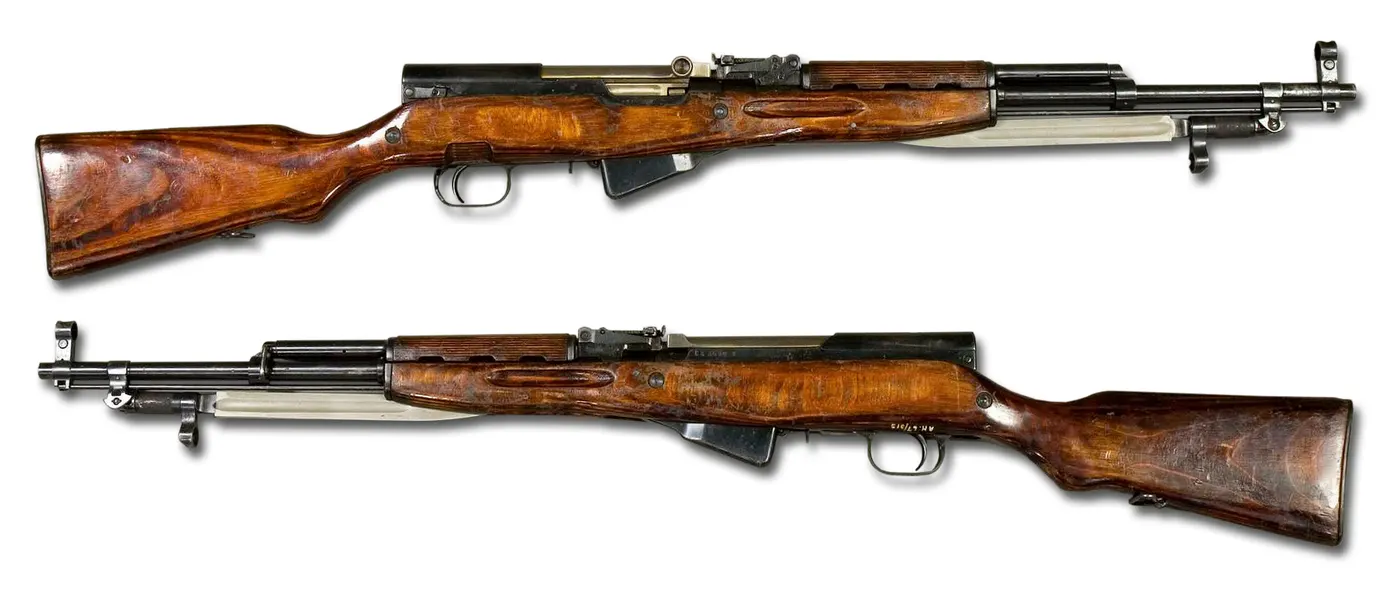

The SKS (Samozaryadny Karabin sistemy Simonova, self loading carbine of the Simonov system) is a semi-automatic gas-operated carbine chambered for the 7.62x39mm cartridge, one of the most widely distributed rifles of the twentieth century.1 Sergei Gavrilovich Simonov finished the design in 1945, the Soviet Army adopted it formally in 1949, and within less than a decade Soviet planners had already begun shifting frontline units to the select-fire AK-47.1,2 That short first-line career is misleading. The Soviet Union alone built roughly 2.7 million SKS carbines before ending production at the Tula Arms Plant in 1958, and licensed manufacture in China, Yugoslavia, Albania, North Korea, North Vietnam, East Germany, Romania, Bulgaria and Poland pushed cumulative global output into the tens of millions, with Chinese Type 56 production alone passing nine million units by the 1980s.1,3
- simple, low-parts-count gas system
- deliberately loose tolerances resist fouling and dirt
- longer sight radius than the AK-47
- cheap and abundant on the surplus market
- integral folding bayonet
- fixed 10-round magazine, slow to top off under fire
- no select-fire option
- superseded by the AK-47 within a decade of adoption
- limited spare-parts standardization across licensed producers
The SKS belongs to the semi-automatic rifles category, sitting between the bolt-action service rifles of the Second World War and the select-fire assault rifles that replaced it within a single generation.1 It fires the same intermediate 7.62x39mm round later associated with the AK-47, fed from a fixed 10-round box magazine loaded from the top with a stripper clip rather than a detachable box.1 Anyone asking how the SKS works is really asking about that magazine and about its short-stroke gas piston, both covered in detail below. The rifle is not select-fire, has no folding stock in its standard Soviet configuration, and carries a permanently attached folding bayonet that cannot be lost or left behind, a detail collectors and issuing armies alike have commented on for seventy years.1,4
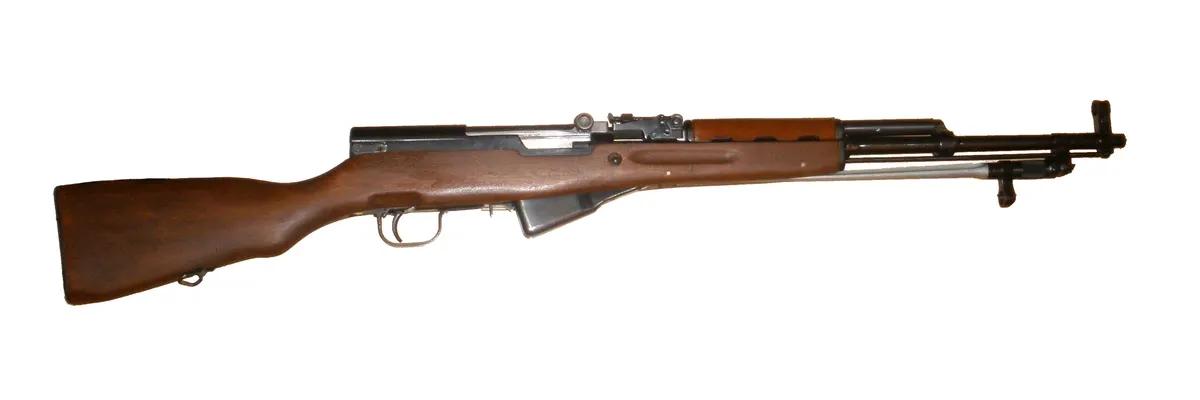
Despite that fast retirement from first-line Soviet service, the SKS never really left the world's battlefields. It armed Vietnamese, Chinese, North Korean, Angolan, Rhodesian and Afghan combatants across three decades of Cold War proxy wars, remained a common insurgent weapon into the Syrian and Iraqi civil conflicts of the 2010s, and still turns up in the hands of Russian territorial defense volunteers and honor guard units today.5,6 Original Soviet, Chinese, Yugoslav, Romanian and Albanian production rifles are also a fixture of the North American surplus market, where an SKS bought for around seventy dollars in the early 1990s can now sell for several hundred.7
A Short-Stroke Gas Piston Borrowed From an Anti-Tank Rifle
Sergei Simonov scaled the SKS's operating system down from the PTRS-41 anti-tank rifle he had designed for the Red Army in 1941, an unusual technical starting point for a standard infantry carbine.2,8 Propellant gas tapped from the barrel drives a piston and a separate tappet rearward. The tappet strikes the bolt carrier and returns to its forward position under its own spring, while the bolt carrier continues rearward under its own momentum to cycle the action.9 Because the piston and bolt carrier are mechanically separated rather than fixed together, the SKS is classified as a short-stroke, rather than long-stroke, gas system, a difference that reduces reciprocating mass and felt recoil compared with rifles like the AK-47 that carry the piston fixed to the carrier.9 Locking is handled by a tilting bolt, whose rear lug drops into a recess machined into the receiver floor when the action is in battery and lifts clear only once the piston tappet has driven the carrier back far enough to unlock it.9 Small arms researchers who have handled original Soviet rifles note that Simonov cut tolerances deliberately loose rather than tight, trading a small amount of accuracy for a rifle that keeps cycling reliably when dirty, dry or poorly maintained, a practical priority for a Red Army carbine expected to serve in Siberian winters and Central Asian dust alike.4
- First Production Year1944
- Service Entry Year1945
- DesignerSergei Gavrilovich Simonov
- Weight (Empty)3.85 kg
- Currently In ServiceYes
- Notable UsersSoviet Border Troops, PLA, insurgent forces
A Fixed Ten-Round Magazine Loaded by Stripper Clip
Unlike the AK-47 that replaced it, the standard SKS feeds from a fixed internal magazine holding 10 rounds of 7.62x39mm ammunition, reloaded either one cartridge at a time through the open action or all at once with a stripper clip pressed down into guides machined above the bolt.1 The hinged floorplate can also be opened by hand to empty the magazine quickly, a feature drilled into Soviet conscripts and later exported to every licensed user of the design.10 At 735 m/s (2,411 ft/s), SKS muzzle velocity with the 7.62x39mm's typical 122-grain (7.9 g) bullet is respectable for an intermediate cartridge, and Simonov's rifle carries an official effective range figure around 400 meters, with the rear tangent sight graduated out to 1,000 meters for area fire that the round itself cannot realistically reach with precision.1,11 The 20.5 inch (521 mm), four-groove, right-hand-twist barrel (a 1 turn in 14 inch twist rate) and a full-length sight radius running nearly the entire 40.2 inch (1,021 mm) overall length give the SKS a genuine, if modest, accuracy edge over the shorter-sight-radius AK-47 it was designed alongside.11,12
- Cartridge7.62×39mm
- Calibre7.62 mm
- Case Length39 mm
- Calibre Classintermediate
- Bullet Weight7.9 g
- RimfireNo
- Caseless AmmunitionNo
The Bayonet That Never Comes Off
Every standard-production SKS carries a bayonet lug integrated into a folding bayonet permanently pinned beneath the muzzle, swung forward and locked with a spring catch rather than fitted and removed like a conventional detachable blade.4 Soviet and Yugoslav production rifles use a flat blade pattern, while the Chinese Type 56 is best known for a needle-like 12 inch cruciform spike bayonet that echoes the very earliest 1949 Soviet SKS pattern before Tula switched to the blade design.4,13 At 3.85 kg (8.5 lb) unloaded, with a steel stamped-and-machined receiver and a wood (later laminate) stock and handguard, the rifle sits solidly in the weight class of contemporaries such as the SVT-40 it effectively replaced in Soviet infantry doctrine, without the SVT's more complex, jam-prone action.1,2
- Action TypeGas-Operated
- Fire Modessemi-automatic
- Select FireNo
- Feed SystemInternal Magazine
- Magazine Capacity10
- Practical Rate of Fire35
- Trigger Typesingle-stage
- Safety Typemanual
- Muzzle Velocity735 m/s
- Effective Range (point)400 m
- Sighting Range1,000 m
- Barrel Length521 mm
- Rifling Twist1:14 RH
- Rifling Grooves4
- Sight Typeiron
- Optic RailNo
- Iron SightsYes
- Threaded BarrelNo
- Overall Length1,021 mm
- Receiver Materialsteel
- Furniture Materialwood
- Folding / Collapsing StockNo
- Bullpup LayoutNo
- Ambidextrous ControlsNo
- Total Production15,000,000
- Production Start1949
- Production End1958
From the PTRS-41 to a Postwar Standard Rifle
Simonov began work on a self-loading carbine in 1941, the same year his PTRS-41 anti-tank rifle entered Red Army service, but German advances that summer shelved Soviet rifle trials.2 Wartime experience with captured German 7.92x33mm Kurz ammunition, combined with Soviet analysis showing most rifle engagements happened well under 300 meters, pushed Soviet ordnance authorities toward a new intermediate cartridge, the 7.62x39mm M1943.2 Simonov rechambered his carbine for the new round in 1944, dropped an unwieldy early muzzle brake, added the now-signature folding bayonet, and fitted a wooden handguard over the gas tube.2 A small pre-production batch reached the 1st Belorussian Front in the final months of the war for live field trials against retreating German forces, and the rifle performed well enough that the trials commission recommended general adoption.2,14 Simonov's carbine received the formal designation 7.62 mm Samozaryadny Karabin sistemy Simonova obraztsa 1945 goda (SKS-45), but full production only started once the Soviet Army completed further testing, and general issue did not begin until 1949.2,3
Overtaken by the AK-47 Within a Decade
Full-scale Soviet production ran at the Tula Arms Plant from 1949 to 1958, with a smaller run at the Izhevsk Mechanical Plant between 1953 and 1954, together totaling roughly 2.7 million rifles.1,3 The SKS briefly stood as the standard Soviet infantry rifle, finally retiring the long-serving Mosin-Nagant bolt-action family from frontline units.3 That status did not last. Soviet doctrine wanted every rifleman in a squad able to fire fully automatically on demand, a capability the semi-automatic-only SKS could never offer, and Mikhail Kalashnikov's AK-47 answered that requirement directly.1 Production problems delayed AK-47 distribution to ordinary troops until roughly 1956, but once resolved the AK-47 rendered the SKS obsolete for first-line Soviet service, and by the 1980s only a small number of SKS carbines remained in Soviet hands, mostly with support units and honor guards.1
Licensed Abroad While Retired at Home
Even as the Soviet Army was quietly setting the SKS aside, Moscow was exporting the design itself. In June 1955 a Chinese military and civilian delegation toured the Tula Arms Plant and watched SKS assembly firsthand, and after negotiations between Mao Zedong and Soviet premier Nikita Khrushchev, the USSR agreed to transfer full production rights for the SKS, the AK-47 and the 7.62x39mm cartridge itself.3 Chinese production began in 1956 at State Factory 66 before shifting to Norinco, and the resulting Type 56 carbine remained in PLA general issue for roughly thirty years, with total Chinese output eventually passing nine million rifles.1,3 Parallel licenses and technical assistance went out to Yugoslavia, Albania, North Korea, North Vietnam, East Germany, Romania, Bulgaria and Poland through the 1950s and 1960s, though Poland notably imported the full technical package and tooling and then rejected the SKS for general infantry service in 1956, relegating it to ceremonial honor-guard duty until it was finally superseded there in 2016.5
The SKS has appeared as set-dressing or a playable weapon in dozens of Vietnam War films, almost always representing North Vietnamese Army or Viet Cong fighters, and it remains a recurring inventory item in modern military shooters such as Escape from Tarkov and Far Cry 6, decades after the last original-production example left a Soviet factory.17
Fighting Alongside Its Own Mirror Image in Vietnam
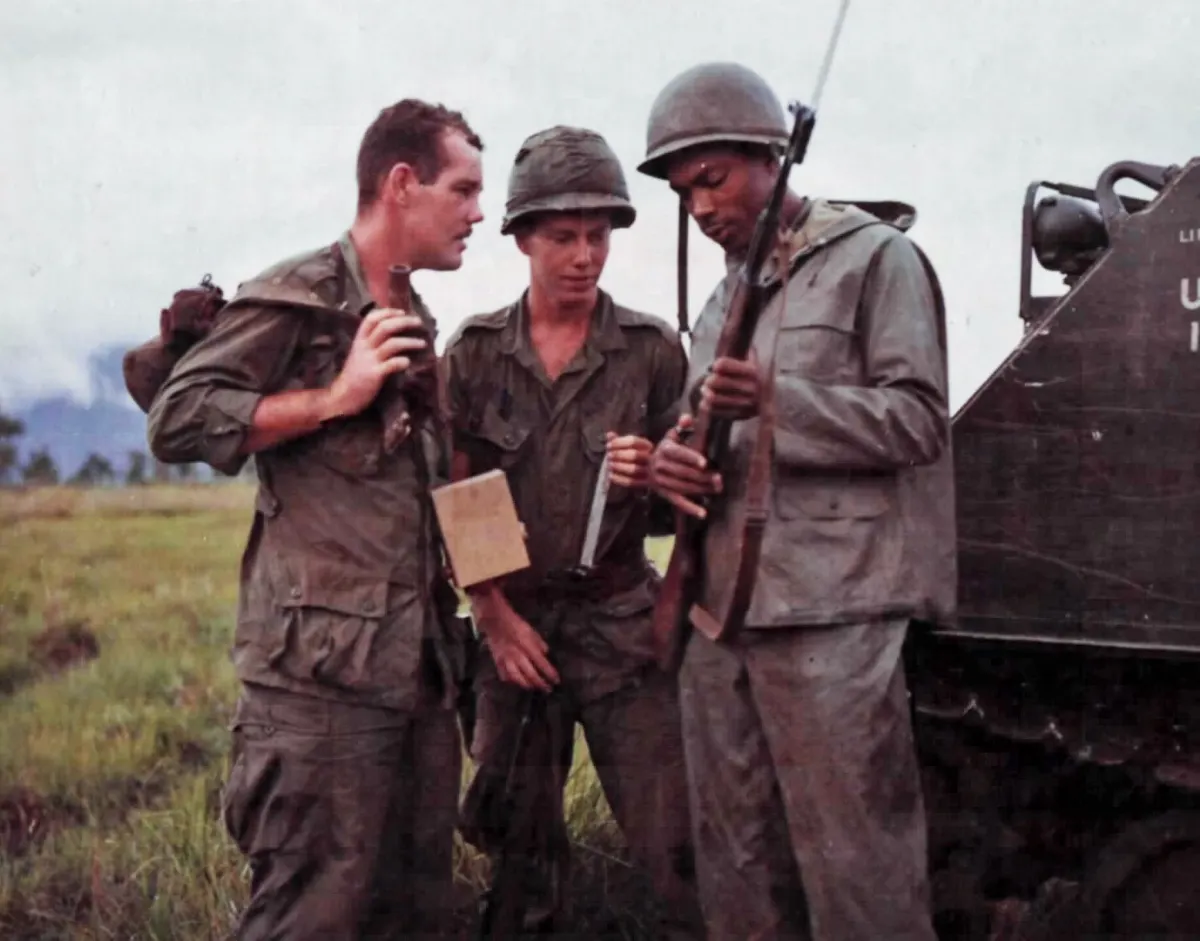
The Vietnam War did more than any other conflict to make the SKS internationally recognizable. Soviet and Chinese SKS and Type 56 carbines reached the Viet Cong and North Vietnamese Army in vast quantities as Cold War military aid, and a small arms factory built with Chinese assistance north of Yen Bai turned out roughly 6,000 domestically-assembled SKS carbines between 1962 and 1965 before American bombing forced its closure.18 Some Viet Cong units even produced crude, hand-finished copies of their own when supply ran short, identifiable today by rough tool marks absent from factory rifles.18 American troops encountered the weapon so often that it became a byword for enemy small arms alongside the AK-47, typically fielded opposite the M14 rifles US infantry carried through the early years of the war before the M16 took over.19
China's Own Rifle on Both Sides of a Border War
Two Chinese-supplied conflicts show how completely the SKS spread through communist arsenals. In the Sino-Indian War of 1962, People's Liberation Army infantry carrying Type 56 carbines held a real edge over Indian units still equipped largely with bolt-action Lee-Enfield rifles.20 Seventeen years later, the Sino-Vietnamese War of 1979 produced the stranger outcome of PLA and Vietnamese infantry, many on both sides still carrying Type 56 and SKS carbines respectively, fighting each other with what was functionally the same rifle their governments had once shared as allies.20
A Rebel's Rifle in the Mountains of Afghanistan
During the Soviet-Afghan War, China supplied Type 56 carbines to the mujahideen even as captured Soviet-issue SKS rifles from Afghan government stocks circulated through the same networks.21 Afghan and Soviet accounts from the conflict describe the SKS as genuinely preferred by some mujahideen fighters over the more common AKM in the country's mountain valleys, where engagement ranges of 400 to 600 meters favored the SKS's longer sight radius and better inherent accuracy over the AKM's volume of automatic fire.22
Decolonization Wars in Southern Africa
The SKS found particular favor among the insurgent movements fighting to end colonial and white-minority rule across southern Africa. Guerrillas of the Zimbabwe African National Liberation Army and the Zimbabwe People's Revolutionary Army carried SKS carbines through the Rhodesian Bush War, and captured examples were sometimes reissued to Rhodesian security forces working under an international arms embargo.23 After Angola's independence, the Soviet Union delivered as many as 5,000 SKS carbines to the Marxist MPLA during the long Angolan Civil War that followed the earlier Angolan War of Independence, by which point the carbine was already obsolete by Soviet standards but still entirely serviceable as a low-cost infantry weapon for a poorly resourced army.1,23
Still Turning Up in the 2010s and 2020s
Decades after its last first-line military role ended, the SKS has continued to surface in modern conflicts. It has been documented in the hands of insurgent and paramilitary fighters in Syria and Iraq during the 2010s, and photographs from the ongoing Russo-Ukrainian War show SKS carbines drawn from old Soviet-era territorial depots being issued to Ukrainian territorial defense volunteers early in the full-scale invasion, when modern rifles were in short supply.6

The Chinese Type 56 Family
China's Type 56 carbine is the largest and most varied group of SKS derivatives outside the original Soviet rifle, including stamped-receiver production runs from around 1970, an SKS-D variant re-engineered to accept detachable AK-pattern box magazines, and an SKS-Para paratrooper model with its barrel cut down to 16.5 inches (420 mm).13 Commercial export models sold into North America carry their own sub-designations, including the Model D with a detachable magazine and the Model M, which removed the bayonet lug entirely to comply with US import restrictions.13
The Yugoslav M59/66 and Its Grenade Launcher
Zastava Arms built the most mechanically distinctive SKS derivative, the Zastava M59/66, fitted with a permanently attached 22 mm rifle-grenade launcher and a purpose-built bayonet mount that doubles as the folding grenade-launcher sight.24 Yugoslav production also skipped the chrome bore lining standard on most other licensed SKS rifles, a cost-saving choice that later collectors have flagged as a durability tradeoff.24
East German, Romanian, Albanian and North Korean Production
East Germany's Karabiner-S, built only briefly before Warsaw Pact forces standardized on the AK platform, is remembered among collectors for unusually precise fit and finish despite its short production run.25 Romania manufactured its own SKS at the Cugir arsenal from the late 1950s, identifiable by a fletchless arrow-in-triangle proof mark distinct from Soviet Izhevsk marks.25 Albania produced roughly 18,000 SKS carbines at the Poliçan factory with a distinctive long handguard and hook-shaped charging handle, and North Korea's rare Type 63, built in at least three sub-variants including a grenade-launcher model similar to the Yugoslav M59/66, remains one of the least documented SKS derivatives in Western collections.25,26
 AlgeriaACTIVE
 AngolaACTIVE
 ArmeniaACTIVE
 AzerbaijanACTIVE
 BangladeshACTIVE
 BelarusACTIVE
 BeninACTIVE
 CambodiaACTIVE
 Cape VerdeACTIVE
 Central African RepublicACTIVE
 ComorosACTIVE
 CroatiaACTIVE
 CubaACTIVE
 Equatorial GuineaACTIVE
 EthiopiaACTIVE
 GeorgiaACTIVE
 GrenadaACTIVE
 GuineaACTIVE
 Guinea-BissauACTIVE
 GuyanaACTIVE
 HungaryACTIVE
 IndiaACTIVE
 IndonesiaACTIVE
 IraqACTIVE
 KazakhstanACTIVE
 KenyaACTIVE
 KosovoACTIVE
 KyrgyzstanACTIVE
 LaosACTIVE
 LibyaACTIVE
 MadagascarACTIVE
 MaliACTIVE
 MaltaACTIVE
 MoldovaACTIVE
 MongoliaACTIVE
 MontenegroACTIVE
 MoroccoACTIVE
 MozambiqueACTIVE
 MyanmarACTIVE
 NamibiaACTIVE
 North MacedoniaACTIVE
 OmanACTIVE
 PortugalACTIVE
 RwandaACTIVE
 SerbiaACTIVE
 SeychellesACTIVE
 Sierra LeoneACTIVE
 SloveniaACTIVE
 South SudanACTIVE
 Sri LankaACTIVE
 SudanACTIVE
 TajikistanACTIVE
 TanzaniaACTIVE
 TurkmenistanACTIVE
 UgandaACTIVE
 UkraineACTIVE
 UzbekistanACTIVE
 YemenACTIVE
 ZambiaACTIVE
 ZimbabweACTIVE
 North KoreaSTOCK
 VietnamSTOCK
 AlbaniaRETIRED
 BulgariaRETIRED
 EgyptRETIRED
 GermanyRETIRED
 People's Republic of ChinaRETIRED
 PolandRETIRED
 RomaniaRETIRED
 RussiaRETIRED
| Year | Buyer | Quantity | Amount | Present Value (2025) |
|---|---|---|---|---|
| 1955 |  People's Republic of China | — | — | — |
The SKS was formally adopted by the Russian armed forces as the Soviet Union's standard infantry rifle in 1949 before its retirement from first-line service in the mid-1950s, with remaining stocks retained for reserve, training and ceremonial honor-guard duty into the post-Soviet era.1 China operated the Type 56 derivative as a PLA general-issue rifle from 1956 into the 1980s and still fields it for reserve and militia use.1,3 North Korea, Vietnam, Albania, Romania and Germany (East Germany prior to reunification) all built and issued SKS variants under license through the Cold War, and most retain small reserve or ceremonial holdings today.3,25 Poland never issued the rifle for general infantry use, keeping it strictly for honor-guard ceremonial functions until replacing it with an MSBS-based ceremonial rifle in 2016.5 Egypt also received Soviet SKS carbines as part of its Cold War military modernization before shifting toward domestically produced Kalashnikov derivatives.27
Beyond formal state operators, the SKS has armed an extraordinarily long list of insurgent, guerrilla and paramilitary forces since the 1960s, a legacy of Soviet and Chinese Cold War arms transfers that continued circulating war surplus rifles for decades after the states that originally issued them stopped using them.1,6
Soviet planners actually fielded the SKS and the AK-47 side by side for several years in the mid-1950s before doctrine settled the argument decisively in the AK's favor, which makes the two rifles less like distant rivals and more like two competing answers the Red Army tested against each other in real units.1 The core difference is fire control rather than raw mechanical quality. The SKS is semi-automatic only, feeding from a fixed 10-round magazine reloaded by stripper clip, while the AK-47 offers select-fire automatic fire from a detachable 30-round box magazine that can be swapped in seconds.1 That single difference decided the argument for the Soviet Army, but it did not settle the argument for every user afterward. The SKS's longer 521 mm barrel and correspondingly longer sight radius give it a genuine, measurable edge in iron-sight practical accuracy over the AK-47's shorter barrel, which is part of why mujahideen fighters in Afghanistan sometimes preferred a captured SKS over an AKM at longer mountain engagement ranges even after the AK-47 had become the more common weapon worldwide.22
| Spec | SKS | AK-47 |
|---|---|---|
| Cartridge | 7.62x39mm | 7.62x39mm |
| Magazine | 10-round fixed, stripper clip | 30-round detachable box |
| Fire control | Semi-automatic only | Select-fire |
| Weight (empty) | 3.85 kg | 3.47 kg |
| Barrel length | 521 mm | 415 mm |
Every number in that table is sourced above in Specs and Design and History.1,11
The SKS's other defining rivalry took shape on opposite sides of the same battlefield rather than through any technical relationship between the two rifles. In Vietnam, American infantry carrying the semi-automatic M14 in 7.62x51mm NATO faced Viet Cong and NVA fighters armed with the semi-automatic SKS in 7.62x39mm, a genuine doctrinal echo across enemy lines, since both rifles were built around the idea of aimed semi-automatic fire from a full-power or near-full-power rifle round rather than automatic fire from a short-cased intermediate cartridge.19 The M14 hit harder at range and was far more expensive and complex to manufacture, while the SKS traded power and reach for a fraction of the production cost and a far simpler, more easily maintained action, a contrast that mirrors the wider Cold War pattern of Warsaw Pact mass-production doctrine against higher unit cost, higher precision Western small-arms manufacturing.19


Is the SKS still in service today Not as a first-line military rifle. Russia, China and most of its other Cold War operators retired the SKS from general infantry issue decades ago, but reserve stocks, ceremonial honor-guard units and insurgent groups around the world still use surviving examples, and it remains extremely common on the civilian surplus market in North America.1,6
What caliber does the SKS use The SKS is chambered for the 7.62x39mm intermediate cartridge, the same round later associated with the AK-47, firing a roughly 122-grain (7.9 g) bullet at approximately 735 m/s from its 521 mm barrel.1,11
How much does an SKS cost SKS unit cost on the modern civilian market varies heavily by country of origin and condition. Surplus Chinese Type 56 carbines commonly sell for $450 to $650, while original Soviet Tula or Izhevsk production rifles in good condition often exceed $1,000, a sharp rise from the roughly $70 asking price common when Chinese surplus first flooded the US market in the early 1990s.7
How does the SKS compare to the AK-47 The SKS is semi-automatic only with a fixed 10-round magazine, while the AK-47 offers select-fire automatic fire from a 30-round detachable magazine, which is why Soviet doctrine replaced the SKS with the AK-47 within a decade of adopting it, even though the SKS retains a longer sight radius and a modest accuracy edge in semi-automatic fire.1
Who designed the SKS rifle Soviet engineer Sergei Gavrilovich Simonov designed the SKS, scaling down the operating mechanism of his earlier PTRS-41 anti-tank rifle, and the Soviet Army formally adopted his design in 1949.2,8
What is the effective range of the SKS The SKS carries an official effective range of approximately 400 meters, with a rear sight graduated out to 1,000 meters for area or plunging fire, though practical aimed accuracy with the 7.62x39mm cartridge falls off well before that maximum sight setting.1,11
- "SKS", Wikipedia — en.wikipedia.org ↩
- "A Look Back at the SKS-45 Rifle", American Rifleman — americanrifleman.org ↩
- "Who Made the SKS Rifle? History & Identification Guide", Crate Club — crateclub.com ↩
- "The Simonov SKS carbine (USSR)", Modern Firearms — modernfirearms.net ↩
- "The Rifle That Just Won't Die: Meet the SKS (the Cockroach of Guns?)", The National Interest — nationalinterest.org ↩
- "Guns in Ukraine", Forgotten Weapons — forgottenweapons.com ↩
- "SKS Price Trends", Rock Island Auction — rockislandauction.com ↩
- "Sergei Simonov (firearms designer)", Wikipedia — en.wikipedia.org) ↩
- "How Does an SKS Rifle Work? A Technical & Tactical Guide", Crate Club — crateclub.com ↩
- "Exploded View: SKS Carbine", American Rifleman — americanrifleman.org ↩
- "Simonov SKS", Weaponsystems.net — weaponsystems.net ↩
- "Simonov SKS (& close derivatives) Technical Information", Small Arms Survey — smallarmssurvey.org ↩
- "Type 56 carbine / Chinese SKS carbine / Chicom SKS (PR China)", Modern Firearms — modernfirearms.net ↩
- "Russian SKS History", Russian SKS Guide — russiansks.weebly.com ↩
- "Communist Small Arms Of The Korean War", American Rifleman — americanrifleman.org ↩
- "TC 9-56 Rifle SKS Simonov Type 56 (Owner's Manual)", CIA Library, Abbottabad Compound Documents — cia.gov.PDF) ↩
- "SKS rifle", Internet Movie Firearms Database — imfdb.org ↩
- "SKS", Vietnam War Wiki — wiki.militaryconflictvietnam.com ↩
- "When the SKS Faced the M14", The Armory Life — thearmorylife.com ↩
- "Type 56 assault rifle", Wikipedia — en.wikipedia.org ↩
- "List of military equipment used by the mujahideen during the Soviet-Afghan War", Wikipedia — en.wikipedia.org ↩
- "Weapons of the Afghan dushmans. Self-loading rifles and assault rifles", Voennoye Obozreniye — en.topwar.ru ↩
- "List of weapons of the Rhodesian Bush War", Wikipedia — en.wikipedia.org ↩
- "Zastava PAP M59/66 (Yugoslav SKS)", Gun of the Week — eyrie.net ↩
- "[Review] SKS: Norinco & Yugoslavian Variants", Pew Pew Tactical — pewpewtactical.com ↩
- "Centrefire self-loading rifle, Simonov Type 63 (SKS)", Royal Armouries — royalarmouries.org ↩
- "SKS", Union of Soviet Socialist Republics Wiki — ussr.fandom.com ↩