

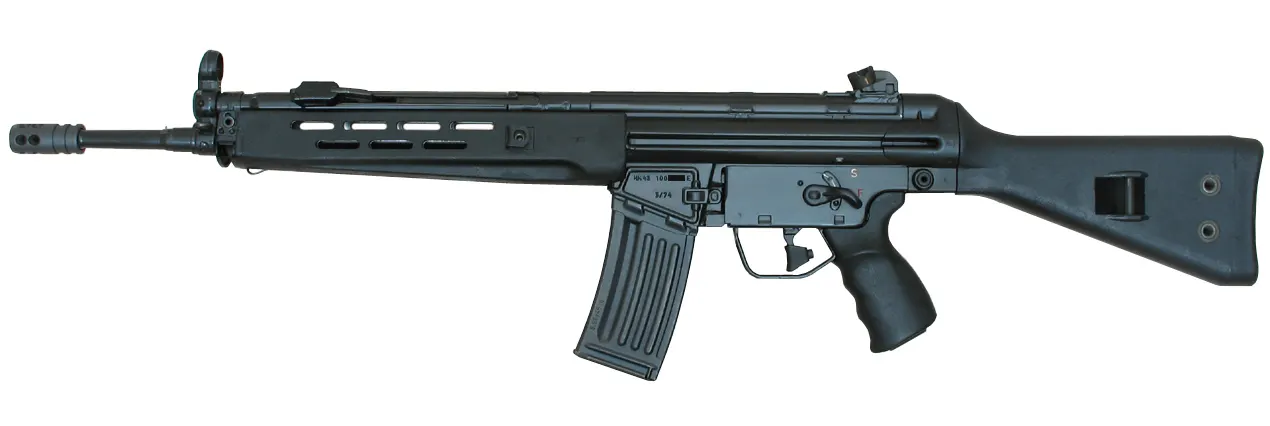

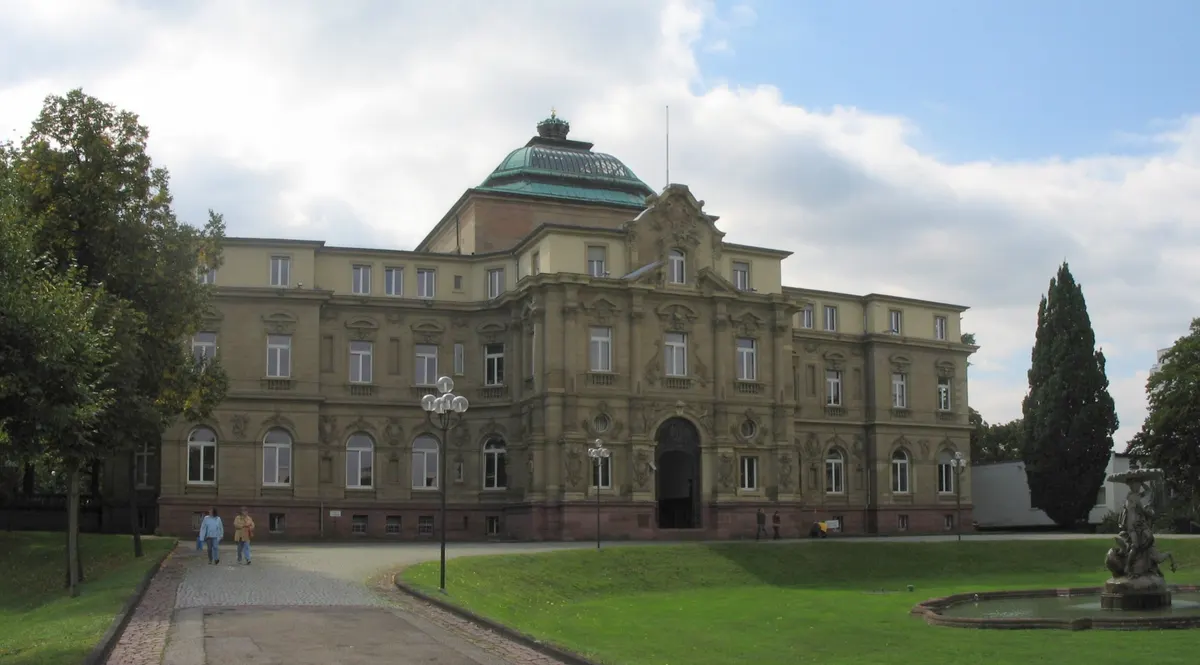
On the morning of 7 April 1977, a motorcycle pulled alongside a Mercedes stopped at a traffic light in Karlsruhe, West Germany. Its passenger emptied fifteen rounds from a semi-automatic rifle into the car, killing Attorney General Siegfried Buback and his driver and fatally wounding a third passenger. The rifle was a Heckler & Koch HK43, the civilian semi-automatic derivative of the Heckler & Koch HK33 assault rifle, and the shooting remains the single most notorious moment in the weapon's short commercial life.1,4
- Direct semi-automatic parity with the HK33 service rifle
- Compatible with standard HK33 magazines (20/25/30/40-round)
- Proven roller-delayed blowback action shared with the G3 family
- Lightweight at 3.8 kg unloaded
- Extremely low production (roughly 377 units total)
- Factory trigger housing could accept an illegally substituted full-auto pack
- Discontinued after German licensing rules tightened in the mid-1970s
- Parts and magazines now scarce and expensive on the collector market

Away from that one attack, the HK43 was never meant to be dramatic. It was one of a handful of low-volume 40-series civilian rifles that Heckler & Koch built alongside its military contracts in the early 1970s, originally aimed at West German and Swiss reservists who wanted a semi-automatic rifle chambered the same as their service weapon for practice shooting before conscription.1,2 Total production across the run is estimated at only around 377 rifles, of which roughly 200 were exported to the United States in 1974 alone, making the HK43 one of the rarer Heckler & Koch production models still traded today.1 It belongs to the wider family of semi-automatic rifles, sharing its roller-delayed blowback action and much of its receiver tooling with the HK33 and with the 7.62mm HK41, the equivalent civilian version of the G3.
Manufactured in Oberndorf am Neckar, Germany, the HK43 used a leading 4 in H&K's own numbering system to mark it as a paramilitary rifle, with the trailing 3 denoting the 5.56x45mm NATO chambering, exactly as the leading 1 in the HK41 denoted 7.62x51mm NATO.1 Anyone searching HK43 specifications, HK43 caliber, or how the HK43 compares to the HK33 is really asking about the same rifle wearing a civilian trigger pack.
The HK43 weighs 3.8 kg (8.4 lb) unloaded and measures 920mm overall, with a 431mm (16.975 in) barrel lengthened slightly from the HK33's own barrel to satisfy US import minimums.1 Early production rifles actually reused surplus HK33 barrels cut to 15.35 inches with a 1 in 12 inch rifling twist rather than the faster 1 in 9 inch commonly assumed for 5.56mm rifles today, a detail confirmed independently by collectors who have slugged original barrels.5 That twist rate suited the lighter 55-grain ammunition standard in the early 1970s, before the heavier 62-grain NATO loadings that faster-twist barrels were later cut for.
- First Production Year1974
- Designerheckler_koch
- Weight (Empty)3.8 kg
- Currently In ServiceNo
- Notable UsersRote Armee Fraktion (RAF), used a KA1-pattern HK43 to assassinate West German Attorney General Siegfried Buback in April 1977
Operating on the same roller-delayed blowback system as the G3 and HK33, the HK43 uses a two-piece bolt in which locking rollers are cammed inward by the barrel extension to delay unlocking under pressure, the same delayed-blowback principle H&K carried across its entire postwar rifle family.2 The rifle feeds from detachable double-column box magazines in 20, 25, 30, or 40-round capacities, fully interchangeable with HK33 magazines, and factory rifles typically shipped with steel 25-round magazines.1 Sights are a protected post front and a rotating diopter rear, the same iron sights pattern used across H&K's roller-delayed rifles of the era, and every HK43 retained the HK33's bayonet lug and standard furniture rather than being cut down for the civilian market.1
- Cartridge5.56x45mm NATO
- Calibre5.56 mm
- Case Length44.7 mm
- Calibre Class5.56mm
- Bullet Weight4 g
- RimfireNo
- Caseless AmmunitionNo
The design detail that mattered most, though, was inside the grip frame. Like the rest of the 40-series, the HK43 shipped with a semi-automatic-only trigger pack, but the housing that held it was mechanically identical to the one on a full-automatic HK33.2,3 A trigger group swap, using an illegally obtained select-fire auto sear, could turn a semi-automatic HK43 into a functional machine gun without any modification to the receiver itself, a vulnerability H&K did not design out until its successor, the HK93, added a metal shelf inside the trigger well that physically blocked a full-auto pack from seating.3
- Action TypeDelayed Blowback
- Fire Modessemi_automatic
- Select FireNo
- Feed SystemDetachable Magazine
- Magazine Capacity25
The rifle also wore the same NATO black finish as the HK41, a slightly duller coating on the steel than the black phosphate or blue-gray finish H&K later used on the HK91/93 line, paired with a short, slim forend forestock and dark polymer furniture instead of the wider civilian handguards fitted to the later import rifles.1
- Barrel Length431.165 mm
- Rifling Twist1:12
- Sight Typeiron sights
- Iron SightsYes
- Overall Length920 mm
- Folding / Collapsing StockNo
- Bullpup LayoutNo
- Modularitytrigger_pack_swap_for_full_auto_conversion
- Total Production377
- Production Start1974
- Production End1989
- Unit Cost8,750 USD
- Variants3
Heckler & Koch developed the HK33 in the 1960s as a scaled-down, 5.56x45mm derivative of its G3 battle rifle, built primarily for export rather than for the West German army itself, which stayed with the 7.62mm G3.2 Once the HK33 was established, H&K used the same tooling to build a small line of semi-automatic civilian rifles it called the 40-series, aimed chiefly at reservists in Germany and Switzerland, where owning a semi-automatic version of a soldier's service weapon for private practice ahead of conscription was an accepted, even encouraged, custom.1,2 The HK41 covered the 7.62mm G3 pattern, the HK43 covered the 5.56mm HK33 pattern, and both entered production in March 1974.1
The domestic German market did not last. By the mid-1970s, tightening West German firearms licensing made the reservist purchase scheme too cumbersome to sustain, and H&K wound the line down.3 The company replaced it in the US market with the HK91 and HK93, rifles built to satisfy the American Gun Control Act's import points system while remaining functionally identical to the HK41 and HK43 they replaced, right down to sharing the earlier rifles' magazines.1,3 The trailing production figures in H&K's own records place HK43 manufacture as continuing in small runs through 1989, even as the HK93 became the more common US import in the interim.1
Three factory variants are documented. The KA1 carried a fixed stock and, in a shortened batch, a 322mm barrel roughly four inches shorter than standard. The A2 used a rigid, fixed synthetic stock. The A3 used a telescoping metal stock that collapsed for storage.1 It was a KA1-pattern short-barreled HK43 that the West German militant group the Rote Armee Fraktion, commonly abbreviated RAF, used in the Buback assassination, not to be confused with the unrelated Royal Air Force that the same three letters usually denote outside Germany.1,4
A cell calling itself Kommando Ulrike Meinhof claimed responsibility for the killing, which opened what West German media later called the Deutscher Herbst, the German Autumn of 1977, the RAF's most violent year of kidnappings and killings.4,7 Four RAF members were eventually charged, though the identity of the actual shooter remained disputed for decades, with former RAF member Peter-Jurgen Boock naming Stefan Wisniewski as the gunman only in 2007.4
The Buback killing was followed five months later by the kidnapping and murder of employer association president Hanns-Martin Schleyer and the hijacking of a Lufthansa airliner to Mogadishu, the chain of events that made the Deutscher Herbst the low point of West German domestic security in the postwar era.7 The HK43 itself played no further documented role in that chain of attacks, its notoriety resting on the single April morning in Karlsruhe.
The KA1 is the fixed-stock variant most associated with the shortened, 322mm-barrel batch built around 1977, the configuration used in the Buback shooting.1 The A2 is the standard full-length rifle with a fixed synthetic stock and is the version most commonly encountered among the roughly 200 rifles imported to the United States in 1974.1 The A3 swaps in a telescoping metal stock for a more compact folded length, mirroring the stock options H&K later offered on the HK41 and on the HK93 that replaced both rifles.1
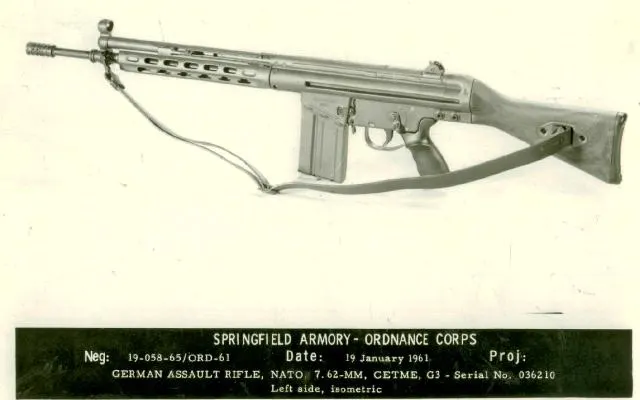
All three variants accept the same 20, 25, 30, and 40-round HK33 magazines, so magazine capacity was never a distinguishing feature between them, only stock configuration and barrel length changed across the run.1
Later reproductions complicate the picture. Century International Arms later built a rifle called the C93 from Thai-surplus Type-11 parts kits fitted to new American-made barrels, cosmetically close to an HK43 or HK93 but not a genuine H&K product and not counted in the roughly 377-unit factory total.1 Collectors researching an HK43 for sale should treat any listing carefully against factory serial ranges for exactly this reason.


Where the HK41 gave civilian shooters a semi-automatic G3 chambered in 7.62x51mm NATO, the HK43 did the same job one caliber class down, built on the lighter HK33 pattern in 5.56x45mm NATO. Both share the identical trigger-pack vulnerability and the identical roller-delayed blowback operating system, and both were sold through the same short-lived reservist program before US import rules pushed H&K toward the HK91 and HK93 instead.1,2 The practical difference for a period buyer was recoil and weight rather than mechanism, since the two rifles were built on the same production line with the same tooling.
| Spec | HK43 | HK41 |
|---|---|---|
| Caliber | 5.56x45mm NATO | 7.62x51mm NATO |
| Weight (empty) | 3.8 kg | Heavier, larger receiver for 7.62mm |
| Parent military rifle | HK33 | G3 |
| Production run | approx. 377 units, 1974-1989 | Similarly small, same era |
Set against contemporaries like the semi-automatic Colt AR-15 sporting rifles of the same decade, the HK43's roller-delayed blowback action needed no gas port or piston, trading a small amount of weight for a mechanism that later proved easier to keep clean under sustained shooting, a distinction still cited by HK33 and G3 shooters today.2


Is the HK43 rifle still in production? No. Heckler & Koch built the HK43 between 1974 and 1989 in very small numbers and never resumed the line, replacing it commercially with the HK91 and HK93.1
What is the difference between the HK43 and the HK33? The HK33 is a select-fire military assault rifle. The HK43 is its semi-automatic-only civilian counterpart, built on the same receiver and roller-delayed blowback action but originally fitted with a trigger pack that lacked a full-auto position.1,2
Was the HK43 used in the Buback assassination? Yes. A shortened KA1-pattern HK43 was the weapon the Rote Armee Fraktion used to kill Attorney General Siegfried Buback and two others in Karlsruhe on 7 April 1977.1,4
How much does an HK43 cost today? Surviving, documented examples typically sell between roughly $7,500 and $10,000 at US auction, reflecting their rarity and their legal status under machine-gun-conversion registration rules rather than the rifle's original retail price.1,6
Can an HK43 be converted to full auto? The factory trigger housing could accept a full-auto trigger pack, which is precisely why the design is treated as sensitive under US federal firearms law, and why the successor HK93 was redesigned specifically to block that swap.3
- "Heckler & Koch HK43", Wikipedia — en.wikipedia.org ↩
- "Heckler & Koch HK33", Wikipedia — en.wikipedia.org ↩
- "HK43: The 5.56mm Paramilitary Rifle", Forgotten Weapons — forgottenweapons.com ↩
- "Siegfried Buback", Wikipedia — en.wikipedia.org ↩
- "HK33 barrel - twist rate?", HKPRO Forums — hkpro.com ↩
- "Heckler & Koch HK 43 Semi-Automatic Rifle", Rock Island Auction Company — rockislandauction.com ↩
- "A Radical Rethinks Terrorist Violence after the Murder of Chief Federal Prosecutor Siegfried Buback (April 25, 1977)", German History in Documents and Images — germanhistorydocs.org ↩
- "The Baader Meinhof Complex (Der Baader Meinhof Komplex)", Internet Movie Firearms Database — imfdb.org) ↩