

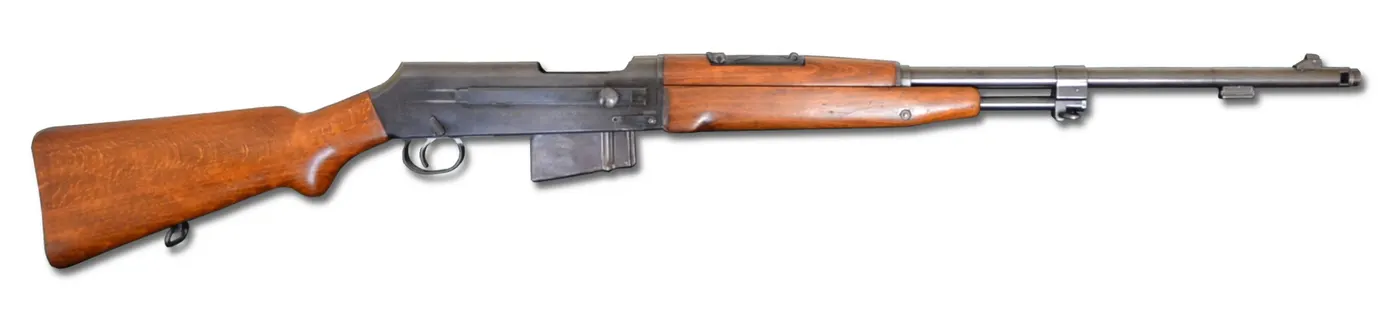

Fewer than ten confirmed examples of the Kbsp wz. 1938M survive anywhere in the world today, and that scarcity is itself the most important fact about this Polish semi-automatic rifle.1,2 Chambered for the 7.92x57mm cartridge developed by the German firm Mauser, the same round Poland's own bolt-action Kb wz. 98a and Germany's Kar98k already used, the wz. 1938M was a gas-operated, tilting-bolt self-loader fed from a fixed 10-round internal magazine loaded with standard Mauser stripper clips.1,3 Only around 150 rifles had left the production line by the time Germany invaded Poland in September 1939, and the outbreak of the war ended the program before it produced a rifle for general issue.1,2
- simple 68-part construction, strips into four main groups with one pin
- 10-round fixed magazine reloadable from standard Mauser stripper clips
- gas-operated tilting bolt, no muzzle-mounted gas trap to fail or foul
- chambered for the 7.92x57mm Mauser round already standard in Polish and German service
- war interrupted production before any full military order was completed
- never issued to a standing Polish Army unit as a standard weapon
- firing pin breakage a recurring cause of jams in trials
- total output, roughly 150 rifles at most, too small for more than test issue
The engineer behind the design, Józef Maroszek (1904 to 1985), was already a proven name in Polish ordnance circles by the late 1930s, having designed the wz. 35 anti-tank rifle that Poland's infantry carried into the same 1939 campaign.6 Maroszek entered the semi-automatic rifle field through a 1934 Polish Army trials program that tested competing self-loading designs against the requirement to eventually replace the bolt-action service rifle, and his design was one of the winners selected for continued development.1,3 The path from that 1934 trial to a numbered, serialized production rifle took roughly four years, and even then the wz. 1938M never received full military adoption, only a limited troop-trial order split awkwardly between two Polish state arms factories.3
The Kbsp wz. 1938M's specifications, its 7.92x57mm Mauser chambering, and the question of why Poland never mass-produced a working semi-automatic rifle before 1939 come up often among interwar small-arms researchers and collectors. The honest answer is that Poland's ordnance industry ran out of time, not out of a workable design. A functioning, trials-tested semi-automatic rifle existed on paper and in small numbers in Polish hands before September 1939, and the invasion, not any technical failure, is what stopped it.
The Browning and Petter Tilting Bolt Poland Chose Over a Rotating Design
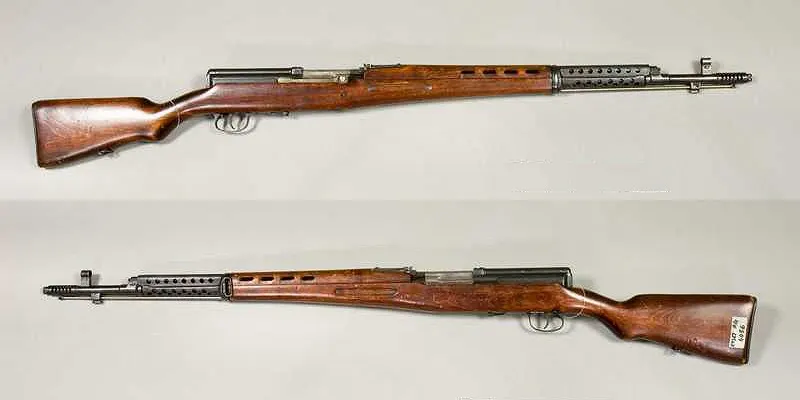
The wz. 1938M used a gas-operated system with the gas tube running under the barrel, driving a piston that unlocked the bolt by tilting its rear upward out of a locking recess milled into the top of the receiver, a Browning and Petter type mechanism rather than a rotating bolt.2,3 That layout let Maroszek keep the moving-parts count low. Published counts put the wz. 1938M at 68 components, compared with 63 for the Soviet SVT-38, 66 for the German Gewehr 41(W), and 55 for the American M1 Garand, a rough but telling measure of how differently national ordnance bureaus solved the same self-loading problem in the same decade.3
- First Production Year1938
- Service Entry Year1938
- DesignerJózef Maroszek
- Weight (Empty)4.5 kg
- Currently In ServiceNo
- Notable UsersPoland, Germany
The 10-round magazine was fixed rather than detachable, loaded from the top with two five-round Mauser stripper clips through the open bolt, the same internal-magazine approach most contemporary semi-automatic service rifles used to avoid the cost and loss risk of issuing detachable box magazines to every soldier.1,3 A return spring wrapped around the gas piston and bolt carrier, a layout Small Arms Review compared directly to the American M1918 Browning Automatic Rifle's internal spring arrangement, and testers identified a breaking firing pin as the recurring cause of jams during the 1937 to 1938 trial period.3
- Cartridge7.92×57mm Mauser
- Calibre7.92 mm
- Case Length57 mm
- RimfireNo
- Caseless AmmunitionNo
Ballistically, the rifle fired its 7.92x57mm Mauser round at a muzzle velocity of 808 meters per second, sighted through a Mauser-pattern tangent leaf rear sight graduated from roughly 300 out to 2,000 meters, in line with the iron sights fitted to contemporary Kar98k-pattern service rifles.1 The rifle weighed 4.5 kilograms unloaded, a figure that also doubled as a hard design requirement Maroszek was told not to exceed, and it mounted a wz. 29 bayonet lug and a small muzzle brake at the front of the barrel.1,3 Sources disagree on the barrel length, with figures of 600 and 625 millimeters both published, a discrepancy worth noting honestly rather than presenting either number as fully settled.1,3
- Action TypeGas-Operated
- Fire ModesSemi-automatic
- Select FireNo
- Feed SystemInternal Magazine
- Magazine Capacity10
- Safety Typelever
- Muzzle Velocity808 m/s
- Sighting Range2,000 m
- Barrel Length625 mm
- Sight Typetangent leaf
- Iron SightsYes
- Overall Length1,134 mm
- Total Production150
- Production Start1938
- Production End1939
From a 1934 Trials Program to a Rifle That Arrived Too Late
Poland's Institute for Armament Materials Research opened a competition for a self-loading service rifle in 1934, and Maroszek's entry was one of the designs carried forward for further refinement through the mid-1930s.1,3 He reworked the rifle's locking system from scratch around 1936, and by 1937 pre-production examples were undergoing troop and ballistic trials with encouraging results.3 The Second Polish Republic's ordnance bureau conditionally accepted the design as the wz. 38M in early 1938, pending further field testing rather than as a final adoption.3
Production planning then ran into Poland's own limited industrial capacity. The original order, for roughly 72 rifles, was aimed at the Łucznik Arms Factory in Radom, but that plant was already backlogged with wz. 29 carbine orders and a two-year-late run of Vis pistols, so in July 1938 the order shifted instead to Zbrojownia Nr. 2, the Warsaw arsenal's experimental works, with barrels supplied separately by the Państwowa Fabryka Karabinów, the State Rifle Factory in Warsaw.3 Most sources put total wartime production at approximately 150 rifles, though the surviving serial numbers run only from 1001 to 1054, a range some collectors read as evidence the true figure sits closer to 54 than the widely repeated 150.2,3 Both figures appear in reputable published sources and neither can be fully confirmed today.
Maroszek's own account, given after the war, claims that during the September 1939 evacuation from the Institute of Armament Technology his train was attacked near the town of Zdołbunów by two low-flying German aircraft, and that he fired back through a train window with his own wz. 1938M, hitting the gunner and forcing one of the aircraft to land.1,2 The story has never been independently corroborated and rests entirely on Maroszek's own postwar telling, which is worth stating plainly rather than repeating as settled fact.2
The rifle reached a far larger audience through Battlefield V's 2019 Defying the Odds content update, which added the Karabin 1938M as a playable Assault-class weapon modeled with gameplay statistics deliberately close to the German Gewehr 43 also featured in that game.7 It remains the wz. 1938M's best-known public appearance by a wide margin, reaching more people than the rifle's own wartime production run ever did.
The 2013 Seizure That Made an Obscure Prototype International News
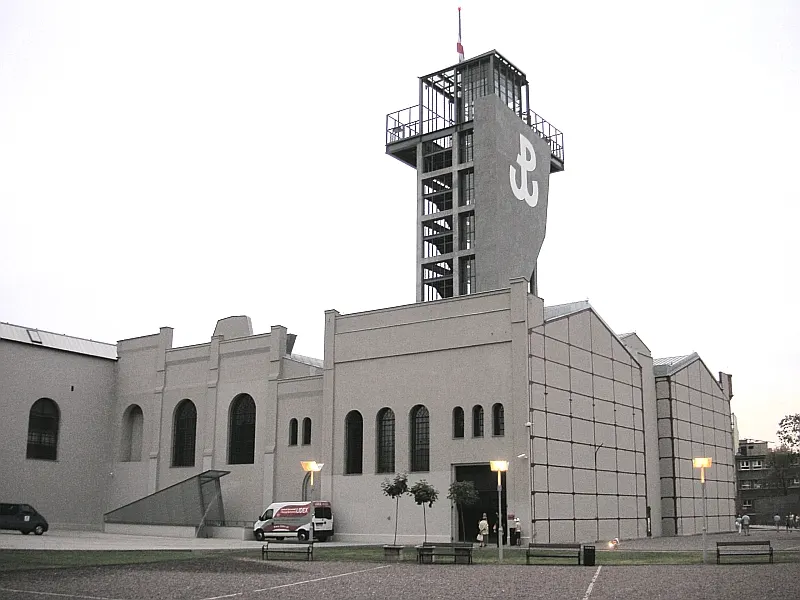
The wz. 1938M's small surviving population turned one particular rifle into an international legal dispute. A collector in Virginia, in the United States, Kristopher Gasior, a Polish immigrant, had bought serial number 1019 legally in 1993 for 9,500 US dollars.4 When he listed the rifle for sale in March 2013 at 65,000 dollars, agents from the US Department of Homeland Security seized it at his home, acting on information supplied by the Polish government, which argued the rifle had left Poland improperly.4 The case was settled later that year, with Gasior paid 25,000 dollars and the rifle placed on permanent exhibit at the Warsaw Rising Museum rather than returned to him.4
That case remains the most publicly documented chapter in the wz. 1938M's whole history, arguably better known today than anything the rifle actually did during the war it was built for. A second surviving rifle, serial number 1048, sold at a United States firearms auction in 2017 for 69,000 dollars, purchased by Poland's own Ministry of National Defence for museum display, underlining just how much collector demand a handful of surviving prototypes from a failed 1938 production run can generate decades later.1
A Trials Rifle Caught in the September 1939 Campaign
The wz. 1938M's combat record from the 1939 invasion of Poland amounts to a handful of trial rifles in the hands of Institute of Armament Technology personnel and whatever small number reached testing units, not a fielded service weapon issued to line infantry.1,3 Maroszek's own claimed engagement near Zdołbunów is the only specific combat account tied to the rifle, and it rests on one man's postwar recollection rather than an independently confirmed record.1,2 No Polish infantry regiment is documented as carrying the wz. 1938M as standard equipment during the campaign, the way it carried the bolt-action Kb wz. 98a or the Maroszek-designed wz. 35 anti-tank rifle in genuine numbers.3,6
Whatever rifles survived the campaign passed out of Polish state hands entirely once Germany occupied the country, and the isolated, unverified claim of captured examples reappearing with German soldiers in occupied Warsaw is the closest the design comes to any further wartime use.1 That places the wz. 1938M's wartime footprint closer to a research program interrupted mid-course than to a rifle that ever saw organized combat service on either side.
Cross-Bolt Differences and a Modern Civilian Rebirth
Surviving wz. 1938M rifles are not perfectly uniform. Collectors examining the small surviving population have noted some rifles built with a single cross-bolt through the receiver and others with two, a detail read as evidence of running design changes made during the short 1938 to 1939 production window rather than confirmation of any formally named variant.3 No wz. 1938M is documented as ever being select-fire or chambered for any cartridge other than 7.92x57mm Mauser.1
The design's most concrete modern variant is not Polish military hardware at all. Gunsmith Ryszard Tobys, based near Poznań and already known internationally as a large-scale manufacturer of cap-and-ball revolvers, completed a hand-built civilian replica of the wz. 1938M in November 2013, chambered in 8x57 JS Mauser rather than the original military 7.92x57mm loading.3 Tobys worked from original factory blueprints held by one of Maroszek's own relatives, an unusually direct chain of provenance for a design whose factory records were otherwise scattered or destroyed during the war.3


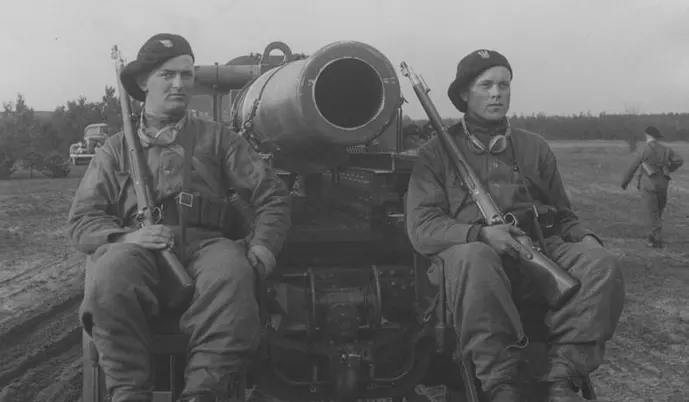
Poland is the only confirmed operator of the Kbsp wz. 1938M, and even that use was limited to Institute of Armament Technology trials personnel and whatever small number of the roughly 150 completed rifles reached Polish Army testing units before September 1939.1,3 No standing Polish Army infantry unit is documented as having received the wz. 1938M as standard issue, since the rifle never advanced beyond conditional troop trials before the invasion ended the program.3
A single, unverified account places captured wz. 1938M rifles in the hands of German occupation troops in Warsaw after 1939, but no confirmed unit-level German adoption or reissue program is documented, and Maroszek himself is the sole source for that claim.1 The overwhelming majority of Polish infantry in the same campaign still carried the bolt-action Kb wz. 98a, the wz. 1938M's intended eventual replacement that never got the chance to actually replace it.8
The wz. 1938M and the SVT-38, One Rifle Year, Two Very Different Outcomes
Poland's wz. 1938M and the Soviet Union's SVT-38 both reached production in 1938, out of national trials programs that ran on almost identical timelines, yet their fates diverged by something close to four orders of magnitude in total output.1,7 Fedor Tokarev's SVT-38 beat out Sergei Simonov's improved AVS-36 and a design by Rukavishnikov in the Soviet Union's own 1938 trials, and that program had the industrial backing to refine the winning design into the SVT-40 and eventually build 1.6 million rifles before 1945.7 Poland's wz. 1938M never reached that stage. Its own factories delivered perhaps 150 rifles, at most, before the war that both programs were racing to prepare for arrived and stopped one of them cold.1,3
| Spec | Kbsp wz. 1938M | SVT-38/SVT-40 |
|---|---|---|
| Cartridge | 7.92x57mm Mauser | 7.62x54mmR |
| Magazine | 10-round fixed, stripper-clip loaded | 10-round detachable box |
| Production total | Approximately 150 | Approximately 1,600,000 |
| Adopted for general service | No | Yes, 1938/1940 |
Both rifles used a gas-operated action and both grew out of interwar programs aimed at the same goal, giving an infantryman more than the five or ten shots a bolt-action rifle offered before reloading. The real difference was never mechanical. It was that the Soviet Union had the arsenal capacity, and the years of peace before its own 1941 invasion, to turn a winning trials design into over a million rifles, while Poland's ordnance industry ran out of both time and factory space before its own winning design left the prototype stage in any real numbers.1,3,7


What caliber is the Kbsp wz. 1938M chambered for? The Kbsp wz. 1938M fires the 7.92x57mm Mauser cartridge, the same round used by Poland's own Kb wz. 98a bolt-action rifle and Germany's Kar98k.1
Who designed the Kbsp wz. 1938M? Polish engineer Józef Maroszek designed the rifle, having already designed Poland's wz. 35 anti-tank rifle, after his entry was selected for further development in a 1934 Polish Army self-loading rifle trials program.1,6
How many Kbsp wz. 1938M rifles were made? Most published sources put production at approximately 150 rifles before the September 1939 invasion of Poland ended the program, though the surviving serial number range (1001 to 1054) has led some collectors to question whether the true total was closer to 54.2,3
Did the Kbsp wz. 1938M see combat in World War II? Only in one unverified account. Designer Józef Maroszek claimed he used his own rifle to fire on a low-flying German aircraft near Zdołbunów during the September 1939 evacuation, but the rifle was never issued to Polish infantry units in numbers and has no other documented combat record.1,2
How many Kbsp wz. 1938M rifles survive today? Fewer than ten confirmed examples are known, held by the Polish Army Museum, the Warsaw Rising Museum, Russia's Central Armed Forces Museum, and a small number of private collections in the United States and Germany.1,2
Is the Kbsp wz. 1938M the same rifle as the wz.39 Mors? No. The wz.39 Mors is a separate submachine gun designed by Piotr Wilniewczyc and Jan Skrzypiński. The Mors name is sometimes wrongly attached to Maroszek's semi-automatic rifle online, but no period source supports that nickname for the wz. 1938M.2,5
- "Kbsp wz. 38M", Wikipedia — en.wikipedia.org ↩
- "Polish wz.38M semiauto rifle", Forgotten Weapons — forgottenweapons.com ↩
- "The wz.38M, Lost Classic is Back", Small Arms Review — smallarmsreview.com ↩
- "The Strange Case of Kris Gasior and his Kbsp wz.38M Rifle", Guns.com — guns.com ↩
- "Karabin wz. 38M", Wikipedia (Polish) — pl.wikipedia.org ↩
- "Wz. 35 anti-tank rifle", Wikipedia — en.wikipedia.org ↩
- "SVT-40", Wikipedia — en.wikipedia.org ↩
- "Model 98a rifle", Wikipedia — en.wikipedia.org ↩