

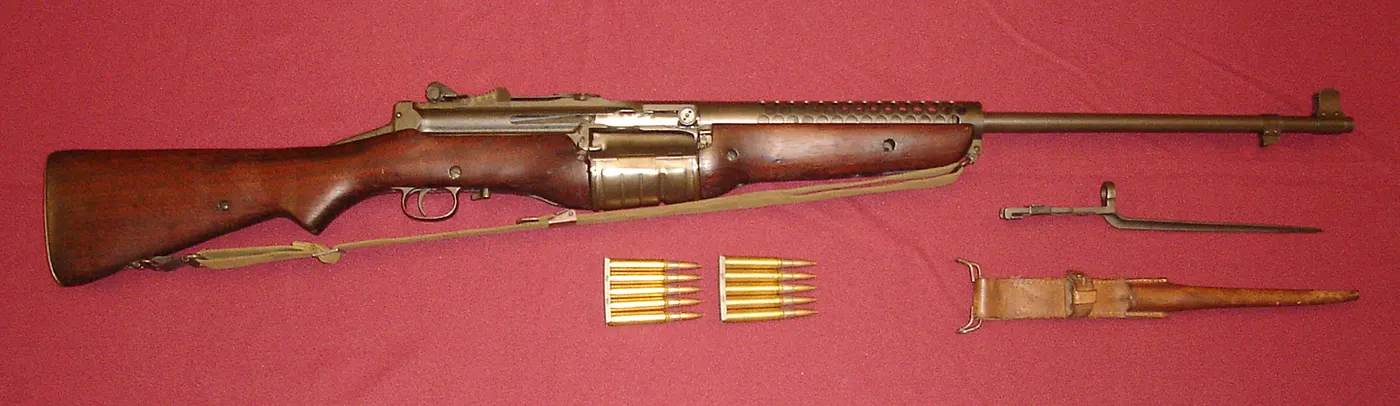

The M1941 Johnson rifle is a short-recoil operated semi-automatic rifle chambered for .30-06 Springfield, built around a ten-round rotary magazine that could be topped off with the bolt closed and a round chambered, something the competing M1 Garand could not do.1 Designed by Melvin Johnson, a Marine Corps reserve officer and patent lawyer, the rifle is the losing side of one of American small-arms history's best documented procurement fights. The Army had already adopted the Garand when Johnson brought his own design forward, and the resulting public argument ran through Congress, the trade press and two separate rounds of service trials before the Johnson lost.2
- ten-round rotary magazine, top-loadable anytime
- quick-change barrel for field maintenance
- softer felt recoil than the Garand
- mild vertical stringing under sustained fire
- reciprocating barrel fails with a fixed bayonet
- no established American logistics chain
Roughly 21,988 M1941 Johnson rifles were built between 1940 and 1945, most of them for a Dutch government-in-exile contract rather than for American service.3 The United States Marine Corps picked up a limited number outside normal ordnance channels for its Paramarine battalions, and the rifle went on to see combat on Guadalcanal, in the Dutch East Indies, in the Chinese Civil War and even at the Bay of Pigs, well after the U.S. Army had settled permanently on the Garand.4 It belongs to the broader family of semi-automatic rifles fielded by multiple armies during and after World War II, alongside gas-operated and recoil-operated designs that competed for the same infantry role.
The Johnson rifle's short-recoil action and rotating bolt put it in a small group of American service rifles that did not use gas operation, and later small-arms designers, including Eugene Stoner at ArmaLite, studied the mechanism closely when the AR-15 was developed a decade later.5 Both the Marine Corps and the Netherlands government tested and bought Johnson's rifle chiefly because it reached the market as a finished, in-production alternative at a moment when Garand output could not keep pace with demand.
The Short-Recoil Rotating Bolt Behind the M1941 Johnson Rifle's Action
The M1941 Johnson rifle operates on short recoil. When a round fires, the barrel and bolt, locked together by an eight-lug rotating bolt head, travel rearward together for a short distance before the barrel stops and the bolt continues alone, rotating roughly twenty degrees to unlock, then extracting and ejecting the spent case before chambering the next round on its return stroke.7 Muzzle velocity for .30-06 ball ammunition was measured at 866 m/s (2,840 ft/s) from a 22-inch barrel, close to Garand-issue figures for the same cartridge.8 The receiver splits into upper and lower halves rather than the traditional lock-stock-and-barrel breakdown of a bolt-action rifle, a layout choice that later shows up again in the AR-15 and its descendants.
- First Production Year1940
- Service Entry Year1941
- Designermelvin_johnson
- Weight (Empty)4.31 kg
- Weight (Loaded)5.22 kg
- Currently In ServiceNo
- Notable UsersUnited States, Netherlands, Chile, Republic of China, Cuba
Because the barrel itself reciprocates, the mechanism is sensitive to added muzzle weight. A fixed bayonet changes the barrel's moving mass enough to disrupt reliable cycling, which is why Johnson designed an unusually light, all-metal spike bayonet purely to satisfy the requirement rather than to be a useful blade.3 The same reciprocating-barrel trait produces a small amount of extra vertical shot dispersion compared to a fixed-barrel rifle, a criticism Ordnance testers raised repeatedly during the 1940 trials.
- Cartridge30_06_springfield
- Calibre7.62 mm
- Case Length51.8 mm
- Calibre Classfull_size_rifle
- Bullet Weight9.7 g
- RimfireNo
- Caseless AmmunitionNo
A Ten-Round Rotary Magazine You Could Top Off With the Bolt Closed
Johnson's rotary magazine, holding ten rounds of .30-06, was loaded through the top of the open action with standard five-round M1903 Springfield stripper clips or single cartridges, and unlike the Garand's eight-round en-bloc clip it did not have to be emptied before reloading.9 A Marine could add rounds one at a time in a lull in firing, something Springfield-clip and en-bloc-fed rifles of the period could not do. The mechanism drew inspiration from the earlier Krag-Jørgensen rifle's side-loading gate, adapted into a rotating internal magazine rather than a fixed box.10 The design traded outright magazine capacity, ten rounds against the Garand's eight, for reload flexibility rather than raw volume of fire.
- Action TypeShort Recoil
- Fire Modessemi_automatic
- Select FireNo
- Feed SystemDrum
- Magazine Capacity10
- Trigger Typesingle_stage
- Safety Typemanual
The Quick-Change Barrel and the Bayonet Problem It Created
A distinguishing feature the Marines specifically valued was the Johnson's quick-change barrel, removable and replaceable in the field in seconds without tools, useful both for overheated barrels and for compact parachute-drop packaging.11 Overall length ran to about 1,165 mm (45.9 in) with the barrel fitted, and empty weight was 4.31 kg (9.5 lb), noticeably lighter than a loaded Garand.
- Muzzle Velocity866 m/s
- Effective Range (point)500 m
- Barrel Length559 mm
- Rifling Twist1_10
- Rifling Grooves4
- Sight Typeiron_sights
- Optic RailNo
- Iron SightsYes
- Threaded BarrelNo
- Overall Length1,165 mm
- Receiver Materialsteel
- Furniture Materialwood
- Folding / Collapsing StockNo
- Bullpup LayoutNo
- Ambidextrous ControlsNo
- Modularitynone
- Total Production21,988
- Production Start1940
- Production End1945
- Unit Cost125 USD
- Variants2
Melvin Johnson's Break From the Garand's Gas-Operated Design
Melvin Johnson began work on his own semi-automatic rifle in 1936, shortly after the Army formally adopted John Garand's gas-operated design, doubting that wartime propellant would burn consistently enough for a gas system to cycle reliably under field conditions.1 A machine shop built his first working prototype for about $300. Over the following four years Johnson refined the rifle through several iterations, adding the rotary magazine, an improved cocking handle and a redesigned extraction system, while personally lobbying officers, congressmen and the press to get his design in front of the services.12
The 1940 Trials at Fort Belvoir, Quantico and San Diego
By February 1940 the rivalry between the two rifles had become public. The Washington Evening Star ran a series titled Battle Efficiency of Garand Rifle Provokes Controversy, and the argument reached the U.S. Senate Committee on Military Affairs that May, in the same week the British Expeditionary Force was evacuating Dunkirk.9 Formal trials at Quantico in May 1940 measured hit percentages of 81.2 percent for the Johnson against 71.3 percent for the M1 Garand under identical courses of fire.2 A separate comparison at Fort Belvoir and a further round at San Diego in November 1940, this time including an M1903 Springfield and a Winchester prototype, found the Garand marginally ahead of the Johnson overall, with the Winchester entry trailing both.9
The Army rejected the Johnson rifle in early 1941, and the decision came down to logistics rather than raw performance. The Garand was already in full production at Springfield Armory, spare parts were flowing through Ordnance depots worldwide, and switching rifles mid-mobilization was judged too disruptive.9 Johnson's own combative lobbying style and poor sense of political timing did him no favors either.
Cranston Arms Co. and the Dutch East Indies Contract
Locked out of the U.S. Army, Johnson found a buyer in the Netherlands government-in-exile, which needed a modern semi-automatic rifle for the Royal Netherlands East Indies Army (KNIL) facing a deteriorating position against Japan. On August 19, 1940, the Netherlands Purchasing Commission placed an initial order for 10,200 rifles and 515 Johnson light machine guns, followed by a further order for around 20,000 more rifles.1 To fill the contract, Johnson Automatics and Universal Windings of Providence set up a dedicated production line in nearby Cranston, Rhode Island, trading as Cranston Arms Co. Inc, and had the factory staffed and producing rifles within roughly five months.6
The pace of shipping could not match the pace of the Japanese advance. Only about 1,999 rifles reached the Dutch East Indies before Japanese forces overran the archipelago on March 8, 1942, out of nearly 22,000 eventually manufactured.3 The bulk of production instead sat in American warehouses, which is what made the rifle available to the Marine Corps at all.
From Gavutu to Bloody Ridge, the Johnson Rifle's Combat Debut
Although the Marine Corps had officially declined to adopt the rifle, Johnson personally arranged for 23 M1941 rifles to be issued to the 1st Marine Parachute Battalion just before it deployed to the Solomon Islands.13 Those rifles saw their first combat during the parachute battalion's assault on Gavutu island on August 7, 1942, the opening day of the Guadalcanal campaign, and went on to equip Marine paratroopers through the fighting at Tulagi and the defense of Bloody Ridge on Guadalcanal itself.11 After the parachute battalion withdrew, the Marine Corps arranged to buy an additional 750 rifles from the Dutch Purchasing Commission's own stock for further Paramarine issue.13
World War II, the Pacific Theater and the Paramarines
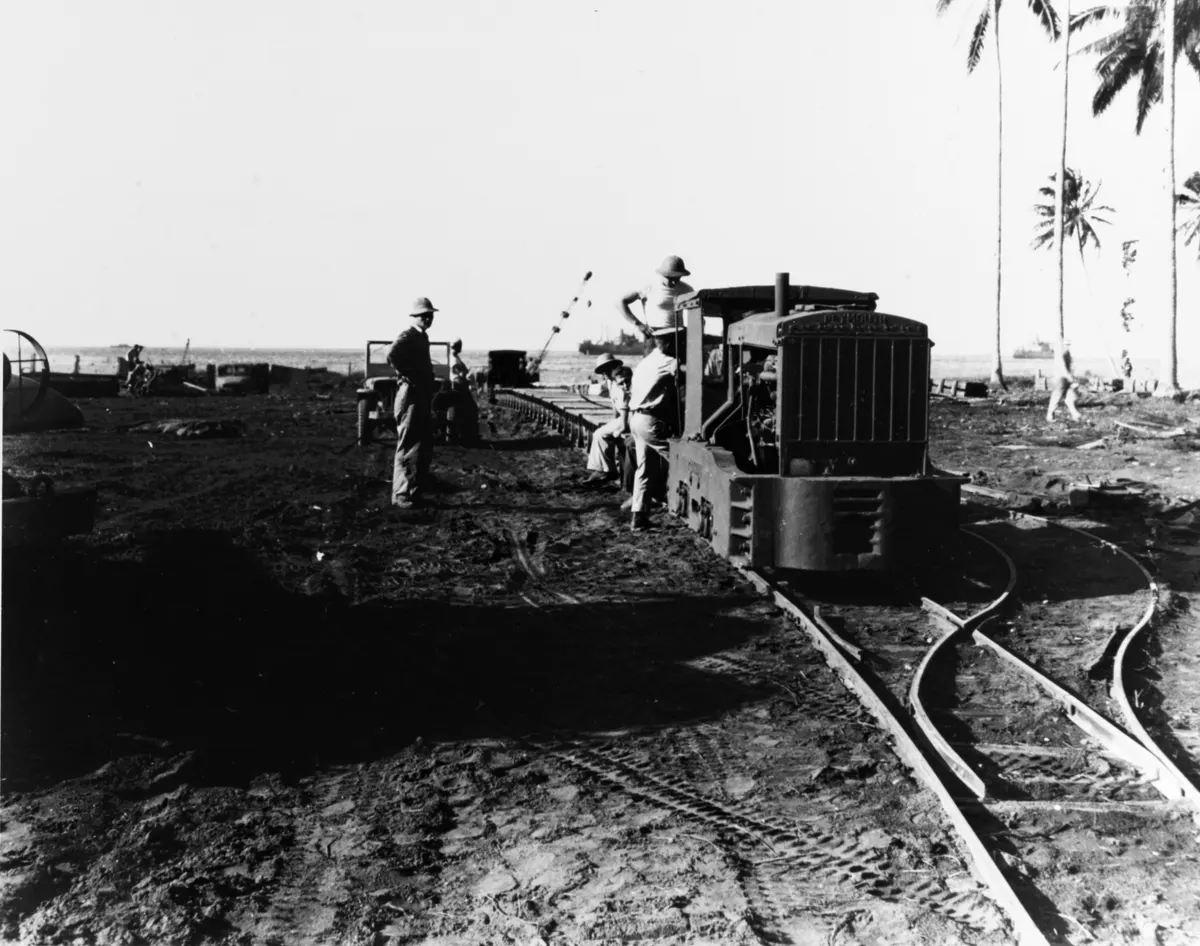
Beyond the Solomons, small numbers of Johnson rifles followed individual Marines through later Pacific fighting, most famously with Dunlap at Iwo Jima in 1945, even as the Garand remained the Corps' standard-issue rifle by that stage of the war.1 In Dutch hands the rifle's combat record is shorter but more concentrated, tied almost entirely to the doomed defense of the Dutch East Indies in early 1942, where KNIL units equipped with the newly arrived Johnsons faced a Japanese invasion force they could not stop.3
Post-War Service in the Chinese Civil War, Indonesia and Cuba
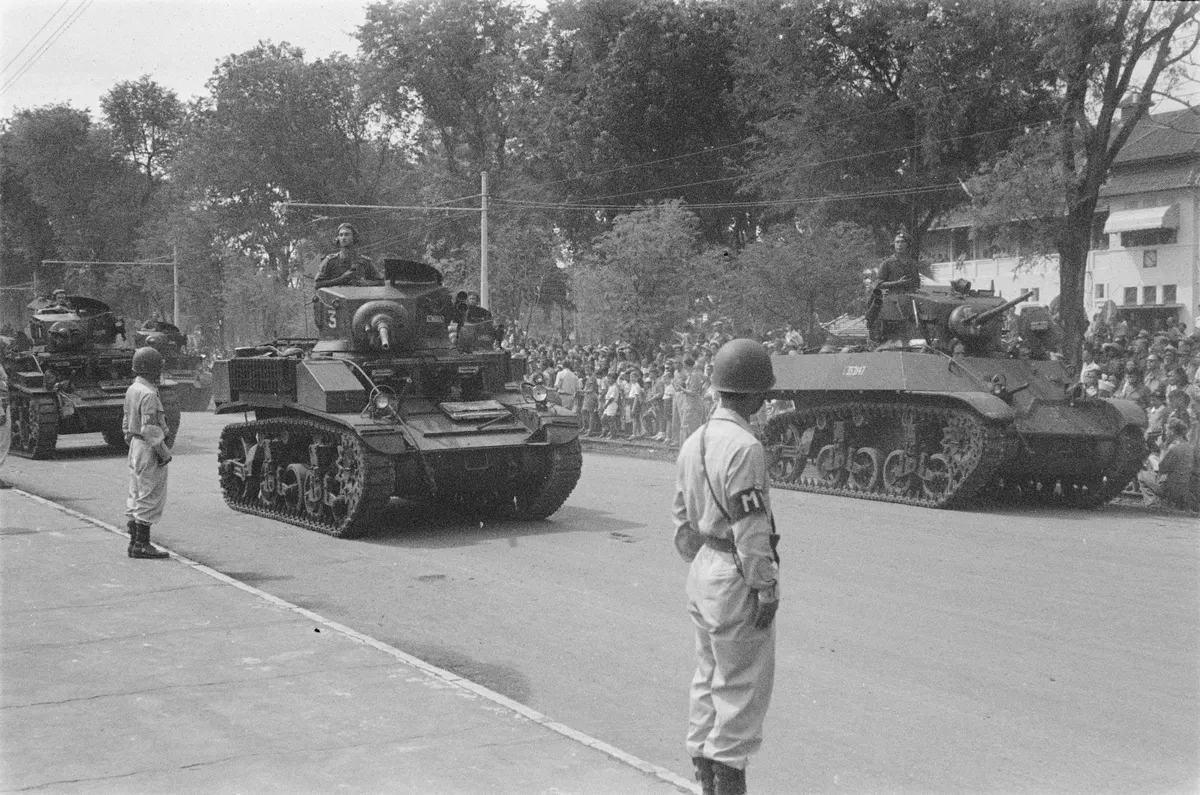
Surplus and Dutch-purchased Johnson rifles kept circulating long after 1945. Nationalist forces fighting in the Chinese Civil War carried some as part of a broader mix of American, Japanese and domestically produced small arms, and photographs from Shanghai in 1949 show Johnson rifles still in the hands of Nationalist troops at roadblocks in the final weeks before the city fell.14 The Dutch army kept its own Johnsons in service into the Indonesian National Revolution, using them against the independence forces they had originally been bought to fight the Japanese alongside.1 The Chilean military, an early export customer, took delivery of 1,000 rifles rebarreled for 7×57mm Mauser in 1943.4 Decades later, Johnson rifles surfaced again in the hands of Cuba's CIA-organized Brigade 2506 during training for, and the landing at, the Bay of Pigs in 1961, among the last documented combat use of the design anywhere.4
The Model 1941 Rifle Family, the Light Machine Gun and the M1947 Auto Carbine
Johnson built the same short-recoil, rotating-bolt operating system into a companion light machine gun, the M1941 Johnson machine gun, fed from a 20-round side-mounted magazine and adjustable between roughly 200 and 600 rounds per minute, considerably lighter than the Browning Automatic Rifle it competed against.15 Units of the joint American-Canadian First Special Service Force favored the Johnson light machine gun's quick-change barrel and lighter weight over the BAR during the Italian campaign, though that combat record belongs to the machine gun rather than the rifle covered here.16 After the war Johnson scaled the same basic action down into the M1947 Johnson auto carbine, nicknamed Daisy Mae, a shorter and lighter derivative that never reached significant production despite being marketed into the early Cold War period.
Chilean 7×57mm and Sporting Chamberings
Beyond the standard .30-06 rifle, Cranston Arms produced a small run rebarreled for 7×57mm Mauser to fill the Chilean contract, and postwar sporterized examples occasionally turn up rechambered for .270 Winchester by gunsmiths rather than the factory.4 No factory-built folding-stock or true carbine-length variant of the rifle itself exists, that distinction belongs to the separate M1947 auto carbine described above.


| Year | Buyer | Quantity | Amount | Present Value (2025) |
|---|---|---|---|---|
| 1943 |  Chile | 1,000 | — | — |
| 1940 |  Kingdom of the Netherlands | 10,200 | — | — |
The United States never formally adopted the M1941 Johnson rifle, but the Marine Corps fielded small, informally-acquired numbers through its Paramarine battalions from 1942 onward before the type was fully retired from Marine service in favor of the Garand.13 The Netherlands was the rifle's largest intended customer, ordering roughly 30,000 rifles for KNIL forces in the Dutch East Indies, of which only a fraction arrived before the 1942 Japanese occupation, with the remainder retained in Dutch hands into the Indonesian National Revolution.1 Chile bought 1,000 rebarreled examples in 1943, and Nationalist China (present-day Taiwan) received some rifles as part of broader U.S. military aid before the Communist victory in 1949 ended their service there.14 Cuban exile forces of Brigade 2506 used Johnson rifles during the 1961 Bay of Pigs operation, the last confirmed combat deployment of the type.4
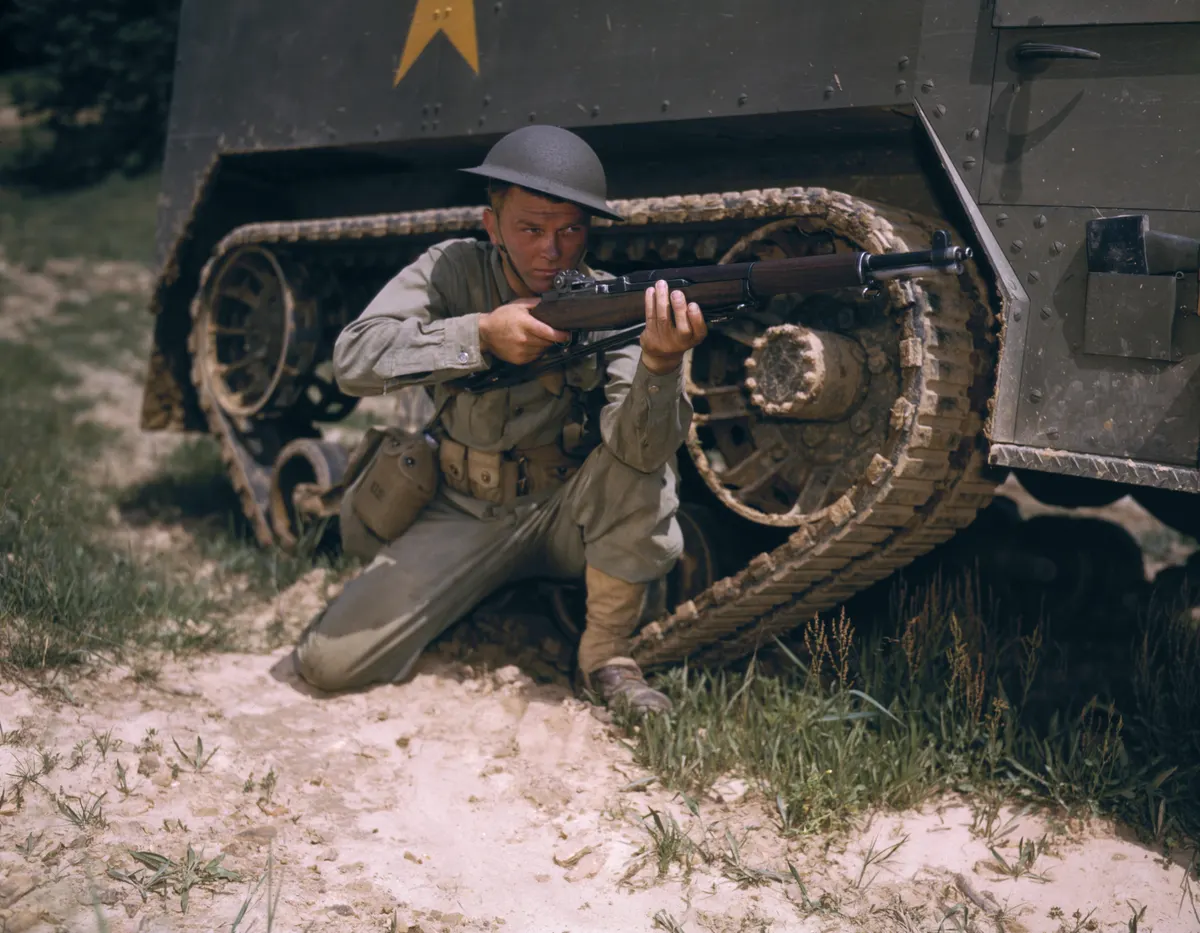
The M1941 Johnson rifle and the M1 Garand were never really competing on paper capability, they were competing on timing. Both fired the same .30-06 Springfield cartridge at similar velocity, both were semi-automatic, and both scored well in the 1940 trials, but the Garand had a two-year head start in Army adoption and an already-running production line at Springfield Armory when the Johnson showed up looking for a contract.9 The Johnson's rotary magazine let a rifleman top off ammunition without emptying the action first, a real tactical advantage over the Garand's eight-round en-bloc clip, which had to be fully spent (or forcibly ejected) before reloading. The Garand's simpler fixed-barrel gas system, in exchange, gave it better sustained-fire accuracy and none of the Johnson's bayonet-cycling problem.
| Trait | M1941 Johnson rifle | M1 Garand |
|---|---|---|
| Action | Short-recoil, rotating bolt | Gas-operated, rotating bolt |
| Magazine | 10-round rotary, top-loadable | 8-round en-bloc clip |
| Empty weight | 4.31 kg | 4.31 kg |
| Muzzle velocity | 866 m/s | ~853 m/s |
| Units produced | ~21,988 | ~5.4 million |
Where the Garand's influence stopped at its own service life, the Johnson's rotating multi-lug bolt had a second act. Eugene Stoner worked with Johnson as a consultant around the time he was developing the AR-10 and AR-15 for ArmaLite, and the AR-15's seven-lug rotating bolt, in-line recoil path and split upper and lower receiver all echo choices Johnson made in his rifle fifteen years earlier.5 The Colt AR-15 that grew out of that design went on to sell in numbers the Johnson rifle never approached, but the mechanical family resemblance is well documented rather than coincidental.


What is the M1941 Johnson rifle's caliber? The M1941 Johnson rifle is chambered for .30-06 Springfield, the same standard-issue American service rifle cartridge used by the M1 Garand, with a small number of Chilean-contract rifles rebarreled for 7×57mm Mauser.4
How does the M1941 Johnson rifle work? It cycles on short recoil rather than gas pressure. The barrel and bolt travel rearward together for a short distance after firing, an eight-lug rotating bolt then unlocks, and the bolt alone continues rearward to extract, eject and chamber the next round from the ten-round rotary magazine.7
Why did the M1941 Johnson rifle lose to the M1 Garand? Ordnance officials rejected it in early 1941 primarily for logistics reasons. The Garand was already in full production with an established parts and repair network, and switching the standard rifle again during mobilization was judged too costly, even though the Johnson had matched or beaten the Garand's hit percentage in the May 1940 Quantico trials.9
Is the M1941 Johnson rifle still in service anywhere? No. Its last confirmed combat use was with Cuban exile forces at the 1961 Bay of Pigs invasion, and it has been out of any regular military service since. Surviving examples are now sought by collectors rather than issued to troops.4
What is a M1941 Johnson rifle worth today? Prices for original examples have climbed steadily, averaging roughly $10,000 to $11,000 at major auction in recent years, with documented U.S. Marine Corps-issue rifles reaching well into five figures because of their rarity and combat provenance.17
- "M1941 Johnson rifle", Wikipedia — en.wikipedia.org ↩
- "M1 Garand vs. M1941 Johnson Rifle Debate", The Armory Life — thearmorylife.com ↩
- "The M1941 Johnson Rifle Goes to War", Rock Island Auction — rockislandauction.com ↩
- "1941 Johnson Rifle, An Unsung Hero of World War II", Guns.com — guns.com ↩
- "M1941 Johnson Rifle, AR-15 Progenitor", Small Arms Review — smallarmsreview.com ↩
- "Johnson Automatics Manufacturing Company During World War Two", US Auto Industry in World War II — usautoindustryworldwartwo.com ↩
- "Johnson M1941 rifle (USA)", Modern Firearms — modernfirearms.net ↩
- "Semi-Automatic Rifle, Johnson Model 1941", Military Factory — militaryfactory.com ↩
- "Was the Johnson Rifle Better than the Garand?", Guns.com — guns.com ↩
- "M1941 Johnson Semiauto Rifle, Part 1, History", Practically Shooting — practicallyshooting.com ↩
- "The Model Of 1941 Johnson Rifle In Marine Service", American Rifleman — americanrifleman.org ↩
- "History", Johnson Automatics — johnsonautomatics.com ↩
- "Ready For Action, The Arms of the Paramarines", American Rifleman — americanrifleman.org ↩
- "WWII weapons in Shanghai, VJ Day to 1949", wwiiafterwwii — wwiiafterwwii.wordpress.com ↩
- "The Model Of 1941 Johnson Light Machine Gun", American Rifleman — americanrifleman.org ↩
- "The Light Machine Gun Favored By the Devil's Brigade and Elite Marine Paratroopers", War History Online — warhistoryonline.com ↩
- "1941 Johnson Rifle, Value & Selling Guide", WeBuyGuns — webuyguns.com ↩