

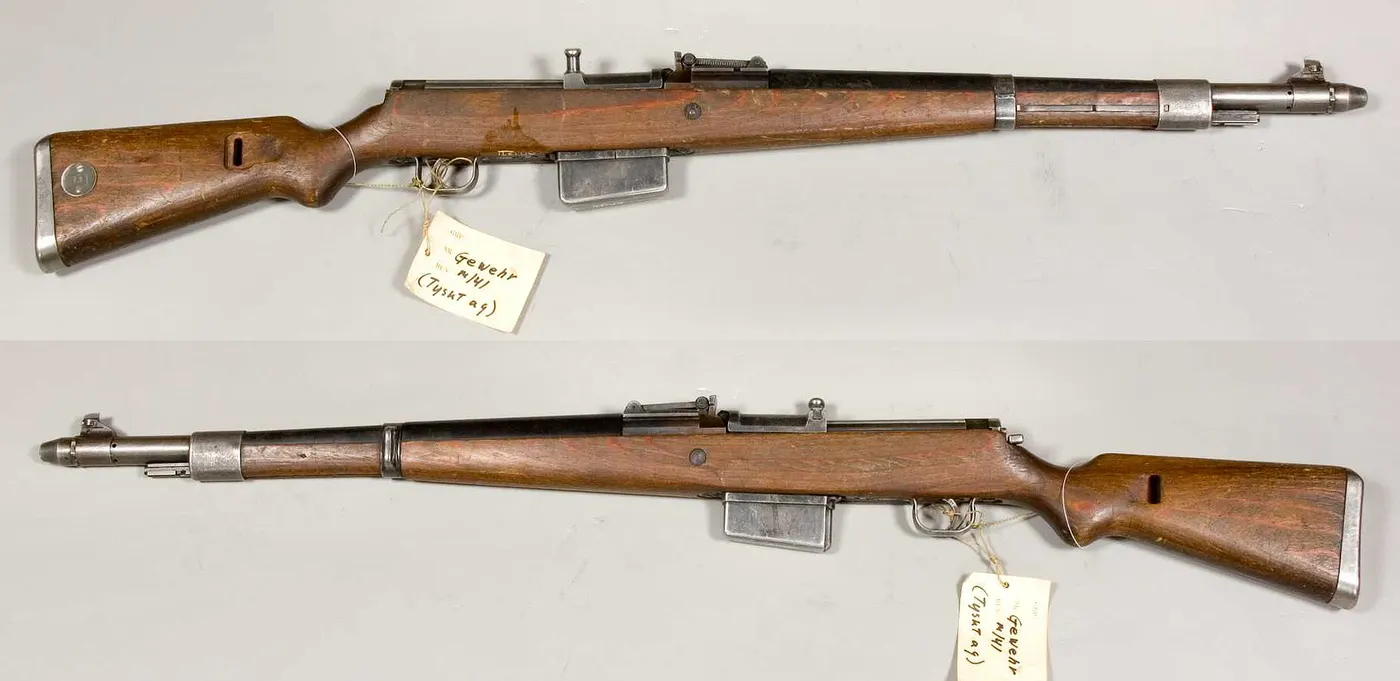

The Gewehr 41 is a gas-operated, semi-automatic rifle built for the German army during the early years of World War II and chambered for the standard 7.92x57mm Mauser cartridge. It reached troops in two distinct forms, the Mauser Gewehr 41(M) and the Walther Gewehr 41(W), both submitted to the same 1940 requirement and both built around the same unusual gas-operated principle. The Gewehr 41(W) was the version the Heereswaffenamt (Army Weapons Office) formally adopted in December 1942, and it is the version most collectors and historians mean when they simply say Gewehr 41 today.1
- Genuine semi-automatic fire from a standard-issue infantry rifle
- Retained bolt-action capability as a mechanical fallback
- Reused the existing 7.92x57mm Mauser cartridge and ammunition supply chain
- Tight German manufacturing tolerances gave good practical accuracy when clean
- Muzzle-heavy balance from the gas trap assembly at the front of the barrel
- Gas system fouled quickly from powder residue, mud, and snow
- Roughly 4.9 to 5 kilograms empty, heavier than the rifle it was meant to replace
- Fixed 10-round magazine loaded only from stripper clips, no detachable box
The rifle exists because Nazi Germany fell behind in a race it had barely noticed it was running. By 1940 the Soviet Union had already fielded the SVT-38 and was moving to the improved SVT, and the United States had adopted the M1 Garand as its standard infantry rifle. Wehrmacht infantry were still carrying the bolt-action Karabiner 98k, and the high command wanted an answer.1,2 The German army's answer came with a strange condition attached. The specification issued by the Heereswaffenamt banned any hole drilled into the barrel to bleed off propellant gas, banned moving parts on the rifle's upper surface, and still demanded a manual bolt-action fallback in case the self-loading mechanism jammed.1,3 That single anti-gas-port rule is the reason the Gewehr 41 looks and behaves the way it does, and it is also the central reason the rifle failed.
Roughly 120,000 Gewehr 41 rifles of both types were built before production shifted entirely to the redesigned Gewehr 43 in 1943.1 That number sounds substantial until it is set against the millions of Karabiner 98k rifles Germany produced across the same war, or against the hundreds of thousands of SVT-40s and M1 Garands the Soviet Union and the United States fielded. The Gewehr 41 was never the rifle the German army wanted it to be, but it was the only semi-automatic rifle Germany built in meaningful numbers until the Gewehr 43 arrived, and understanding why it struggled explains almost everything about how the Gewehr 43 was designed a year later.
A rifle designed around a rule instead of a target
Most rifle designs start from a performance target and work backward to a mechanism. The Gewehr 41 started from a mechanism ban. The German army's insistence that no gas port be drilled into the barrel was rooted in a distrust of gas-operated rifles common to several ordnance departments before the war, the concern being that a hole in the bore would accelerate erosion and hurt accuracy over the rifle's service life.1,3 Denied the simple solution of tapping gas straight from the barrel, both Mauser and Walther turned to a much older idea, the muzzle-trap gas system originally worked out by the Danish engineer Søren H. Bang in the early twentieth century for his own experimental self-loading rifle.10 In the Bang system, a cone-shaped sleeve fits over the muzzle. Propellant gas and the last fraction of pressure behind the departing bullet push that sleeve forward, and a rod connects the sleeve's motion back to the bolt carrier to cycle the action, all without a single hole in the barrel itself.1,5
- First Production Year1941
- Service Entry Year1941
- DesignerSøren H. Bang (Bang system)
- Weight (Empty)4.9 kg
- Currently In ServiceYes
- Notable UsersNazi Germany, Italian Social Republic
The system worked, in the sense that it cycled a round without violating the specification. It also concentrated a mass of precision-fitted steel parts at the extreme front of the barrel, which made the whole rifle muzzle-heavy and awkward to hold on target, and it created a small, tightly toleranced mechanism sitting exactly where mud, snow, and unburned powder would collect during firing.5,6 German propellant of the period was comparatively dirty and left heavy fouling, which aggravated a gas trap that was already difficult to strip and clean in the field.6,12 During sustained firing, the trap assembly also heated enough to introduce play in the front sight base, which shifted point of impact downrange, an accuracy problem layered on top of the reliability problem.1
- Cartridge7.92×57mm Mauser
- Calibre7.92 mm
- Case Length57 mm
- Calibre Class7.92mm
- RimfireNo
- Caseless AmmunitionNo
Mauser's compliant design against Walther's practical one
Mauser-Werke followed the Heereswaffenamt's rules to the letter for its Gewehr 41(M), including the ban on visible moving parts and the mandatory bolt-action backup. The result used a connecting rod under the barrel linked to bars along both sides of the receiver, a rotating bolt with a spiral cam track, and eighteen separate springs to make the whole arrangement work.3,4 It was intricate, hard to manufacture, and unreliable in trials. Only 6,673 Gewehr 41(M) rifles were built before Mauser production ended, and nearly 1,700 of those were returned to the factory as unusable.1
- Action TypeGas-Operated
- Fire Modessemi-automatic
- Select FireNo
- Feed SystemInternal Magazine
- Magazine Capacity10
- Practical Rate of Fire25
- Trigger Typesingle-stage
- Safety Typemanual
Carl Walther Waffenfabrik took a more pragmatic route and simply ignored the parts of the specification it judged unworkable, dropping the visible-moving-parts restriction and simplifying the fallback bolt mechanism.3,4 The resulting Gewehr 41(W) proved more reliable in the Army's 1941 to 1942 evaluation and won the competition outright, after which Mauser's design was dropped and all further production went to Walther's pattern, built at both the Walther plant in Zella-Mehlis and at Berlin-Lübecker Maschinenfabrik.5,7 Even the winning design stayed muzzle-heavy, awkward, and gas-trap fouling never went away, it was simply reliable enough compared with Mauser's version to be worth keeping in production for another year.
- Muzzle Velocity776 m/s
- Effective Range (point)400 m
- Sighting Range1,200 m
| Spec | Gewehr 41(M), Mauser | Gewehr 41(W), Walther |
|---|---|---|
| Locking system | Rotating bolt, spiral cam, connecting rods both sides | Dual locking flaps beside the bolt |
| Visible moving parts | None (per specification) | Reciprocating charging handle |
| Units built | 6,673 | approx. 115,000 to 130,0001,5 |
| Adopted | No, trials failed | Yes, December 1942 |
Empty weight of the production Gewehr 41(W) ran close to 4.9 to 5 kilograms (roughly 11 pounds), overall length about 1,140 mm, with a 546mm barrel.1,5 It fed from a fixed 10-round internal magazine reloaded from two 5-round stripper clips, since there was no detachable box, and it used conventional iron sights with a tangent rear leaf graduated out to roughly 1,200 meters even though its realistic effective range sat closer to 400 meters.1,5 Muzzle velocity with standard ball ammunition measured about 776 m/s, and practical rate of fire, limited by clip reloading and semi-automatic trigger pull, worked out to roughly 20 to 30 rounds per minute.1 It carried a bayonet lug and a conventional wood stock over a steel receiver, nothing exotic there. The exotic part was entirely at the muzzle.
- Barrel Length546 mm
- Sight Typeiron sights
- Optic RailNo
- Iron SightsYes
- Threaded BarrelNo
- Overall Length1,140 mm
- Receiver Materialsteel
- Furniture Materialwood
- Folding / Collapsing StockNo
- Bullpup LayoutNo
- Ambidextrous ControlsNo
- Total Production120,000
- Production Start1941
- Production End1945
- Variants2
From the 1940 requirement to troop trials in 1941
The German army launched its semi-automatic rifle program in 1940 specifically because it saw what its likely opponents were doing. The Soviet Union, through the SVT-38 and its successors, and the United States, through the M1 Garand program, were both moving their infantry toward self-loading rifles, and German planners did not want their own riflemen outgunned in a firefight.1,9 Mauser and Walther both submitted prototypes under the Heereswaffenamt's no-gas-port rule, trials ran through 1941, and by the end of that year the German army committed to limited-scale field issue rather than waiting for a perfect design. A batch of roughly 3,400 rifles went to the Eastern Front at the close of 1941 for troop trials, ahead of the Mauser design's rejection and Walther's formal adoption the following December.1,9
Germany's own encounter with the SVT-40 sharpened the urgency. When Operation Barbarossa began in June 1941, Wehrmacht units repeatedly ran into Red Army soldiers carrying a semi-automatic rifle that actually worked in the field, and captured SVT-40s ended up studied at length by German engineers.9,11 That direct comparison did the Gewehr 41 no favors. Soviet designers had tapped gas straight from the barrel with a simple short-stroke piston, exactly the approach the German specification had ruled out, and their rifle cycled through mud and cold with far less drama than either German gas-trap design.
Field performance and why frontline photographs are so scarce

Once fielded in numbers, the Gewehr 41(W) confirmed most of what its trials had already suggested. Powder fouling clogged the gas trap after sustained firing, cold Eastern Front winters caused components to bind or crack, and the front-heavy balance made the rifle tiring to carry and slow to bring on target compared with the standard Karabiner 98k.1,12 Cleaning the muzzle assembly in field conditions meant stripping a cluster of small, tightly fitted parts, exactly the kind of maintenance a frontline rifleman had the least time and the fewest tools to perform.5,6
The rifle was never issued as universal standard infantry equipment. Surviving unit records and period photography instead show it concentrated in smaller numbers alongside specialist and reconnaissance elements, rather than replacing the Karabiner 98k across whole infantry battalions.1,9 Production of the Gewehr 41(W) is usually put somewhere between 115,000 and 130,000 rifles by weapon-specific counts, though one widely cited overall figure for both German gas-trap models combined lands closer to 120,000, and the spread between sources is itself a sign of how thin wartime German production paperwork on this particular rifle turned out to be.1,5
The redesign that became the Gewehr 43
By late 1942 the German army had enough combat experience, and enough captured SVT-40 rifles, to accept that the original no-gas-port rule had been a mistake. Walther engineers took the Gewehr 41(W)'s existing locking system and bolt, discarded the muzzle trap entirely, and cut a conventional gas port into the barrel roughly a third of the way back from the muzzle, feeding a short-stroke piston copied directly from the captured Soviet rifles.2,11 They also replaced the fixed magazine with a detachable 10-round box. The result, adopted in 1943 as the Gewehr 43, was lighter, more reliable, and far cheaper to build than the Gewehr 41(W) it replaced, and German mountain troops reportedly trusted its receiver enough to use surplus rifles as improvised ladder rungs during climbing training, a small anecdote that says a great deal about how much sturdier the new design felt compared with the old one.2 Roughly 402,000 Gewehr 43 and its carbine variant were built between 1943 and 1945, more than three times the total production of both Gewehr 41 models combined.2 Existing Gewehr 41(W) rifles stayed in second-line and specialist use through the rest of the war rather than being withdrawn outright, but no further examples were built once Gewehr 43 production ramped up.1,2
The Gewehr 41's combat record is almost entirely an Eastern Front record. Its first field trials during Operation Barbarossa in late 1941 put it directly against the same Soviet forces whose SVT-40 rifles had prompted the German program in the first place, and the bulk of the roughly 115,000 to 130,000 Gewehr 41(W) rifles built went to units fighting in the Soviet Union between 1942 and 1944.1,9 Mud, cold, and heavy German propellant fouling all did their damage there, and by the time Germany was fighting the harshest winters of the war in the east, most frontline units that still carried self-loading rifles were being reissued the newer Gewehr 43 instead.1,12
A smaller, later chapter played out in Italy. After the Italian Social Republic was established in 1943 following Italy's armistice with the Allies, several German-trained divisions of its Republican National Army, including the 2nd Grenadier Division Littorio, the 3rd Marine Infantry Division San Marco, and the 4th Alpine Division Monterosa, were equipped with German small arms during their training in Germany in 1944, and Gewehr 41(W) rifles were among the weapons issued.1 These units returned to fight in the Italian Campaign against Allied forces and Italian partisans through the final year of the war, a much smaller and later deployment than the Eastern Front issue but the clearest confirmed use of the rifle outside German army hands.1
Outside these two theaters the Gewehr 41 has no confirmed combat record. Production never reached a scale that let the German army issue it to units fighting in North Africa or, later, Western Europe, and by the time the Allies landed in Normandy in June 1944 priority had already shifted to the Gewehr 43. The Eastern Front and the Italian Social Republic's 1944 to 1945 divisions remain its only documented conflict zones.1,2
The two production types, the Gewehr 41(M) and the Gewehr 41(W), amount to two genuinely different rifles sharing only a caliber, a magazine capacity, and a muzzle-trap operating concept, covered in full in Specs and Design above. Mauser's design never left limited trial production, while Walther's became the version issued across the Eastern Front and, later, to Italian Social Republic divisions.1,3,4
Beyond that base split, Walther also assembled a small number of Gewehr 41(W) rifles fitted with scope rails and the same ZF41 family of low-power telescopic sights used on the Karabiner 98k, marked ZF40 and ZF40\* to distinguish them from the standard rifle-scope pattern.8 German sniper schools rejected the idea almost immediately. The scope's fixed 1.5x magnification and the rifle's already compromised accuracy from muzzle heating made it unsuitable for the kind of precision, long-range shooting a dedicated sniper rifle needed to deliver, and the scoped Gewehr 41 never became a real designated-marksman platform in the way the later scoped Gewehr 43 briefly did.8
Surviving scoped Gewehr 41(W) rifles are rarer still than the standard pattern, since only a small fraction of an already small production run ever received the scope mount, and most of the ZF40/ZF40\* sights German industry built during the war went to Karabiner 98k rifles instead.8 Unlike the Gewehr 43, whose own scoped K43 variant became a genuine fixture of late-war German sniper and designated-marksman units, the scoped Gewehr 41 never progressed past this small trial batch.2,8


Nazi Germany was the only user of the Gewehr 41 at any real scale, issuing both the Mauser and Walther patterns to Wehrmacht units between 1941 and 1945, with the bulk of service concentrated on the Eastern Front.1 The only other confirmed operator was the Italian Social Republic, whose Republican National Army received a limited number of German-supplied Gewehr 41(W) rifles in 1944 for divisions trained under German command.1 No wartime allied nation and no postwar army adopted the rifle, unlike its Gewehr 43 successor, which went on to see limited postwar service in several countries.2
The Gewehr 41's most revealing comparison is against its own direct successor. The Gewehr 43 used the same cartridge, nearly the same magazine capacity, and even the same basic bolt-locking geometry that the Gewehr 41(W) had introduced, yet swapping the muzzle trap for a conventional gas port and a detachable magazine turned a heavy, fouling-prone rifle into one German troops actually trusted.2,11 Where the Gewehr 41(W) needed roughly 130,000 units built across more than a year to leave a modest mark, the Gewehr 43 reached over 400,000 units in the same production window once the design stopped fighting its own mechanism.1,2 Anyone searching Gewehr 41 vs Gewehr 43 is really asking what happens when the same manufacturer removes one bad design constraint, and the answer is almost the entire difference between the two rifles' reputations.
| Spec | Gewehr 41(W) | Gewehr 43 |
|---|---|---|
| Gas system | Muzzle-trap (Bang system) | Conventional barrel gas port, short-stroke piston |
| Magazine | Fixed, 10-round, stripper-clip fed | Detachable, 10-round box |
| Empty weight | approx. 4.9 to 5 kg | lighter, closer to 4.3 kg |
| Units built | approx. 115,000 to 130,000 | approx. 402,0002 |
| Adopted | December 1942 | 1943 |
Against the SVT-40 the comparison runs the other direction. The Soviet rifle used the exact gas-port solution German engineers were initially forbidden from copying, and it reached troops in far larger numbers, with over a million built by the time Germany's own program was still struggling through Mauser and Walther trials.9,11 The SVT-40's reputation for jamming in extreme cold is well documented too, so neither rifle was flawless in Eastern Front conditions, but the Gewehr 41(W) carried the added handicap of a heavier, harder-to-clean muzzle mechanism that its Soviet counterpart never had to deal with in the first place. Whether the Gewehr 41 is still in service anywhere today has a simple answer, it left frontline use entirely by 1945 and survives only in museum and private collections.


What cartridge did the Gewehr 41 use? The Gewehr 41 was chambered for the standard German 7.92x57mm Mauser rifle cartridge, the same round used in the Karabiner 98k and the MG34 and MG42 machine guns, which simplified ammunition supply for the units that carried it.1
How does the Gewehr 41 gas system work? It uses a muzzle-mounted gas trap, the Bang system, rather than a hole drilled in the barrel. Propellant gas pushes a sleeve fitted over the muzzle forward, and a connecting rod transmits that motion back to unlock and cycle the bolt, avoiding the barrel gas port the German army's 1940 specification had banned.1,5
Why was the Gewehr 41 replaced so quickly? Because its gas trap fouled easily in mud, snow, and heavy German propellant residue, and because the same muzzle assembly made the rifle front-heavy and slow to clean in the field. The 1943 Gewehr 43 fixed both problems by adopting a conventional gas port and a detachable magazine.1,2
Is the Gewehr 41 still in service anywhere? No. It was withdrawn from German service by the end of World War II in 1945 and was never adopted by any other country in significant numbers, unlike the Gewehr 43, which saw limited postwar use elsewhere.1,2
How much did a Gewehr 41 cost, and what is one worth today? Wartime unit cost figures are not well documented, but on today's collector market a Gewehr 41(W) typically sells for roughly $7,000 and a genuine Gewehr 41(M) for roughly $20,000, reflecting how much rarer the failed Mauser design was.6
- "Gewehr 41", Wikipedia — en.wikipedia.org ↩
- "Gewehr 43", Wikipedia — en.wikipedia.org ↩
- "Gewehr 41(M)", Forgotten Weapons — forgottenweapons.com ↩
- "Gewehr 41(W)", Forgotten Weapons — forgottenweapons.com ↩
- "G.41(W)", Modern Firearms — modernfirearms.net ↩
- "The G41(W): A Flawed but Notable Part of 20th Century Firearms History", RECOIL — recoilweb.com ↩
- "Berliner Luebecker Maschinenfabrik Gewehr 41 Semi Automatic Rifle", NRA Museums — nramuseum.org ↩
- "ZF41", Wikipedia — en.wikipedia.org ↩
- "Gewehr 43: The German Semi-Automatic Rifle Inspired By the Soviet SVT-40", War History Online — warhistoryonline.com ↩
- "M1922 Bang rifle", Wikipedia — en.wikipedia.org ↩
- "Gewehr 43: The Road To Germany's Garand", Gun Digest — gundigest.com ↩
- "Gas Systems of the Eastern Front, 1945", The Firearm Blog — thefirearmblog.com ↩
- "Gewehr 41", Official Post Scriptum Wiki — postscriptum.fandom.com ↩
- "Gewehr 41", Enlisted Wiki — enlisted.fandom.com ↩