


The AMT Lightning 25/22 packs a 25-round detachable box magazine into a stainless steel and nylon copy of the Ruger 10/22, more than doubling the capacity of the rifle it was built to imitate.1 Made by Arcadia Machine & Tool (AMT) of Irwindale, California, in the United States, between 1984 and 1994, the Lightning 25/22 is chambered for the .22 Long Rifle rimfire cartridge and belongs to the same broad family of semi-automatic rifles as its Ruger inspiration, though it was never a factory design of its own so much as a stainless-steel reinterpretation of an existing bestseller.2
- 25-round magazine, well above the Ruger 10/22's stock 10-round capacity
- Stainless steel receiver resists rust in field or marine use
- Folding stock aids storage and transport
- Compatible with standard Ruger 10/22 magazines and many aftermarket parts
- Reputation for feeding and disconnector reliability problems out of the box
- Discontinued since 1994, with no factory parts or warranty support
- Never adopted by any military or law-enforcement service
- Stainless-and-nylon Tactical stock feels less refined than a finished wood stock
AMT sold the Lightning 25/22 in a folding-stock Tactical configuration and a fixed-stock Target configuration, both built around a stainless steel receiver and a black nylon stock and pistol grip rather than the walnut or birch furniture Ruger used.1,3 The Tactical model weighs about 2.72 kg (6 lb) empty and carries a 17.5-inch (444.5mm) barrel, figures confirmed independently across multiple gun-value references and matching the blowback-operated detachable-magazine design common to rimfire plinking rifles of the era.1,3 Its folding stock let the rifle collapse to roughly 26.5 inches for storage or travel and open back out to about 37.5 inches for shouldering, a feature aimed at hunters, campers, and survivalist buyers rather than any military customer.1
The AMT Lightning 25/22's core appeal was always the magazine capacity implied by its own name, twenty-five rounds of .22 Long Rifle in a rifle that otherwise ran the same blowback mechanism, buffer spring, and general layout as the Ruger 10/22 it was cloned from.1 AMT was not shy about the resemblance. The company built its entire catalog on faithfully reproducing established designs in stainless steel rather than developing original mechanisms, and the Lightning 25/22 is one of the clearest examples of that strategy applied to a rimfire sporting rifle instead of AMT's more famous stainless pistols.2,3
A Stainless 10/22 Clone, Not an Original Action
The AMT Lightning 25/22 is functionally a copy of the Ruger 10/22's blowback action, only executed in stainless steel and paired with a much larger magazine.1 Like the Ruger, the bolt is held closed purely by spring tension and the mass of the bolt itself, with no rotating lugs or gas system, a mechanically simple approach that low-pressure rimfire cartridges such as the .22 Long Rifle can use safely.1 The .22 LR round itself is a rimfire cartridge, meaning the firing pin strikes the case rim rather than a centered primer, and it is loaded with a roughly 2.6-gram (40-grain) bullet in a case about 15.1mm long, dimensions confirmed by multiple period references for this specific rifle.1,3
- First Production Year1984
- Weight (Empty)2.72 kg
- Currently In ServiceNo
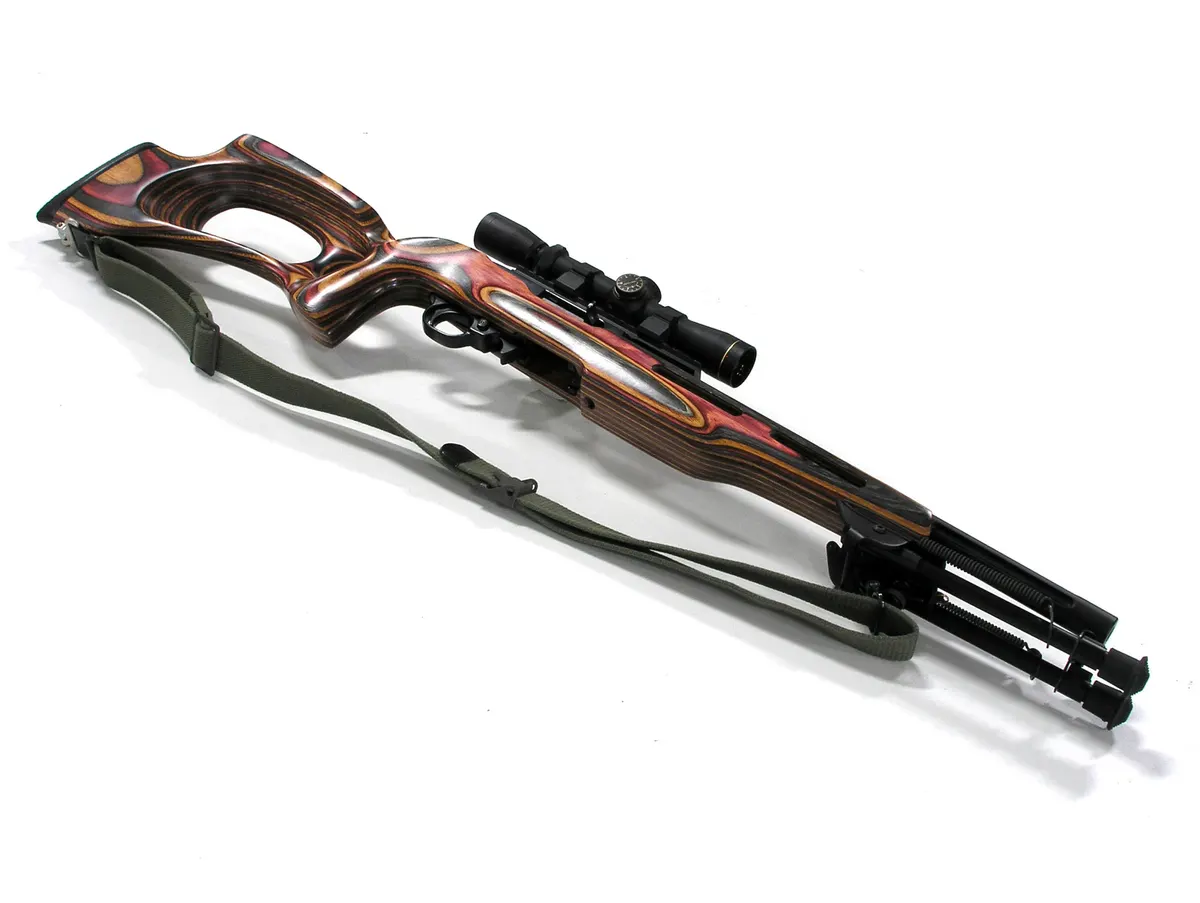
Where the AMT Lightning 25/22 departs from the Ruger 10/22 is materials and capacity rather than mechanism. AMT machined the receiver from stainless steel instead of the Ruger's cast aluminum alloy, a choice consistent with the company's identity as a specialist in stainless firearms at a time when stainless construction was still uncommon on mass-market .22 rifles.2,3 The stock and pistol grip are molded black nylon rather than wood, and the Tactical model's stock folds flat against the receiver, a feature the fixed-stock Ruger never offered from the factory.1 Wikipedia and multiple gun-value references list the standard detachable-magazine capacity as 25 rounds, with a 30-round version also cataloged during production, both well beyond the 10-round rotary magazine Ruger built the 10/22 around, and the AMT magazine was itself, per period owner accounts, interchangeable with standard Ruger 10/22 magazines in the same well.1,6
- Cartridge.22 LR
- Calibre5.6 mm
- Case Length15.1 mm
- Calibre Classrimfire
- Bullet Weight2.6 g
- RimfireYes
- Caseless AmmunitionNo
The extended magazine release on the Lightning 25/22 was sized for a taller box magazine rather than Ruger's flush rotary magazine, and several owner and collector accounts from gun forums describe factory fit and finish as inconsistent, with disconnectors and feed ramps sometimes needing hand-fitting or Ruger replacement parts before the rifle would cycle reliably.6 That inconsistency has become part of the Lightning 25/22's reputation among modern collectors, who prize well-tuned examples for their reliability and accuracy precisely because so many others left the factory needing work.6 Current AMT Lightning 25/22 rifle prices reflect that mixed reputation, with dealer listings for standard examples running near $399 and better-finished examples reaching several hundred dollars more on the collector market, a modest but real premium for a discontinued rimfire rifle more than three decades out of production.8,9
- Action TypeBlowback
- Fire Modessemi-automatic
- Select FireNo
- Feed SystemDetachable Magazine
- Magazine Capacity25
- Barrel Length444.5 mm
- Receiver Materialstainless steel
- Furniture Materialnylon
- Folding / Collapsing StockYes
- Bullpup LayoutNo
- Production Start1984
- Production End1994
- Variants1
From Auto Mag Corporation to Arcadia Machine & Tool
Arcadia Machine & Tool traces its roots to Harry Sanford's Auto Mag Corporation, founded in Pasadena, California in 1970 to build the powerful .44 AutoMag pistol.2 Auto Mag Corporation delivered its first pistol in 1971 but went bankrupt within a year, having built fewer than 3,000 guns, and the AutoMag design and tooling then passed through several short-lived owners, including Trade Deed Estates, OMC, and Thomson Oil Company, before Arcadia Machine & Tool took over the trademark around 1977 in Irwindale, California.2

AMT carried Sanford's stainless-steel, high-performance approach forward into a much broader catalog, including the Hardballer series of stainless 1911-pattern pistols, backup pocket pistols, and eventually the Lightning line of rimfire clones.2,3 The U.S. Bureau of Alcohol, Tobacco, Firearms and Explosives later grouped AMT among the so-called Ring of Fire companies, a cluster of small Southern California gunmakers that included Bryco, Lorcin, Jennings, Jimenez, Davis, and Phoenix Arms alongside AMT itself, known collectively for cheap, high-volume handguns.5
The Lightning name reached its rimfire rifle form in 1984, when AMT introduced the Lightning 25/22 as a stainless, high-capacity take on the already dominant Ruger 10/22.1 AMT paired it with a separate AMT Lightning pistol line, an unlicensed stainless clone of the Ruger Mark II with target sights, a target trigger, and Pachmayr grips added as standard equipment, a pistol close enough to the Ruger original that it eventually drew legal attention of its own.7
The Ruger Trademark Suit and the End of Production
Sturm, Ruger & Co. sued AMT over the Lightning line in the early 1990s, arguing trademark confusion rather than patent infringement, on the theory that the AMT Lightning pistol and Lightning 25/22 rifle looked close enough to genuine Ruger products that ordinary buyers could be misled.4,7 Ruger won the case, and the judgment forced AMT to discontinue the entire Lightning line, pistol and rifle together, rather than let the company keep selling either product under a name so close to Ruger's own model numbering.7 AMT ended Lightning 25/22 production in 1994, ten years after its introduction, closing out one of the more distinctive clone rifles of the American rimfire market.1
AMT itself did not long outlast the Lightning line. Continued quality problems and financial pressure pushed the company into bankruptcy later in the 1990s, and its assets and trademark passed to Irwindale Arms Incorporated, then to Galena Industries of Sturgis, South Dakota in 1998, and finally to Crusader Gun Company (later High Standard Manufacturing) of Houston, Texas in 2001, each successive owner continuing limited production of AMT-pattern pistols under the old brand name.2 None of AMT's later owners revived the Lightning 25/22 rifle itself, leaving the original 1984 to 1994 production run as the entire supply of factory-made examples on the collector market today.1,2
- Lightning 25/22 Tactical, the folding-stock, 17.5-inch-barrel configuration most commonly seen today, with a stainless receiver, nylon furniture, and a 25-round detachable magazine.1,3
- Lightning 25/22 Target, a fixed black synthetic stock version with a longer, roughly 20.5-inch stainless barrel aimed at bench and small-game accuracy rather than portability.3
- AMT/Theoben Target Model, a small run exported to the United Kingdom and reworked by Theoben Engineering, a British firm better known for gas-ram air rifles, with a bull target barrel, a wood pistol-grip stock, and an integral moderator, produced in far smaller numbers than the standard American versions and correspondingly rarer on the collector market.3,10
The Theoben-tuned rifles represent an unusual cross-market pairing, an American stainless clone rifle reworked by a company whose own reputation rested on precision spring and gas-ram air rifles rather than firearms, and it is the rarest and most collectible of the Lightning 25/22's factory-adjacent variants as a result.3,10 Beyond AMT's own catalog, period reports describe aftermarket gunsmith John Norrell converting some Lightning 25/22 rifles to fire fully automatically, using shortened barrels, though this was never a factory AMT configuration and details on how many were built or registered remain thin.3

Every documented AMT Lightning 25/22 variant, Tactical, Target, or Theoben-modified, shares the same .22 Long Rifle chambering and the same fundamentally Ruger-derived blowback mechanism, with the differences confined to barrel length, stock material, and, in the Theoben case, accuracy tuning rather than caliber or action type.1,3 No factory select-fire version ever existed, and the semi-automatic Tactical model remains by far the most common surviving configuration.1
Collector demand today ranks the three variants roughly in order of rarity. Tactical folders turn up most often on the used market, fixed-stock Target models appear less frequently, and the Theoben-modified export guns are scarce enough that most American collectors will never handle one in person.3,9 That scarcity, rather than any dramatic difference in shooting performance, is what drives the price gap between a standard Lightning 25/22 and a documented Theoben example.8,9


The AMT Lightning 25/22 exists only because the Ruger 10/22 already dominated the American rimfire rifle market by the early 1980s, and every meaningful comparison between the two starts from that relationship rather than from independent design choices.1 Both rifles share the same blowback action and the same .22 Long Rifle chambering, but AMT built its version around a 25-round detachable box magazine and a stainless receiver where Ruger used a proprietary 10-round rotary magazine and cast aluminum.1 That trade favored AMT on raw capacity and corrosion resistance, while Ruger's rotary magazine sat flush in the stock and avoided the rim-lock jams that box-fed rimfire magazines are prone to, a reliability advantage that shows up repeatedly in period and modern owner accounts of the AMT Lightning 25/22's feeding problems.1,6
| Feature | AMT Lightning 25/22 | Ruger 10/22 |
|---|---|---|
| Receiver material | Stainless steel | Cast aluminum alloy |
| Magazine | 25-round detachable box | 10-round detachable rotary |
| Production years | 1984 to 1994 (discontinued) | 1964 to present |
| Stock | Nylon, folding (Tactical) | Wood or synthetic, fixed |
The Ruger 10/22 ultimately won the rivalry in the marketplace and the courtroom, an outcome the spec sheet alone never predicted. Ruger's rotary-magazine design has stayed in continuous production since 1964 and anchors one of the largest aftermarket parts ecosystems of any rimfire rifle, while the AMT Lightning 25/22's ten-year production run ended in litigation and left no factory support behind it.1,7 A different kind of comparison applies to other current rimfire trainers like the Smith & Wesson M&P 15-22, which is a genuine AR-15-pattern rimfire rifle built on a real AR-15 lower and upper. The AMT Lightning 25/22 is often lumped into the same tactical-looking .22 shopping category because of its black furniture and folding stock, but mechanically and visually it remains a 10/22 clone rather than an AR-15 derivative, a distinction worth stating plainly since the two rifle families are frequently confused by casual buyers searching for a tactical rimfire trainer.


Is the AMT Lightning 25/22 still in production? No. Arcadia Machine & Tool built the Lightning 25/22 from 1984 to 1994, when a Ruger trademark lawsuit forced the entire Lightning line off the market, and the rifle has never been reintroduced by any of AMT's later corporate successors.1,7
How much does an AMT Lightning 25/22 cost today? Dealer and collector listings for the discontinued AMT Lightning 25/22 generally run from around $399 for standard examples upward, depending on condition, with well-preserved stainless examples and the rare Theoben-tuned UK variant commanding a further premium on the collector market.8,9
What magazine capacity does the AMT Lightning 25/22 use? The standard AMT Lightning 25/22 magazine holds 25 rounds of .22 Long Rifle, with a 30-round version also cataloged during production, both well above the Ruger 10/22's factory 10-round rotary magazine that inspired the design.1
Is the AMT Lightning 25/22 a Ruger 10/22 clone? Yes. The AMT Lightning 25/22 uses the same blowback mechanism and general layout as the Ruger 10/22, built instead with a stainless steel receiver, nylon furniture, and a much larger detachable box magazine in place of Ruger's rotary design.1,3
Why was the AMT Lightning 25/22 discontinued? Sturm, Ruger & Co. sued AMT in the early 1990s over trademark confusion between the Lightning line and Ruger's own products, and the resulting judgment forced AMT to end production of both the Lightning pistol and the Lightning 25/22 rifle by 1994.4,7
- "AMT Lightning 25/22", Wikipedia — en.wikipedia.org ↩
- "Arcadia Machine & Tool", Wikipedia — en.wikipedia.org ↩
- "AMT Lightning 25/22", Firearm Wiki — firearmwiki.com ↩
- "Ruger Takes S&W To Court Over 10-22", The Captain's Journal — captainsjournal.com ↩
- "RING OF FIRE / Companies and What They Make", PBS Frontline — pbs.org ↩
- "AMT Lighning .22LR pistol", Rimfire Central Firearm Forum — rimfirecentral.com ↩
- "AMT Lightning pistol", Wikipedia — en.wikipedia.org ↩
- "AMT Lightning 25/22 Rifle For Sale, $399, Review, Price", GunCritic — guncritic.com ↩
- "AMT ARCADIA MACHINE TOOL LIGHTNING New and Used Price, Value, & Trends", TrueGunValue — truegunvalue.com ↩
- "Theoben Air Rifles", Solware Ltd — solware.co.uk ↩