

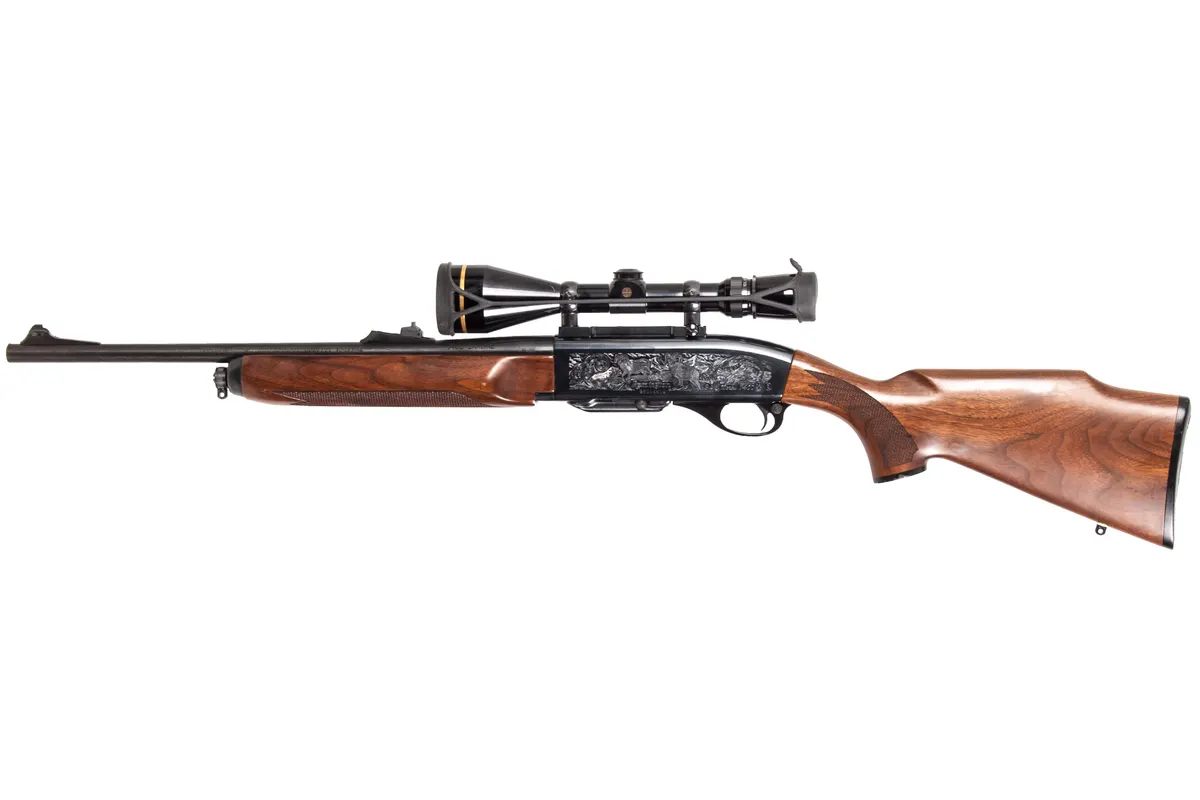

In January 1981, Remington Arms put two almost identical semi-automatic rifles on dealer shelves at the same time, the field-grade Remington Model 7400 and the Remington Model Four sold beside it at a noticeably higher price.1,2 Both replaced the Remington Model 742, and both used the identical gas-operated action, the identical calibers, and the identical 4-round detachable box magazine.1,3 What separated the Remington Model Four from its cheaper sibling was wood and metalwork, not mechanics, a distinction that makes it one of the clearer case studies in the semi-automatic rifles category of a manufacturer selling the same gun twice at two price points.
- shared the 7400's stronger three-lug bolt and hardened receiver rail
- high-gloss walnut stock with fuller cheekpiece and finer checkering
- chambered in six established big-game cartridges up to .30-06 Springfield
- 1982 Diamond Anniversary edition became a genuine limited-run collectible
- carried a retail premium over the mechanically identical Model 7400
- discontinued years before the 7400 it was meant to outclass in finish
- fixed 4-round magazine capacity, unchanged from the cheaper rifle
- inherited the same series-wide reputation for eventual bolt and receiver-rail wear
Remington had built autoloading hunting rifles since the Remington Model 8 of 1906, and the Remington Model Four arrived as the deluxe, top-of-the-line expression of that line, aimed at hunters who wanted the reliability of the Model 7400 platform with the fit and finish of a premium sporting rifle.1,2 It stayed in the catalog for a short run, roughly seven years, before Remington folded its distinguishing features back into upgraded grades of the Model 7400 and let the Model Four name disappear.2,3 The rifle is still a recognizable name today among hunters and collectors researching Remington Model Four specifications, Remington Model Four price history, and how the Remington Model Four compares to the Model 7400 it was sold alongside.
Remington positioned the Remington Model Four squarely as a hunting rifle for deer, elk and similar big game, never as a police or military weapon, and it was chambered in .243 Winchester, 6mm Remington, .270 Winchester, .280 Remington, .30-06 Springfield and .308 Winchester.1 All of that mirrored the Model 7400's own chambering list exactly, which is the core fact buyers weighing a Remington Model Four versus a Model 7400 needed to understand, the extra money bought appearance and feel, not extra performance.1,3
A Shared Three-Lug Bolt Borrowed From the Model 7400 Redesign
The Remington Model Four used the same gas-operated action Remington introduced across the whole 74-series relaunch in 1981, replacing the older Model 742's five-lug bolt with a stronger three-lug design and adding a hardened steel rail insert in the receiver to resist the wear that had plagued the 742's softer receiver walls.3 That redesign, not the Model Four's wood or engraving, is what a Popular Mechanics test at launch credited with giving the new rifles a smoother action and a stronger lockup than the older Remington Model 742, a five-lug design built from 1960 to 1980 that the Model Four and Model 7400 jointly replaced in 1981.1,4 The Remington Model Four weighed 3.4kg (7.5lb) empty, ran a 559mm (22in) barrel, and measured about 1,067mm (42in) overall, figures that match the Model 7400 exactly rather than reflecting any extra heft from the Model Four's fancier stock.1,4
- First Production Year1981
- Weight (Empty)3.4 kg
- Currently In ServiceNo
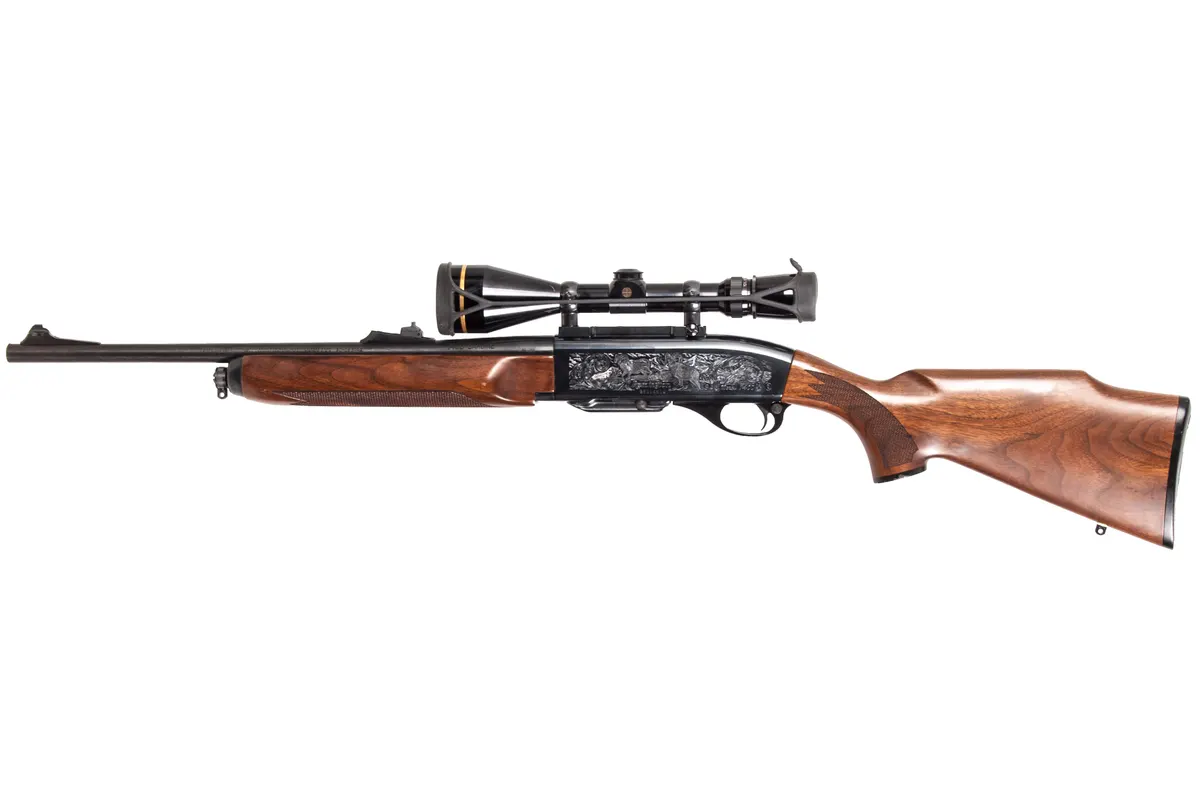
Feeding came from a detachable magazine, a 4-round box that dropped free from the belly of the stock, the same capacity and layout used on the 742, the 7400, and the earlier Remington Model 740 that started the family in 1955.1,4 The Remington Model Four carried plain iron sights, a ramped front post and an adjustable rear notch, standard hunting-rifle sighting equipment that left the scope-mounting rail on top of the receiver as the practical choice for most owners.1
- Cartridge.243 Winchester, 6mm Remington, .270 Winchester, .280 Remington, .30-06 Springfield, .308 Winchester
- RimfireNo
- Caseless AmmunitionNo
The Checkering, Wood Grade and Finish That Actually Separated the Two Rifles
Where the Remington Model Four earned its higher price was in the details a Model 7400 buyer did not get, positive-cut checkering on the pistol grip and forearm rather than the 7400's simpler pressed pattern, a fuller cheekpiece on a Monte Carlo-profile buttstock for better scope-eye alignment, a flared forend, and a high-gloss finish over select walnut rather than the 7400's plainer wood and duller sheen.2,3 Remington's own retrospective on the rifle describes it as an enhanced version of the Model 7400 built around a high-gloss Monte Carlo stock, which is a fair one-line summary of the entire pitch, buy the Remington Model Four if the wood and checkering mattered to you, buy the Model 7400 if they did not.2
- Action TypeGas-Operated
- Fire Modessemi-automatic
- Select FireNo
- Feed SystemDetachable Magazine
- Magazine Capacity4
One small quirk touches the caliber list itself. Remington had briefly renamed the .280 Remington cartridge the 7mm Express Remington in 1979 to draw attention to a hotter factory load, then reversed the change back to .280 Remington in 1981 after buyers kept confusing it with the unrelated 7mm Remington Magnum.6 Remington Model Four rifles built right at the start of production in 1981 could therefore leave the factory marked either way, a detail collectors still check on early-production examples.1,6
- Barrel Length559 mm
- Sight Typeiron sights
- Optic RailNo
- Iron SightsYes
- Threaded BarrelNo
- Furniture Materialwalnut
- Folding / Collapsing StockNo
- Bullpup LayoutNo
- Ambidextrous ControlsNo
- Production Start1981
- Production End1987
- Variants1
Launched in January 1981 as the 742's Premium Replacement
Remington introduced the Remington Model Four in January 1981 at a retail price of $449.95, positioned above the standard-grade Model 7400 and marketed as the direct successor to the discontinued Model 742 BDL Custom Deluxe, the top trim level of the outgoing rifle.5,1 The launch closed out more than seven decades of Remington autoloading rifle development that had begun with the long-recoil Remington Model 8 in 1906, moved through the gas-operated Remington Model 740 in 1955, and continued through the Model 742 from 1960 to 1980.7,4 Remington leaned into that history at launch, marketing the Remington Model Four's first production year as a Diamond Anniversary, seventy-five years since the original 1906 autoloader.2
The 1982 Diamond Anniversary Collectors Edition
In 1982, Remington built 1,500 Remington Model Four Diamond Anniversary Collectors Edition rifles, all chambered in .30-06 Springfield, with a laser-etched receiver carrying 24-karat gold inlays and a high-polish blued finish over the standard checkered walnut stock and forearm.1 The limited run explicitly commemorated Remington's 75 years of continuous autoloading rifle production traced back to the 1906 Model 8, and surviving examples still trade in the collector market today, generally in the $1,000 to $1,500 range depending on condition.1
Discontinued in the Late 1980s as the 7400 Absorbed Its Best Features
Sources disagree slightly on the exact final year. Wikipedia's production record puts the standard Remington Model Four run at 1981 to 1987, while Remington's own historical retrospective dates the rifle's discontinuation to 1988, likely reflecting dealer stock still being sold after the factory had stopped building new ones.1,2 Either way, the Remington Model Four left the catalog years before its cheaper sibling, and Remington folded the discontinued rifle's premium checkering, gloss finish and cheekpiece stock into new higher grades of the Model 7400 rather than replacing the Model Four with a direct successor.3 That decision effectively answered the question the rifle had posed for its whole run, whether hunters would keep paying a premium for wood and metalwork alone, with a quiet no.
The Diamond Anniversary Collectors Edition Remains the Only Distinct Factory Variant
Remington did not split the Remington Model Four into separate BDL, Deluxe or Peerless grades the way it later did with the Model 7400, so the 1982 Diamond Anniversary Collectors Edition is the rifle's only widely recognized factory variant, a fixed run of 1,500 .30-06 Springfield rifles with the gold-inlaid receiver described above rather than an open-ended product line.1 Every other Remington Model Four built between 1981 and its discontinuation shared the same standard specification across all six chamberings, differing only in caliber marking and, on early guns, the .280 Remington versus 7mm Express Remington stamping quirk.1,6
Collectors today generally value a standard-grade Remington Model Four close to an equivalent Model 7400 of the same caliber and condition, with the real price gap reserved for the Diamond Anniversary Collectors Edition itself, which trades in the $1,000 to $1,500 range specifically because of its fixed 1,500-unit production run rather than any mechanical rarity.1 That pattern, ordinary specimens worth little more than the cheaper sibling while the one true limited edition commands a real premium, is common across Remington's other commemorative-grade autoloaders from the same era.2

The Remington Model Four was never adopted by a military or police service and has no formal operator list in the way a service rifle would, it was sold exclusively through Remington's civilian sporting-goods channels in the United States to individual hunters shopping for a premium big-game autoloader.1,2 That puts it in a different category from an ancestor like the Remington Model 8, which saw genuine law-enforcement use in the 1920s and 1930s, the Remington Model Four's market was always the deer camp and the gun shop counter, not a department armory.
The Remington Model Four's whole identity depends on the Remington Model 7400 it sat beside on the same dealer racks from 1981 onward, because the two rifles were, mechanically, one rifle sold under two names. Both used the same three-lug bolt and hardened receiver rail introduced that year, both fed from the same 4-round detachable magazine, both weighed the same 3.4kg, and both were offered in the identical six-caliber lineup from .243 Winchester up to .30-06 Springfield.1,3 The real question a buyer answered by paying the Remington Model Four's premium over the Model 7400 was purely cosmetic, whether positive-cut checkering, a fuller Monte Carlo cheekpiece and a higher-gloss walnut finish were worth the extra money for a rifle that would shoot exactly the same either way.2,3 The Model 7400 far outlasted the Model Four in the catalog, staying in production until 2004 and gaining an 18-inch carbine barrel option and a .35 Whelen chambering along the way before Remington finally replaced the whole 74-series with the Model 750 in 2006.8
| Spec | Remington Model Four | Remington Model 7400 |
|---|---|---|
| Introduced | 1981 | 1981 |
| Action | Gas-operated, 3-lug bolt | Gas-operated, 3-lug bolt |
| Magazine | 4-round detachable box | 4-round detachable box |
| Weight | 3.4kg (7.5lb) | 3.4kg (7.5lb) |
| Stock grade | High-gloss, cut checkering, Monte Carlo comb | Standard walnut, pressed checkering |
| Discontinued | 1987 (or 1988, sources vary) | Later, replaced by the Model 750 in 2006 |
Set against the older Remington Model 742 it replaced, the Remington Model Four represented a real mechanical upgrade rather than only a cosmetic one, since the 742's five-lug bolt and softer receiver rails were a genuine reliability weak point that the whole 1981 redesign, Model Four included, was built to fix.3 That makes the Remington Model Four an unusual product in Remington's own history, a rifle that was a meaningful engineering improvement over its direct predecessor and, at the very same time, a purely cosmetic upgrade over the cheaper sibling it launched alongside.


What is the difference between the Remington Model Four and the Remington Model 7400? Mechanically nothing, both used the identical gas-operated action, three-lug bolt and 4-round magazine introduced in 1981. The Remington Model Four added higher-grade checkering, a glossier walnut finish and a fuller Monte Carlo cheekpiece, and sold at a higher retail price for that extra fit and finish.2,3
What calibers does the Remington Model Four come in? .243 Winchester, 6mm Remington, .270 Winchester, .280 Remington, .30-06 Springfield and .308 Winchester, the same six chamberings offered in the Model 7400.1
Is the Remington Model Four still in production? No. Remington discontinued the Remington Model Four in the late 1980s, with sources citing either 1987 or 1988 as the final year, and folded its premium features into upgraded grades of the Model 7400 instead of replacing it directly.1,2
How much did a Remington Model Four cost new? Remington listed the Remington Model Four at $449.95 when it launched in January 1981, a premium over the standard Model 7400's price at the time.5
How much magazine capacity does the Remington Model Four have? A 4-round detachable box magazine, unchanged from the Model 7400 and the older Model 742 it replaced.1
- "Remington Model Four", Wikipedia — en.wikipedia.org ↩
- "Model Four", Remington Arms — remarms.com ↩
- "TFB Armorer's Bench: Commentary on The Remington 74 Series", The Firearm Blog — thefirearmblog.com ↩
- "Remington Model 742", Wikipedia — en.wikipedia.org ↩
- "MODEL FOUR New and Used Price, Value, & Trends", TrueGunValue — truegunvalue.com ↩
- ".280 Remington", Wikipedia — en.wikipedia.org ↩
- "Remington Model 740", Wikipedia — en.wikipedia.org ↩
- "Remington Model 7400", Wikipedia — en.wikipedia.org ↩