

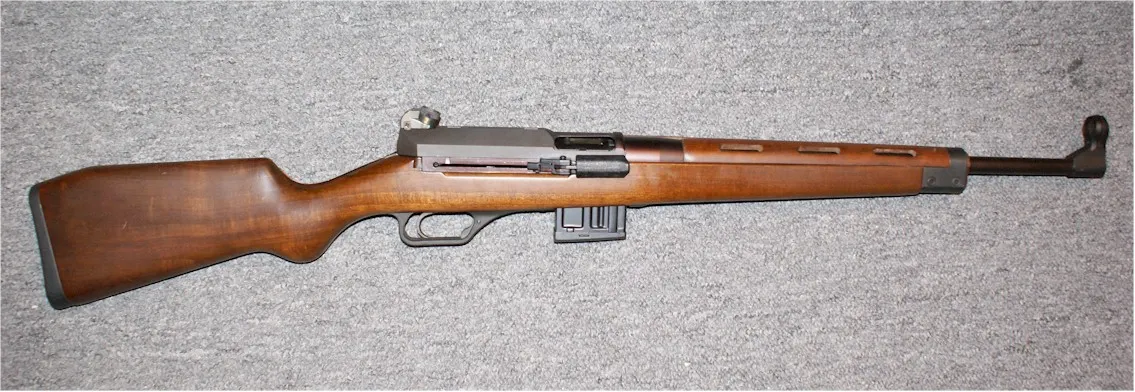

- Roller-delayed blowback action shared with the G3, no gas system to foul
- Compact detachable-magazine carbine built to hunting-rifle proportions
- G3-pattern rotary aperture sight and long sight radius
- Genuine early-1980s West German manufacturing quality
- No longer produced since 1991, parts and factory magazines increasingly scarce
- Small legal magazine capacity in some markets (3 or 4 rounds)
- Roller-delayed action needs precisely fitted rollers, costlier to build than a simple blowback
- Never adopted as an issued weapon by any military or police force
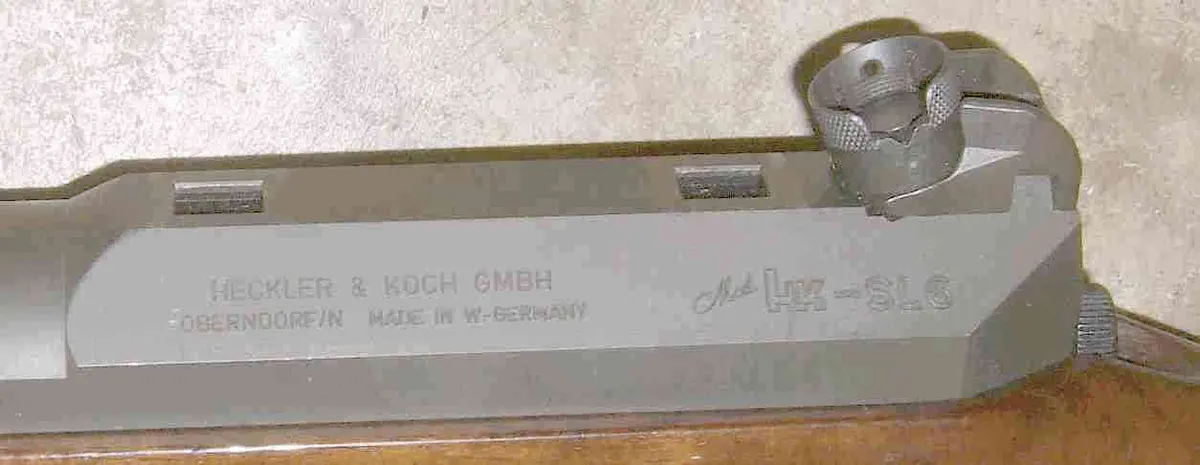
West German firearms law, not military doctrine, shaped the Heckler & Koch SL6. It is a 5.56x45mm NATO semi-automatic carbine built by Heckler & Koch in Germany around the same roller-delayed blowback locking system used in the company's G3 battle rifle, dressed instead in a walnut hunting-rifle stock and sold as a civilian sporting arm.1,2 The SL6 fires semi-automatically only, feeding from a detachable magazine holding 3, 4, or 10 rounds depending on the market it was sold into, and it weighs 3.6kg unloaded with a 450mm barrel.1 It belongs to the broader family of semi-automatic rifles that European manufacturers built specifically to satisfy civilian ownership law rather than combat requirements, and its own history is a direct response to a 1973 change in that law.2,6
Heckler & Koch built the SL6 to replace an earlier product, the Heckler & Koch HK41, a semi-automatic G3 derivative that West German reservists had been allowed to buy privately and practice with since the 1960s.5,6 A 1973 revision of West German weapons law made the HK41 effectively impossible for a private citizen to own, and production of that rifle ended in 1977.5 The SL6, introduced in the early 1980s, answered the same reservist-training and sport-shooting demand with a design built around a civilian hunting rifle rather than a stripped-down service rifle, and it is that legal history, more than any battlefield requirement, that explains why the SL6 looks the way it does.6,4
The Roller-Delayed Blowback System Borrowed From the G3
The Heckler & Koch SL6 uses the same delayed-blowback roller-locking action as the G3 and the earlier HK41, a system that delays bolt opening with a pair of rollers rather than tapping gas from the barrel.1,3 The barrel has four grooves of polygonal rifling with a right-hand twist of roughly 1 turn in 10.6 inches, the same fluted-chamber approach used across HK's roller-delayed rifles to ease case extraction by letting propellant gas float the spent case free of the chamber wall before it is pulled back.1,2 Sights are a rotary rear aperture drum graduated out to 400 meters and a hooded post foresight, both drawn straight from the G3 pattern rather than a typical hunting-rifle open sight.1,3
- First Production Year1982
- Weight (Empty)3.6 kg
- Currently In ServiceNo
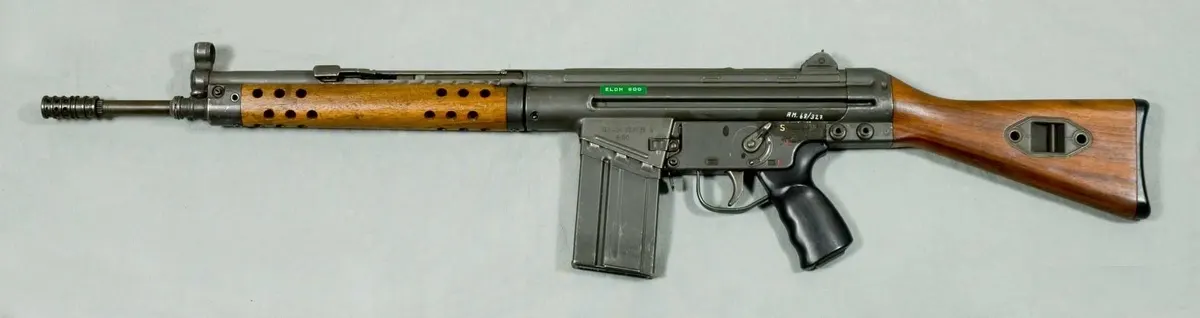
Feeding comes from a single-column detachable magazine offered in 3, 4, or 10-round capacities, the smaller sizes built to satisfy hunting-law magazine limits in some European markets rather than any handling preference.1,2 The receiver is stamped steel, and the standard SL6 fires semi-automatically only. This point matters because a distinct export-only sibling, the SL6A2, did add a two-round burst selector, and the two rifles are frequently confused in secondary listings even though the base SL6 sold in Germany never carried that capability.4,7 Heckler & Koch also offered a proprietary quick-detach claw scope mount, the same HK05 pattern used across its other roller-delayed rifles, letting an owner add optics without permanently altering the receiver.2
- Cartridge5.56x45mm NATO
- Calibre5.56 mm
- Case Length45 mm
- Calibre Class5.56mm
- Bullet Weight4 g
- RimfireNo
- Caseless AmmunitionNo
From a Hunting Rifle to a Reservist Carbine, the HK 630 Connection
The SL6's starting point was not the G3 at all. It was developed from the Heckler & Koch 630, a .223 Remington bolt-style hunting rifle the company had sold since the early 1980s, itself part of a civilian hunting line that also included the .308 Winchester HK 770 and the larger .30-06 HK 940.1,3 Heckler & Koch shortened the barrel, added the G3-style aperture sights, and kept a walnut stock with a Bavarian cheekpiece, producing a rifle that read to German regulators as a sporting hunting carbine rather than a demilitarized service weapon.4
- Action TypeDelayed Blowback
- Fire Modessemi_automatic
- Select FireNo
- Feed SystemDetachable Magazine
- Magazine Capacity10
That styling choice was not cosmetic. West German law after 1973 treated any rifle that looked like a demilitarized combat weapon as a restricted paramilitary firearm requiring special federal authorization, exactly the trap that had killed the HK41's civilian market.5,6 Building the SL6 around a hunting-rifle silhouette, complete with wood furniture and a hunting-style buttplate, kept it inside the ordinary sporting-firearm licensing category that any legally registered German gun owner could use.4 The tradeoff was weight and cost. A roller-delayed blowback receiver machined to G3 tolerances is a more expensive thing to manufacture than a simple hunting-rifle blowback action, and the SL6 sold at a real premium over an ordinary .223 hunting carbine of the same era.2
- Sighting Range400 m
- Barrel Length450 mm
- Rifling Twist1:10.6
- Rifling Grooves4
- Sight Typerotary rear aperture drum, hooded foresight
- Optic RailNo
- Iron SightsYes
- Threaded BarrelNo
- Receiver Materialsteel
- Furniture Materialwood
- Folding / Collapsing StockNo
- Bullpup LayoutNo
- Ambidextrous ControlsNo
- Production Start1982
- Production End1991
- Variants2
A Post-1973 Answer to West Germany's New Weapons Law
The Heckler & Koch HK41 had served West German reservists informally since the 1960s as a semi-automatic G3 they could legally keep at home and use for weekend range practice, a role German soldiers called the Reservistengewehr.5,6 Roughly 1,350 HK41s were built before West Germany's 1973 weapons law change required special Federal Criminal Office (BKA) authorization to own one, a bar high enough that ordinary reservists could no longer buy the rifle, and HK41 production ended around 1977.5 That left a real gap. Reservists still wanted a semi-automatic rifle that trained their hands and eyes for G3-pattern handling, but nothing on the German civilian market legally filled that role for several years.6
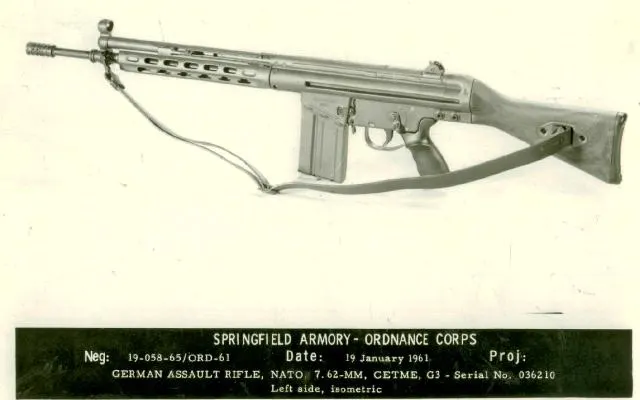
Heckler & Koch's answer, introduced in the early 1980s and generally dated by collectors' factory records to around 1982, was the SL6 and its 7.62x51mm sibling the SL7, both marketed under the company's Selbstladegewehr (self-loading rifle) naming convention already used elsewhere in its civilian catalog.9,3 By building the new rifle on the HK 630 hunting-rifle platform instead of a stripped G3, Heckler & Koch produced a semi-automatic roller-delayed rifle that stayed inside ordinary sporting-firearm law, sidestepping the paramilitary classification that had ended the HK41.4,6
An export-only variant, the SL6A2, added a muzzle brake and a safe, semi-automatic, two-round burst selector for markets outside Germany where that capability was legal to sell commercially, most likely police or paramilitary buyers rather than ordinary hunters.4,7 That variant, not the standard SL6 covered here, is the source of most online claims that the SL6 offers select fire.
Import to the United States and the End of Production
Heckler & Koch's American subsidiary imported the SL6 into the United States through the early-to-mid 1980s, but importation stopped in 1986, leaving the rifle relatively obscure and expensive on the American market compared with the company's better-known HK91 and HK93 semi-automatic rifles.2,3 Domestic West German production continued longer. Factory date-code research by collectors places the main SL6 production run between 1982 and 1987, with a documented second run from 1991 to 1996 and a final small batch as late as 1999, a longer and more broken production history than the simpler 1980s-to-1991 timeline usually quoted.9 Heckler & Koch's own catalog treats 1991 as the SL6's discontinuation year, replaced in the civilian lineup by the bolt-action SLB 2000.1,3
No combat use, military adoption, or notable incident involving the SL6 turned up in this research. It remained a commercial civilian and reservist-training product throughout its production life, never issued or procured as service equipment by any government.2,6
The SL6A2, an Export-Only Burst-Fire Version
The SL6A2 is the SL6's most misunderstood variant. It kept the same 5.56x45mm chambering, roller-delayed action, and general profile as the standard rifle, but added a flash hider or muzzle brake and a safe, single-shot, two-round burst fire selector, a configuration Heckler & Koch built for export sale outside West Germany rather than for the domestic civilian market.4,7 Because German-market SL6 rifles and export SL6A2 rifles share a name and a silhouette, secondary sources and auction listings frequently attribute the SL6A2's burst capability to the base SL6, which is not accurate for the rifle marketed and sold inside Germany.4
The SL7, a 7.62mm Sibling for Bigger Game
The Heckler & Koch SL7 is the SL6's direct sibling, built on the same roller-delayed action and the same hunting-carbine styling but chambered in 7.62x51mm NATO (.308 Winchester) instead of 5.56mm, aimed at hunters who needed more power for larger game like red deer or wild boar rather than the SL6's smaller-caliber niche.8,7 German sources give the SL7 a slightly shorter 425mm barrel and a longer 655mm sight radius than the SL6, small dimensional differences reflecting the different cartridge and a scope-mount package tuned for longer hunting shots.7
Both the SL6 and SL7 trace back to the same HK 630 and HK 770 hunting-rifle bodies, and both were withdrawn from the catalog around the same time in the early 1990s, replaced by the bolt-action SLB series that dropped the roller-delayed semi-automatic system entirely.1,8


A Commercial Sporting Rifle, Never a Service Weapon
No military or police force adopted the Heckler & Koch SL6 as issued equipment. It was a commercial product sold through ordinary gun dealers to licensed civilian owners in Germany, marketed toward reservists who wanted G3-pattern practice, hunters who used it for driven boar and other small-to-medium game, and sport shooters drawn to the roller-delayed action's reputation for smooth recoil.3,4 Collector and auction records also place SL6 rifles in Switzerland and other European civilian markets, alongside the shorter run of rifles imported into the United States before 1986.12,2
Ownership today is almost entirely in the hands of collectors and sport shooters rather than working hunters, since the rifle has been out of production since the 1990s and factory magazines and some proprietary parts are increasingly hard to source. It remains a niche but recognized item within the wider Heckler & Koch collector market, distinct from the company's far more common G3-family rifles.10
Same Company, Same Buyer, a Completely Different Action, the HK SL8
Heckler & Koch answered the same brief, a civilian self-loading carbine for German hunters and sport shooters, twice, roughly fifteen years apart, with two mechanically unrelated rifles. The Heckler & Koch SL8, introduced in 1998 as the Selbstladegewehr 1998, is a civilian derivative of the G36 rather than the G3, using a gas-operated rotating bolt instead of roller-delayed blowback, a 510mm heavy barrel, and a fiber-reinforced polymer stock with a thumbhole grip rather than the SL6's walnut furniture.11 Where the SL6 kept the SL8 within a hunting silhouette to satisfy 1980s German law, the SL8 kept its G36 heritage visible and instead complied with import law abroad, most notably being built to reject the G36's staggered 20 and 30-round magazines when sold into the United States, accepting only single-stack 10-round magazines there.11
| Spec | Heckler & Koch SL6 | Heckler & Koch SL8 |
|---|---|---|
| Introduced | early 1980s | 1998 |
| Action | roller-delayed blowback | gas-operated rotating bolt |
| Cartridge | 5.56x45mm NATO | 5.56x45mm NATO |
| Barrel length | 450mm | 510mm |
| Weight, unloaded | 3.6kg | 4.3kg |
| Stock material | walnut | fiber-reinforced polymer |
An Older Design the SL6 Effectively Replaced, the HK41
The comparison that explains the SL6 best is its own predecessor, the Heckler & Koch HK41. Both rifles used the identical roller-delayed action, and both existed to let West German civilians and reservists own a semi-automatic G3-pattern rifle legally. The difference is entirely about German law rather than engineering. The HK41 looked and handled like a demilitarized G3, which is exactly what made it illegal to buy after 1973, while the SL6 achieved a nearly identical shooting experience inside a hunting-rifle body that stayed on the right side of that same law for another decade.5,6,4


Is the Heckler & Koch SL6 select-fire or fully automatic? No. The standard SL6 sold in Germany fires semi-automatically only, one shot per trigger pull. A separate export variant, the SL6A2, added a two-round burst selector, but that capability was never sold as part of the base SL6.4,7
What caliber and cartridge does the HK SL6 use? The Heckler & Koch SL6 is chambered in 5.56x45mm NATO, the same cartridge fired by .223 Remington ammunition, and feeds from 3, 4, or 10-round detachable magazines.1
Is the HK SL6 still in production? No. Production ended in the 1990s, with documented factory runs as late as 1996 and a final small batch in 1999, well after Heckler & Koch's catalog treats 1991 as the discontinuation year and replaced the SL6 with the bolt-action SLB 2000.1,9
What is the difference between the HK SL6 and the HK SL7? The SL6 and SL7 share the same roller-delayed blowback action and hunting-carbine styling. The SL6 is chambered in 5.56x45mm NATO for smaller game, while the SL7 is chambered in 7.62x51mm NATO (.308 Winchester) for larger game like red deer or wild boar.8,7
Was the HK SL6 ever imported into the United States? Yes. Heckler & Koch's American subsidiary imported the SL6 through the early-to-mid 1980s, but importation was discontinued in 1986, making it a relatively rare and expensive find on the US market even at the time.2,3
How much does an HK SL6 cost today? Collector market guides commonly place a standard-condition SL6 at roughly $1,300 to $1,600 as of the mid-2020s, reflecting its discontinued status and Heckler & Koch's strong collector following rather than its original commercial price when new.10
- "Heckler & Koch SL6", Wikipedia — en.wikipedia.org ↩
- "H&K SL-6 and SL-7 Rifles at RIA", Forgotten Weapons — forgottenweapons.com ↩
- "Heckler-Koch HK SL-6 SL-7", Modern Firearms — modernfirearms.net ↩
- "HK SL6", Wikipedia (German) — de.wikipedia.org ↩
- "Heckler & Koch HK41", Wikipedia — en.wikipedia.org ↩
- "HK 41, Paramilitary Rifle for the Bundeswehr", Forgotten Weapons — forgottenweapons.com ↩
- "HK SL7", Wikipedia (German) — de.wikipedia.org ↩
- "Heckler & Koch SL7", Wikipedia — en.wikipedia.org ↩
- "Production years for 630/770/SL6/SL7?", HK Proshop Forums — hkproshop.com ↩
- "H&K SL6 Price (2026), What It's Worth Today", WeBuyGuns — webuyguns.com ↩
- "Heckler & Koch SL8", Wikipedia — en.wikipedia.org ↩
- "Heckler & Koch SL6", Swisswaffen — swisswaffen.com ↩