


- Enormous aftermarket parts ecosystem
- Reliable rotary magazine feed
- Low cost per round of .22 LR ammunition
- Easy user-level barrel and trigger swaps
- Six decades of parts and magazine compatibility
- Limited stopping power and range of the .22 LR cartridge
- Accuracy heavily dependent on ammunition quality
- Not accepted for most law-enforcement tactical-rifle courses
- Twist rate not ideal for the heaviest subsonic match loads
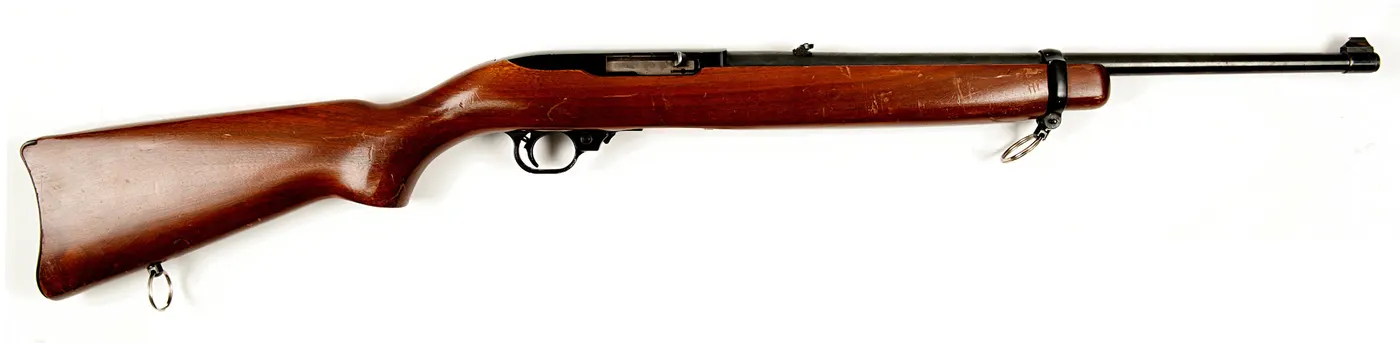
More 10/22 rifles have been built than any other .22 Long Rifle semi-automatic in history, with production passing 7 million units since the design entered production in 1964.1 The Ruger 10/22, made by Sturm, Ruger & Co. in the United States, is a blowback-operated rimfire carbine built around a patented 10-round rotary magazine, and it has stood at or near the top of American rimfire rifle sales for six decades.2 It belongs to the broad family of semi-automatic rifles, though its role sits far from the battle rifles and designated-marksman rifles that dominate that category. The 10/22 was built as a plinking, small-game, and training rifle, and that civilian mission, not military adoption, explains almost all of its commercial success.
William B. Ruger designed the 10/22 as a rimfire companion to his earlier .44 Magnum Carbine, and the rifle's blowback action, 10-round rotary magazine, and V-block barrel mount have barely changed since 1964.2 The cartridge itself, the .22 Long Rifle, is a rimfire round rather than a centerfire one, meaning the firing pin strikes the case rim instead of a primer cup, and that distinction shapes almost every part of the rifle's design and cost profile.1
Sturm, Ruger & Co. still lists the standard 10/22 Carbine as a current-production item, with a manufacturer suggested price near $369 as of 2025, a large jump from the rifle's 1965 launch price of $54.50.17,18 That gap between launch price and current retail is itself a common search question for buyers researching a used example, since resale values for well-kept 10/22 rifles now range roughly from $150 for older or worn carbines to $450 or more for premium factory variants.17
The Rotary Magazine, Ruger's Most Copied Idea
The single most distinctive part of the Ruger 10/22 is its 10-round rotary magazine, marketed today as the BX-1.1 Instead of stacking cartridges vertically as a conventional box magazine does, the rotary magazine holds each of its ten rounds in an individual pocket around a spring-loaded, cogwheel-shaped rotor. Each cartridge sits at a fixed angle, isolated from its neighbors, which prevents the rim-lock jams that plague many other rimfire box magazines when thin .22 LR rims catch on each other during feeding.1 William B. Ruger reportedly drew the concept from the rotary magazine of the lever-action Savage Model 99, a rifle he admired for the same compact, flush-fitting profile the 10/22's magazine achieves.5 Because the magazine sits entirely within the stock's magazine well rather than protruding below it, the 10/22 balances and carries like a fixed-magazine rifle even though the magazine is fully detachable.1
- First Production Year1964
- Service Entry Year1964
- DesignerWilliam B. Ruger
- Weight (Empty)2.27 kg
- Currently In ServiceYes
- Notable Usersisrael_defense_forces
The design has proven durable enough that Ruger has changed it only incrementally in sixty years, and third-party magazine makers still build clones and higher-capacity alternatives (15- and 25-round box magazines, and aftermarket drums claiming 50 rounds or more) around the same magazine-well geometry.1 Later bolt-action Ruger rifles, including the Ruger Model 77 rotary-magazine line, reused the same rotary concept in a different platform, a sign of how central the mechanism became to Ruger's broader rimfire and centerfire product identity.
- Cartridge.22 Long Rifle
- Calibre5.7 mm
- Case Length15.6 mm
- Calibre Classrimfire
- Bullet Weight2.6 g
- RimfireYes
The V-Block Barrel and a Simple Blowback Action
The 10/22 cycles by straightforward blowback operation. The cartridge's own rimfire .22 LR pressure pushes the bolt rearward against spring tension with no gas system or locking lugs involved, a mechanically simple approach that low-pressure rimfire cartridges can use safely where a centerfire rifle cannot.1 The barrel attaches to the aluminum-alloy receiver with a two-screw V-block clamp, a detail unusual for a factory rifle of any caliber, which lets an owner remove and replace the barrel with an Allen wrench rather than a gunsmith's tools.2 That single design choice, more than any single accessory, is what turned the 10/22 into the foundation of an entire replacement-parts industry, because swapping to a different barrel length, profile, or caliber conversion requires no permanent modification of the receiver.9
- Action TypeBlowback
- Fire Modessemi_automatic
- Feed SystemDetachable Magazine
- Magazine Capacity10

The standard Carbine ships with an 18.5-inch (470 mm) barrel, a 1-in-16-inch rifling twist with six grooves, a 10-round rotary magazine, and an empty weight of about 5 pounds (2.27 kg).1,2 Muzzle velocity with typical 40-grain high-velocity .22 LR ammunition runs roughly 1,150 to 1,200 feet per second (350 to 366 m/s) out of the 10/22's barrel length, slightly slower than the cartridge's nominal rating because a semi-automatic action bleeds a small amount of velocity compared to a bolt gun.16 Practical accuracy varies enormously with ammunition, a stock Carbine can group around 2 MOA with bulk ammunition and closer to 1 MOA with match-grade loads, while the dedicated Target model, with its heavier bull barrel and two-stage target trigger, routinely holds sub-MOA groups at 100 yards.16
- Muzzle Velocity360 m/s
- Muzzle Energy168
- Effective Range (point)150 m
- Maximum Range200 m
- Accuracy2
An Aftermarket Bigger Than the Factory Catalog
No other rimfire rifle, and few centerfire rifles outside the AR-15, supports an aftermarket as large as the Ruger 10/22's.9 Because the receiver, barrel mount, trigger group, and stock interface are all standardized and unmodified since 1964, dozens of manufacturers sell drop-in replacement barrels, target triggers, extended magazine releases, chassis stocks, and complete receiver clones, to the point that a fully functioning 10/22-pattern rifle can be assembled without a single Ruger-made part.9 Builders use that modularity to chase accuracy well beyond the factory rifle's capability, with well-tuned aftermarket 10/22 builds capable of sub-quarter-inch groups at 50 yards and sub-MOA performance well past 200 yards, figures that rival dedicated bolt-action rimfire target rifles.9 The same aftermarket has also produced novelty conversion stocks that reshape the 10/22 to resemble other historic firearms, including M1 Carbine and Thompson submachine gun replicas, none of which change the underlying rifle's action or caliber.1
- Barrel Length469.9 mm
- Rifling Grooves6
- Receiver Materialaluminum
- Total Production7,000,000
- Production Start1964
- Unit Cost54.5 USD
From the .44 Magnum Carbine to a Rimfire Companion
William B. Ruger founded Sturm, Ruger & Co. with Alexander Sturm in 1949 in a rented machine shop in Southport, Connecticut, and their first product, the Ruger Standard .22 pistol, sold well over a million units and established the young company's reputation for well-engineered, affordable rimfire designs.3,4 By 1960 Ruger had moved into rifles with the .44 Magnum Carbine, and the 10/22 grew directly out of that carbine's styling, conceived as a lower-recoil rimfire companion aimed at the same buyers.5 Ruger's engineers, including Harry Sefried II, who is credited alongside William Ruger as a principal designer of the 10/22 action, worked through the early 1960s to adapt the centerfire carbine's profile to a blowback rimfire action.1 Ruger's own 1964 sales catalog described the new rifle as built to high-power rifle standards, an unusual claim for a .22 that nonetheless signaled the company's intent to sell the 10/22 as a serious rifle rather than a toy.5
Continuous Production Since 1964
The 10/22 entered production in 1964 and has never left the Ruger catalog since, an unusually long unbroken run for any firearm design.1 Ruger passed 6 million units built by around 2015 and has since passed 7 million, a figure driven by both steady civilian demand and the rifle's use as a low-cost training and youth rifle across generations of American shooters.1,2 The rifle's core Carbine configuration is close to unchanged from the original 1964 pattern, and Ruger has leaned into that continuity commercially, releasing Collector's Series anniversary editions on major milestones, including a 50th Anniversary rifle in 2014 and a 60th Anniversary Carbine in 2024 finished with a Magpul Hunter X-22 stock and a laser-engraved bolt.7,8
A Discontinued Magnum Branch and a Modern Takedown
Ruger has periodically tried variants chambered outside standard .22 LR. A 10/22 Magnum chambered in .22 WMR ran from 1998 to 2006 before being dropped, and a 10/17 chambered in .17 HMR was cataloged only briefly in 2004 to 2005 and never reached wide production, leaving the standard .22 Long Rifle chambering as the model's defining cartridge.1 The most significant modern addition came on 28 March 2012, when Ruger introduced the 10/22 Takedown, a version that splits into barrel and receiver/stock halves for compact storage and travel while returning to identical point of impact after reassembly, a claim that most takedown-style rifles struggle to match.10,11
Israeli Security Forces and a Contested Less Lethal Role
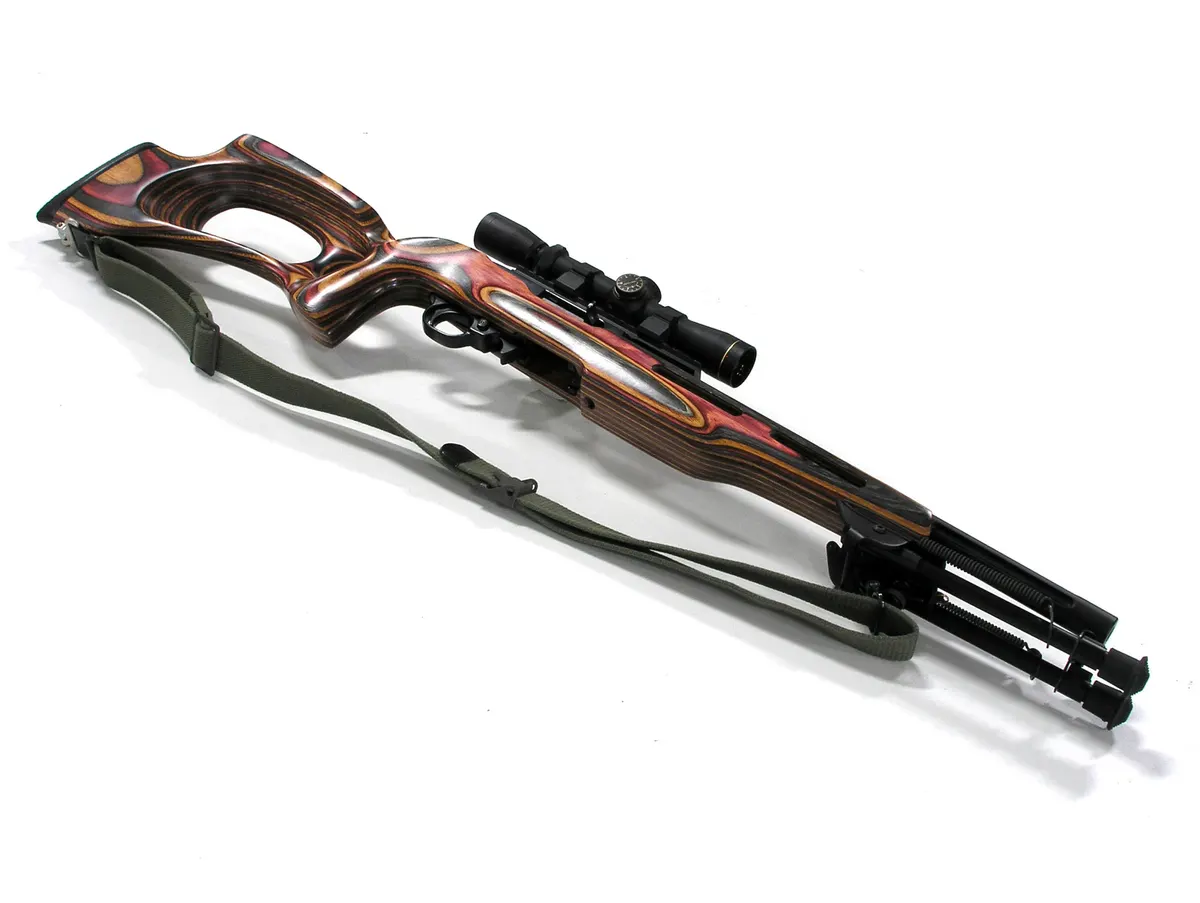
Outside its dominant civilian market, the Ruger 10/22's best documented military and security use has been by Israeli security forces. The Israel Defense Forces began purchasing 10/22 rifles in 1987, during the First Intifada, for use by Israeli Border Police (Mishmar HaGvul) and other security units confronting stone-throwing and unarmed demonstrators in the West Bank and Gaza.12 The rifles Israel fielded were not stock civilian carbines. Wooden-stocked 10/22s were modified by the Italian firm Sabatti with a heavy bull barrel wrapped in an integral suppressor (deliberately styled to resemble an oversized flashlight), a scope mounted on a Weaver rail, and a forward bipod, and the rifle became known informally among Israeli operators simply as the Two-Two.12
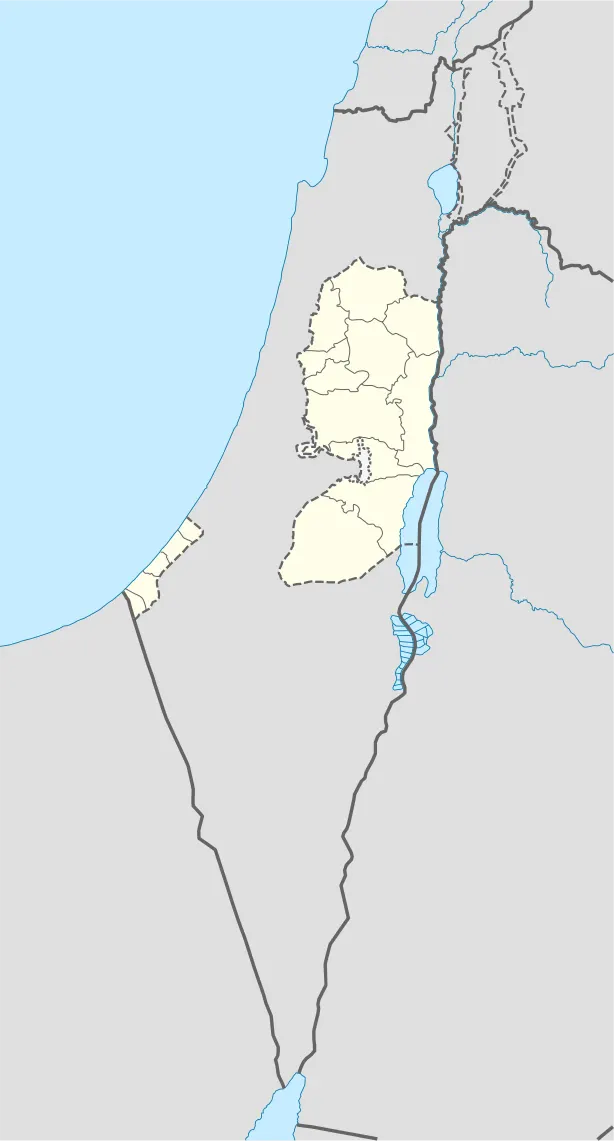
Israel classified the modified 10/22 as a less lethal, crowd control weapon on the reasoning that its small .22 LR bullet caused less severe wounds than a standard rifle round, and it was used as an intermediate option between rubber-coated bullets or tear gas and full lethal force, typically fired at the legs of demonstrators identified as ringleaders.12,13 That classification did not last unchallenged. In 2001 Israel's Military Advocate General ruled that the Ruger and its .22 LR ammunition could not legally be treated as a riot control weapon, ordering that open-fire rules for the 10/22 match those governing standard assault rifles, which effectively pulled the weapon out of routine crowd control use.13 The rifle was reintroduced under a different set of engagement rules around 2008 to 2009 and has remained in use by Israeli security forces since.12,14
Human-rights monitors have specifically flagged an escalation in .22 LR use in West Bank confrontations, with B'Tselem documenting a marked rise in the years around 2015, describing firing incidents occurring on a near-weekly basis at protest sites and reporting that most of those injured have been young Palestinians, including minors.15 Yesh Din's own review concluded that Israeli soldiers and police have killed dozens of Palestinians and seriously injured many others with Ruger-type firearms over the weapon's decades of deployment in what Israeli authorities classify as riot control settings rather than armed conflict.13 The broader pattern of live-fire use against demonstrators in the Israeli occupation of the Palestinian territories has drawn separate scrutiny from journalists covering how the .22 LR round's technical classification as less lethal has been used to describe fatal and near-fatal shootings in terms that understate their severity.14
This role has no real parallel among the 10/22's other users, nearly all of whom are civilian shooters, hunters, and youth or introductory shooting programs rather than military forces. It is worth stating plainly given how sensitive the topic is, the underlying facts come from Israeli military legal rulings and independent human-rights documentation, not from a single advocacy claim, and the weapon's civilian .22 LR chambering is precisely what let Israeli authorities argue for its less lethal classification in the first place.13
Ruger has sold the 10/22 in enough configurations that the word variant almost undersells the range, since most differences are limited to barrel profile, stock material, and sights rather than a change to the underlying action or magazine.1
- 10/22 Carbine, the original 1964 pattern, 18.5-inch barrel, synthetic or hardwood stock, and the configuration most other variants are measured against.1
- 10/22 Sporter, a higher-grade walnut or birch-stocked version with a blued barrel, adjustable rear sight, and gold-bead front sight, aimed at hunters and traditional shooters.1
- 10/22 Target, a heavy bull barrel and two-stage target trigger (roughly 3.0 pounds pull weight) built for bench and competition accuracy rather than field carry.1
- 10/22 Compact, a shortened 16.12-inch barrel and reduced 12.5-inch length of pull, marketed for smaller-statured and younger shooters.1
- 10/22 Tactical, a threaded, flash-suppressor-equipped barrel and a Picatinny rail milled into the receiver for red-dot or scope mounting.1
- 10/22 Takedown, introduced in March 2012, splits into two halves via a cam-lock barrel mount for storage and travel while returning to point of impact after reassembly.10,11
- 10/22 International, a Mannlicher full-length stock variant, since discontinued.1
- 10/22 Magnum and 10/17, short-lived branches chambered in .22 WMR (1998 to 2006) and .17 HMR (2004 to 2005), both dropped in favor of the standard .22 LR chambering.1

Ruger has also spun off related but distinct rimfire products from the 10/22 platform, including the AR-15-styled SR-22 rifle (2009) built on an aluminum chassis around the 10/22's action, and the 22 Charger pistol, a short-barreled handgun variant first released in 2007. Neither is a 10/22 variant in the strict sense, but both reuse its rotary magazine and trigger group.1


| Year | Buyer | Quantity | Amount | Present Value (2025) |
|---|---|---|---|---|
| 1987 |  Israel | — | — | — |
The overwhelming majority of Ruger 10/22 rifles in circulation are in private civilian hands in the United States, where the rifle is a staple of youth marksmanship programs, hunter education courses, and informal target shooting because of its low recoil and inexpensive .22 LR ammunition.2 Formal law-enforcement adoption has been limited. The rifle's rimfire chambering makes it unsuitable for most tactical-rifle certification courses, which typically require a centerfire duty caliber, but many departments still use 10/22s informally as low-cost marksmanship trainers for new recruits before they move on to duty-caliber rifles.2
The clearest documented government use remains the Israel Defense Forces and Israeli Border Police deployment described above, where modified, suppressed 10/22s have served since 1987 in a security and crowd-control role distinct from any of the rifle's civilian applications.12,13 Ruger's own rotary-magazine concept also lives on in other company products used by hunters and target shooters worldwide, including the bolt-action Ruger Model 77 rotary-magazine rifle line, though that platform is a separate, centerfire design rather than a 10/22 derivative.
The Ruger 10/22's longest-running rivalry is with the Marlin Model 60, and together the two rifles have been the best-selling semi-automatic .22 LR rifles on the American market for decades.19 The rivalry is really a rivalry of feed systems as much as of brands. The 10/22 uses its detachable rotary magazine, while the Marlin Model 60 feeds from a tubular magazine under the barrel holding 14 or more rounds with no separate magazine to lose, buy, or swap.19 That difference decides most of the buying decision between the two rifles. Shooters who want quick reloads, aftermarket capacity options, and the ability to change barrels and calibers gravitate to the Ruger, while shooters who want a simple, self-contained rifle with a higher single-load round count and a historically lower price tend to prefer the Marlin.19
Raw accuracy between the two is closer than either fan base tends to admit, and comparisons that control for ammunition quality generally find the Ruger 10/22 and Marlin Model 60 within a fraction of an MOA of each other rather than one being clearly superior.19 Where the 10/22 pulls decisively ahead is aftermarket support and scope mounting, since its receiver is factory-drilled and tapped for a proper base rather than the Marlin's narrower dovetail rail, and the sheer scale of Ruger's aftermarket has no equivalent in the Marlin ecosystem.19 Price has also diverged over time. New Marlin Model 60 rifles have historically retailed for roughly $150 to $200, well under the modern 10/22's price of around $350 to $450, a gap that did not exist when both rifles launched decades ago at broadly comparable prices.19


Is the Ruger 10/22 still in production? Yes. The 10/22 has been in continuous production since 1964 and remains a current Ruger catalog item, including a 2024 60th Anniversary Collector's Series edition.1,7
What caliber is the Ruger 10/22? The Ruger 10/22 is chambered in .22 Long Rifle, a rimfire cartridge, with discontinued variants having briefly offered .22 WMR and .17 HMR chamberings.1
How much does a Ruger 10/22 cost? Standard Ruger 10/22 Carbines have a manufacturer suggested price around $369 as of 2025, with used examples selling anywhere from roughly $150 to $450 depending on condition and configuration, and premium factory models like the Carbon Fiber edition listing near $649.17,18
How accurate is the Ruger 10/22? A stock Carbine typically groups around 1 to 2 MOA with good ammunition, while the dedicated Target variant, with its heavy barrel and target trigger, routinely shoots sub-MOA groups, and heavily modified aftermarket builds can shrink that further.16,9
Does the military use the Ruger 10/22? Military use is limited. Its best documented government use is by the Israel Defense Forces and Israeli Border Police, which have fielded modified, suppressed 10/22s since 1987 in a disputed crowd-control role, rather than as a standard-issue combat rifle for any national military.12,13
- "Ruger 10/22", Wikipedia — en.wikipedia.org ↩
- "The Ruger 10/22: History & Design", American Rifleman — americanrifleman.org ↩
- "William B. Ruger", Wikipedia — en.wikipedia.org ↩
- "Sturm, Ruger & Co.", Wikipedia — en.wikipedia.org ↩
- "Ruger 10/22 History", Wideners Shooting, Hunting & Gun Blog — wideners.com ↩
- "Ruger Celebrates the 60th Anniversary of the 10/22 Rifle", Sturm, Ruger & Co. — ruger.com ↩
- "Ruger Unveils 60th Anniversary 10/22 Rimfire Carbine", Guns.com — guns.com ↩
- "Ruger 10/22: Customizing For Accuracy", Gun Digest — gundigest.com ↩
- "The Ultimate Guide to Choosing the Perfect Ruger 10/22 Variant", WOOX Journal — wooxstore.com ↩
- "10/22 Takedown", Sturm, Ruger & Co. — ruger.com ↩
- "The plinker went to war: The IDF's Ruger 10/22", Laststandonzombieisland — laststandonzombieisland.com ↩
- "Lethal Weapon .22 — Deadly use of Ruger-type weapons against Palestinians in the West Bank", Yesh Din — yesh-din.org ↩
- "How the Israeli army obfuscates its use of live fire against Palestinians", +972 Magazine — 972mag.com ↩
- "Military steps up use of live 0.22 inch bullets against Palestinian stone-throwers", B'Tselem — btselem.org ↩
- "Gun Review: Ruger 10/22 Target Rifle", The Truth About Guns — thetruthaboutguns.com ↩
- "Ruger 10/22 Price (2026), What It's Worth Today", WeBuyGuns — webuyguns.com ↩
- "Ruger 10/22 Autoloading Rifle", Sturm, Ruger & Co. — ruger.com ↩
- "Marlin 60 vs Ruger 10/22, Expert Breakdown and Comparison", Ruger1022.com — ruger1022.com ↩