

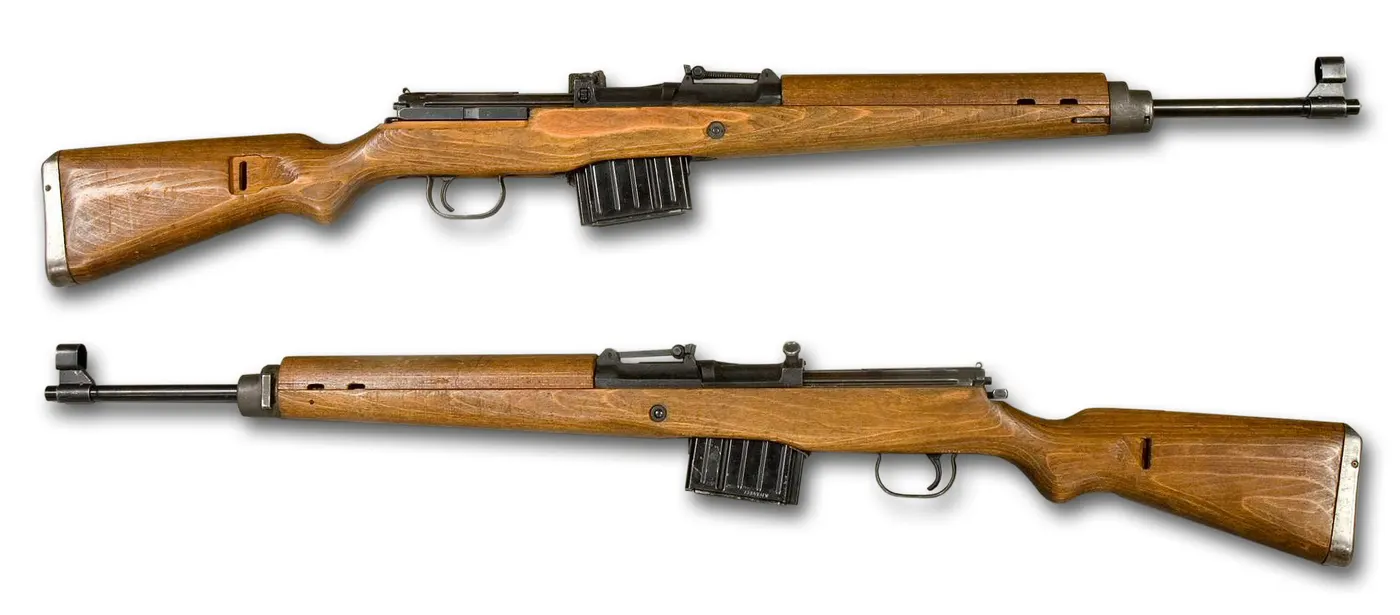

The Gewehr 43 entered German service in October 1943 as a semi-automatic rifle whose gas system was copied almost directly from a captured Soviet weapon.1 German troops first encountered the Soviet SVT-40 during Operation Barbarossa in 1941, and its simple barrel-ported gas piston embarrassed the German army, which had spent years developing self-loading rifles that jammed constantly in the field.2 Walther's engineers reverse-engineered the SVT-40's short-stroke piston, mated it to the flapper-locking bolt of their earlier Gewehr 41, and delivered a rifle that actually worked.1,3
- reliable SVT-40-derived gas system
- fast reloading via detachable box magazine
- strong sniper platform with ZF4 optic
- simplified, faster production than the Gewehr 41
- no bayonet lug or rifle-grenade capability
- rougher machining and finish than the M1 Garand
- came too late and in too few numbers to matter strategically
- late-war units suffered sabotage and poor quality control
Chambered for the standard German 7.92x57mm Mauser cartridge, the Gewehr 43 weighed 4.4 kg empty and fed from a 10-round detachable magazine, a genuine improvement over the internal, stripper-clip-only magazines of the rifles it replaced.1 Muzzle velocity ran 746 to 776 m/s depending on the ammunition lot, giving an effective range of roughly 500 meters with iron sights and up to 800 meters when fitted with the ZF4 telescopic sight.1 Total wartime production reached 402,713 rifles between 1943 and 1945, split between standard infantry rifles and at least 53,435 sniper-configured examples.1,6
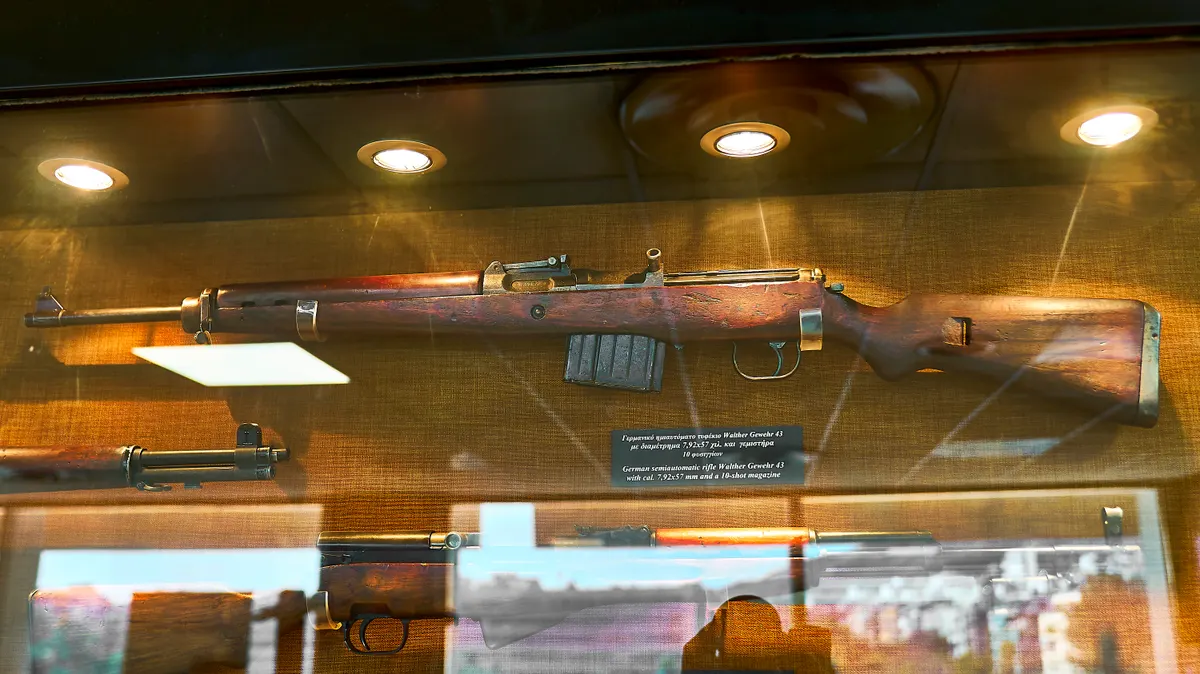
The rifle is one of the more studied examples in the semi-automatic rifles category precisely because it shows a major industrial power abandoning a flawed indigenous design in favor of copying an enemy's simpler solution mid-war.2 Carl Walther Waffenfabrik built the bulk of production at Zella-Mehlis, with Berlin-Lübecker Maschinenfabrik and the Wilhelm Gustloff Stiftung plant at Weimar-Buchenwald adding capacity from early 1944 onward.1,4 Unlike the bolt-action Karabiner 98k that remained the German infantry's standard weapon throughout the war, the Gewehr 43 never reached more than a fraction of front-line units, and it is best understood as a specialist marksman's rifle that arrived at the point Germany's semi-automatic rifle program should have started.3
The SVT-40-Derived Short-Stroke Gas System
The core of the Gewehr 43's design is a gas-operated short-stroke piston tapped from a port roughly a third of the way down the barrel, a layout lifted almost unchanged from the Soviet SVT-40.1,2 Gas bled through the port drives a short piston rod a few centimeters rearward before disengaging, which then knocks the bolt carrier back to cycle the action. This is mechanically distinct from the long-stroke piston used in most German and Soviet rifles of the era, and it kept the moving mass low enough that the rifle stayed controllable in semi-automatic fire.2
- First Production Year1943
- Service Entry Year1943
- Designerwalther
- Weight (Empty)4.4 kg
- Currently In ServiceNo
- Notable Userswehrmacht_french_indochina_forces_czechoslovak_forces_east_germany
The bolt itself locks with a pair of flapper lugs on either side of the bolt head that spread outward into recesses in the receiver when the action closes, a mechanism carried over directly from the Gewehr 41(W).1,4 Compared to the rotating-bolt locking used in the M1 Garand, the flapper system is mechanically simpler and tolerates the SVT-derived gas system's shorter dwell time well, though collectors and armorers generally rate it as less refined than the M1's Garand's locking geometry.8
- Cartridge7_92_57mm_mauser
- Calibre7.92 mm
- Case Length57 mm
- Calibre Class7_92mm
- Bullet Weight12.8 g
- RimfireNo
- Caseless AmmunitionNo
Germany's earlier semi-automatic attempt, the Gewehr 41, had used the Bang gas-trap system with a cone fitted over the muzzle, a configuration the Army insisted on so the barrel itself would not need a drilled gas port.2 The gas-trap cone was extremely difficult to keep clean, and low-quality wartime ammunition regularly caused it to fail to cycle or, at the opposite extreme, to rip the case head off on extraction.2,4 Walther's redesign threw that requirement out entirely and drilled the barrel, the same solution the SVT-40 had used from the start.1
- Action TypeGas-Operated
- Fire Modessemi_automatic
- Select FireNo
- Feed SystemDetachable Magazine
- Magazine Capacity10
Sights, the ZF4 Mount, and Wartime Simplification

Standard Gewehr 43 rifles used a hooded post front sight and a tangent rear sight, both linked to iron sights doctrine common to German service rifles of the period.1 An unusual design touch for a mass-issue rifle was a machined dovetail rail cut directly into the receiver's right side, allowing a scope mount to be fitted at the factory or in the field without gunsmith work.7 Roughly 50,000 rifles, sourced variously as 46,042 to 53,435 depending on how sniper-marked receivers are counted, received the ZF4, a compact 4x scope with bullet-drop compensation graduated in 50-meter steps out to 800 meters.1,6 Voigtländer und Sohn alone delivered around 73,000 ZF4 units, with Opticotechna in occupied Czechoslovakia and AGFA Kamerawerk supplying the remainder, output that outpaced the number of rifles actually able to mount them.6
- Muzzle Velocity746 m/s
- Effective Range (point)500 m
- Effective Range (area)800 m
Late-production rifles, made after Germany renamed the type Karabiner 43 in April 1944, show visible cost-cutting. Wood furniture increasingly used laminated rather than solid stock blanks, and internal changes such as a stainless steel gas piston and enlarged gas-cylinder relief holes were introduced to compensate for the poor ammunition and rough machining reaching front-line units by late 1944.2 The rifle notably lacks any bayonet lug or threaded muzzle. Contemporary German ordnance decided a longer forend and lug would cost time and material the wartime economy could not spare, so the standard Schiessbecher rifle-grenade launcher fitted to the Karabiner 98k and StG 44 was never adapted for it, despite early testing.9
- Barrel Length550 mm
- Sight Typeiron_sights_and_optical_crosshair
- Optic RailNo
- Iron SightsYes
- Threaded BarrelNo
- Overall Length1,115 mm
- Receiver Materialsteel
- Furniture Materialwood_and_steel
- Folding / Collapsing StockNo
- Bullpup LayoutNo
- Ambidextrous ControlsNo
- Total Production402,713
- Production Start1943
- Production End1945
- Variants3
Barbarossa and the Failure of the Gewehr 41
Nazi Germany entered the Soviet Union in June 1941 confident in its infantry doctrine, and the appearance of the semi-automatic SVT-38 and SVT-40 in Soviet hands the same year was a genuine shock to German planners, who had nothing comparable ready for issue.2,3 Walther and Mauser had already built the competing Gewehr 41(W) and Gewehr 41(M) designs, but the Army's insistence on avoiding a drilled gas port forced both firms into the unreliable muzzle gas-trap system.2 Field reports from the Eastern Front described rifles jamming from fouling within a few hundred rounds, and only around 120,000 Gewehr 41s of both makes were built before the Army effectively gave up on the type.4
Captured SVT-40 rifles, shipped back to Germany for technical evaluation after the initial invasion, gave Walther's designers the fix the Gewehr 41 needed. Combining the SVT-40's barrel-ported short-stroke gas system with the flapper-locked bolt already proven in the Gewehr 41(W), Walther produced a rifle that passed troop trials far more successfully than its predecessor and entered production in 1943.1,3 The German army accepted it into service that October as the Gewehr 43, initially as a Walther-only product before Berlin-Lübecker Maschinenfabrik and the Wilhelm Gustloff Stiftung were brought in to expand output in 1944.1
Service Entry, the Karabiner 43 Renaming, and Deployment Reality
On 6 April 1944, Adolf Hitler issued a decree renaming the Gewehr 43 as the Karabiner 43, the same order that renamed the MP 43 submachine gun as the Sturmgewehr 44.5 The rifle and its scoped variant were physically identical before and after the change, only the roll-marking differed, and the renaming reflected a wider German push during 1944 to standardize small-arms nomenclature rather than any redesign.5,7 Despite the rebrand, production never came close to matching the volumes Walther and its subcontractors had hoped for. Total wartime output across all three makers reached 402,713 rifles, a fraction of the millions of Karabiner 98k bolt-action rifles Germany fielded in the same period.1
Deployment also fell short of the standard-infantry-rifle role Germany originally envisioned. Rather than re-equipping whole rifle companies, the Gewehr 43 and Karabiner 43 were mostly issued to designated marksmen attached to machine-gun sections and to dedicated snipers using the ZF4-scoped variant.4 Surviving veteran accounts collected by collectors and historians describe mixed feelings among the troops who carried it. Some praised its reliability improvement over the Gewehr 41, while others still preferred the well-worn Karabiner 98k or, when they could get one, a captured American M1 Garand.10
Forced Labor and the Late-War Quality Collapse
Much of the Gewehr 43's wartime production depended on forced labor, including work performed at satellite sites tied to the Buchenwald and Neuengamme concentration camps as Walther and Gustloff expanded capacity through 1944 and 1945.2,4 That labor system, combined with dwindling raw material quality and repeated Allied bombing of German industrial centers, produced a visible decline in fit and finish on late-production rifles. Contemporary accounts and postwar armorer inspections both describe rougher machining, more frequent sabotage-related defects, and inconsistent ZF4 scope quality control in rifles built after mid-1944.2,6
By the time production ramped toward its final totals in early 1945, entire batches of Karabiner 43 rifles were leaving factories with parts sourced from whichever supplier could still deliver, a symptom common across German small-arms output in the war's final months rather than a Gewehr 43-specific failure.4 The rifle's reputation among modern collectors reflects that split. Early-war Walther-built Gewehr 43 rifles are generally regarded as well finished, while late Berlin-Lübecker and Gustloff-marked Karabiner 43 rifles from 1945 are the ones most associated with rough machining and reliability complaints.7
The Gewehr 43's combat history is dominated by the Eastern Front of World War II, where it entered service specifically to counter Soviet semi-automatic rifles and where the great bulk of the 402,713 rifles built were issued.1,3 German army groups facing the Red Army from late 1943 onward received priority for both standard and ZF4-scoped rifles, since the marksman and sniper role the Gewehr 43 filled was most valuable against an opponent already fielding large numbers of its own semi-automatic infantry weapons.3
Captured and surplus rifles carried on into a second conflict after Germany's defeat. France issued numbers of captured Gewehr 43 and Karabiner 43 rifles to colonial troops during the First Indochina War against Viet Minh forces in the early 1950s, a conflict the rifle was never designed for but that its worldwide postwar surplus glut made cheaply available for.3,4 The rifle's actual influence on either war's outcome was marginal. It arrived too late in too small numbers to change the Eastern Front's trajectory, and in Indochina it was one of many mismatched surplus weapons issued to under-equipped colonial forces rather than a frontline standard.8
The Karabiner 43 designation, applied from April 1944, is not a distinct variant in any mechanical sense. It is the same rifle under Hitler's 6 April 1944 nomenclature decree, identical apart from the roll-mark stamped on the receiver.5,7 The scoped Gewehr 43 (Sniper) and Karabiner 43 (Sniper) configurations, fitted with the factory dovetail rail and the ZF4 telescopic sight, form the only functionally distinct wartime variant, and they represent the version most valued by collectors and most documented in period photographs.1,6
An unfinished experimental line, internally designated Gerät 03, replaced the flapper-locking bolt with a roller-locking mechanism related to the systems that would later define postwar rifles such as the Sturmgewehr 44's conceptual successors in West Germany. The Gerät 03 never reached production before the war ended.1 Separately, an unknown but small number of late-war Karabiner 43 rifles were experimentally rechambered for the 7.92x33mm Kurz round and adapted to accept StG 44 magazines, apparently as a stopgap once 7.92x57mm ammunition supplies were disrupted, though this conversion never became a formal production variant.1
Postwar, Brazil built its own derivative rather than simply importing surplus rifles. The state arsenal at Itajubá, which later became IMBEL, produced roughly 300 examples of the M954 Mosquetão, a Gewehr 43 copy rechambered for .30-06 Springfield with a strengthened bolt carrier, an improved gas system, and a new magazine influenced by the Browning Automatic Rifle's design, before the program was cancelled in favor of continued Mauser bolt-action production and, eventually, the FN FAL.9


Germany's Wehrmacht was the only wartime user of the Gewehr 43, issuing it primarily to Eastern Front units and dedicated marksmen from October 1943 until the war's end in 1945.1,3 After the war, Czechoslovakia inherited large stocks of captured Gewehr 43 and Karabiner 43 rifles and kept the type in service with its army for several years, valuing it specifically as a sniper platform.1
Smaller numbers reached other users through Czechoslovak surplus channels. Romania received a limited quantity directly from wartime Germany, while Guatemala purchased a small batch from Czechoslovakia before the country's 1954 coup.3 France armed some of its colonial forces with captured examples during the First Indochina War in the early 1950s.3,4 None of these postwar users retained the Gewehr 43 as a primary service rifle for long, and by the later 1950s the type had been retired everywhere in favor of purpose-built postwar battle rifles.
German ordnance rejected the Gewehr 41's gas-trap muzzle cap entirely when it built the Gewehr 43, replacing a fragile, fouling-prone mechanism with the barrel-ported system copied from the SVT-40.1,2 The two rifles share a bolt design (the Gewehr 43 reused the Gewehr 41(W)'s flapper lock nearly unchanged) but differ completely in how they cycle, in magazine type, and in how they held up under real combat conditions.1,4 The Gewehr 41 fed from a fixed, non-detachable magazine reloaded via stripper clips, while the Gewehr 43 gained a genuine detachable box magazine, a small but meaningful difference in a rifle meant for fast reloading under fire.1 Roughly 120,000 Gewehr 41s were built against 402,713 Gewehr 43s, and the reliability gap between the two designs is the main reason for that production shift rather than any change in strategic priority.4
| Spec | Gewehr 41(W) | Gewehr 43 | M1 Garand |
|---|---|---|---|
| Gas system | Muzzle gas-trap | Barrel-ported short-stroke piston | Long-stroke piston |
| Feed | Fixed, stripper-clip loaded | 10-round detachable box | 8-round en-bloc clip |
| Weight (empty) | 4.9 kg | 4.4 kg | 4.31 kg |
| Production | approx. 120,000 | 402,713 | approx. 5.4 million |
Against the American M1 Garand, the comparison is less about mechanism and more about industrial scale and manufacturing quality. Both rifles are gas-operated semi-automatics chambered for a full-power rifle cartridge, and both entered large-scale wartime service within a few years of each other, but the United States built over 5.4 million Garands against Germany's 402,713 Gewehr 43 and Karabiner 43 rifles combined.11 Wartime and postwar assessments consistently rate the Garand's machining, gas system, and en-bloc clip feeding as more consistent and more reliable in sustained field use than the Gewehr 43's, a gap widened further by Germany's late-war reliance on forced labor and degraded raw materials.8,9 The Gewehr 43's real advantage over the Garand was its detachable magazine, which allowed a soldier to top off or swap rounds without the Garand's audible clip-ejection ping and without emptying the magazine first, a genuine tactical edge that postwar rifle designs (including the American M14 that eventually replaced the Garand) would adopt as standard.8


What caliber is the Gewehr 43 chambered in? The Gewehr 43 fires the standard German 7.92x57mm Mauser rifle cartridge, the same round used in the Karabiner 98k and most other German infantry rifles and machine guns of the period.1
How does the Gewehr 43's gas system actually work? It uses a barrel-ported, gas-operated short-stroke piston copied from the Soviet SVT-40, a mechanism that proved far more reliable than the gas-trap system used on the earlier Gewehr 41.1,2
Is the Gewehr 43 still in service anywhere today? No. It was retired from German service in 1945 and from its last known military user, Czechoslovakia, by the later 1950s. Surviving examples today are exclusively collector and museum pieces.1
How much does a Gewehr 43 cost today? Collector prices vary widely by condition and originality. Shooter-grade examples have traded in the roughly $2,500 to $3,000 range, while matching, all-original rifles, particularly ZF4-scoped sniper examples, have sold for $5,000 or more.12
How does the Gewehr 43 compare to the M1 Garand and Gewehr 41? It was more reliable than the Gewehr 41 it replaced and gained a detachable magazine neither the Gewehr 41 nor the M1 Garand had, but it was outproduced roughly thirteen to one by the Garand and is generally rated as less refined in machining and finish. See the Comparison section above for the full breakdown.8,9
Why was the Gewehr 43 renamed the Karabiner 43? Adolf Hitler's decree of 6 April 1944 renamed it alongside the MP 43 (which became the Sturmgewehr 44) as part of a wider German small-arms nomenclature standardization, not because of any mechanical change to the rifle itself.5
- "Gewehr 43", Wikipedia — en.wikipedia.org ↩
- "Gewehr 43", Forgotten Weapons — forgottenweapons.com ↩
- "Gewehr 43: The German Semi-Automatic Rifle Inspired By the Powerful Soviet SVT-40", War History Online — warhistoryonline.com ↩
- "Gewehr (rifle) 43", WW2-Weapons.com — ww2-weapons.com ↩
- "POTD: The Karabiner 43, Hitler's Garand", The Firearm Blog — thefirearmblog.com ↩
- "G/K43", wwiigermansniper.com — wwiigermansniper.com ↩
- "Gewehr 43: The Road To Germany's Garand", Gun Digest — gundigest.com ↩
- "No, the Gewehr 43 Was Not a German M1 Garand", The National Interest — nationalinterest.org ↩
- "Brazil's .30-06 Copy of the G43, The Mosquetão Semi-Automático M954", Forgotten Weapons — forgottenweapons.com ↩
- "Was the Gewehr 43 a good rifle?", Axis History Forum — forum.axishistory.com ↩
- "M1 Garand", Wikipedia — en.wikipedia.org ↩
- "G43 New and Used Price, Value, & Trends 2026", TrueGunValue — truegunvalue.com ↩
- "Enemy at the Gates", Internet Movie Firearms Database — imfdb.org ↩
- "Gewehr 43", Internet Movie Firearms Database — imfdb.org ↩