

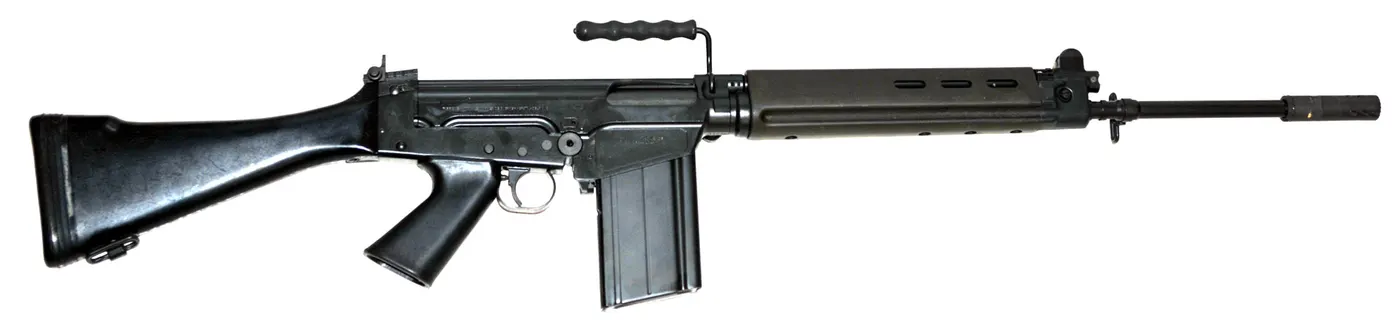

The FN FAL (Fusil Automatique Léger, French for light automatic rifle) is a battle rifle designed by FN Herstal of Belgium, chambered for the 7.62x51mm NATO cartridge and built around a gas-operated action with a tilting breechblock.1 Chief designer Dieudonné Saive led development from 1947 to 1951 with engineer Ernest Vervier, carrying forward experience Saive had gained decades earlier working alongside John Browning at FN and, separately, as principal designer of the Browning Hi-Power pistol.1,2 Production began in 1953, and over the following four decades FN and roughly a dozen foreign licensees built the rifle for an estimated up to seven million total units, a figure spread across FN's own Belgian output and licensed manufacture abroad rather than from a single factory.1,7
- Powerful 7.62x51mm NATO cartridge with genuine long-range stopping power
- User-adjustable gas regulator tunes the action to ammunition and climate
- Simple gas-piston mechanism, widely regarded as easy to field-strip and maintain
- Broad, battle-tested licensed production base across NATO and aligned states
- Folding-stock paratrooper variants gave airborne and mechanized troops a compact option
- Heavy recoil impulse limits controllable full-automatic fire to short bursts
- Documented sand and dust ingress problems in desert conditions (notably Israeli service)
- Basic aperture sights with no fine windage or elevation adjustment
- Lost the US trials that produced NATO's other Cold War rifle, the M14
- At roughly 4.3 kg unloaded plus a loaded 20 or 30-round magazine, heavier than later intermediate-caliber rifles
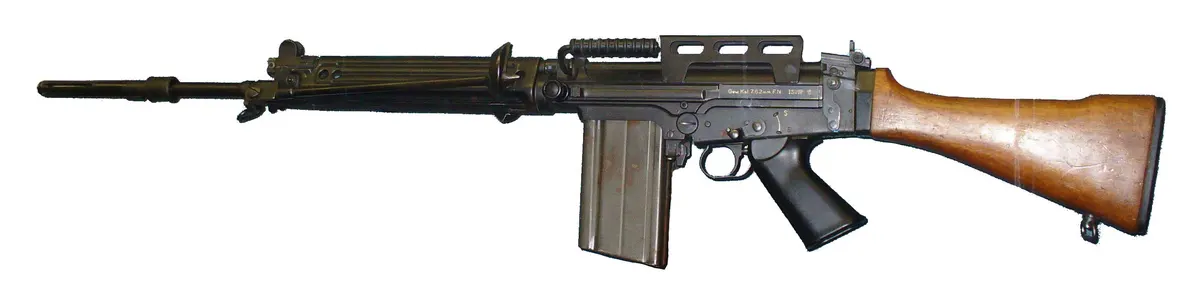
Cold War marketing gave the FAL a lasting nickname, the right arm of the free world, reflecting its spread through NATO's European members (other than the United States) and dozens of allied and aligned states outside the alliance, framed at the time as the West's answer to the ubiquity of the Kalashnikov.3 Roughly 90 countries adopted the rifle in original or licensed form over its service life, and variants remain in reserve or front-line use in a smaller number of them today.3,1
The FAL belongs to the first generation of NATO battle rifles built around the alliance's newly standardized 7.62x51mm cartridge, a category that also includes the American M14 and the West German Heckler & Koch G3.4 All three trace back to the same postwar argument over what a NATO service rifle should fire, and the FAL's own path through that argument, from a wartime German cartridge to a rejected British one to the American round that eventually won, is one of the more tangled design histories of any Cold War infantry weapon.5
The FAL operates on a short-stroke, spring-loaded gas piston mounted above the barrel, which drives a tilting breechblock that locks by dropping into a shoulder machined into the receiver, a locking method conceptually related to the one used in the Soviet SKS and the French MAS-49.6 Some general firearms references mislabel the system as long-stroke gas operation, but detailed technical breakdowns of the mechanism confirm it uses a short-stroke piston that strikes the bolt carrier and then returns independently, rather than staying coupled to the carrier for the full cycle.6
- First Production Year1953
- Service Entry Year1953
- DesignerDieudonné Saive and Ernest Vervier
- Weight (Empty)4.25 kg
- Currently In ServiceYes
A distinguishing feature is the user-adjustable gas regulator, a knurled valve behind the front sight base that lets a soldier tune how much propellant gas bleeds into the piston system.1 Turning it down reduces the energy delivered to the action, which cuts felt recoil and softens the impact of the reciprocating parts, useful for adjusting to different ammunition pressures, heavy fouling, or cold-weather lubricant thickening. Turning it up compensates for a dirty or worn gun that would otherwise short-cycle. In practice, this tunability is one reason the FAL earned a reputation for comparatively light, manageable recoil in semi-automatic fire despite firing a full-power rifle cartridge.1
- Cartridge7.62x51mm NATO
- Calibre7.62 mm
- Case Length51 mm
- Bullet Weight9.5 g
Standard barrel length on the full-size FAL 50.00 rifle is 533 mm, firing a 9.5 g bullet at a muzzle velocity of about 840 m/s from a fixed 20-round detachable box magazine (30-round magazines and a 50-round drum were also produced), with a cyclic rate near 650 rounds per minute in select-fire versions and a sight-adjustable range out to 1,000 m.1 Overall length on the fixed-stock rifle runs to roughly 1,090 mm. Loaded weight, empty weight (4.25 kg), and these dimensional figures are broadly confirmed across manufacturer literature and independent references, with no serious discrepancy found in current research.1,7
- Action TypeGas-Operated
- Select FireYes
- Feed SystemDetachable Magazine
- Magazine Capacity30
- Drum / Belt Capacity50
- Cyclic Rate of Fire650
Sights are a fixed post front sight paired with a ramped aperture rear sight, adjustable from 200 to 600 m in 100 m increments, a simple arrangement criticized by some users for lacking fine windage and elevation clicks compared to rivals of the same generation.1 Full-automatic fire is available on select-fire models, but the rifle's recoil impulse makes it difficult to keep on target in bursts. Because of this, many forces that adopted the FAL issued the standard light-barrel rifle for semi-automatic use only, reserving automatic fire for the separate heavy-barrel FALO variant built for a squad-support role.1
- Muzzle Velocity840 m/s
- Maximum Range1,000 m
Reliability carries a genuinely mixed record depending on environment. The FAL built a strong reputation for tolerating neglect and rough handling in bush and jungle conditions, a reputation that led some users to compare it favorably to the Kalashnikov's own toughness.8 Desert service told a different story. Israeli forces operating the FAL (locally designated Romat) in Sinai found that fine sand and dust worked into the rifle's close-tolerance parts and caused jamming. Israel and other users experimented with sand-clearance cuts in the receiver, later incorporated into the British L1A1 and Canadian C1A1 variants, but the modification did not fully resolve the problem.9 That desert failure mode was a real factor in Israel's decision to retire the FAL in favor of the M16 from 1972 and the locally designed Galil from 1974.9
- Barrel Length533 mm
- Sight Type* ramped aperture rear sight (adjustable from 200 to 600 m/yd in 100 m/yd increments) * post front sight
- Iron SightsYes
- Overall Length1,090 mm
- Folding / Collapsing StockNo
- Total Production7,000,000
- Production Start1953
- Production End1988
The FAL's development traces back to the final year of the Second World War, when FN engineers first explored an intermediate-cartridge automatic rifle inspired by the German StG 44. The first true FAL prototype, completed in 1946, was chambered for the same 7.92x33mm Kurz round the StG 44 used, reflecting the immediate postwar interest across several countries in stepping down from full-power rifle cartridges.1 By 1948 FN had drawn British attention. The United Kingdom tested an early FN prototype and asked the company to build further examples, including a bullpup configuration, this time chambered for Britain's own experimental .280 British (7x43mm) intermediate round.10
In 1950 the UK brought its redesigned FN rifle and its own EM-2 bullpup, both chambered in .280 British, to the United States for a joint trial against the US Army's T25 prototype, designed by Earle Harvey and chambered in a full-power .30-caliber round.10 American observers rejected the .280 cartridge as underpowered and insufficient in range compared to a .30-caliber round, effectively vetoing Britain's intermediate-cartridge program before it could become NATO standard.11 FN, meanwhile, secured a 1951 agreement granting the United States royalty-free rights to produce the FAL design domestically in exchange for continued cooperation.1
What followed has been described by several historians as a political trade rather than a pure technical decision. In 1952, with Winston Churchill back in office as British prime minister, an understanding was reportedly reached between Churchill and US President Harry Truman under which Britain abandoned its preferred .280 cartridge and accepted the American T65 round, which became the 7.62x51mm NATO standard, in exchange for American backing of the FN FAL as a serious NATO rifle candidate.11,12 Britain, in effect, gave up the cartridge its own ordnance designers believed was the better engineering choice for the sake of alliance cohesion.11
Production of the 7.62mm NATO FAL began in Belgium in 1953, with Belgium itself among the first adopters.1,7 The United States, having secured production rights, nonetheless kept developing its own parallel design, and by 1954 American trials had narrowed to a direct comparison between the T44E4 (a modernized M1 Garand derivative) and the T48, which was simply the American-made FAL.12 Despite broadly comparable trial performance, the US Army selected the T44, standardized as the M14, a decision several firearms historians describe as institutional and political rather than a clear technical verdict for either design.12,13 One frequently cited technical point in the M14's favor was that the FAL's gas regulator needed manual readjustment when moving between arctic and tropical conditions, a step the M14's fixed gas system did not require.12
Losing the American trials did not slow the FAL's international momentum. FN marketed the rifle aggressively as a turnkey, NATO-standard option and extended favorable licensing terms to allied and aligned governments well beyond NATO's own membership, including the United Kingdom, Canada, Austria, Israel, South Africa, Brazil, Argentina, Venezuela, India, and Nigeria.1,3 West Germany also sought a license, but FN refused given lingering friction from the wartime German occupation of Belgium, and West Germany instead adopted the CETME-derived Heckler & Koch G3 in January 1959 after its own multi-rifle trial.4,14 FN's own manufacture of the FAL continued in Belgium from 1953 until 1988, though several licensees kept producing FAL-pattern rifles well beyond that date, including the American company DSA, whose SA58 line began production in 1997 and continues today.1,7
The FAL's combat debut came during the 1956 Suez Crisis, when Israeli forces carried the rifle into Sinai against Egyptian positions, only three years after Belgian production had begun.9
Five years later, in the Congo Crisis, the FAL was the primary weapon of roughly 155 to 160 Irish United Nations peacekeepers of the Irish Army's 35th Battalion, A Company, during the Siege of Jadotville from 13 to 17 September 1961.15 Besieged near Jadotville (present-day Likasi, in the Democratic Republic of the Congo) by Katangese secessionist forces reported at 3,000 to 4,000 strong, the Irish company repelled repeated assaults over several days before surrendering once ammunition and water ran out.15 The episode became politically controversial in Ireland for decades, with the defenders facing quiet institutional suspicion rather than recognition, and it was not formally acknowledged and honored by the Irish state until 2005.15
Israel continued to field the FAL (as the Romat) through the 1967 Six-Day War, the 1967 to 1970 War of Attrition, and the 1973 Yom Kippur War, before phasing it out from 1972 onward in favor of the M16 and later the domestically designed IWI Galil, a shift driven partly by the desert jamming problems described above.9
Portugal fought the Portuguese Colonial War across Angola, Guinea-Bissau, and Mozambique from 1961 to 1974 with the FAL, locally designated the m/962, issued alongside the G3 and the AR-10, and favored in particular by Portugal's elite Caçadores Especiais commando units.17
In the Rhodesian Bush War (1964/1966 to 1979), the FN FAL was the standard rifle of Rhodesian security forces, supplied through South Africa's licensed R1 variant and supplemented by original Belgian and West German-made rifles acquired in defiance of the international arms embargo imposed on Rhodesia.18 Rhodesian forces valued the 7.62mm cartridge's ability to punch through the same dense bush cover that often stopped the lighter 7.62x39mm round fired by guerrilla forces' AK-47s.18
British forces carried the L1A1, the semi-automatic-only Commonwealth version of the FAL, as their standard-issue rifle through most of the Troubles in Northern Ireland, from 1968 until the SA80 replaced it in 1985.19 The Provisional IRA, in the conflict's early years, used FN FAL and L1A1 rifles stolen from Irish Army stocks or captured from British troops, before shifting toward AK-pattern rifles supplied by Libya's Muammar Gaddafi from the late 1980s onward.19
Both sides carried FAL-pattern rifles in the 1982 Falklands War. British forces used the semi-automatic-only L1A1, while Argentine forces fielded the full-automatic-capable FN FAL and the heavy-barrel FALO in a squad-support role, with some examples scoped for designated marksman use.20
Roughly a decade later, FAL-pattern rifles surfaced again in the 1990s Yugoslav Wars, where Croatian forces received them through Argentine export channels.21 The rifle's long service life has carried it into the Syrian Civil War as well, where legacy stocks in the hands of the Syrian Arab Army, various rebel factions, the Islamic State, and Kurdish YPG forces reflect decades of prior arms transfers rather than any recent acquisition.22


FN produced the FAL in several factory configurations built around two basic choices, stock type and barrel length.1 The FAL 50.00 is the baseline full-length rifle with a fixed wood stock and standard 533 mm barrel. The FAL 50.61, sometimes called the Type 3 Para, keeps the full 533 mm barrel but replaces the fixed stock with a folding one for paratroop and vehicle-crew use. The FAL 50.62 pairs the folding stock with a shortened 457 mm barrel, while the FAL 50.63, the Paratrooper or Type 2 Para 16 model, goes further still with a roughly 436 to 440 mm barrel and a folding charging handle, a design driven by the specific requirement to fit the weapon, folded and slung across the chest, through the door of a C-119 Flying Boxcar transport aircraft.16 The FAL 50.64, or Para 3, returns to the full 533 mm barrel but uses a lightweight Hiduminium aluminum-alloy lower receiver to cut weight.1
Alongside the standard rifles, FN built the FALO (Fusil Automatique Lourd), a heavy-barrel version intended for sustained automatic fire in a squad-support role, adopted by Canada as the C2A1 and by Australia as the L2A1.1 A wide family of licensed foreign variants followed FN's own model line closely enough that they are generally treated as distinct national weapons rather than FAL sub-variants in their own right, including Britain's L1A1, Canada's C1, Australia's L1A1 and L2A1, Israel's Romat, South Africa's R1, Austria's StG 58, Brazil's IMBEL M964, and Nigeria's DICON NR-1, alongside further licensed or unlicensed production in Argentina, Venezuela, and India.1,3
 AlgeriaACTIVE
 AngolaACTIVE
 ArgentinaACTIVE
 AustriaACTIVE
 BahrainACTIVE
 BangladeshACTIVE
 BarbadosACTIVE
 BelizeACTIVE
 BoliviaACTIVE
 BotswanaACTIVE
 BrazilACTIVE
 BurundiACTIVE
 CambodiaACTIVE
 CameroonACTIVE
 Central African RepublicACTIVE
 ChadACTIVE
 ChileACTIVE
 ColombiaACTIVE
 Costa RicaACTIVE
 CroatiaACTIVE
 CubaACTIVE
 CyprusACTIVE
 Democratic Republic of the CongoACTIVE
 DjiboutiACTIVE
 Dominican RepublicACTIVE
 EcuadorACTIVE
 EgyptACTIVE
 EswatiniACTIVE
 GermanyACTIVE
 GhanaACTIVE
 GreeceACTIVE
 GuyanaACTIVE
 HondurasACTIVE
 IndiaACTIVE
 IndonesiaACTIVE
 IraqACTIVE
 Ivory CoastACTIVE
 JamaicaACTIVE
 KenyaACTIVE
 KuwaitACTIVE
 LebanonACTIVE
 LesothoACTIVE
 LiberiaACTIVE
 LibyaACTIVE
 LuxembourgACTIVE
 MalaysiaACTIVE
 MaltaACTIVE
 MexicoACTIVE
 MoroccoACTIVE
 MozambiqueACTIVE
 MyanmarACTIVE
 NepalACTIVE
 NigerACTIVE
 NigeriaACTIVE
 OmanACTIVE
 PakistanACTIVE
 PalestineACTIVE
 PanamaACTIVE
 Papua New GuineaACTIVE
 ParaguayACTIVE
 PeruACTIVE
 PhilippinesACTIVE
 PortugalACTIVE
 QatarACTIVE
 Republic of the CongoACTIVE
 RwandaACTIVE
 Saint Vincent and the GrenadinesACTIVE
 Saudi ArabiaACTIVE
 SomaliaACTIVE
 South AfricaACTIVE
 SurinameACTIVE
 SyriaACTIVE
 TanzaniaACTIVE
 TogoACTIVE
 Trinidad and TobagoACTIVE
 TunisiaACTIVE
 TurkeyACTIVE
 UgandaACTIVE
 UkraineACTIVE
 United Arab EmiratesACTIVE
 UruguayACTIVE
 VenezuelaACTIVE
 YemenACTIVE
 ZambiaACTIVE
 ZimbabweACTIVE
 BelgiumSTOCK
 IrelandSTOCK
 ThailandSTOCK
 AustraliaRETIRED
 CanadaRETIRED
 IsraelRETIRED
 United KingdomRETIRED
At its Cold War peak the FAL and its licensed derivatives equipped roughly 90 countries, a spread FN's own marketing built directly into the rifle's right arm of the free world identity.3 Early adopters clustered around the mid-1950s NATO standardization process, with the United Kingdom, Israel, Canada, and Belgium itself all fielding the rifle by 1954, followed by Iraq in 1957 and Australia and Brazil in 1959.1 Ireland's 1961 acquisition places its FAL purchase in the same year as the Jadotville siege described above, giving that adoption date a direct combat anchor.15 Thailand followed in 1962.
Beyond these original licensees, dozens of further states adopted original or secondhand FAL-pattern rifles across Africa, Latin America, and the Middle East over subsequent decades, including South Africa (as the R1), Argentina, Venezuela, Austria (as the StG 58), Kenya, Nigeria, and many of the newly independent African states that emerged from British, Belgian, and Portuguese colonial territories through the 1960s and 1970s. A meaningful number of these operators list the rifle as still active in reserve or limited front-line roles today, generally in older stock rather than continued production, reflecting the sheer size and durability of the Cold War-era manufacturing base rather than recent purchasing.
The FAL's closest rival, in both timing and role, is the West German Heckler & Koch G3, the other major first-generation NATO 7.62mm battle rifle and the weapon that prevented the FAL from becoming the alliance's single default rifle.4 The two designs solve the same problem, controlling a full-power cartridge in a select-fire infantry rifle, through fundamentally different mechanisms. The FAL uses a short-stroke gas piston and a tilting locking breechblock with a manually adjustable gas regulator, while the G3 uses roller-delayed blowback, an operating system derived from the wartime German StG45(M) prototype by way of the Spanish CETME rifle, with no separate gas system to tune at all.4,6
That mechanical difference shapes the two rifles' reputations in opposite directions depending on who is asked. Some armorers and historians rate the G3's roller-delayed system as more fouling-sensitive and dependent on a properly fluted chamber to extract reliably, arguing the FAL's simpler gas-piston layout is easier to field-maintain under harsh conditions.4 Others point to the G3's stronger overall adoption numbers, roughly 50 countries versus the FAL's approximately 90, coupled with licensed production in a dozen of them, as evidence the G3 earned a reputation for reliability that matched or exceeded the FAL's own.4 Neither claim is settled in the available sourcing, and the honest picture is a contested one rather than a clear win for either rifle.4
| Parameter | FN FAL | Heckler & Koch G3 |
|---|---|---|
| Operating system | Short-stroke gas piston, tilting breechblock6 | Roller-delayed blowback4 |
| Cartridge | 7.62x51mm NATO1 | 7.62x51mm NATO4 |
| Empty weight | 4.25 kg1 | Approximately 4.4 kg4 |
| Barrel length | 533 mm (standard)1 | 450 mm4 |
| Adjustable gas system | Yes, manual regulator1 | No, fixed system4 |
| Approximate country adoptions | ~903 | ~50, licensed in about a dozen4 |
| First adopted | 1953 (Belgium)1 | 1959 (West Germany)14 |
Had West Germany accepted an FN license rather than developing its own CETME-derived rifle, one plausible reading of the record is that the FAL alone might have equipped most of Western Europe through the Cold War.4 Instead, the G3's arrival split the NATO market and gave momentum to both designs for the following three decades, with the FAL generally reaching a wider spread of countries and the G3 building a reputation, contested but genuine, as a comparably serious rival rather than a clearly inferior alternative.


What are the FN FAL's basic specifications? The standard FAL 50.00 fires 7.62x51mm NATO from a 533 mm barrel, weighs 4.25 kg empty, and reaches a muzzle velocity of about 840 m/s from 20 or 30-round detachable box magazines, with a cyclic rate near 650 rounds per minute on select-fire versions.1
How does the FN FAL work? It uses a short-stroke, spring-loaded gas piston above the barrel to drive a tilting breechblock that locks into a shoulder in the receiver, with a manually adjustable gas regulator letting the user tune the system for ammunition, fouling, and climate.1,6
Is the FN FAL still in service? FN's own Belgian production ended in 1988, but licensed manufacture continued longer in some countries, and a number of the roughly 90 states that once fielded the rifle still hold it in reserve or limited front-line use, generally as older stock rather than through continued purchasing.1,7
How does the FN FAL compare to the Heckler & Koch G3? Both are first-generation NATO 7.62mm battle rifles from the same Cold War era, but the FAL uses a gas-piston action with a tilting bolt and adjustable regulator, while the G3 uses roller-delayed blowback with no separate gas system. The FAL reached more countries overall (about 90 against the G3's roughly 50), while opinions remain genuinely divided over which rifle proved more reliable in the field.4
What is FN FAL's unit cost? No verifiable per-unit contract price for the FAL was found in the sources consulted for this profile. Cold War-era rifle contracts of this kind were typically negotiated government to government and are not consistently published.
- "FN FAL", Wikipedia — en.wikipedia.org ↩
- "Brief Bio: Dieudonné Saive", High Caliber History — highcaliberhistory.com ↩
- "The FN FAL, The Right Arm of the Free World", NRA Blog — nrablog.com ↩
- "M14 Battles the FAL", The Armory Life — thearmorylife.com ↩
- "The FN FAL", War History Online — warhistoryonline.com ↩
- "Understanding How FN FAL Works: A Deep Dive Into the Iconic Battle Rifle", Crate Club — crateclub.com ↩
- "FN FAL", Modern Firearms — modernfirearms.net ↩
- "The AK of the West: The FN FAL", Gun Digest — gundigest.com ↩
- "FN FAL", Wikipedia (Israel service section) — en.wikipedia.org ↩
- "FAL Prototype", Forgotten Weapons — forgottenweapons.com ↩
- "How Churchill Paved the Way for NATO's Standard Ammunition", War on the Rocks — warontherocks.com ↩
- "The FN FAL Was Almost America's Battle Rifle", War Is Boring (Medium) — medium.com ↩
- "FN FAL Compared to M-14", M14 Forum — m14forum.com ↩
- "Heckler & Koch G3", Wikipedia — en.wikipedia.org ↩
- "Siege of Jadotville", Wikipedia — en.wikipedia.org ↩
- "FAL Paratrooper Models", Forgotten Weapons — forgottenweapons.com ↩
- "Portuguese Colonial War", Wikipedia — en.wikipedia.org ↩
- "Rhodesian Bush War", Wikipedia — en.wikipedia.org ↩
- "The Troubles", Wikipedia — en.wikipedia.org ↩
- "Falklands War", Wikipedia — en.wikipedia.org ↩
- "Croatian War of Independence weapons", Wikipedia — en.wikipedia.org ↩
- "Syrian Civil War", Wikipedia — en.wikipedia.org ↩