

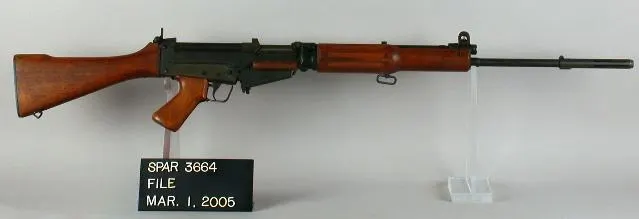
The T48 was the United States military's trials designation for an Americanized, license-built version of the Belgian FN FAL, produced and converted between 1953 and 1955 as the U.S. Army searched for a replacement for the M1 Garand.1 It was not a separate design. It was the FAL itself, re-drawn to American inch-pattern manufacturing standards and built partly in the United States, competing head to head against Springfield Armory's homegrown T44, which won the contest and entered service in 1957 as the M14.1,2 Nowhere else in the FAL's history did the rifle lose a national trial. The T48 is that one exception, and its story is the clearest window into how the FAL and the M14 diverged from a shared starting point.
- Full-power 7.62x51mm NATO cartridge shared with both eventual NATO standard rifles
- Adjustable gas regulator, useful for tuning to ammunition and climate
- Rated by 1952 to 1953 trial boards as easier to field-strip than the T44
- Backed by FN's mature, already-exported FAL production base
- No cold-weather preparation comparable to the T44's ahead of the decisive Arctic trials
- Gas system grew sluggish in cold conditions, and a field fix caused broken parts
- About a pound heavier than the T44 in trial configuration
- Never entered production or service anywhere, unlike its FAL parent
FN Herstal of Belgium supplied most of the actual trial hardware and licensed the design to the U.S. government royalty free, a step FN took specifically to encourage American adoption and to push the FAL toward NATO standardization.1,2 Two American companies did the domestic work. High Standard Manufacturing Company of Hartford, Connecticut converted FN's metric engineering drawings into American inch-pattern format and built a dozen functional prototypes, while Harrington and Richardson (H&R) of Worcester, Massachusetts mass-produced 500 American-pattern rifles as a manufacturability study.1,7
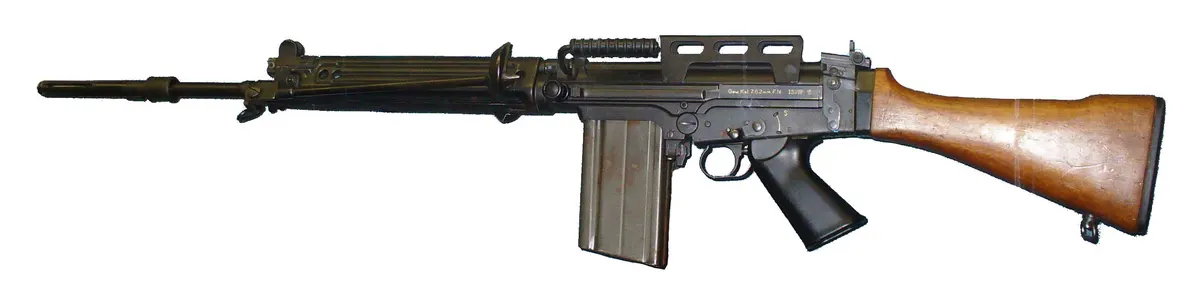
The FAL went on to become one of the most widely issued rifles of the Cold War, adopted by roughly 90 countries and produced in numbers estimated up to seven million.2 The T48 never left the trial range. No T48 entered U.S. service, and unlike the parent FAL, it was never exported or adopted anywhere else.1 That makes the T48 an unusual entry in the FAL's family of licensed variants, the one branch that FN's own design lost rather than won.
The Inch-Pattern FAL American Manufacturers Had to Reinvent
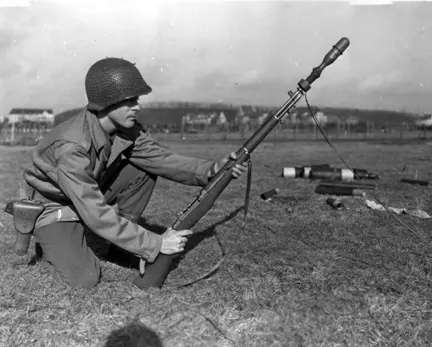
The T48 shared its core mechanism with the Belgian FAL, a gas-operated action using a short-stroke piston and a tilting breechblock, chambered for the 7.62x51mm NATO cartridge and firing from a 20-round detachable box magazine at a cyclic rate near 600 rounds per minute.1,2 Original 1950s trial rifles carried a 21-inch, four-groove barrel, an overall length of about 47.25 inches, and an empty weight of 9.43 pounds (about 4.3 kilograms), rising to 10.2 pounds when fitted with a rifle grenade launcher.1 A heavy-barrel variant, the T48E1, added a bipod and weighed 12.43 pounds, built as a squad automatic weapon rather than a standard rifle and issued in a batch of roughly 200 for separate testing.1
- First Production Year1953
- DesignerDieudonné Saive
- Weight (Empty)4.3 kg
- Weight (Loaded)4.5 kg
- Currently In ServiceNo
- Notable UsersUnited States (testing)
Converting FN's metric drawings to American inch-pattern manufacturing was not a paperwork exercise. High Standard's engineers had to redraw tolerances, thread pitches, and fitted-part dimensions across the entire rifle before H&R could tool up for production, and the two American manufacturers ended up building rifles with genuinely different furniture from each other and from the Belgian original.1 Belgian-built trial rifles kept FN's original wood handguard. High Standard used a three-slot wraparound handguard of its own design, while H&R adopted a two-slot pattern closer to the inch-pattern style Commonwealth manufacturers were converging on.1 All three American-configured variants used a wraparound wing-style buttstock and a folding trigger guard and pistol grip assembly, features that distinguish photographs of T48 trial rifles from standard Belgian FAL production.1
- Cartridge7.62×51mm NATO
- Calibre7.62 mm
- Case Length51 mm
- Calibre Classfull-power rifle
- Bullet Weight9.5 g
- RimfireNo
- Caseless AmmunitionNo
Sights, safety, and trigger arrangement followed the Belgian FAL pattern closely, with an aperture rear sight and post front sight, a manual safety, and a single-stage trigger.1 Where the T48 diverged most sharply from the T44 it was competing against was in its user-adjustable gas regulator, a knurled valve that let a soldier bleed off excess propellant gas to compensate for fouling, ammunition variance, or cold-weather lubricant thickening. Springfield's T44 used a self-compensating gas system that needed no such adjustment, and trial boards eventually treated that difference as a genuine practical advantage for the T44 rather than a wash.3
- Action TypeGas-Operated
- Fire Modesselect-fire (semi-automatic/full-automatic)
- Select FireYes
- Feed SystemDetachable Magazine
- Magazine Capacity20
- Cyclic Rate of Fire600
- Trigger Typesingle-stage
- Safety Typemanual safety
- Muzzle Velocity820 m/s
- Muzzle Energy2,100
- Effective Range (point)600 m
- Maximum Range800 m
- Penetration10 mm
- Accuracy2.5
- Barrel Length533 mm
- Rifling Twist1:12
- Rifling Grooves4
- Sight Typeiron sights
- Optic RailNo
- Iron SightsYes
- Threaded BarrelNo
- Overall Length1,200 mm
- Receiver Materialsteel
- Furniture Materialwood
- Folding / Collapsing StockNo
- Bullpup LayoutNo
- Ambidextrous ControlsNo
- Modularitylimited (detachable magazine)
- Total Production3,200
- Production Start1953
- Production End1955
- Variants1
- Width45 mm
The NATO Cartridge Fight Behind the T48
The T48 program cannot be separated from a parallel argument that had nothing to do with rifle mechanisms, over what cartridge a standardized NATO rifle should fire. Britain championed its own .280 British round and a bullpup design, the EM-2, briefly adopted by the British Army in April 1951.4 The United States insisted on a more powerful, roughly .30-caliber cartridge, and a 1951 shoot-off at Aberdeen Proving Ground tested the American T65 round against the British .280, alongside an FN prototype rebarreled for the .280 cartridge.1,4
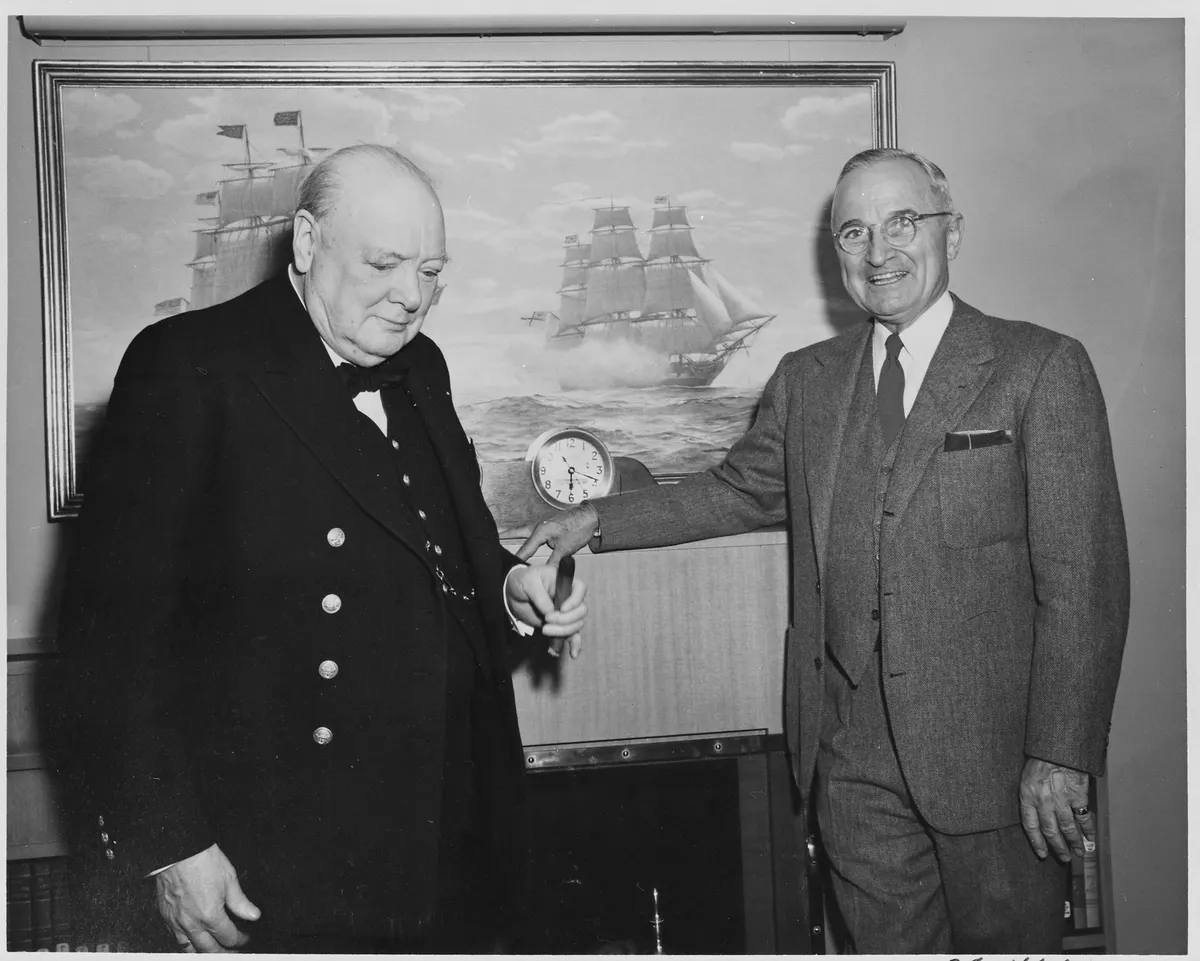
Several firearms historians describe what followed as a political trade rather than a pure engineering decision. Britain accepted the American T65 round, standardized in January 1954 as 7.62x51mm NATO, abandoning the .280 cartridge its own ordnance designers preferred.1,3 Some accounts hold that in exchange the United States was expected to adopt the FAL as a NATO-standard rifle in its own right.
Whatever the precise terms, FN moved to secure American goodwill on its own initiative, licensing the FAL design to the U.S. government royalty free specifically to encourage domestic production and NATO-wide standardization.1 That license became the T48 program, run alongside Springfield Armory's own T44, itself a product-improved Garand derivative building on earlier work by Earle Harvey's T25 and credited in large part to Lloyd Corbett.1
The Trials, From Fort Benning to the Arctic
Fort Benning's Infantry Board opened comparative trials in 1950 with three rifles in the field, the T44, Harvey's redesignated T25, and FN's T48.1 Testing through 1952 and 1953 found the T48 and T44 broadly comparable, with the T48 holding an edge in ease of field-stripping and dust resistance, while the third contender fell behind in both dust and cold trials and was dropped in 1953, narrowing the competition to two rifles.1

The decisive round came in December 1953 and the following winter, in comparative Arctic trials. Springfield Armory engineers spent weeks beforehand using the armory's own cold chamber to specially prepare their T44 test rifles, redesigning the gas regulator and modifying magazines and other parts to reduce friction and seizing in extreme cold.1,3 The T48 rifles received no comparable preparation. In the cold, their gas systems grew sluggish, and when FN engineers tried a field fix by opening the gas ports, the change caused early and violent extraction and broken parts under the increased pressure.1,3 The T44 was ranked decidedly superior in the cold-weather phase, and it is worth being precise that this Arctic testing happened over the winter of 1953 to 1954, not in 1957, a date sometimes confused with the later, separate designation of Fort Greely, Alaska as home of the Army's Arctic Test Board.1
Colonel Rene Studler, who led U.S. Ordnance research and development through this period, is repeatedly described in firearms histories as fundamentally resistant to adopting a foreign-designed service rifle, a background factor some writers cite in explaining how the trials were framed.3 Testing continued through the T48's desert phase, where it reportedly performed poorly, and by 1956 improved T48 rifles had brought malfunction rates down close to parity with the T44, suggesting the eventual margin between the two designs had narrowed considerably by the end of the process.1 Spring 1956 trials at Fort Benning were judged inconclusive, with both rifles considered suitable for service, while separate testing at Quantico reported a slight edge for the T44E4 among Marine Corps evaluators.1
On May 1, 1957, the Secretary of the Army announced adoption of the T44E4 and T44E5 as the standard M14 and M15 service rifles, and the T48 program ended.1 The stated reasons favored the T44 on weight (about a pound lighter), a simpler parts count, its self-compensating gas system, and better-documented cold-weather performance, along with a claim that the design could be built on existing M1 Garand tooling.1,3 That tooling claim was later found to be false. New tooling was required regardless, undercutting one of the practical arguments that had tipped the decision toward the T44 in the first place.1
Canada and Britain Chose Differently
Canada obtained FAL production rights and technical documentation from FN early in the process and spent about 18 months converting the metric drawings to a first-angle inch pattern, a conversion later used across the rest of the Commonwealth.1 After building 20 toolroom prototypes and making its own sight and detail changes, Canada began full production as the C1 rifle, becoming the first NATO country to formally adopt the FAL, and the design served Canadian forces from 1955 until 1985.1 American drawings for the T48 reportedly benefited from Canadian work, and it was Canada's reinforced-magazine-lip design that H&R carried into American T48 production.1
Britain took a more circuitous path. It abandoned its own .280-caliber EM-2 in 1951 to 1952 under American pressure over the NATO cartridge, ran its own comparative FAL trials, and selected the FAL as the basis for its next service rifle in 1953.1,4 Britain formally adopted the design in 1957 as the L1A1 Self-Loading Rifle, manufactured domestically at Royal Small Arms Factory Enfield and by BSA.1,5
The irony is exact rather than approximate. Britain adopted its own FAL-derived rifle in the same year, 1957, that the United States formally rejected the FAL-derived T48 in favor of the M14. Both countries ran their own trials against the same basic action. One found a service rifle it kept for nearly three decades. The other found a reason to build something else, and lived with the consequences of that choice for barely half as long.1,3

 T48 rifle
Three distinct production lines make up the T48 family. High Standard's dozen prototype rifles, serial numbers HS1 through HS12, existed to prove that FN's metric drawings could be converted into a workable American inch-pattern rifle at all, and were not intended as a production run.1 Harrington and Richardson's 500-rifle batch represented the actual manufacturability study, built to American-pattern specifications with H&R's own two-slot handguard and Canadian-derived magazines.1,7 FN's own Belgian-built trial rifles made up the largest share of hardware supplied to the U.S. Army, though the exact total is one of the least settled figures in the T48's history, with estimates across sources ranging from roughly 2,600 to 3,800 rifles when combined with a separate batch of about 200 heavy-barrel T48E1s built for squad automatic weapon testing.1 Only the H&R figure of 500 and the High Standard figure of 12 are treated as solid across sources.1
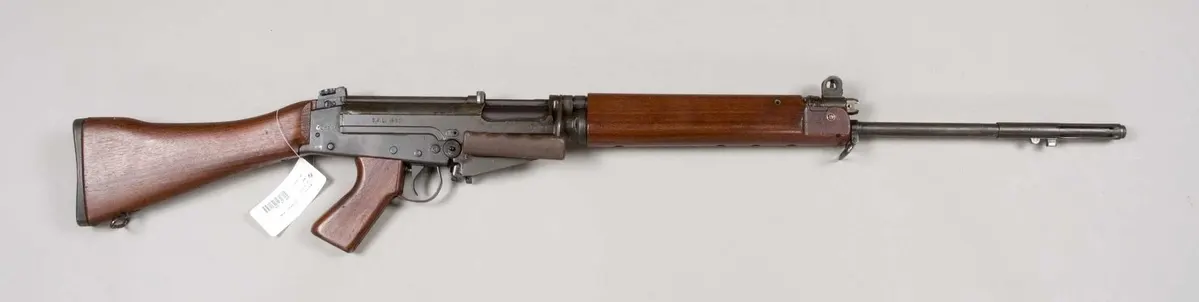
The T48E1 heavy-barrel variant deserves separate mention. Fitted with a bipod and weighing 12.43 pounds, it was conceived as a squad automatic weapon in the same role the standard-barrel FALO filled in FAL-pattern service elsewhere, and roughly 200 were acquired for U.S. testing alongside the standard T48.1 None of the three production lines, standard T48, T48E1, or High Standard prototype, ever reached issued service.


| Year | Buyer | Quantity | Amount | Present Value (2025) |
|---|---|---|---|---|
| 1954 | United States | 500 | — | — |
| 1953 | United States | 12 | — | — |
| 1951 | United States | — | — | — |
The T48 never entered service with the United States military or any other country. Its only operator, in the strict sense, was the U.S. Army and, to a lesser extent, the U.S. Marine Corps, both of which evaluated the rifle strictly as a trials weapon between 1953 and 1957 without ever fielding it operationally.1 Records occasionally attach later FN FAL-pattern operators, including South Korea and the Philippines, to the T48 designation, but those countries fielded the standard Belgian-pattern FAL rather than the American trials variant, and the T48 itself was never exported, licensed abroad, or adopted anywhere after the U.S. Army rejected it in 1957.1
That absence of any operator record is itself informative. Every other branch of the FAL family, Belgian production, the Canadian C1, the British L1A1, and a dozen further licensees, found at least one government willing to issue it. The T48 stands out precisely because the chain stopped at the test range. When FN wanted to demonstrate the FAL's flexibility to a prospective customer elsewhere in the world, it pointed to Belgian, Canadian, or British service records rather than to the American trials program, since the T48 itself never produced one.1,2
The T48 and the FAL It Was Built From
Comparing the T48 to the FAL is less a comparison of two rifles than an accounting of what changed when a single design crossed the Atlantic. The action, cartridge, magazine capacity, and cyclic rate carried over unchanged.1,2 What changed was tolerancing, furniture, and a magazine that no longer fit Belgian-pattern rifles, differences driven entirely by the mechanics of converting metric engineering drawings into American inch-pattern manufacturing rather than by any attempt to improve on FN's design.1 The FAL went on to prove itself in the hands of dozens of armies over several decades. The T48 was never given the chance, since it competed only once, in a single country's trials, and lost.
The T48 and the M14 It Lost To
The comparison that matters most is the one against the M14, because the two rifles were built to solve the identical problem for the identical customer at the identical moment. Both fired the new 7.62x51mm NATO cartridge from a 20-round detachable magazine and offered select-fire capability, and independent trial rounds through 1952 and 1953 found them close enough in raw performance that observers on the boards themselves called the contest roughly even outside the cold-weather phase.1,3 The margin that decided the contest was about a pound of weight, a simpler self-compensating gas system that needed no field adjustment, and a home-field advantage in Arctic testing that the T48 was never given a comparable chance to match.1,3
The two rifles also diverged in what backed them up. The T44 had Springfield Armory's entire domestic infrastructure and decades of institutional relationships with the Ordnance Corps behind it. The T48 had FN's export reputation and a royalty-free license, useful for winning trials abroad but far less useful for winning a trial run by the same government the T44's own developers worked for.1,3 Judged purely as rifles tested side by side, later writers have generally found the two closer to a coin flip than the eventual decision suggests. Judged as a contest between an outside design and a home team, the outcome looks considerably less surprising.
| Measure | T48 (trial configuration) | M14 |
|---|---|---|
| Cartridge | 7.62x51mm NATO1 | 7.62x51mm NATO3 |
| Empty weight | 9.43 lb (~4.3 kg)1 | ~8.7 lb (~3.9 kg)3 |
| Overall length | ~47.25 in1 | ~44.3 in3 |
| Gas system | User-adjustable regulator1 | Self-compensating3 |
| Adopted | Never | May 19573 |
History delivered its own verdict on that decision. The M14 is frequently cited as the shortest-serving standard infantry rifle in American history, replaced in general issue by the M16 beginning in 1966 to 1967 after fewer than a decade in front-line use, and a September 1962 Department of Defense report reportedly judged it completely inferior to the M1 Garand it had replaced.3 The M14's select-fire role was judged largely unsuccessful, since the rifle proved too light and too uncontrollable in automatic fire for an individual rifleman, and the manufacturability advantage that helped sell it over the T48 turned out to be illusory once new tooling proved necessary anyway.1,3 Many historians and firearms writers treat the T44 versus T48 selection as a case study in institutional self-preservation outweighing a close and, by the end, nearly even set of trial results, though that framing remains an argument rather than an official finding.1
Measured against what came after, the United States is the outlier in this story rather than the FAL. The FAL went on to arm roughly 90 countries and an estimated total production running into the millions of rifles across FN's own output and licensed manufacture abroad, a run of service stretching across most of the Cold War and beyond.2 The M14 that beat it, by contrast, is routinely cited as the shortest-serving standard infantry rifle in American history, pulled from general issue within a decade. What survives of the T48 today sits in glass cases rather than armories. Springfield Armory Museum alone holds 58 T48 rifles, a mix of 28 H&R-made examples, 5 of the rare High Standard prototypes, and 25 Belgian-built FN rifles, transferred into the collection between 1959 and 1965.7 Interest in the rifle has outlived its trial run by seven decades. In January 2025, Palmetto State Armory and FAL manufacturer DS Arms announced a semi-automatic civilian reproduction of the H&R T48, a collector-grade recreation of a rifle that never won a contract, built for a market that, unlike the U.S. Army in 1957, wanted one anyway.6,7


Is the T48 rifle the same as the FN FAL? Yes, mechanically. The T48 was the FN FAL's action, cartridge, and magazine system re-drawn to American inch-pattern manufacturing standards and partly built in the United States by High Standard and Harrington and Richardson, rather than a separate design.1
Why did the United States choose the M14 over the T48? Trial boards favored the T44 (adopted as the M14) for being about a pound lighter, having fewer parts, using a self-compensating gas system that needed no field adjustment, and performing better in December 1953 Arctic cold trials, though Springfield Armory's own special cold-weather preparation of its test rifles ahead of that phase is a point some historians cite as an unfair advantage.1,3
How many T48 rifles were made? American production is well documented at 500 rifles from Harrington and Richardson and 12 prototypes from High Standard, a combined total near 512 rifles built in the United States. FN's Belgian-built trial-rifle deliveries are less certain, with estimates across sources ranging from roughly 2,600 to 3,800 rifles including a separate batch of about 200 heavy-barrel T48E1s.1
Is the T48 rifle still in service anywhere? No. The T48 never entered service with any country. The program ended when the U.S. Army adopted the M14 in May 1957, and surviving T48 rifles today sit in museum and historical collections rather than in any armed force's inventory.1
Can you buy a T48 rifle today? Original 1950s trial rifles are museum pieces and are not available on the civilian market. In January 2025, Palmetto State Armory announced a semi-automatic civilian reproduction of the H&R T48, built in partnership with FAL manufacturer DS Arms and marketed as a historical recreation rather than an original trials rifle.6,7
- "T48 rifle", Wikipedia — en.wikipedia.org ↩
- "FN FAL", Wikipedia — en.wikipedia.org ↩
- "M14 rifle", Wikipedia — en.wikipedia.org ↩
- "EM-2", Wikipedia — en.wikipedia.org ↩
- "L1A1 Self-Loading Rifle", Wikipedia — en.wikipedia.org ↩
- "H&R Launches Retro T48 Rifle, DOE Pistol", Guns.com — guns.com ↩
- "Harrington and Richardson T48 Selective Fire Rifle", NRA National Firearms Museum — nramuseum.org ↩