


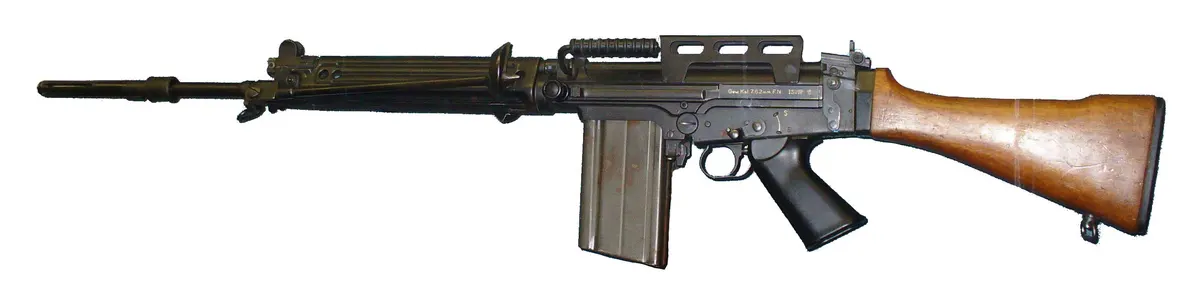
The R1 rifle is the South African licensed production version of the Belgian FN FAL, built by Lyttleton Engineering Works (LIW) near Pretoria and formally adopted by the South African Defence Force (SADF) in 1960.1 It shares its full mechanical layout with the standard metric-pattern FAL developed by FN Herstal, the same gas-operated action, the same 7.62x51mm NATO chambering, and the same overall dimensions, and remained South Africa's standard infantry rifle for two decades before the locally designed Vektor R4 replaced it.2 What separates the R1 from its Belgian parent is less the rifle itself than the industrial and political story behind it, a licensing deal signed years before international pressure made indigenous arms production a matter of survival for the apartheid government.
- proven, accurate metric FAL action built to full NATO specification
- established indigenous production chain, reduced reliance on foreign suppliers
- heavy-barrel and sniper variants extended the base design's roles
- full-auto capability alongside reliable semi-automatic fire
- weight and 20-round magazine capacity limited a soldier's carried ammunition
- tight manufacturing tolerances raised production cost and complexity
- reliability suffered in the sandy, dusty terrain of South West Africa
- fully superseded by the lighter, higher-capacity R4 by the early 1980s
South Africa trialled three candidate rifles before settling on the FAL, the American ArmaLite AR-10, the West German G3, and the FN FAL itself, and judged the Belgian design the best overall fit for SADF requirements.3 Production at LIW, an Armscor subsidiary, began in 1961, and the rifle went on to see extensive combat in the South African Border War and, through informal transfers, in the neighboring Rhodesian Bush War. By the time it was declared obsolete in the late 1990s, the R1 had outlived the political order that built it.
A Faithful Metric FAL, Built Under License Rather Than Redesigned
The R1 is a direct license copy of the FN FAL, sharing the Belgian rifle's gas-operated, tilting-breechblock action, its layout, and its performance figures almost point for point.1 Gas tapped from the barrel drives a piston that unlocks the bolt by tilting it out of engagement with the receiver, the same principle used across the FAL family regardless of which country built the individual rifle. South African-made receivers carry their own factory proof mark, an M stamped inside a U, which later became an important identifying feature when Rhodesian forces tried to disguise the origin of South African-supplied rifles, described in Conflicts below.4
- First Production Year1961
- Service Entry Year1960
- DesignerDieudonne Saive (FN Herstal), license-adapted by Lyttleton Engineering Works
- Weight (Empty)4.31 kg
- Weight (Loaded)5.06 kg
- Currently In ServiceNo
- Notable UsersSouth African Defence Force, Rhodesian Security Forces (via South African transfer)
Weight, Dimensions, and Rate of Fire
The R1 weighs 4.31 kilograms (9.50 lb) empty and about 5.06 kilograms loaded with a 20-round magazine, measures 1,053mm (41.46in) overall with a 533mm (20.98in) barrel, and fires the 7.62x51mm NATO cartridge from a detachable 20- or 30-round box magazine.2 Muzzle velocity is generally cited around 840 to 853 meters per second, and effective range is usually given as roughly 600 meters, figures that vary slightly between sources but sit squarely within the standard metric FAL's known performance band.2 Cyclic rate of fire runs to about 675 rounds per minute on full automatic, though sustained combat rates were considerably lower in practice, closer to 35 rounds per minute in short rapid bursts and 20 rounds per minute in normal sustained fire, a detail that mattered more to a rifleman managing a single 20-round magazine than the theoretical cyclic figure ever did.3 Like the standard FAL, the R1 is select-fire, capable of both semi-automatic and full-automatic fire, a feature later removed entirely on the semi-automatic-only R3 police variant described in Variants.
- Cartridge7.62x51mm NATO
- Action TypeGas-Operated
- Select FireYes
- Feed SystemDetachable Magazine
- Magazine Capacity20
- Cyclic Rate of Fire675
- Practical Rate of Fire35
- Muzzle Velocity853 m/s
- Effective Range (point)600 m
- Barrel Length533 mm
- Optic RailNo
- Iron SightsYes
- Overall Length1,053 mm
- Receiver Materialmilled steel
- Furniture Materialwood and steel
- Production Start1961
- Production End1988
- Variants5
From Rifle Trials to a Licensing Deal With FN Herstal
By the mid-1950s South Africa had begun building local infrastructure, with British assistance, to manufacture a new standard rifle rather than continue buying finished weapons abroad.1 After trials weighing the AR-10, the G3, and the FN FAL against SADF requirements, the FAL was judged the best fit, and Lyttleton Engineering Works was established as an Armscor subsidiary outside Pretoria specifically to build it under license.1 An agreement between FN Herstal and Armscor, signed in the early 1960s, formalized licensed production by LIW, and the South African-built rifle received its own designation, the R1. Formal adoption came in 1960, with production at LIW beginning the following year to equip the SADF at scale.2
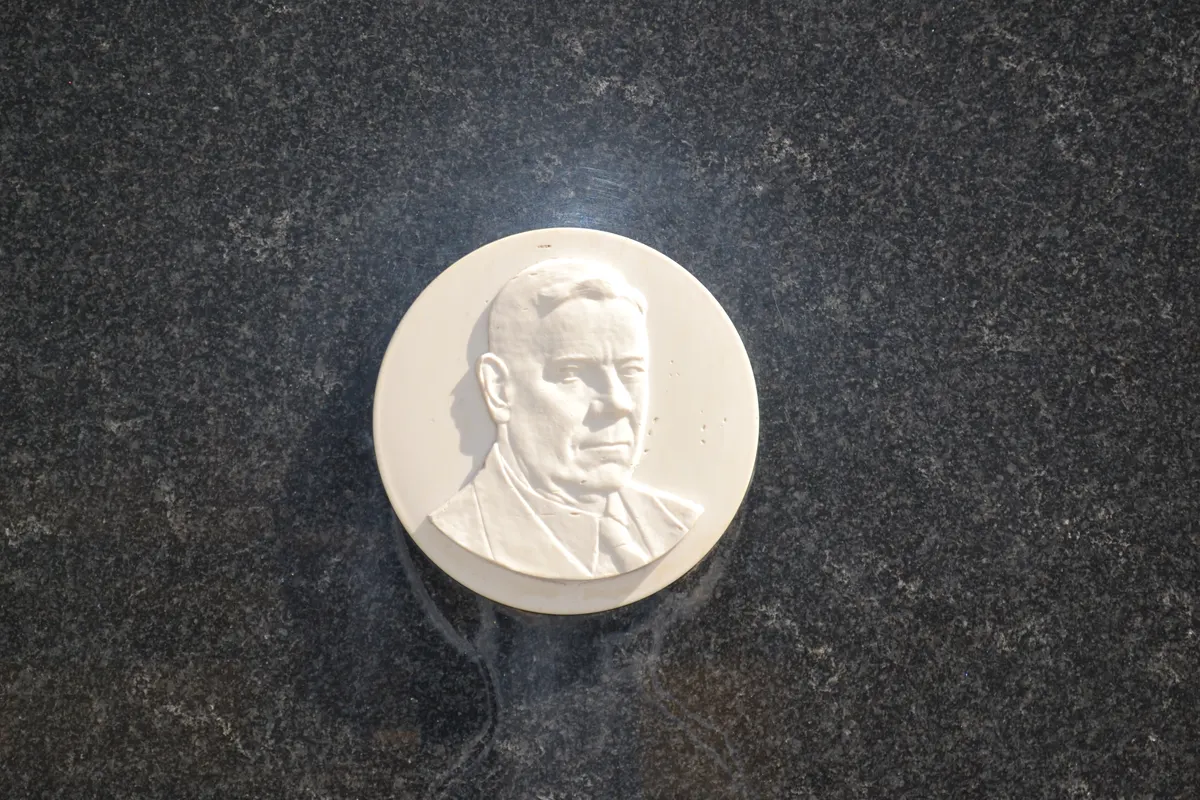
The first South African-produced R1, serial number 200001, was presented to then Prime Minister Hendrik Verwoerd by Armscor and remains on display today at the South African National Museum of Military History in Johannesburg.3 It stands as the physical marker of a program that mattered as much for what it signaled as for the rifle itself, that South Africa could arm its own soldiers without depending on an outside supplier willing to sell.
A Self-Sufficiency Drive That Predates the Arms Embargo
The R1 program is easy to misread as a reaction to international sanctions, but the sequence runs the other way. Licensed production began in 1960 and 1961, more than a decade and a half before the arms embargo that eventually made continued self-sufficiency existential.5 South Africa's Armaments Board, created under the Armaments Development and Production Act of 1968, merged with the Armaments Corporation in April 1977 to form Armscor, an institution built specifically to develop domestic capacity across small arms, ammunition, and vehicles.5 By the late 1960s South Africa already held at least 127 foreign production licenses across arms, ammunition, and vehicle categories, and by the 1980s Armscor operated nine production facilities employing roughly 130,000 people directly and indirectly in domestic arms manufacturing.

That capacity became critical after the United Nations Security Council adopted Resolution 418 on 4 November 1977, imposing a mandatory arms embargo on South Africa following international reaction to the Soweto Uprising and to apartheid repression generally, an escalation of a voluntary embargo already in place since 1963.6 The R1 and the LIW production line that built it stand as the earliest and most emblematic example of that self-sufficiency drive, a policy the 1977 embargo later made non-negotiable and that accelerated South Africa's shift toward the wholly indigenous rifle described next.
Sand, Weight, and a Rifle Borrowed From Israel
By the mid-1970s the SADF had accumulated real complaints about the R1 in the field. A soldier carrying eight loaded 20-round magazines, a realistic combat load, still had only about 160 rounds, and the FAL's tight manufacturing tolerances made it expensive to produce and increasingly prone to stoppages as operations shifted into the sandy, dusty terrain of South West Africa, today's Namibia.7 Israel had faced an almost identical problem with its own FAL variant, the Romat, whose reliability suffered in the same kind of desert conditions during the Six-Day War of 1967 and the Yom Kippur War of 1973, and had already replaced it with the Galil.7 Israel was also one of the few states still willing to arm South Africa as diplomatic isolation deepened, a direct link between the embargo and what came next.
South Africa adopted the Galil-pattern rifle in 1975, and the first Israeli-made examples reached SADF paratroopers, reconnaissance commandos, and mechanized infantry, in that order, in 1977, before wider infantry issue followed.7 The indigenized version, designated the R4, fully replaced the R1 as standard SADF issue by the early 1980s, though the older rifle continued in secondary roles until the Border War itself ended.
The South African Border War and Operation Savannah
The R1 was the SADF's standard service rifle throughout the South African Border War, fought from 1966 against the People's Liberation Army of Namibia (PLAN), the armed wing of SWAPO, during the wider Namibian War of Independence.8 Its reputation for durability and accuracy reportedly gave South African forces an edge through much of the conflict, though the rifle was progressively superseded by the R4 rather than withdrawn outright, and R1s remained in service alongside the newer rifle until the war ended in 1989.
South Africa's covert 1975 to 1976 intervention into the Angolan Civil War, known as Operation Savannah, falls squarely within the R1's period as the SADF's sole frontline rifle, since the R4 had not yet reached even elite units at that date.9 It is the cleanest single conflict association the R1 has, alongside the Border War itself. 32 Battalion, formed that same year by Colonel Jan Breytenbach and Commandant Sybie van der Spuy and deployed as a buffer force in southern Angola, is described as the SADF unit with the greatest combat involvement of the entire war and is credited, in some accounts, with inflicting more enemy casualties than any other SADF formation.10 Sources do not spell out the unit's exact small-arms loadout, but given the timing, standard-issue R1s are a reasonable inference for its early years.
Sanitized Rifles in the Rhodesian Bush War
South Africa also transferred R1 rifles to Rhodesian Security Forces during the Rhodesian Bush War, fought from 1964 to 1979 in what is now Zimbabwe, acting as a sympathetic arms supplier to a fellow government under international sanction.11 Some sources cite a figure of roughly 30,000 South African-supplied rifles reaching Rhodesia over the course of the war, though the figure is widely repeated rather than clearly sourced to a primary record. R1s, under their South African designation, were issued across every branch of the Rhodesian security establishment from 1966 onward.
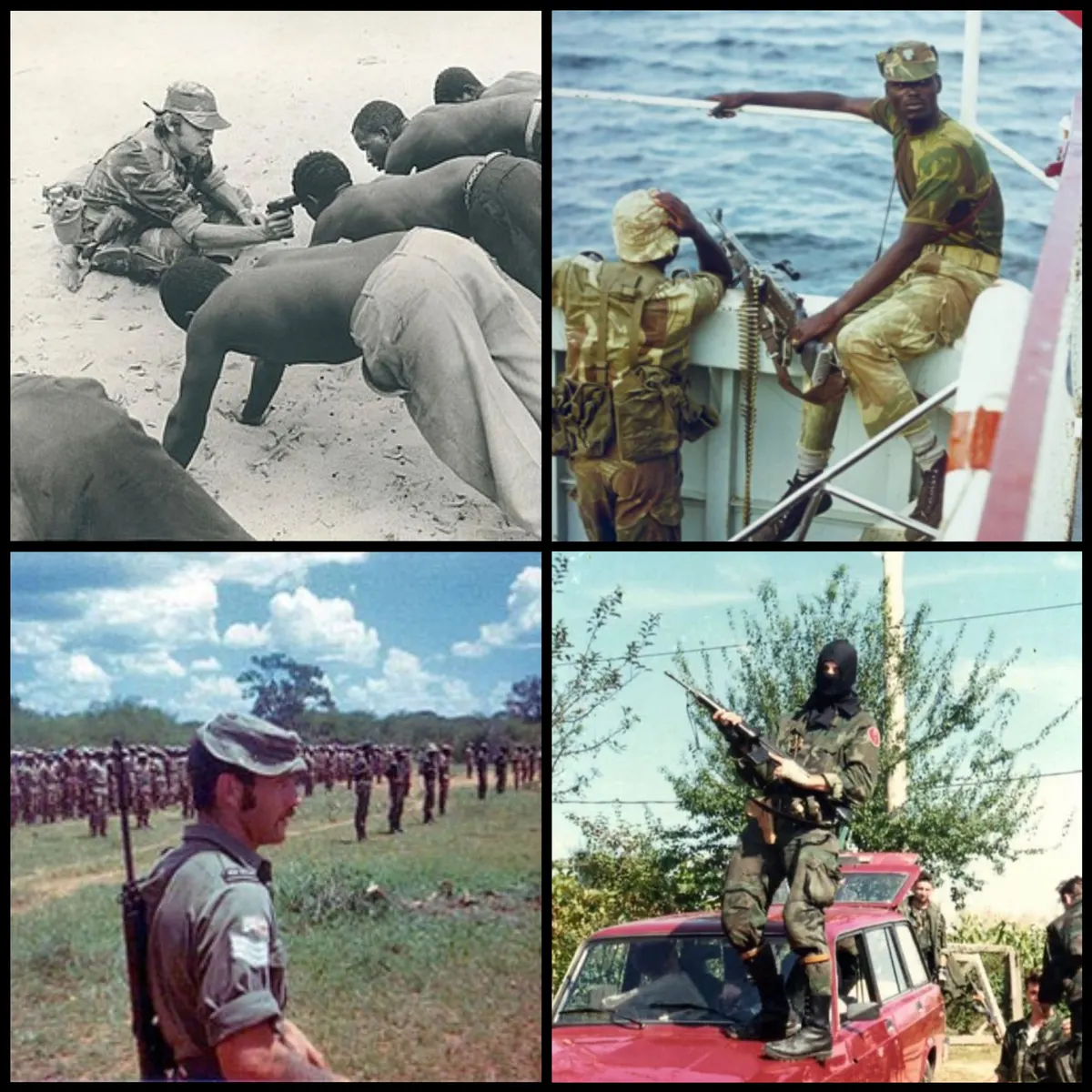
Because Rhodesia was itself under sanction, its forces went to some lengths to hide the South African origin of these rifles. The M-in-U proof mark stamped into every LIW-built receiver was drilled or dimpled out on Rhodesian-issued rifles, either lightly enough to leave a shallow depression or deeply enough to erase the mark entirely, specifically so that any rifle captured by opposing forces could not be produced as evidence of continued South African arms transfers to UN monitors.4 Grenade-launching sights, a feature carried over from the South African R1 pattern, became a common addition on Rhodesian-issued FALs generally as a result of this supply relationship.
The FN FAL pattern rifle, in its South African guise, has a modest but genuine screen record. The Recce (2018), a South African film following a Reconnaissance Commando declared killed in action behind enemy lines in 1981 Angola, arms its SADF soldiers with FN FAL battle rifles described by weapons researchers as an iconic weapon of the Border War, alongside some substitute British L1A1 rifles standing in for the same family.12 Catch a Fire (2006), a biographical thriller about anti-apartheid activist Patrick Chamusso, depicts South African police and soldiers carrying FN FAL rifles throughout, a historically accurate choice given the SADF and South African Police's R1, R2, and R3 issue during that era.13 American Ninja 4, The Annihilation (1990), filmed on location in South Africa, is credited by weapons researchers with a Vektor R1 among the firearms its commando characters carry, though other FN FAL pattern rifles seen in rebel hands in the same film are noted only as being of unclear model, possibly further R1s.14
R1HB, R1 Sniper, and the R1 Para Carbine
The R1HB is a heavy-barrel version fitted with a bipod, intended for a squad automatic or light support role alongside standard riflemen.2

The R1 Sniper is an accurized, scope-equipped variant built around semi-automatic fire for designated marksmen. A shortened R1 Para Carbine, more compact for vehicle crews and support troops, is described in some sources as fitted with a Single Point IR sight, though that detail appears in lower-quality references and may reflect confusion with a later accessory rather than an original feature of the carbine itself.
The R2, a Genuine Sourcing Conflict, and the Semi-Automatic R3
The designation R2 is not consistently defined across the available sources. Most describe it as a lightweight, folding-stock FAL variant based on the Belgian FN FAL 50.64 paratrooper model, issued to airborne and seaborne units for whom the standard rifle's fixed wooden stock was impractical, a reading that also fits the simple naming logic of R1, R2, and R3 as variants of the same FAL-pattern family.3 At least one specialist source instead uses R2 for a Portuguese-manufactured FMP G3A3, with roughly 100,000 examples procured to equip reserve and second-line units, later refitted with Choate Machine and Tool furniture after the original Portuguese plastic components degraded in South West Africa's heat and ultraviolet exposure. Both claims cannot describe the same weapon, so this article treats the folding-stock FAL reading as the majority view while still flagging the Portuguese G3A3 claim.
The R3 is a semi-automatic-only variant built for police and security use, with its select-fire capability removed entirely, the same restriction later applied to the definitive CETME-family police rifles used elsewhere in the region's small-arms trade.


South Africa, From Standard Issue to Retirement
The R1 equipped the SADF as its standard rifle from 1961 until progressive replacement by the R4 through the late 1970s and early 1980s, remaining in secondary and reserve use until the Border War's end in 1989 and 1990.7 It was declared militarily obsolete by the late 1990s.
Some accounts describe South African Army stocks being destroyed in 2001 under that operation, though the figure should be treated cautiously. A small number of accurized R1s reportedly continued in reserve or designated-marksman roles afterward, a minor residual detail rather than a change to its overall obsolete status. Lyttleton Engineering Works itself continued as an arms manufacturer under Denel and survives today as Denel Land Systems.
Rhodesian Security Forces, an Informal Wartime Transfer
Beyond South Africa itself, the R1's only other significant user was Rhodesia, today Zimbabwe, whose security forces received South African-supplied rifles throughout the Bush War described in Conflicts above.11 This was a bilateral, sanctions-era arms relationship between two governments under international pressure rather than a formal export program, and it left no other confirmed state operator on record.
The R1 Against Its Belgian Parent, the FN FAL
Mechanically, the R1 and the standard FN FAL are the same rifle, sharing the same gas-operated tilting-breechblock action, the same 7.62x51mm NATO chambering, and nearly identical dimensions and performance figures.1 The real difference is context rather than engineering. FN Herstal's original design reached an estimated 90 or more countries through open export sales, while the R1 existed so an isolated, sanctioned state could keep issuing that same design without relying on a foreign supplier that might stop selling at any point. The West German G1, the Bundeswehr's own brief license-built FAL variant, makes an instructive parallel. West Germany dropped its FAL license within a few years for the domestic G3, while South Africa kept issuing the R1 for two full decades because the embargo left it far fewer alternatives.
The R1 Against Its Own Successor, the R4
| R1 | Vektor R4 | |
|---|---|---|
| Base design | FN FAL (Belgium), licensed | Galil (Israel), indigenized |
| Cartridge | 7.62x51mm NATO | 5.56x45mm NATO |
| Magazine capacity | 20 or 30 rounds | 35 rounds |
| Weight (empty) | 4.31 kg2 | Lighter than the R17 |
| Adopted by SADF | 1960/1961 | 1975, standard issue by early 1980s |
The comparison that matters most for the R1 sits against its own replacement rather than against any true rival. The R4 addressed almost every complaint levelled at the R1 directly, trading the older rifle's full-power cartridge and 20-round magazine for a lighter 5.56mm round and a 35-round magazine, while its Galil-derived action proved considerably more tolerant of the sandy, dusty conditions of South West Africa that had degraded R1 reliability in the field. The R1 remained a sound rifle by the standards of its own era. It simply belonged to a design generation that the specific demands of the Border War outgrew.


What is the R1 rifle? The R1 is the South African licensed production version of the FN FAL, built by Lyttleton Engineering Works under an agreement with FN Herstal and formally adopted by the SADF in 1960.1
What are the R1 rifle's specifications? The R1 weighs 4.31 kilograms empty, measures 1,053mm overall with a 533mm barrel, fires 7.62x51mm NATO from a 20- or 30-round magazine, and reaches a cyclic rate of about 675 rounds per minute with an effective range of roughly 600 meters.2
How does the R1 rifle work? It uses the standard FN FAL's gas-operated, tilting-breechblock action, in which gas tapped from the barrel drives a piston that unlocks the bolt by tilting it out of engagement with the receiver, and it fires in both semi-automatic and full-automatic modes.1
Is the R1 rifle still in service? No. South Africa declared the R1 obsolete by the late 1990s after the R4 fully replaced it as standard issue in the early 1980s, and South African Army stocks were reportedly destroyed in the early 2000s, though a handful of accurized examples may have continued in limited reserve roles.7
How does the R1 compare to the FN FAL and the R4? Mechanically the R1 is identical to the standard FN FAL, differing mainly in where and under what political circumstances it was built, while the R4 that replaced it switched to a lighter 5.56mm cartridge, a higher-capacity 35-round magazine, and a Galil-derived action better suited to South West Africa's sandy operating environment.7
- "FN FAL", Wikipedia — en.wikipedia.org ↩
- "Vektor Rifle R1 Battle Rifle", Military Factory — militaryfactory.com ↩
- "The R1, South African Bush Rifle", History Guild — historyguild.org ↩
- "Rhodesian FALs, A Brief History and How to Spot One in the Wild", The Kommando Blog — kommandoblog.com ↩
- "Armscor", Wikipedia — en.wikipedia.org ↩
- "United Nations Security Council Resolution 418", Wikipedia — en.wikipedia.org ↩
- "Vektor R4", Wikipedia — en.wikipedia.org ↩
- "South African Border War", Wikipedia — en.wikipedia.org ↩
- "Operation Savannah (Angola)", Wikipedia — en.wikipedia.org) ↩
- "32 Battalion (South Africa)", Wikipedia — en.wikipedia.org) ↩
- "Rhodesian Bush War", Wikipedia — en.wikipedia.org ↩
- "The Recce", Internet Movie Firearms Database — imfdb.org ↩
- "Catch a Fire", Internet Movie Firearms Database — imfdb.org ↩
- "American Ninja 4, The Annihilation", Internet Movie Firearms Database — imfdb.org ↩