

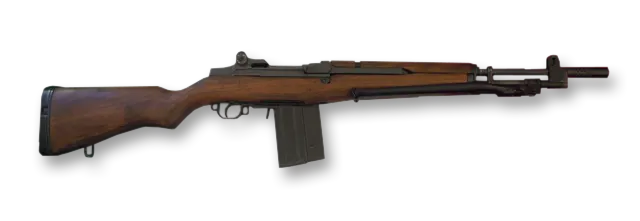

The Beretta BM59 is an Italian battle rifle chambered in 7.62×51mm NATO, built around a reworked M1 Garand action fitted with a detachable box magazine and a selective-fire trigger group.1 Two Beretta engineers, Domenico Salza and Vittorio Valle, developed it between 1957 and 1959 as a way to bring Italy's existing Garand-pattern rifles into line with the new NATO standard cartridge without designing an entirely new weapon.2 Italy formally adopted the rifle around 1959, though trials continued into 1960 and general issue to Italian Army units took until the early 1960s.1,3
- Proven, simple Garand-derived gas action
- Tri-compensator adds genuine grenade-launch capability
- Cheap to field from existing Garand tooling and parts
- Widely exported and locally produced under license
- 20-round magazine capacity is light for a full-auto rifle
- Heavy for a selective-fire weapon at 4.4 kg empty
- Full-auto controllability is poor, like most 7.62mm NATO battle rifles
- Top ejection port historically complicated scope mounting
It remained the country's standard infantry rifle until 1990, when the Beretta AR70/90 began replacing it, and small numbers stayed on for ceremonial and reserve duty afterward.2 Beyond Italy, the BM59 was built under license in Indonesia and adopted, in various forms, by Argentina, Morocco, Nigeria, and a scattering of smaller African and Middle Eastern armies.2,4 Its defining feature is the tri-compensator, a muzzle device that combines a flash suppressor, a muzzle brake, and a NATO-standard 22mm rifle grenade launcher in a single fitting, together with a folding grenade sight and a gas cutoff valve.3,5
The rifle's closest relative is the American M14, which solved the same NATO-conversion problem from the same Garand starting point but through a new-build receiver rather than a modernization of existing stock. Compared with the FN FAL and the Heckler and Koch G3, the two rifles that came to dominate NATO's non-American arsenals, the BM59 occupies an unusual place. It was neither an original design nor a straightforward foreign purchase. It was a rebuild, and that rebuild let a cash-strapped postwar Italy field a modern, magazine-fed, select-fire rifle years earlier and far more cheaply than a clean-sheet program would have allowed. That same rebuild approach also explains why the rifle spread so widely through licensed and surplus channels afterward, since a design built around existing Garand tooling was comparatively easy for other Garand-equipped militaries, including Indonesia and Argentina, to pick up in turn.
Reworking the Garand for 7.62×51mm NATO and Selective Fire
Italy had re-armed after the Second World War largely with American-supplied M1 Garand rifles chambered in .30-06, and it had also received the Garand production machinery itself. Winchester donated a set of M1 manufacturing tooling to Beretta, giving the Italian state arsenal a low-cost path to a modern rifle rather than a bill for an entirely new production line.3 Salza and Valle, who had both trained under Beretta's longtime chief engineer Tullio Marengoni, used that tooling as the starting point.1
- First Production Year1959
- Service Entry Year1959
- DesignerDomenico Salza
- Weight (Empty)4.4 kg
- Weight (Loaded)4.8 kg
- Currently In ServiceYes
- Notable UsersItalian, Argentinian, Indonesian, Moroccan armies; Italian Navy; Nigerian Army; Pindad; Defence Industries Corporation
Their conversion shortened and modified the Garand's operating rod and gas system, added a detachable 20-round box magazine in place of the Garand's fixed internal magazine and en-bloc clips, and fitted a disconnector assembly adapted from the M2 carbine to allow full-automatic fire.1,3 The bolt, receiver geometry, and overall gas-operated rotating-bolt mechanism trace directly back to John Garand's design.
- Cartridge7.62×51mm NATO
- Calibre7.62 mm
- Case Length51 mm
- Calibre Class7.62mm NATO
- Bullet Weight9.7 g
- RimfireNo
- Caseless AmmunitionNo
The Tri-Compensator and Its Dual-Function Grenade Sight
The tri-compensator is the rifle's most distinctive feature. Mounted at the muzzle, it acts as a flash hider and muzzle brake in normal rifle fire, but flips into a different mode for launching NATO-standard 22mm rifle grenades, including the 75mm MECAR Energa anti-tank grenade.3,5 A gas cutoff valve built into the device seals off the gas port when a grenade is loaded, so propellant gas is diverted into projecting the grenade instead of cycling the action, and a folding sight leaf on the same unit flips up to provide grenade-range aiming marks.5 This let a single muzzle attachment serve as flash suppressor, recoil brake, and grenade-launching sight without extra parts, a genuinely efficient piece of engineering for a rifle otherwise assembled from decades-old Garand parts. On the Para and Mark III (Alpini) variants the tri-compensator was built as a removable two-piece unit rather than a fixed collar, a distinction covered in more detail in Variants below. Rifle grenades of this kind were standard infantry anti-armor and anti-bunker tools in the 1950s and 1960s, before dedicated shoulder-fired rocket launchers became universal, so the tri-compensator gave BM59-armed squads a real capability rather than a novelty attachment.
- Action TypeGas-Operated
- Fire Modesselective fire
- Select FireYes
- Feed SystemDetachable Magazine
- Magazine Capacity20
- Cyclic Rate of Fire750
- Practical Rate of Fire40
- Trigger Typesingle-stage
- Safety Typelever
Cyclic Rate, Weight, and the Numbers Behind the Specification
The BM59 fires from a 20-round detachable box magazine at a cyclic rate generally given as 750 to 800 rounds per minute in full-auto, faster than the 600 rounds per minute sometimes quoted for it.1 It weighs about 4.4 kg empty, carries a 491mm (19.3 in) barrel on the standard Ital pattern, and has an overall length of roughly 1,095mm (43.1 in).1,2 Muzzle velocity for standard ball ammunition runs close to 820 m/s, consistent with other 7.62×51mm NATO rifles of its generation. Sights are a simple rear aperture and front post, with no factory optic rail, a limitation shared with the M14 and FAL of the same era and one that later drove aftermarket Picatinny conversions on civilian-market Garand and BM59 rebuilds.
- Muzzle Velocity820 m/s
- Muzzle Energy3,300
- Effective Range (point)600 m
- Effective Range (area)800 m
- Maximum Range3,700 m
- Sighting Range1,000 m
- Penetration300 mm
- Accuracy3
- Barrel Length491 mm
- Rifling Twist1:12
- Rifling Grooves4
- Sight TypeRear aperture, front post
- Sight Radius600 mm
- Optic RailNo
- Iron SightsYes
- Threaded BarrelNo
- Receiver Materialsteel
- Furniture Materialwood, metal, plastic
- Folding / Collapsing StockYes
- Bullpup LayoutNo
- Ambidextrous ControlsNo
- Modularitylimited
- Production Start1959
- Unit Cost42 USD
- Variants6
- Width80 mm
- Height230 mm
From Loaned Garands to a NATO-Standard Rifle
After 1945, Italy's army rebuilt itself largely on American-supplied equipment, including hundreds of thousands of M1 Garand rifles in .30-06.3 When NATO standardized on the 7.62×51mm cartridge in the mid-1950s, member states faced a choice. Belgium had the FN FAL ready for export, and West Germany would soon adopt the roller-delayed Heckler and Koch G3.
Italy, still rebuilding its industrial base and short on hard currency, chose a third route. It converted what it already had. Rather than buy a license for a foreign rifle, the state chose to modernize the Garand stock and tooling already sitting in Italian arsenals, producing an effective and inexpensive rifle at a fraction of the cost of standing up a new production line or paying foreign license fees.3
Domenico Salza, Vittorio Valle, and Beretta's Design Team
Salza and Valle built early prototypes, sometimes referred to as the Garand Type E conversion, in the late 1950s, refining a detachable-magazine, select-fire Garand derivative through 1959.1,3 Formal trials followed in 1960, and the finished BM59 entered Italian Army service in the early 1960s under the designation Fucile Automatico Beretta Modello 1959 (Beretta Automatic Rifle Model 1959), the source of its name.2 Both engineers had trained under Tullio Marengoni, Beretta's chief designer through the interwar years and the creator of the MAB series of submachine guns, and the BM59 program is often described as an extension of Marengoni's workshop rather than a break from it.1
Italian Service, 1990 Retirement, and Ceremonial Use
The BM59 stayed in Italian Army front-line service for roughly three decades, a notably long run for a rifle built on a design already twenty years old when it entered service. Replacement began in 1990 with the Beretta AR70/90 assault rifle, and the older rifle was withdrawn from combat units through the following years.2 The Italian Navy kept BM59s in limited ceremonial and reserve use after the Army's changeover, and rebuilt Garand-pattern BM59s later found a second life as semi-automatic civilian rifles, including a run of parts-kit builds by Springfield Armory in the United States from the 1980s onward.1
The Nigerian Civil War and the Federal Army's Rifle
Nigeria adopted the BM59 in 1963, with domestic assembly undertaken by the state-run Defence Industries Corporation in Kaduna.4 When the Nigerian Civil War broke out in 1967 between the federal government and the secessionist Republic of Biafra, federal forces fought with the BM59 as a standard infantry rifle, and Biafran forces are also listed among the rifle's historical users, likely through captured federal stock.4,6
The Nigerian Civil War ran until 1970 and remains one of the rifle's longest sustained combat deployments outside Italy itself.
Indonesia's Licensed Rifles in the Invasion and Occupation of East Timor
Indonesia's army fielded BM59-derived rifles built domestically under license by Pindad as the SP-1, SP-2, and SP-3.7,8 These entered Indonesian service from the late 1960s and were still on issue when Indonesia invaded the former Portuguese colony of East Timor in December 1975, launching the Indonesian invasion of East Timor and the far longer Indonesian occupation of East Timor that followed.7
The Timorese resistance movement FALINTIL fought that occupation for more than two decades, and part of its arsenal came from captured Indonesian equipment, including SP-series rifles taken from Indonesian army stocks.7 Indonesia itself gradually phased the SP rifles out in favor of the M16A1 and later the locally designed Pindad SS1 through the 1980s and into 1991.8
The Argentine Navy's BM59 E in the Falklands War
Argentina's navy operated a rebuilt variant known as the BM59 E, roughly 2,100 rifles that had arrived together with American-built warships Argentina purchased during the 1950s and 1960s.9 During the 1982 Falklands War, Argentine naval infantry and, to a lesser extent, army and air force personnel used the BM59 E as a designated-marksman and second-line rifle behind the more numerous FN FAL, and a number of captured examples were brought back to Britain as war trophies.9
The Standard Ital, Mark I, and Mark II Infantry Rifles
The baseline BM59 Ital carried the full tri-compensator, an integral bipod, and grenade-launching capability, and served as Italy's standard infantry configuration.2 Export-oriented Mark I rifles simplified this by dropping the bipod and grenade-launch fittings for a plainer 44cm-barrel rifle with a semi-pistol grip, while the Mark II added a full pistol grip aimed at better full-automatic control.2,3
The Alpini's Fixed Compensator and the Para's Removable Muzzle Device
Two variants targeted airborne and mountain troops. The Mark III, known in Italian service as the BM59 Ital TA (Truppe Alpine) or informally the Alpini, added a side-folding metal buttstock for Italy's mountain infantry and kept the tri-compensator as a fixed fitting on the barrel.2
The BM59 Para (Paracadutisti), built for paratroopers, used the same folding stock but paired it with a shorter barrel and a tri-compensator built as a removable two-part unit, so the whole muzzle device could be taken off to shorten the weapon further for jumps and confined transport.2,3 Folded and with the compensator removed, the Para came in well under 75cm, a meaningful difference for troops jumping with a rifle strapped across the body.
The Mark IV Squad Automatic and Indonesia's SP Series
The Mark IV fitted a heavier barrel and a plastic prone-firing stock, positioning the rifle as a light squad automatic weapon, though its 20-round magazine limited its usefulness in that role and Italy never adopted it in numbers.2 Indonesia's Pindad-built equivalents followed a parallel naming scheme rather than Beretta's own model numbers, with the SP-1 corresponding to a Mark I pattern rifle, the SP-2 adding the grenade-launching system, and the SP-3 fitted with a bipod for a Mark IV-style role.8 A separate BM59 E variant, discussed above under Argentina, retained a longer Garand-length barrel and dropped the grenade-launching hardware entirely for naval second-line use.9


| Year | Buyer | Quantity | Amount | Present Value (2025) |
|---|---|---|---|---|
| 1968 |  Indonesia | 69,000 | — | — |
Italy, Argentina, and Morocco
Italy was the primary operator from 1959 until the 1990 changeover to the AR70/90, and remains the reference case for the rifle's full production history.2 Argentina operated the naval BM59 E variant described above, while Morocco received the rifle through licensed or transferred production and has listed it among its small arms inventory for decades, though detailed Moroccan service history is thin in available sources.2
Indonesia's Pindad Production and Its Long Phase-Out
Indonesia represents the largest licensed-production program outside Italy. Pindad's initial contracts, placed from the late 1960s, covered roughly 50,000 SP-1 rifles, 10,000 SP-2 rifles, and 9,000 SP-3 rifles, a combined order in the tens of thousands that made Indonesia's domestic BM59 family arguably more numerous than Italy's own.7,8
Some Indonesian small-arms histories place the origin of Pindad's contract in the context of Indonesia's Konfrontasi confrontation with Malaysia, but that conflict ended in 1966, two years before Pindad's production run is documented as beginning, making East Timor rather than Konfrontasi the rifle's best-documented Indonesian combat use.7
Nigeria and the Smaller African and Middle Eastern Operators
Nigeria adopted the BM59 in 1963 and manufactured it domestically through the Defence Industries Corporation in Kaduna, fielding it through the 1967 to 1970 civil war and afterward.4 Beyond these confirmed cases, the rifle has also been reported in smaller numbers with Algeria, Bahrain, Ethiopia, Eritrea, Libya, and Somalia, mostly as legacy or surplus stock rather than as a primary service rifle, and detailed acquisition dates for these smaller holdings are not well documented.2
The BM59 Against Its Own Parent, the M14
The BM59 and the American M14 solved an identical problem, fitting the Garand action for 7.62×51mm NATO with a detachable magazine and selective fire, and they reached broadly similar answers. Both kept the Garand's gas-operated rotating bolt, both weigh close to 4.3 to 4.4 kg empty, and both were criticized for exactly the same weakness, a full-auto rate of fire too violent for a 20-round magazine and a rifle that heavy to control on target. The difference is in how each country got there. The United States built the M14 as a new receiver and new production line, a more expensive and slower path that did not reach service until 1959 after years of parallel trials against the FAL. Italy instead rebuilt existing Garand receivers and tooling, reaching essentially the same capability years earlier and at a fraction of the direct cost, at the price of tri-compensator and other new parts fitted to older barreled actions rather than a wholly fresh rifle.
| Spec | Beretta BM59 | M14 | FN FAL |
|---|---|---|---|
| Cartridge | 7.62×51mm NATO1 | 7.62×51mm NATO | 7.62×51mm NATO |
| Weight (empty) | 4.4 kg1 | 4.3 kg | 4.25 kg |
| Cyclic rate | ~750 to 800 rpm1 | ~700 to 750 rpm | ~650 to 700 rpm |
| Magazine | 20-round detachable1 | 20-round detachable | 20 or 30-round detachable |
The BM59 Against the FN FAL and the Heckler and Koch G3
Against the FAL and the G3, the rifles Italy chose not to adopt, the BM59's advantage was economic rather than technical. The FAL's short-stroke gas piston and adjustable gas regulator, and the G3's roller-delayed blowback system, were both purpose-built mechanisms optimized from the start for the 7.62mm NATO cartridge. The BM59's gas system was adapted from a design conceived thirty years earlier around a different, lower-pressure American cartridge. In direct terms the FAL and G3 generally proved more refined rifles, which is one reason both went on to far wider adoption across NATO and allied militaries than the BM59 ever achieved. Italy's rifle never aimed to outcompete either on export markets. It existed to solve a narrower problem, getting Italy onto the new NATO cartridge quickly and cheaply using equipment already on hand, and on that narrower measure it succeeded for three decades of continuous service.


Is the Beretta BM59 Still in Service
Italy retired the BM59 from front-line Army service in 1990, replacing it with the Beretta AR70/90, though the Italian Navy retained small numbers afterward for limited and ceremonial use.2 Some African and Middle Eastern operators may still hold surplus stocks, though active first-line use anywhere today is unlikely.
How Does the BM59 Differ From the M14
Both rifles convert the M1 Garand action to 7.62×51mm NATO with a detachable magazine and selective fire, but the M14 was built as a new receiver and production line in the United States, while the BM59 rebuilt existing Italian Garand stock and Winchester-donated tooling. The BM59 also added the tri-compensator grenade-launching muzzle device as standard, a feature the M14 lacked.1,3
What Did the BM59 Cost
Beretta's unit price in the early 1960s was reported at roughly $42, reflecting the savings from reusing existing Garand parts and tooling rather than machining a rifle from scratch.1
How Does the Tri-Compensator Work
The tri-compensator functions as a flash hider and muzzle brake during normal rifle fire. For launching NATO 22mm rifle grenades, a built-in gas cutoff valve seals the gas port so propellant gas drives the grenade instead of cycling the action, and a folding grenade sight on the same unit provides aiming references for indirect grenade fire.3,5
Who Used the Beretta BM59 in Combat
Confirmed combat users include Nigeria's federal army during the 1967 to 1970 civil war against Biafra, Indonesian forces during the 1975 invasion and subsequent occupation of East Timor, and the Argentine Navy's BM59 E rifles during the 1982 Falklands War.4,7,9 Timorese FALINTIL guerrillas also fought with captured Indonesian rifles through much of the occupation.7
- "Evolution Of The BM-59", American Rifleman — americanrifleman.org ↩
- "Beretta BM 59", Wikipedia — en.wikipedia.org ↩
- "The History of the Italian FAL, Beretta's Long-Serving BM59", Small Arms Review — smallarmsreview.com ↩
- "List of equipment of the Biafran Army", Wikipedia — en.wikipedia.org ↩
- "BM59, The Italian M14", Forgotten Weapons — forgottenweapons.com ↩
- "Beretta Model 59 (BM59) Automatic Battle Rifle", Military Factory — militaryfactory.com ↩
- "Beretta BM-59 Asal Italia, Dilisensi Sebagai SP-1 dan Menjadi Pelopor Senapan Infanteri Produksi Indonesia", Sejarah Militer — sejarahmiliter.com ↩
- "License-Made FNC, BM-59, and PM12 Headed to U.S. From Pindad", Guns.com — guns.com ↩
- "Rifle automatico, Beretta BM59 (Italia)", FDRA Malvinas — fdra-malvinas.blogspot.com ↩