

The AG-3 (Automatgevær 3, Norwegian for automatic rifle 3) is Norway's own production version of the West German Heckler & Koch G3 battle rifle, chambered for the 7.62x51mm NATO cartridge and built under license by Kongsberg Våpenfabrikk at its arms plant in Kongsberg.1,2 Norway ran a national rifle trial in 1960 and 1961 that tested the Armalite AR-10, the Beretta BM-59, the FN FAL, and the G3, with the older M1 Garand kept in the mix as a baseline reference rather than a live candidate.1 Formal approval of the G3 as Norway's new service rifle came in 1966, under the official designation 7,62 mm x 51 Automatgevær 3.1,2 Kongsberg Våpenfabrikk signed its production contract with Heckler & Koch on 21 June 1966, and the first rifles reached Norwegian units in February 1967.1
- Full-power 7.62x51mm NATO cartridge with genuine long-range performance
- Domestically produced by Kongsberg, giving Norway an established local supply and repair base
- Norwegian-specific bolt carrier groove allows quiet, manual bolt closure
- Extended service life across four decades of Cold War and post-Cold War duty
- AG-3F2 rail upgrade kept the design viable into the 2000s with modern optics
- Roller-delayed blowback action is more fouling-sensitive than a gas-piston rival like the FAL
- Standard AG-3 has a fixed stock, less compact than folding-stock rifles issued to other NATO armies
- Heavier and longer than the intermediate-caliber rifles that eventually replaced it
- Adoption was driven by an industrial offset deal with West Germany rather than a clear trial win
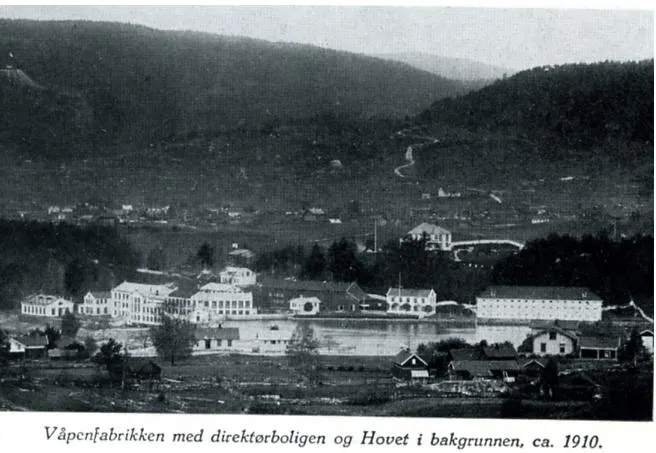
Norway's choice was not primarily a performance verdict on the four rifles it tested. Kongsberg Våpenfabrikk was already tooled up to build roughly 100,000 G3 components for West Germany's Bundeswehr under a bilateral reciprocal purchase arrangement between the two countries, so licensing the G3 for Norway's own army was a low-cost extension of production lines that already existed.1 Fully retooling for the FAL, by contrast, would have meant setting up an entirely new manufacturing line for a design Kongsberg had no existing stake in.1 The result was a rifle chosen as much for its fit with Norwegian industrial policy as for anything the 1960/1961 trial reports said about accuracy or reliability.
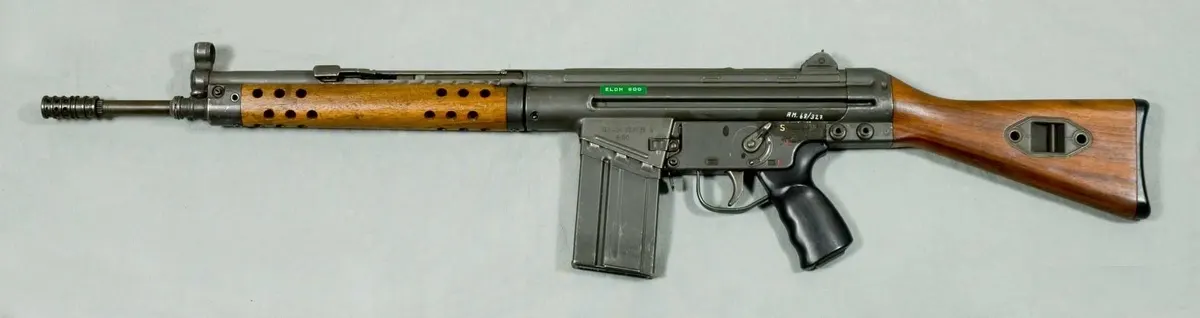
Between February 1967 and November 1974, Kongsberg Våpenfabrikk built 253,497 AG-3 rifles, a run that also included a separate 11,000-unit batch of the collapsible-stock AG-3F1 variant produced inside the same window.3,4 The rifle was designed for a service life of roughly thirty years, out to 1997, but Norway kept it in front-line and reserve use for far longer than that estimate, with the last examples only leaving Home Guard service around 2021.3,5
Fully domestically manufactured under license by Kongsberg Vapenfabrikk in Norway from 1967 to 1974 (253,497 units), including Norway-specific modifications (longer stock, silent bolt-closure groove, all-metal cocking handle, locally made M/1968 and Eickhorn bayonets) not found on the German-made G3.
The AG-3 inherits the G3's roller-delayed blowback action, a mechanism that traces back through the Spanish CETME rifle to a wartime German prototype, and needs no separate gas system or user-adjustable regulator the way the FAL does.1 Norway's version is not a plain copy, though. Kongsberg's rifles use a buttstock roughly two centimeters longer than the German original, a change suited to the average build of Norwegian conscripts, and the bolt carrier carries a serrated thumb groove absent from the standard German G3 that lets a soldier close the bolt by hand quietly, useful in situations where the loud mechanical clack of a G3-family bolt slamming home would give away a position.6 The cocking handle is machined from solid metal rather than the plastic-shrouded handle fitted to German-made rifles, and Kongsberg-built AG-3s carry a crowned K proof mark identifying their Norwegian manufacture.6,1
- First Production Year1967
- Service Entry Year1967
- DesignerOriginal G3 design by CETME/Heckler & Koch; Norwegian production and modification by Kongsberg Vapenfabrikk
- Weight (Empty)4.1 kg
- Weight (Loaded)4.7 kg
- Currently In ServiceYes
Official Norwegian Armed Forces weapons registry data (registry entry MG0007) gives the most authoritative dimensions available. The barrel measures 485 mm, total rifle length is 1,020 mm, and the sight radius runs to 575 mm.4 The same registry lists a loaded weight of 4.7 kg with a full magazine fitted, and a cyclic rate of 550 to 650 rounds per minute, with practical semi-automatic fire naturally well below that figure.4 Muzzle velocity sits close to 800 m/s, in line with the wider G3 family rather than the higher figure occasionally attributed to the AG-3 specifically.7 The rifle feeds from a 20-round detachable box magazine chambered for the 7.62x51mm NATO cartridge and is capable of both semi-automatic and fully automatic fire, selected through a rotating lever on the left side of the receiver.1
- Cartridge7.62x51mm NATO
- Calibre7.62 mm
- Case Length51 mm
- Calibre Classfull-powered
- Bullet Weight9.7 g
Sights are a hooded post front sight paired with a rotating drum rear sight offering four preset range settings, a simple, rugged arrangement rather than a click-adjustable target sight, matching the standard G3 pattern rather than departing from it.1 Furniture is polymer rather than wood, a material choice that held up well in Norway's wet coastal climate and cold winters. The standard AG-3 carries a fixed stock, and it is worth being precise about this because a folding-stock version exists but is a distinct, much smaller-production variant covered below, not the common rifle most Norwegian conscripts carried.3
- Action TypeDelayed Blowback
- Fire ModesSemi-automatic and fully automatic, selector on left side of receiver
- Select FireYes
- Feed SystemDetachable Magazine
- Magazine Capacity20
- Cyclic Rate of Fire650
- Practical Rate of Fire40
Norway also equipped the rifle with its own bayonet rather than adopting the German G3's standard blade. The first pattern, the M/1968, was made by Vinghøgs Mekaniske Verksted with grips supplied by Strømbergs, and 171,500 were produced from 1968 onward, with some drawing on repurposed American M3 fighting knife blades or older Norwegian M/1956 bayonets already in inventory.8 A second pattern arrived in the 1980s, made by the German firm A. Eickhorn GmbH and built to the standard G3 bayonet pattern rather than a Norwegian-specific design.8
- Muzzle Velocity800 m/s
- Muzzle Energy3,400
- Effective Range (point)600 m
- Effective Range (area)800 m
- Maximum Range3,700 m
- Sighting Range800 m
- Penetration300 mm
- Accuracy3
- Barrel Length485 mm
- Rifling Grooves4
- Sight Radius575 mm
- Optic RailYes
- Iron SightsYes
- Threaded BarrelNo
- Overall Length1,020 mm
- Folding / Collapsing StockNo
- Bullpup LayoutNo
- Ambidextrous ControlsNo
- Total Production253,497
- Production Start1967
- Production End1974
- Variants4
- Width80 mm
- Height220 mm
Norway's postwar rifle needs had been met by a mix of American M1 Garands and older Krag-Jørgensen rifles left over from before the Second World War, and by the late 1950s the Norwegian Army wanted a purpose-designed NATO rifle of its own.1 The 1960/1961 trial brought together the era's leading NATO-cartridge rifle candidates. Norwegian testers evaluated the AR-10 from the American firm Armalite, Beretta's BM-59 (Italy's own G3-era evolution of the M1 Garand pattern), the FN FAL already spreading through much of Western Europe, and the roller-delayed G3, still new at that point after West Germany's own January 1959 adoption.1

None of the surviving accounts of that trial describe a clean technical win for the G3 over its rivals. What tipped the decision was industrial. Kongsberg Våpenfabrikk, Norway's state arms manufacturer since 1814, was already producing roughly 100,000 G3 components for West Germany's own rearming Bundeswehr, part of a bilateral offset arrangement in which Norway received defense-industrial work in exchange for other purchases from West German firms.1 Adopting the G3 domestically let Kongsberg extend tooling it already owned rather than build an entirely new production line, a consideration that outweighed whatever marginal performance differences the trial reports found among the four candidates.1
Formal government approval followed in 1966, and Kongsberg Våpenfabrikk signed its production agreement with Heckler & Koch on 21 June 1966.1 The first AG-3 rifles reached Norwegian Armed Forces units in February 1967, and production continued at Kongsberg through November 1974, by which point 253,497 rifles had been built, plus the separate 11,000-unit AG-3F1 run described in Variants below.3,4 The rifle was designed against a nominal thirty-year service horizon running to roughly 1997, an estimate Norway comfortably exceeded, keeping the AG-3 as a first-line rifle for over four decades and in Home Guard hands considerably longer still.3
The AG-3 equipped the Norwegian Army, Navy, Air Force, Royal Guard, and the Military Academy (Krigsskolen) from the moment production began, making it the standard individual weapon across every branch rather than an army-only rifle.3 That breadth of issue is part of why the rifle became such a fixture of Norwegian military life for a generation of conscripts serving under the country's mandatory service system.
For most of its service life the AG-3 stood watch rather than fired in anger. Norway's long land border with the Soviet Union in Finnmark, in the country's far north, was a Cold War garrison and deterrence posting rather than a combat front, and no sourced account documents the AG-3 seeing shooting combat inside Norway itself.1 That garrison role, unglamorous as it was, was arguably the rifle's primary strategic job for its first two decades in service, defending NATO's northern flank in a theater where the two sides never directly exchanged fire.
The rifle did see genuine expeditionary use later in its service life. Norwegian troops carried the AG-3 as part of NATO's Kosovo Force deployment following the 1999 Kosovo War, and again with the International Security Assistance Force and later missions during the War in Afghanistan that began in 2001.9,14 By the time of the Afghanistan deployment, Norwegian infantry sections were mixing the AG-3 with newer optics and support weapons, but the rifle itself remained the standard NATO-caliber battle rifle in Norwegian hands through much of that campaign, before the wider fleet-wide replacement by the HK416 discussed below.9
Norway also maintained a long-running troop contribution to the United Nations peacekeeping force in southern Lebanon from the late 1970s onward, and the AG-3 was Norway's standard rifle through most of that period, though no weapon-specific source directly documents its use on that particular deployment, so this should be read as a reasonable inference from Norway's standard-issue rifle of the era rather than a confirmed combat record.1
Four distinct configurations of the rifle exist. The baseline AG-3, built to the same fixed polymer stock pattern as the German G3A3, makes up the overwhelming majority of the 253,497 rifles Kongsberg produced.3
The AG-3F1, built to the folding metal stock pattern of the German G3A4, saw a separate production run of 11,000 rifles inside the same 1967 to 1974 window.3,4 Norway issued the AG-3F1 to troops who needed to dismount a vehicle quickly, including Navy personnel, cavalry and armored reconnaissance crews, artillery gunners, the Royal Guard, and War College personnel, with drivers of the tracked Bv 202 over-snow vehicle specifically cited among its users.4 The shorter, collapsible profile made far more sense inside a cramped vehicle hull than the fixed-stock standard rifle.
A modernization effort beginning around 2005 to 2007 produced the AG-3F2, in which roughly 5,000 rifles received a Picatinny rail handguard from the Swiss firm B&T along with Swedish-made Aimpoint red-dot sights, giving crews the option to add lights or a vertical foregrip.5 The AG-3F2 represented the rifle's final operational form and was the version most associated with Norwegian units in the last years before full replacement.5
The fourth variant, the AG-3HVU, was built for Norway's Home Guard and is distinguished mainly by a red-marked safety selector that physically and visually blocks the fully automatic setting, restricting Home Guard personnel to semi-automatic fire only.4 Because the Home Guard held onto the AG-3 the longest of any Norwegian force, the AG-3HVU was effectively the last version of the rifle in widespread service anywhere in the country.

| Year | Buyer | Quantity | Amount | Present Value (2025) |
|---|---|---|---|---|
| 1966 |  Norway | — | — | — |
Norway is the only country known to have fielded or licensed the AG-3 specifically. The wider G3 design was exported and license-built across dozens of states, including Pakistan and Turkey among many others, but the Norwegian-specific modifications, the longer stock, the serrated bolt handle, and the locally made bayonets, do not appear to have been adopted anywhere outside Norway.6,1
On 11 April 2007, Norway announced that the Heckler & Koch HK416 would replace the AG-3 across every branch except parts of the Home Guard, and regular Norwegian units had largely converted to the locally designated HK416N by 2008.9 The Home Guard kept its older rifles considerably longer. In January 2019 Norway signed a further HK416 contract worth roughly 22 million euros covering about 11,000 rifle sets over a 36-month delivery schedule, aimed specifically at replacing the roughly 7,000 AG-3 rifles still held by Home Guard units.10,11
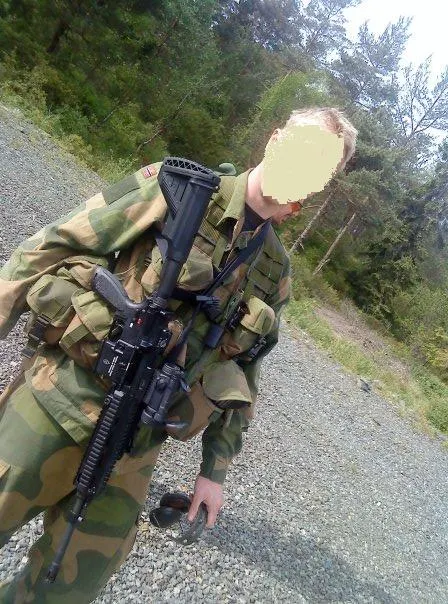
The final rearmament rolled out unit by unit starting in autumn 2020, when the Trøndelag Home Guard districts began receiving new HK416 rifles together with the compact HK MP7 for troops in roles where a full-length rifle was impractical, with the changeover intended to reach the entire Home Guard through 2021.12 That drawn-out, region-by-region schedule meant the AG-3's active service life closed gradually rather than on a single retirement date, a fitting end for a rifle that had entered service just as slowly, factory batch by factory batch, back in 1967.
The AG-3's closest and most obvious comparison is the rifle it was built from, the West German Heckler & Koch G3. Both share the same roller-delayed blowback action and the same 7.62x51mm NATO chambering, and the core mechanical story is identical between them.1 The differences that matter are the small, deliberate changes Kongsberg made for Norwegian service, the longer stock, the quiet-closing bolt groove, the all-metal cocking handle, and the Norwegian-pattern bayonets, none of which alter the rifle's fundamental operation but all of which reflect Norway's own conscript army and cold-climate requirements rather than a wholesale redesign.6
| Parameter | AG-3 (Norway) | Heckler & Koch G3 (West Germany) |
|---|---|---|
| Operating system | Roller-delayed blowback1 | Roller-delayed blowback1 |
| Cartridge | 7.62x51mm NATO4 | 7.62x51mm NATO1 |
| Empty weight | 4.1 kg7 | Approximately 4.4 kg1 |
| Barrel length | 485 mm4 | 450 mm1 |
| Cocking handle | All-metal6 | Plastic-shrouded6 |
| Bolt closure | Serrated silent-closing groove6 | Standard, no silent-closing feature6 |
| Production | 253,497 units, 1967 to 1974, Kongsberg3,4 | Millions of units across West German and licensed production1 |
The AG-3 also invites a comparison Norway itself made in 1960 and 1961, against the FN FAL the country ultimately rejected. Where the G3's roller-delayed system needs no separate gas regulation, the FAL relies on a gas piston and a user-adjustable gas valve that lets a soldier tune the action for ammunition, fouling, and climate, a genuine field-maintenance advantage in some conditions but also one more part that requires attention.1 Norway's decision between the two rifles turned less on either mechanical argument than on the industrial fact that Kongsberg already had G3 tooling in place through its West German offset work, an advantage the FAL could not match regardless of its own technical merits.1


What are the AG-3's basic specifications? The AG-3 fires 7.62x51mm NATO from a 485 mm barrel, weighs 4.1 kg empty and 4.7 kg loaded, and reaches a muzzle velocity of roughly 800 m/s from a 20-round detachable box magazine, with a cyclic rate of 550 to 650 rounds per minute according to Norway's own official weapons registry.4,7
How does the AG-3 work? It uses the same roller-delayed blowback action as the German G3 it was licensed from, in which two rollers in the bolt head briefly delay the bolt's rearward movement under chamber pressure rather than locking it shut the way a rotating-bolt or gas-piston rifle does.1
Is the AG-3 still in service? No. Regular Norwegian units converted to the HK416 by 2008, and the Home Guard, which held onto the AG-3 the longest, completed its own rearmament with the HK416 and MP7 in a unit-by-unit rollout that ran from autumn 2020 through 2021.9,12
How does the AG-3 compare to the German G3? Both fire the same cartridge through the same roller-delayed action. The AG-3 differs in a longer buttstock, an all-metal cocking handle, a serrated bolt carrier groove for silent manual closing, and Norwegian-made bayonets, changes suited to Norwegian conscripts and climate rather than a different weapon design.6
What is the AG-3's unit cost? No verifiable per-unit contract price from the original 1966 Kongsberg production agreement was found. Norway's later 2019 HK416 replacement contract for Home Guard use, by contrast, is documented at roughly 22 million euros for about 11,000 rifle sets.10
- "AG3", no.wikipedia.org — no.wikipedia.org ↩
- "AG3", FVV Stavern — fvv.stavern.no ↩
- "Heckler & Koch G3", Wikipedia — en.wikipedia.org ↩
- "Automatgevær 3 (AG-3), MG0007 / MG0015", Kongelig Norsk Våpenfortegnelse (KVF) — kvf.no ↩
- "Modernizing the G3", Forgotten Weapons — forgottenweapons.com ↩
- "AG-3", Military History Fandom Wiki — military-history.fandom.com ↩
- "AG3", Store Norske Leksikon — snl.no ↩
- "M/1968 Bayonet", Bajonetter.no — bajonetter.no ↩
- "Norway to replace AG-3 with HK416", ESUT — esut.de ↩
- "Norway orders more HK416 rifles for Home Guard", Army Technology — army-technology.com ↩
- "Norway signs HK416 contract for Home Guard rearmament", Overt Defense — overtdefense.com ↩
- "Norwegian Home Guard Gets More HK416s and MP7s as AG-3 is Phased Out", The Firearm Blog — thefirearmblog.com ↩
- "AG-3", Phantom Forces Wiki, Fandom — roblox-phantom-forces.fandom.com ↩
- "AG3 (Q994157)", Wikidata — wikidata.org ↩